
Information Consumption 2010: Portable, Participatory and Personal Kristen Purcell, Ph.D. Associate Director, Research Pew Internet Project New Jersey Arts Marketers  Media Roundtable June 14 th , 2010
Pew Internet Project Part of the Pew Research Center, a nonpartisan “fact tank” that seeks to provide high quality, objective data to thought leaders and policy makers Funded by the Pew Charitable Trusts, but a separate entity All findings are based on nationally representative telephone surveys of US adults age 18+, drawn from dual-frame (RDD/cell) samples
Today’s Discussion Present some highlights of the new information ecology Information Sources/Consumption Patterns Online information consumers (including online news consumers, chronically ill internet users, and health information seekers) Talk about generational differences  Present some tips for success in the new information ecology based on our findings and our own digital strategy
The Basics (internet, mobility) The New Information Ecology Online Information Consumption Tips for Success
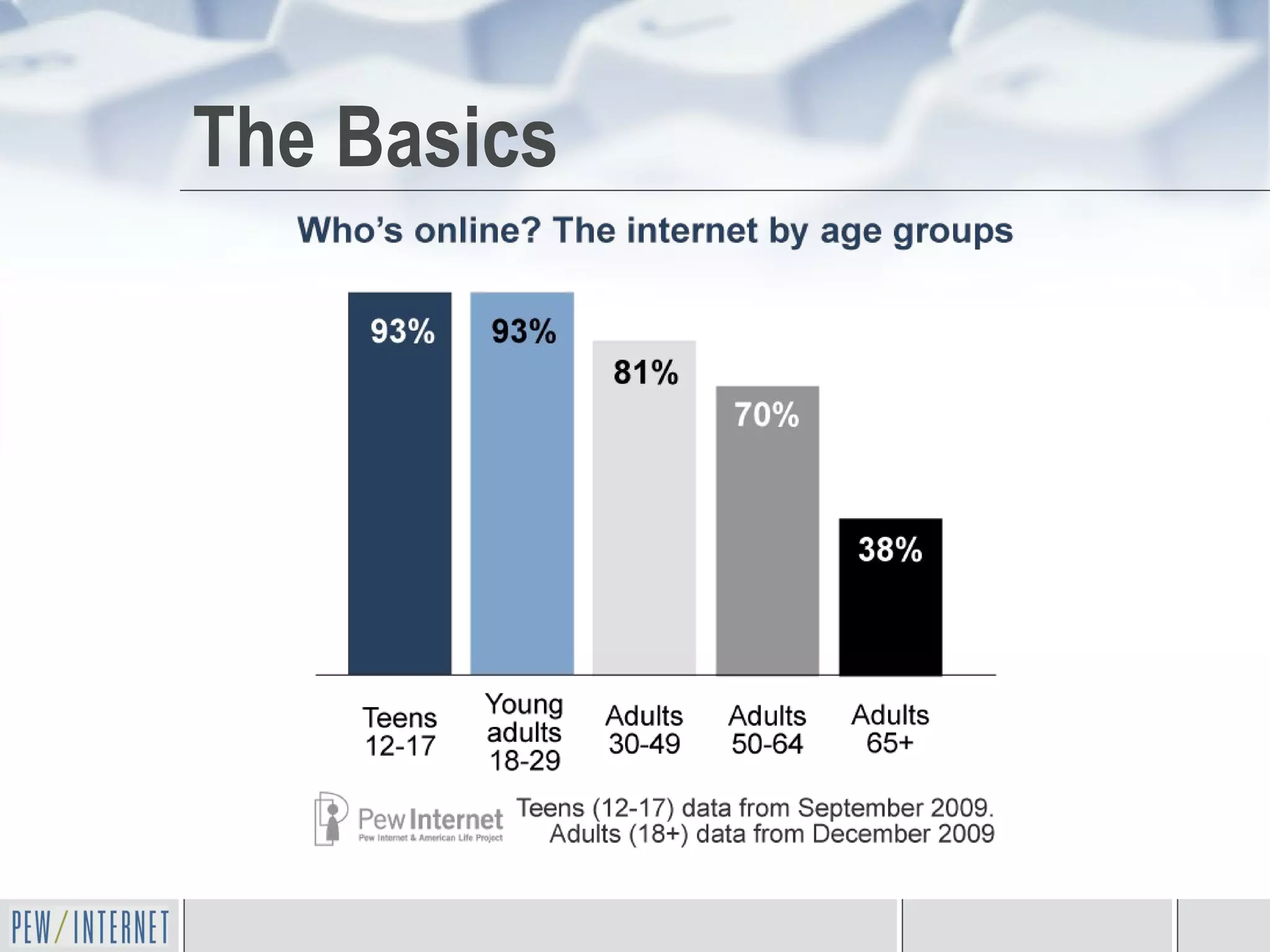
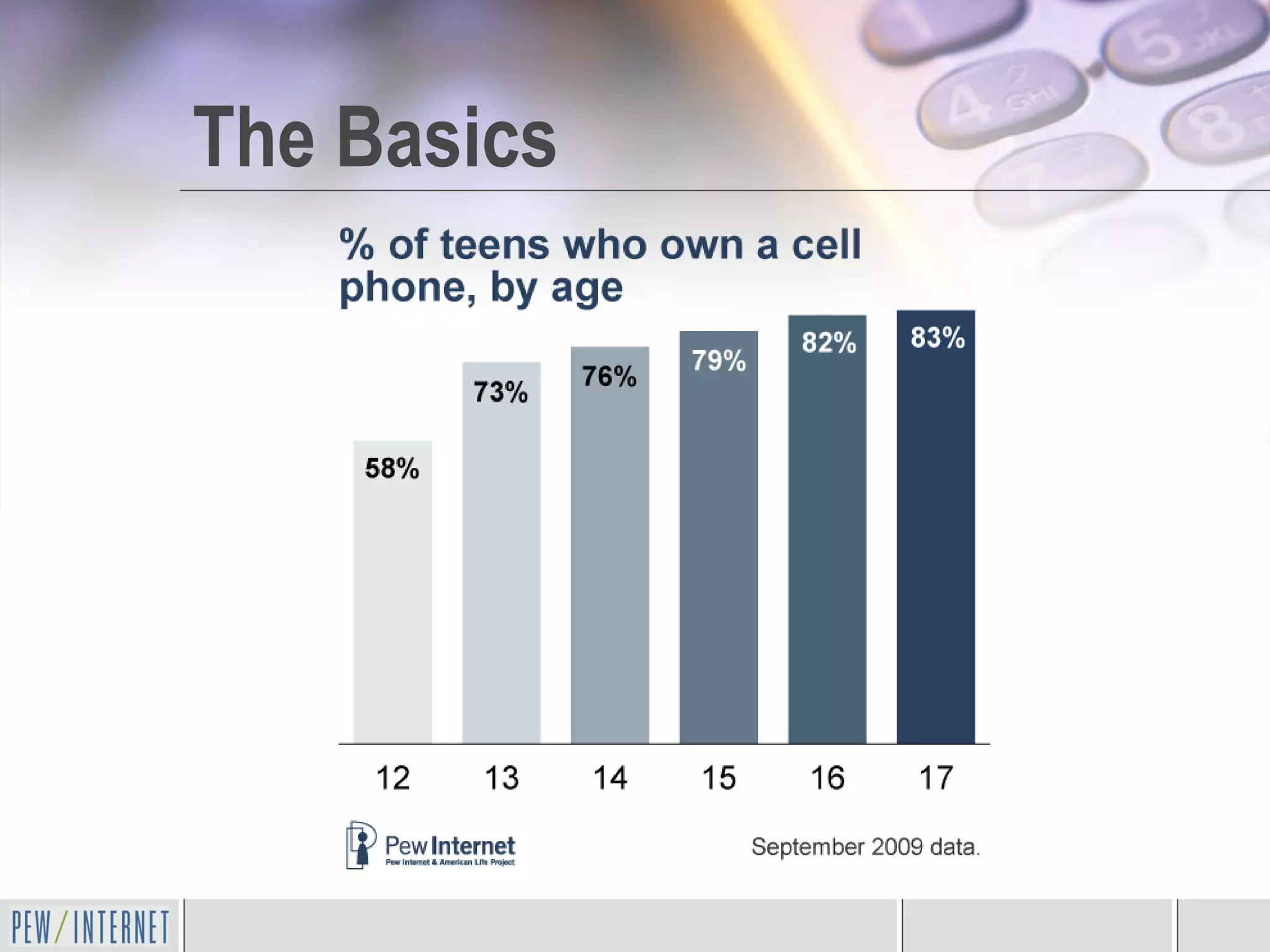
The Basics
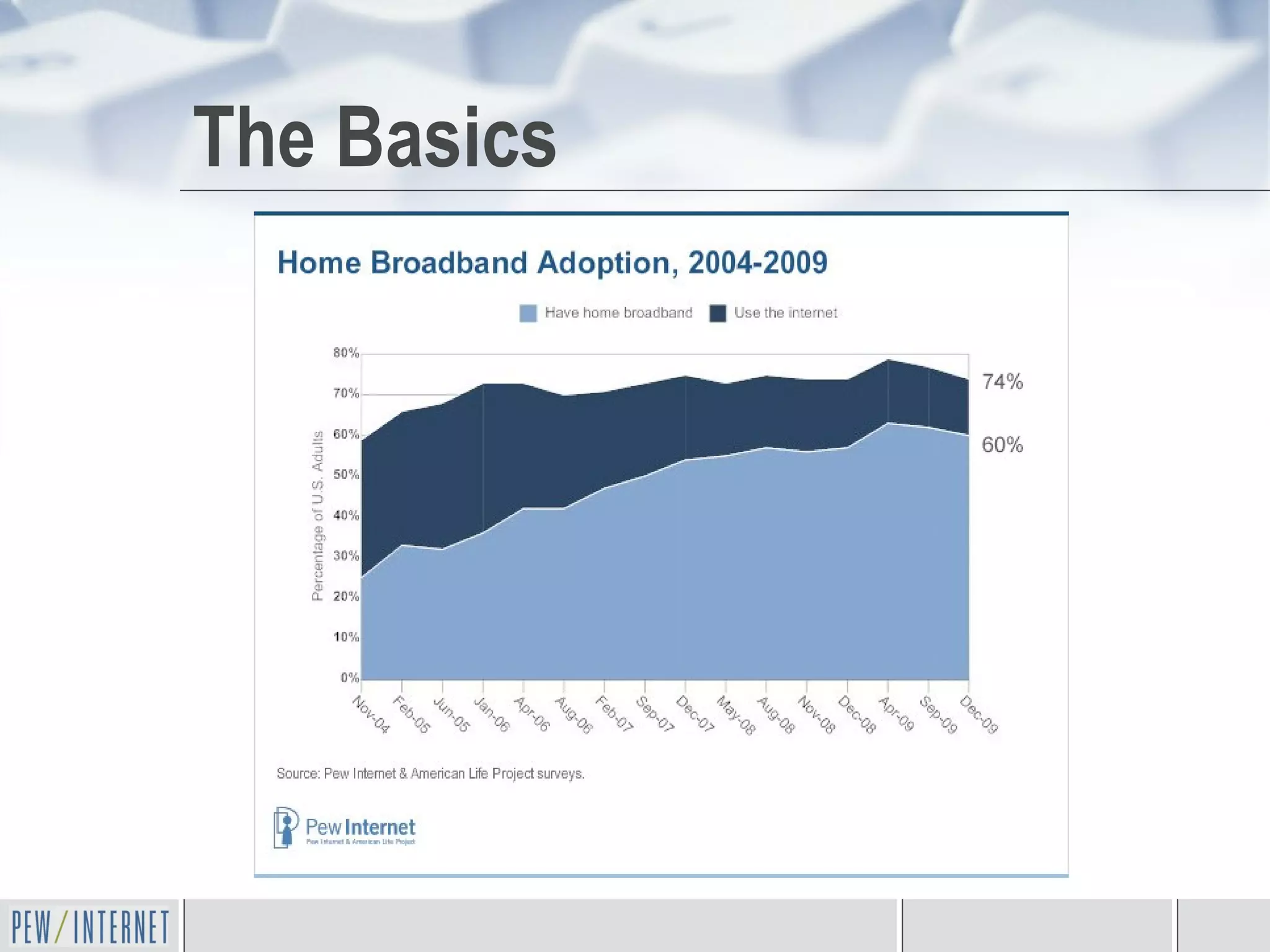
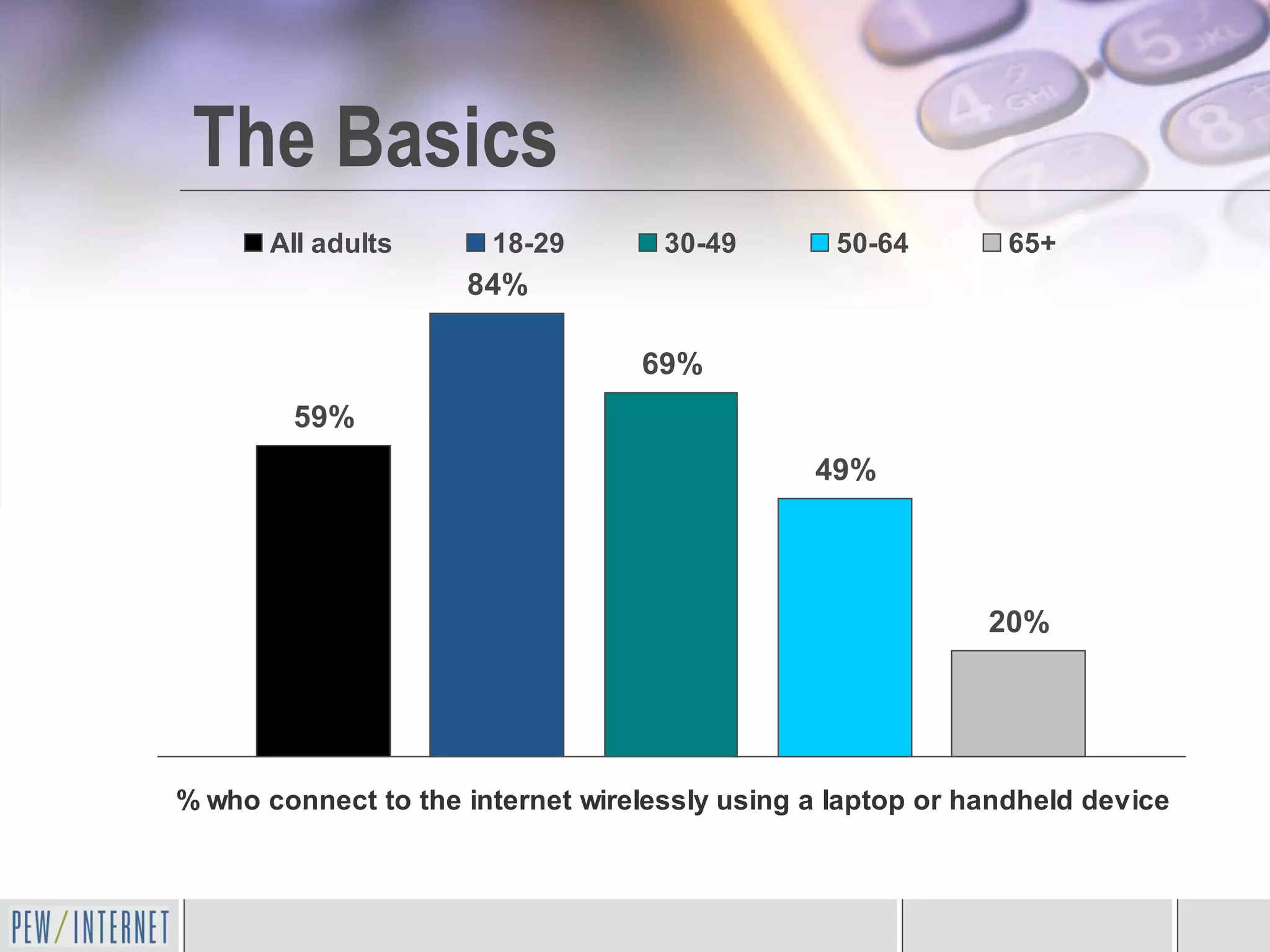
The Basics
The Basics
The Basics
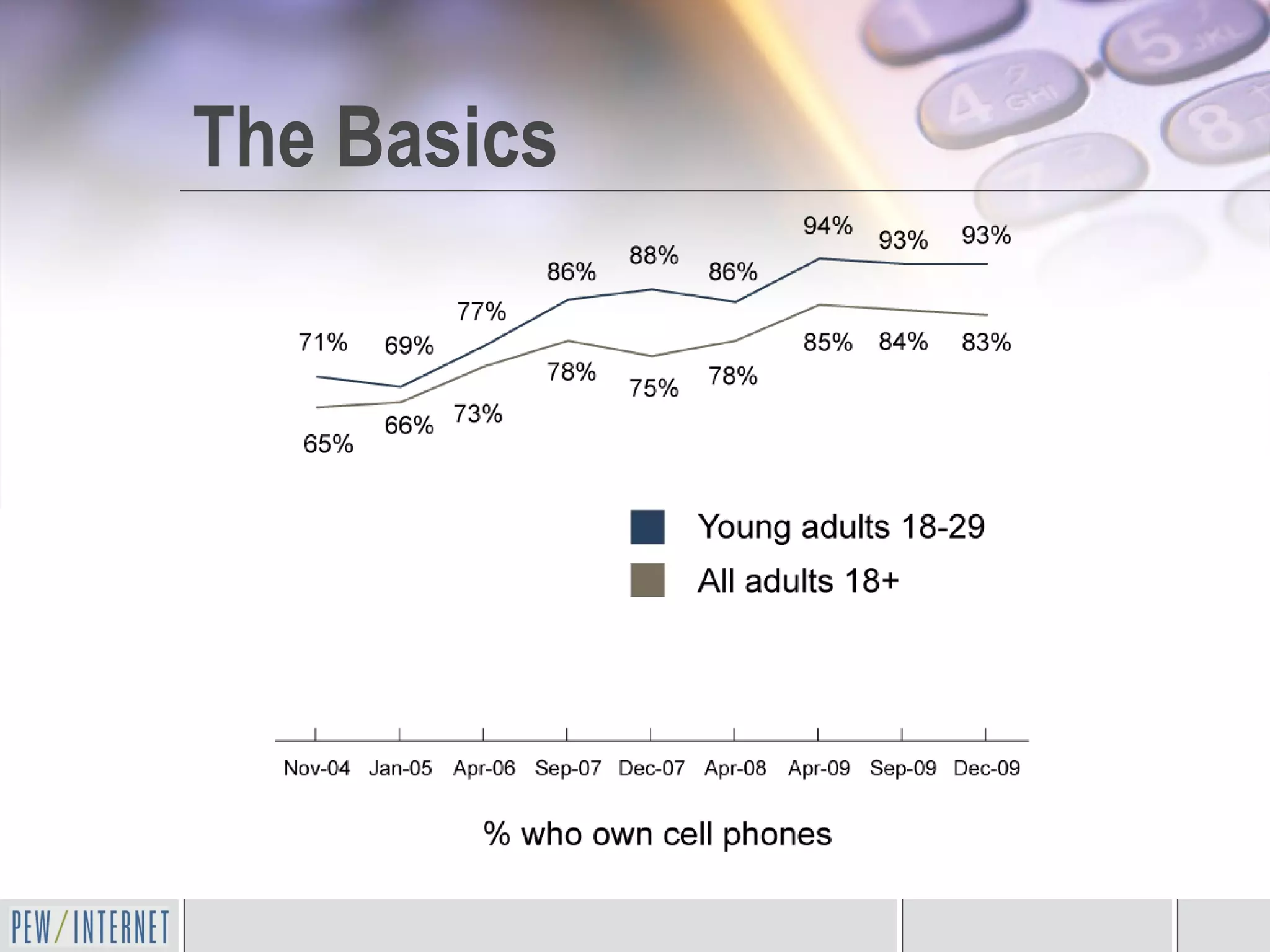
The Basics
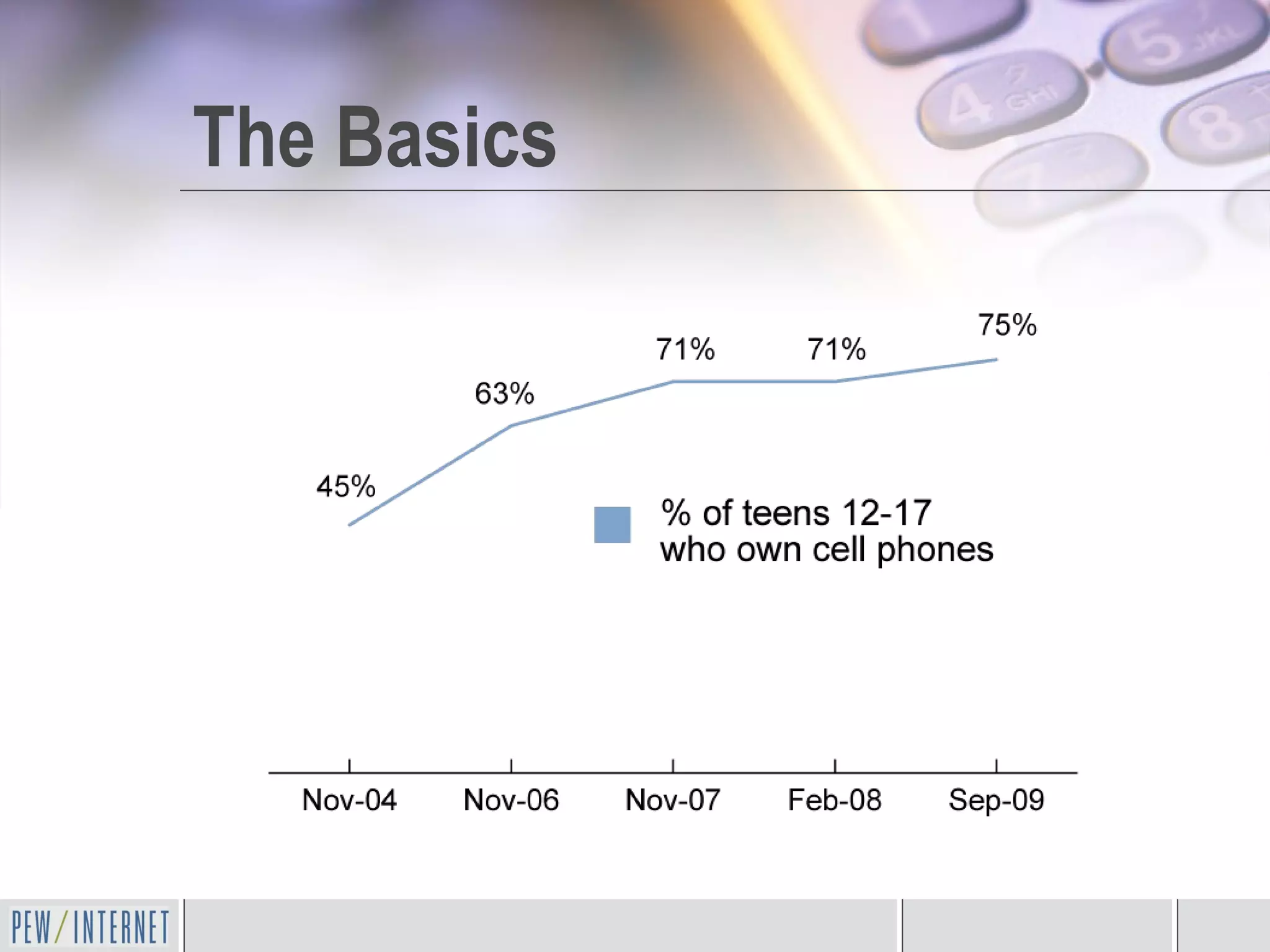
The Basics
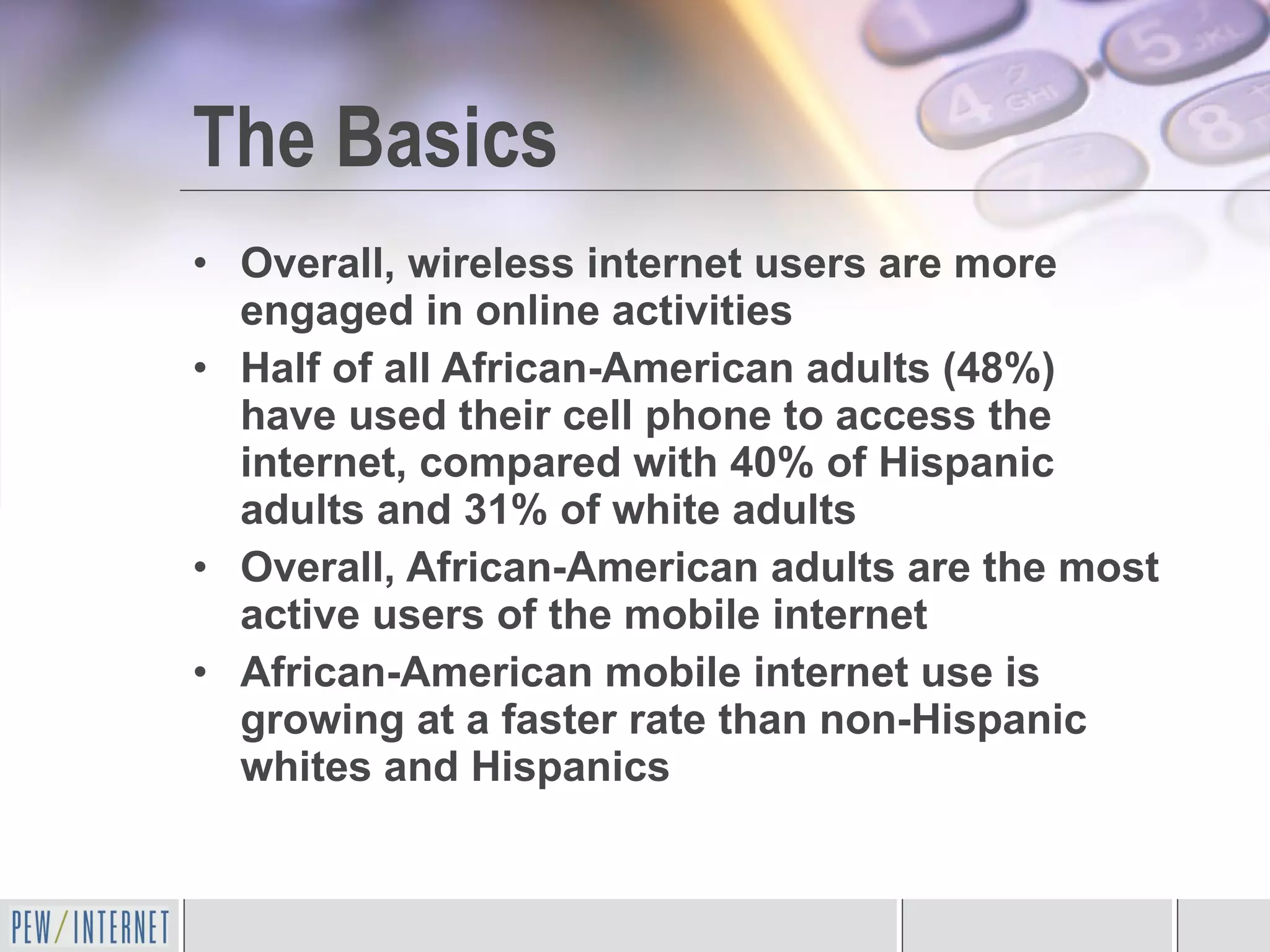
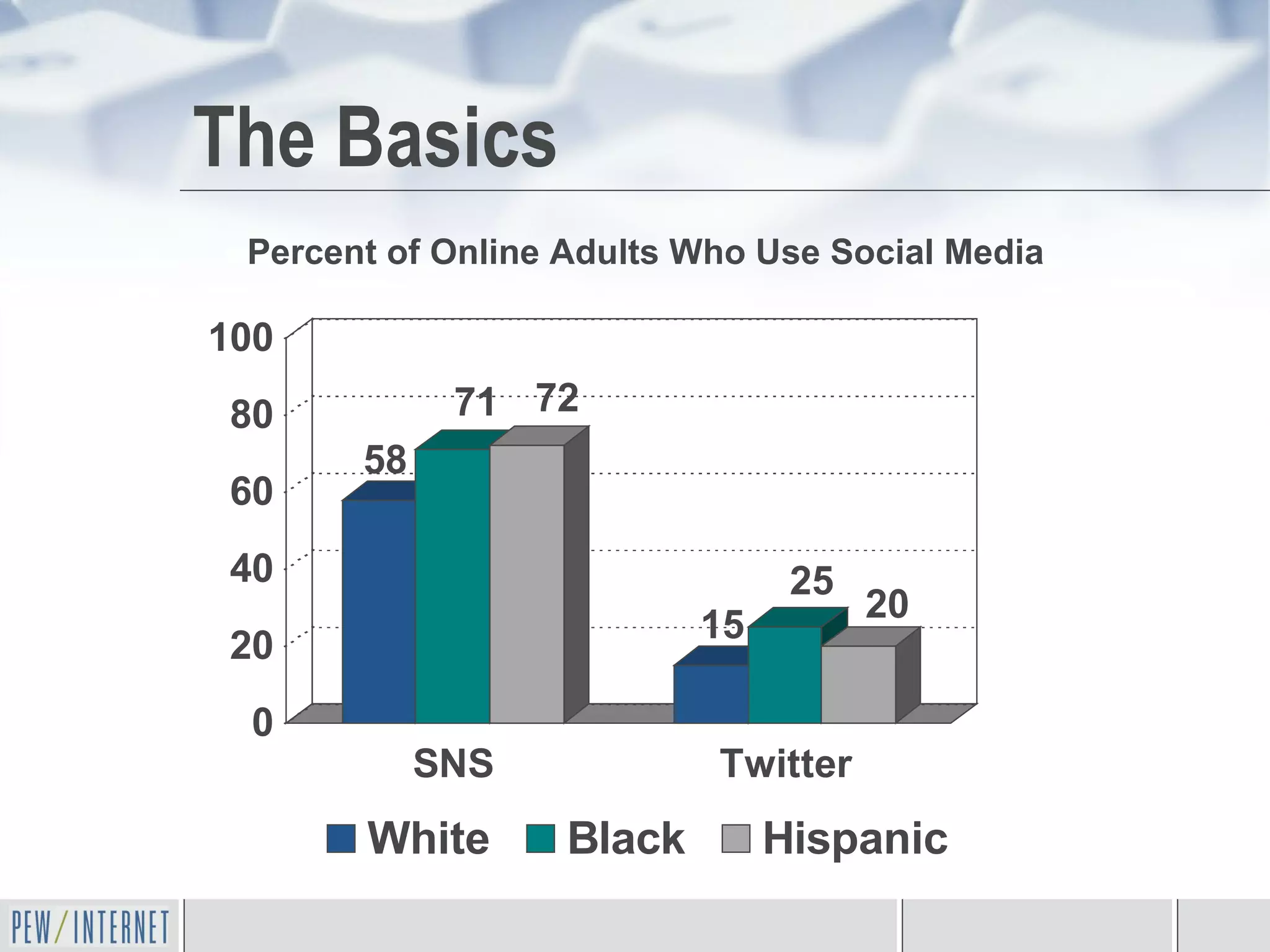
The Basics Overall, wireless internet users are more engaged in online activities Half of all African-American adults (48%) have used their cell phone to access the internet, compared with 40% of Hispanic adults and 31% of white adults Overall, African-American adults are the most active users of the mobile internet African-American mobile internet use is growing at a faster rate than non-Hispanic whites and Hispanics
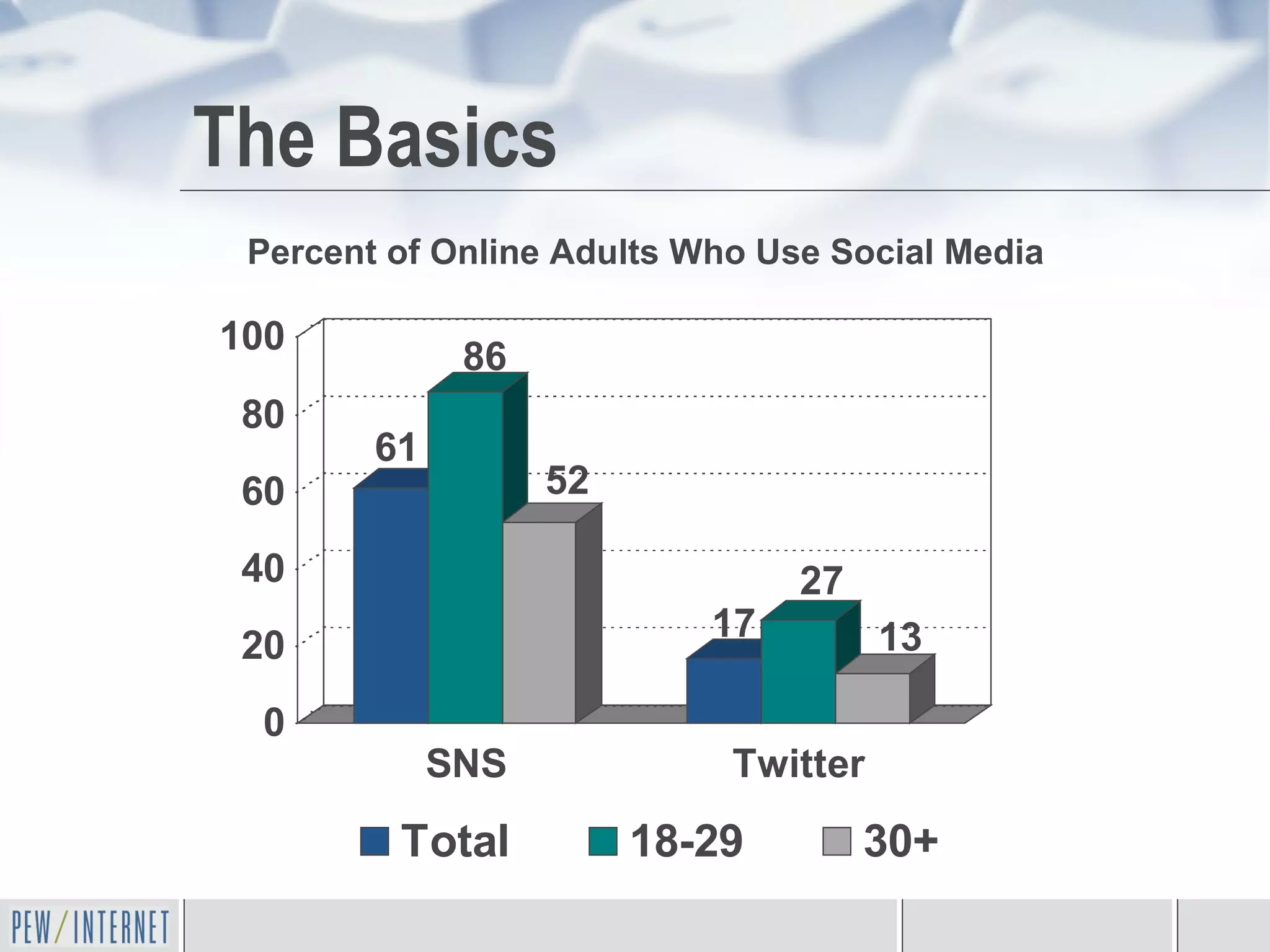
The Basics Percent of Online Adults Who Use Social Media
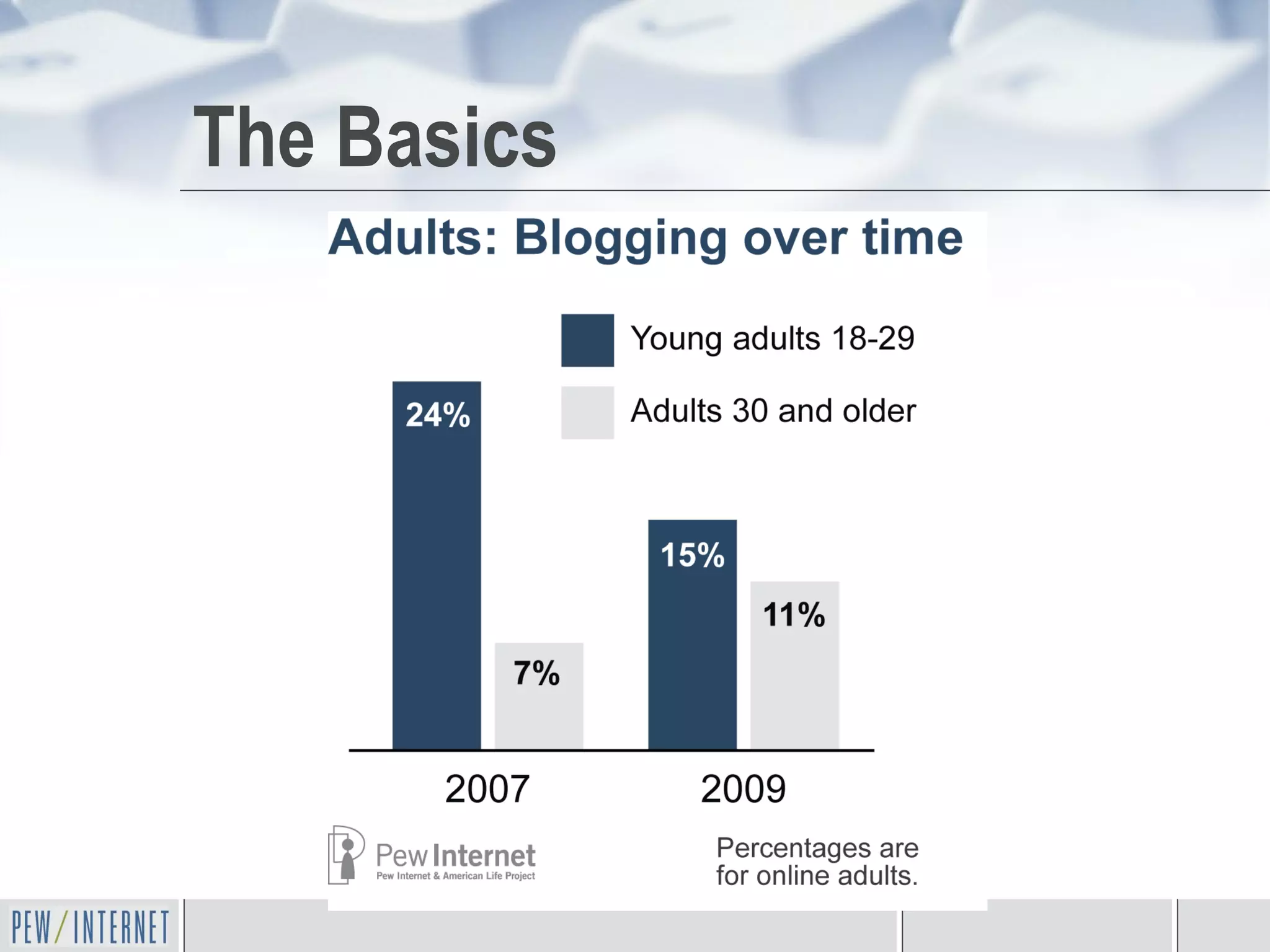
The Basics
The “New” Information Ecology
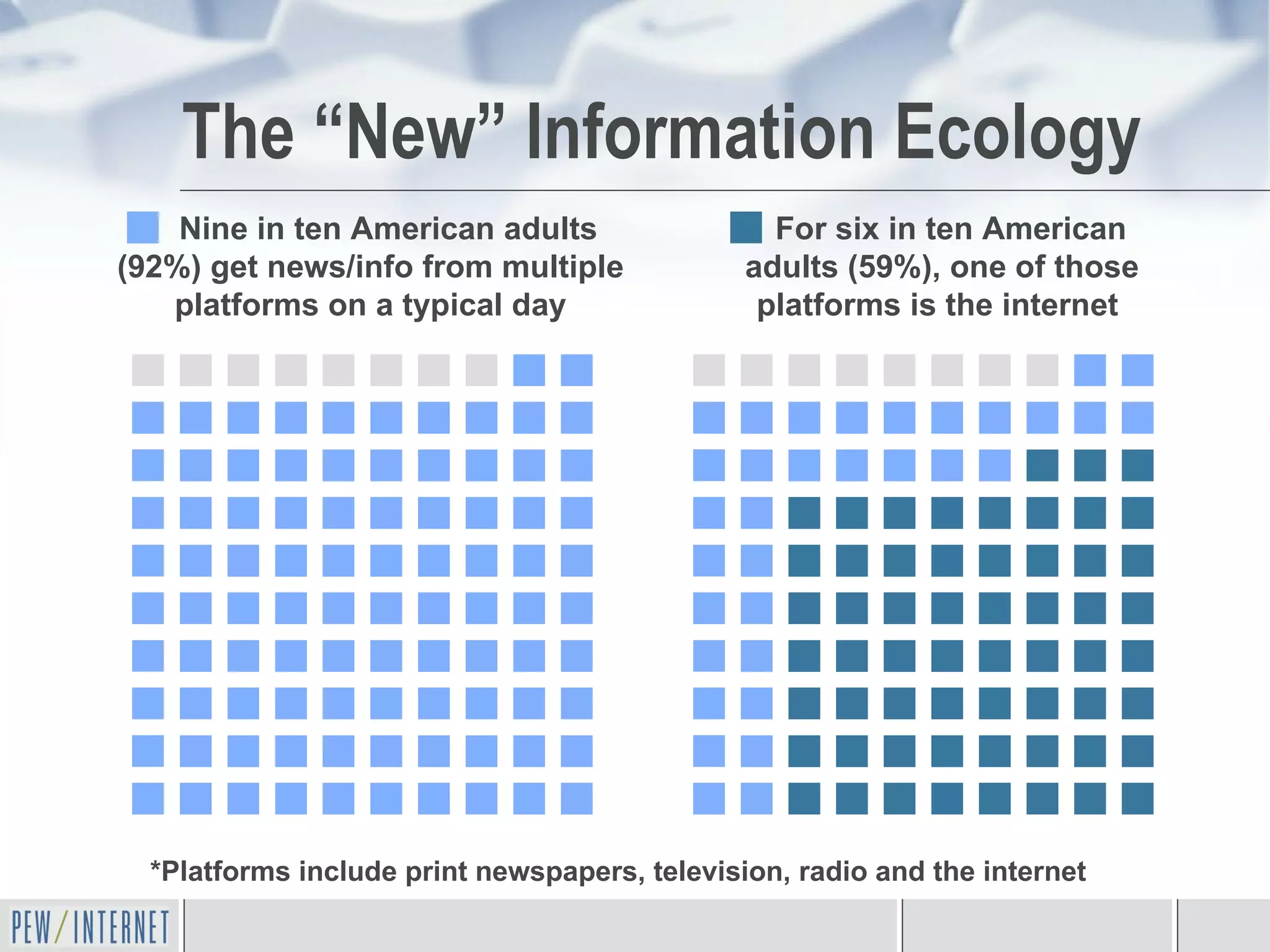
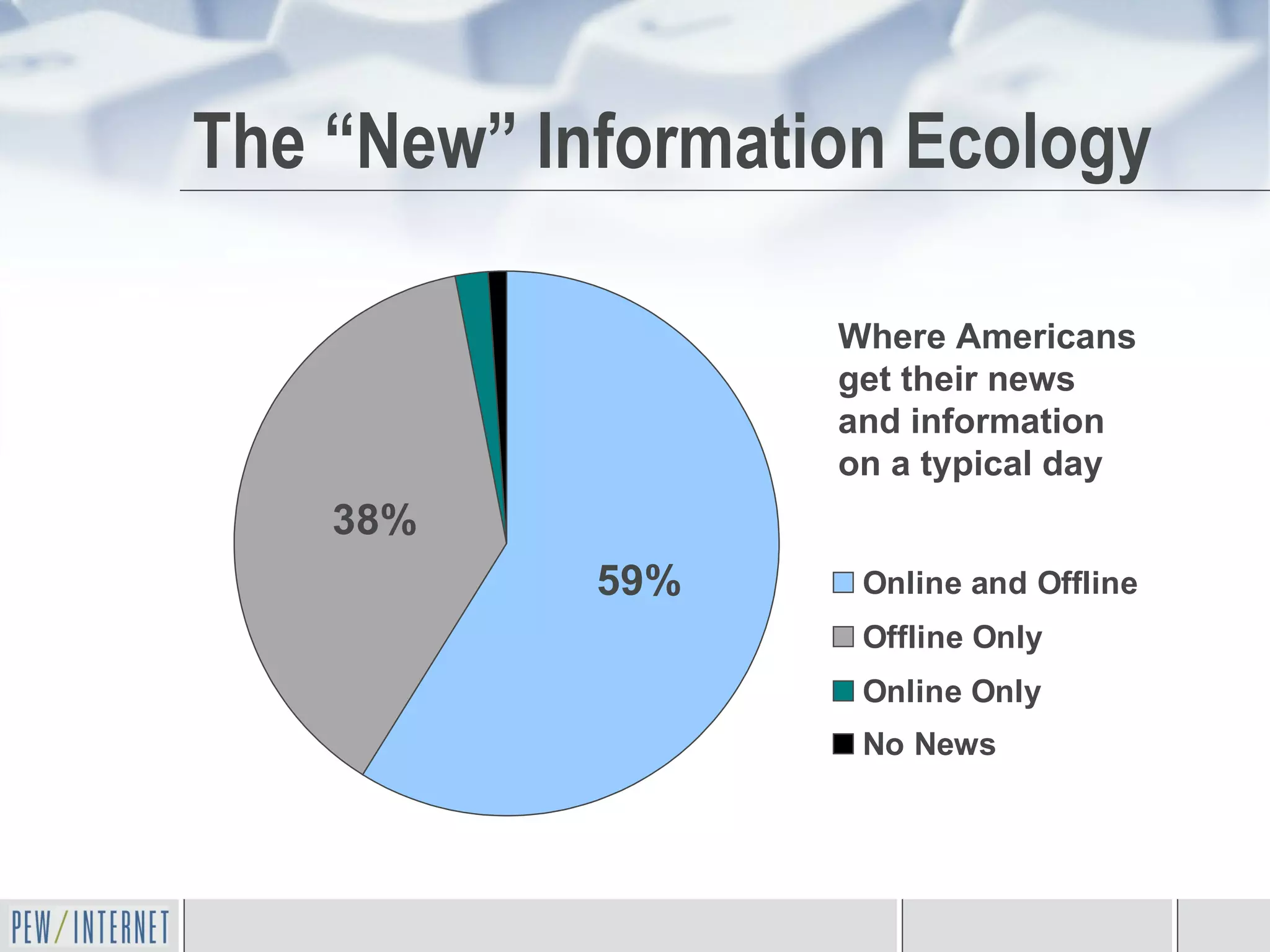
Nine in ten American adults (92%) get news/info from multiple platforms on a typical day For six in ten American adults (59%), one of those platforms is the internet   *Platforms include print newspapers, television, radio and the internet The “New” Information Ecology
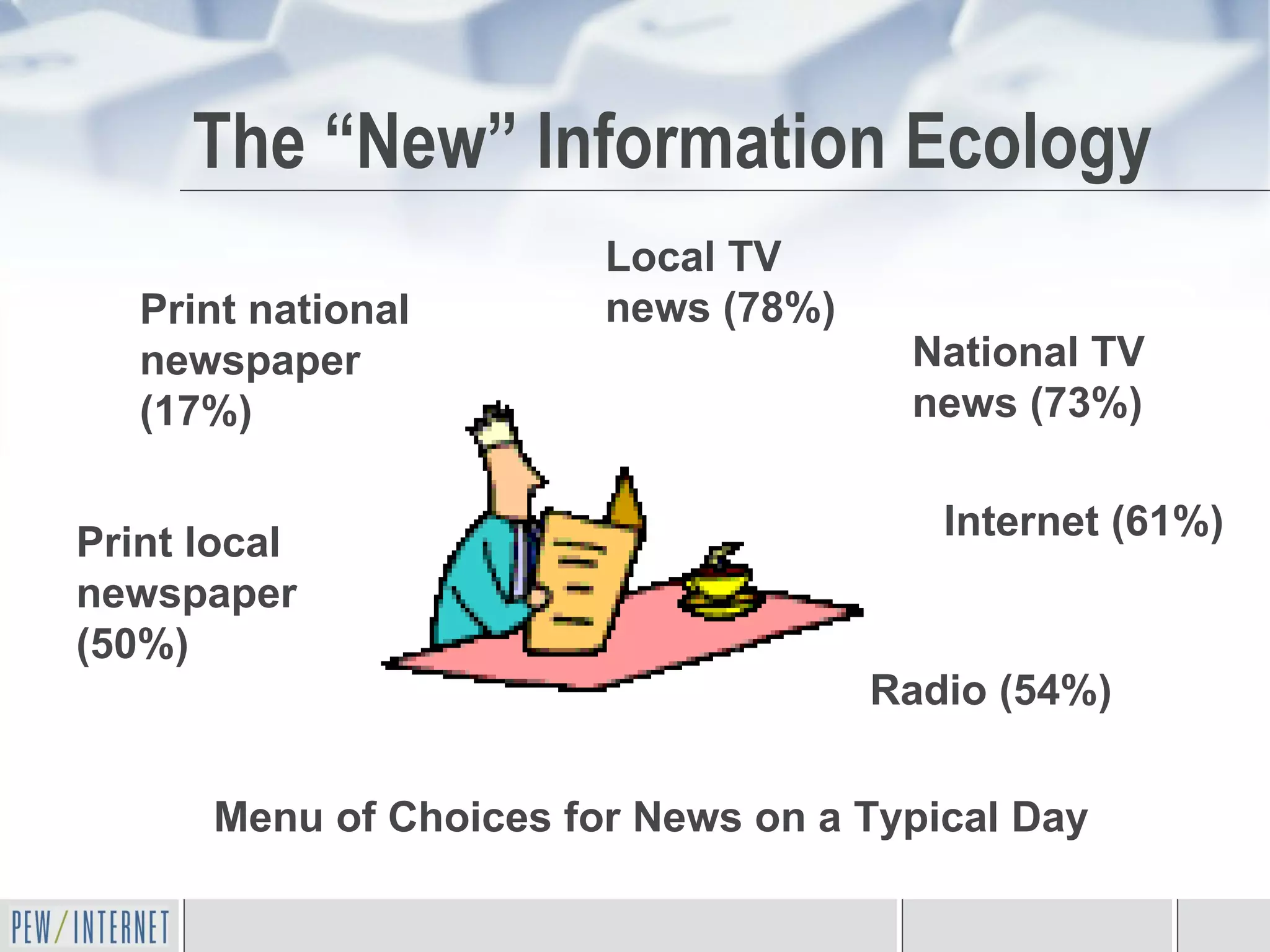
The “New” Information Ecology Print local newspaper (50%) Print national newspaper (17%) Radio (54%) Internet (61%) Local TV news (78%) National TV news (73%) Menu of Choices for News on a Typical Day
The “New” Information Ecology Where Americans get their news and information on a typical day
The “New” Information Ecology The internet has not replaced/ displaced traditional media  but… It is fundamentally changing the way people consume and interact with information
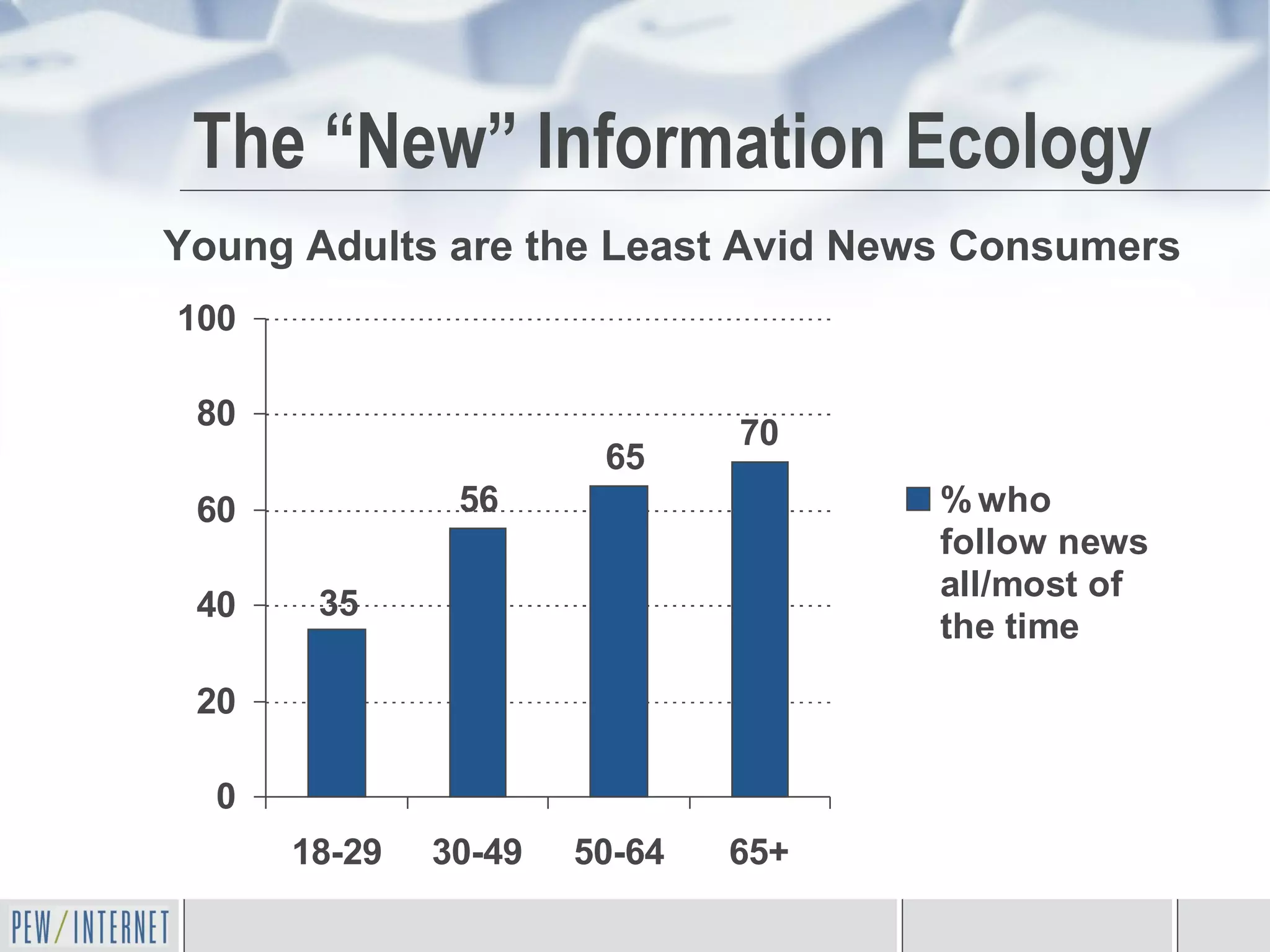
The “New” Information Ecology Young Adults are the Least Avid News Consumers
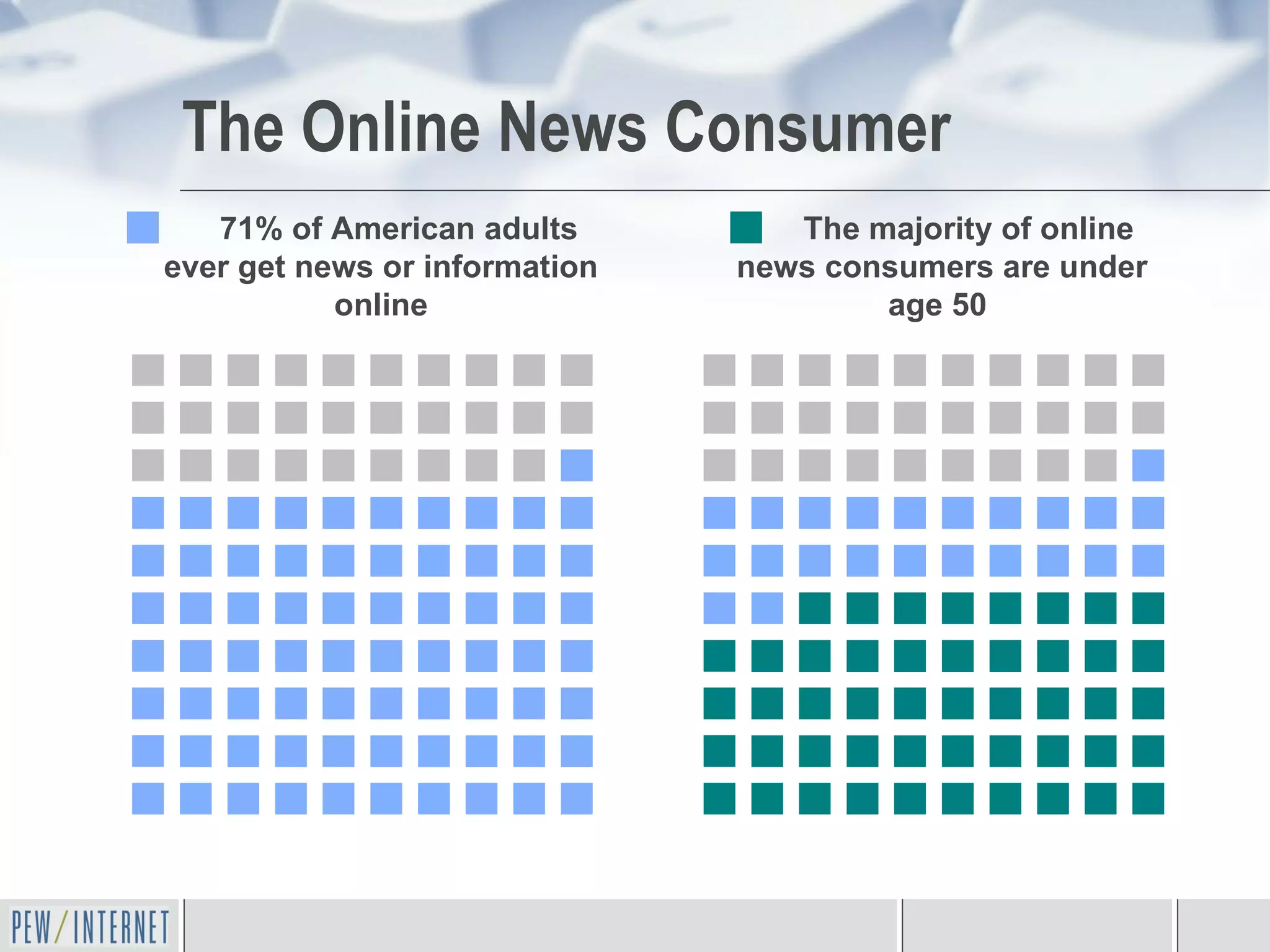
71% of American adults ever get news or information online The majority of online news consumers are under age 50   The Online News Consumer
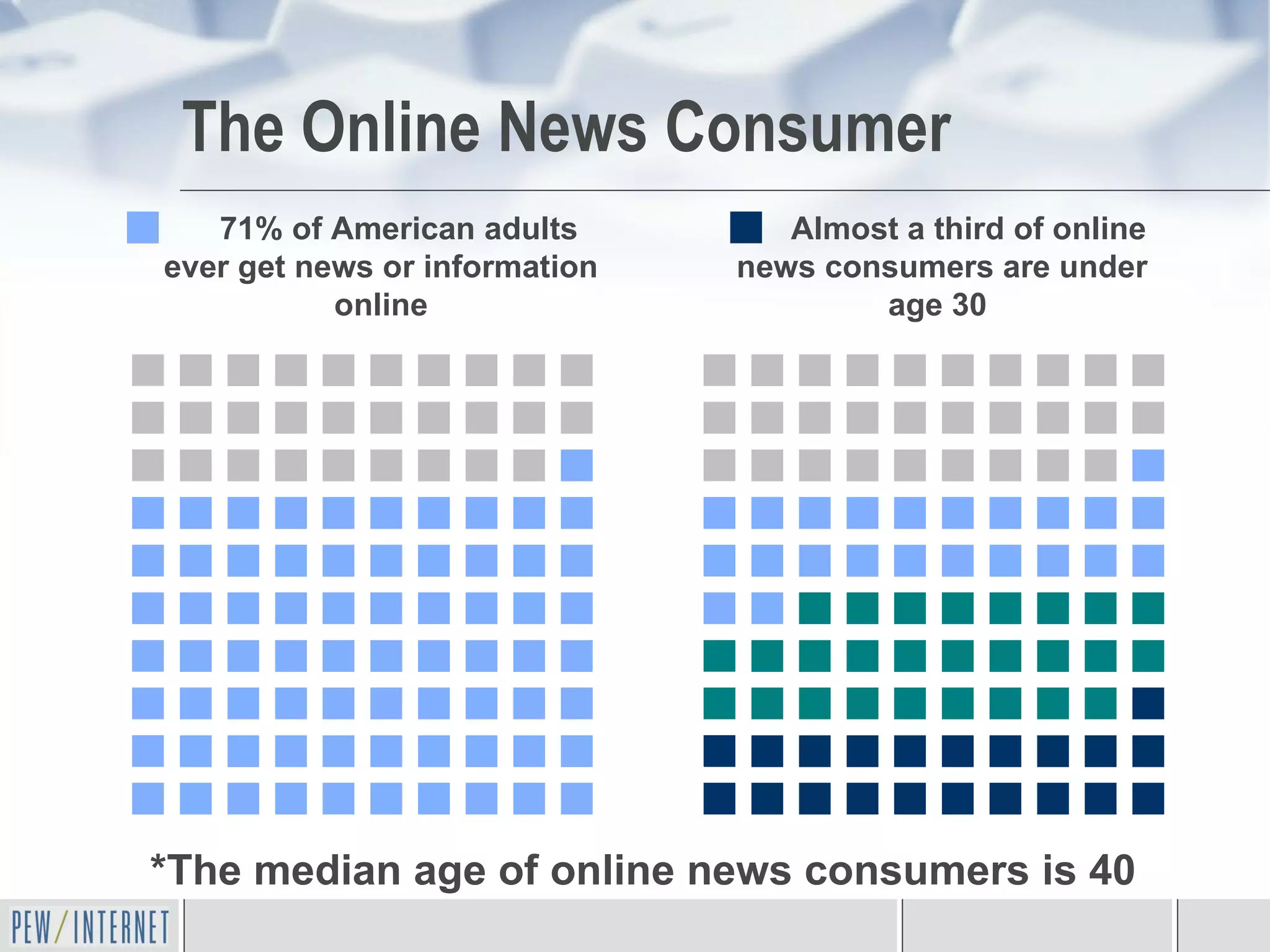
71% of American adults ever get news or information online Almost a third of online news consumers are under age 30   The Online News Consumer *The median age of online news consumers is 40
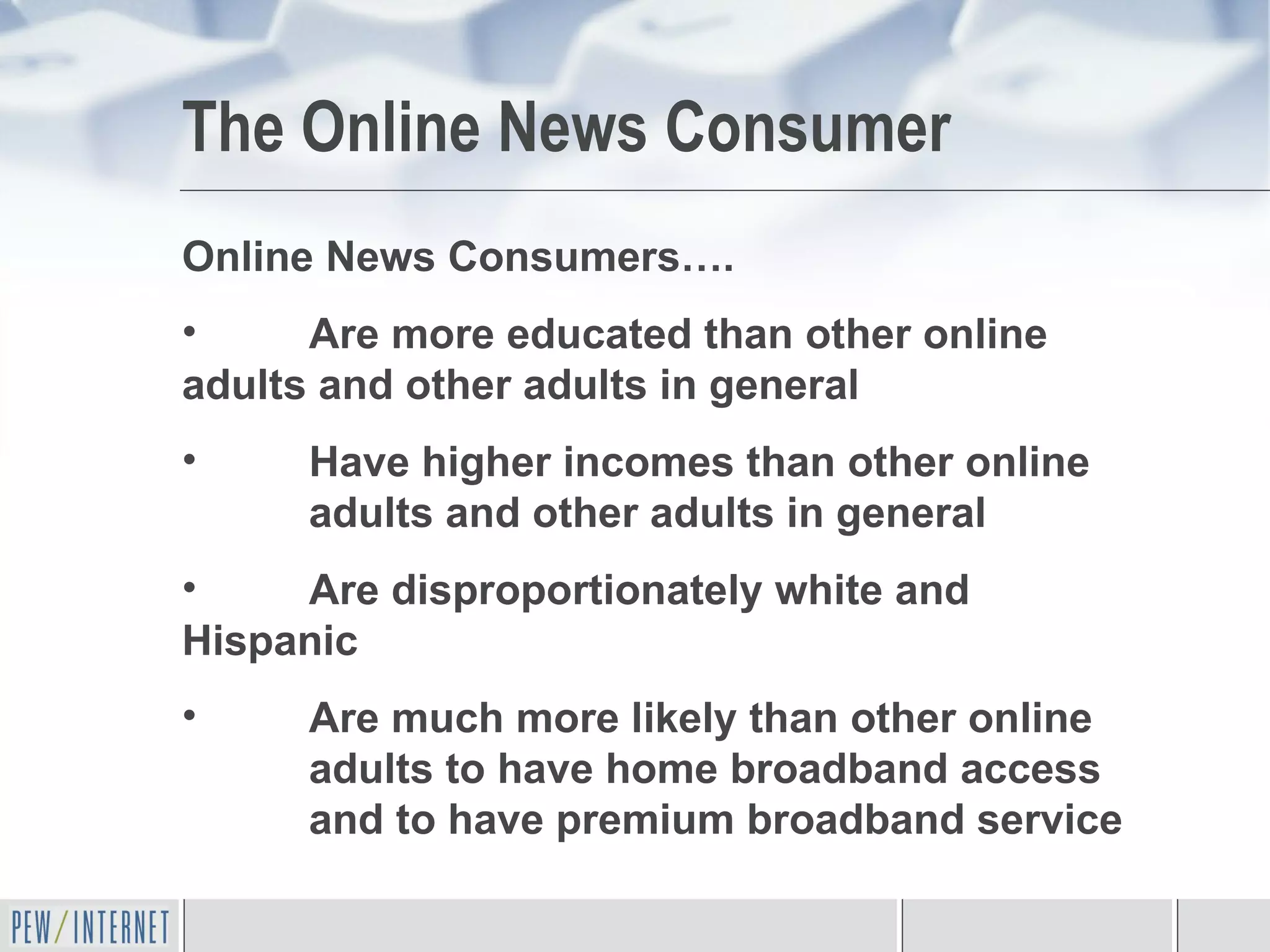
The Online News Consumer Online News Consumers…. Are more educated than other online  adults and other adults in general Have higher incomes than other online  adults and other adults in general Are disproportionately white and  Hispanic Are much more likely than other online  adults to have home broadband access  and to have premium broadband service
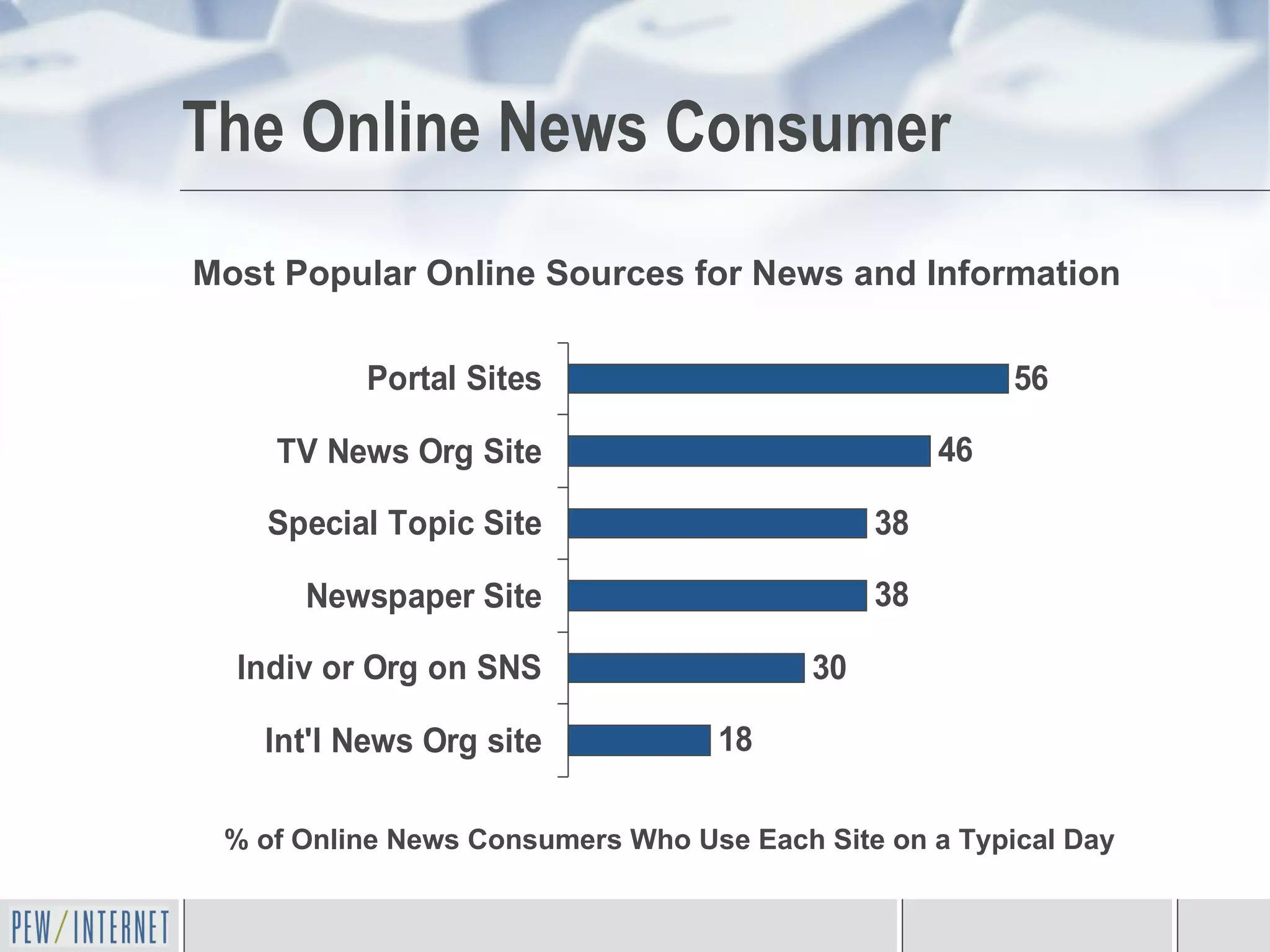
The Online News Consumer % of Online News Consumers Who Use Each Site on a Typical Day Most Popular Online Sources for News and Information
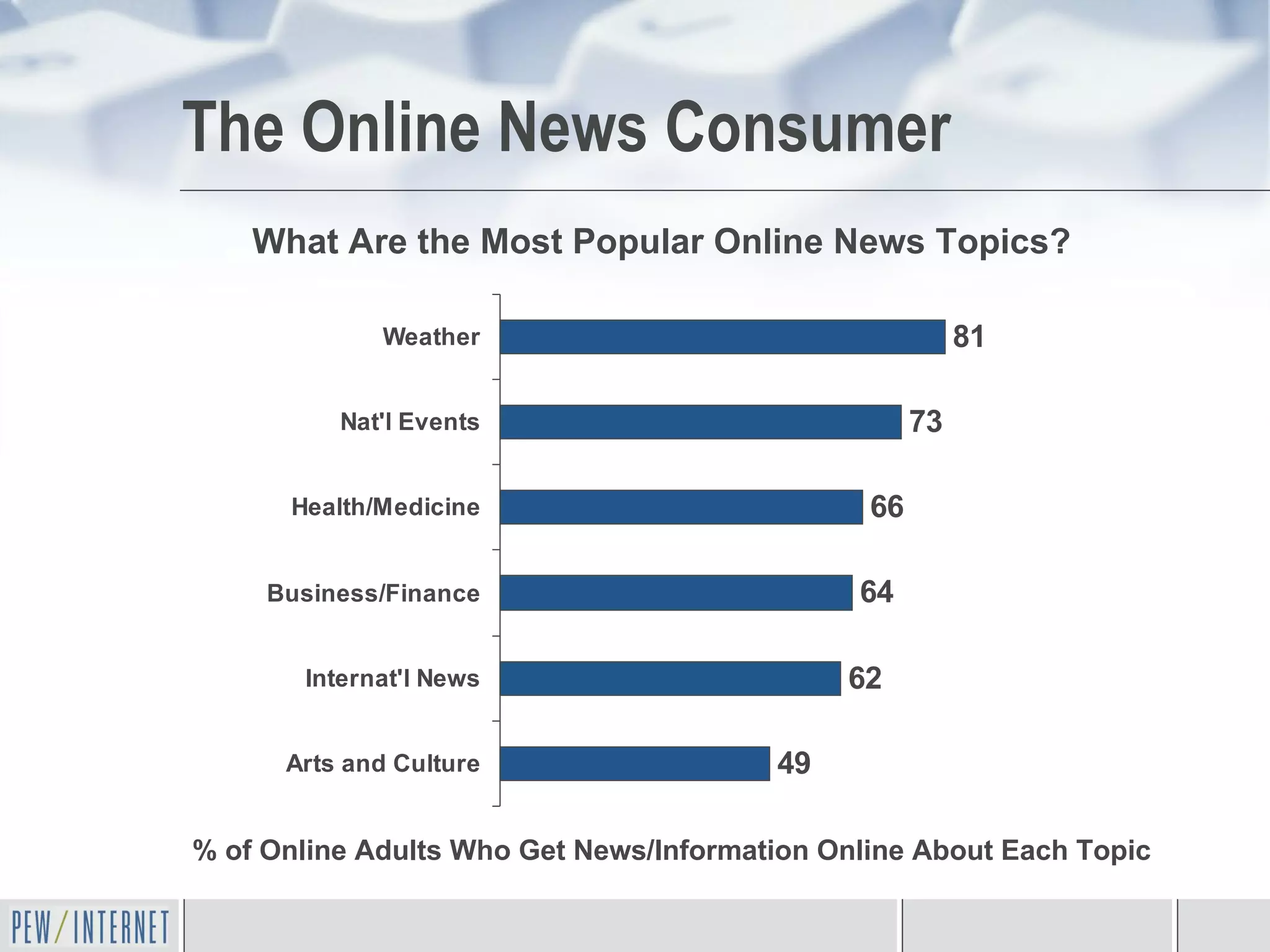
The Online News Consumer % of Online Adults Who Get News/Information Online About Each Topic What Are the Most Popular Online News Topics?
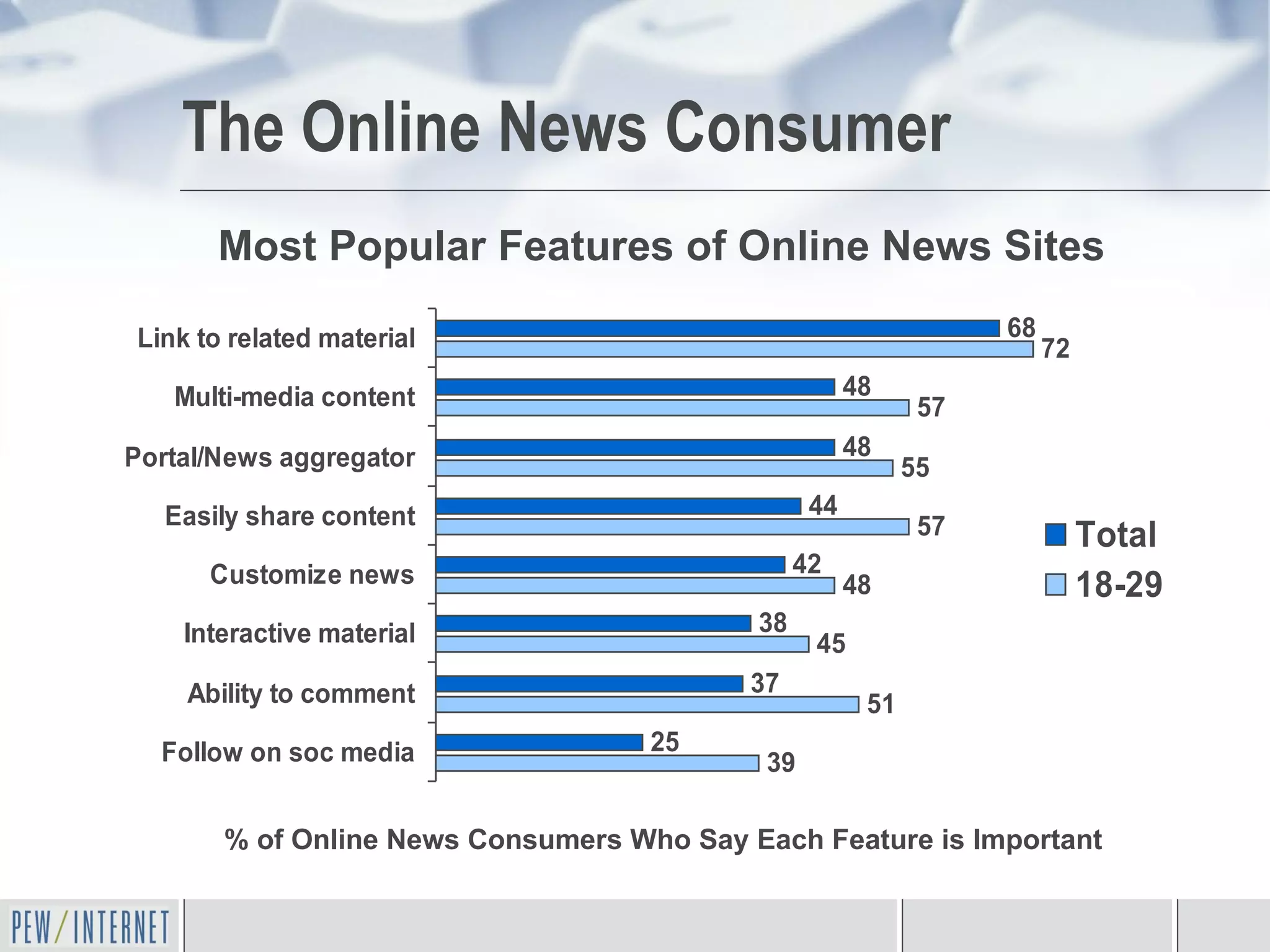
The Online News Consumer % of Online News Consumers Who Say Each Feature is Important Most Popular Features of Online News Sites
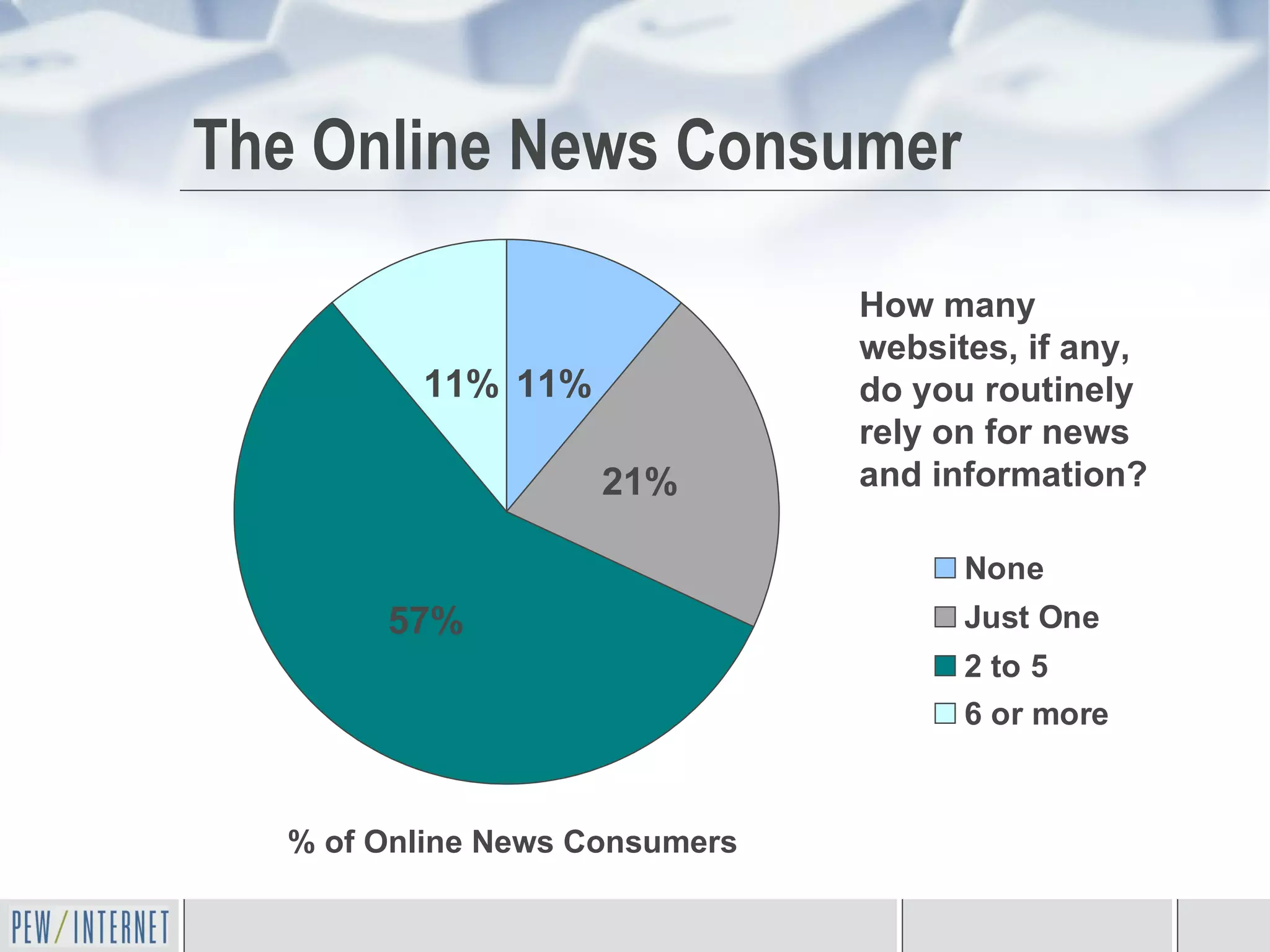
The Online News Consumer How many websites, if any, do you routinely rely on for news and information? % of Online News Consumers
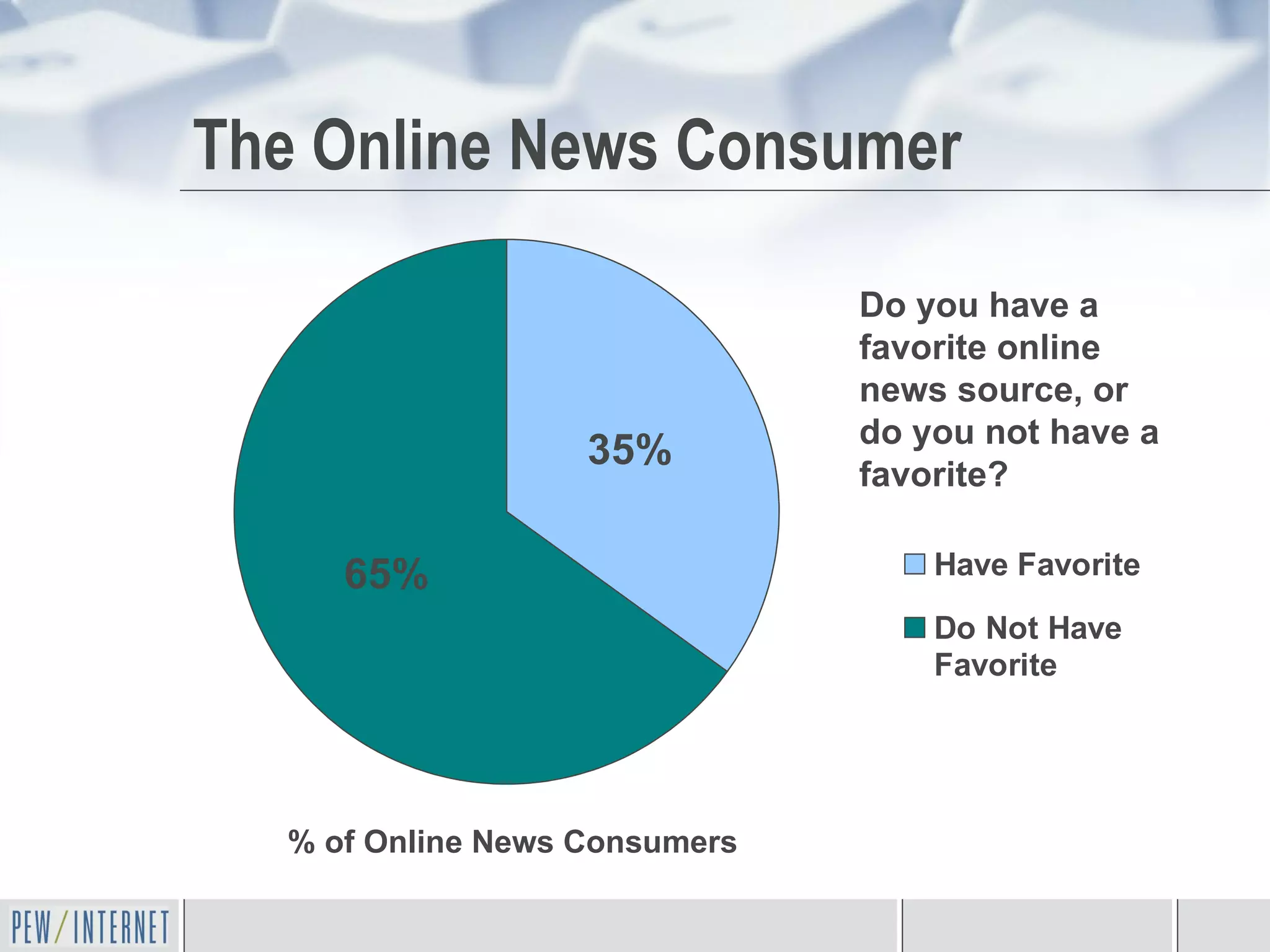
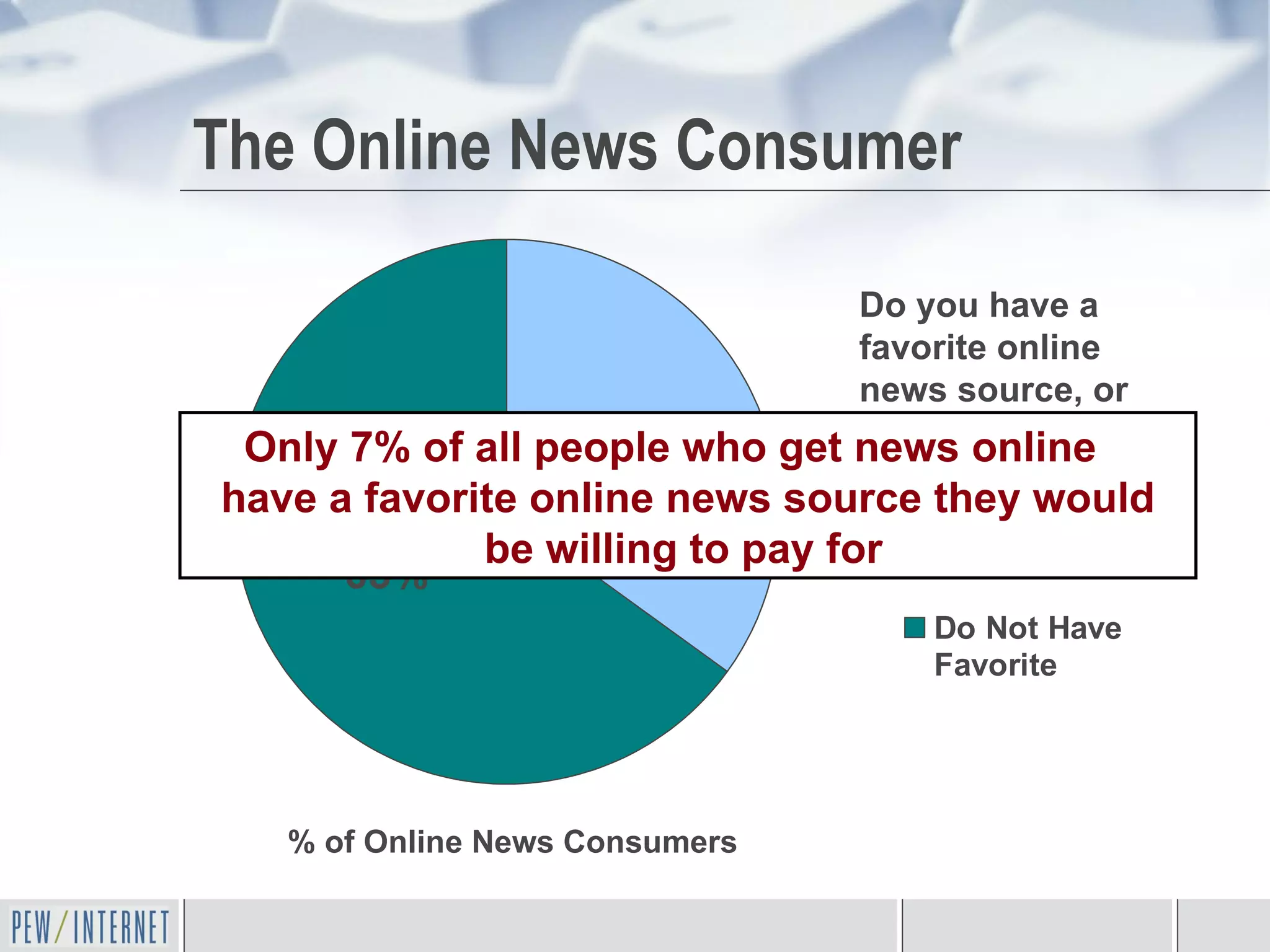
The Online News Consumer Do you have a favorite online news source, or do you not have a favorite? % of Online News Consumers
The Online News Consumer Do you have a favorite online news source, or do you not have a favorite? % of Online News Consumers  Only 7% of all people who get news online  have a favorite online news source they would be willing to pay for
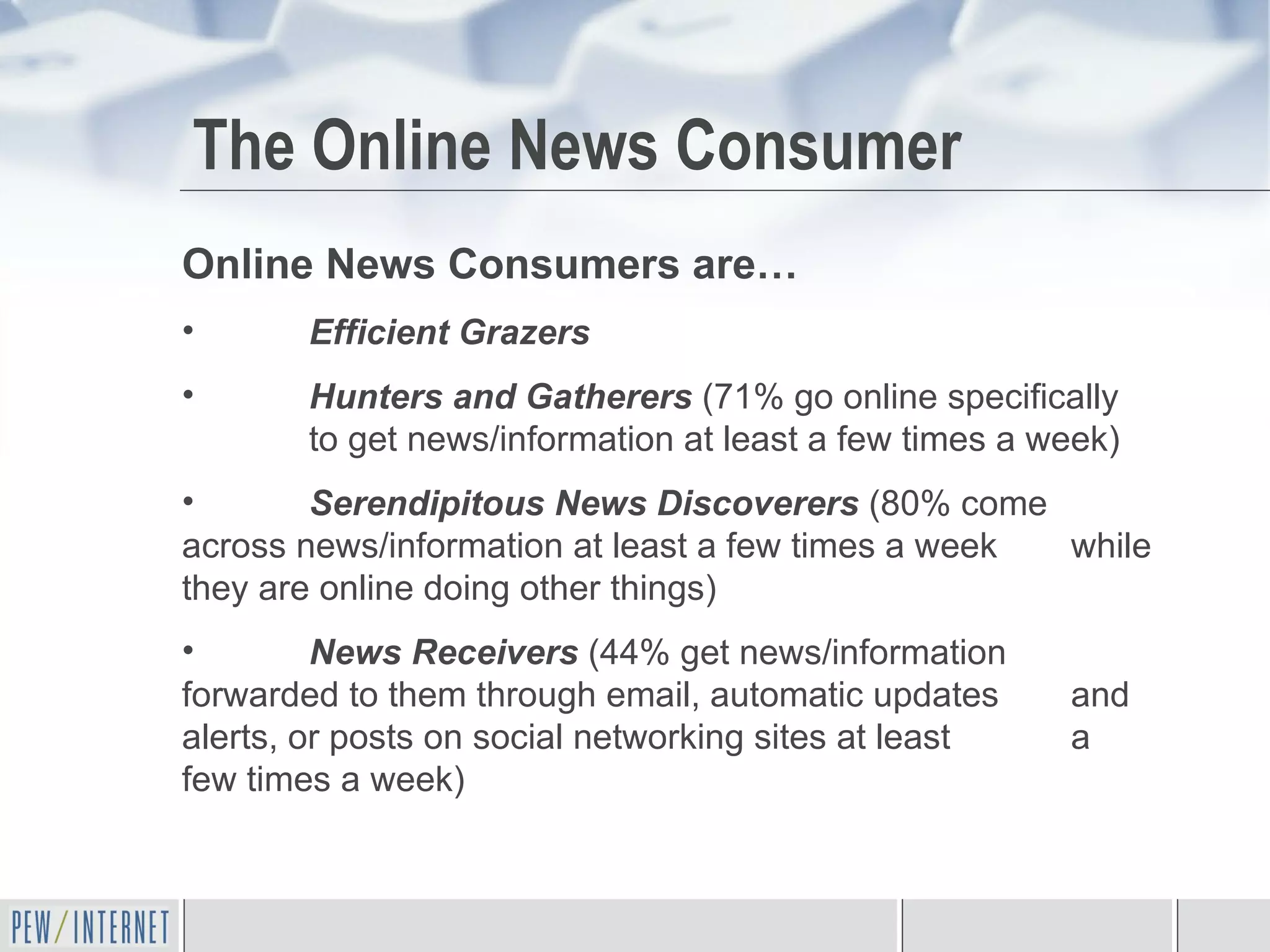
The Online News Consumer Online News Consumers are… Efficient Grazers Hunters and Gatherers   (71% go online specifically  to get news/information at least a few times a week) Serendipitous News Discoverers   (80% come  across news/information at least a few times a week  while they are online doing other things) News Receivers   (44% get news/information  forwarded to them through email, automatic updates  and alerts, or posts on social networking sites at least  a few times a week)
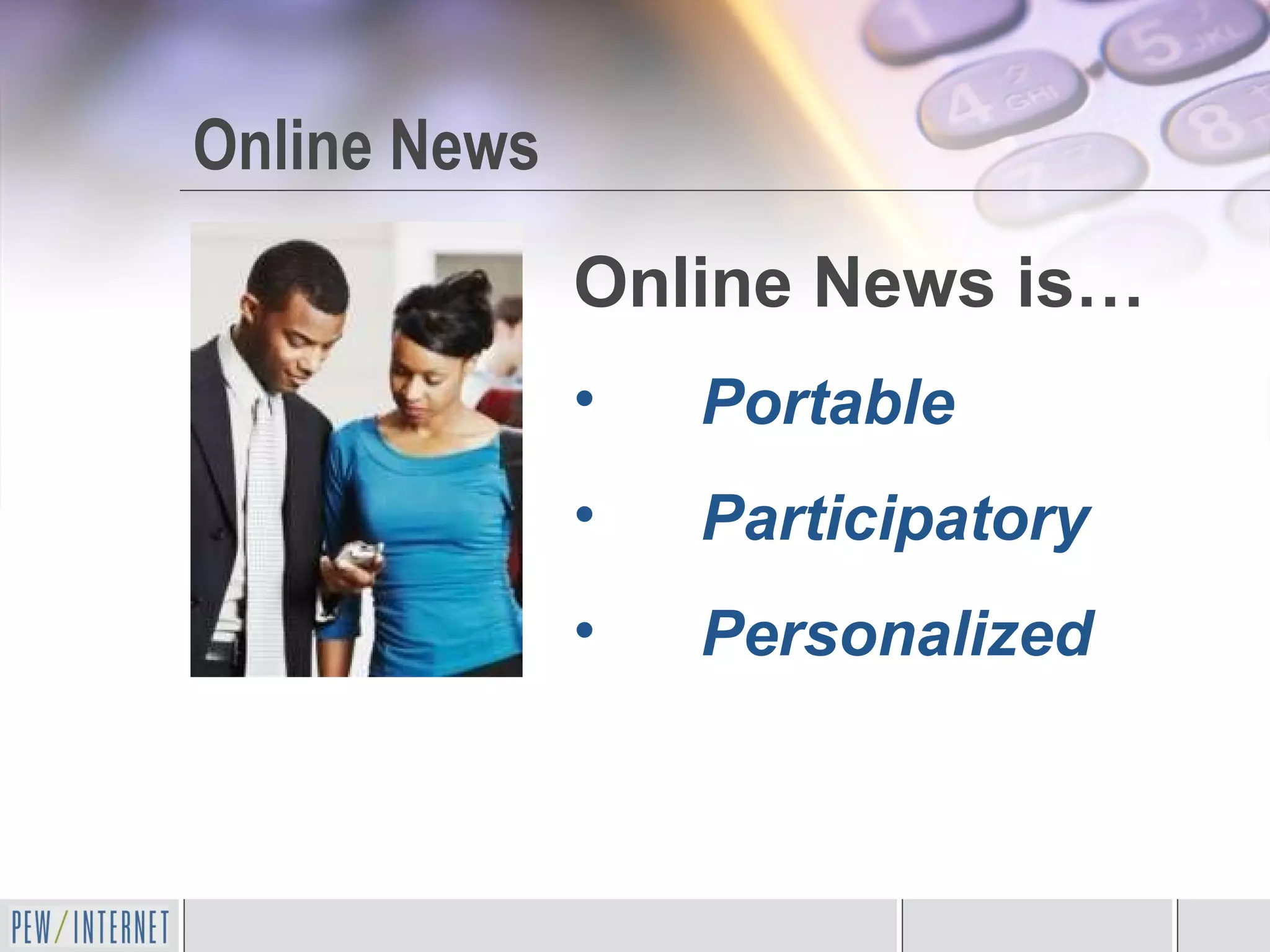
Online News  Online News is… Portable Participatory Personalized
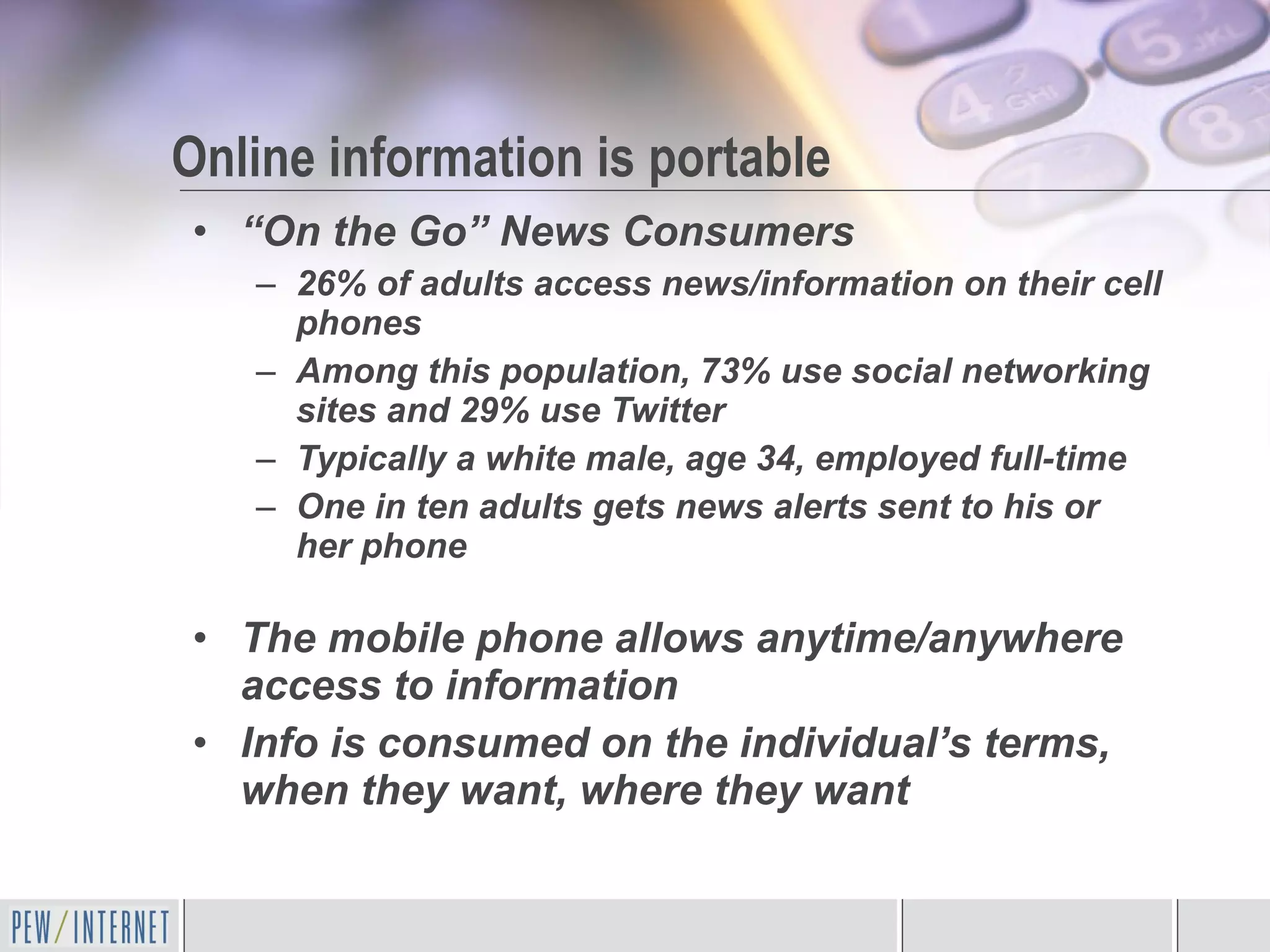
“ On the Go” News Consumers 26% of adults access news/information on their cell phones Among this population, 73% use social networking sites and 29% use Twitter Typically a white male, age 34, employed full-time One in ten adults gets news alerts sent to his or her phone The mobile phone allows anytime/anywhere access to information Info is consumed on the individual’s terms, when they want, where they want Online information is portable
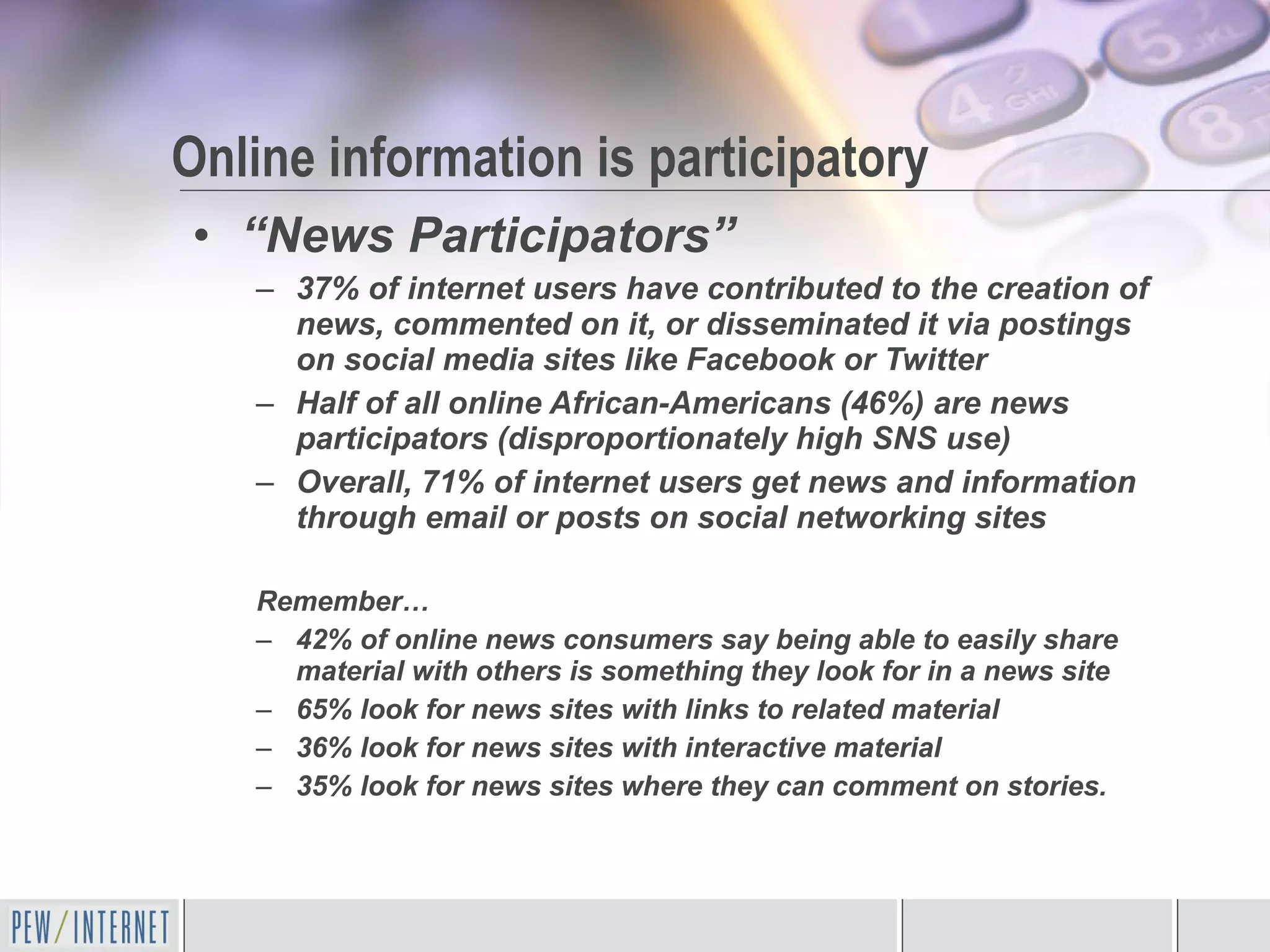
“ News Participators” 37% of internet users have contributed to the creation of news, commented on it, or disseminated it via postings on social media sites like Facebook or Twitter Half of all online African-Americans (46%) are news participators (disproportionately high SNS use) Overall, 71% of internet users get news and information through email or posts on social networking sites Remember… 42% of online news consumers say being able to easily share material with others is something they look for in a news site 65% look for news sites with links to related material 36% look for news sites with interactive material 35% look for news sites where they can comment on stories. Online information is participatory
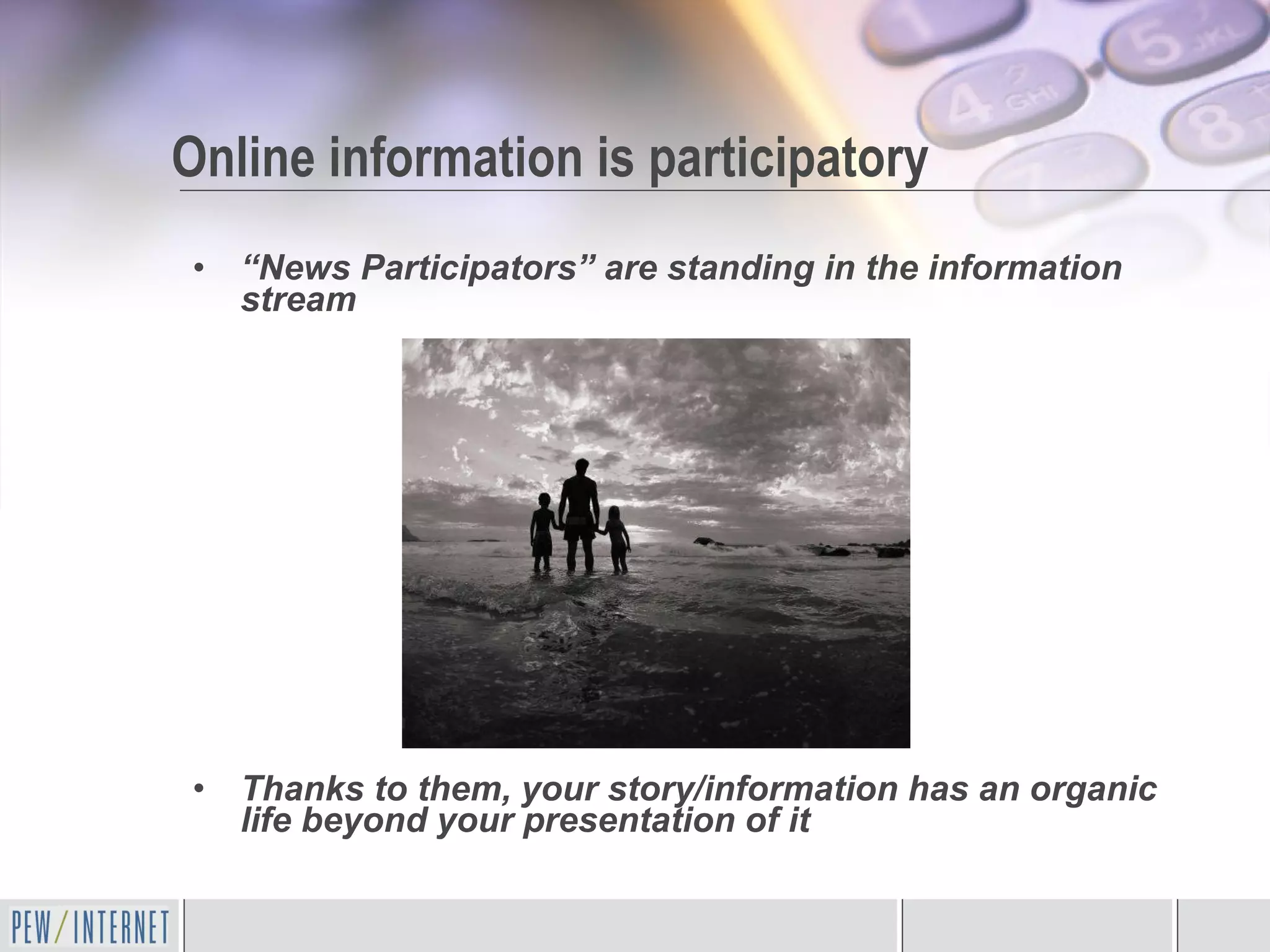
“ News Participators” are standing in the information stream Thanks to them, your story/information has an organic life beyond your presentation of it Online information is participatory
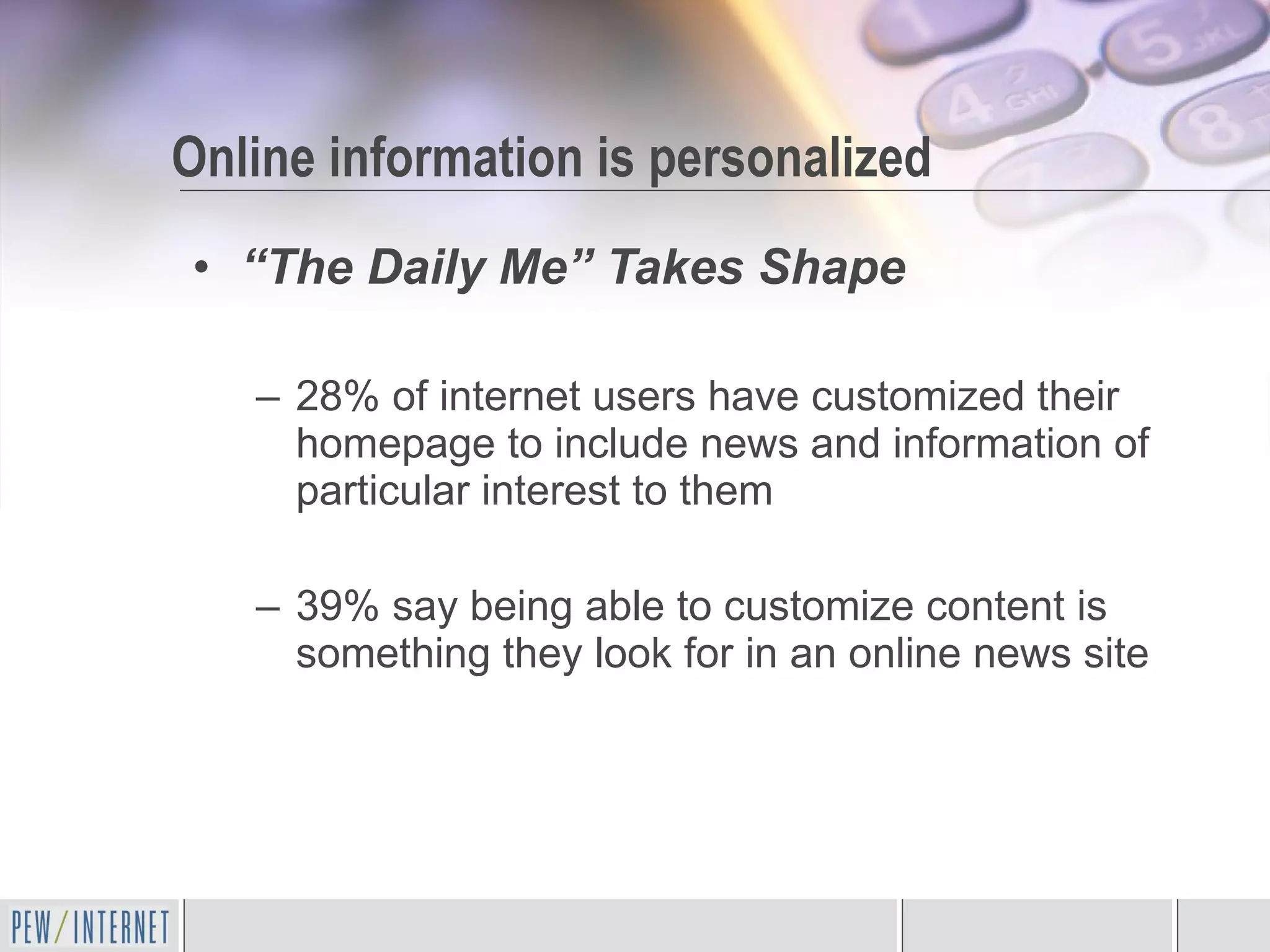
“ The Daily Me” Takes Shape 28% of internet users have customized their homepage to include news and information of particular interest to them  39% say being able to customize content is something they look for in an online news site Online information is personalized
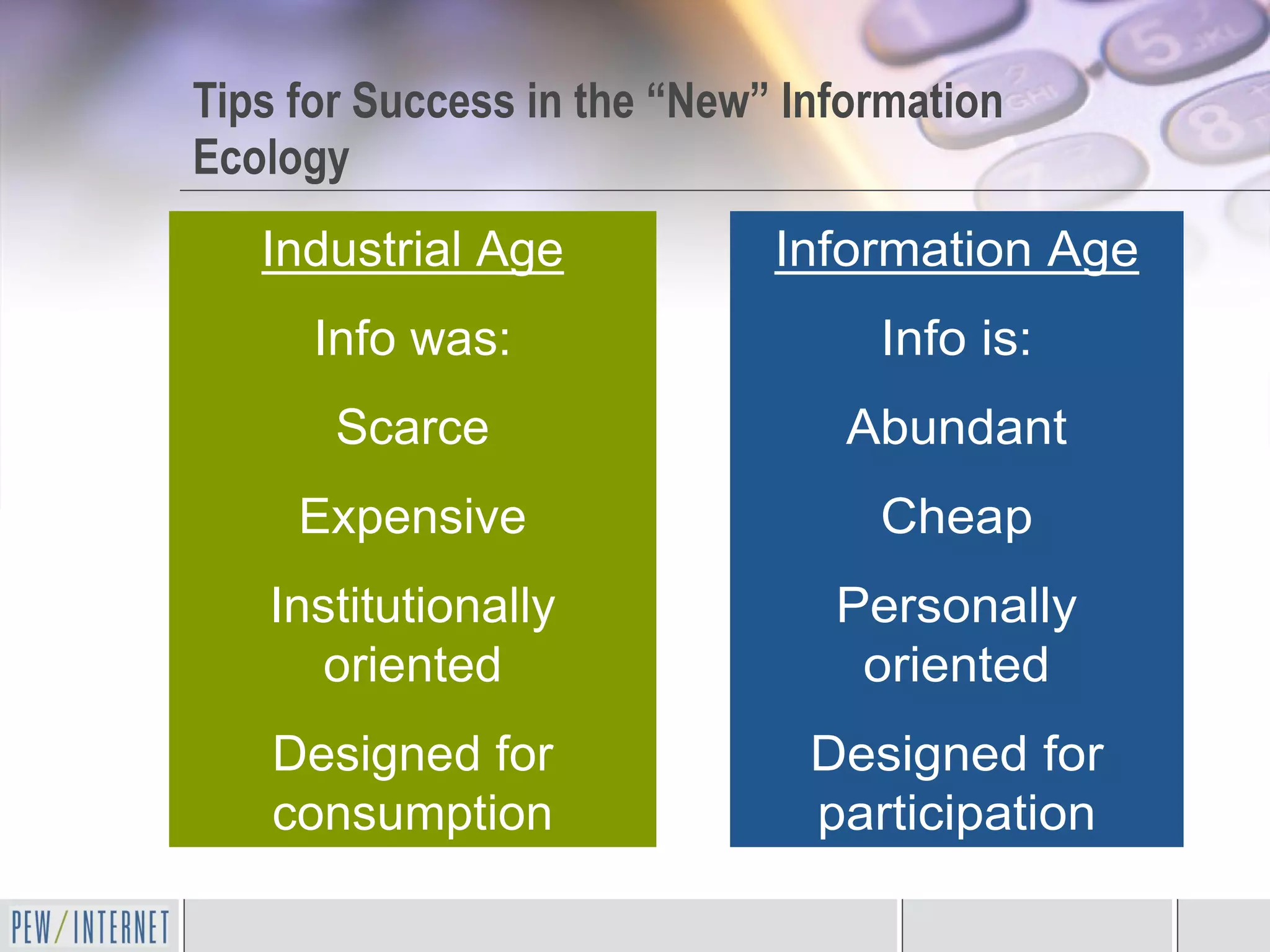
Tips for Success in the “New” Information Ecology
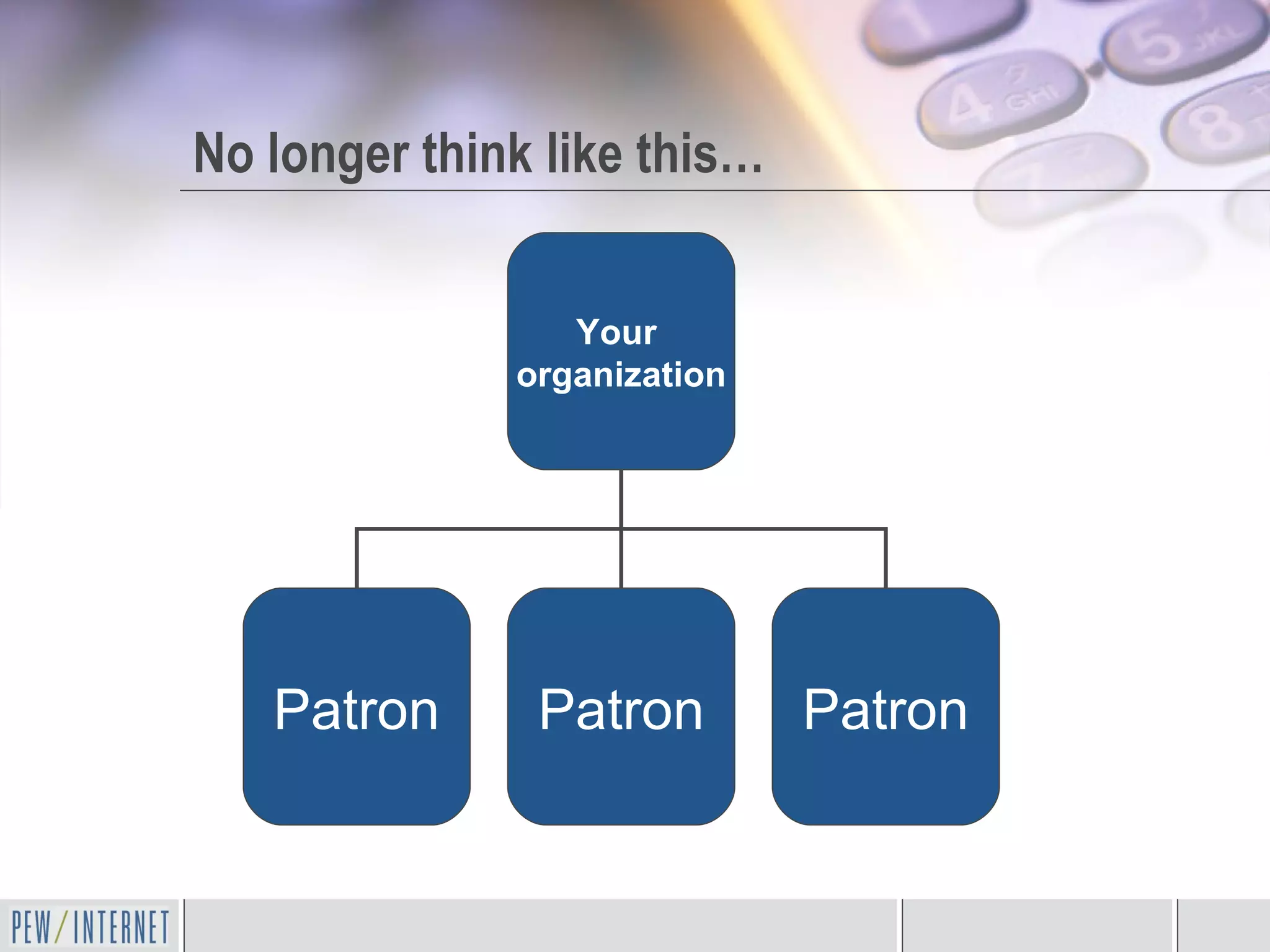
No longer think like this… Your  organization Patron Patron Patron
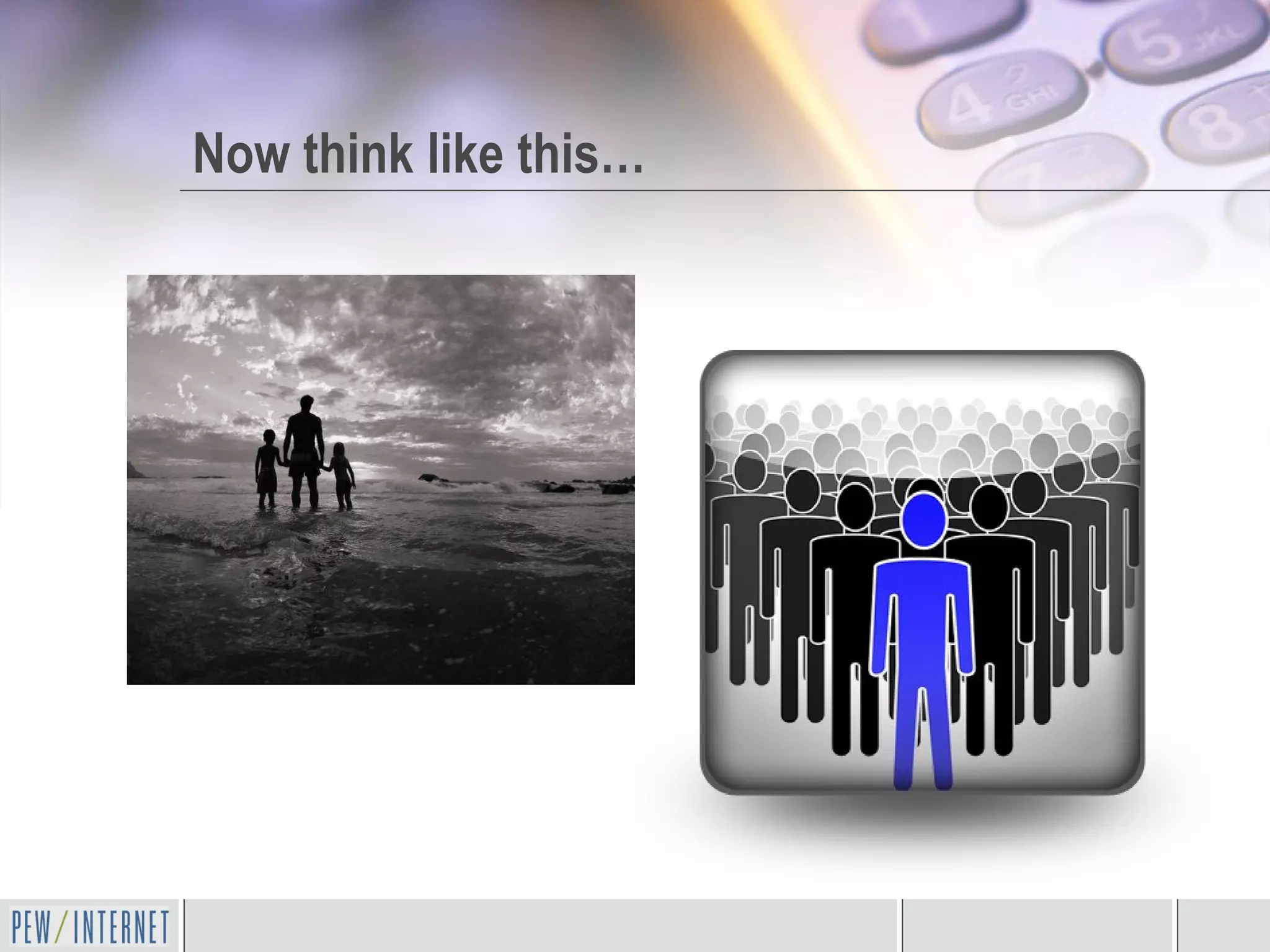
Now think like this…
How to become a node in people’s social networks
Tips on becoming a node in a social network Think like a friend, not an institution Play to your strengths by being an expert, a filter, a recommender (linker), and a facilitator  Be aware that your audience is bigger than the available evidence provides – lurkers and future arrivals are part of the mix Remember that your information can (will, should) have an organic life beyond your presentation of it Look for opportunities to build communities with your material
More tips on becoming a node in a social network Participate in the Web 2.0 world Embrace the move towards mobility, constant connectivity, perpetual contact  This changes the realities of time and space and presence Ask for feedback Act on/respond to that feedback Provide opportunities for interaction with and customization of material Facilitate information sharing
The four A’s of online information flow Get  Attention Leverage your services and knowledge Offer alerts, updates, feeds Have a presence in relevant places Find pathways through someone’s social network Enable  Acquisition Be findable in a long-tail world Pursue new distribution methods Offer link love (for selfish reasons) Participate in the conversation about your work
The four A’s of online information flow Help with Information  Assessment Be transparent Link everything and archive everything Aggregate the best related work Acknowledge mistakes and seek forgiveness Facilitate  Action Offer opportunities for feedback Offer opportunities for remixing, customization, interaction Offer opportunities for community building Be open to the wisdom of the crowd
Finally…. BE READY FOR THE SPOTLIGHT!! You never know when your material will go viral, be picked up by a major organization, or create/mobilize a community or following
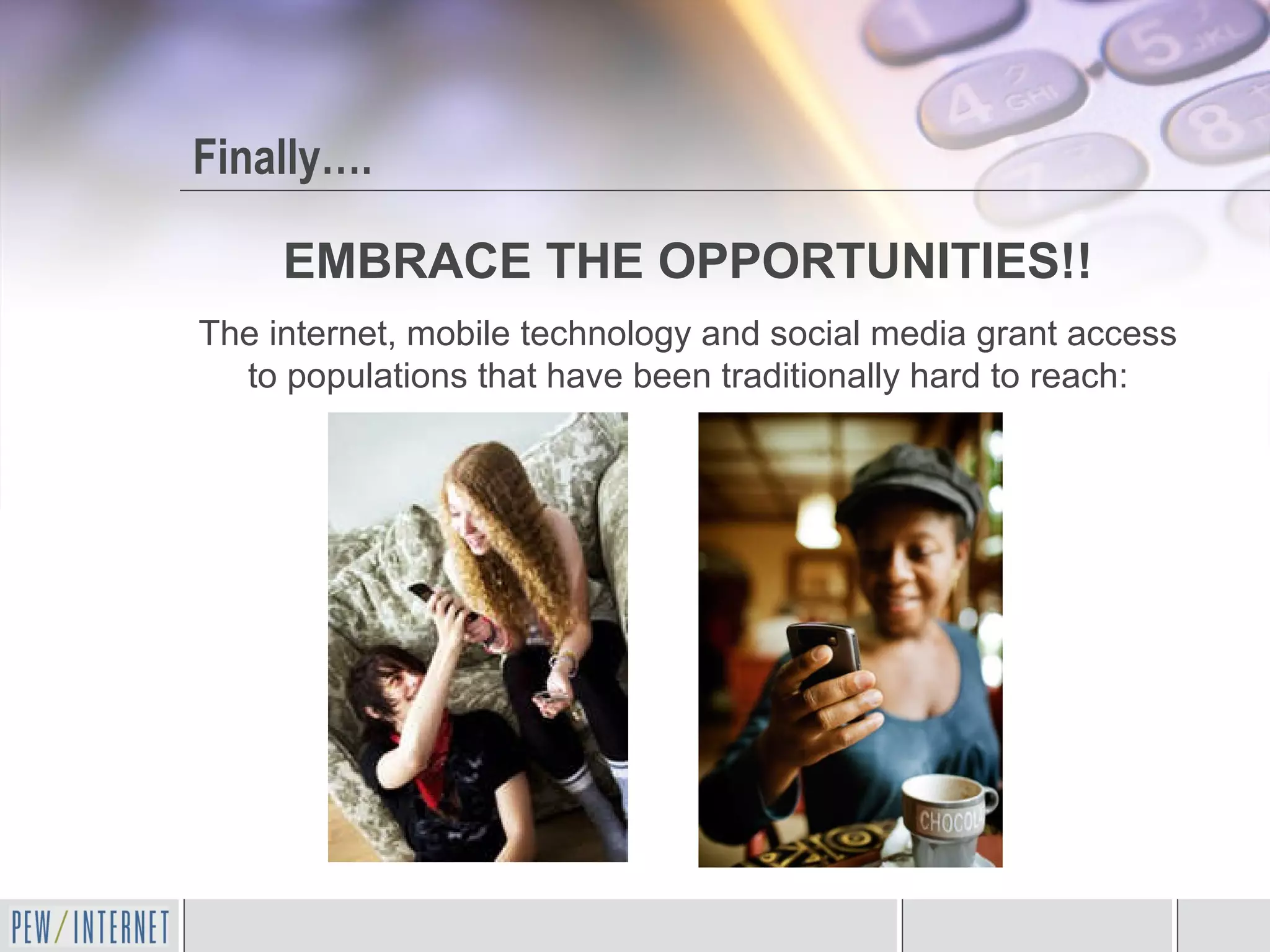
Finally…. EMBRACE THE OPPORTUNITIES!! The internet, mobile technology and social media grant access to populations that have been traditionally hard to reach:
Available at www.pewinternet.org... Understanding the Participatory News Consumer  http://www.pewinternet.org/Press-Releases/2010/Online-News.aspx   Social Media and Young Adults   http://www.pewinternet.org/Reports/2010/Social-Media-and-Young-Adults.aspx   Teens and Mobile Phones 2004-2009   http://www.pewinternet.org/Reports/2009/14--Teens-and-Mobile-Phones-Data-Memo.aspx Wireless Internet Use   http://www.pewinternet.org/Reports/2009/12-Wireless-Internet-Use.aspx   Chronic Disease and the Internet   http://www.pewinternet.org/Reports/2010/Chronic-Disease.aspx   The Social Life of Health Information   http://www.pewinternet.org/Reports/2009/8-The-Social-Life-of-Health-Information.aspx
Thank you! Kristen Purcell, Ph.D. Associate Director, Research Pew Research Center’s Internet & American Life Project 1615 L Street NW Suite 700 Washington, DC 20036 Email: kpurcell@pewinternet.org Twitter: http://twitter.com/kristenpurcell  202-419-4500

Information Consumption 2010: Portable, Participatory and Personal

  • 1.
    Information Consumption 2010:Portable, Participatory and Personal Kristen Purcell, Ph.D. Associate Director, Research Pew Internet Project New Jersey Arts Marketers Media Roundtable June 14 th , 2010
  • 2.
    Pew Internet ProjectPart of the Pew Research Center, a nonpartisan “fact tank” that seeks to provide high quality, objective data to thought leaders and policy makers Funded by the Pew Charitable Trusts, but a separate entity All findings are based on nationally representative telephone surveys of US adults age 18+, drawn from dual-frame (RDD/cell) samples
  • 3.
    Today’s Discussion Presentsome highlights of the new information ecology Information Sources/Consumption Patterns Online information consumers (including online news consumers, chronically ill internet users, and health information seekers) Talk about generational differences Present some tips for success in the new information ecology based on our findings and our own digital strategy
  • 4.
    The Basics (internet,mobility) The New Information Ecology Online Information Consumption Tips for Success
  • 5.
  • 6.
  • 7.
  • 8.
  • 9.
  • 10.
  • 11.
    The Basics Overall,wireless internet users are more engaged in online activities Half of all African-American adults (48%) have used their cell phone to access the internet, compared with 40% of Hispanic adults and 31% of white adults Overall, African-American adults are the most active users of the mobile internet African-American mobile internet use is growing at a faster rate than non-Hispanic whites and Hispanics
  • 12.
    The Basics Percentof Online Adults Who Use Social Media
  • 13.
    The Basics Percentof Online Adults Who Use Social Media
  • 14.
  • 15.
  • 16.
    Nine in tenAmerican adults (92%) get news/info from multiple platforms on a typical day For six in ten American adults (59%), one of those platforms is the internet *Platforms include print newspapers, television, radio and the internet The “New” Information Ecology
  • 17.
    The “New” InformationEcology Print local newspaper (50%) Print national newspaper (17%) Radio (54%) Internet (61%) Local TV news (78%) National TV news (73%) Menu of Choices for News on a Typical Day
  • 18.
    The “New” InformationEcology Where Americans get their news and information on a typical day
  • 19.
    The “New” InformationEcology The internet has not replaced/ displaced traditional media but… It is fundamentally changing the way people consume and interact with information
  • 20.
    The “New” InformationEcology Young Adults are the Least Avid News Consumers
  • 21.
    71% of Americanadults ever get news or information online The majority of online news consumers are under age 50 The Online News Consumer
  • 22.
    71% of Americanadults ever get news or information online Almost a third of online news consumers are under age 30 The Online News Consumer *The median age of online news consumers is 40
  • 23.
    The Online NewsConsumer Online News Consumers…. Are more educated than other online adults and other adults in general Have higher incomes than other online adults and other adults in general Are disproportionately white and Hispanic Are much more likely than other online adults to have home broadband access and to have premium broadband service
  • 24.
    The Online NewsConsumer % of Online News Consumers Who Use Each Site on a Typical Day Most Popular Online Sources for News and Information
  • 25.
    The Online NewsConsumer % of Online Adults Who Get News/Information Online About Each Topic What Are the Most Popular Online News Topics?
  • 26.
    The Online NewsConsumer % of Online News Consumers Who Say Each Feature is Important Most Popular Features of Online News Sites
  • 27.
    The Online NewsConsumer How many websites, if any, do you routinely rely on for news and information? % of Online News Consumers
  • 28.
    The Online NewsConsumer Do you have a favorite online news source, or do you not have a favorite? % of Online News Consumers
  • 29.
    The Online NewsConsumer Do you have a favorite online news source, or do you not have a favorite? % of Online News Consumers Only 7% of all people who get news online have a favorite online news source they would be willing to pay for
  • 30.
    The Online NewsConsumer Online News Consumers are… Efficient Grazers Hunters and Gatherers (71% go online specifically to get news/information at least a few times a week) Serendipitous News Discoverers (80% come across news/information at least a few times a week while they are online doing other things) News Receivers (44% get news/information forwarded to them through email, automatic updates and alerts, or posts on social networking sites at least a few times a week)
  • 31.
    Online News Online News is… Portable Participatory Personalized
  • 32.
    “ On theGo” News Consumers 26% of adults access news/information on their cell phones Among this population, 73% use social networking sites and 29% use Twitter Typically a white male, age 34, employed full-time One in ten adults gets news alerts sent to his or her phone The mobile phone allows anytime/anywhere access to information Info is consumed on the individual’s terms, when they want, where they want Online information is portable
  • 33.
    “ News Participators”37% of internet users have contributed to the creation of news, commented on it, or disseminated it via postings on social media sites like Facebook or Twitter Half of all online African-Americans (46%) are news participators (disproportionately high SNS use) Overall, 71% of internet users get news and information through email or posts on social networking sites Remember… 42% of online news consumers say being able to easily share material with others is something they look for in a news site 65% look for news sites with links to related material 36% look for news sites with interactive material 35% look for news sites where they can comment on stories. Online information is participatory
  • 34.
    “ News Participators”are standing in the information stream Thanks to them, your story/information has an organic life beyond your presentation of it Online information is participatory
  • 35.
    “ The DailyMe” Takes Shape 28% of internet users have customized their homepage to include news and information of particular interest to them 39% say being able to customize content is something they look for in an online news site Online information is personalized
  • 36.
    Tips for Successin the “New” Information Ecology
  • 37.
    Tips for Successin the “New” Information Ecology
  • 38.
    No longer thinklike this… Your organization Patron Patron Patron
  • 39.
  • 40.
    How to becomea node in people’s social networks
  • 41.
    Tips on becominga node in a social network Think like a friend, not an institution Play to your strengths by being an expert, a filter, a recommender (linker), and a facilitator Be aware that your audience is bigger than the available evidence provides – lurkers and future arrivals are part of the mix Remember that your information can (will, should) have an organic life beyond your presentation of it Look for opportunities to build communities with your material
  • 42.
    More tips onbecoming a node in a social network Participate in the Web 2.0 world Embrace the move towards mobility, constant connectivity, perpetual contact This changes the realities of time and space and presence Ask for feedback Act on/respond to that feedback Provide opportunities for interaction with and customization of material Facilitate information sharing
  • 43.
    The four A’sof online information flow Get Attention Leverage your services and knowledge Offer alerts, updates, feeds Have a presence in relevant places Find pathways through someone’s social network Enable Acquisition Be findable in a long-tail world Pursue new distribution methods Offer link love (for selfish reasons) Participate in the conversation about your work
  • 44.
    The four A’sof online information flow Help with Information Assessment Be transparent Link everything and archive everything Aggregate the best related work Acknowledge mistakes and seek forgiveness Facilitate Action Offer opportunities for feedback Offer opportunities for remixing, customization, interaction Offer opportunities for community building Be open to the wisdom of the crowd
  • 45.
    Finally…. BE READYFOR THE SPOTLIGHT!! You never know when your material will go viral, be picked up by a major organization, or create/mobilize a community or following
  • 46.
    Finally…. EMBRACE THEOPPORTUNITIES!! The internet, mobile technology and social media grant access to populations that have been traditionally hard to reach:
  • 47.
    Available at www.pewinternet.org...Understanding the Participatory News Consumer http://www.pewinternet.org/Press-Releases/2010/Online-News.aspx Social Media and Young Adults http://www.pewinternet.org/Reports/2010/Social-Media-and-Young-Adults.aspx Teens and Mobile Phones 2004-2009 http://www.pewinternet.org/Reports/2009/14--Teens-and-Mobile-Phones-Data-Memo.aspx Wireless Internet Use http://www.pewinternet.org/Reports/2009/12-Wireless-Internet-Use.aspx Chronic Disease and the Internet http://www.pewinternet.org/Reports/2010/Chronic-Disease.aspx The Social Life of Health Information http://www.pewinternet.org/Reports/2009/8-The-Social-Life-of-Health-Information.aspx
  • 48.
    Thank you! KristenPurcell, Ph.D. Associate Director, Research Pew Research Center’s Internet & American Life Project 1615 L Street NW Suite 700 Washington, DC 20036 Email: kpurcell@pewinternet.org Twitter: http://twitter.com/kristenpurcell 202-419-4500

Editor's Notes

  • #12 And most significant, indications are that wireless is lessening the digital divide between white and non-white adults. (Bullet 2 – staggering) Nonwhite adults are more likely to go online via cell, AA are the most active users of the mobile internet, and AA mobile use is growing at rates higher than Hispanic and white mobile use