SOUND LEVELS:
POWER AND
INTENSITY
Leslie Liu
Learning Object
Power and Intensity
 Power: energy emitted by sound waves over a
given period of time
 Units: (J/s or Watts)
 Intensity: amount of energy carried by sound
waves per unit time through a given area
 Commonly referred to as the “loudness” of a
sound
 Units: (Watts/m2)
 Sound waves with high intensity have a high
energy and therefore a high amplitude
Power and Intensity
 The intensity of a sound decreases the further
you move away from the source
 We understand this intuitively, but let’s explain it
with physics!
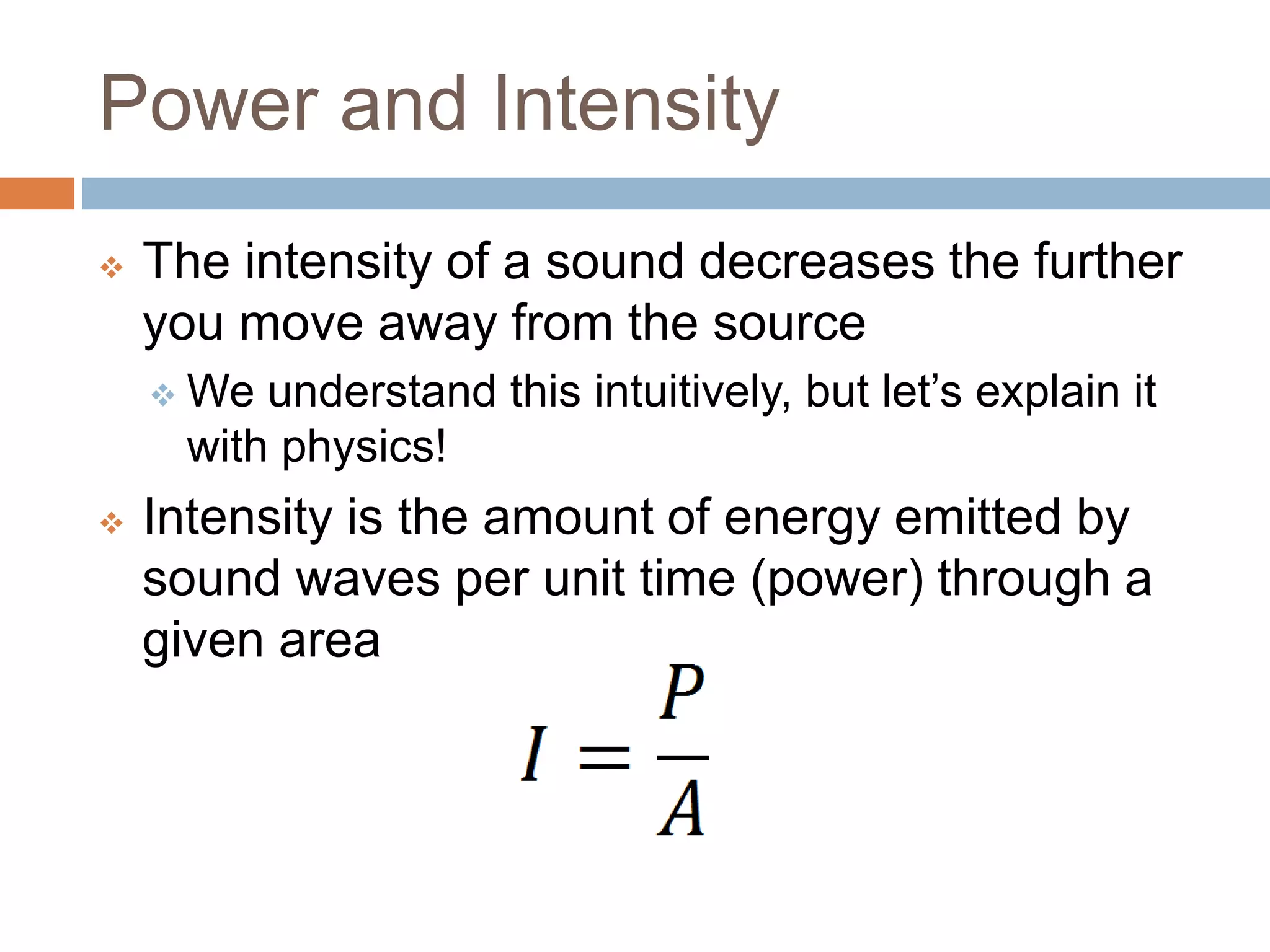
 Intensity is the amount of energy emitted by
sound waves per unit time (power) through a
given area
Power and Intensity
 The energy emitted by a sound wave remains
constant over time and doesn’t change with
distance (conservation of energy)
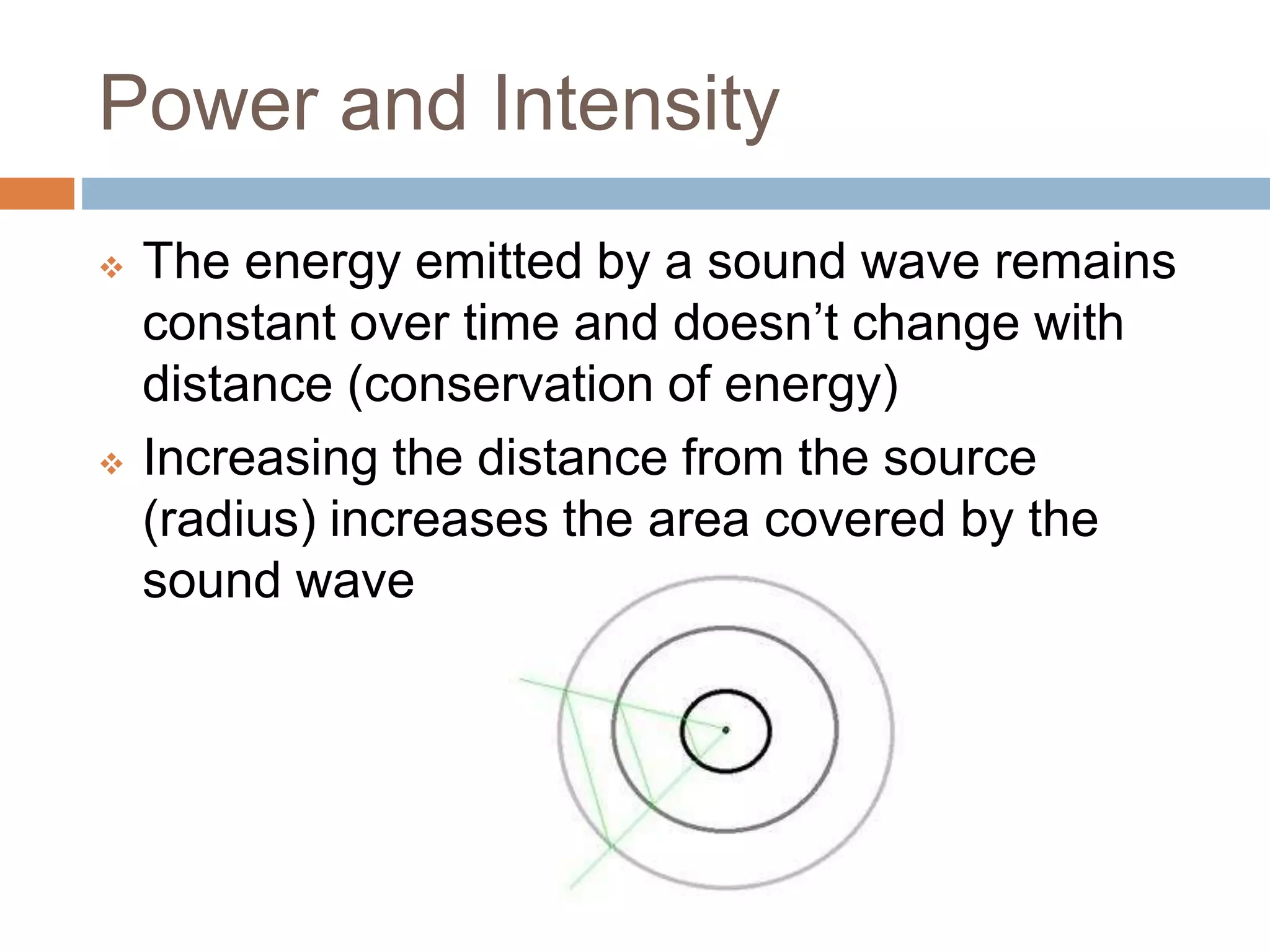
 Increasing the distance from the source
(radius) increases the area covered by the
sound wave
Power and Intensity
 If the power of the sound wave remains the
same and the area covered by the wave
increases, then the intensity will decrease the
further away we move from the source
Example with Numbers:
I1 = P/A I2 = P/A
I1 = 10W/5m2 I2 = 10W/10m2
I1 = 2 W/m2 I2 = 1 W/m2
Power and Intensity
 The intensity of a sound wave is uniformly
distributed at the same distance
 Moving around a point at a constant distance will
produce no change in intensity or “loudness”
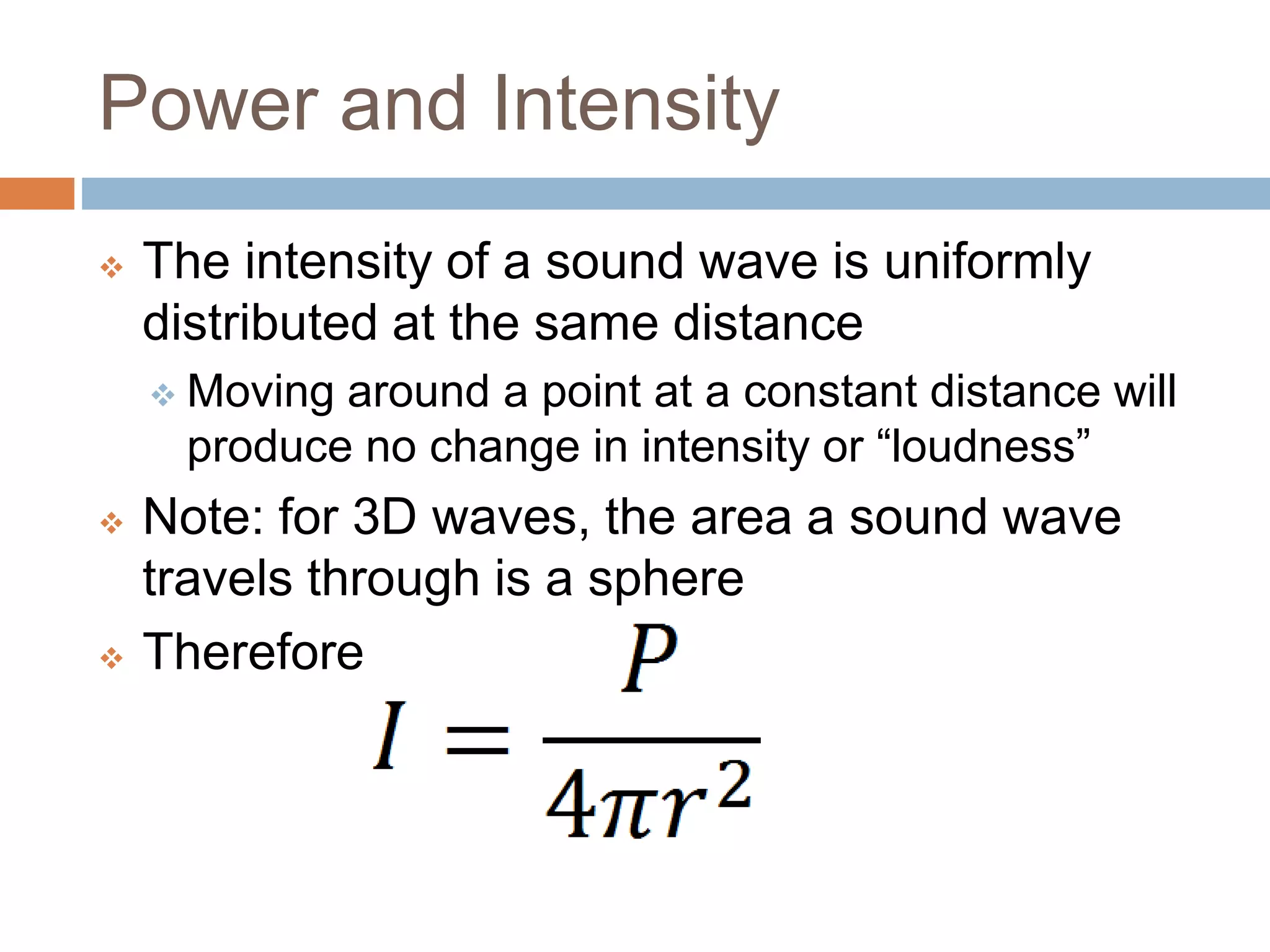
 Note: for 3D waves, the area a sound wave
travels through is a sphere
 Therefore
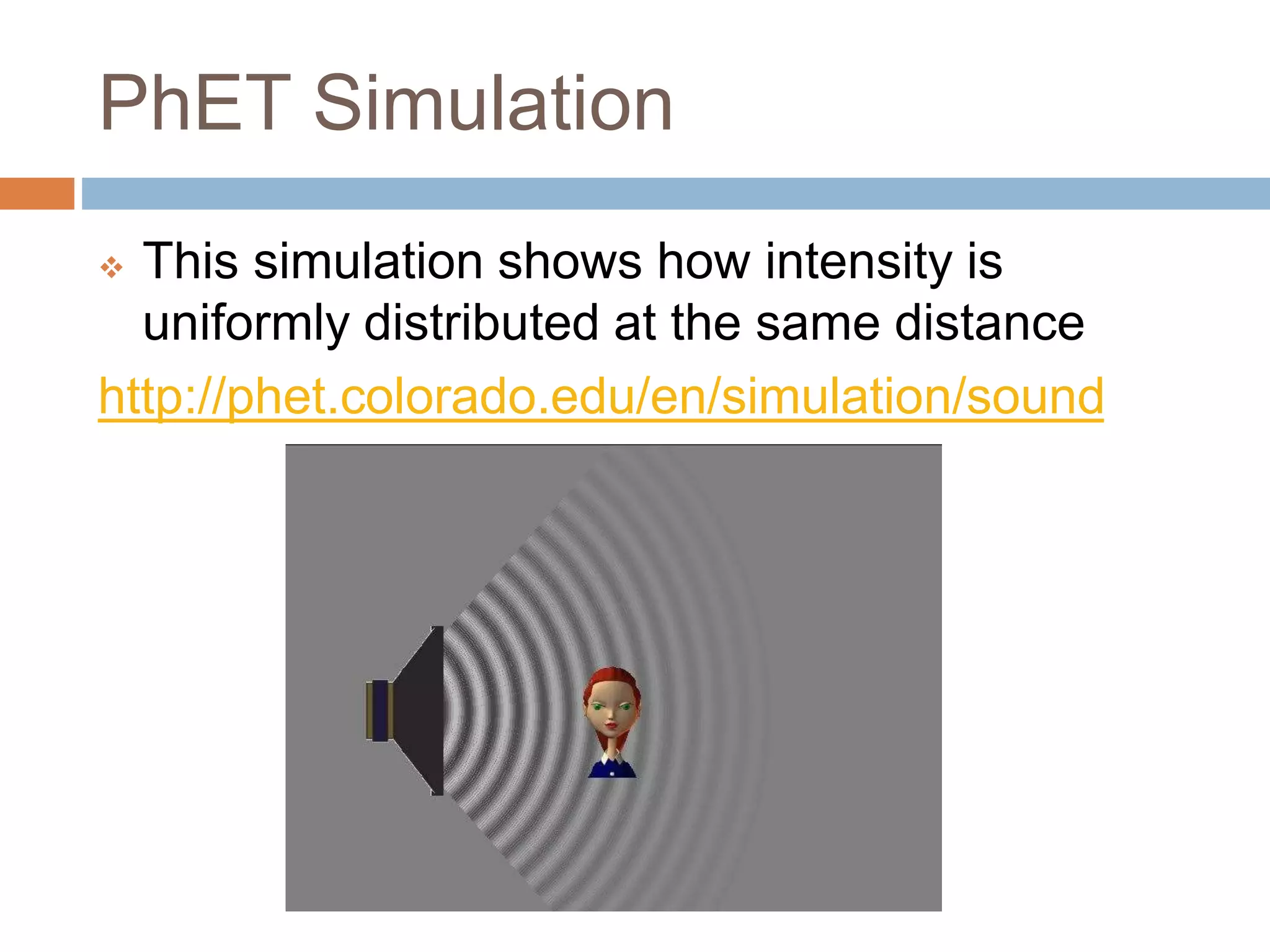
PhET Simulation
 This simulation shows how intensity is
uniformly distributed at the same distance
http://phet.colorado.edu/en/simulation/sound
Question 1:
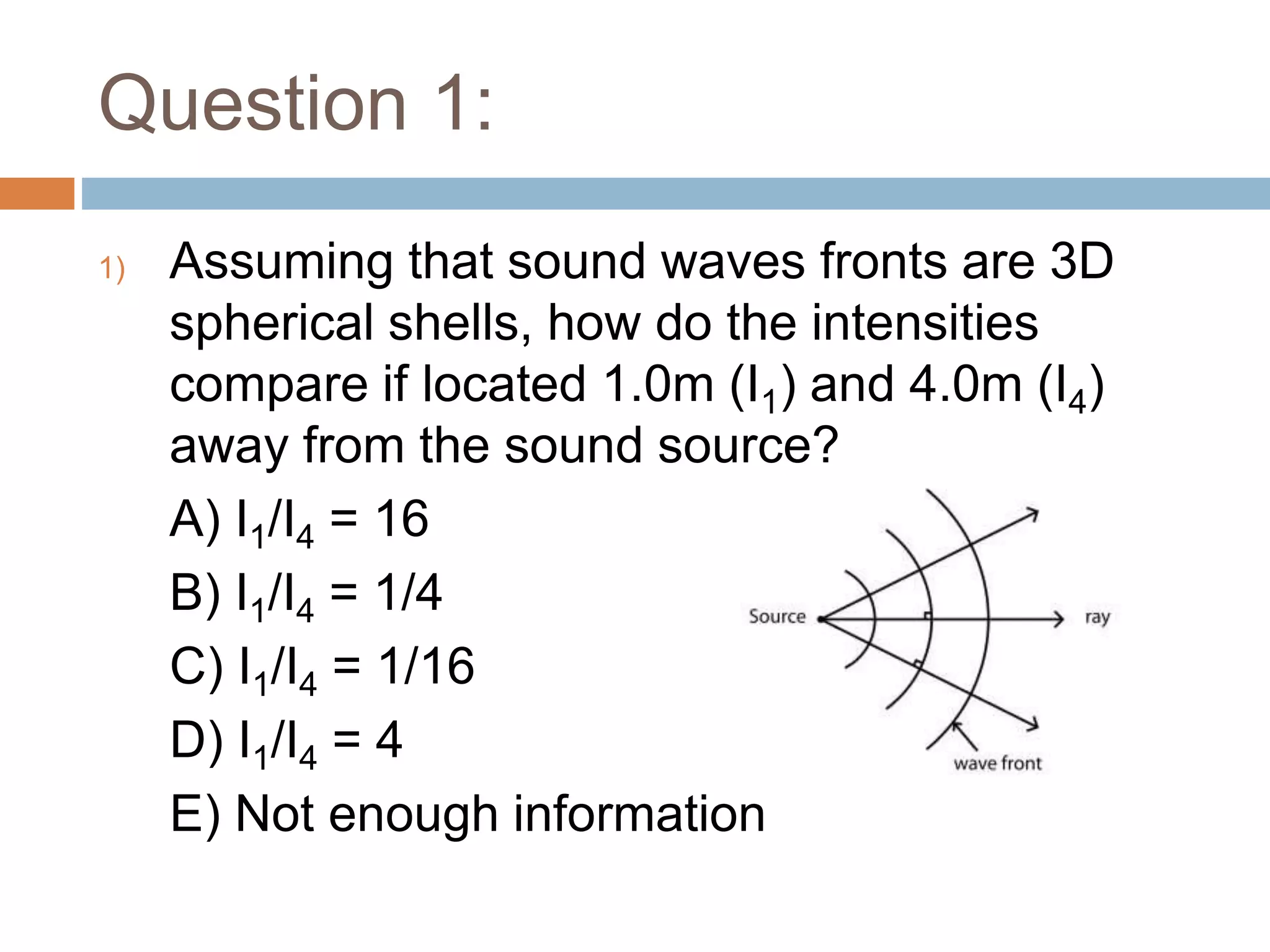
1) Assuming that sound waves fronts are 3D
spherical shells, how do the intensities
compare if located 1.0m (I1) and 4.0m (I4)
away from the sound source?
A) I1/I4 = 16
B) I1/I4 = 1/4
C) I1/I4 = 1/16
D) I1/I4 = 4
E) Not enough information
Question 1: Answer
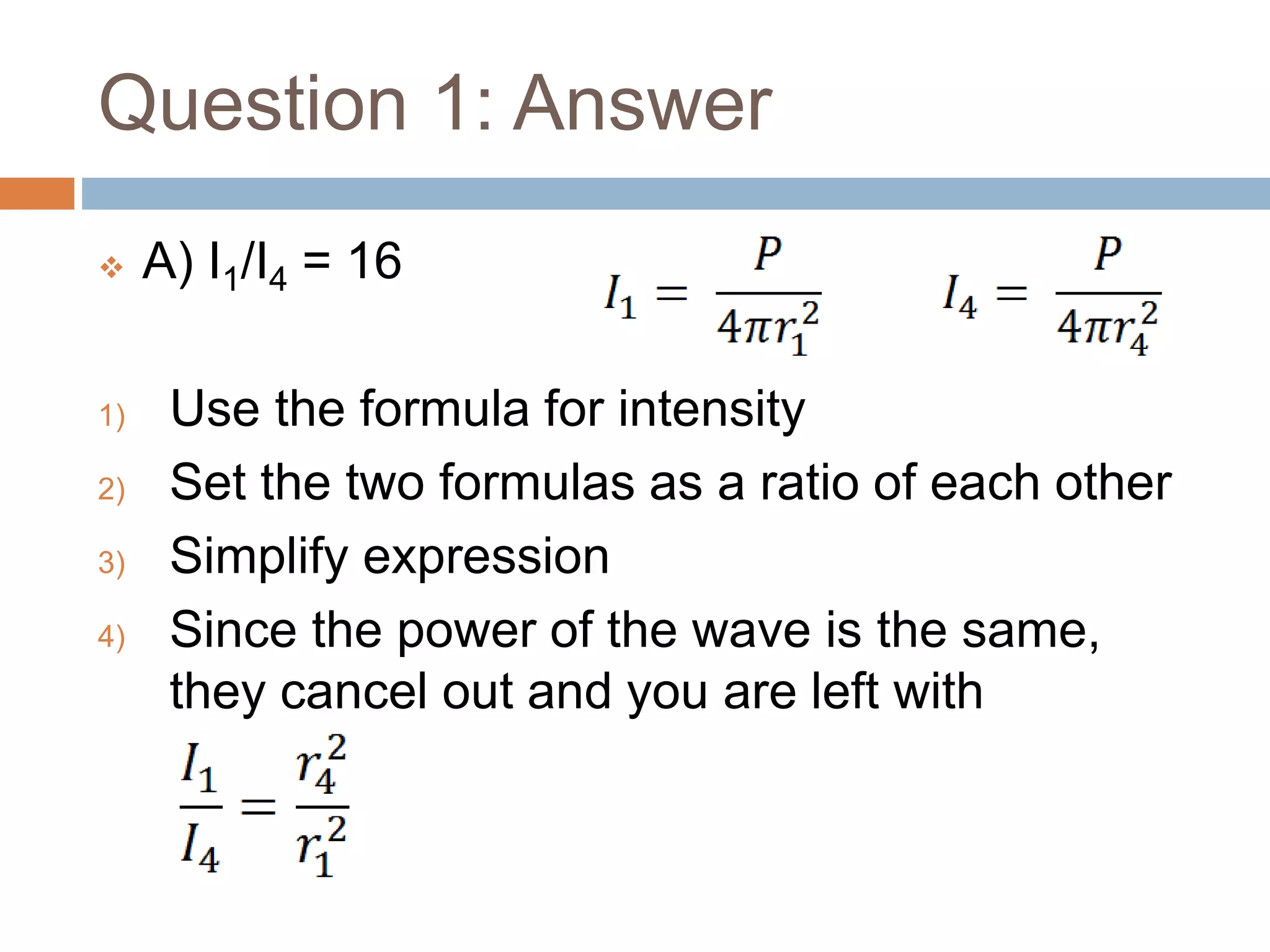
 A) I1/I4 = 16
1) Use the formula for intensity
2) Set the two formulas as a ratio of each other
3) Simplify expression
4) Since the power of the wave is the same,
they cancel out and you are left with
Question 2:
2) A person is standing beside a speaker as it
plays a 10,000 Hz tone. The sound waves
travel away from the speaker uniformly in all
directions. If the distance from the speaker
doubles, then the intensity of the waves that
the person observes:
A) doesn’t change
B) halves
C) decreases by a factor of 4
D) decreases by a factor of 8
Question 2: Answer
 C) decreases by a factor of 4
 The energy of the sound wave remains the
same but the surface area it covers changes
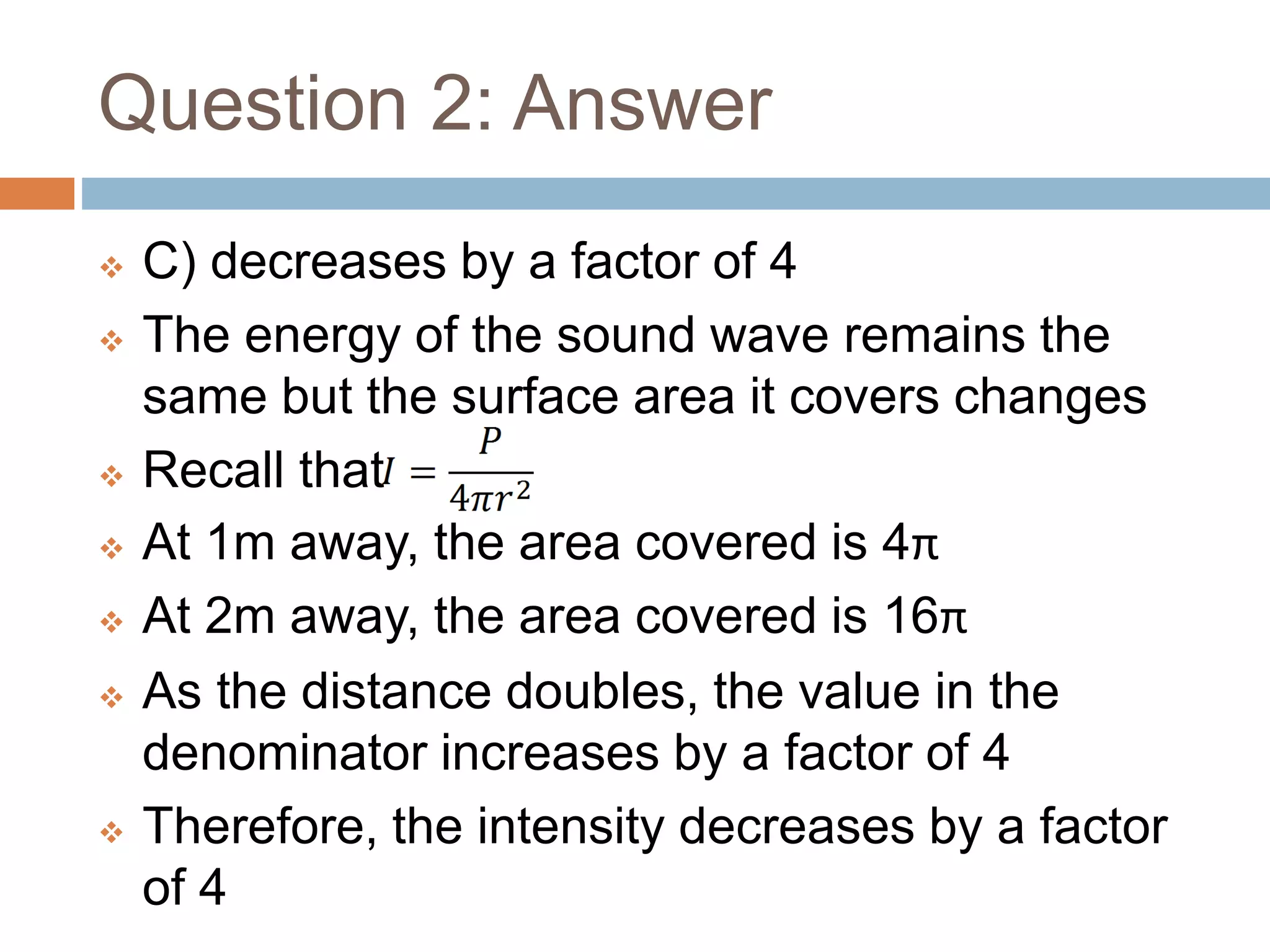
 Recall that
 At 1m away, the area covered is 4π
 At 2m away, the area covered is 16π
 As the distance doubles, the value in the
denominator increases by a factor of 4
 Therefore, the intensity decreases by a factor
of 4
Question 2: Answer
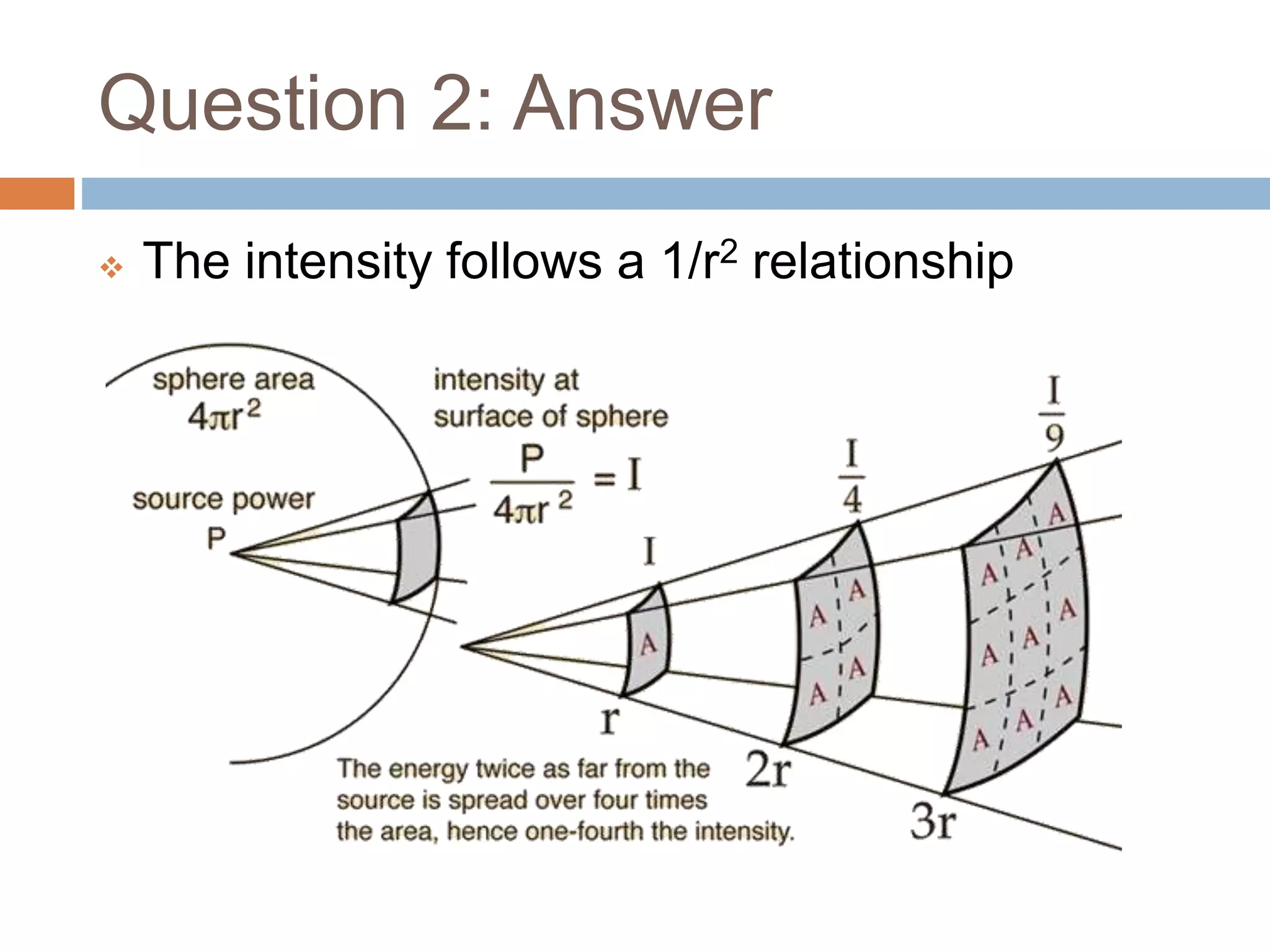
 The intensity follows a 1/r2 relationship
Question 3:
3) A person is standing beside a speaker as it
plays a 10,000 Hz tone. The sound waves
travel away from the speaker uniformly in all
directions. If the distance from the speaker
doubles, then the amplitude of the waves that
the person observes:
A) doesn’t change
B) halves
C) decreases by a factor of 4
D) decreases by a factor of 8
Question 3: Answer
 B) halves
 Recall that the energy of a wave is
proportional to the square of its amplitude
 Energy of a wave is represented by power (P)
in the equation for intensity
 Therefore intensity is also proportional to the
square of the wave’s amplitude
 By rearranging this relationship, we find that
the amplitude is proportional to the square root
of intensity
Question 3: Answer
 From the previous question we determined
that the intensity decreases by a factor of 4
when the distance doubles
 Taking the square root of ¼ gives us ½
 Therefore, the amplitude halves when the
distance doubles
 Sound, Interference, and Pressure PhET
Simulation
 http://phet.colorado.edu/en/simulation/sound
 Physics for Scientists and Engineers – An
Interactive Approach
 Images:
 http://www.elateafrica.org/elate/physics/waves/formsofwavefronts.
htm
 http://hyperphysics.phy-astr.gsu.edu/hbase/acoustic/invsqs.html
Works Cited

Physics 101 LO4 - Power and Intensity

  • 1.
  • 2.
    Power and Intensity Power: energy emitted by sound waves over a given period of time  Units: (J/s or Watts)  Intensity: amount of energy carried by sound waves per unit time through a given area  Commonly referred to as the “loudness” of a sound  Units: (Watts/m2)  Sound waves with high intensity have a high energy and therefore a high amplitude
  • 3.
    Power and Intensity The intensity of a sound decreases the further you move away from the source  We understand this intuitively, but let’s explain it with physics!  Intensity is the amount of energy emitted by sound waves per unit time (power) through a given area
  • 4.
    Power and Intensity The energy emitted by a sound wave remains constant over time and doesn’t change with distance (conservation of energy)  Increasing the distance from the source (radius) increases the area covered by the sound wave
  • 5.
    Power and Intensity If the power of the sound wave remains the same and the area covered by the wave increases, then the intensity will decrease the further away we move from the source Example with Numbers: I1 = P/A I2 = P/A I1 = 10W/5m2 I2 = 10W/10m2 I1 = 2 W/m2 I2 = 1 W/m2
  • 6.
    Power and Intensity The intensity of a sound wave is uniformly distributed at the same distance  Moving around a point at a constant distance will produce no change in intensity or “loudness”  Note: for 3D waves, the area a sound wave travels through is a sphere  Therefore
  • 7.
    PhET Simulation  Thissimulation shows how intensity is uniformly distributed at the same distance http://phet.colorado.edu/en/simulation/sound
  • 8.
    Question 1: 1) Assumingthat sound waves fronts are 3D spherical shells, how do the intensities compare if located 1.0m (I1) and 4.0m (I4) away from the sound source? A) I1/I4 = 16 B) I1/I4 = 1/4 C) I1/I4 = 1/16 D) I1/I4 = 4 E) Not enough information
  • 9.
    Question 1: Answer A) I1/I4 = 16 1) Use the formula for intensity 2) Set the two formulas as a ratio of each other 3) Simplify expression 4) Since the power of the wave is the same, they cancel out and you are left with
  • 10.
    Question 2: 2) Aperson is standing beside a speaker as it plays a 10,000 Hz tone. The sound waves travel away from the speaker uniformly in all directions. If the distance from the speaker doubles, then the intensity of the waves that the person observes: A) doesn’t change B) halves C) decreases by a factor of 4 D) decreases by a factor of 8
  • 11.
    Question 2: Answer C) decreases by a factor of 4  The energy of the sound wave remains the same but the surface area it covers changes  Recall that  At 1m away, the area covered is 4π  At 2m away, the area covered is 16π  As the distance doubles, the value in the denominator increases by a factor of 4  Therefore, the intensity decreases by a factor of 4
  • 12.
    Question 2: Answer The intensity follows a 1/r2 relationship
  • 13.
    Question 3: 3) Aperson is standing beside a speaker as it plays a 10,000 Hz tone. The sound waves travel away from the speaker uniformly in all directions. If the distance from the speaker doubles, then the amplitude of the waves that the person observes: A) doesn’t change B) halves C) decreases by a factor of 4 D) decreases by a factor of 8
  • 14.
    Question 3: Answer B) halves  Recall that the energy of a wave is proportional to the square of its amplitude  Energy of a wave is represented by power (P) in the equation for intensity  Therefore intensity is also proportional to the square of the wave’s amplitude  By rearranging this relationship, we find that the amplitude is proportional to the square root of intensity
  • 15.
    Question 3: Answer From the previous question we determined that the intensity decreases by a factor of 4 when the distance doubles  Taking the square root of ¼ gives us ½  Therefore, the amplitude halves when the distance doubles
  • 16.
     Sound, Interference,and Pressure PhET Simulation  http://phet.colorado.edu/en/simulation/sound  Physics for Scientists and Engineers – An Interactive Approach  Images:  http://www.elateafrica.org/elate/physics/waves/formsofwavefronts. htm  http://hyperphysics.phy-astr.gsu.edu/hbase/acoustic/invsqs.html Works Cited