How X-rays are absorbed
X-rays are not absorbed equally well by all materials; if they were,
they would not be very useful in diagnosis. Heavy elements such as
calcium are much better absorbers of X-rays than light elements such
as carbon, oxygen, and hydrogen, and as a result, structures
containing heavy elements, like the bones, stand out clearly. The soft
tissues-fat, muscles, and tumors-all absorb about equally well and are
thus difficult to distinguish from each other on an X-ray image .
The attenuation of an X-ray beam is its reduction due to the
absorption and scattering of some of the photons out of the beam. A
simple method of measuring the attenuation of an X-ray beam is
shown below.
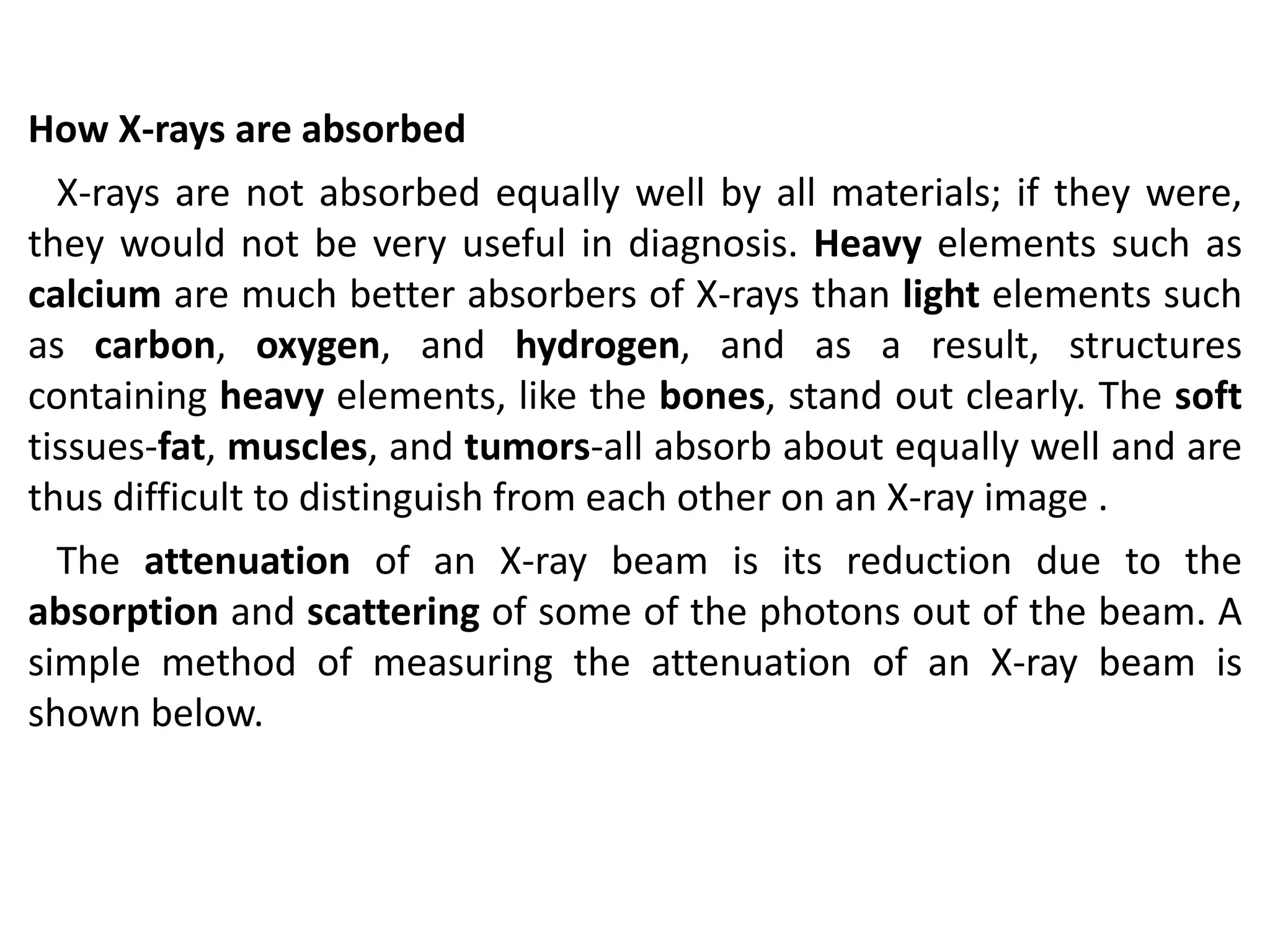
A narrow beam of X-rays is produced with
a collimator-a lead plate with a hole in it-and an X-ray
detector measures the beam intensity. The unattenuated
beam intensity is Io. As sheets of aluminum are introduced
into the beam, the intensity I decreases approximately
exponentially. The lower energy (soft) X-rays are
absorbed more readily than the higher energy (hard) X-
rays.
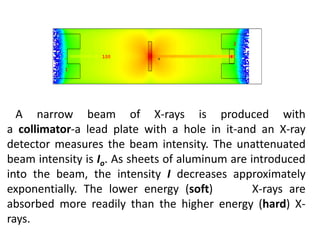
The intensity of a monoenergetic X-ray beam would decrease
exponentially. The exponential equation describing the attenuation
curve for a monoenergetic X-ray beam is: -
Where e=2.718, x is the thickness of the attenuator, and μ is the
linear attenuation coefficient of the attenuator. The linear
attenuation coefficient is dependent on the energy of the X-ray
photons; as the beam becomes harder, it decreases.
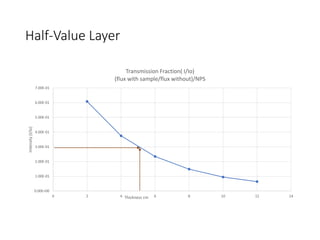
The half-value layer (HVL) for an X-ray beam is the thickness of a
given material that will reduce the beam intensity by one-half.


 e
I
I o
Half-Value Layer
0.00E+00
1.00E-01
2.00E-01
3.00E-01
4.00E-01
5.00E-01
6.00E-01
7.00E-01
0 2 4 6 8 10 12 14
Intensity
(I/Io)
Thickness cm
Transmission Fraction( I/Io)
(flux with sample/flux without)/NPS
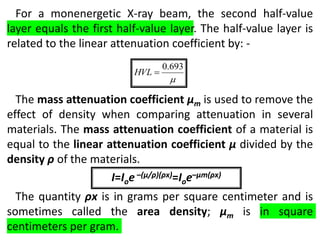
For a monenergetic X-ray beam, the second half-value
layer equals the first half-value layer. The half-value layer is
related to the linear attenuation coefficient by: -
The mass attenuation coefficient μm is used to remove the
effect of density when comparing attenuation in several
materials. The mass attenuation coefficient of a material is
equal to the linear attenuation coefficient μ divided by the
density ρ of the materials.
The quantity ρx is in grams per square centimeter and is
sometimes called the area density; μm is in square
centimeters per gram.

693
.
0

HVL
I=Ioe –(μ/ρ)(ρx)=Ioe–μm(ρx)

hvl.pptx

  • 1.
    How X-rays areabsorbed X-rays are not absorbed equally well by all materials; if they were, they would not be very useful in diagnosis. Heavy elements such as calcium are much better absorbers of X-rays than light elements such as carbon, oxygen, and hydrogen, and as a result, structures containing heavy elements, like the bones, stand out clearly. The soft tissues-fat, muscles, and tumors-all absorb about equally well and are thus difficult to distinguish from each other on an X-ray image . The attenuation of an X-ray beam is its reduction due to the absorption and scattering of some of the photons out of the beam. A simple method of measuring the attenuation of an X-ray beam is shown below.
  • 2.
    A narrow beamof X-rays is produced with a collimator-a lead plate with a hole in it-and an X-ray detector measures the beam intensity. The unattenuated beam intensity is Io. As sheets of aluminum are introduced into the beam, the intensity I decreases approximately exponentially. The lower energy (soft) X-rays are absorbed more readily than the higher energy (hard) X- rays.
  • 3.
    The intensity ofa monoenergetic X-ray beam would decrease exponentially. The exponential equation describing the attenuation curve for a monoenergetic X-ray beam is: - Where e=2.718, x is the thickness of the attenuator, and μ is the linear attenuation coefficient of the attenuator. The linear attenuation coefficient is dependent on the energy of the X-ray photons; as the beam becomes harder, it decreases. The half-value layer (HVL) for an X-ray beam is the thickness of a given material that will reduce the beam intensity by one-half.    e I I o
  • 4.
    Half-Value Layer 0.00E+00 1.00E-01 2.00E-01 3.00E-01 4.00E-01 5.00E-01 6.00E-01 7.00E-01 0 24 6 8 10 12 14 Intensity (I/Io) Thickness cm Transmission Fraction( I/Io) (flux with sample/flux without)/NPS
  • 5.
    For a monenergeticX-ray beam, the second half-value layer equals the first half-value layer. The half-value layer is related to the linear attenuation coefficient by: - The mass attenuation coefficient μm is used to remove the effect of density when comparing attenuation in several materials. The mass attenuation coefficient of a material is equal to the linear attenuation coefficient μ divided by the density ρ of the materials. The quantity ρx is in grams per square centimeter and is sometimes called the area density; μm is in square centimeters per gram.  693 . 0  HVL I=Ioe –(μ/ρ)(ρx)=Ioe–μm(ρx)