THE GRADING SYSTEM
OF POKHARA
UNIVERSITY
OFFICE OF THE CONTROLLER OF
EXAMINATIONS
KASKI, NEPAL
Deepanjal Shrestha, Lecturer & ICT Division
HeadBy
Introduction
 Pokhara University follows three types of
grading system :
 Relative Grading System
 Absolute Grading System
 Percentile System (Only for Nursing Program)
Grading SystemBasics of PU
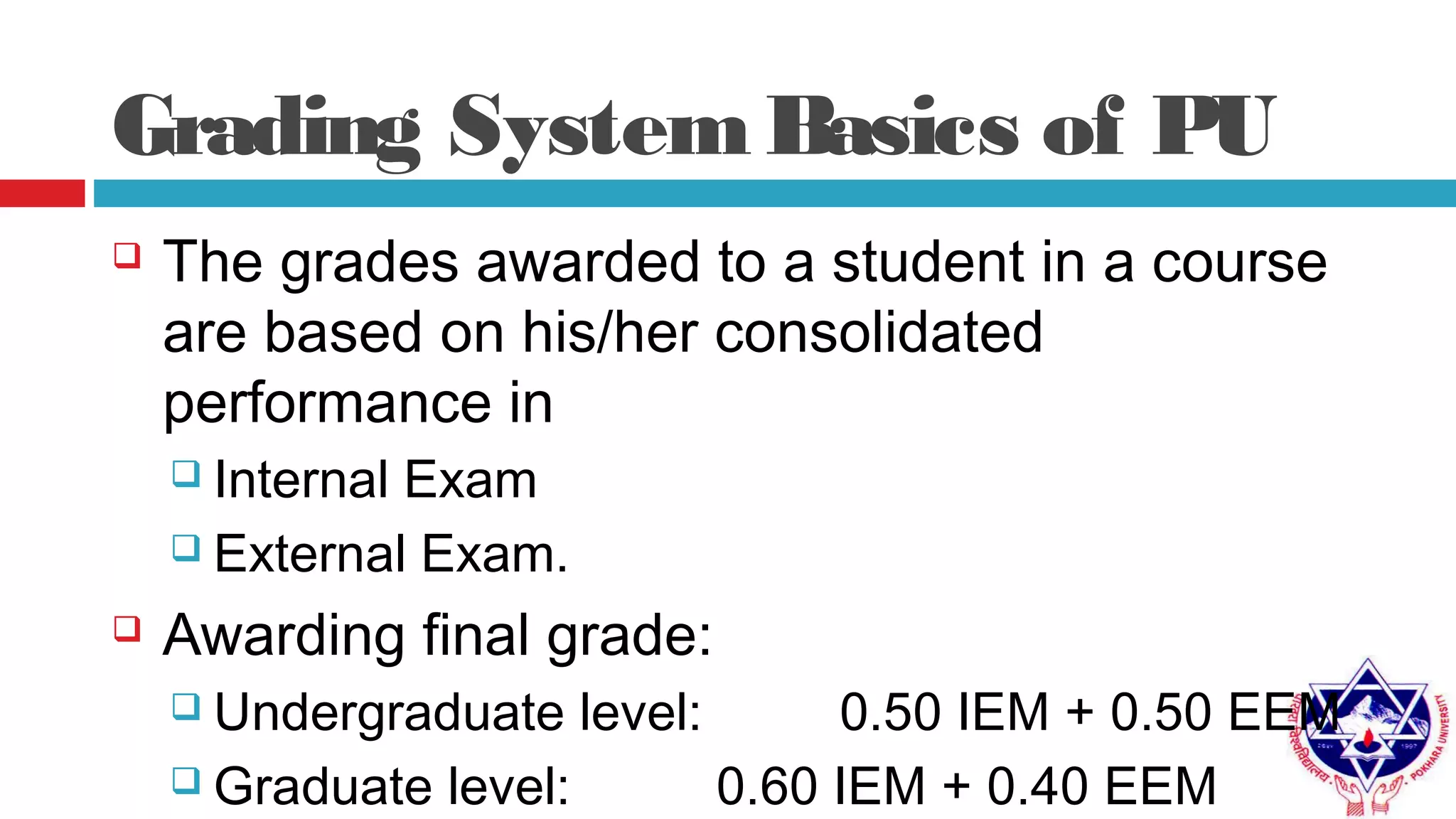
 The grades awarded to a student in a course
are based on his/her consolidated
performance in
 Internal Exam
 External Exam.
 Awarding final grade:
 Undergraduate level: 0.50 IEM + 0.50 EEM
 Graduate level: 0.60 IEM + 0.40 EEM
The Two Important Terminologies
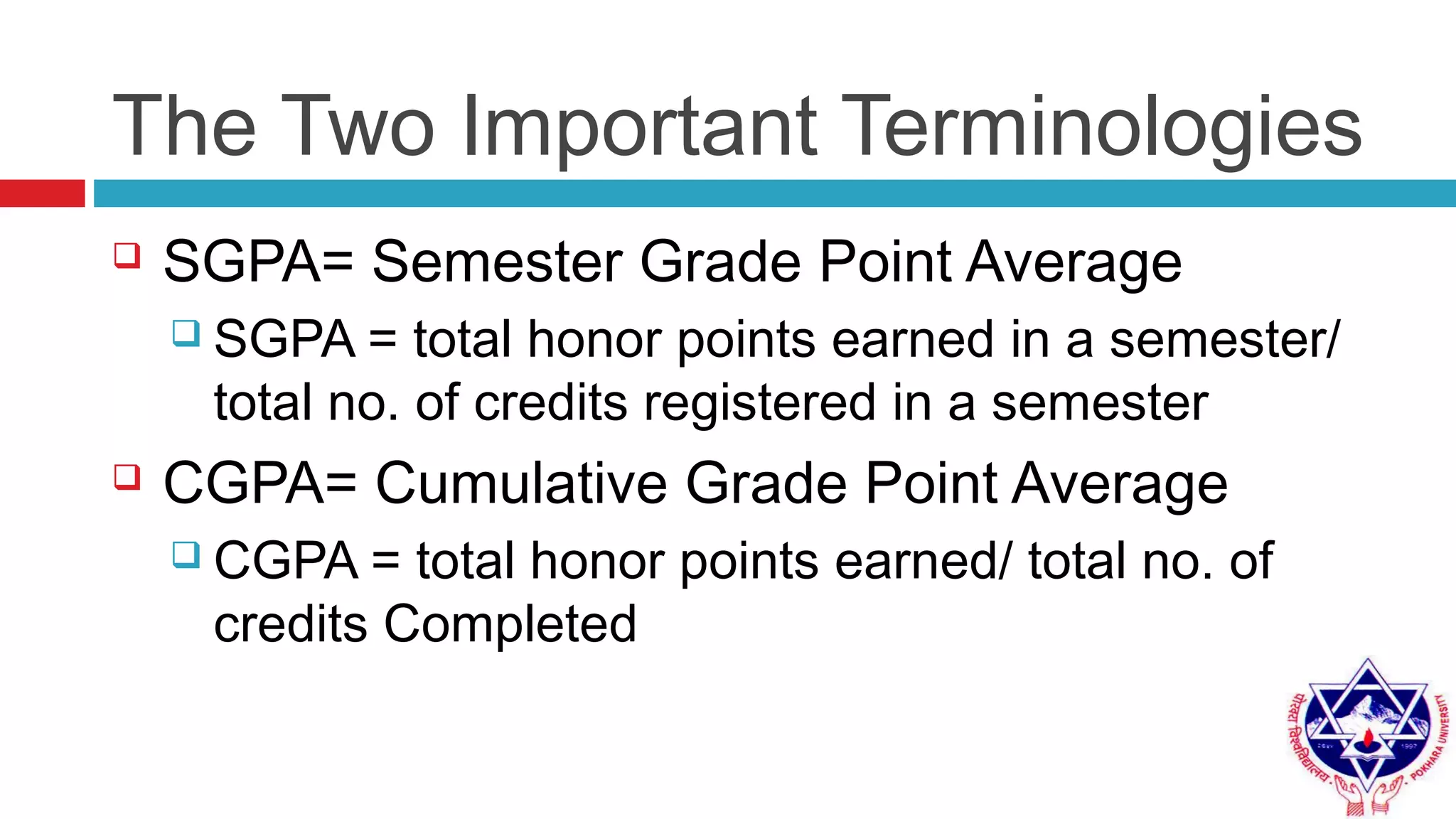
 SGPA= Semester Grade Point Average
 SGPA = total honor points earned in a semester/
total no. of credits registered in a semester
 CGPA= Cumulative Grade Point Average
 CGPA = total honor points earned/ total no. of
credits Completed
Calculating SGPA
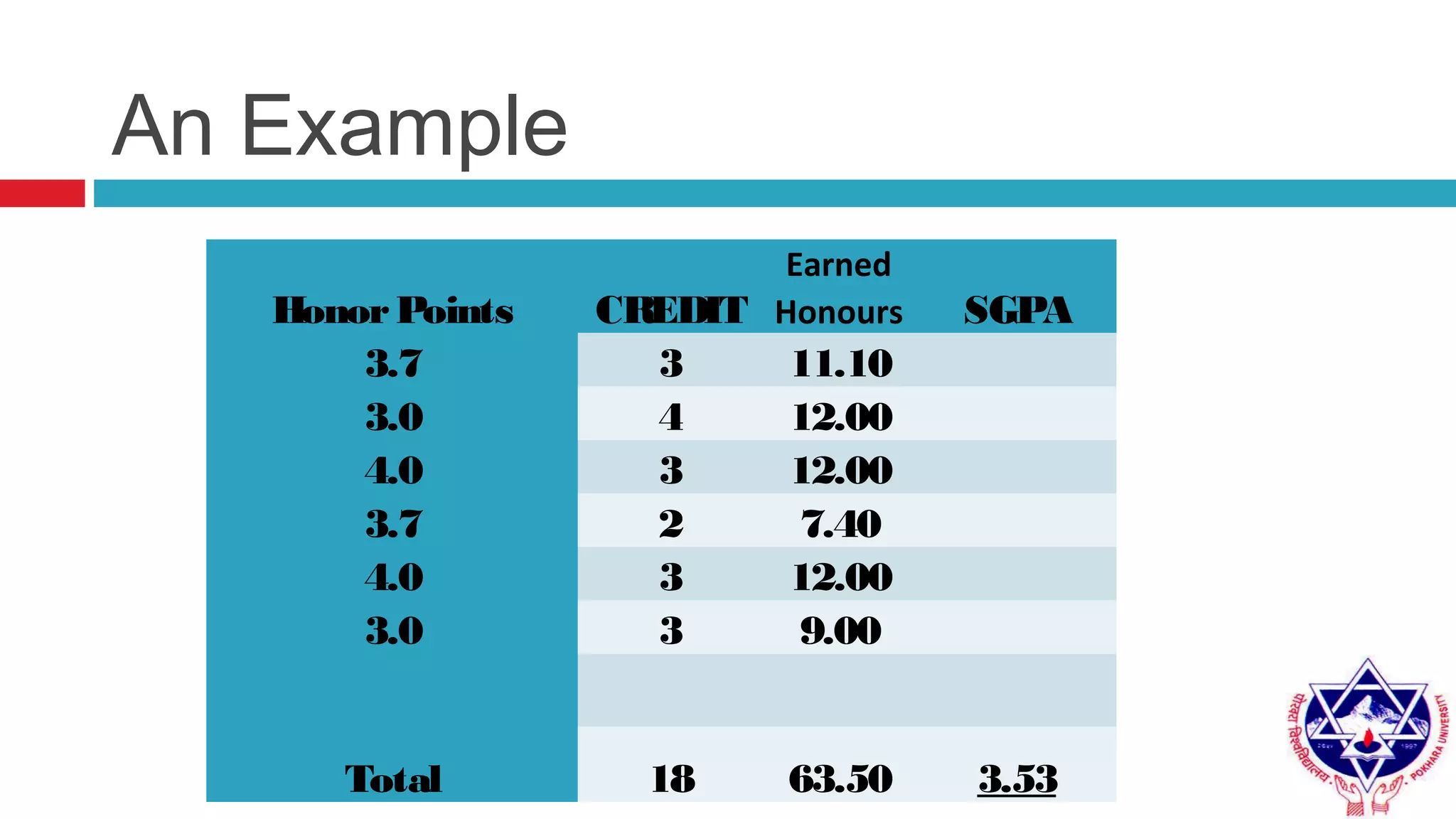
An Example
HonorPoints CREDIT
Earned
Honours SGPA
3.7 3 11.10  
3.0 4 12.00  
4.0 3 12.00  
3.7 2 7.40  
4.0 3 12.00  
3.0 3 9.00  
 
Total 18 63.50 3.53
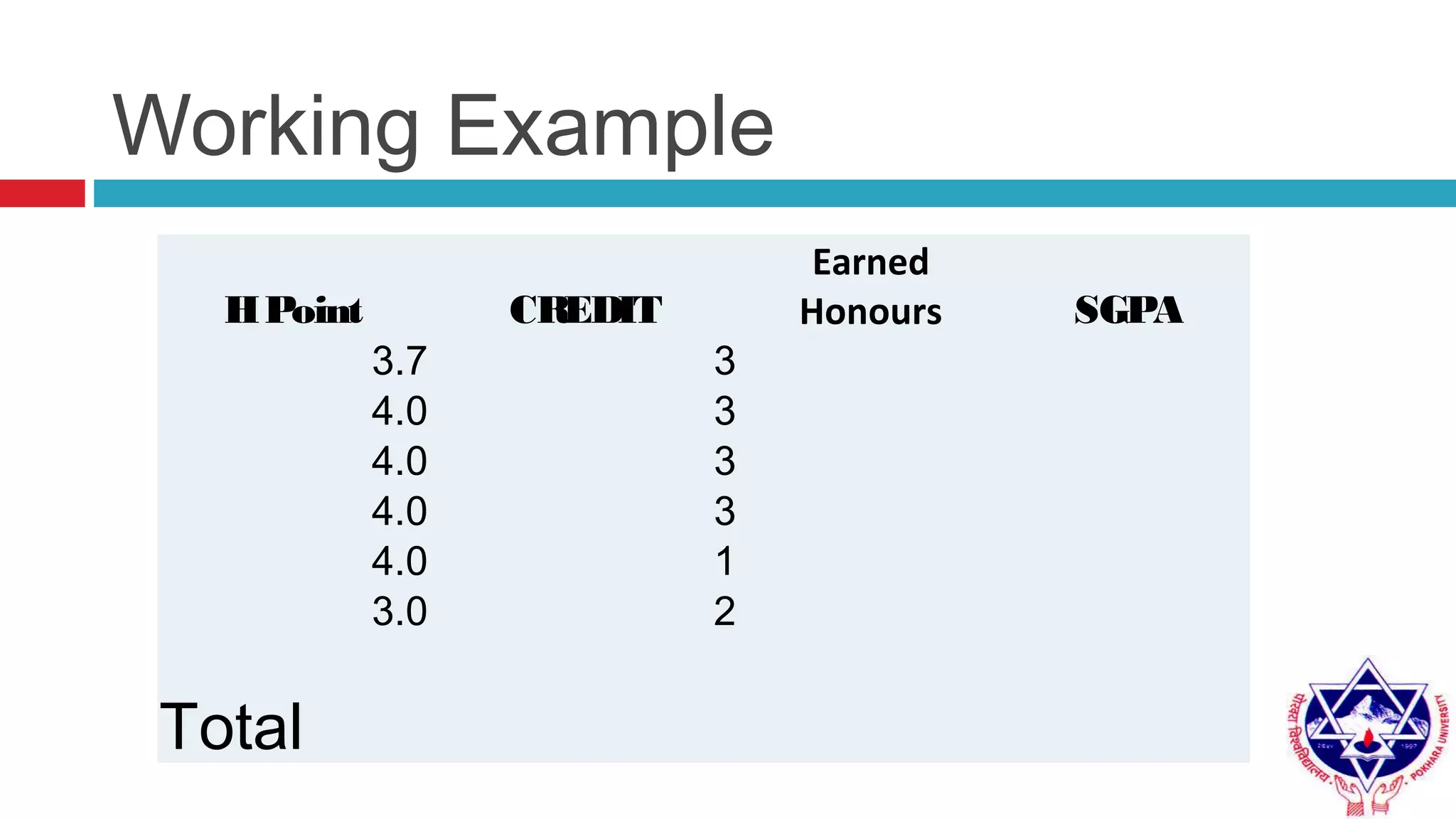
Working Example
HPoint CREDIT
Earned
Honours SGPA
3.7 3  
4.0 3  
4.0 3  
4.0 3  
4.0 1  
3.0 2  
   
Total
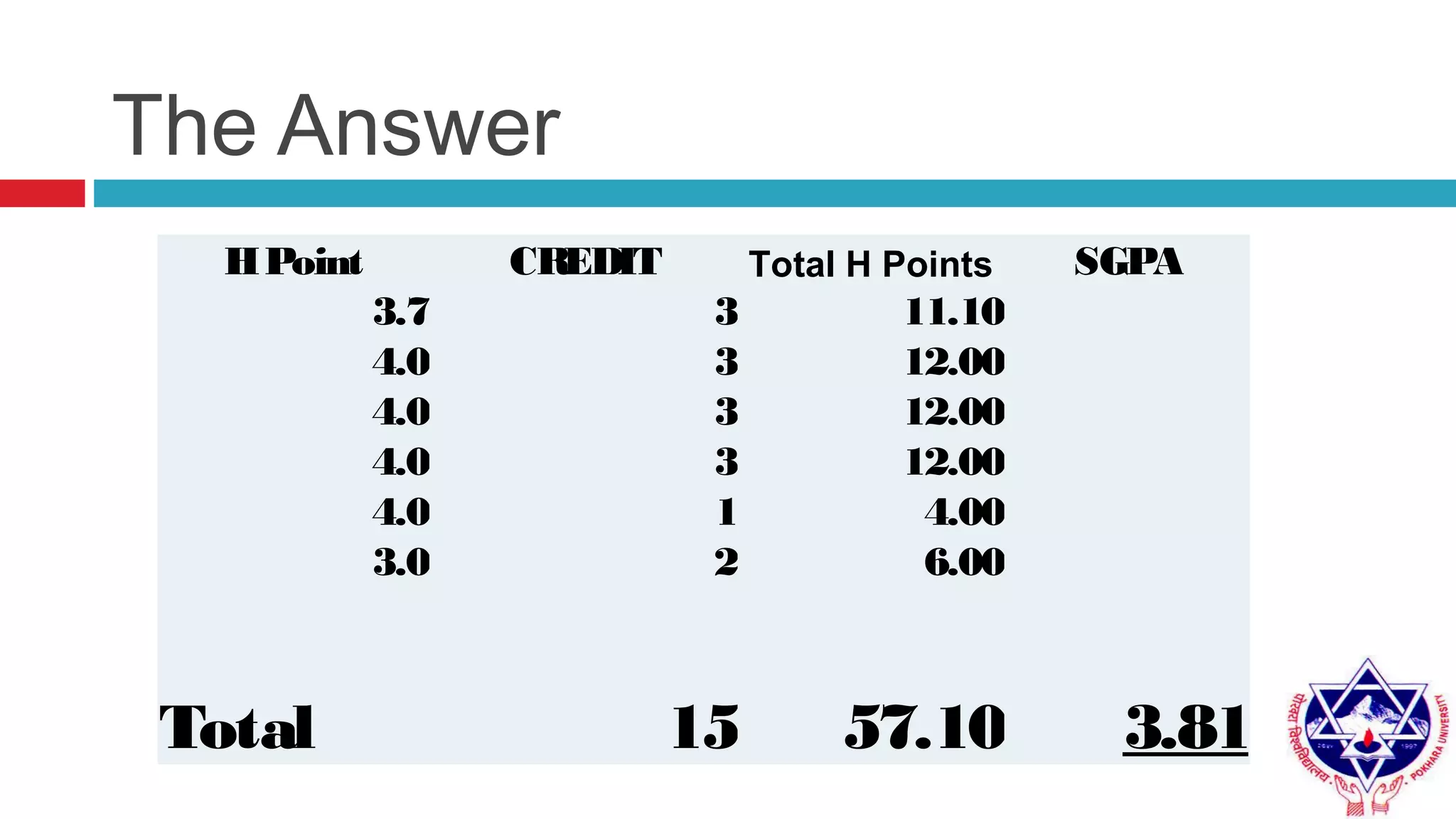
The Answer
HPoint CREDIT Total H Points SGPA
3.7 3 11.10 
4.0 3 12.00 
4.0 3 12.00 
4.0 3 12.00 
4.0 1 4.00 
3.0 2 6.00 
   
       
Total 15 57.10 3.81
The Grading
System
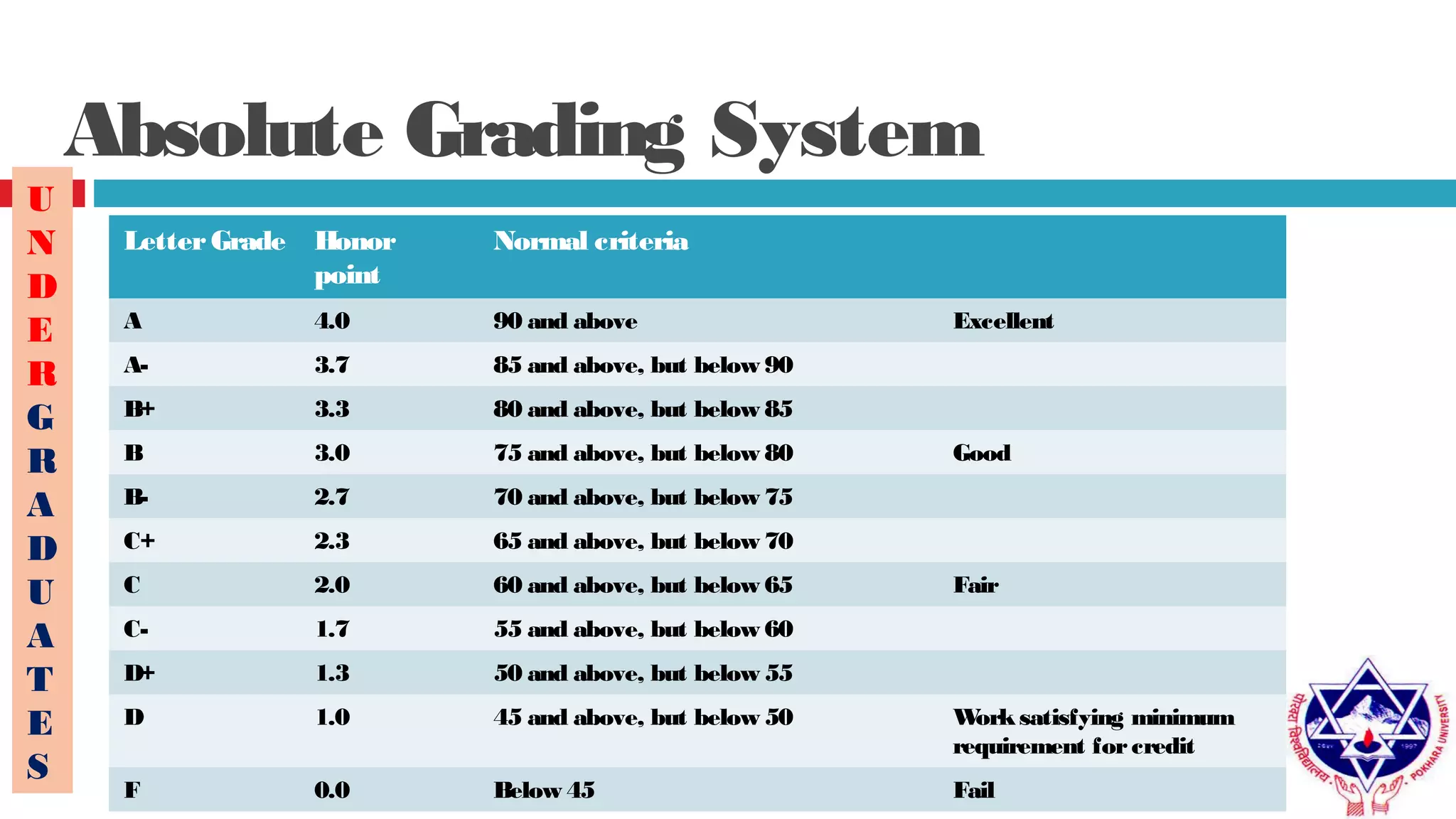
Absolute Grading System
Letter Grade Honor
point
Normal criteria
A 4.0 90 and above Excellent
A- 3.7 85 and above, but below 90
B+ 3.3 80 and above, but below 85
B 3.0 75 and above, but below 80 Good
B- 2.7 70 and above, but below 75
C+ 2.3 65 and above, but below 70
C 2.0 60 and above, but below 65 Fair
C- 1.7 55 and above, but below 60
D+ 1.3 50 and above, but below 55
D 1.0 45 and above, but below 50 Worksatisfying minimum
requirement forcredit
F 0.0 Below 45 Fail
U
N
D
E
R
G
R
A
D
U
A
T
E
S
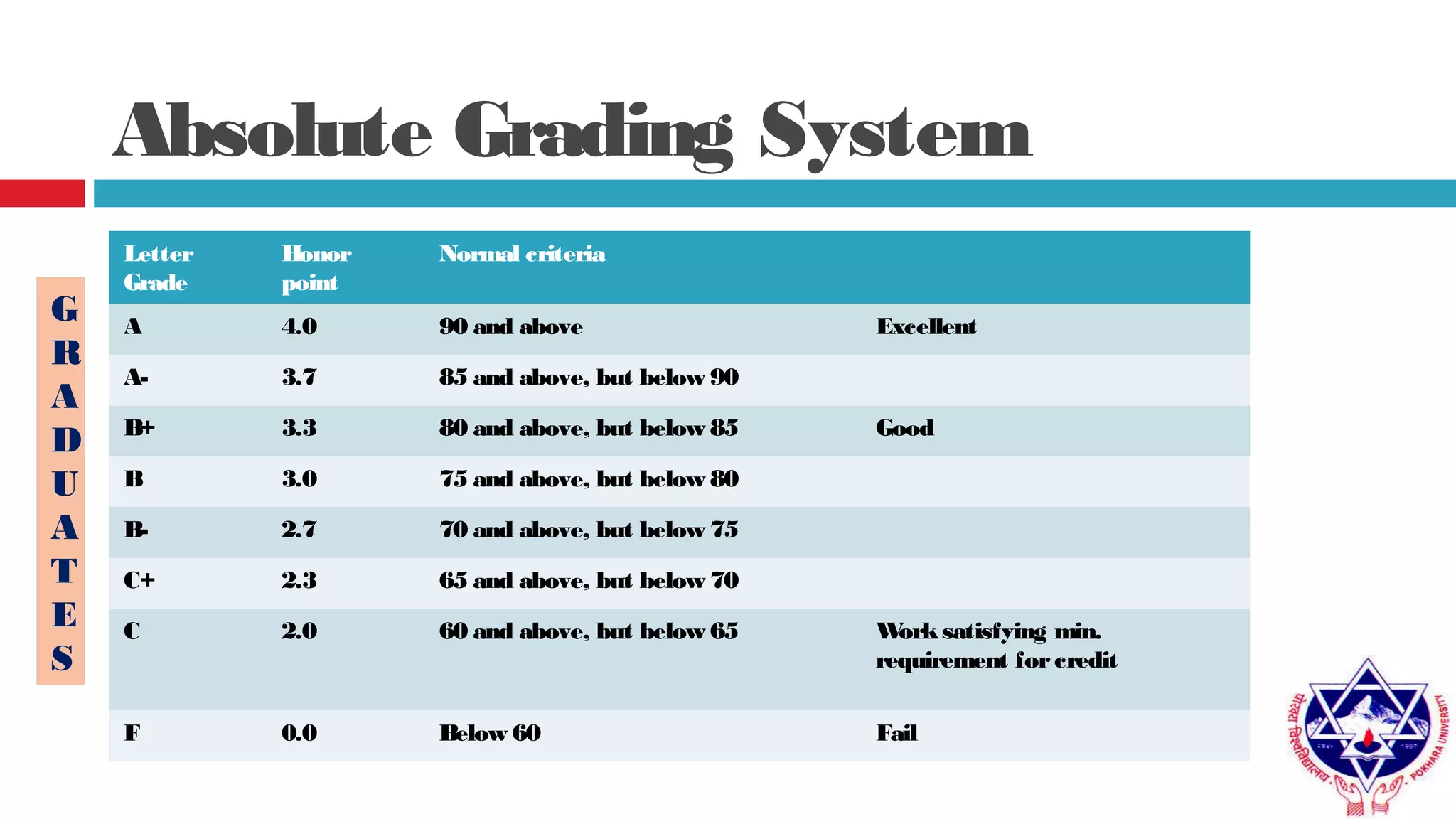
Absolute Grading System
Letter
Grade
Honor
point
Normal criteria
A 4.0 90 and above Excellent
A- 3.7 85 and above, but below 90
B+ 3.3 80 and above, but below 85 Good
B 3.0 75 and above, but below 80
B- 2.7 70 and above, but below 75
C+ 2.3 65 and above, but below 70
C 2.0 60 and above, but below 65 Worksatisfying min.
requirement forcredit
F 0.0 Below 60 Fail
G
R
A
D
U
A
T
E
S
Example
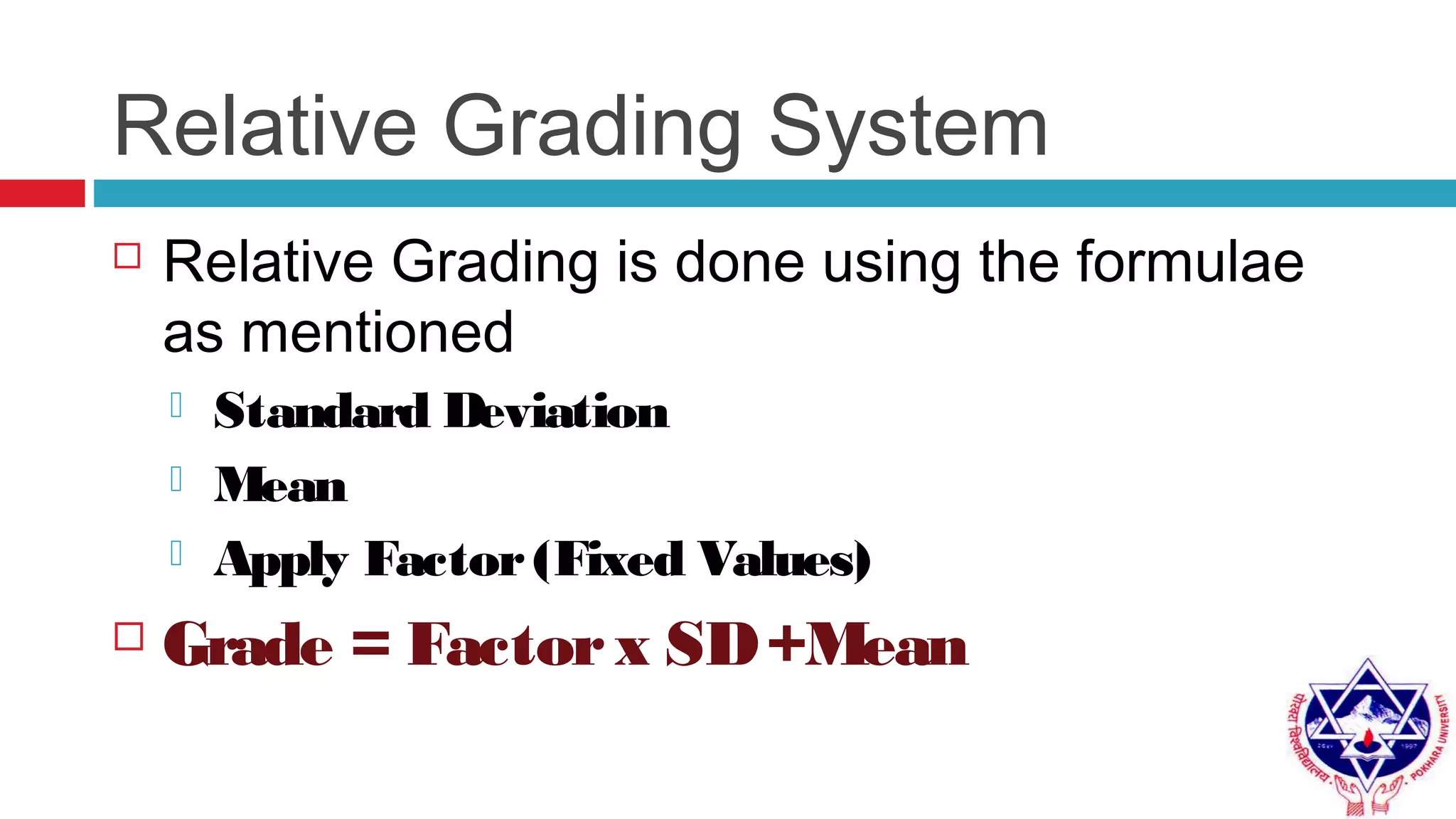
Relative Grading System
 Relative Grading is done using the formulae
as mentioned
 Standard Deviation
 Mean
 Apply Factor(Fixed Values)
 Grade = Factorx SD+Mean
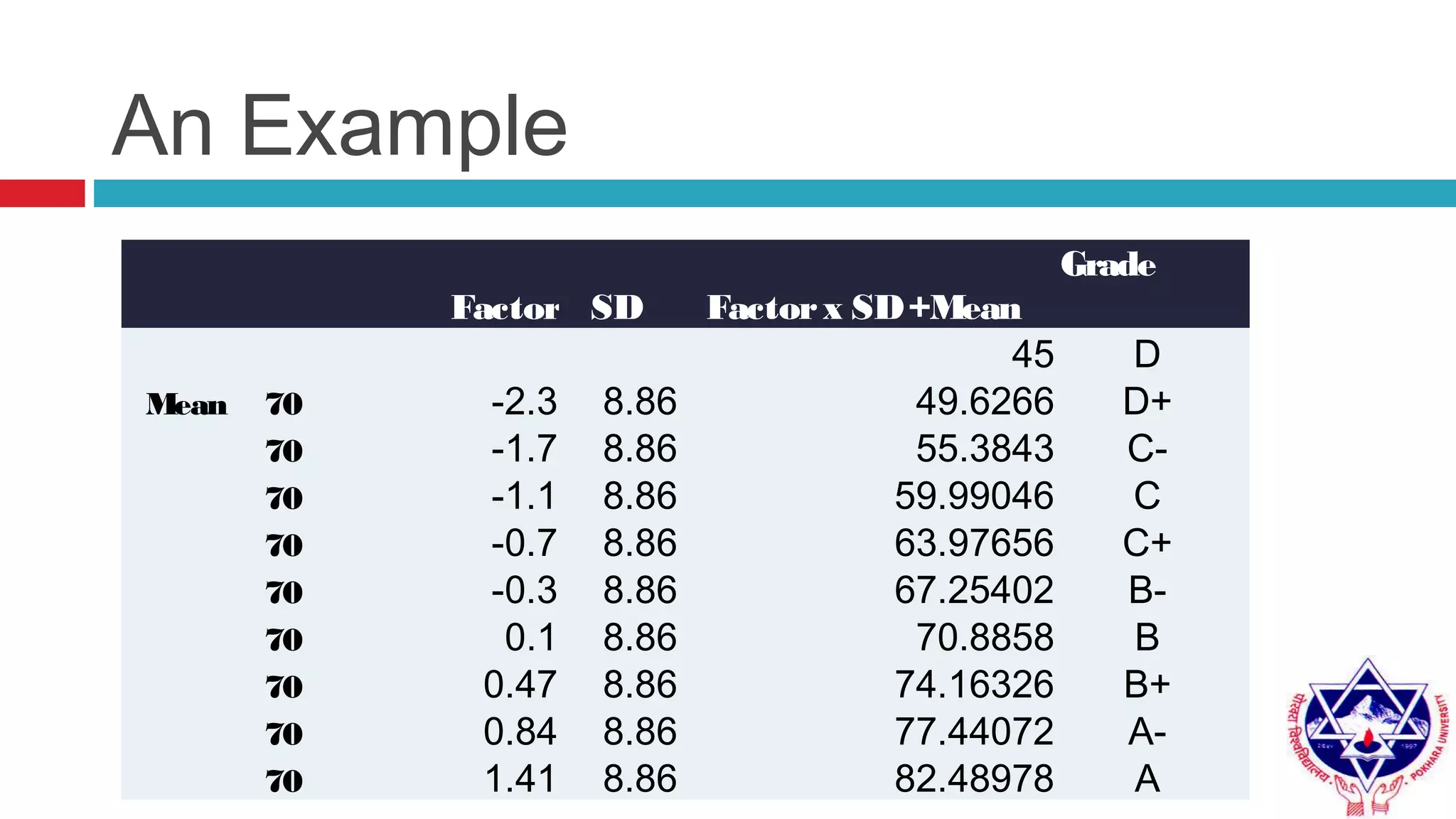
An Example
        Factor SD Factorx SD+Mean
Grade
            45 D
Mean 70     -2.3 8.86 49.6266 D+
  70     -1.7 8.86 55.3843 C-
  70     -1.1 8.86 59.99046 C
  70     -0.7 8.86 63.97656 C+
  70     -0.3 8.86 67.25402 B-
  70     0.1 8.86 70.8858 B
  70     0.47 8.86 74.16326 B+
  70     0.84 8.86 77.44072 A-
  70     1.41 8.86 82.48978 A
Special Considerations
Deviation
 Deviation is applied if the difference between
internal and external marks is
 More then 25 in undergraduate level
 More than 30 in graduate level
 Deviation is calculated for each individual college
and each individual subject.
Working Example
Deviation
Theory reduced
to 50%
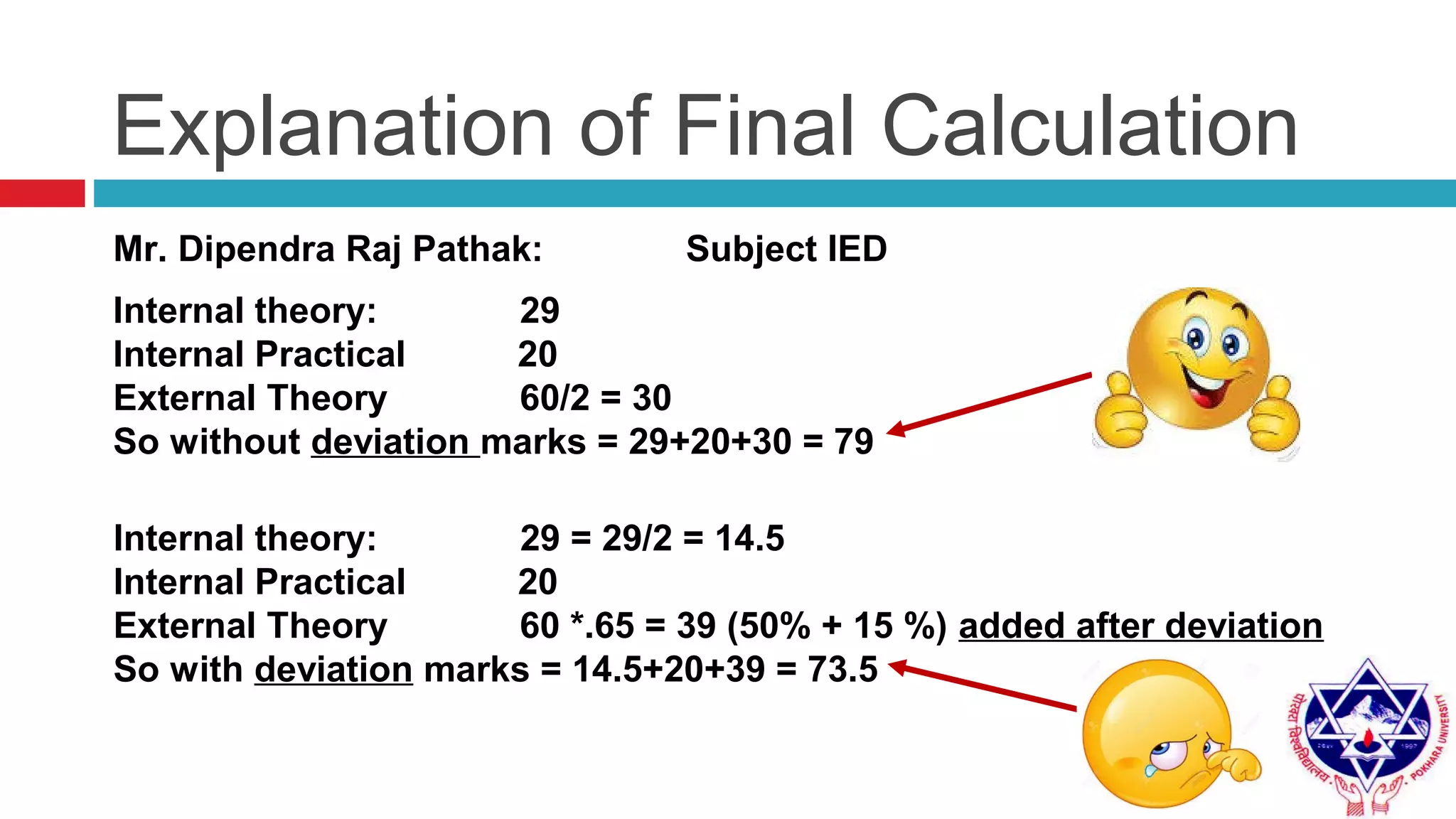
Explanation of Final Calculation
Mr. Dipendra Raj Pathak: Subject IED
Internal theory: 29
Internal Practical 20
External Theory 60/2 = 30
So without deviation marks = 29+20+30 = 79
Internal theory: 29 = 29/2 = 14.5
Internal Practical 20
External Theory 60 *.65 = 39 (50% + 15 %) added after deviation
So with deviation marks = 14.5+20+39 = 73.5
Calculation of
Values
Standard Deviation
Mean
Final
Grade
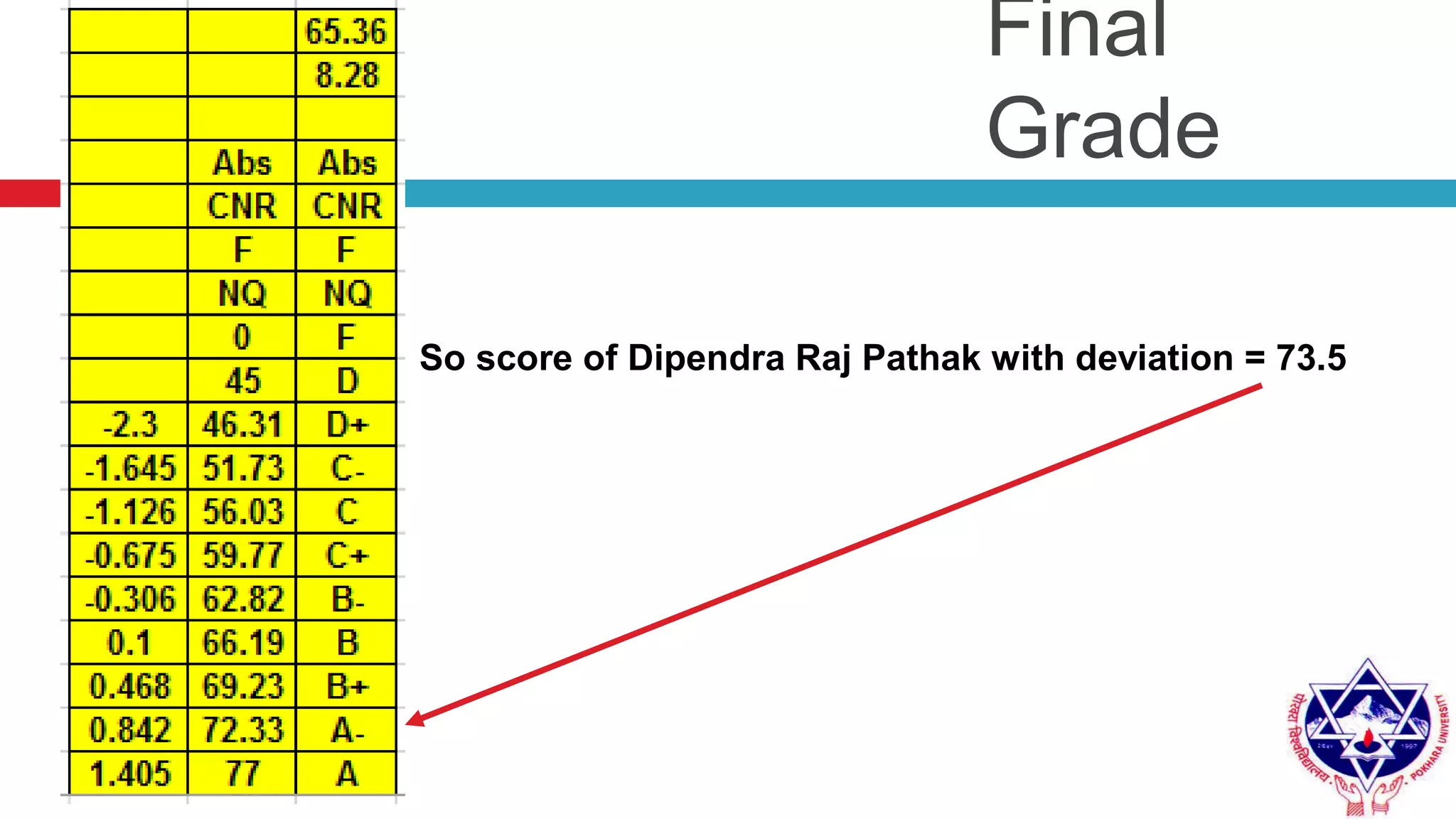
So score of Dipendra Raj Pathak with deviation = 73.5
Final
Grade
And score of Dipendra Raj Pathak without deviation = 77
Any Queries?
ThankYou!

The grading system f

  • 1.
    THE GRADING SYSTEM OFPOKHARA UNIVERSITY OFFICE OF THE CONTROLLER OF EXAMINATIONS KASKI, NEPAL Deepanjal Shrestha, Lecturer & ICT Division HeadBy
  • 2.
    Introduction  Pokhara Universityfollows three types of grading system :  Relative Grading System  Absolute Grading System  Percentile System (Only for Nursing Program)
  • 3.
    Grading SystemBasics ofPU  The grades awarded to a student in a course are based on his/her consolidated performance in  Internal Exam  External Exam.  Awarding final grade:  Undergraduate level: 0.50 IEM + 0.50 EEM  Graduate level: 0.60 IEM + 0.40 EEM
  • 4.
    The Two ImportantTerminologies  SGPA= Semester Grade Point Average  SGPA = total honor points earned in a semester/ total no. of credits registered in a semester  CGPA= Cumulative Grade Point Average  CGPA = total honor points earned/ total no. of credits Completed
  • 5.
  • 6.
    An Example HonorPoints CREDIT Earned HonoursSGPA 3.7 3 11.10   3.0 4 12.00   4.0 3 12.00   3.7 2 7.40   4.0 3 12.00   3.0 3 9.00     Total 18 63.50 3.53
  • 7.
    Working Example HPoint CREDIT Earned HonoursSGPA 3.7 3   4.0 3   4.0 3   4.0 3   4.0 1   3.0 2       Total
  • 8.
    The Answer HPoint CREDITTotal H Points SGPA 3.7 3 11.10  4.0 3 12.00  4.0 3 12.00  4.0 3 12.00  4.0 1 4.00  3.0 2 6.00              Total 15 57.10 3.81
  • 9.
  • 10.
    Absolute Grading System LetterGrade Honor point Normal criteria A 4.0 90 and above Excellent A- 3.7 85 and above, but below 90 B+ 3.3 80 and above, but below 85 B 3.0 75 and above, but below 80 Good B- 2.7 70 and above, but below 75 C+ 2.3 65 and above, but below 70 C 2.0 60 and above, but below 65 Fair C- 1.7 55 and above, but below 60 D+ 1.3 50 and above, but below 55 D 1.0 45 and above, but below 50 Worksatisfying minimum requirement forcredit F 0.0 Below 45 Fail U N D E R G R A D U A T E S
  • 11.
    Absolute Grading System Letter Grade Honor point Normalcriteria A 4.0 90 and above Excellent A- 3.7 85 and above, but below 90 B+ 3.3 80 and above, but below 85 Good B 3.0 75 and above, but below 80 B- 2.7 70 and above, but below 75 C+ 2.3 65 and above, but below 70 C 2.0 60 and above, but below 65 Worksatisfying min. requirement forcredit F 0.0 Below 60 Fail G R A D U A T E S
  • 12.
  • 13.
    Relative Grading System Relative Grading is done using the formulae as mentioned  Standard Deviation  Mean  Apply Factor(Fixed Values)  Grade = Factorx SD+Mean
  • 14.
    An Example        Factor SD Factorx SD+Mean Grade             45 D Mean 70     -2.3 8.86 49.6266 D+   70     -1.7 8.86 55.3843 C-   70     -1.1 8.86 59.99046 C   70     -0.7 8.86 63.97656 C+   70     -0.3 8.86 67.25402 B-   70     0.1 8.86 70.8858 B   70     0.47 8.86 74.16326 B+   70     0.84 8.86 77.44072 A-   70     1.41 8.86 82.48978 A
  • 15.
  • 16.
    Deviation  Deviation isapplied if the difference between internal and external marks is  More then 25 in undergraduate level  More than 30 in graduate level  Deviation is calculated for each individual college and each individual subject.
  • 17.
  • 18.
    Explanation of FinalCalculation Mr. Dipendra Raj Pathak: Subject IED Internal theory: 29 Internal Practical 20 External Theory 60/2 = 30 So without deviation marks = 29+20+30 = 79 Internal theory: 29 = 29/2 = 14.5 Internal Practical 20 External Theory 60 *.65 = 39 (50% + 15 %) added after deviation So with deviation marks = 14.5+20+39 = 73.5
  • 19.
  • 20.
    Final Grade So score ofDipendra Raj Pathak with deviation = 73.5
  • 21.
    Final Grade And score ofDipendra Raj Pathak without deviation = 77
  • 22.
  • 23.