



Credit and Semester system with  Grading. BACHELOR OF EDCUATION DEGREE  PROGRAMME
Preliminaries The four major aspects of the newly  implemented B.Ed. degree programme are  Semesterisation Credit System Continuous Assessment Grading
Definitions Programme  means a one year course of study and examinations spread over two semesters, the successful completion of which would lead to the award of a degree in education. Course  means a segment of subject matter to be covered in a semester
Definitions Common course  means a course that comes under the category of courses which are compulsory – as specified for all students undergoing the B.Ed. Programme. Core course  means a course in the subject of specialization in the B.Ed. degree programme. Complementary Elective   course  means a course which would enrich the B.Ed. programme.
Definitions Semester System  means, the B.Ed. Degree will have two semesters,  with a semester break of atleast one month in between two semesters.  There shall be 90 working days in each semester spread over 18 five day working weeks.  In the Second Semester 30 working days for Teaching Practice.  The time table may be set according to the day order system to provide optimal distribution of contact hours for all courses.
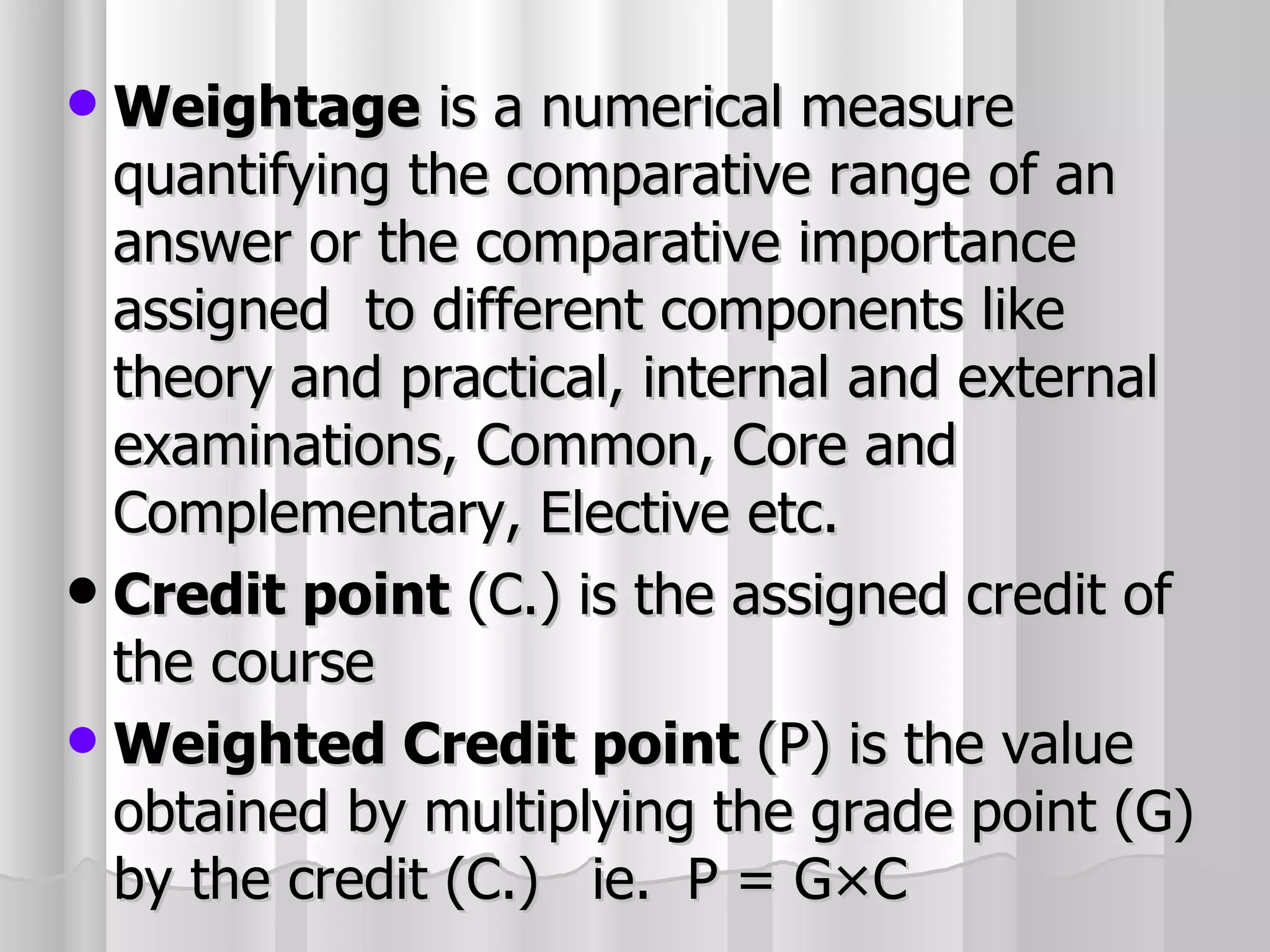
Credit  is a unit of academic input measured in terms of the weekly contact hours assigned to a course in a semester Grade  means a letter symbol (e.g. A.B.C. etc) which indicates the broad level of performance of  a student in an answer/course/semester/programme. Grade point  (G) is an integer indicating the numerical equivalent of the letter grade
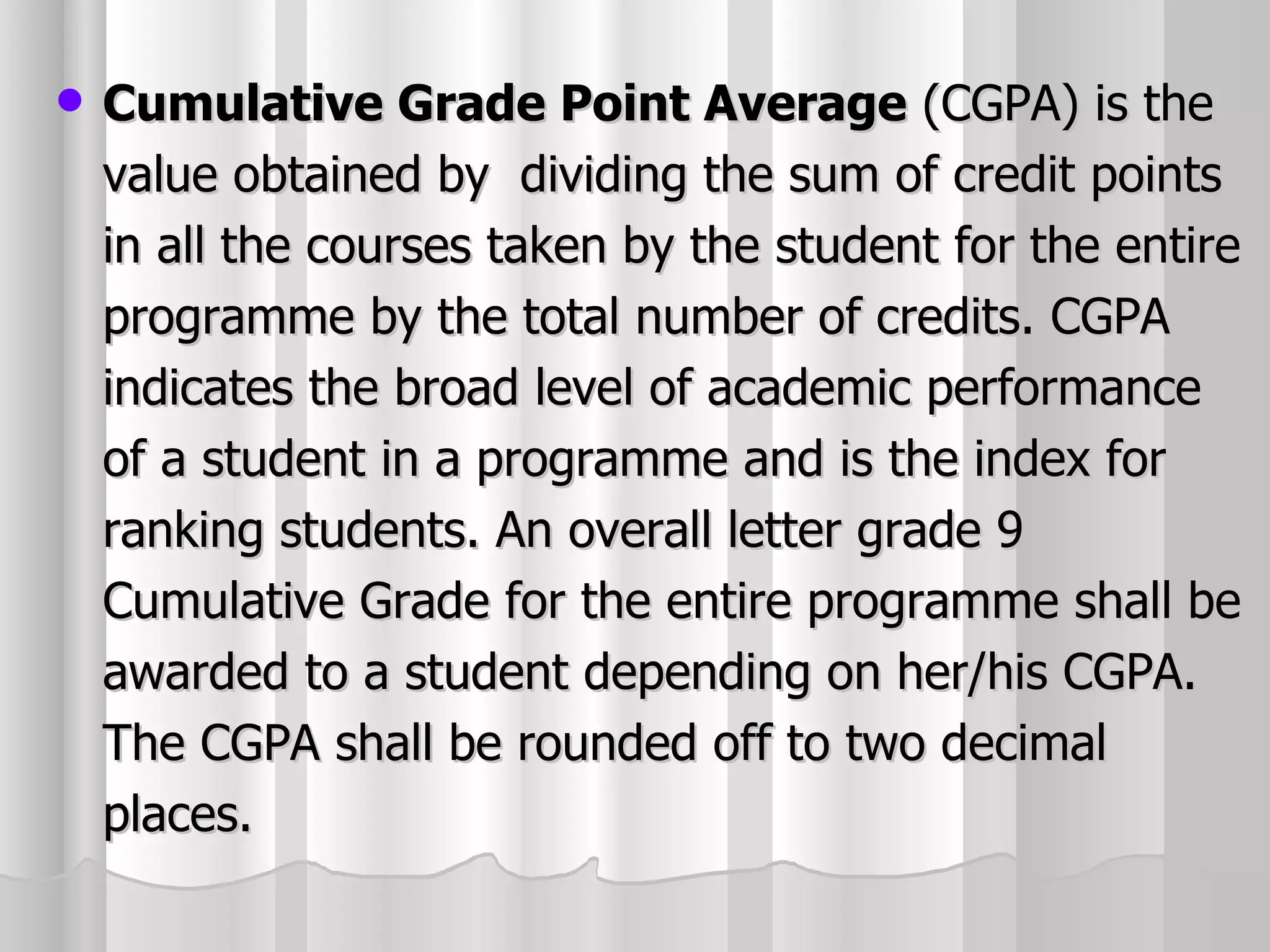
Weightage  is a numerical measure quantifying the comparative range of an answer or the comparative importance assigned  to different components like theory and practical, internal and external examinations, Common, Core and Complementary, Elective etc. Credit point  (C.) is the assigned credit of the course Weighted Credit point  (P) is the value obtained by multiplying the grade point (G) by the credit (C.)  ie.  P = G×C
Cumulative Grade Point Average  (CGPA) is the value obtained by  dividing the sum of credit points in all the courses taken by the student for the entire programme by the total number of credits. CGPA indicates the broad level of academic performance of a student in a programme and is the index for ranking students. An overall letter grade 9 Cumulative Grade for the entire programme shall be awarded to a student depending on her/his CGPA. The CGPA shall be rounded off to two decimal places.
Semester Grade Point  Average (SGPA) is the value obtained by dividing the sum of the weighted credit points (p) obtained by a student in various courses taken in a semester by the total number of credits taken by him/her in that semester. The grade point shall be rounded off to two decimal places.
Grade Point Average  (GPA) is the value obtained by dividing the sum of the weighted grade points obtained by a student in an examination of a course in a semester by the total weightages taken in that examination. The grade point average shall be rounded off to two decimal places. Weighted Grade Point  is the sum of grade point multiplied by weightage.
Duration The duration of B.Ed. programme shall be 2 semesters. The duration of each semester shall be 90 days spread over 18 working weeks .  First semester  is from  November to March  and  Second semester  is from  May to September. The Teaching  practice which is a compulsory part of B. Ed. programme is scheduled in the second semester, for six weeks in a secondary/higher secondary school.
A student may be permitted to complete the programme, on valid reasons, within a period of 6 semesters from the date of commencement of the first semester of the programme. Medium of Instruction and Examination  :  The medium of instruction and examination of the course shall be English. However, candidates who desire to write the examination in Malayalam may be permitted to do so.
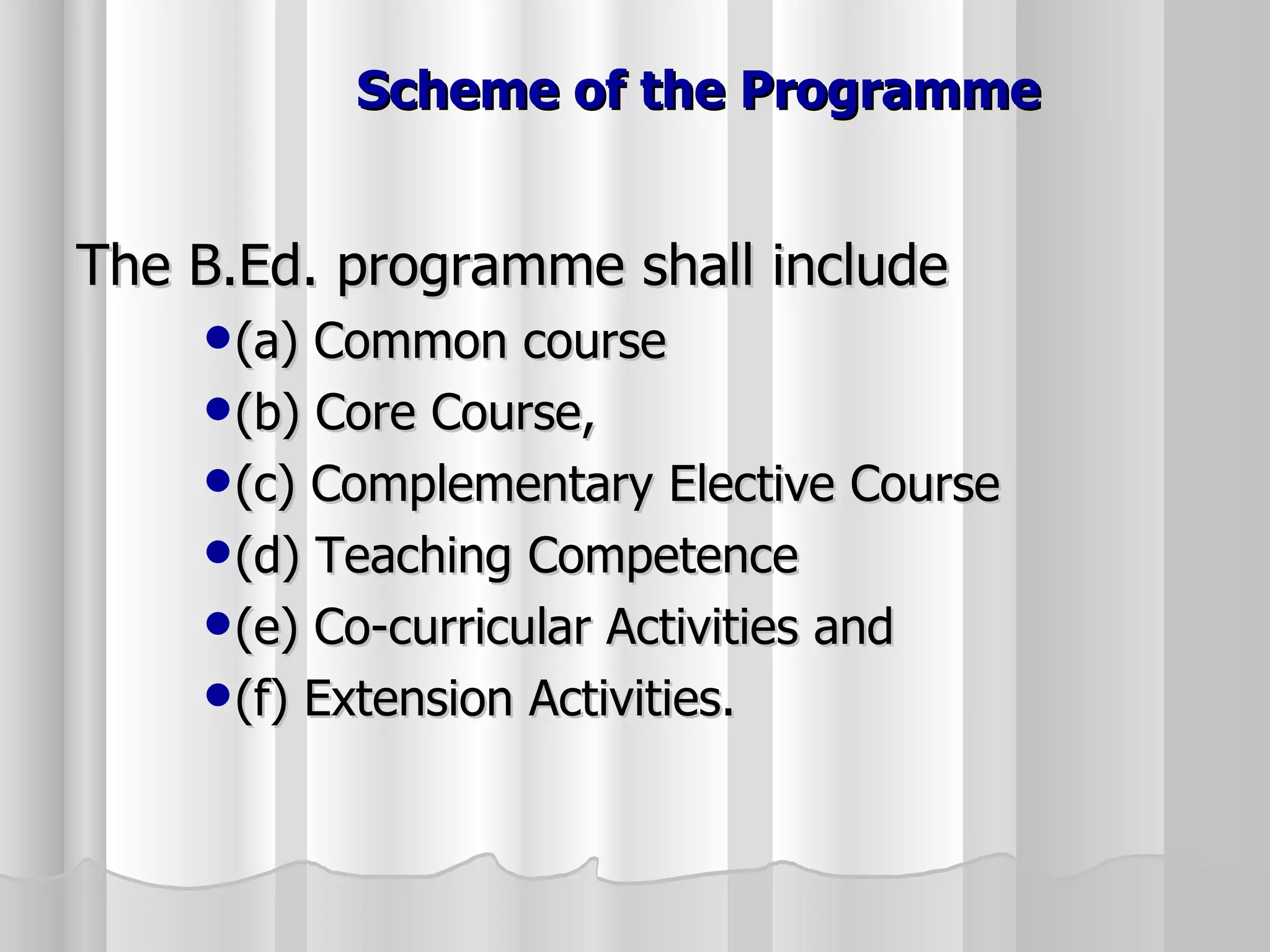
Scheme of the Programme The B.Ed. programme shall include  (a) Common course  (b) Core Course,  (c) Complementary Elective Course  (d) Teaching Competence  (e) Co-curricular Activities and  (f) Extension Activities.
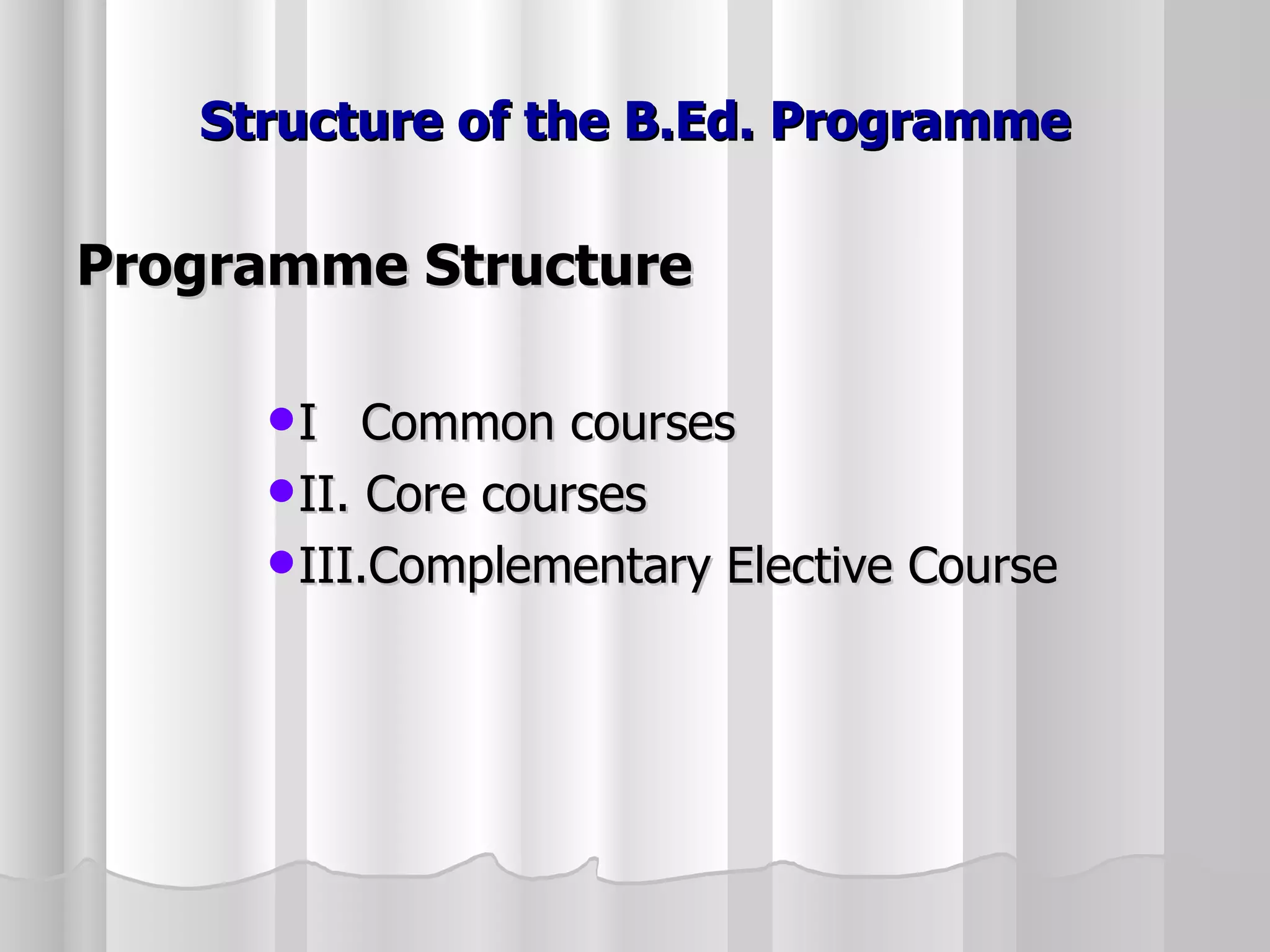
Structure of the B.Ed. Programme Programme Structure I   Common courses II. Core courses III.Complementary Elective Course
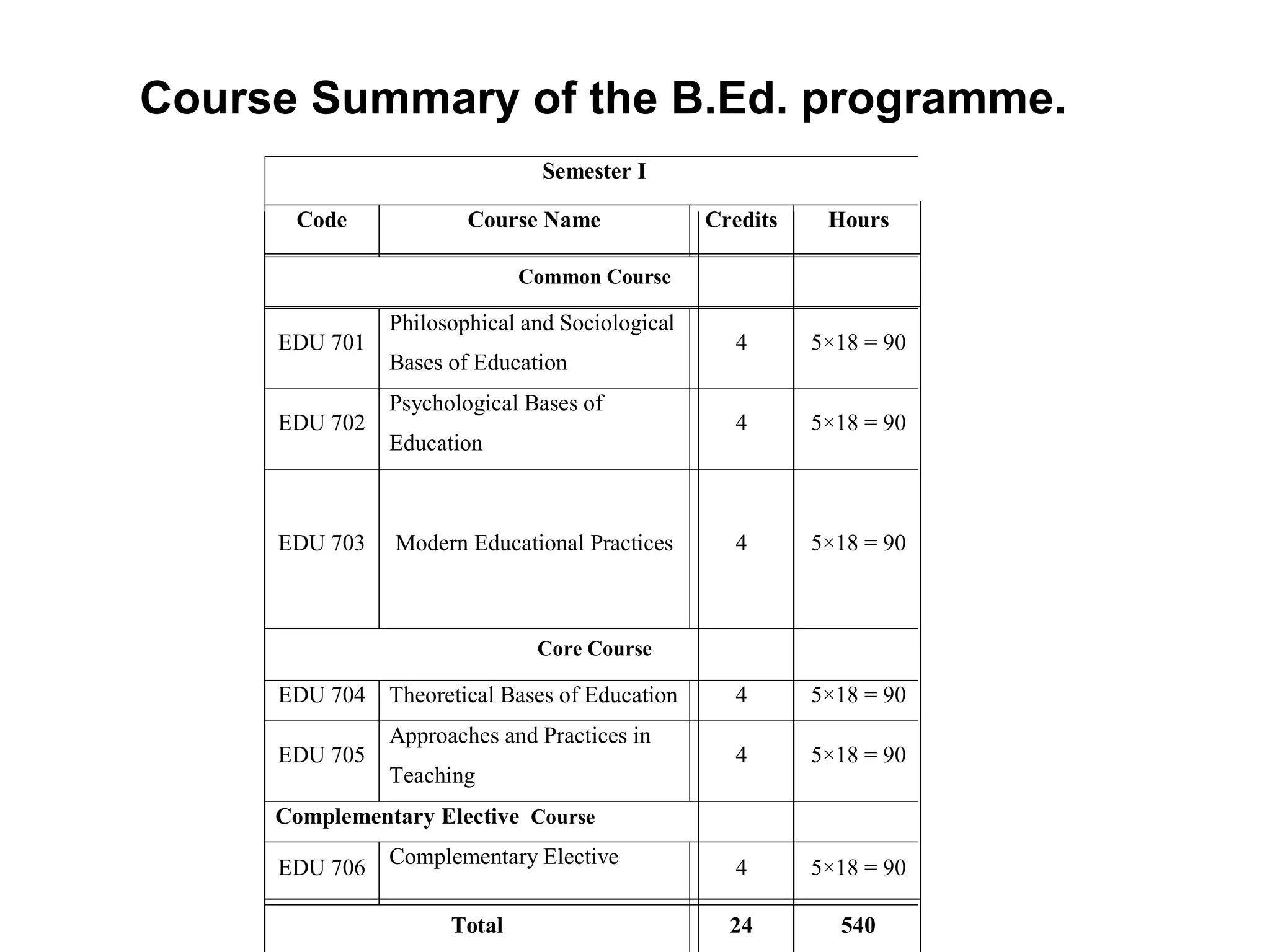
Course Summary of the B.Ed. programme.
 
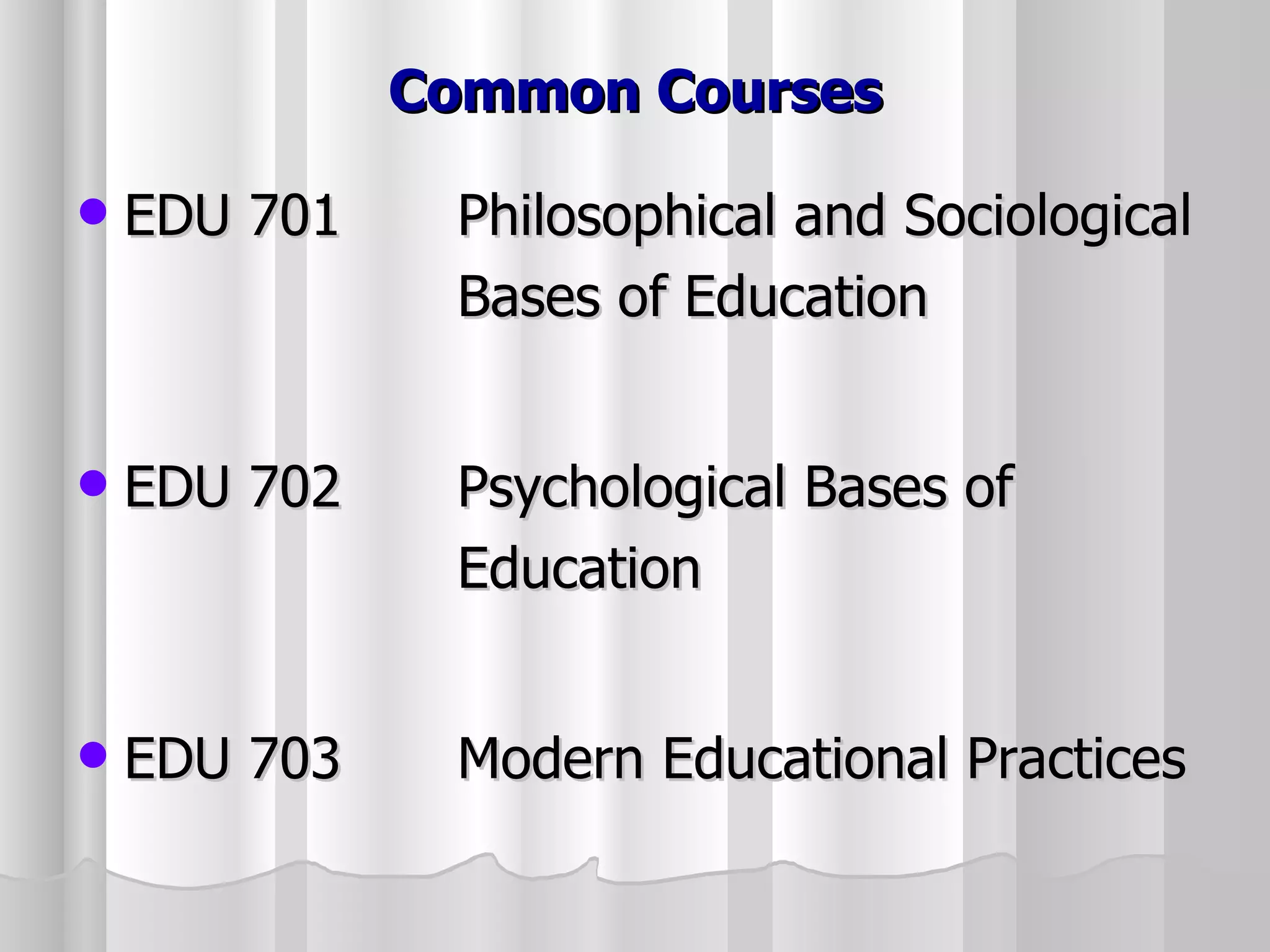
Common Courses EDU 701 Philosophical and Sociological  Bases of Education EDU 702 Psychological Bases of  Education EDU 703 Modern Educational Practices
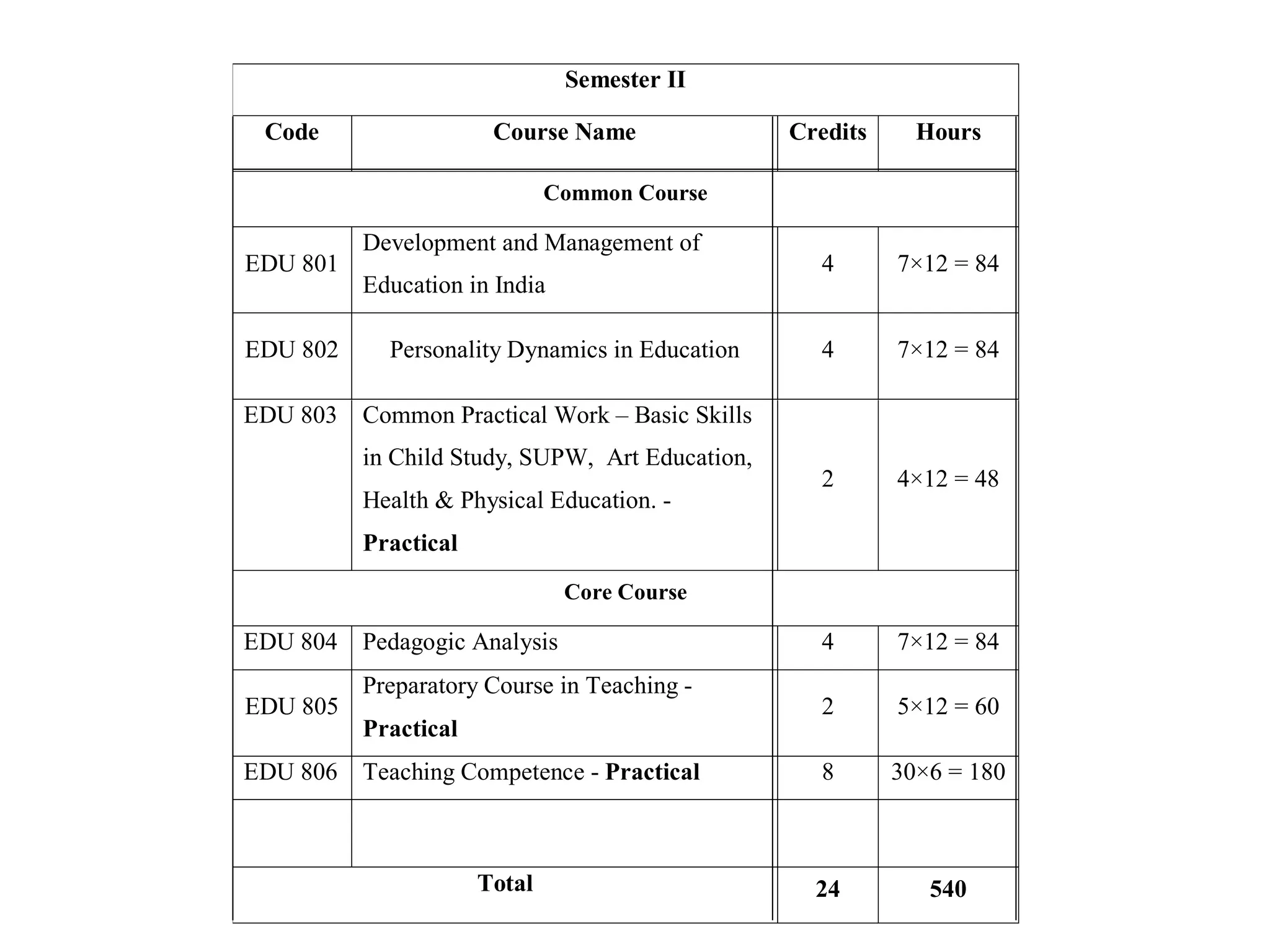
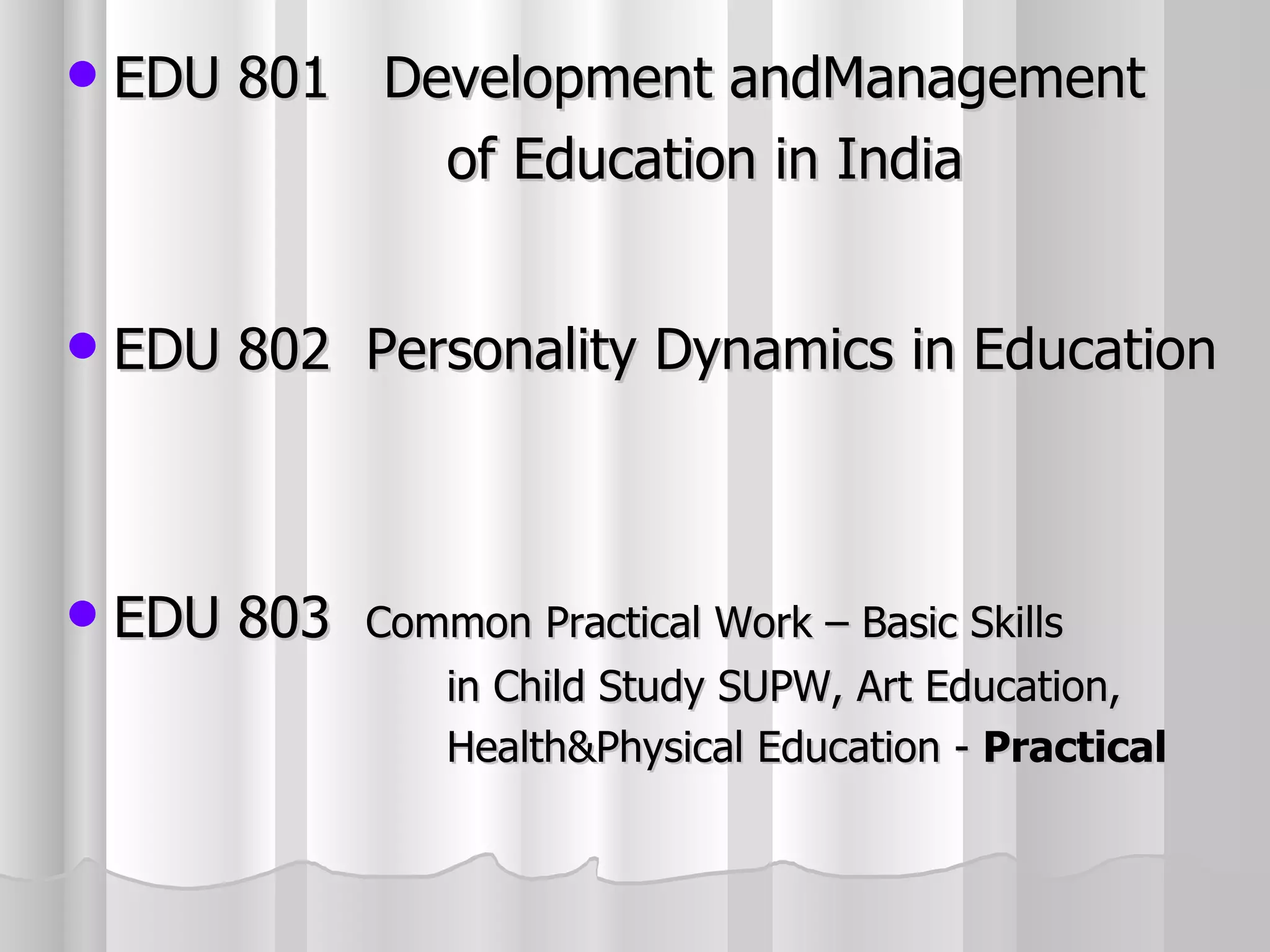
EDU 801  Development andManagement  of Education in India EDU 802  Personality Dynamics in Education EDU 803  Common Practical Work – Basic Skills  in Child Study SUPW, Art Education,  Health&Physical Education -  Practical
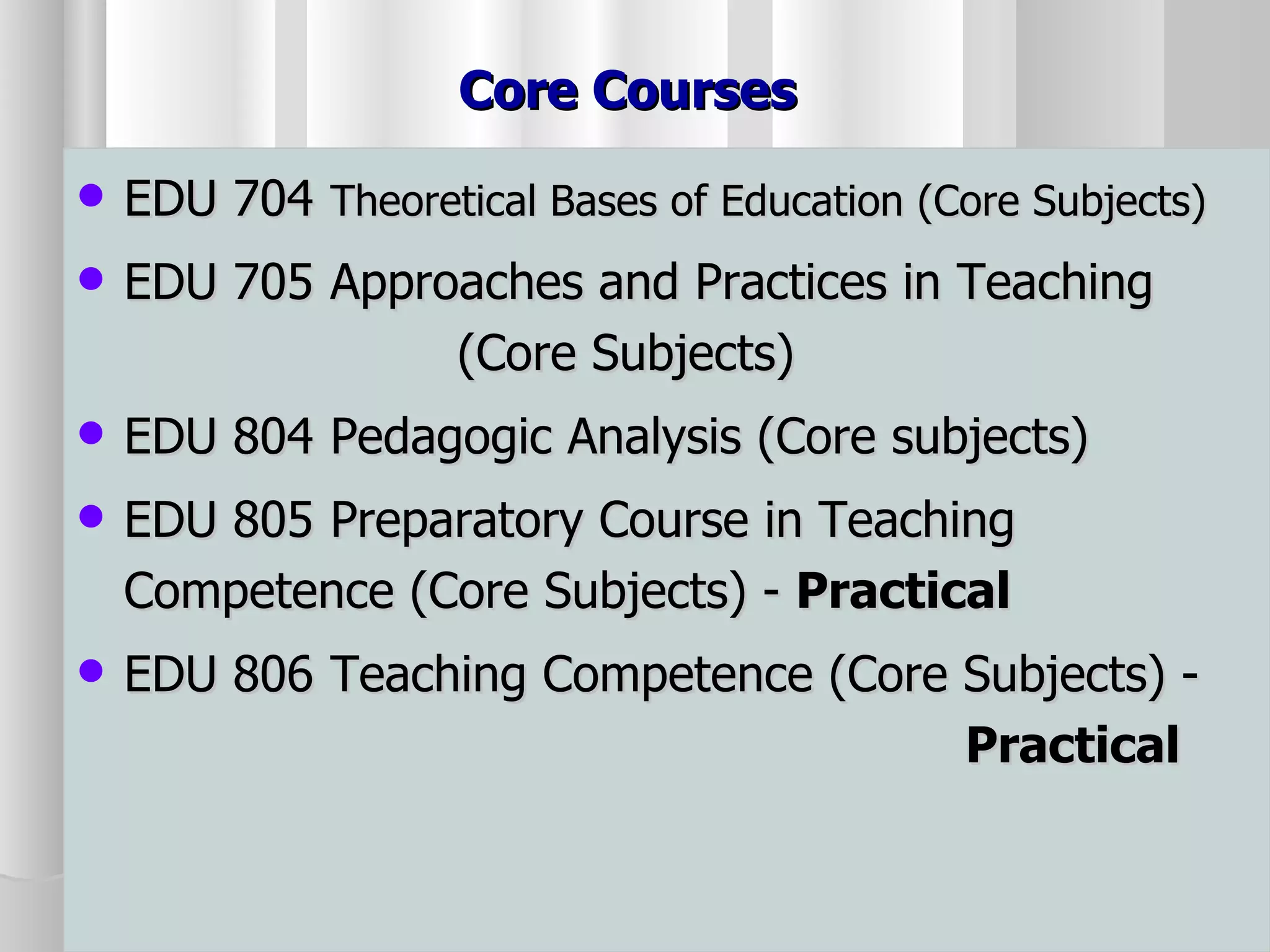
Core Courses  EDU 704 Theoretical Bases of Education (Core Subjects) EDU 705 Approaches and Practices in Teaching  (Core Subjects) EDU 804 Pedagogic Analysis (Core subjects) EDU 805 Preparatory Course in Teaching  Competence (Core Subjects) -  Practical EDU 806 Teaching Competence (Core Subjects) -  Practical
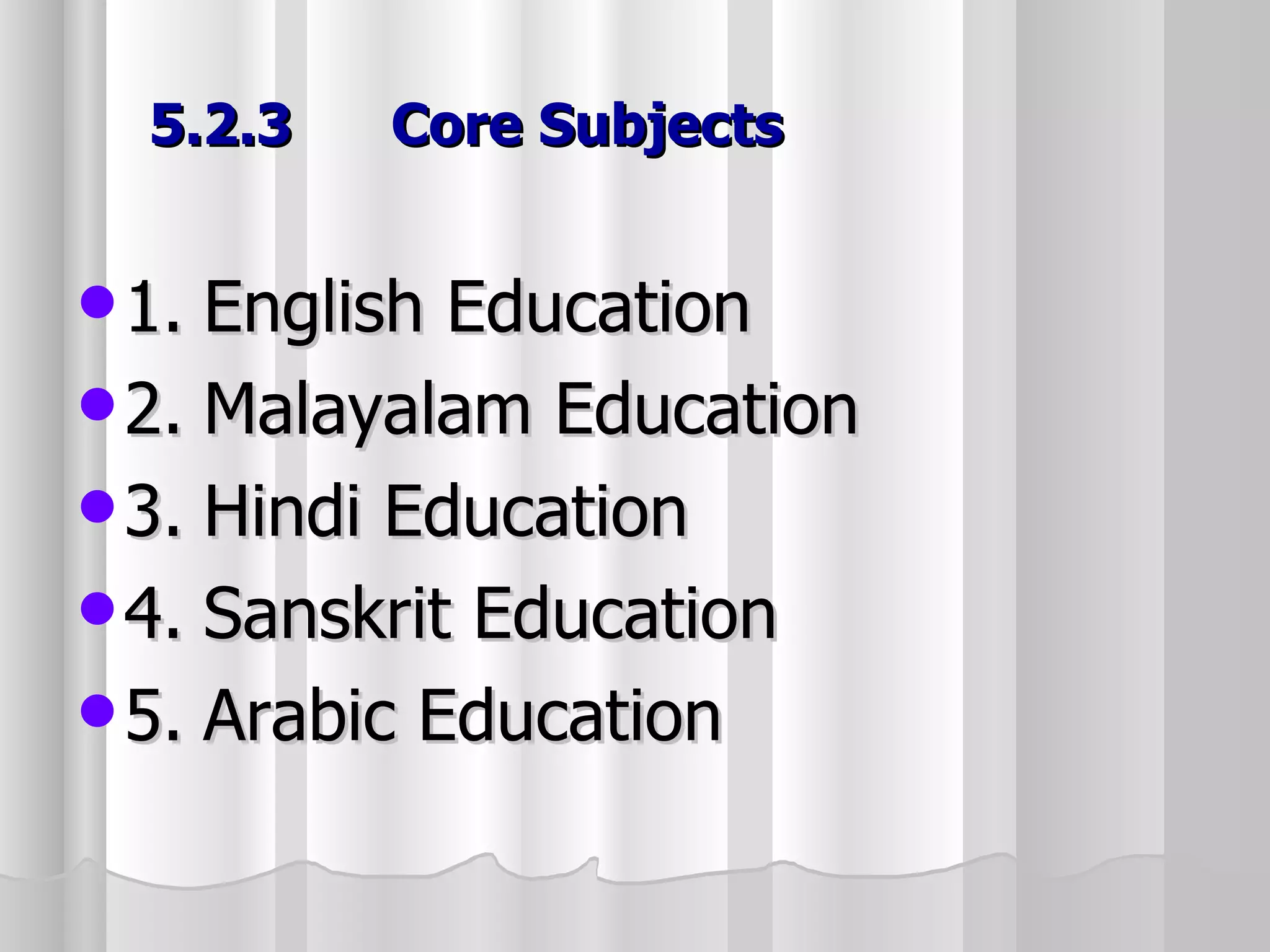
5.2.3  Core Subjects 1. English Education 2. Malayalam Education 3. Hindi Education 4. Sanskrit Education 5. Arabic Education
6. Mathematics Education 7. Physical Science Education 8. Natural Science Education 9. Social Science Education 10. Commerce Education 11. Information Technology Education
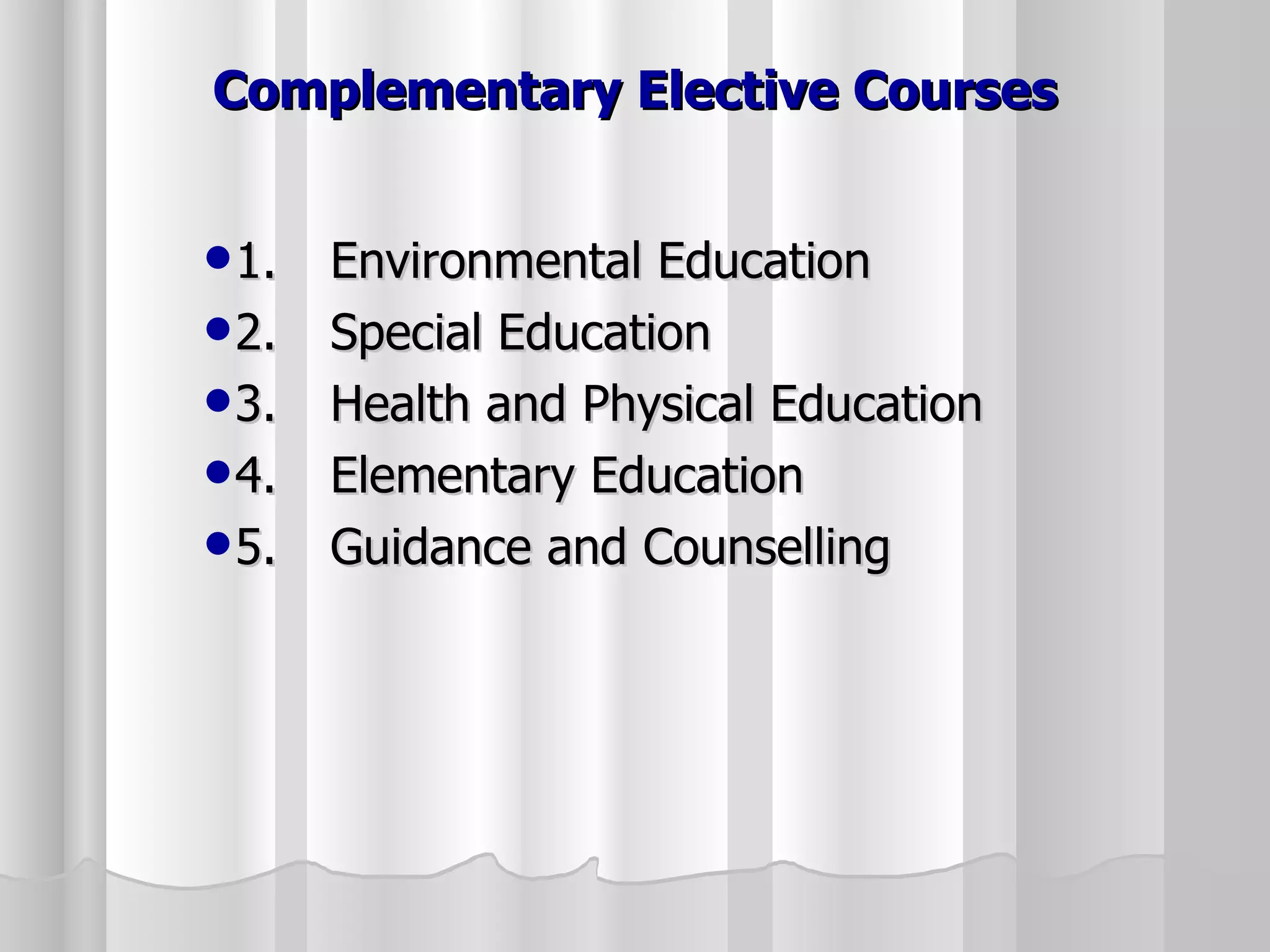
Complementary Elective Courses 1. Environmental Education 2. Special Education 3. Health and Physical Education 4. Elementary Education 5. Guidance and Counselling
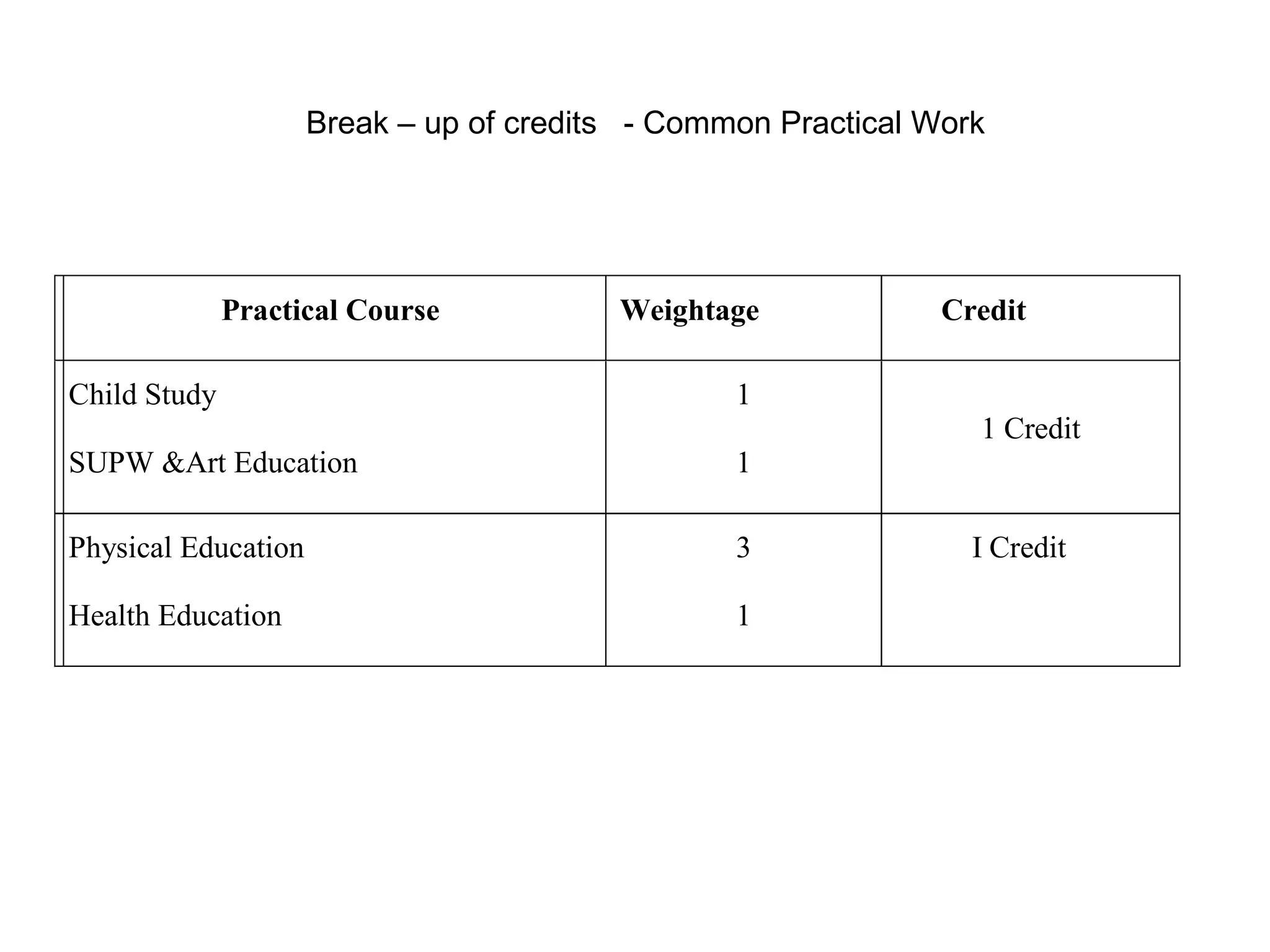
Break – up of credits  - Common Practical Work
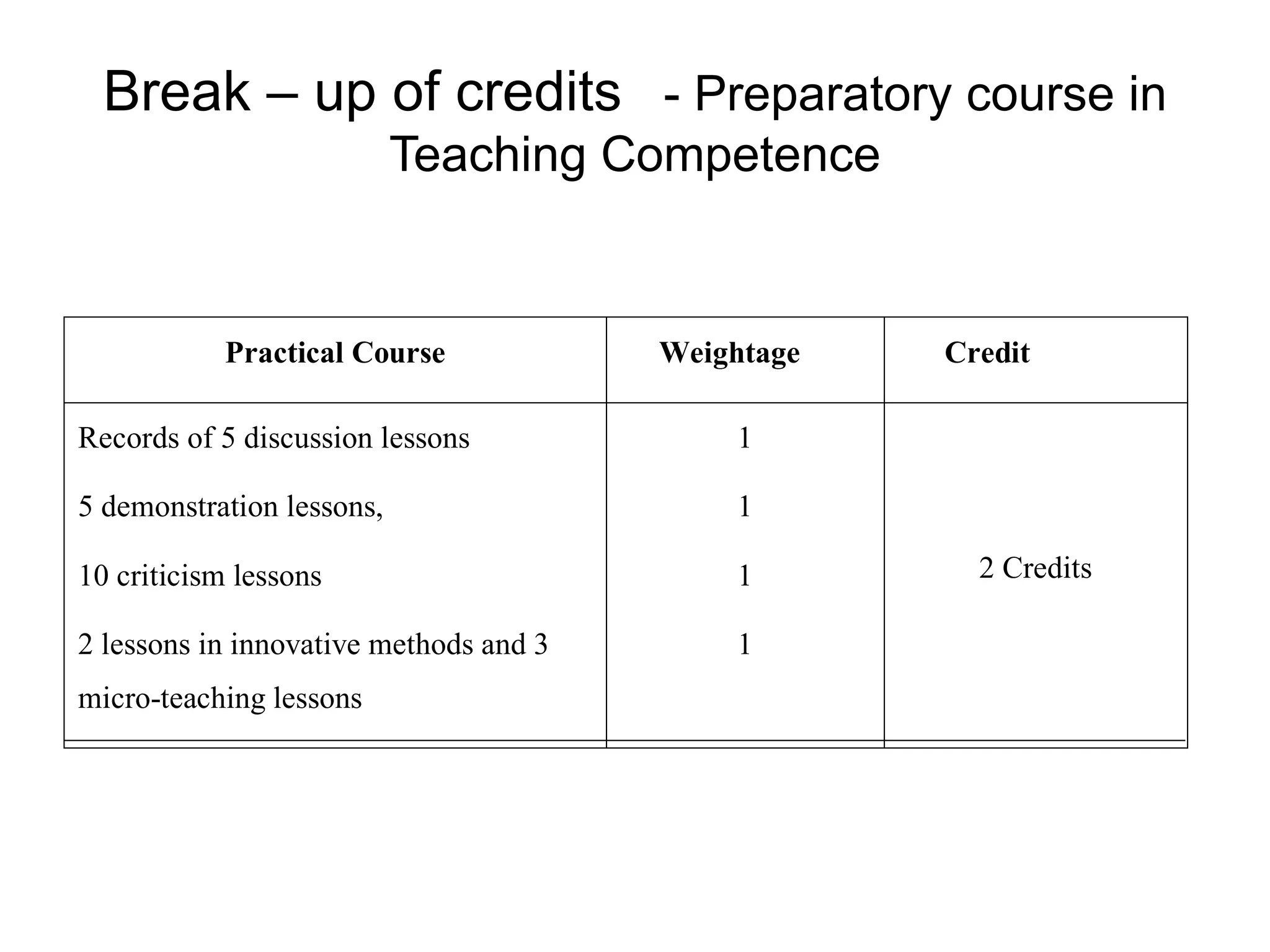
Break – up of credits   - Preparatory course in Teaching Competence
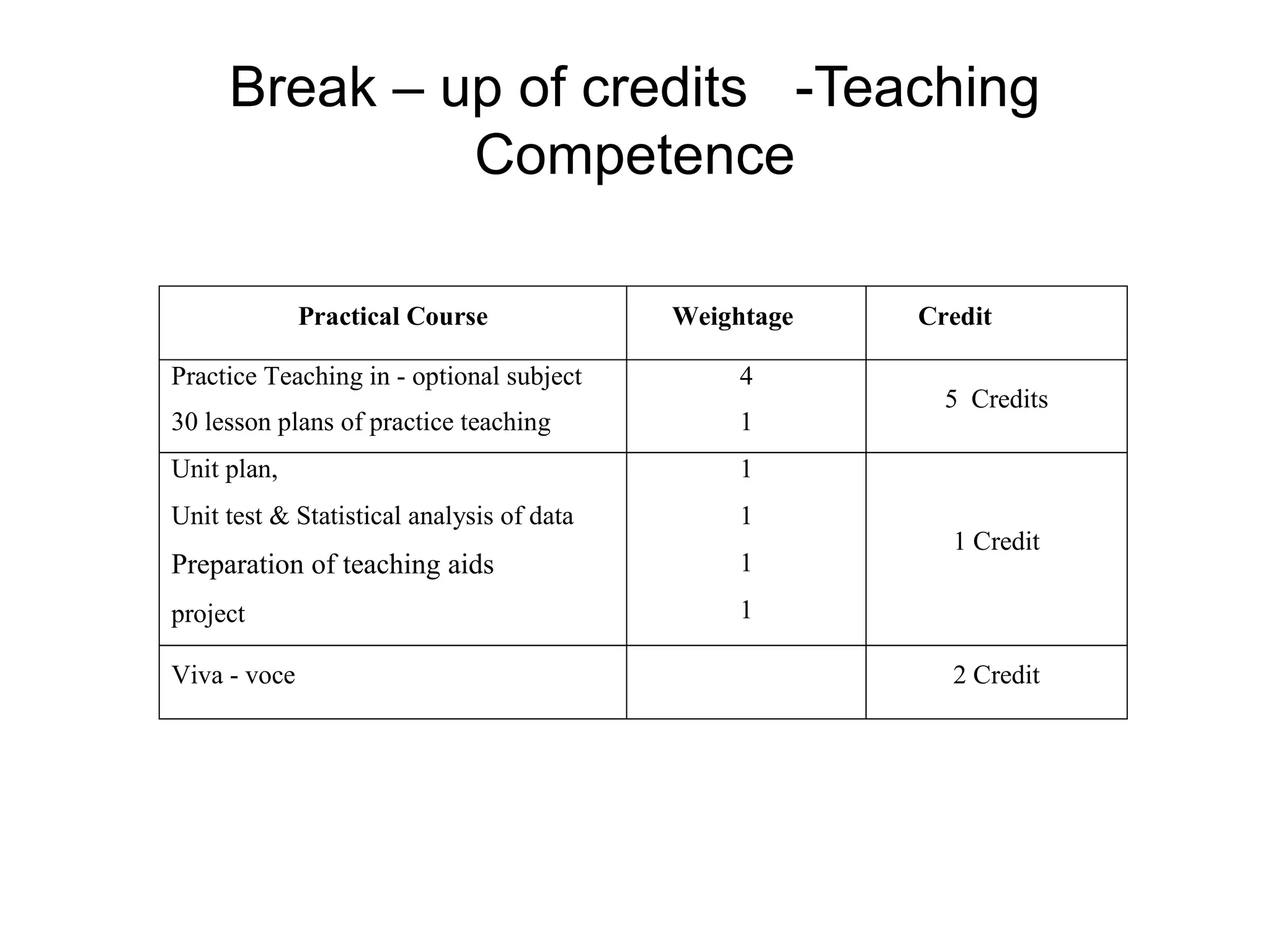
Break – up of credits  -Teaching Competence
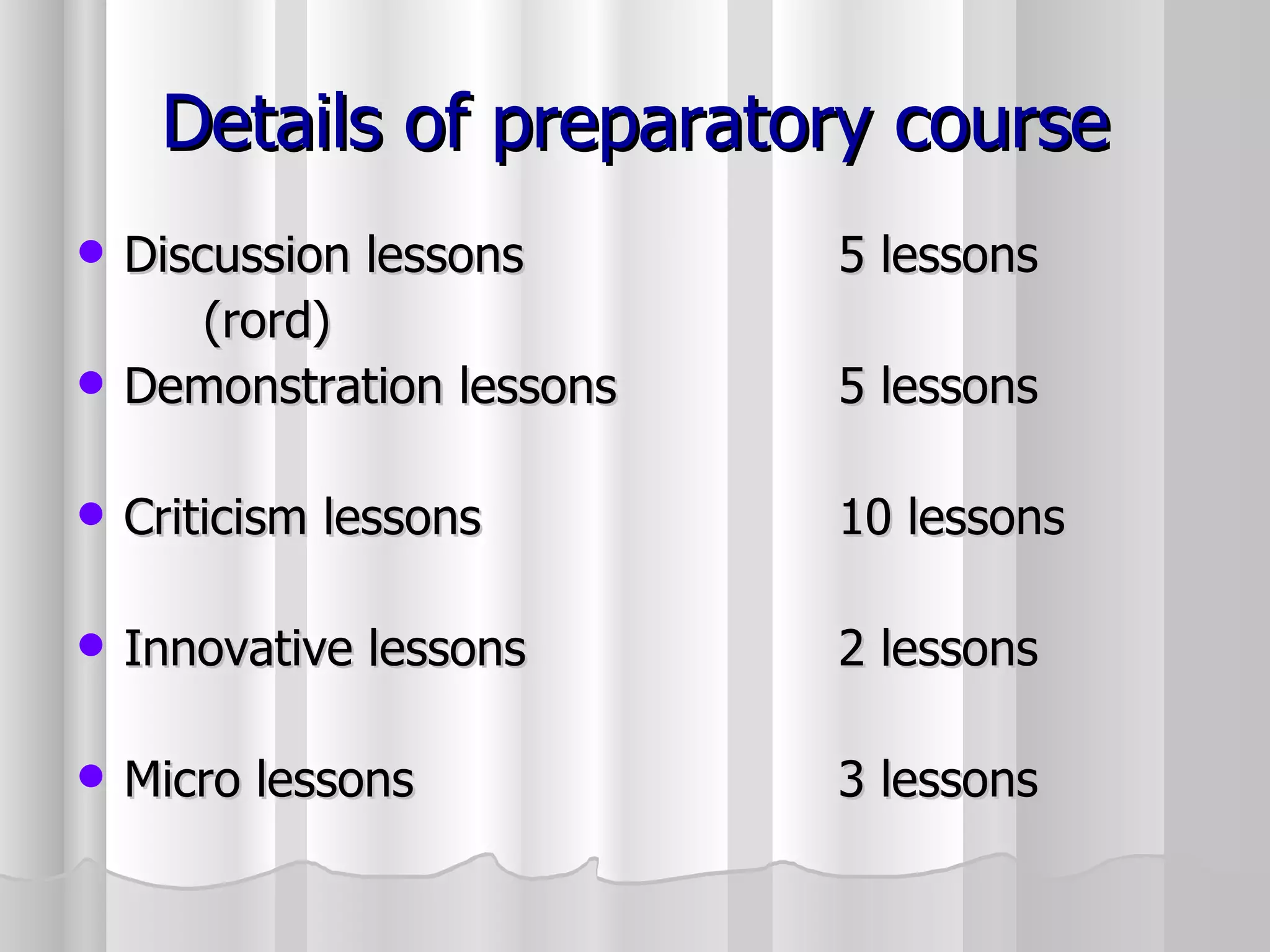
Details of preparatory course Discussion lessons 5 lessons (rord) Demonstration lessons 5 lessons Criticism lessons 10 lessons Innovative lessons 2 lessons Micro lessons 3 lessons
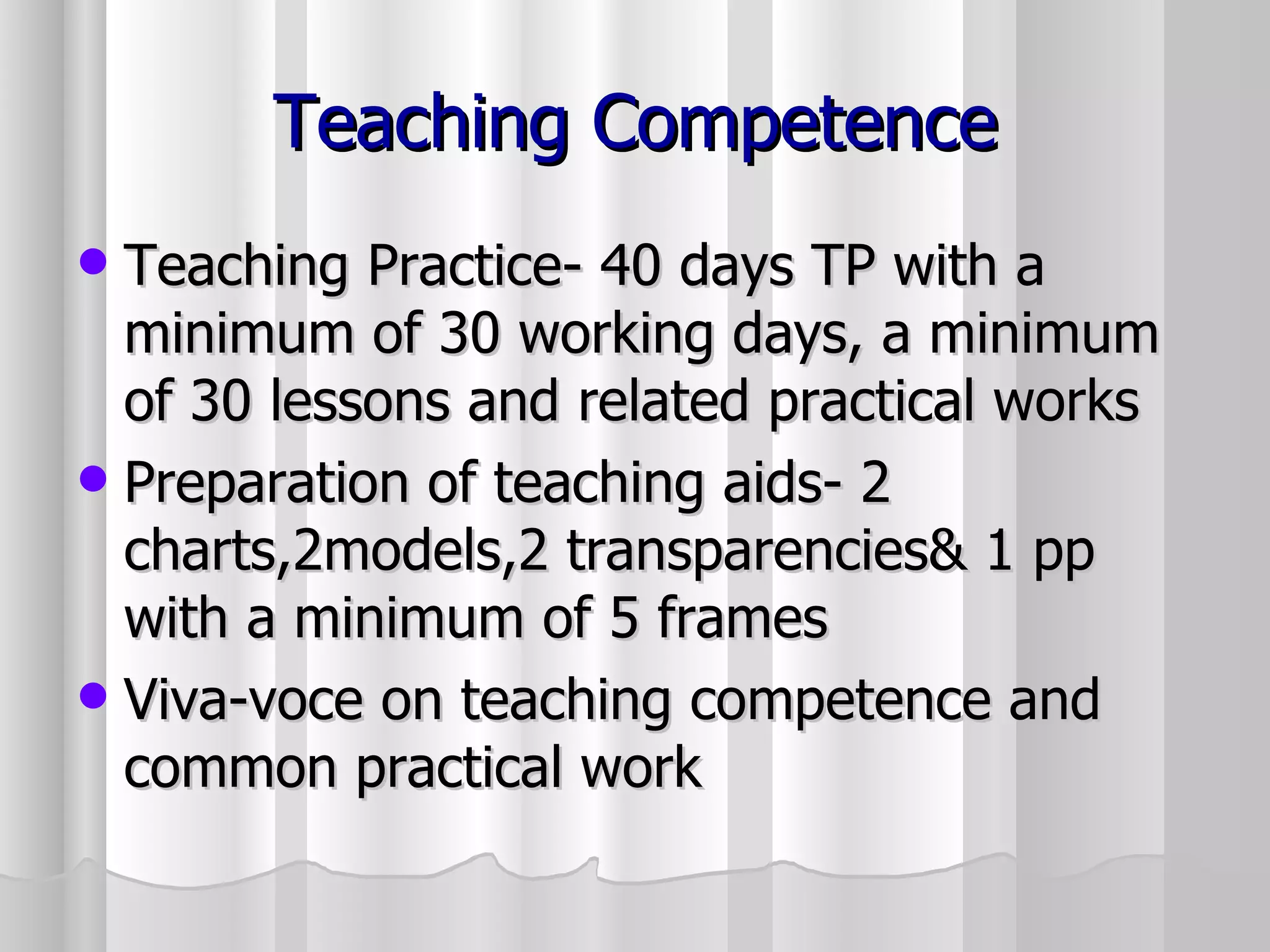
Teaching Competence Teaching Practice- 40 days TP with a minimum of 30 working days, a minimum of 30 lessons and related practical works Preparation of teaching aids- 2 charts,2models,2 transparencies& 1 pp with a minimum of 5 frames Viva-voce on teaching competence and common practical work
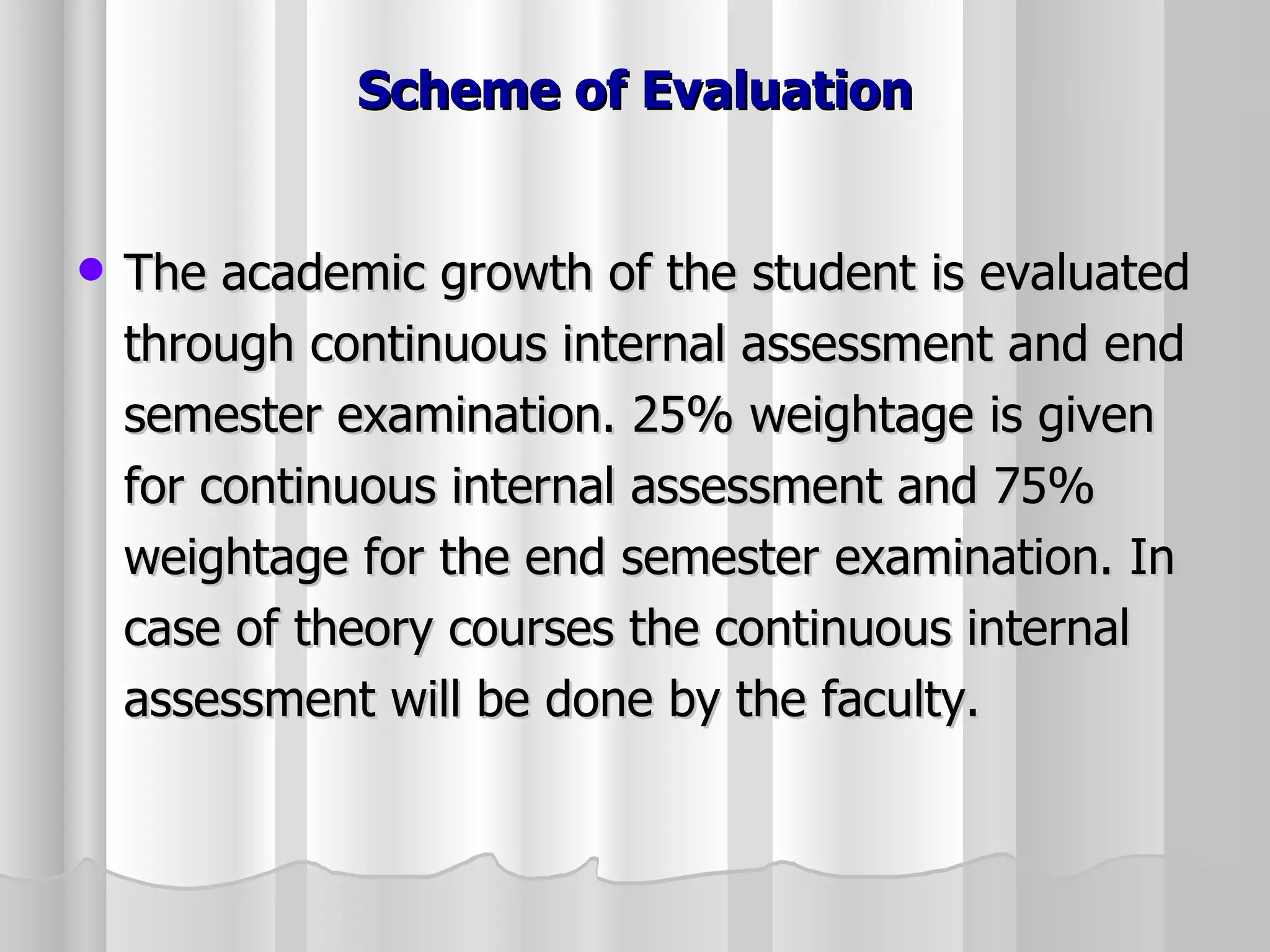
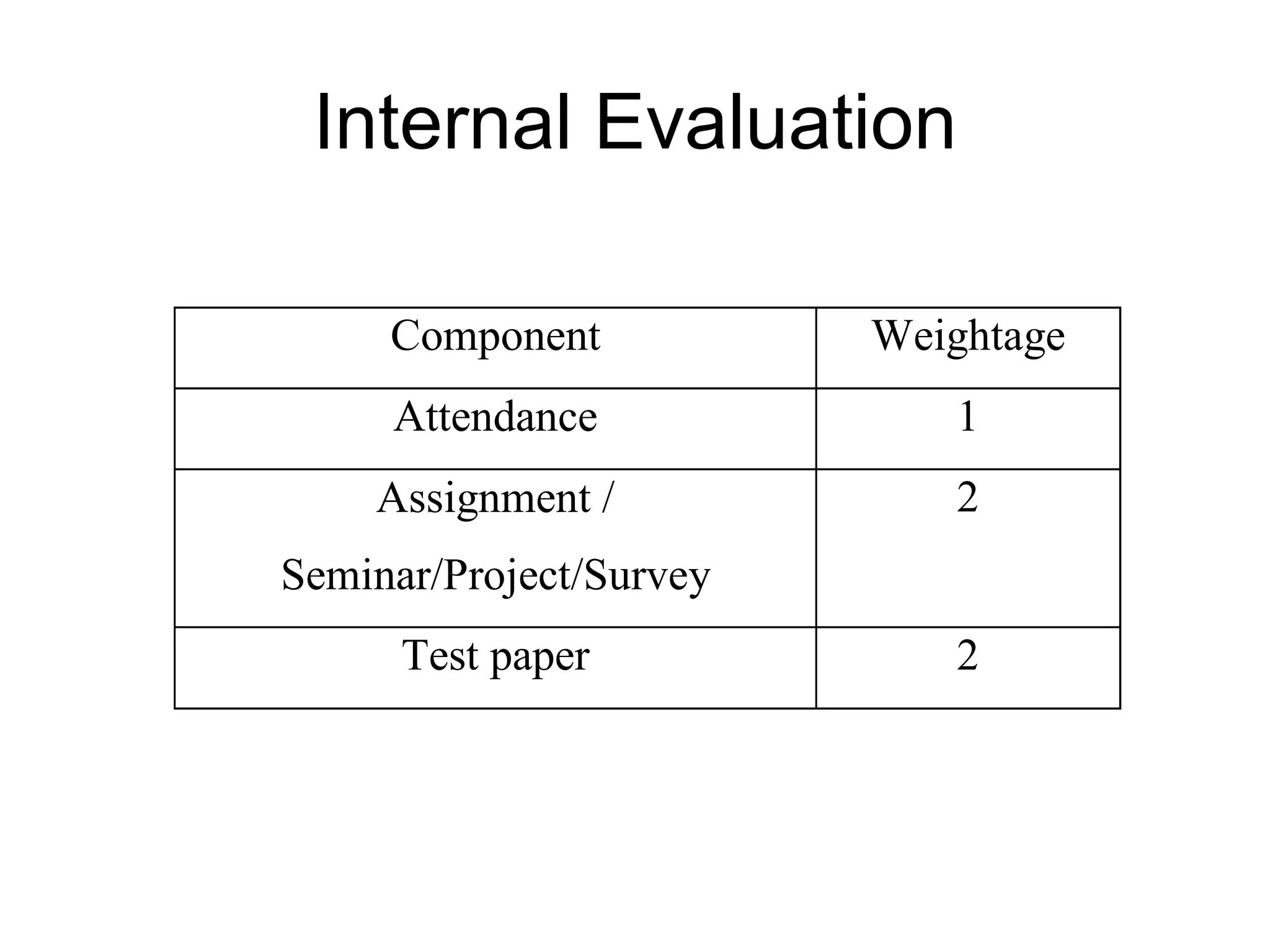
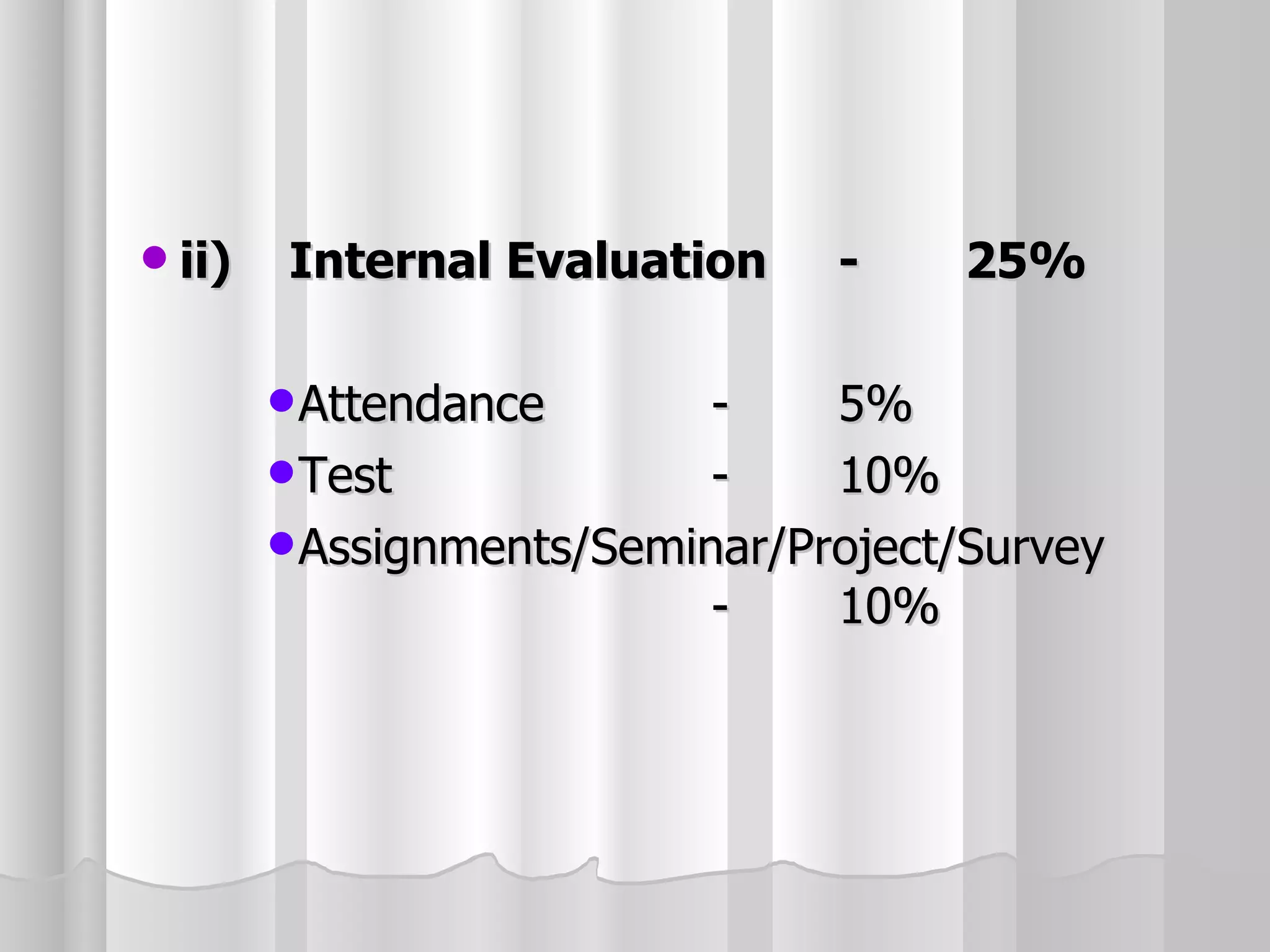
Scheme of Evaluation The academic growth of the student is evaluated through continuous internal assessment and end semester examination. 25% weightage is given for continuous internal assessment and 75% weightage for the end semester examination. In case of theory courses the continuous internal assessment will be done by the faculty.
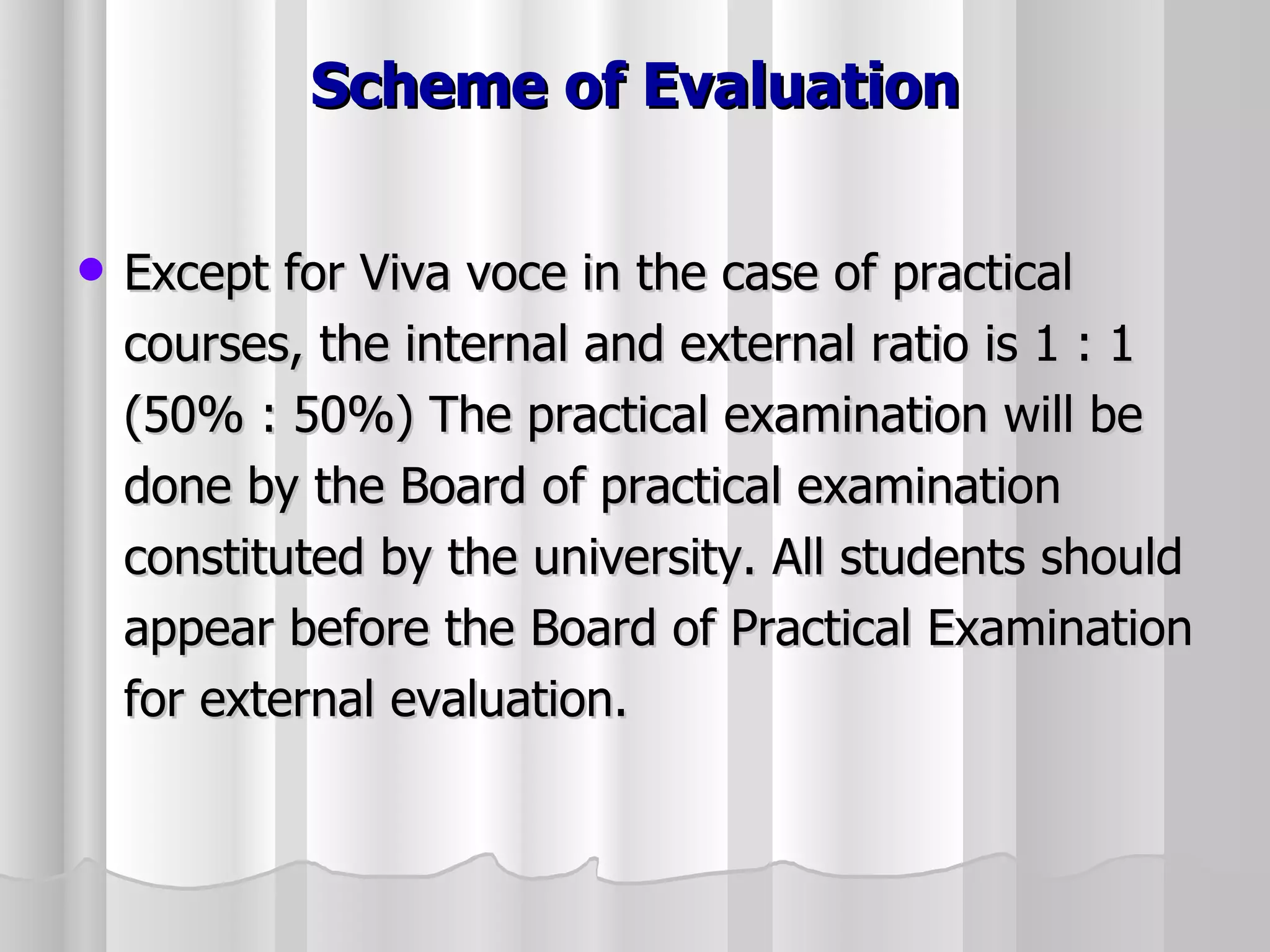
Scheme of Evaluation Except for Viva voce in the case of practical courses, the internal and external ratio is 1 : 1 (50% : 50%) The practical examination will be done by the Board of practical examination constituted by the university. All students should appear before the Board of Practical Examination for external evaluation.
Internal Evaluation
ii)  Internal Evaluation - 25% Attendance - 5% Test - 10% Assignments/Seminar/Project/Survey - 10%
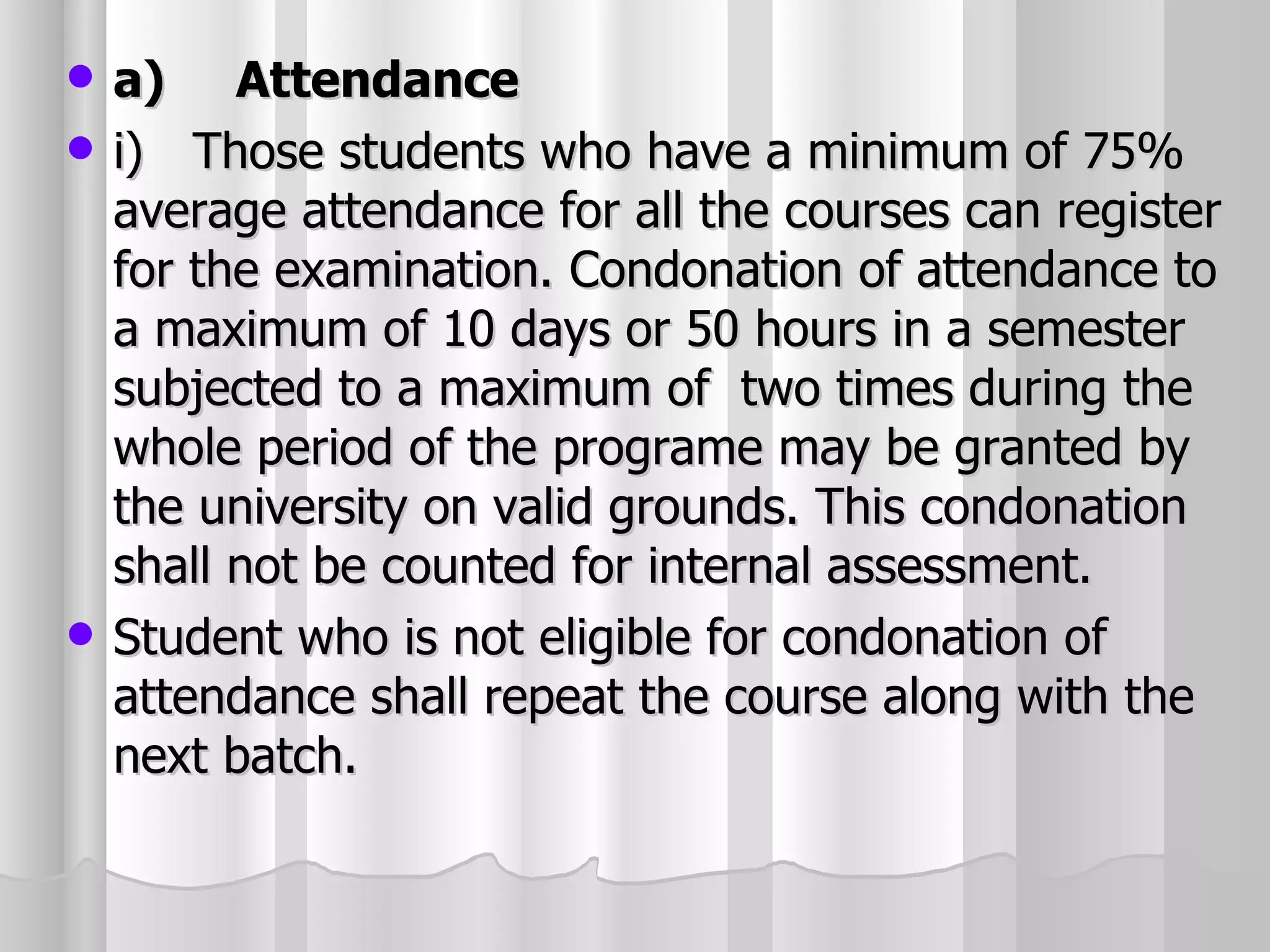
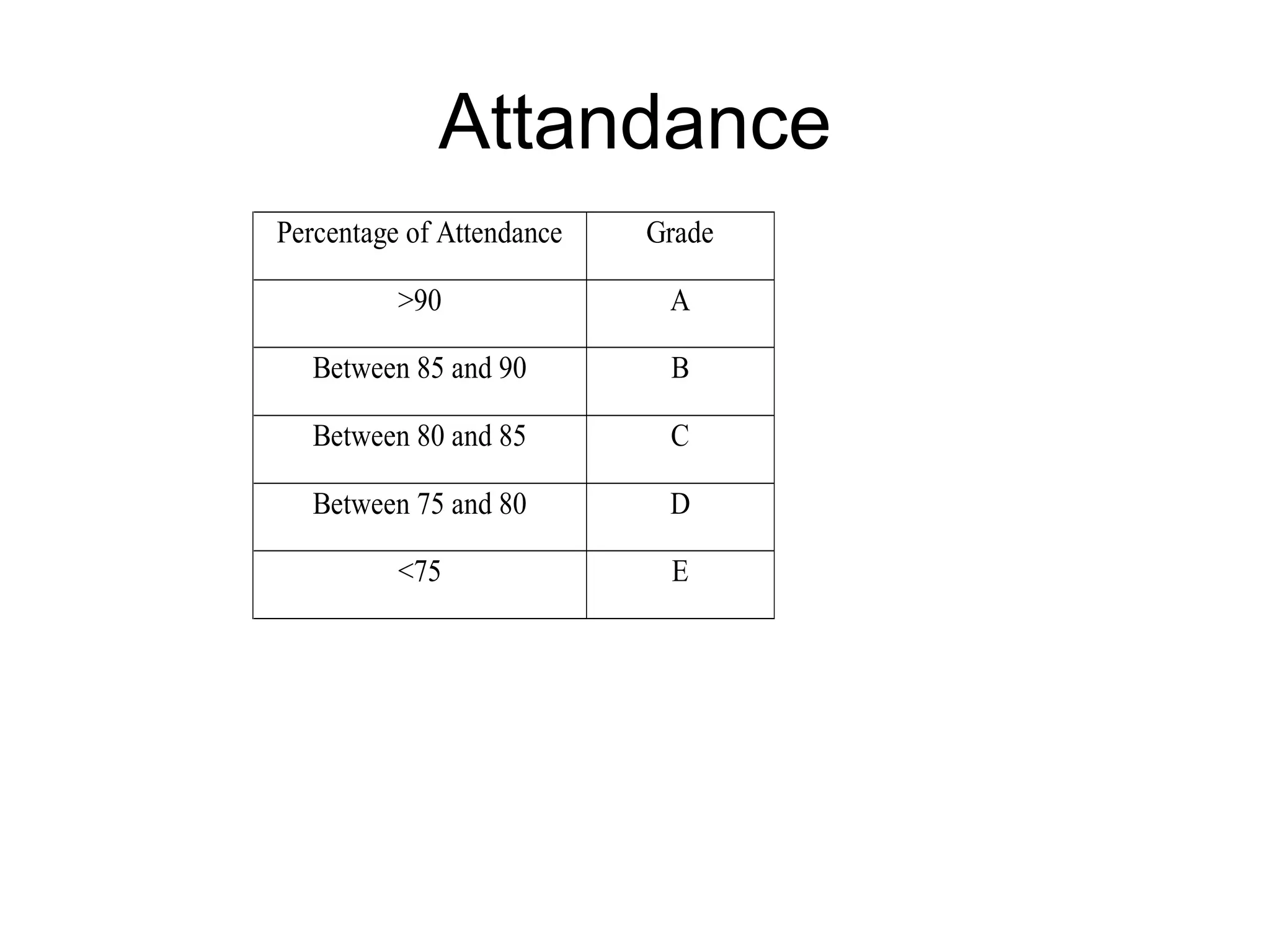
a)   Attendance i) Those students who have a minimum of 75% average attendance for all the courses can register for the examination. Condonation of attendance to a maximum of 10 days or 50 hours in a semester subjected to a maximum of  two times during the whole period of the programe may be granted by the university on valid grounds. This condonation shall not be counted for internal assessment. Student who is not eligible for condonation of attendance shall repeat the course along with the next batch.
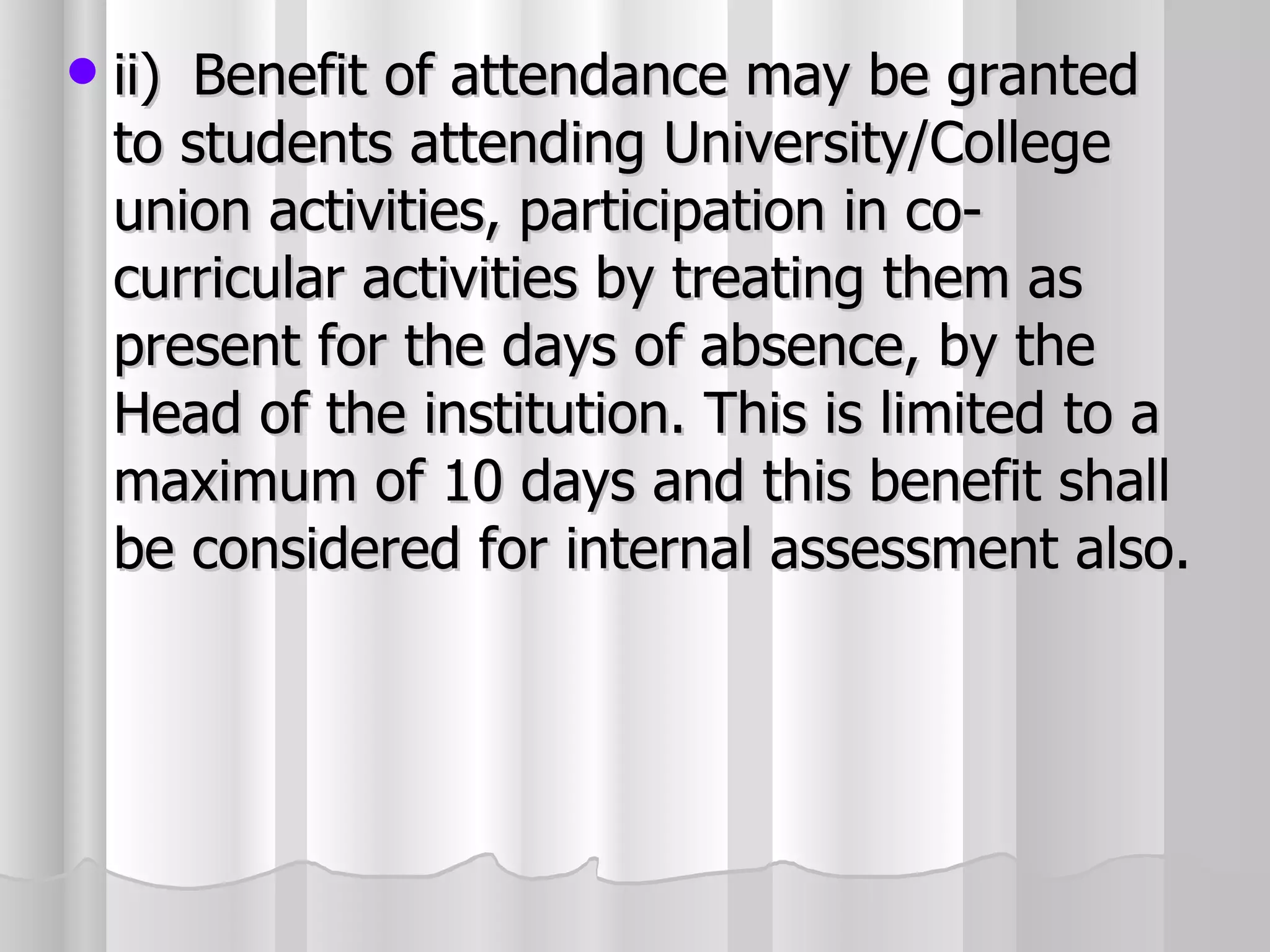
ii) Benefit of attendance may be granted to students attending University/College union activities, participation in co-curricular activities by treating them as present for the days of absence, by the Head of the institution. This is limited to a maximum of 10 days and this benefit shall be considered for internal assessment also.
Attandance
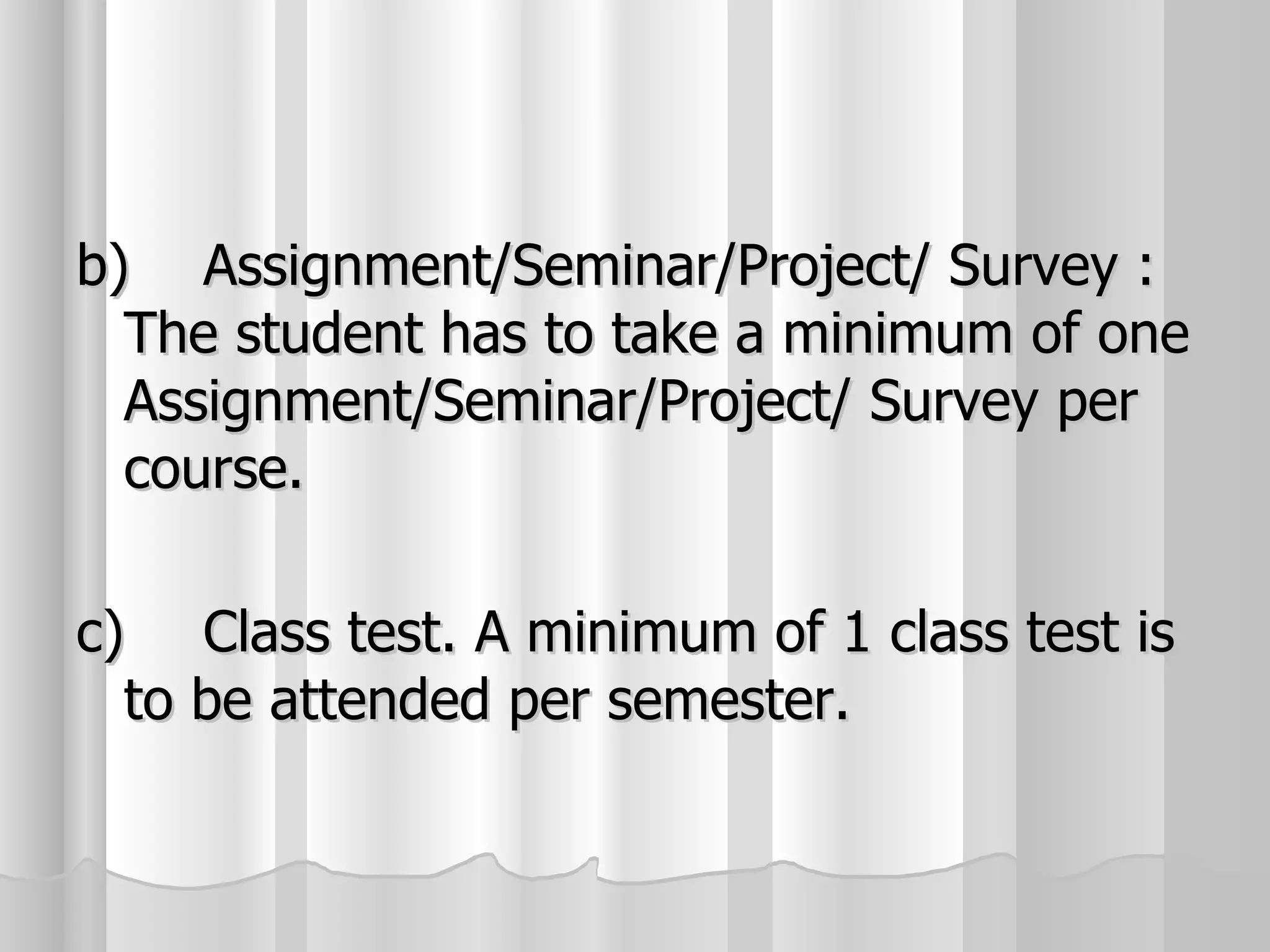
b) Assignment/Seminar/Project/ Survey : The student has to take a minimum of one Assignment/Seminar/Project/ Survey per course. c) Class test. A minimum of 1 class test is to be attended per semester.
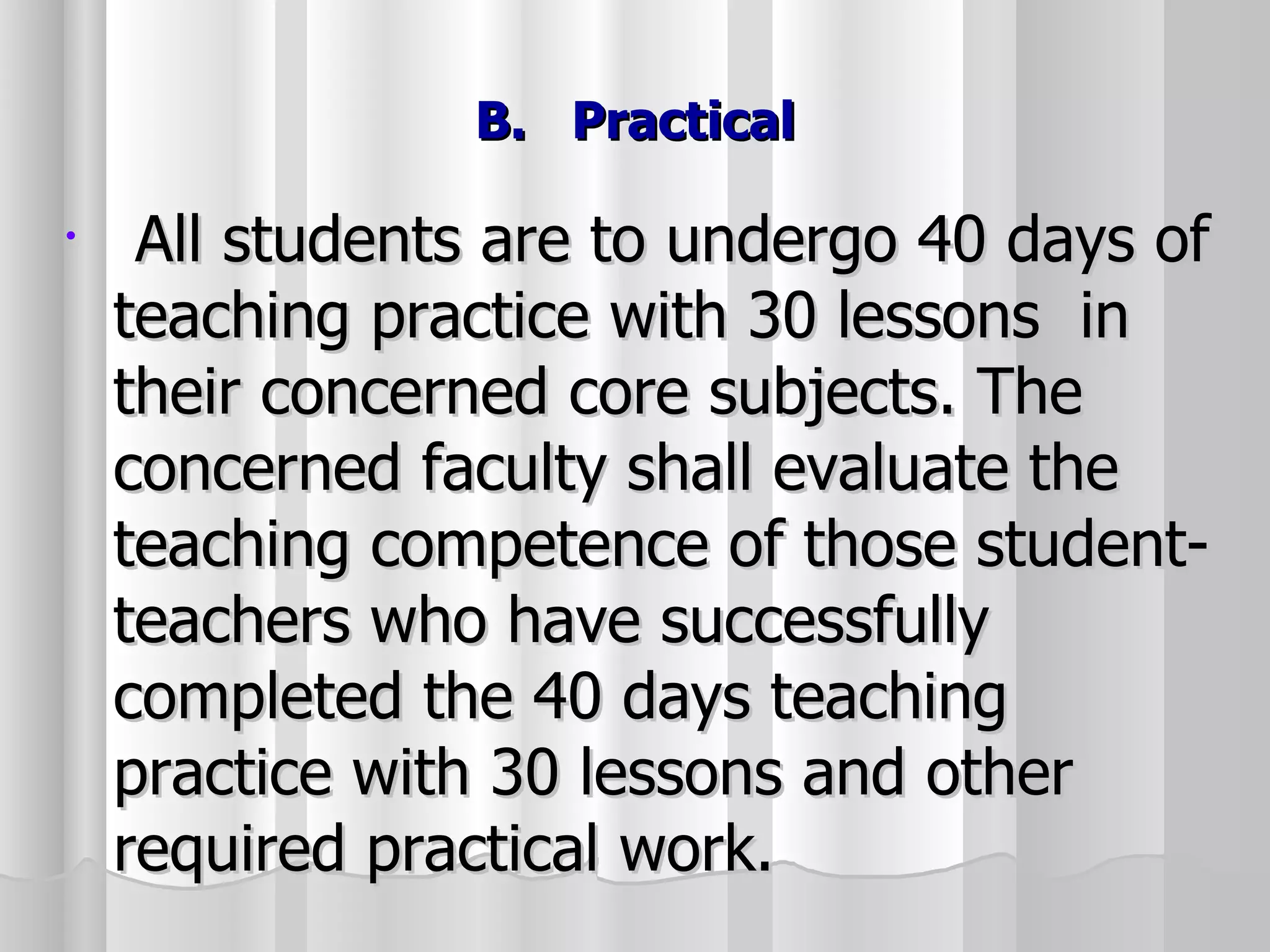
B.  Practical All students are to undergo 40 days of teaching practice with 30 lessons  in their concerned core subjects. The concerned faculty shall evaluate the teaching competence of those student-teachers who have successfully completed the 40 days teaching practice with 30 lessons and other required practical work.
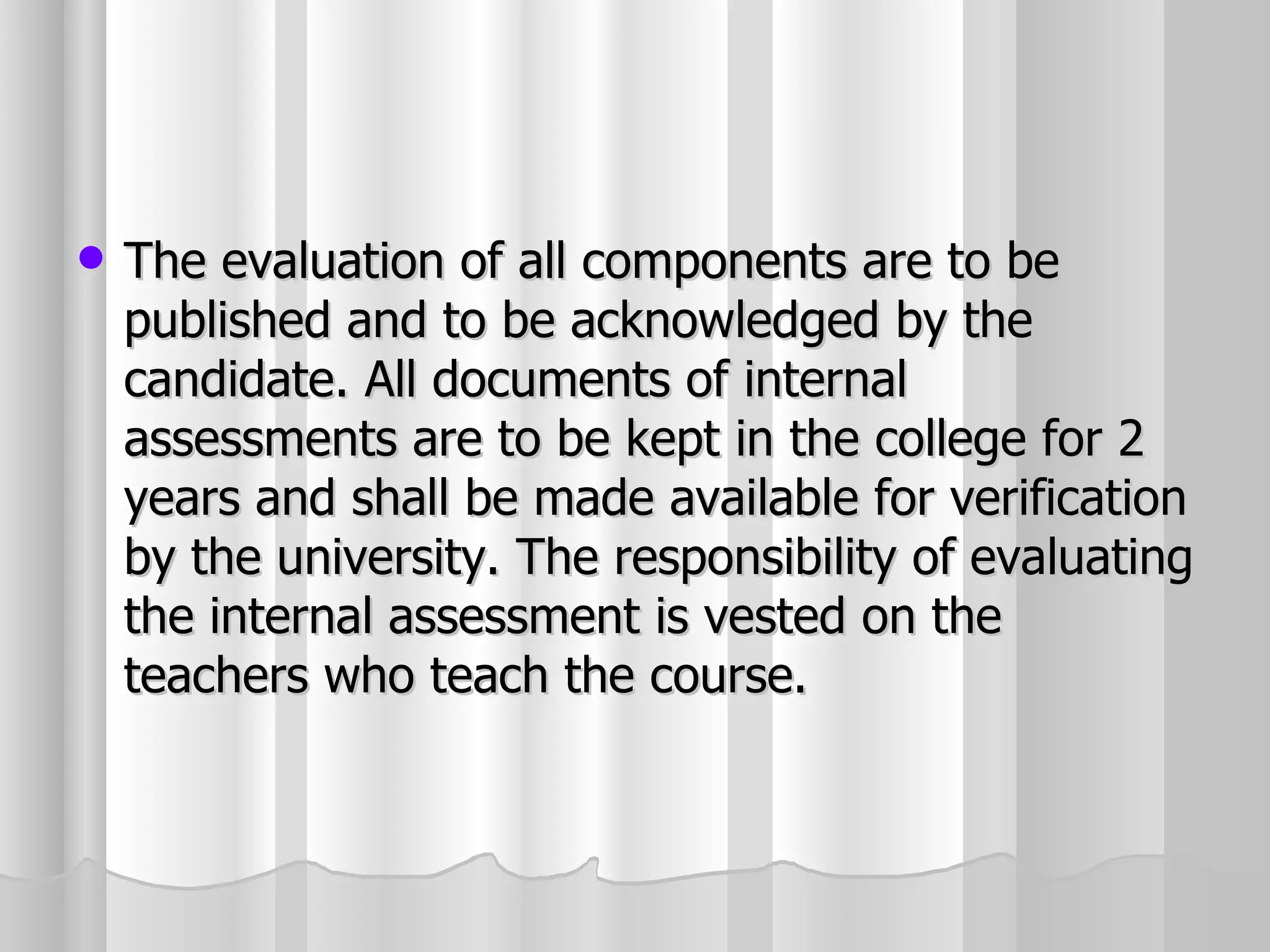
The evaluation of all components are to be published and to be acknowledged by the candidate. All documents of internal assessments are to be kept in the college for 2 years and shall be made available for verification by the university. The responsibility of evaluating the internal assessment is vested on the teachers who teach the course.
External examination  a.   Theory The external examination of all semesters shall be conducted by the university at the close of each semester. b. Practical Practical examination shall be conducted by an external examination board constituted by the university. The external  board shall observe and evaluate  the teaching competency of all candidates
The practical board shall conduct viva voce for each candidate and award grades on the basis of the performance of the candidates and the quality of practical works on the basis of the following components. i) Teaching competence ii) Quality of practical works iii) Subject competency iv) Communication ability
The physical education teachers in the external board shall observe and evaluate the physical education classes of a stratified sample of 10% of the candidates conduct viva voce for another 10% sample of the candidate in the practical examination.    There will be no supplementary exams. For appearance/improvement, students can appear along with the next batch.
Student who register his/her name for the external exam for a semester will be eligible for promotion to the next semester. All programmes and courses shall have unique alphanumeric code. Each teacher working in affiliated institutions shall have a unique identification number and this no. is to be attached with the codes of the courses for which he/she can perform examination duty.
ADVANTAGES OF GRADING Reducing subjectivity Raw assessment on a raw scale Improving quality of assessment
TYPES OF GRADING Direct Grading Indirect Grading
DIRECT GRADING Each answer is graded with letters  Grade letters are A, B, C, D and E
INDIRECT  GRADING: ABSOLUTE Marks awarded are classified into different grades Lead to distortions who score close to the margins
INDIRECT  GRADING Two types of indirect grading… Absolute Grading:   Marks awarded on a 101 point scale are converted to a 5/7/9 point scale Relative grading:  The scores awarded are normalized for proper distribution on the basis of pre-fixed pattern
ADVANTAGES OF DIRECT GRADING Simplifies the process of assessment  Makes a raw assessment on a raw scale Uses a uniform scale for the assessment of quality   Separates assessment of quality and range
MECHANICS OF DIRECT GRADING Assessment of quality on a five point scale for each question Assigning weightage depending on the nature of the question  Calculation of weighted average Certification on a seven point scale
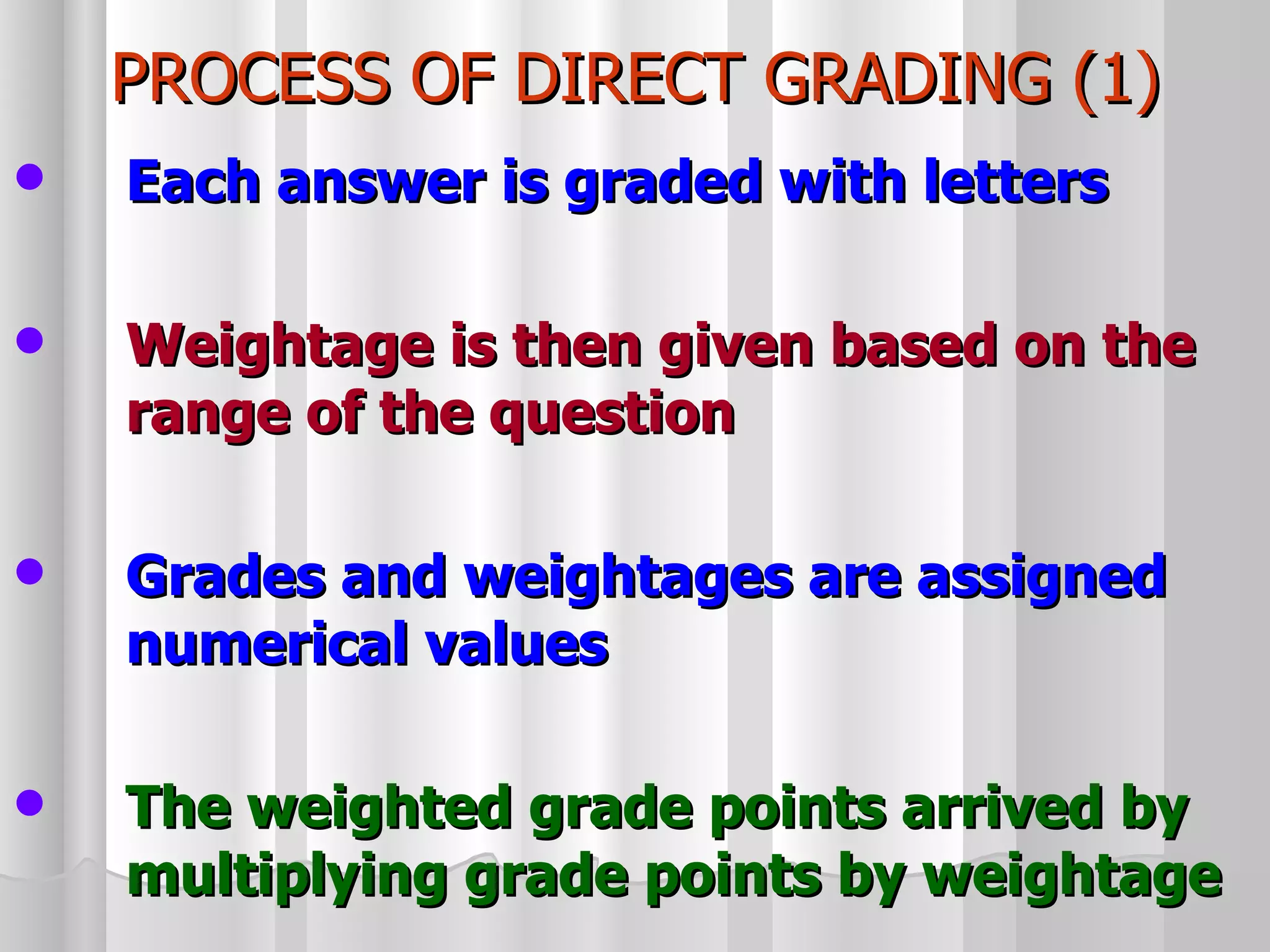
PROCESS OF DIRECT GRADING (1) Each answer is graded with letters Weightage is then given based on the range of the question Grades and weightages are assigned numerical values The weighted grade points arrived by multiplying grade points by weightage
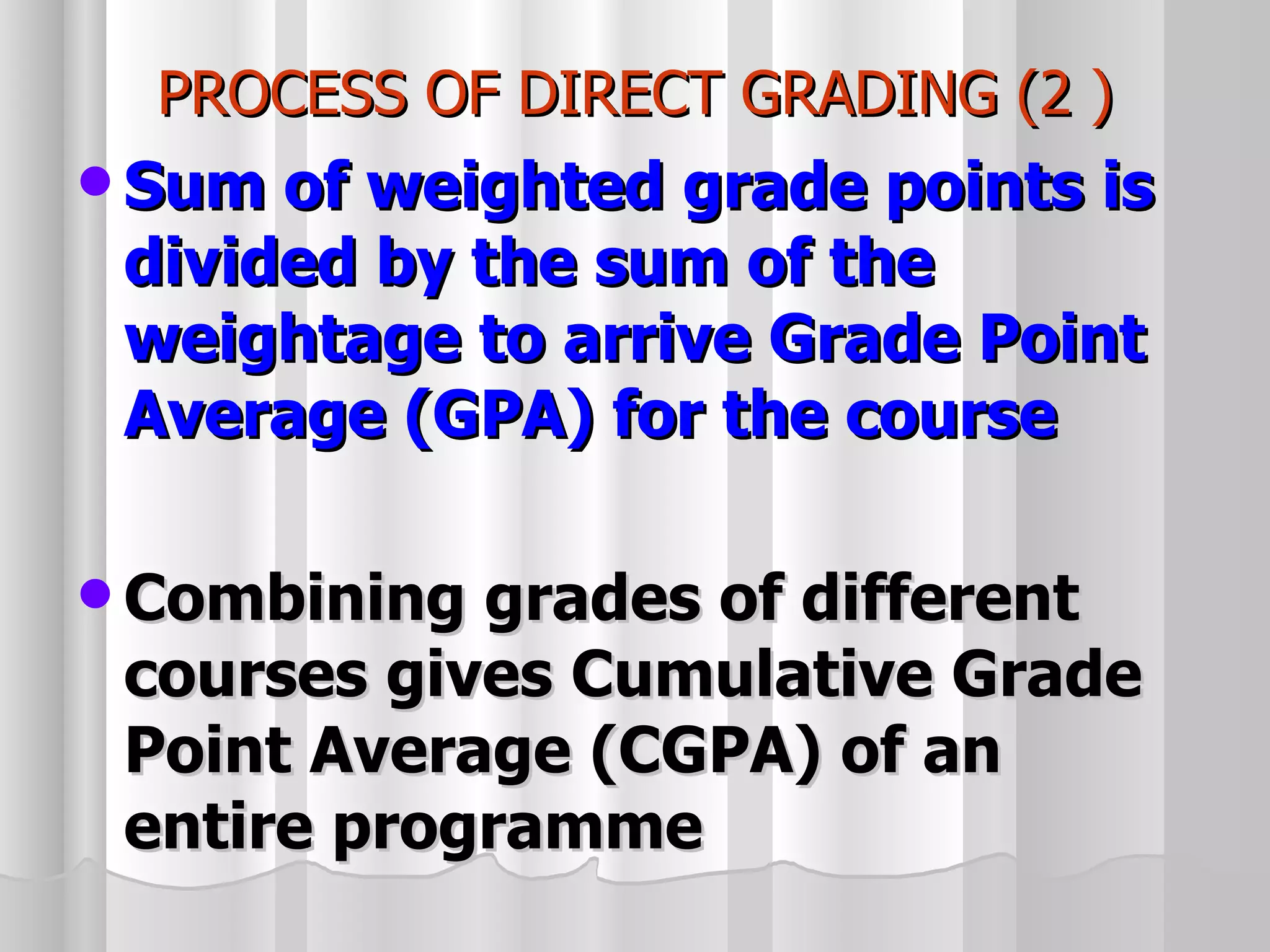
PROCESS OF DIRECT GRADING (2 ) Sum of weighted grade points is divided by the sum of the weightage to arrive Grade Point Average (GPA) for the course Combining grades of different courses gives Cumulative Grade Point Average (CGPA) of an entire programme
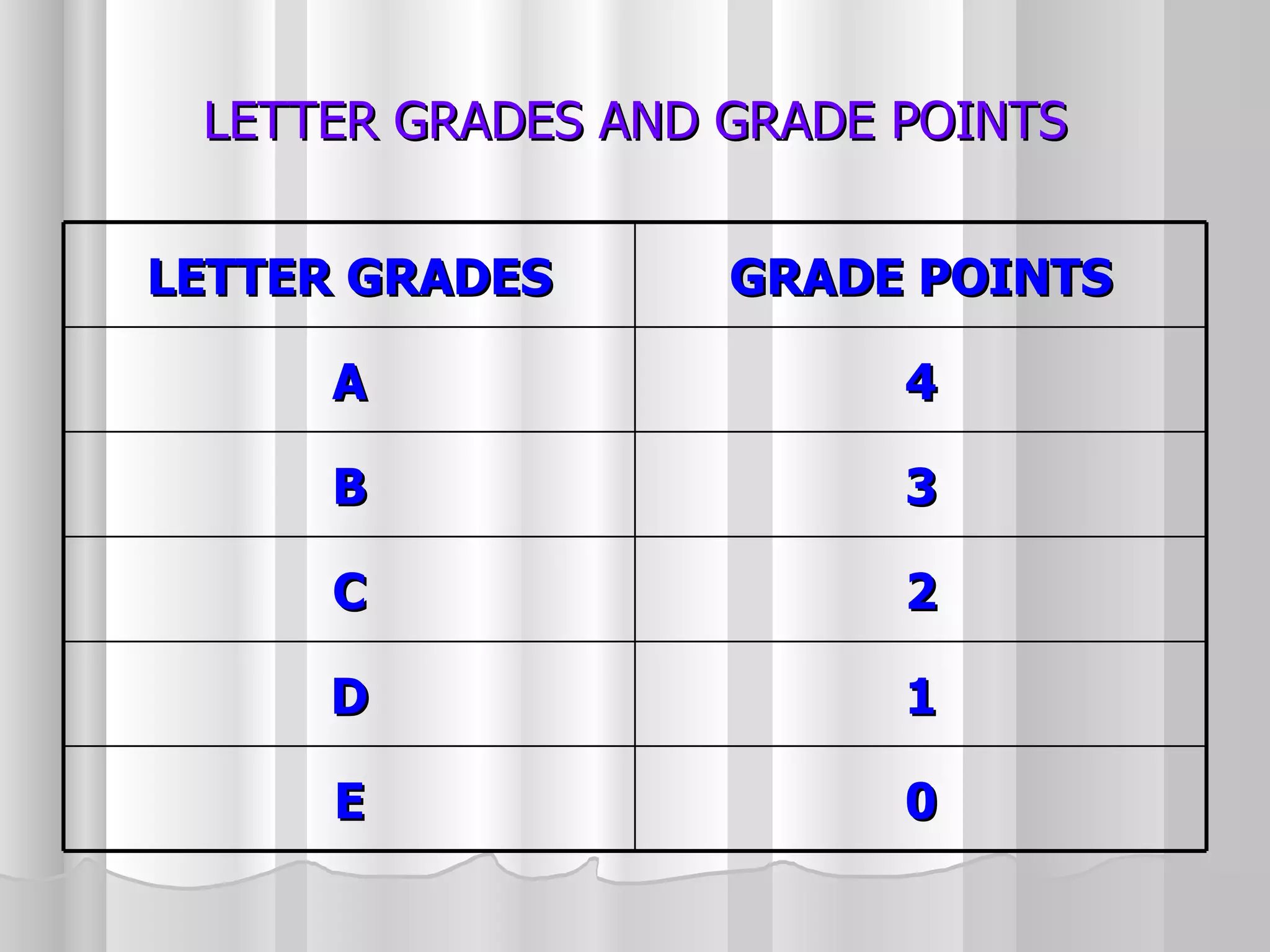
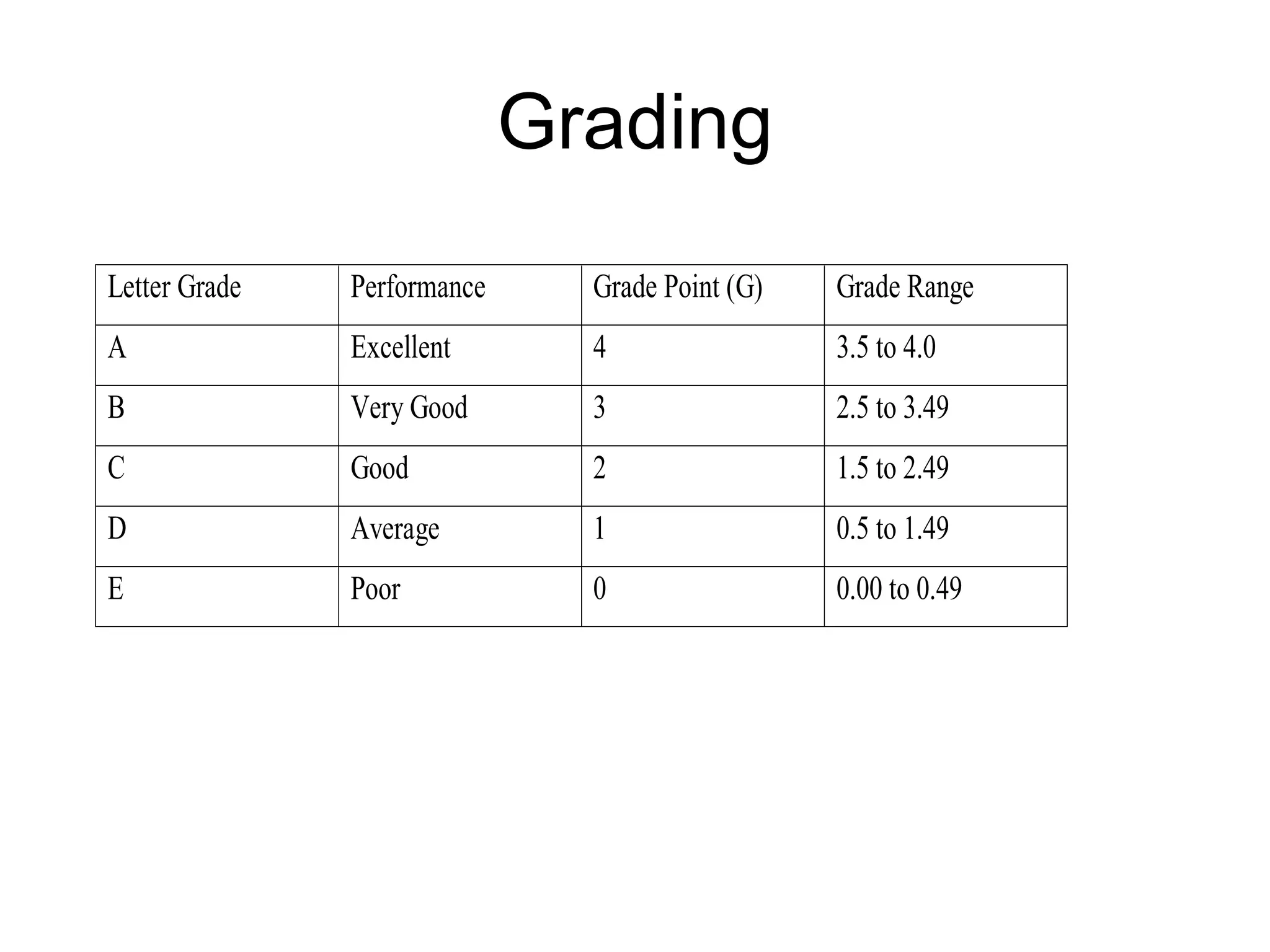
LETTER GRADES AND GRADE POINTS LETTER GRADES GRADE POINTS A 4 B 3 C 2 D 1 E 0
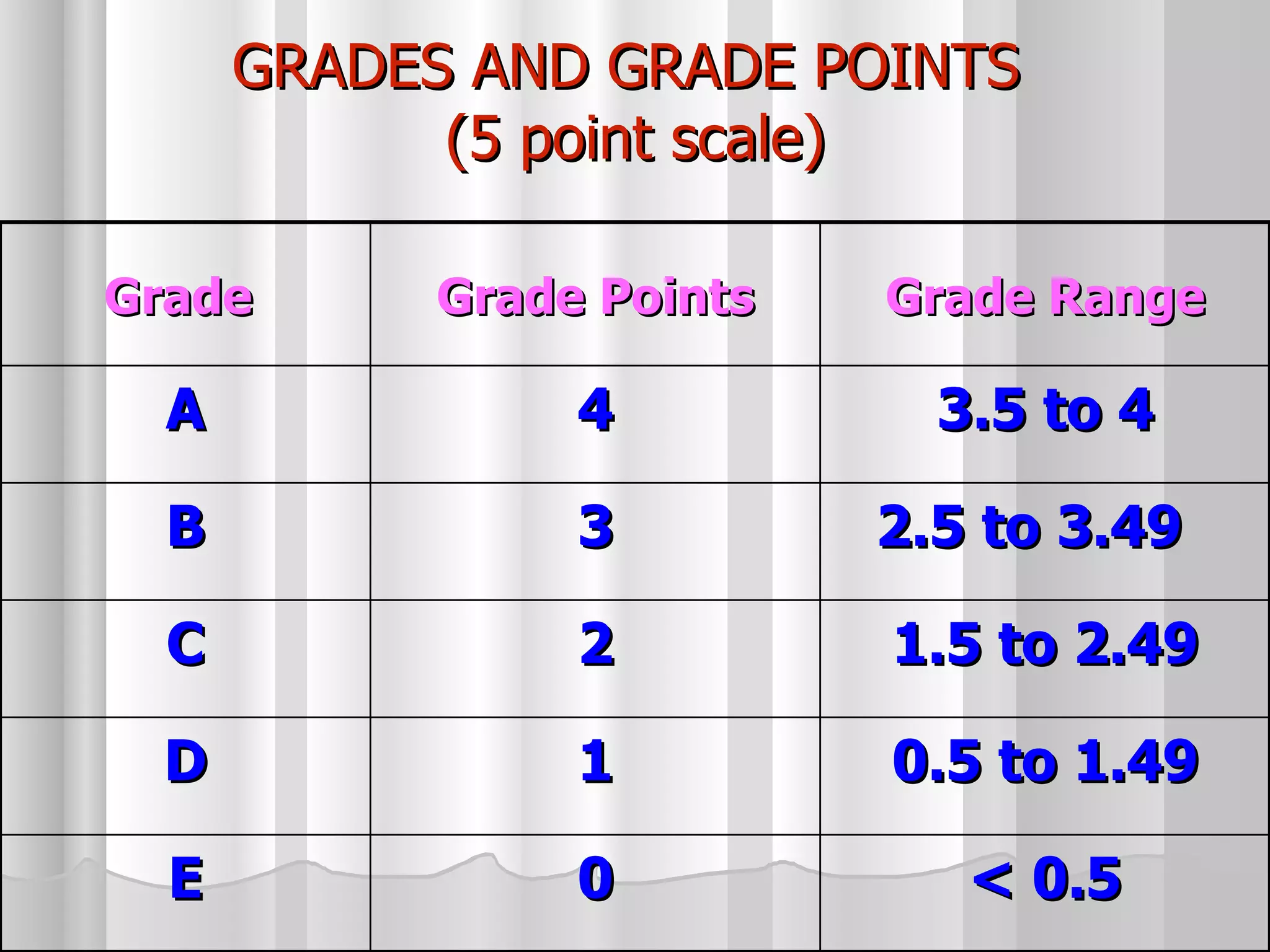
GRADES AND GRADE POINTS  (5 point scale) Grade  Grade Points Grade Range A 4 3.5 to 4 B 3 2.5 to 3.49  C 2 1.5 to 2.49 D 1 0.5 to 1.49 E 0 < 0.5
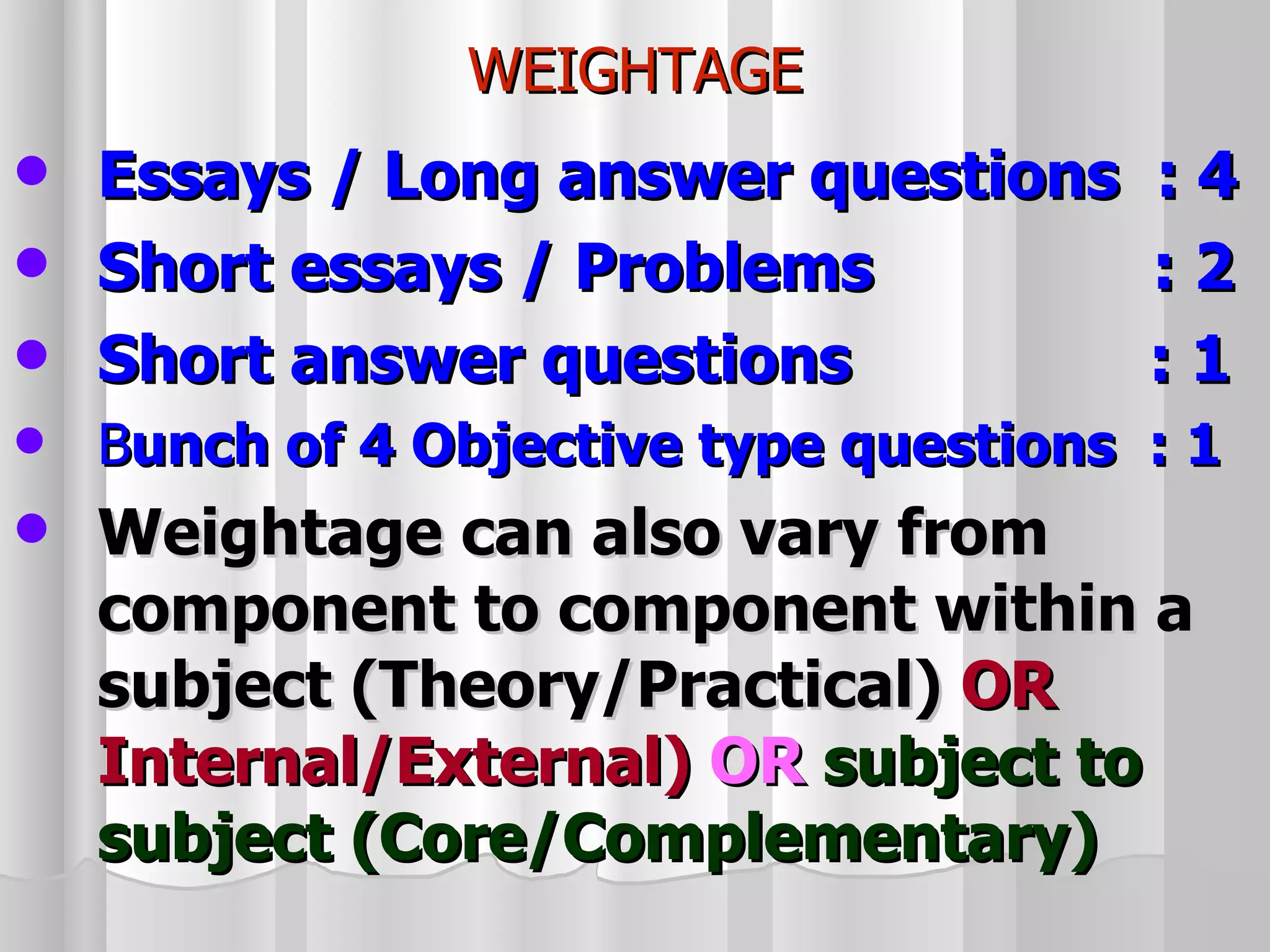
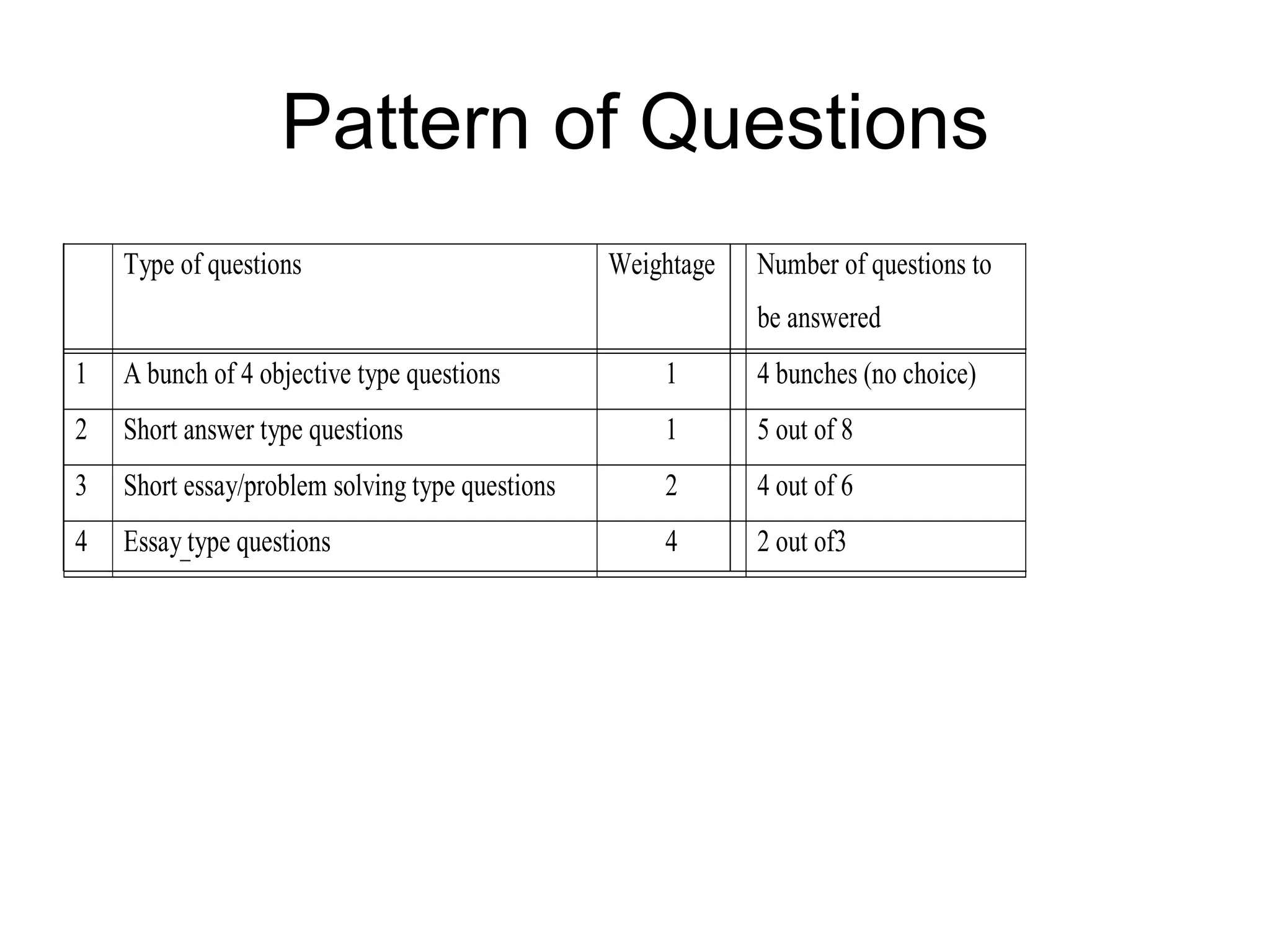
WEIGHTAGE Essays / Long answer questions : 4 Short essays / Problems  : 2 Short answer questions  : 1 B unch of 4 Objective type questions  : 1 Weightage can also vary from component to component within a subject (Theory/Practical)   OR   Internal/External)   OR   subject to subject (Core/Complementary)
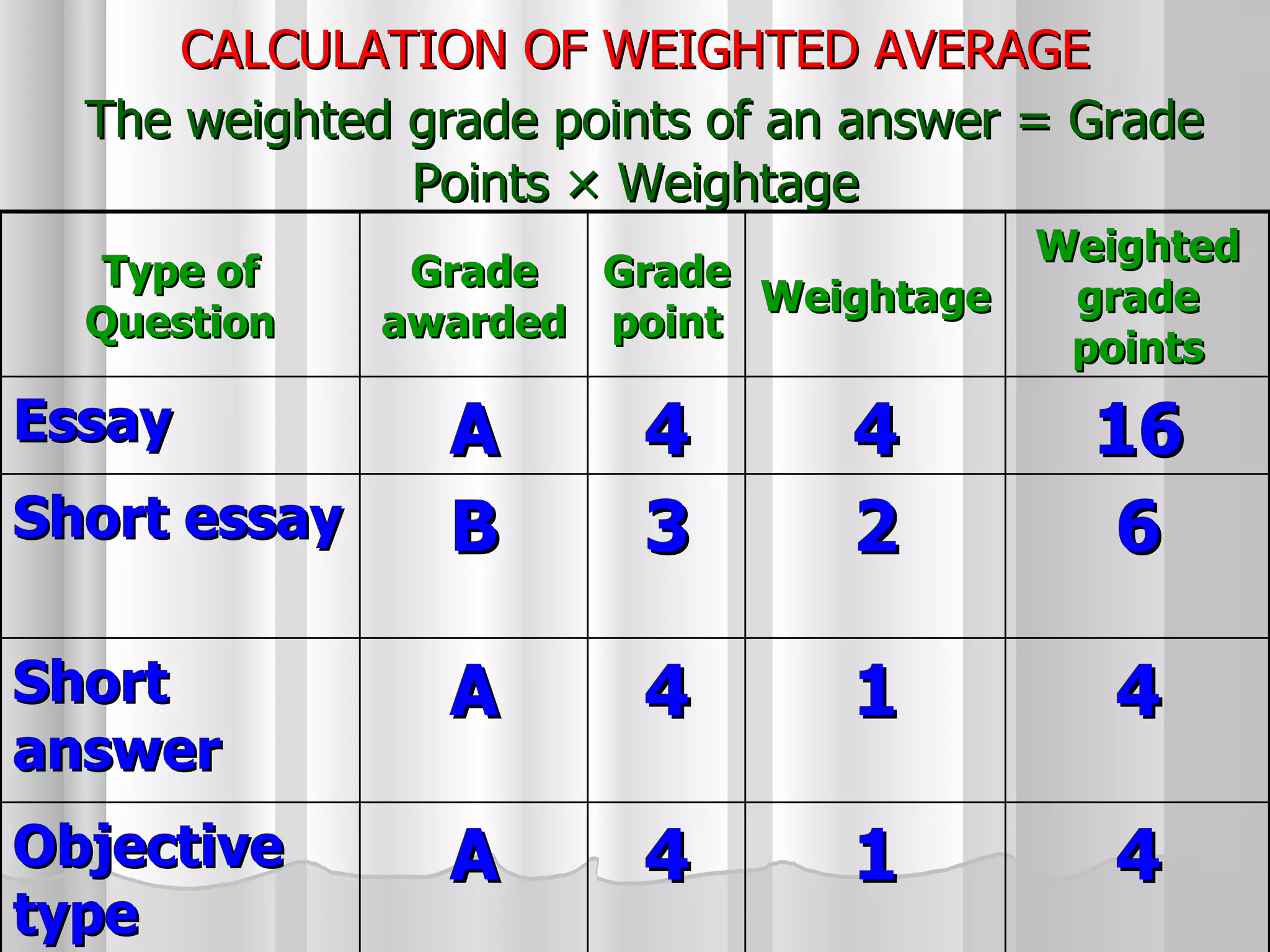
CALCULATION OF WEIGHTED AVERAGE   The weighted grade points of an answer = Grade Points  ×  Weightage Type of Question Grade awarded Grade point Weightage Weighted grade points Essay A 4 4 16 Short essay B 3 2 6 Short answer A 4 1 4 Objective type A 4 1 4
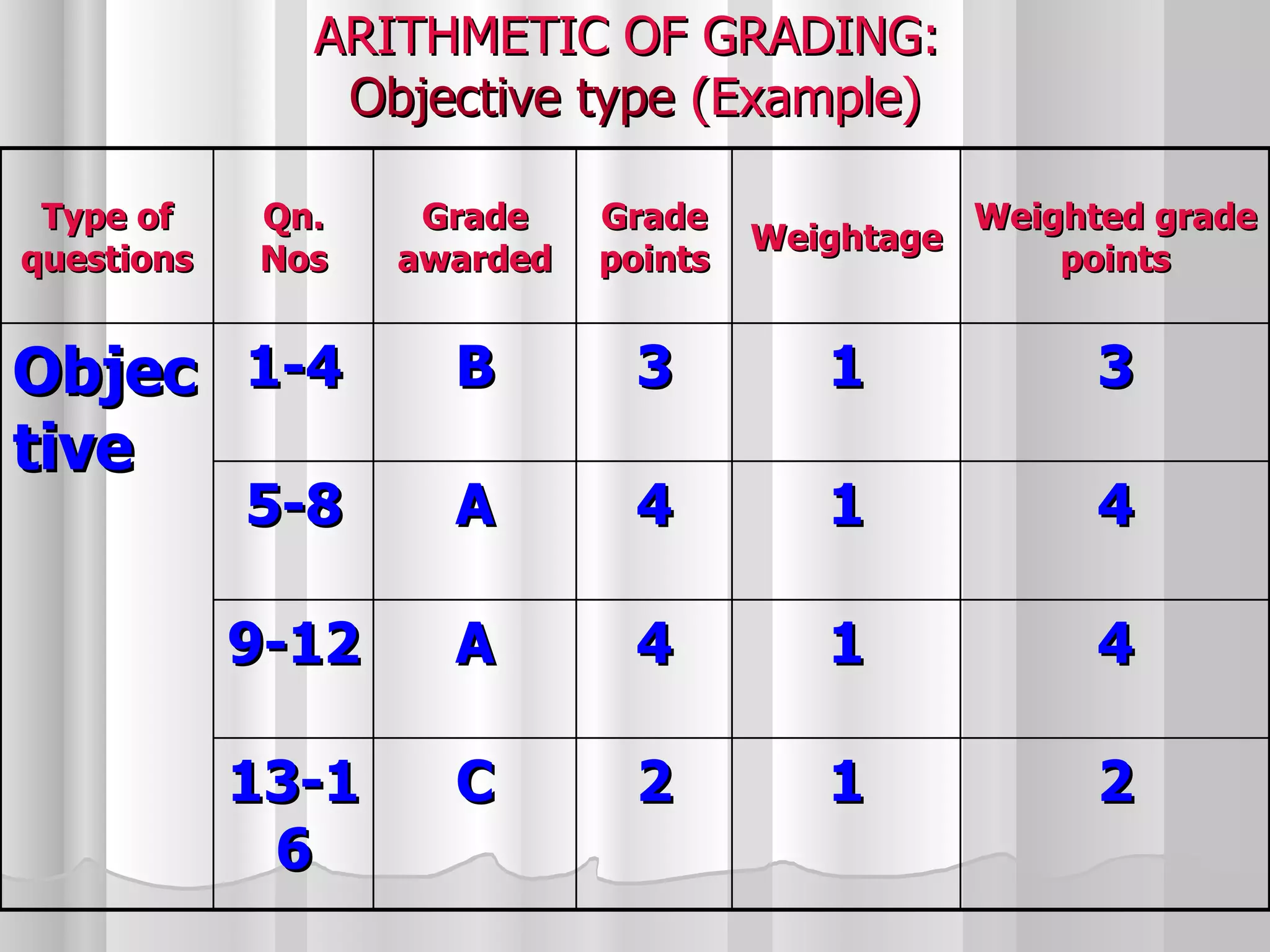
ARITHMETIC OF GRADING:  Objective type   (Example) Type of questions Qn. Nos Grade awarded Grade points Weightage Weighted grade points Objective 1-4 B 3 1 3 5-8 A 4 1 4 9-12 A 4 1 4 13-16 C 2 1 2
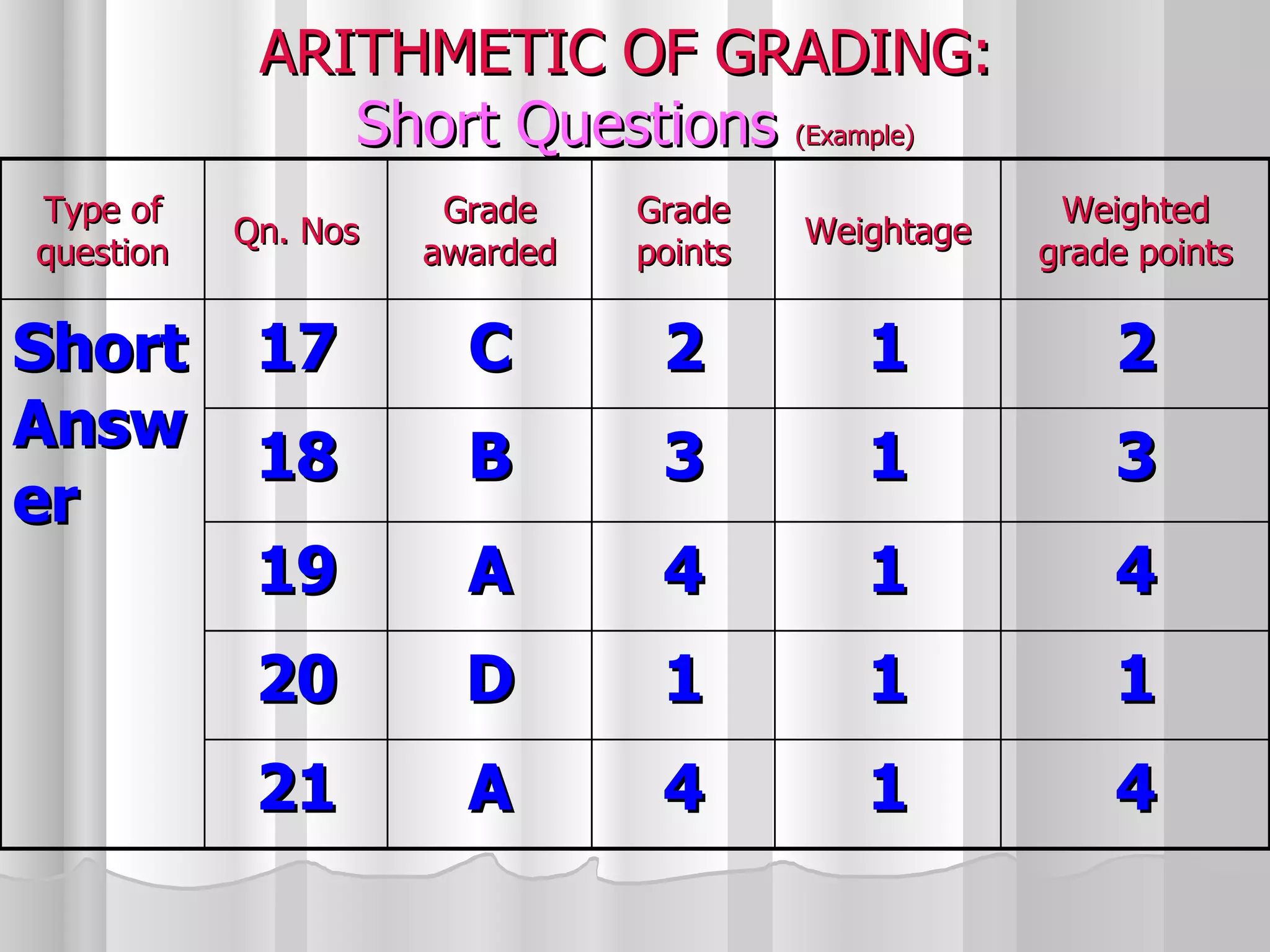
ARITHMETIC OF GRADING:  Short Questions   (Example) Type of question Qn. Nos Grade awarded Grade points Weightage Weighted grade points Short Answer 17 C 2 1 2 18 B 3 1 3 19 A 4 1 4 20 D 1 1 1 21 A 4 1 4
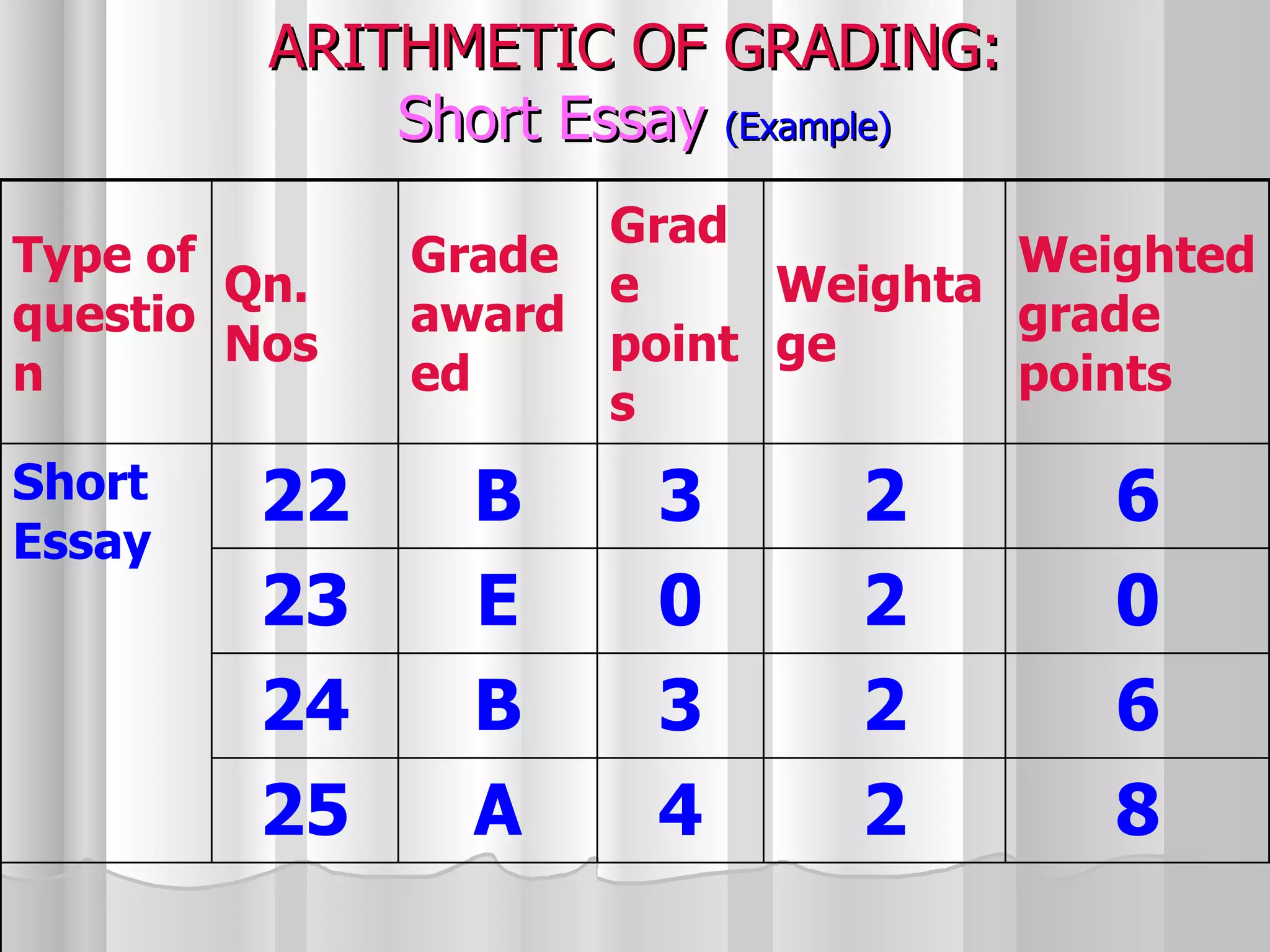
ARITHMETIC OF GRADING:   Short Essay  (Example) Type of question Qn. Nos Grade awarded Grade points Weightage Weighted grade points Short Essay  22 B 3 2 6 23 E 0 2 0 24 B 3 2 6 25 A 4 2 8
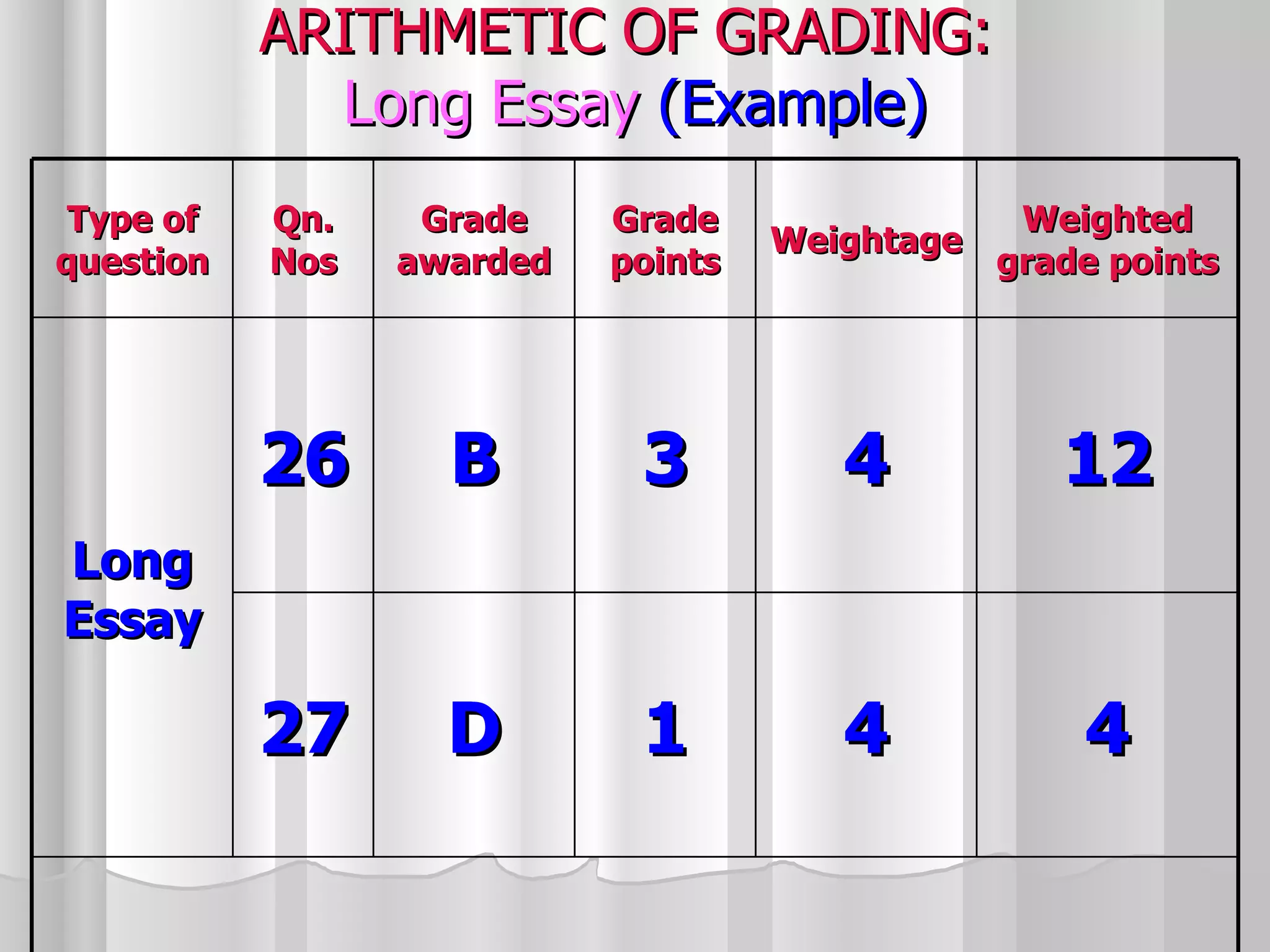
ARITHMETIC OF GRADING:   Long Essay  (Example) Type of question Qn. Nos Grade awarded Grade points Weightage Weighted grade points Long Essay 26 B 3 4 12 27 D 1 4 4
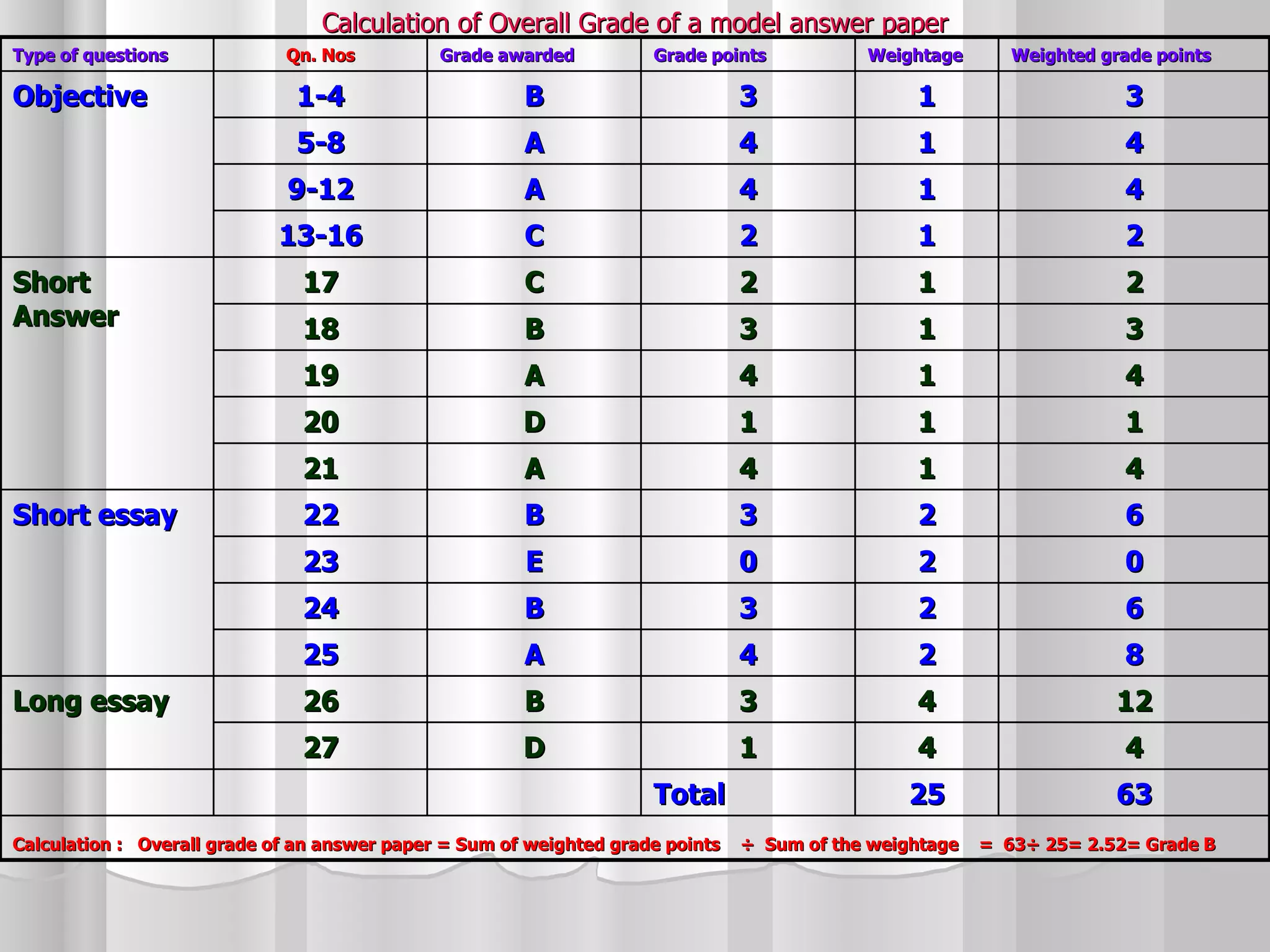
Calculation of Overall Grade of a model answer paper Type of questions Qn. Nos Grade awarded Grade points Weightage Weighted grade points Objective 1-4 B 3 1 3 5-8 A 4 1 4 9-12 A 4 1 4 13-16 C 2 1 2 Short Answer 17 C 2 1 2 18 B 3 1 3 19 A 4 1 4 20 D 1 1 1 21 A 4 1 4 Short essay  22 B 3 2 6 23 E 0 2 0 24 B 3 2 6 25 A 4 2 8 Long essay 26 B 3 4 12 27 D 1 4 4 Total 25 63 Calculation :  Overall grade of an answer paper = Sum of weighted grade points  ÷   Sum of the weightage  =  63 ÷  25= 2.52= Grade B
CALCULATING OVERALL GRADE OF A COURSE   (Theory)
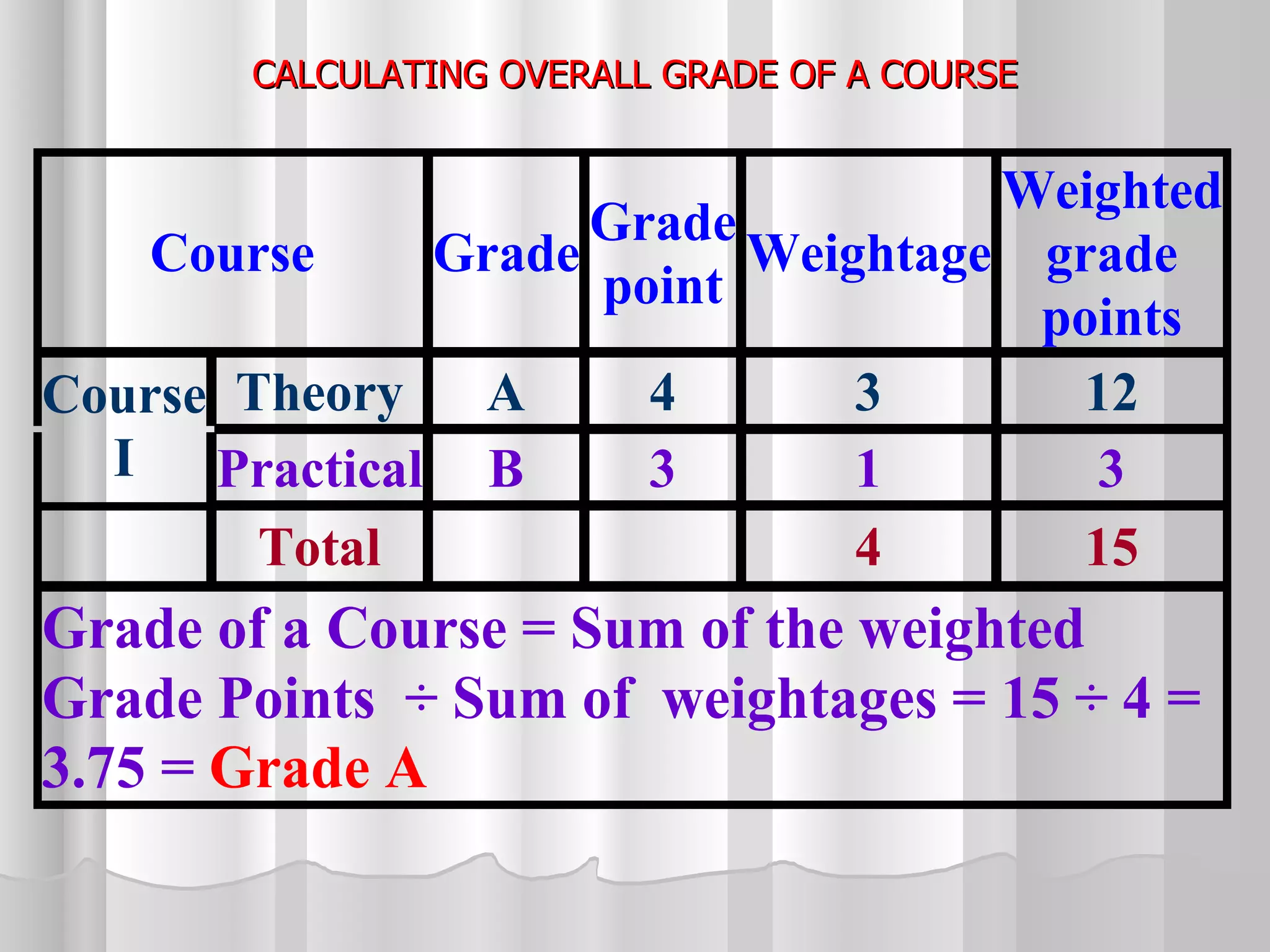
CALCULATING OVERALL GRADE OF A COURSE
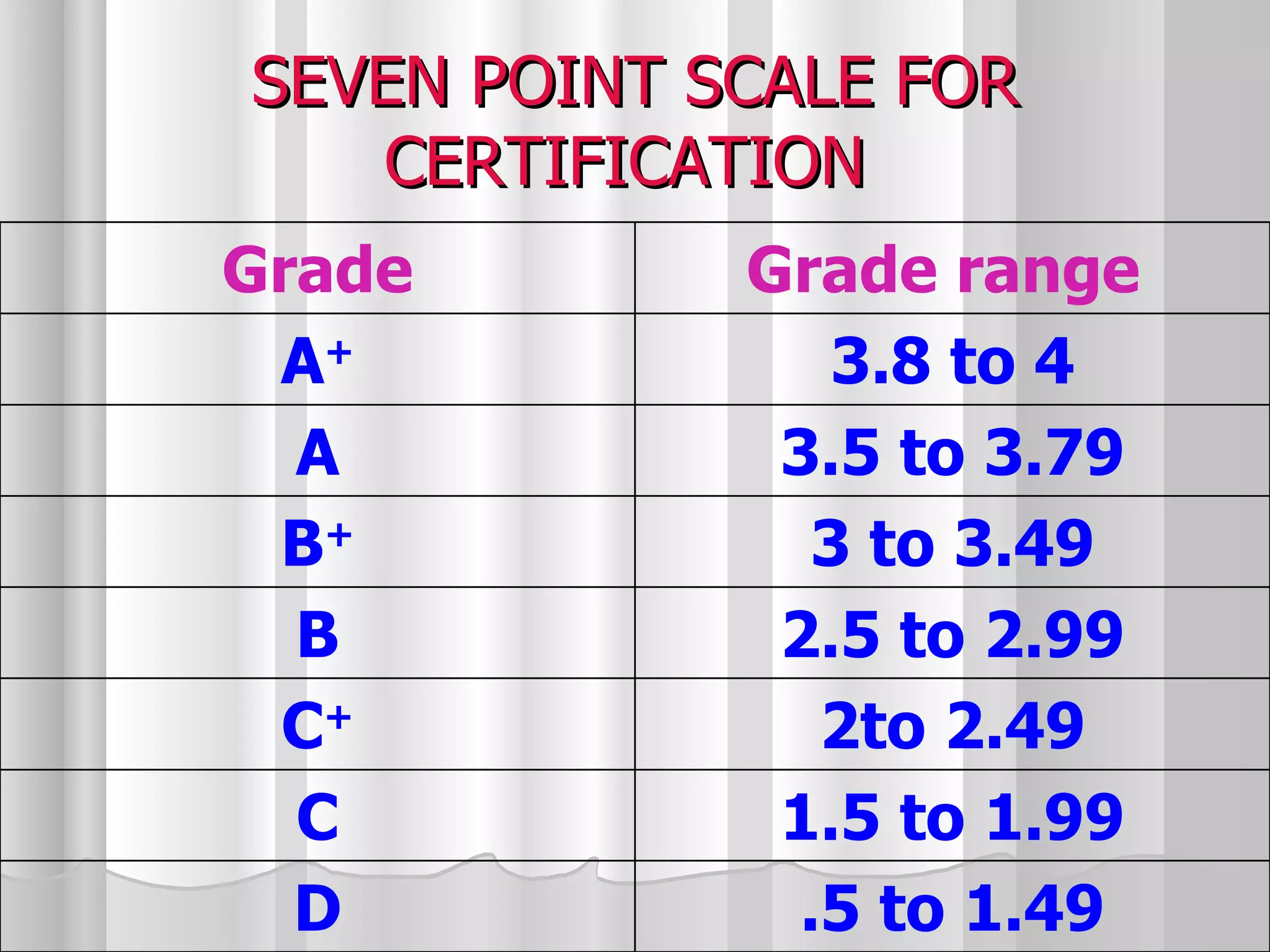
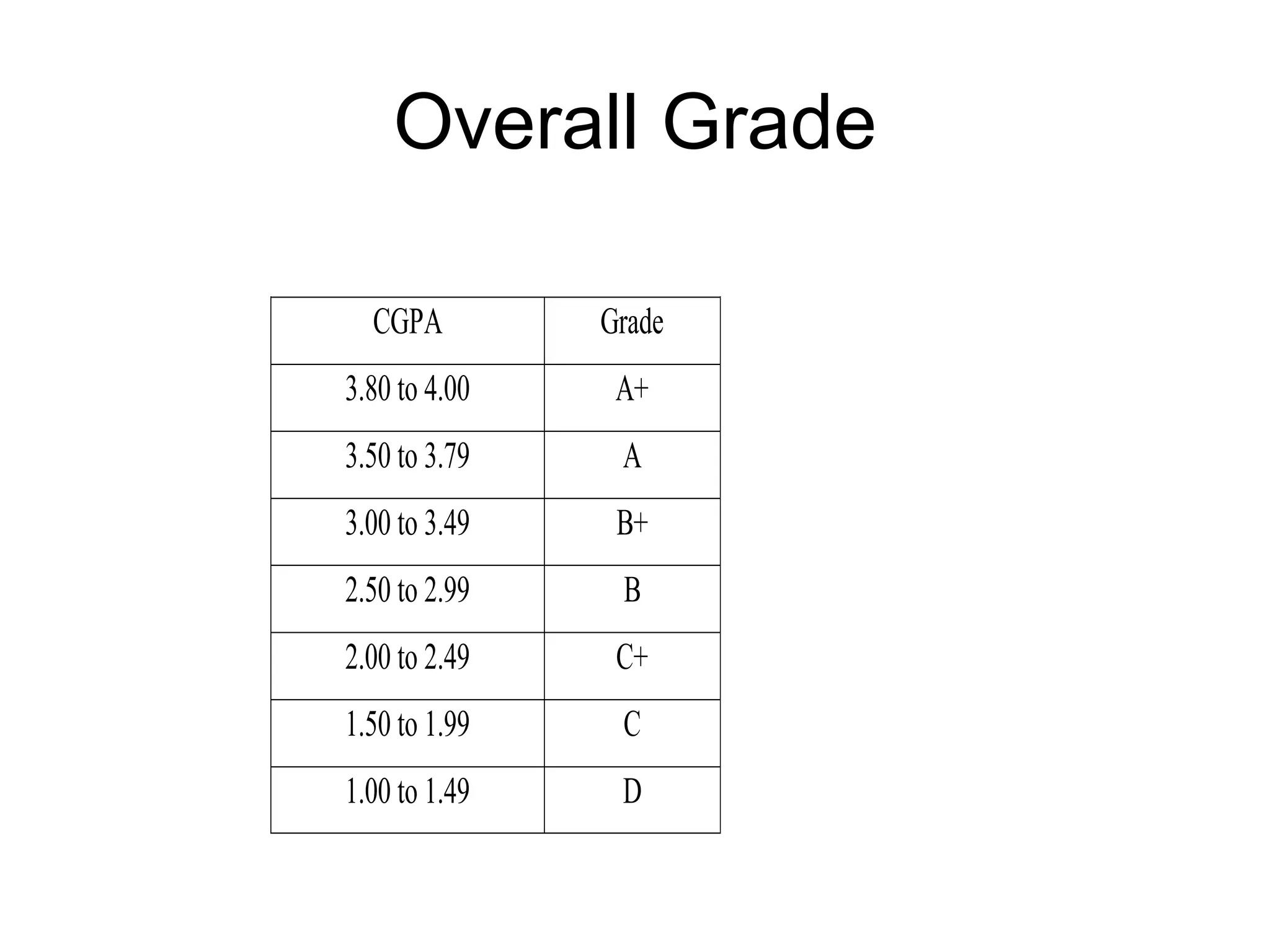
SEVEN POINT SCALE FOR CERTIFICATION   Grade Grade range  A + 3.8 to 4 A 3.5 to 3.79 B + 3 to 3.49 B 2.5 to 2.99 C + 2to 2.49 C 1.5 to 1.99 D .5 to 1.49
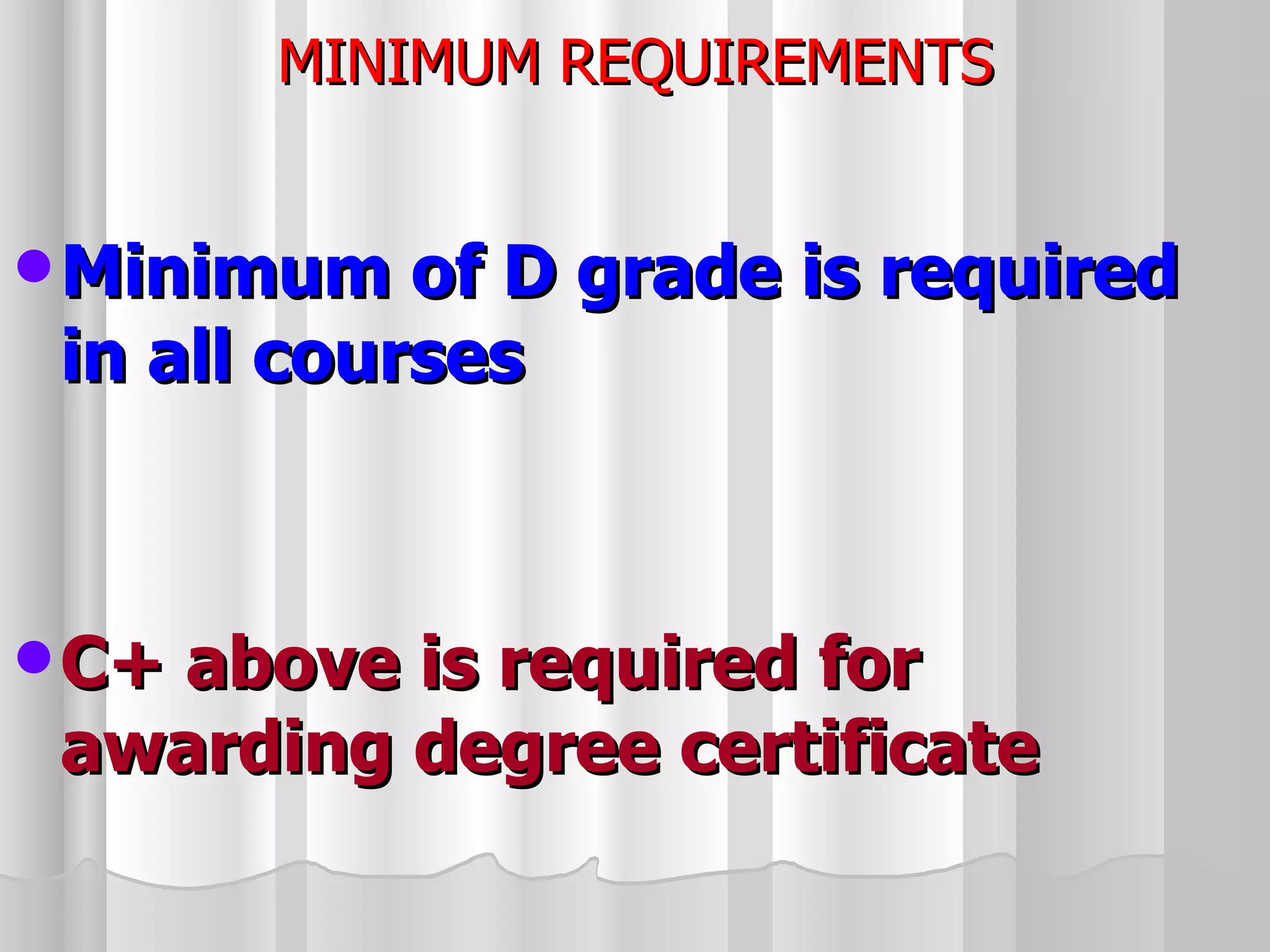
MINIMUM REQUIREMENTS Minimum of D grade is required in all courses C+ above is required for awarding degree certificate
Pattern of Questions
Grading
Overall Grade
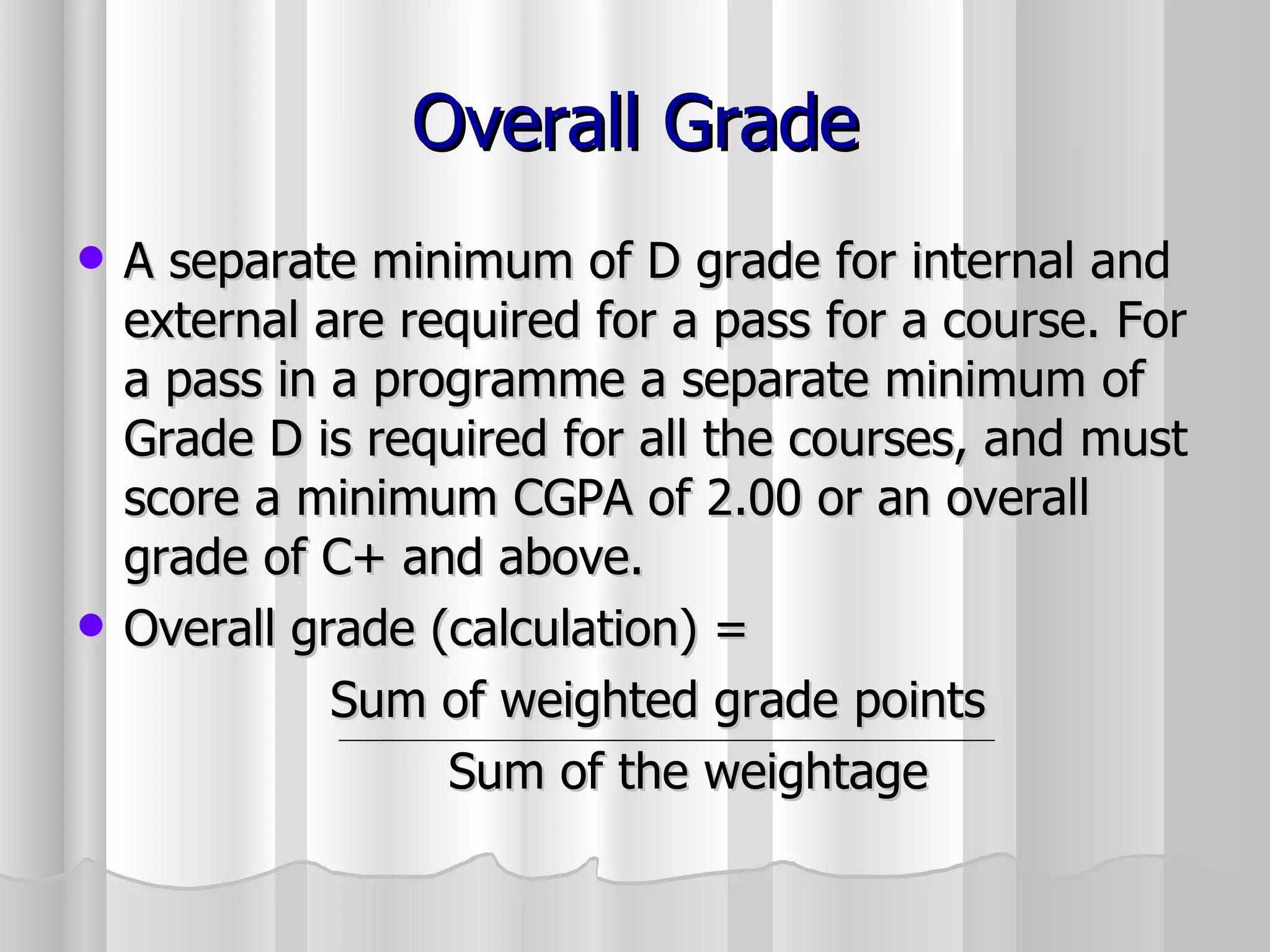
Overall Grade A separate minimum of D grade for internal and external are required for a pass for a course. For a pass in a programme a separate minimum of Grade D is required for all the courses, and must score a minimum CGPA of 2.00 or an overall grade of C+ and above. Overall grade (calculation) =  Sum of weighted grade points    Sum of the weightage

GRADING FOR BACHELOR DEGREE PRO GRAMME

  • 1.
    Credit and Semestersystem with Grading. BACHELOR OF EDCUATION DEGREE PROGRAMME
  • 2.
    Preliminaries The fourmajor aspects of the newly implemented B.Ed. degree programme are Semesterisation Credit System Continuous Assessment Grading
  • 3.
    Definitions Programme means a one year course of study and examinations spread over two semesters, the successful completion of which would lead to the award of a degree in education. Course means a segment of subject matter to be covered in a semester
  • 4.
    Definitions Common course means a course that comes under the category of courses which are compulsory – as specified for all students undergoing the B.Ed. Programme. Core course means a course in the subject of specialization in the B.Ed. degree programme. Complementary Elective course means a course which would enrich the B.Ed. programme.
  • 5.
    Definitions Semester System means, the B.Ed. Degree will have two semesters, with a semester break of atleast one month in between two semesters. There shall be 90 working days in each semester spread over 18 five day working weeks. In the Second Semester 30 working days for Teaching Practice. The time table may be set according to the day order system to provide optimal distribution of contact hours for all courses.
  • 6.
    Credit isa unit of academic input measured in terms of the weekly contact hours assigned to a course in a semester Grade means a letter symbol (e.g. A.B.C. etc) which indicates the broad level of performance of a student in an answer/course/semester/programme. Grade point (G) is an integer indicating the numerical equivalent of the letter grade
  • 7.
    Weightage isa numerical measure quantifying the comparative range of an answer or the comparative importance assigned to different components like theory and practical, internal and external examinations, Common, Core and Complementary, Elective etc. Credit point (C.) is the assigned credit of the course Weighted Credit point (P) is the value obtained by multiplying the grade point (G) by the credit (C.) ie. P = G×C
  • 8.
    Cumulative Grade PointAverage (CGPA) is the value obtained by dividing the sum of credit points in all the courses taken by the student for the entire programme by the total number of credits. CGPA indicates the broad level of academic performance of a student in a programme and is the index for ranking students. An overall letter grade 9 Cumulative Grade for the entire programme shall be awarded to a student depending on her/his CGPA. The CGPA shall be rounded off to two decimal places.
  • 9.
    Semester Grade Point Average (SGPA) is the value obtained by dividing the sum of the weighted credit points (p) obtained by a student in various courses taken in a semester by the total number of credits taken by him/her in that semester. The grade point shall be rounded off to two decimal places.
  • 10.
    Grade Point Average (GPA) is the value obtained by dividing the sum of the weighted grade points obtained by a student in an examination of a course in a semester by the total weightages taken in that examination. The grade point average shall be rounded off to two decimal places. Weighted Grade Point is the sum of grade point multiplied by weightage.
  • 11.
    Duration The durationof B.Ed. programme shall be 2 semesters. The duration of each semester shall be 90 days spread over 18 working weeks . First semester is from November to March and Second semester is from May to September. The Teaching practice which is a compulsory part of B. Ed. programme is scheduled in the second semester, for six weeks in a secondary/higher secondary school.
  • 12.
    A student maybe permitted to complete the programme, on valid reasons, within a period of 6 semesters from the date of commencement of the first semester of the programme. Medium of Instruction and Examination : The medium of instruction and examination of the course shall be English. However, candidates who desire to write the examination in Malayalam may be permitted to do so.
  • 13.
    Scheme of theProgramme The B.Ed. programme shall include (a) Common course (b) Core Course, (c) Complementary Elective Course (d) Teaching Competence (e) Co-curricular Activities and (f) Extension Activities.
  • 14.
    Structure of theB.Ed. Programme Programme Structure I Common courses II. Core courses III.Complementary Elective Course
  • 15.
    Course Summary ofthe B.Ed. programme.
  • 16.
  • 17.
    Common Courses EDU701 Philosophical and Sociological Bases of Education EDU 702 Psychological Bases of Education EDU 703 Modern Educational Practices
  • 18.
    EDU 801 Development andManagement of Education in India EDU 802 Personality Dynamics in Education EDU 803 Common Practical Work – Basic Skills in Child Study SUPW, Art Education, Health&Physical Education - Practical
  • 19.
    Core Courses EDU 704 Theoretical Bases of Education (Core Subjects) EDU 705 Approaches and Practices in Teaching (Core Subjects) EDU 804 Pedagogic Analysis (Core subjects) EDU 805 Preparatory Course in Teaching Competence (Core Subjects) - Practical EDU 806 Teaching Competence (Core Subjects) - Practical
  • 20.
    5.2.3 CoreSubjects 1. English Education 2. Malayalam Education 3. Hindi Education 4. Sanskrit Education 5. Arabic Education
  • 21.
    6. Mathematics Education7. Physical Science Education 8. Natural Science Education 9. Social Science Education 10. Commerce Education 11. Information Technology Education
  • 22.
    Complementary Elective Courses1. Environmental Education 2. Special Education 3. Health and Physical Education 4. Elementary Education 5. Guidance and Counselling
  • 23.
    Break – upof credits - Common Practical Work
  • 24.
    Break – upof credits - Preparatory course in Teaching Competence
  • 25.
    Break – upof credits -Teaching Competence
  • 26.
    Details of preparatorycourse Discussion lessons 5 lessons (rord) Demonstration lessons 5 lessons Criticism lessons 10 lessons Innovative lessons 2 lessons Micro lessons 3 lessons
  • 27.
    Teaching Competence TeachingPractice- 40 days TP with a minimum of 30 working days, a minimum of 30 lessons and related practical works Preparation of teaching aids- 2 charts,2models,2 transparencies& 1 pp with a minimum of 5 frames Viva-voce on teaching competence and common practical work
  • 28.
    Scheme of EvaluationThe academic growth of the student is evaluated through continuous internal assessment and end semester examination. 25% weightage is given for continuous internal assessment and 75% weightage for the end semester examination. In case of theory courses the continuous internal assessment will be done by the faculty.
  • 29.
    Scheme of EvaluationExcept for Viva voce in the case of practical courses, the internal and external ratio is 1 : 1 (50% : 50%) The practical examination will be done by the Board of practical examination constituted by the university. All students should appear before the Board of Practical Examination for external evaluation.
  • 30.
  • 31.
    ii) InternalEvaluation - 25% Attendance - 5% Test - 10% Assignments/Seminar/Project/Survey - 10%
  • 32.
    a) Attendance i) Those students who have a minimum of 75% average attendance for all the courses can register for the examination. Condonation of attendance to a maximum of 10 days or 50 hours in a semester subjected to a maximum of two times during the whole period of the programe may be granted by the university on valid grounds. This condonation shall not be counted for internal assessment. Student who is not eligible for condonation of attendance shall repeat the course along with the next batch.
  • 33.
    ii) Benefit ofattendance may be granted to students attending University/College union activities, participation in co-curricular activities by treating them as present for the days of absence, by the Head of the institution. This is limited to a maximum of 10 days and this benefit shall be considered for internal assessment also.
  • 34.
  • 35.
    b) Assignment/Seminar/Project/ Survey: The student has to take a minimum of one Assignment/Seminar/Project/ Survey per course. c) Class test. A minimum of 1 class test is to be attended per semester.
  • 36.
    B. PracticalAll students are to undergo 40 days of teaching practice with 30 lessons in their concerned core subjects. The concerned faculty shall evaluate the teaching competence of those student-teachers who have successfully completed the 40 days teaching practice with 30 lessons and other required practical work.
  • 37.
    The evaluation ofall components are to be published and to be acknowledged by the candidate. All documents of internal assessments are to be kept in the college for 2 years and shall be made available for verification by the university. The responsibility of evaluating the internal assessment is vested on the teachers who teach the course.
  • 38.
    External examination a. Theory The external examination of all semesters shall be conducted by the university at the close of each semester. b. Practical Practical examination shall be conducted by an external examination board constituted by the university. The external board shall observe and evaluate the teaching competency of all candidates
  • 39.
    The practical boardshall conduct viva voce for each candidate and award grades on the basis of the performance of the candidates and the quality of practical works on the basis of the following components. i) Teaching competence ii) Quality of practical works iii) Subject competency iv) Communication ability
  • 40.
    The physical educationteachers in the external board shall observe and evaluate the physical education classes of a stratified sample of 10% of the candidates conduct viva voce for another 10% sample of the candidate in the practical examination. There will be no supplementary exams. For appearance/improvement, students can appear along with the next batch.
  • 41.
    Student who registerhis/her name for the external exam for a semester will be eligible for promotion to the next semester. All programmes and courses shall have unique alphanumeric code. Each teacher working in affiliated institutions shall have a unique identification number and this no. is to be attached with the codes of the courses for which he/she can perform examination duty.
  • 42.
    ADVANTAGES OF GRADINGReducing subjectivity Raw assessment on a raw scale Improving quality of assessment
  • 43.
    TYPES OF GRADINGDirect Grading Indirect Grading
  • 44.
    DIRECT GRADING Eachanswer is graded with letters Grade letters are A, B, C, D and E
  • 45.
    INDIRECT GRADING:ABSOLUTE Marks awarded are classified into different grades Lead to distortions who score close to the margins
  • 46.
    INDIRECT GRADINGTwo types of indirect grading… Absolute Grading: Marks awarded on a 101 point scale are converted to a 5/7/9 point scale Relative grading: The scores awarded are normalized for proper distribution on the basis of pre-fixed pattern
  • 47.
    ADVANTAGES OF DIRECTGRADING Simplifies the process of assessment Makes a raw assessment on a raw scale Uses a uniform scale for the assessment of quality Separates assessment of quality and range
  • 48.
    MECHANICS OF DIRECTGRADING Assessment of quality on a five point scale for each question Assigning weightage depending on the nature of the question Calculation of weighted average Certification on a seven point scale
  • 49.
    PROCESS OF DIRECTGRADING (1) Each answer is graded with letters Weightage is then given based on the range of the question Grades and weightages are assigned numerical values The weighted grade points arrived by multiplying grade points by weightage
  • 50.
    PROCESS OF DIRECTGRADING (2 ) Sum of weighted grade points is divided by the sum of the weightage to arrive Grade Point Average (GPA) for the course Combining grades of different courses gives Cumulative Grade Point Average (CGPA) of an entire programme
  • 51.
    LETTER GRADES ANDGRADE POINTS LETTER GRADES GRADE POINTS A 4 B 3 C 2 D 1 E 0
  • 52.
    GRADES AND GRADEPOINTS (5 point scale) Grade Grade Points Grade Range A 4 3.5 to 4 B 3 2.5 to 3.49 C 2 1.5 to 2.49 D 1 0.5 to 1.49 E 0 < 0.5
  • 53.
    WEIGHTAGE Essays /Long answer questions : 4 Short essays / Problems : 2 Short answer questions : 1 B unch of 4 Objective type questions : 1 Weightage can also vary from component to component within a subject (Theory/Practical) OR Internal/External) OR subject to subject (Core/Complementary)
  • 54.
    CALCULATION OF WEIGHTEDAVERAGE The weighted grade points of an answer = Grade Points × Weightage Type of Question Grade awarded Grade point Weightage Weighted grade points Essay A 4 4 16 Short essay B 3 2 6 Short answer A 4 1 4 Objective type A 4 1 4
  • 55.
    ARITHMETIC OF GRADING: Objective type (Example) Type of questions Qn. Nos Grade awarded Grade points Weightage Weighted grade points Objective 1-4 B 3 1 3 5-8 A 4 1 4 9-12 A 4 1 4 13-16 C 2 1 2
  • 56.
    ARITHMETIC OF GRADING: Short Questions (Example) Type of question Qn. Nos Grade awarded Grade points Weightage Weighted grade points Short Answer 17 C 2 1 2 18 B 3 1 3 19 A 4 1 4 20 D 1 1 1 21 A 4 1 4
  • 57.
    ARITHMETIC OF GRADING: Short Essay (Example) Type of question Qn. Nos Grade awarded Grade points Weightage Weighted grade points Short Essay 22 B 3 2 6 23 E 0 2 0 24 B 3 2 6 25 A 4 2 8
  • 58.
    ARITHMETIC OF GRADING: Long Essay (Example) Type of question Qn. Nos Grade awarded Grade points Weightage Weighted grade points Long Essay 26 B 3 4 12 27 D 1 4 4
  • 59.
    Calculation of OverallGrade of a model answer paper Type of questions Qn. Nos Grade awarded Grade points Weightage Weighted grade points Objective 1-4 B 3 1 3 5-8 A 4 1 4 9-12 A 4 1 4 13-16 C 2 1 2 Short Answer 17 C 2 1 2 18 B 3 1 3 19 A 4 1 4 20 D 1 1 1 21 A 4 1 4 Short essay 22 B 3 2 6 23 E 0 2 0 24 B 3 2 6 25 A 4 2 8 Long essay 26 B 3 4 12 27 D 1 4 4 Total 25 63 Calculation : Overall grade of an answer paper = Sum of weighted grade points ÷ Sum of the weightage = 63 ÷ 25= 2.52= Grade B
  • 60.
    CALCULATING OVERALL GRADEOF A COURSE (Theory)
  • 61.
  • 62.
    SEVEN POINT SCALEFOR CERTIFICATION Grade Grade range A + 3.8 to 4 A 3.5 to 3.79 B + 3 to 3.49 B 2.5 to 2.99 C + 2to 2.49 C 1.5 to 1.99 D .5 to 1.49
  • 63.
    MINIMUM REQUIREMENTS Minimumof D grade is required in all courses C+ above is required for awarding degree certificate
  • 64.
  • 65.
  • 66.
  • 67.
    Overall Grade Aseparate minimum of D grade for internal and external are required for a pass for a course. For a pass in a programme a separate minimum of Grade D is required for all the courses, and must score a minimum CGPA of 2.00 or an overall grade of C+ and above. Overall grade (calculation) = Sum of weighted grade points Sum of the weightage