
Mohammad Ali Khan
ID: 011131035
Jakir Hossain
ID: 011131036
Jannatul Ferdaus Happy
ID: 011131037
Batch: 32 Sem: 10
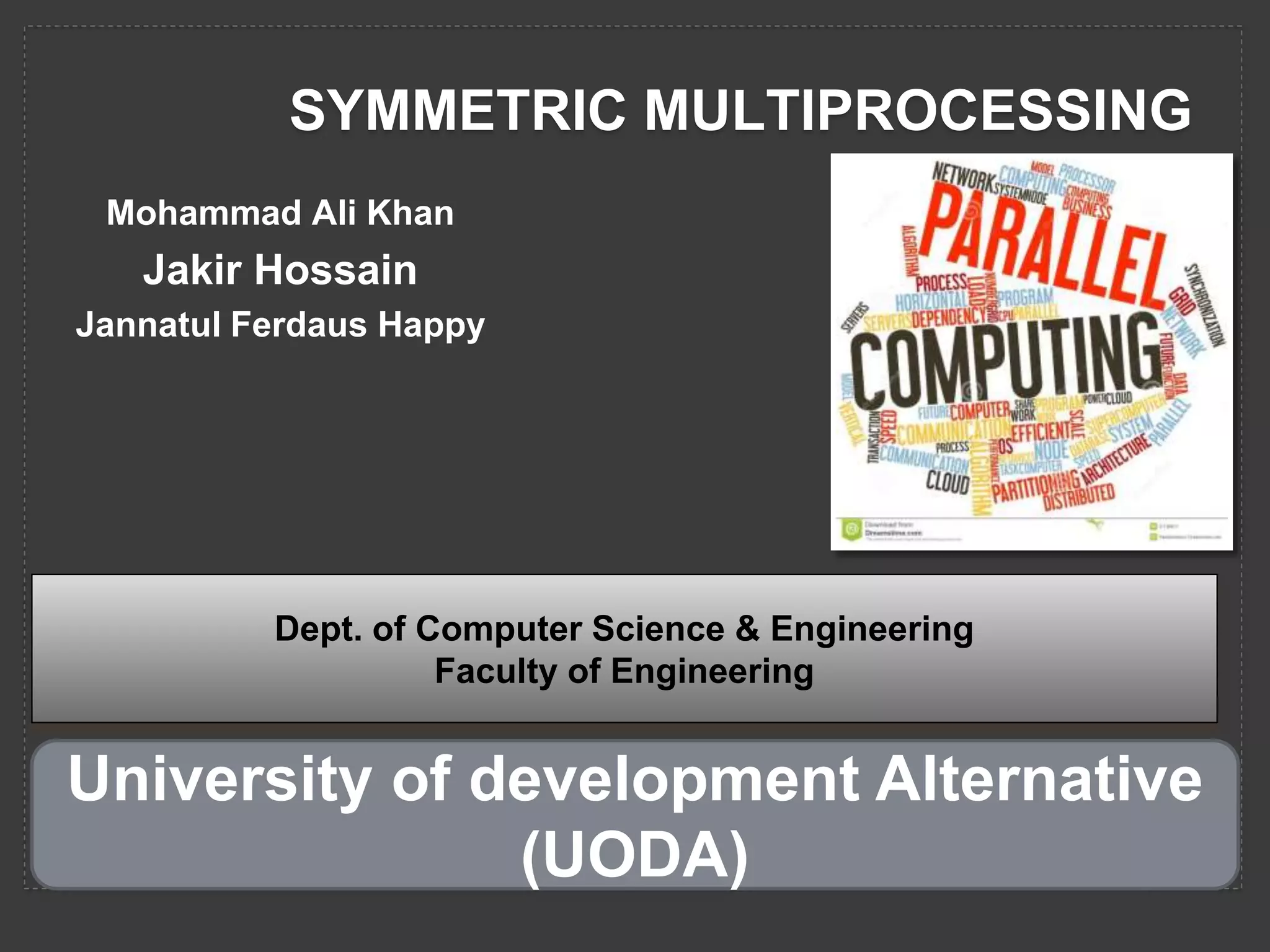
SYMMETRIC MULTIPROCESSING
Dept. of Computer Science & Engineering
Faculty of Engineering
University of development Alternative
(UODA)
PARALLEL COMPUTING
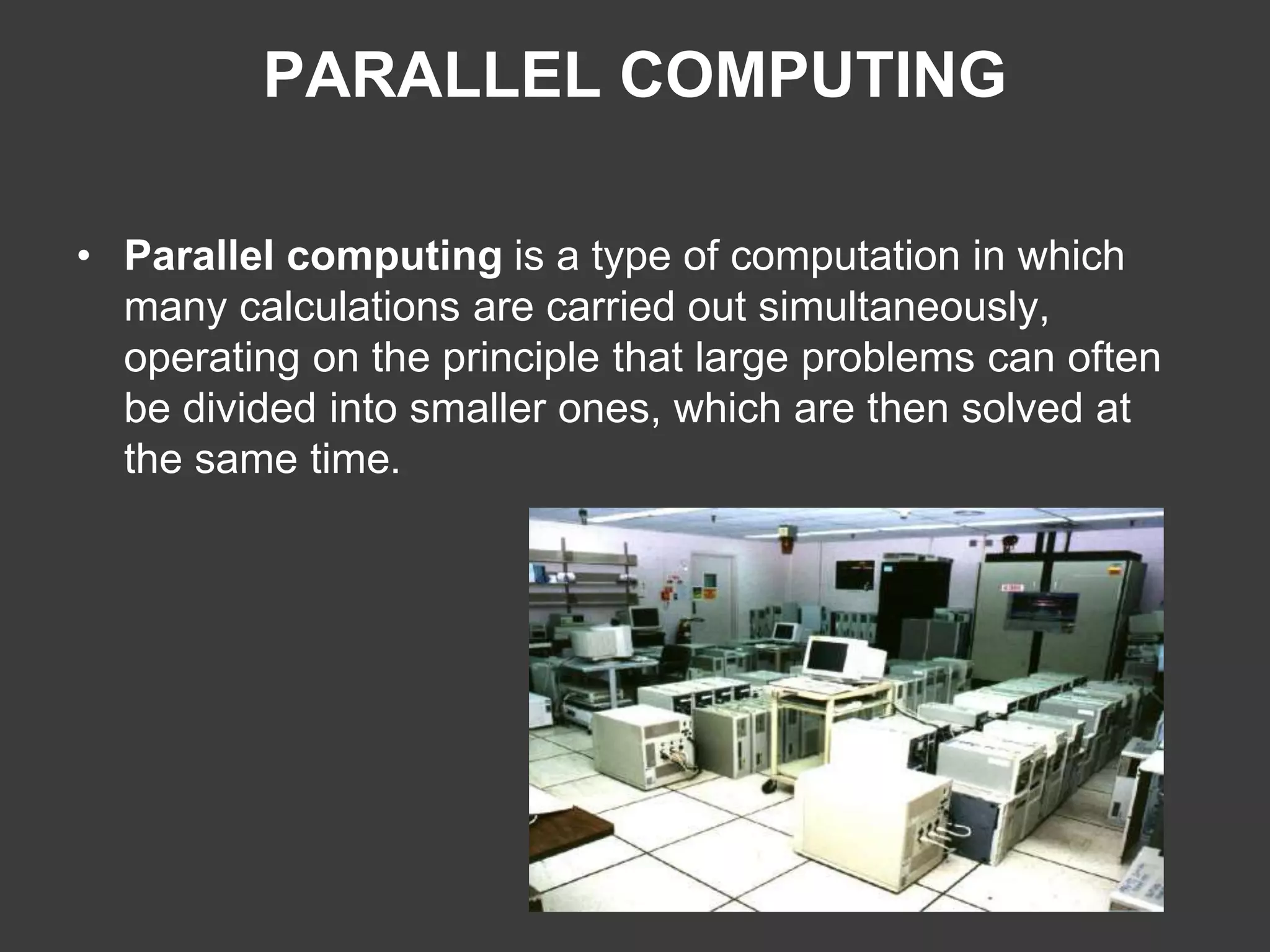
• Parallel computing is a type of computation in which
many calculations are carried out simultaneously,
operating on the principle that large problems can often
be divided into smaller ones, which are then solved at
the same time.
CLASSES OF PARALLEL COMPUTERS
 Multicore Computing
 Symmetric Multiprocessing
 Distributed Computing
 Cluster Computing
 Massive Parallel Processing
 Grid Computing
WHAT IS SMP (SYMMETRIC
MULTIPROCESSING)
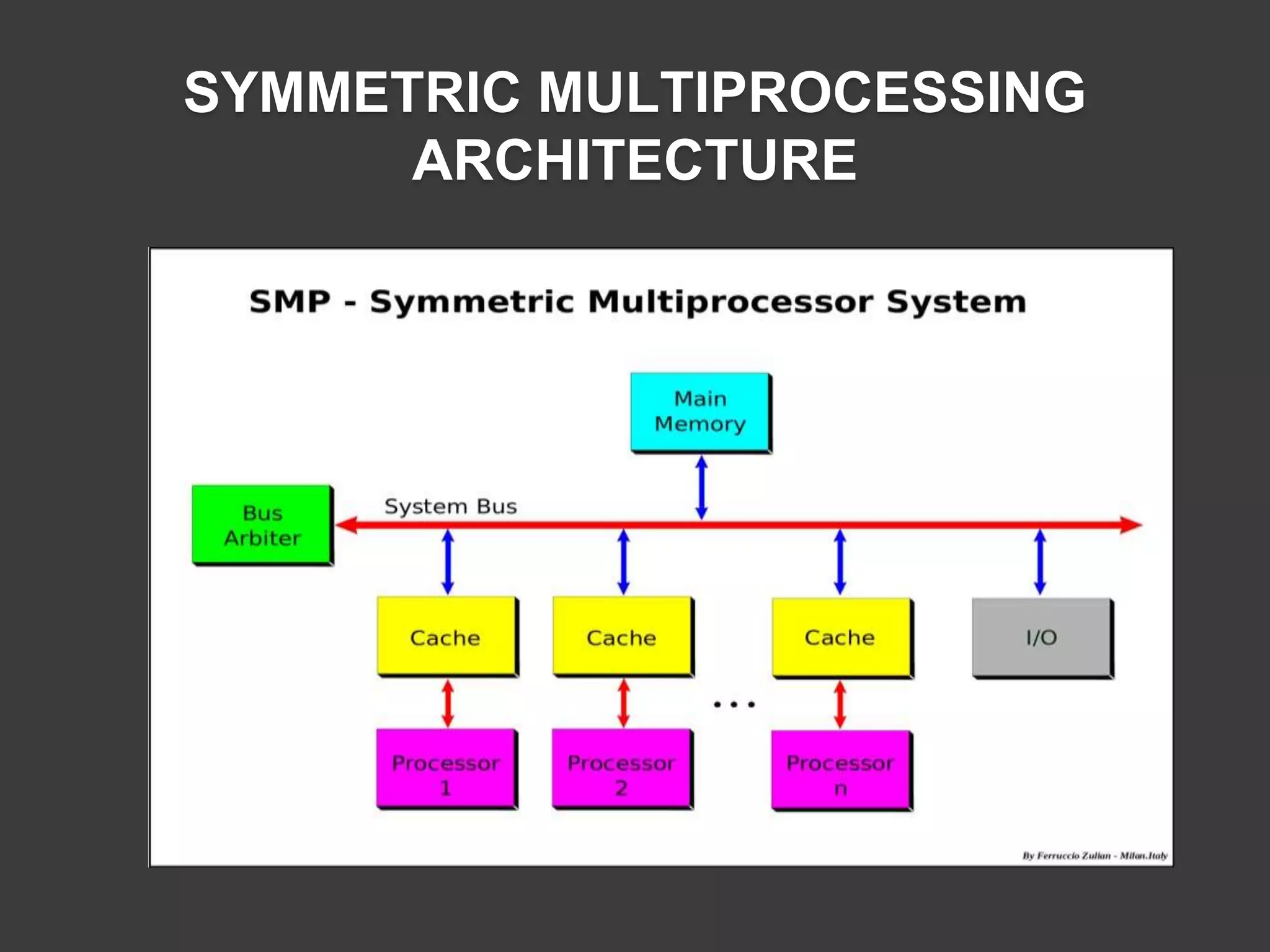
• SMP (symmetric multiprocessing) is the processing of programs by
multiple processors that share a common operating system and memory.
In symmetric (or "tightly coupled") multiprocessing, the processors share
memory and the I/O bus or data path. A single copy of the operating system
is in charge of all the processors.
SYMMETRIC MULTIPROCESSING
ARCHITECTURE
TYPES OF MULTIPROCESSING
Several categories of multiprocessing (MP) systems exist,
as below:
• Shared Nothing MP (pure cluster)
• Shared Disks MP
• Shared Memory Cluster (SMC)
• Shared Memory MP
Source:
http://ps-
2.kev009.com/wisclibrary/aix51/usr/share/man/info/en_US/a_doc_lib/aixbman/prftungd/2365c3
1.htm
Source:
http://scitechconnect.elsevier.com/asymmetric-multi-processing-amp-vs-symmetric-multi-processing-
smp/
SYMMETRIC VS. ASYMMETRIC
ADVANTAGES OF SMP (SYMMETRIC
MULTIPROCESSING)
Performance
Availability
Incremental Growth
Scaling
LIMITATION OF SMP (SYMMETRIC
MULTIPROCESSING)
There are some limitation of Symmetric
multiprocessing:
• The additional complexity in operating system
and possibly application software
• The Master CPU can become bottlenecked
Symmetric multiprocessing

Symmetric multiprocessing

  • 1.
    Mohammad Ali Khan ID:011131035 Jakir Hossain ID: 011131036 Jannatul Ferdaus Happy ID: 011131037 Batch: 32 Sem: 10 SYMMETRIC MULTIPROCESSING Dept. of Computer Science & Engineering Faculty of Engineering University of development Alternative (UODA)
  • 2.
    PARALLEL COMPUTING • Parallelcomputing is a type of computation in which many calculations are carried out simultaneously, operating on the principle that large problems can often be divided into smaller ones, which are then solved at the same time.
  • 3.
    CLASSES OF PARALLELCOMPUTERS  Multicore Computing  Symmetric Multiprocessing  Distributed Computing  Cluster Computing  Massive Parallel Processing  Grid Computing
  • 4.
    WHAT IS SMP(SYMMETRIC MULTIPROCESSING) • SMP (symmetric multiprocessing) is the processing of programs by multiple processors that share a common operating system and memory. In symmetric (or "tightly coupled") multiprocessing, the processors share memory and the I/O bus or data path. A single copy of the operating system is in charge of all the processors.
  • 5.
  • 6.
    TYPES OF MULTIPROCESSING Severalcategories of multiprocessing (MP) systems exist, as below: • Shared Nothing MP (pure cluster) • Shared Disks MP • Shared Memory Cluster (SMC) • Shared Memory MP Source: http://ps- 2.kev009.com/wisclibrary/aix51/usr/share/man/info/en_US/a_doc_lib/aixbman/prftungd/2365c3 1.htm
  • 7.
  • 8.
    ADVANTAGES OF SMP(SYMMETRIC MULTIPROCESSING) Performance Availability Incremental Growth Scaling
  • 9.
    LIMITATION OF SMP(SYMMETRIC MULTIPROCESSING) There are some limitation of Symmetric multiprocessing: • The additional complexity in operating system and possibly application software • The Master CPU can become bottlenecked