Objectives
• Definition
• Multi processor operating systems
• Multiprocessor operating systems type
• Advantages of multiprocessor
• Disadvantages of multiprocessor
• Difference between multiprocessors and multicomputer
In General
Different processors speed up the framework, since various activities can be
performed all the while. Asymmetric multiprocessing is basic, just a single
processor (principal) can get to the information structure. While symmetric
multiprocessing is perplexing as the information structure is divided among all
processors and each processor needs to work in simultaneousness.
Definition
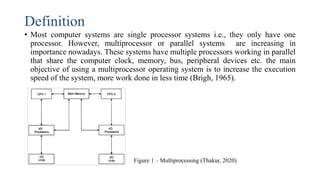
• Most computer systems are single processor systems i.e., they only have one
processor. However, multiprocessor or parallel systems are increasing in
importance nowadays. These systems have multiple processors working in parallel
that share the computer clock, memory, bus, peripheral devices etc. the main
objective of using a multiprocessor operating system is to increase the execution
speed of the system, more work done in less time (Brigh, 1965).
Figure 1 – Multiprocessing (Thakur, 2020)
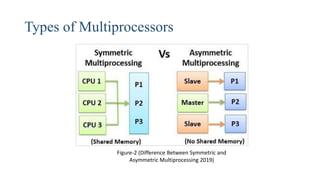
Types of Multiprocessors
• There are two main types of processors, which are divided into symmetrical and
asymmetric types, and as explained below:
• Symmetric
By analogue, each processor has an operating system similar to the rest of
the processors. It works in parallel in a peer-to-peer relationship. An example of
this type of processor is Encore in the Unix kernel.
• Asymmetric
“ each processor is given a predefined task. There is a master processor that
gives instruction to all the other processors. Asymmetric multiprocessor system
contains a master slave relationship.” (Castro, 2020).
Types of Multiprocessors
Figure-2 (Difference Between Symmetric and
Asymmetric Multiprocessing 2019)
Main Difference
• In asymmetric processors, the tasks in the operating system are handled by the
main processor and the main processor distributes the tasks to the rest of the
processors, while in similar processors the tasks are run in the operating system.
• In symmetric multiprocessing, each processor has a queue of ready processes and
processes can be taken from a common queue to be processed.
• In multiple symmetric processors they have the same structure, but in asymmetric
processors the structure of the processors is different.
Main Difference
• Symmetric processors communicate with each other through shared memory, and
in multiple asymmetric processors, they do not need to communicate with each
other, as they are controlled by the main processor.
• In the event of failure of the coprocessor in asymmetric processors, the processing
is transferred to the main processor, but in symmetric processors in case of failure,
the computing power of the system is reduced
Advantages of Multiprocessor
• High productivity
• Less electricity consumption
• High reliability
• Low cost to work
Disadvantages of Multiprocessor
• The complexity of communication architecture
( O.S it take care more processor In same time )
• Big Memory
• Deadlock
• Time Consuming in case of failure
Multiprocessors vs. Multicomputer
Multiprocessor
• Multiprocessor is simply computer that has more than one cpu up on its motherboard .
• Multiprocessing is the use of two or more central processing units cpu with single computer
systems .
• Multiprocessor have single physical address space memory shared by all the cpus
• Multiprocessor would run slower because it would be in one computer .
• Multiprocessor is single system with multiple cpu (Wolf, 2004).
Multiprocessors vs. Multicomputer
• Multicomputer
• A computer made up of several computers . Similar to parallel computing .
• Distributed computing deals with hardware and software systems containing more than one processing
element multiple programs running under loosely or tightly controlled regime .
• Multicomputer have one physical address space per cpu .
• It can run faster
• Is multiple computers each of which can have multiple processor used for true parallel processing
• A concept known as distributed fault-tolerance is introduced. A model of a large multiprocessor system is
developed and techniques, based on this model, are given by which each processing element can correctly
diagnose failures in all other processing elements in the system (Wolf, 2004).
References
• Brigh, H. S. (1965). A Philco multiprocessing system. Proceedings of the October 27-29, 1964, Fall Joint
Computer Conference, Part II: Very High Speed Computer Systems on XX - AFIPS ’64 (Fall, Part II).
https://doi.org/10.1145/1464039.1464051
• Thakur, D. (2020, August 10). Definition Multiprocessor Operating System. Computer Notes. Retrieved
September 22, 2022, from https://ecomputernotes.com/fundamental/disk-operating-
system/multiprocessor-operating-system
• Castro, K. (2020, June 21). Multiprocessor Systems. Tutorials Point. Retrieved September 24, 2022, from
https://www.tutorialspoint.com/Multiprocessor-Systems#
• Difference Between Symmetric and Asymmetric Multiprocessing (with Comparison Chart). (2019,
December 26). Tech Differences. Retrieved September 24, 2022, from
https://techdifferences.com/difference-between-symmetric-and-asymmetric-multiprocessing.html
• Rehman, J. (2021, November 4). Advantages and disadvantages of multiprocessor systems. IT Release.
Retrieved September 24, 2022, from https://www.itrelease.com/2020/06/advantages-and-disadvantages-
of-multiprocessor-systems/
• Wolf, W. (2004). The future of multiprocessor systems-on-chips. Proceedings of the 41st Annual
Conference on Design Automation - DAC ’04. https://doi.org/10.1145/996566.996753

OS multiprocessing1.pptx

  • 1.
    Objectives • Definition • Multiprocessor operating systems • Multiprocessor operating systems type • Advantages of multiprocessor • Disadvantages of multiprocessor • Difference between multiprocessors and multicomputer
  • 2.
    In General Different processorsspeed up the framework, since various activities can be performed all the while. Asymmetric multiprocessing is basic, just a single processor (principal) can get to the information structure. While symmetric multiprocessing is perplexing as the information structure is divided among all processors and each processor needs to work in simultaneousness.
  • 3.
    Definition • Most computersystems are single processor systems i.e., they only have one processor. However, multiprocessor or parallel systems are increasing in importance nowadays. These systems have multiple processors working in parallel that share the computer clock, memory, bus, peripheral devices etc. the main objective of using a multiprocessor operating system is to increase the execution speed of the system, more work done in less time (Brigh, 1965). Figure 1 – Multiprocessing (Thakur, 2020)
  • 4.
    Types of Multiprocessors •There are two main types of processors, which are divided into symmetrical and asymmetric types, and as explained below: • Symmetric By analogue, each processor has an operating system similar to the rest of the processors. It works in parallel in a peer-to-peer relationship. An example of this type of processor is Encore in the Unix kernel. • Asymmetric “ each processor is given a predefined task. There is a master processor that gives instruction to all the other processors. Asymmetric multiprocessor system contains a master slave relationship.” (Castro, 2020).
  • 5.
    Types of Multiprocessors Figure-2(Difference Between Symmetric and Asymmetric Multiprocessing 2019)
  • 6.
    Main Difference • Inasymmetric processors, the tasks in the operating system are handled by the main processor and the main processor distributes the tasks to the rest of the processors, while in similar processors the tasks are run in the operating system. • In symmetric multiprocessing, each processor has a queue of ready processes and processes can be taken from a common queue to be processed. • In multiple symmetric processors they have the same structure, but in asymmetric processors the structure of the processors is different.
  • 7.
    Main Difference • Symmetricprocessors communicate with each other through shared memory, and in multiple asymmetric processors, they do not need to communicate with each other, as they are controlled by the main processor. • In the event of failure of the coprocessor in asymmetric processors, the processing is transferred to the main processor, but in symmetric processors in case of failure, the computing power of the system is reduced
  • 8.
    Advantages of Multiprocessor •High productivity • Less electricity consumption • High reliability • Low cost to work
  • 9.
    Disadvantages of Multiprocessor •The complexity of communication architecture ( O.S it take care more processor In same time ) • Big Memory • Deadlock • Time Consuming in case of failure
  • 10.
    Multiprocessors vs. Multicomputer Multiprocessor •Multiprocessor is simply computer that has more than one cpu up on its motherboard . • Multiprocessing is the use of two or more central processing units cpu with single computer systems . • Multiprocessor have single physical address space memory shared by all the cpus • Multiprocessor would run slower because it would be in one computer . • Multiprocessor is single system with multiple cpu (Wolf, 2004).
  • 11.
    Multiprocessors vs. Multicomputer •Multicomputer • A computer made up of several computers . Similar to parallel computing . • Distributed computing deals with hardware and software systems containing more than one processing element multiple programs running under loosely or tightly controlled regime . • Multicomputer have one physical address space per cpu . • It can run faster • Is multiple computers each of which can have multiple processor used for true parallel processing • A concept known as distributed fault-tolerance is introduced. A model of a large multiprocessor system is developed and techniques, based on this model, are given by which each processing element can correctly diagnose failures in all other processing elements in the system (Wolf, 2004).
  • 12.
    References • Brigh, H.S. (1965). A Philco multiprocessing system. Proceedings of the October 27-29, 1964, Fall Joint Computer Conference, Part II: Very High Speed Computer Systems on XX - AFIPS ’64 (Fall, Part II). https://doi.org/10.1145/1464039.1464051 • Thakur, D. (2020, August 10). Definition Multiprocessor Operating System. Computer Notes. Retrieved September 22, 2022, from https://ecomputernotes.com/fundamental/disk-operating- system/multiprocessor-operating-system • Castro, K. (2020, June 21). Multiprocessor Systems. Tutorials Point. Retrieved September 24, 2022, from https://www.tutorialspoint.com/Multiprocessor-Systems# • Difference Between Symmetric and Asymmetric Multiprocessing (with Comparison Chart). (2019, December 26). Tech Differences. Retrieved September 24, 2022, from https://techdifferences.com/difference-between-symmetric-and-asymmetric-multiprocessing.html • Rehman, J. (2021, November 4). Advantages and disadvantages of multiprocessor systems. IT Release. Retrieved September 24, 2022, from https://www.itrelease.com/2020/06/advantages-and-disadvantages- of-multiprocessor-systems/ • Wolf, W. (2004). The future of multiprocessor systems-on-chips. Proceedings of the 41st Annual Conference on Design Automation - DAC ’04. https://doi.org/10.1145/996566.996753