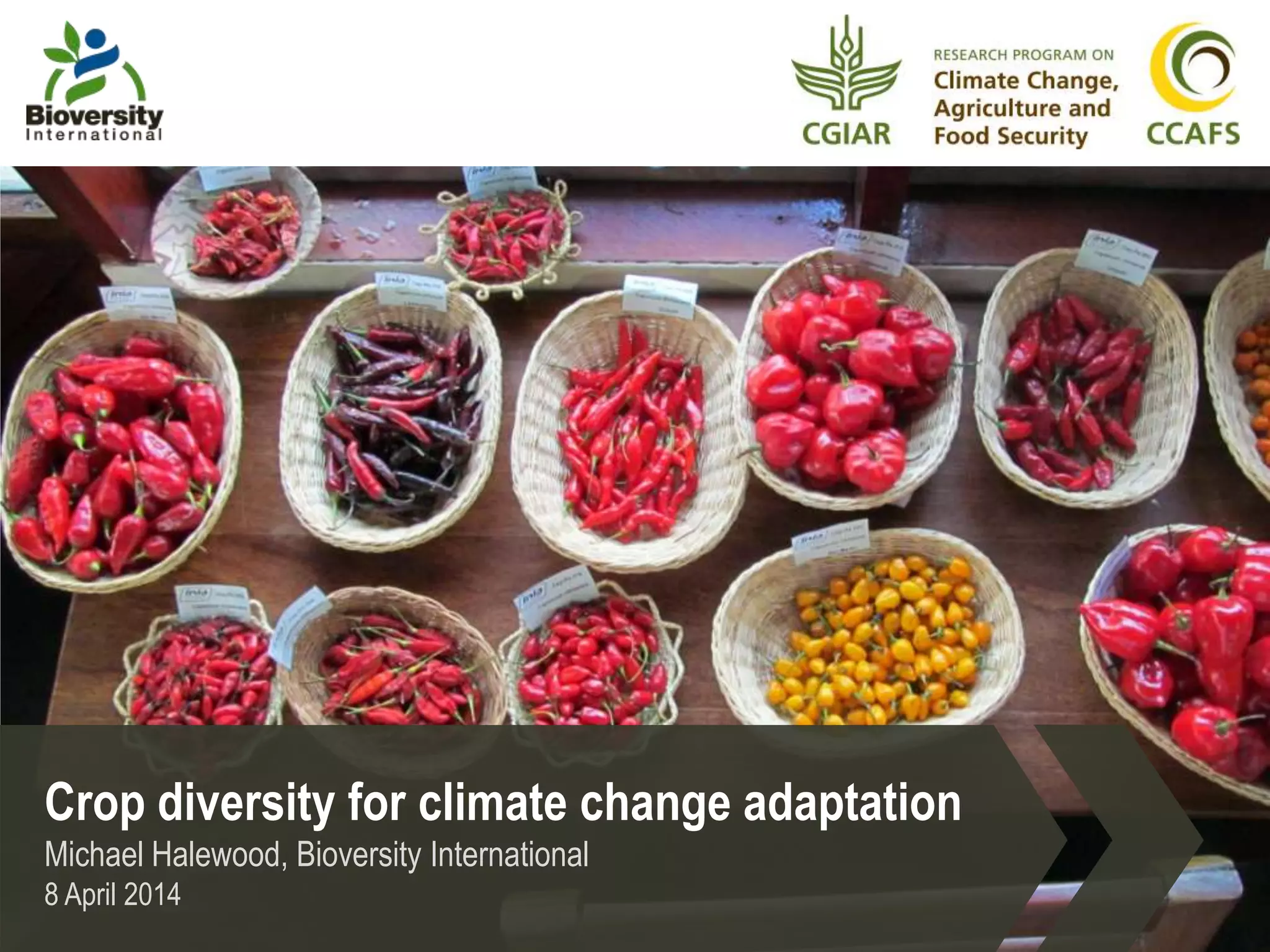
Crop diversity for climate change adaptation
Michael Halewood, Bioversity International
8 April 2014
• Led by the International Center for Tropical Agriculture (CIAT), Program
manager from University of Copenhagen, CCAFS is a collaboration among
all 15 CGIAR research centres with over 700 partners. Future earth is a
founding, executing partner.
• The program is carried out with funding support from governments and aid
agencies, both through the CGIAR Fund and bilaterally: 57 million in 2013
The CGIAR Research Program on Climate Change, Agriculture
and Food Security (CCAFS)
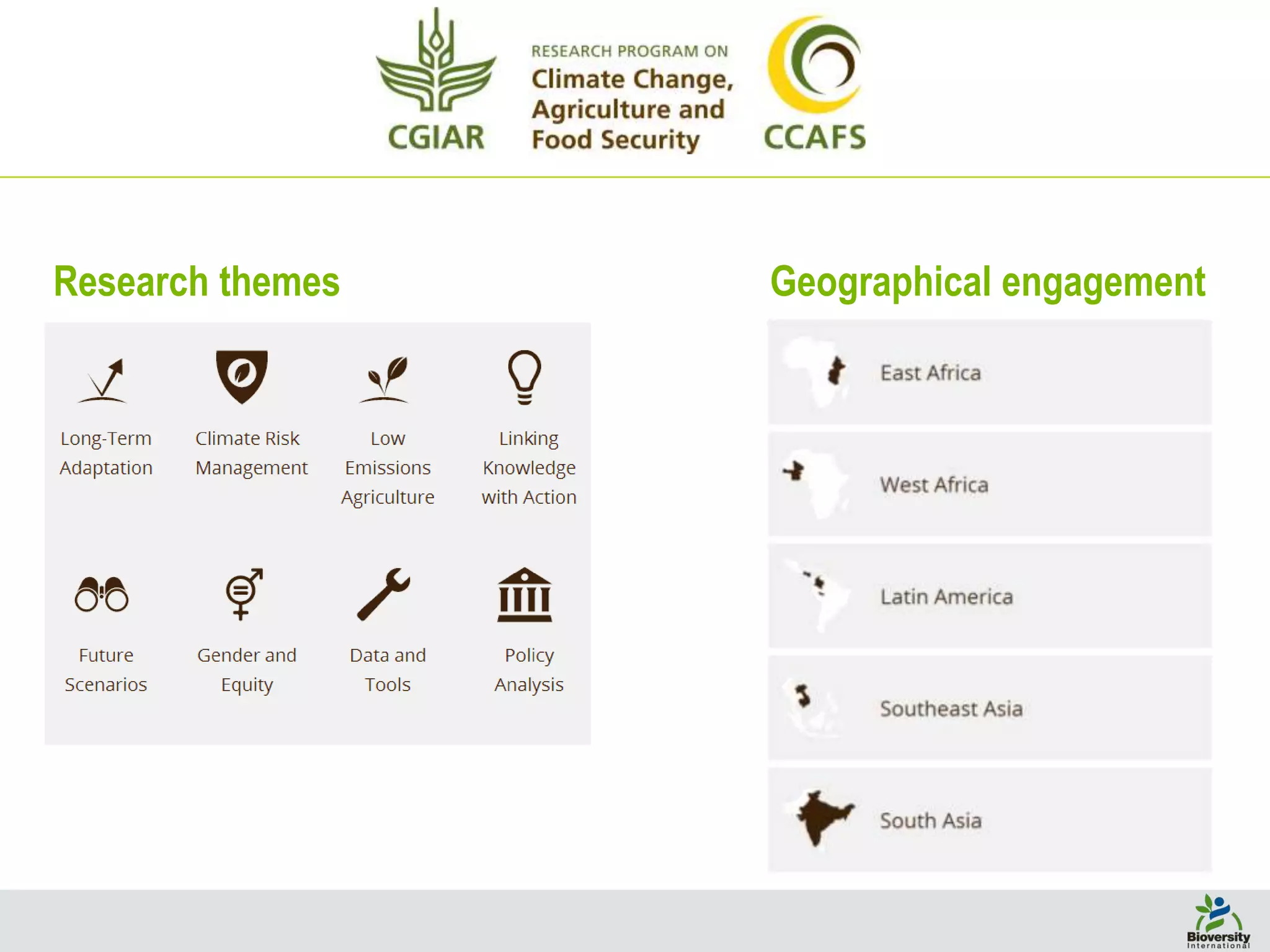
Research themes Geographical engagement
http://ccafs.cgiar.org/
Table of contents
• What do we know about use of crop diversity for adaptation?
• What are there knowledge gaps that need to be addressed?
• How is CCAFS addressing them?
• How will research results be translated into practice?
The CGIAR Research Program on Climate Change, Agriculture
and Food Security (CCAFS)
What we know
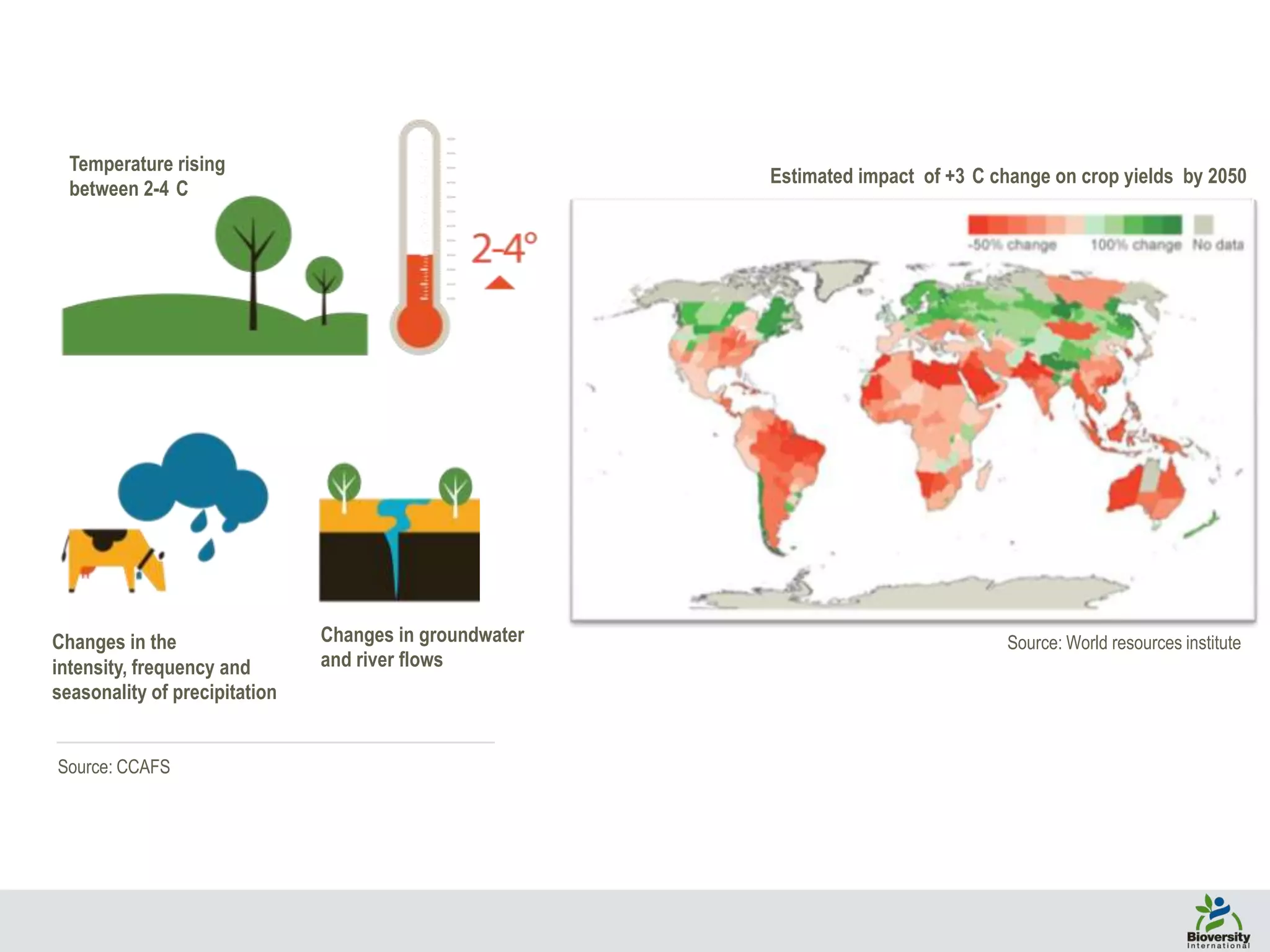
Estimated impact of +3 C change on crop yields by 2050
Source: World resources instituteChanges in the
intensity, frequency and
seasonality of precipitation
Changes in groundwater
and river flows
Temperature rising
between 2-4 C
Source: CCAFS
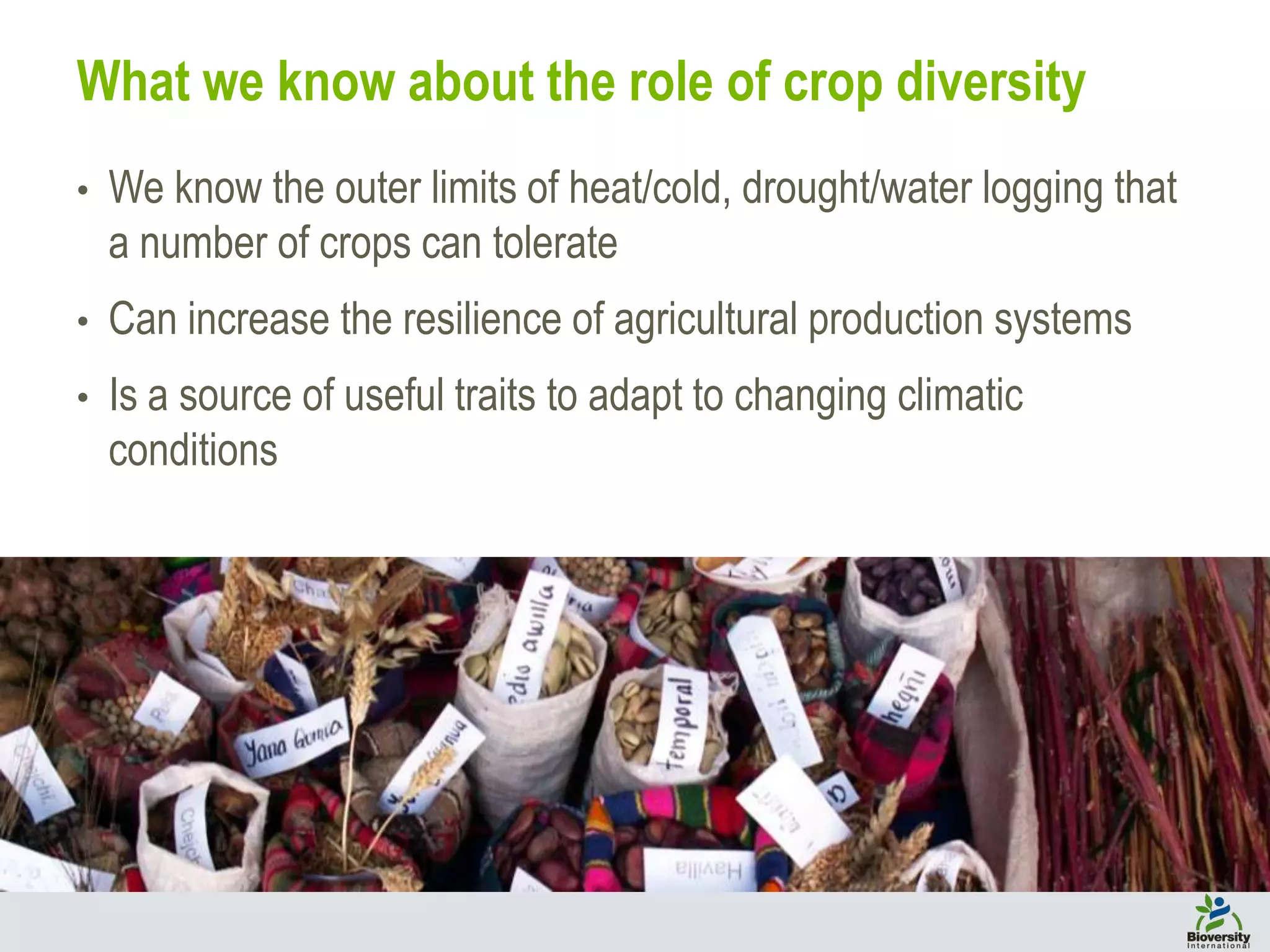
What we know about the role of crop diversity
• We know the outer limits of heat/cold, drought/water logging that
a number of crops can tolerate
• Can increase the resilience of agricultural production systems
• Is a source of useful traits to adapt to changing climatic
conditions
A static, one-time adaptation response is not enough: capacity
to continuously adapt is critical
Adaptive capacity must be continuous, rolling
What we know
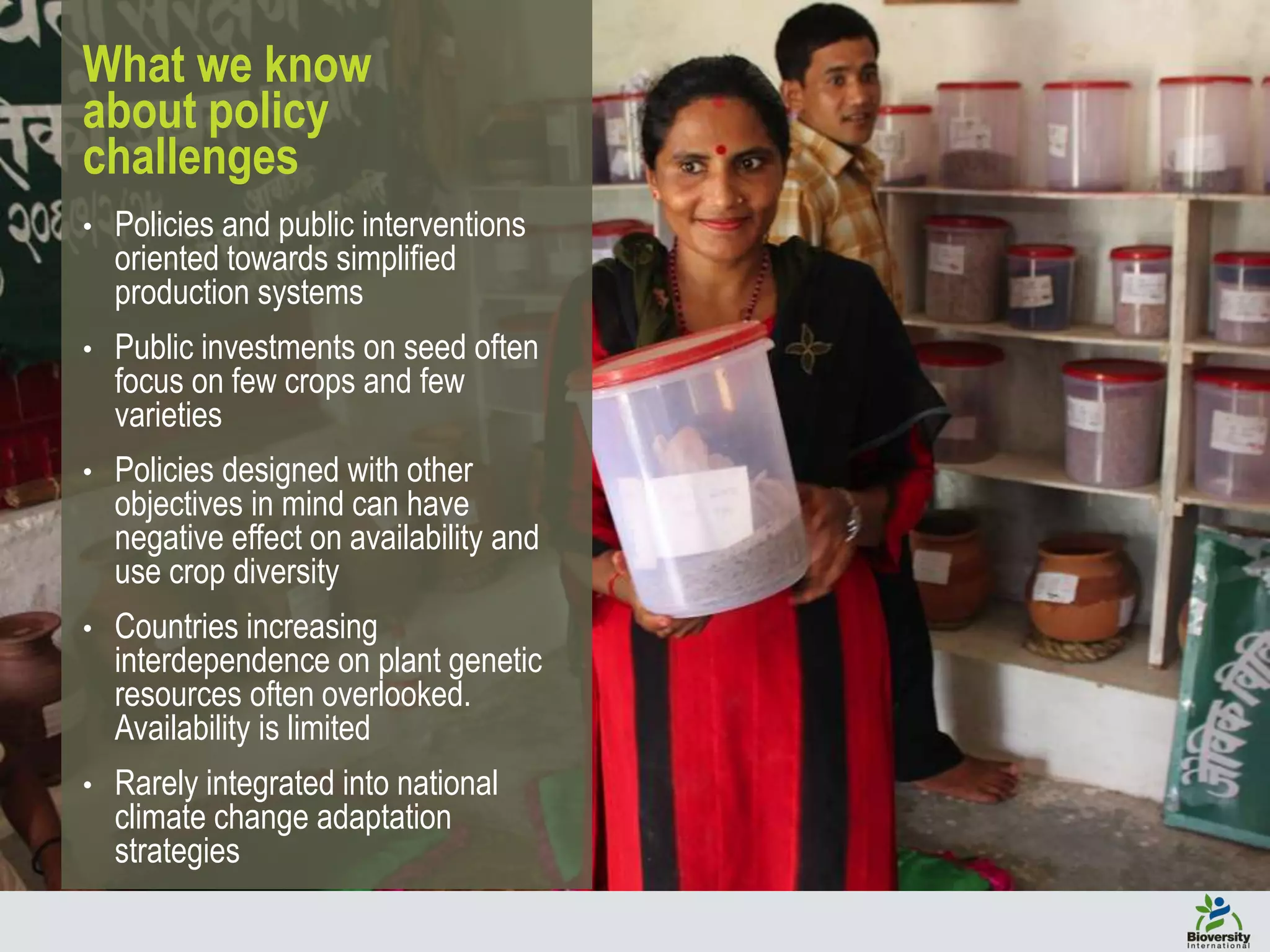
about policy
challenges
• Policies and public interventions
oriented towards simplified
production systems
• Public investments on seed often
focus on few crops and few
varieties
• Policies designed with other
objectives in mind can have
negative effect on availability and
use crop diversity
• Countries increasing
interdependence on plant genetic
resources often overlooked.
Availability is limited
• Rarely integrated into national
climate change adaptation
strategies
What we need to
investigate
• How to identify highest potential (in terms of adaptation) materials
in genebanks, farmers fields, breeding programmes?
• In what situations does crop diversity have high/low potential to
contribute to adaptation and farmers’ livelihoods?
• What diversity-based adaptation interventions have the most
potential to promote gender equity?
• What is the value of the gains that can be made through crop
diversification? How can such information be used for trade-off
decisions?
• How can we scale up projects so that large numbers of farmers can
deploy crop diversity to adapt to climate-related stresses?
Addressing
knowledge gaps
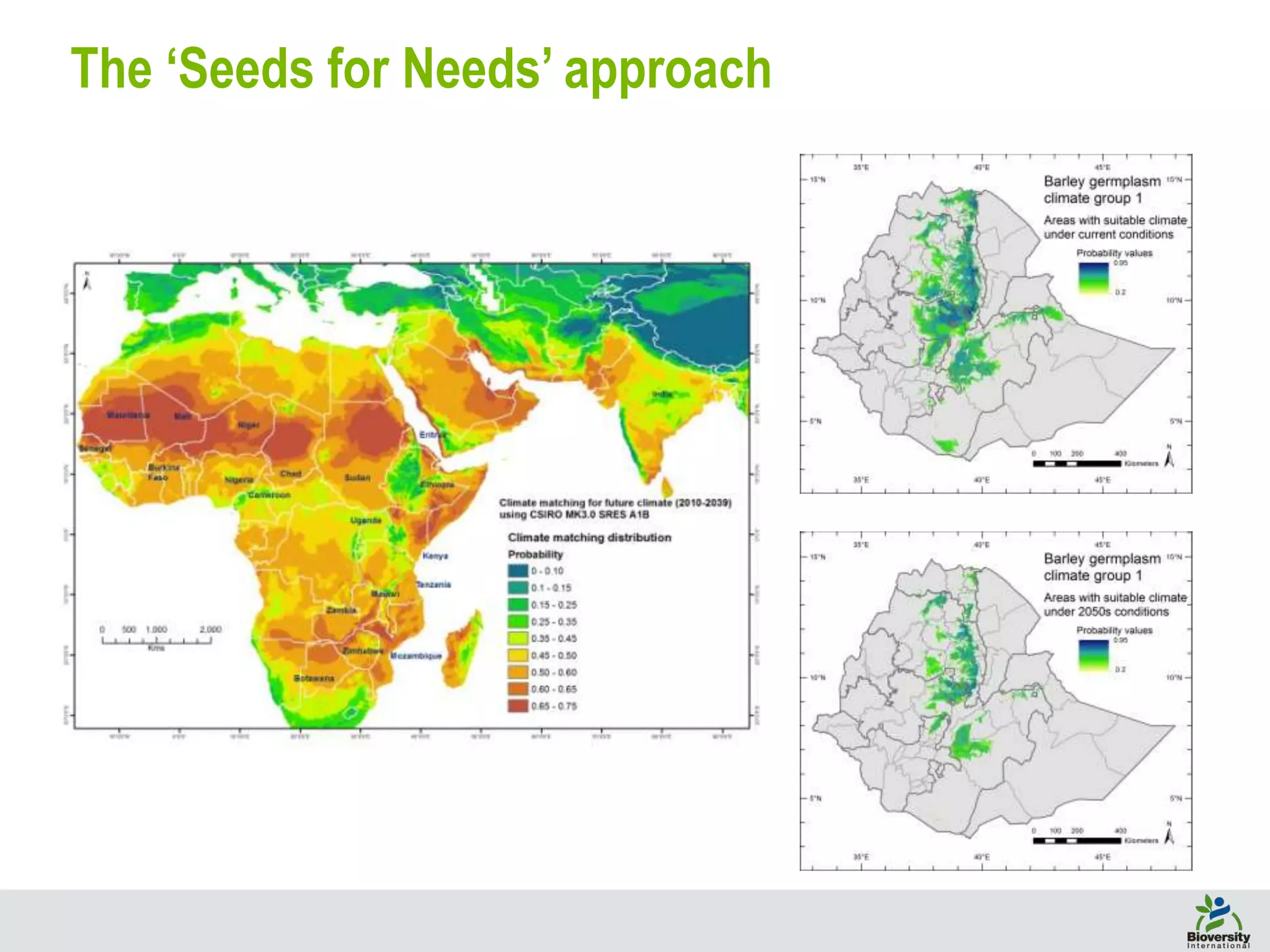
The ‘Seeds for Needs’ approach
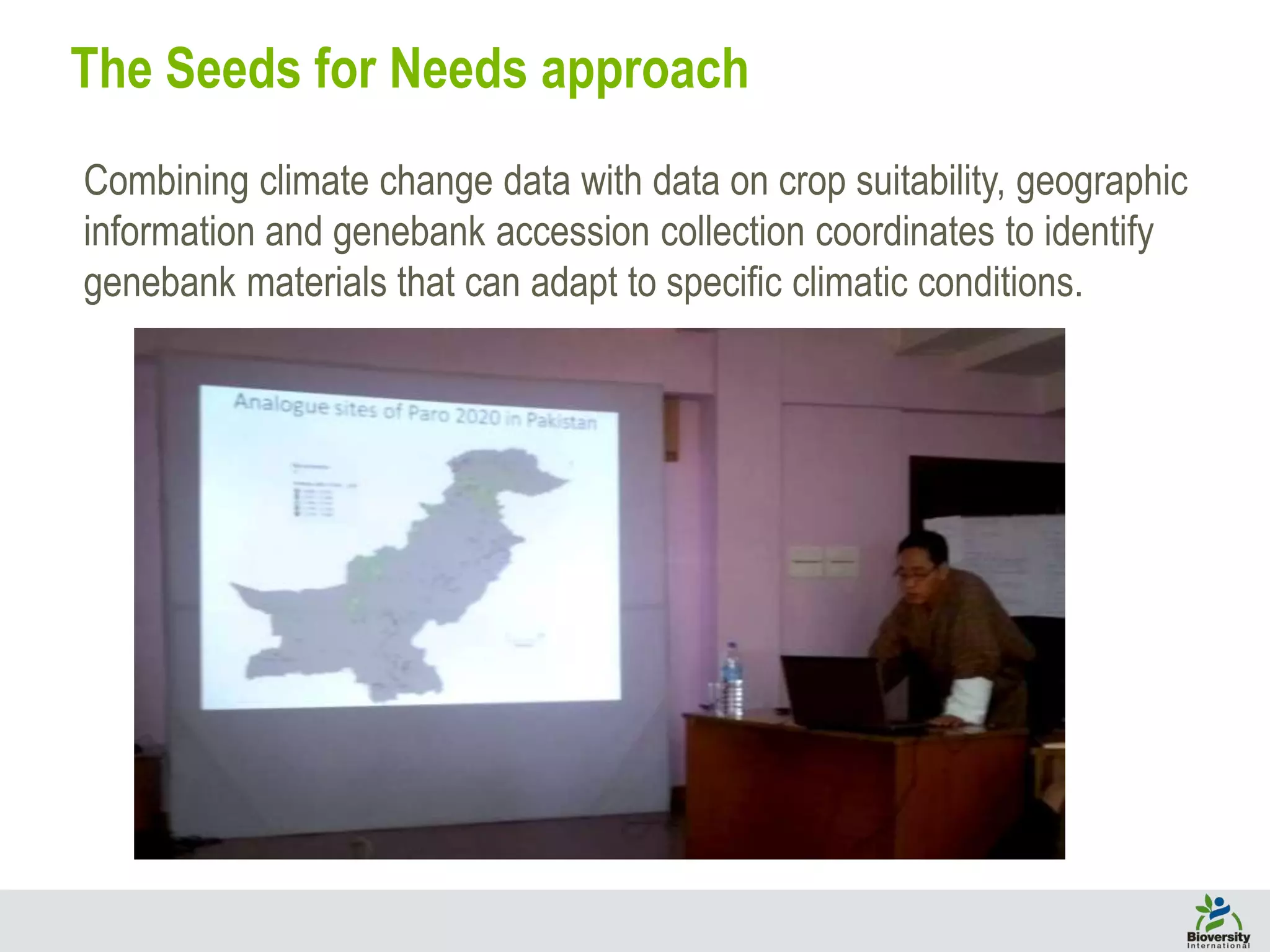
The Seeds for Needs approach
Combining climate change data with data on crop suitability, geographic
information and genebank accession collection coordinates to identify
genebank materials that can adapt to specific climatic conditions.
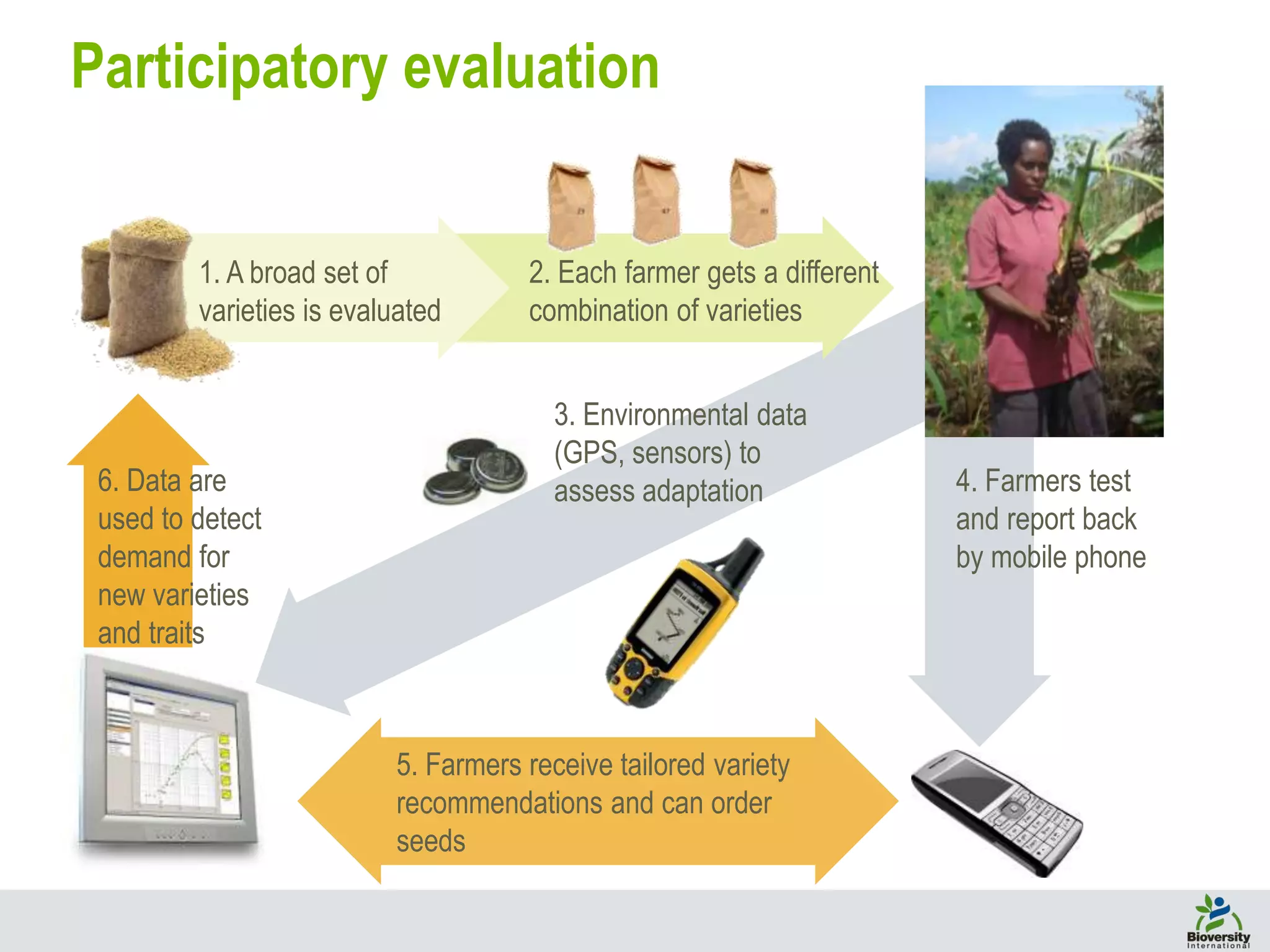
4. Farmers test
and report back
by mobile phone
2. Each farmer gets a different
combination of varieties
3. Environmental data
(GPS, sensors) to
assess adaptation
1. A broad set of
varieties is evaluated
6. Data are
used to detect
demand for
new varieties
and traits
5. Farmers receive tailored variety
recommendations and can order
seeds
Participatory evaluation
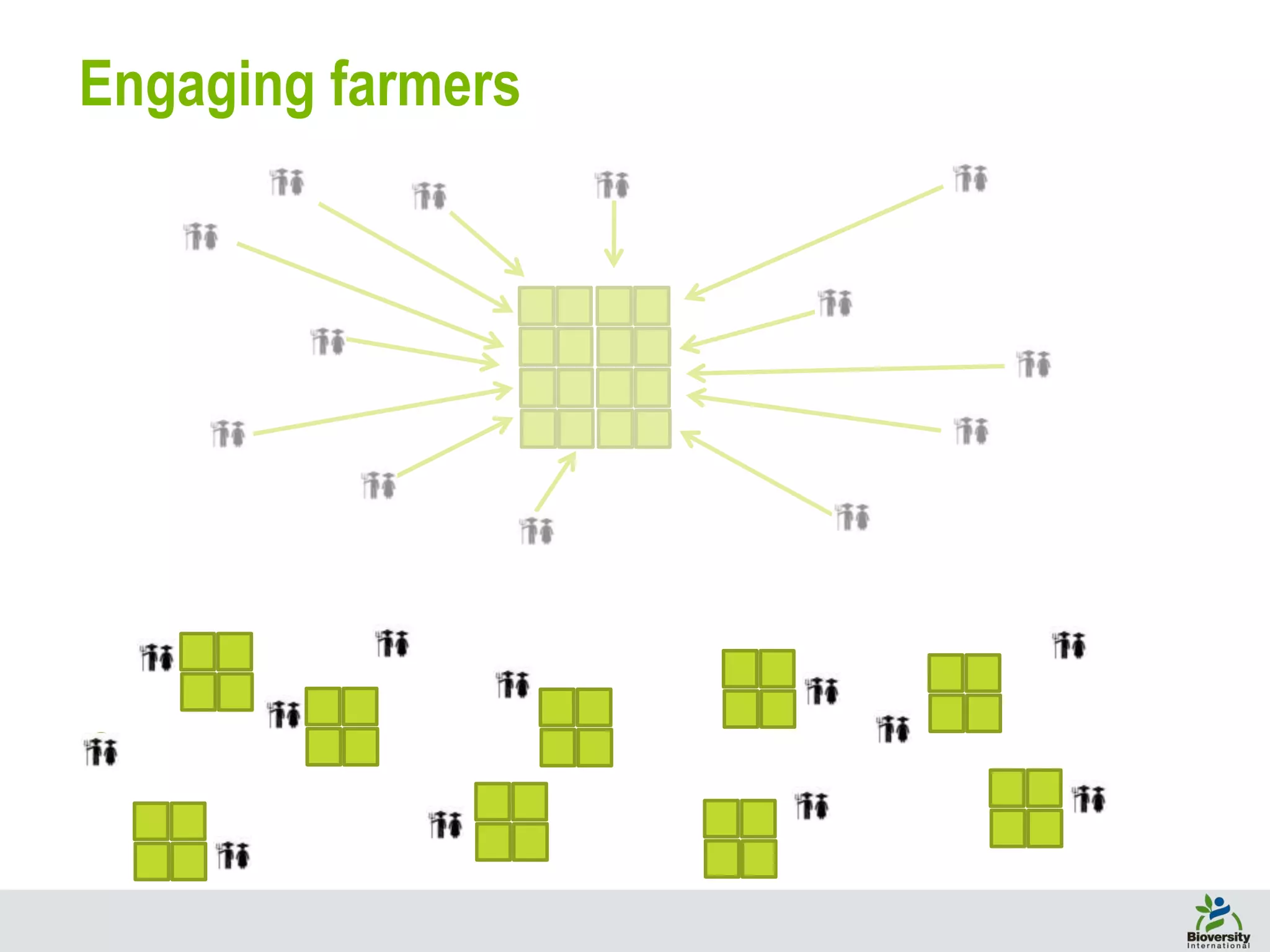
Engaging farmers
18
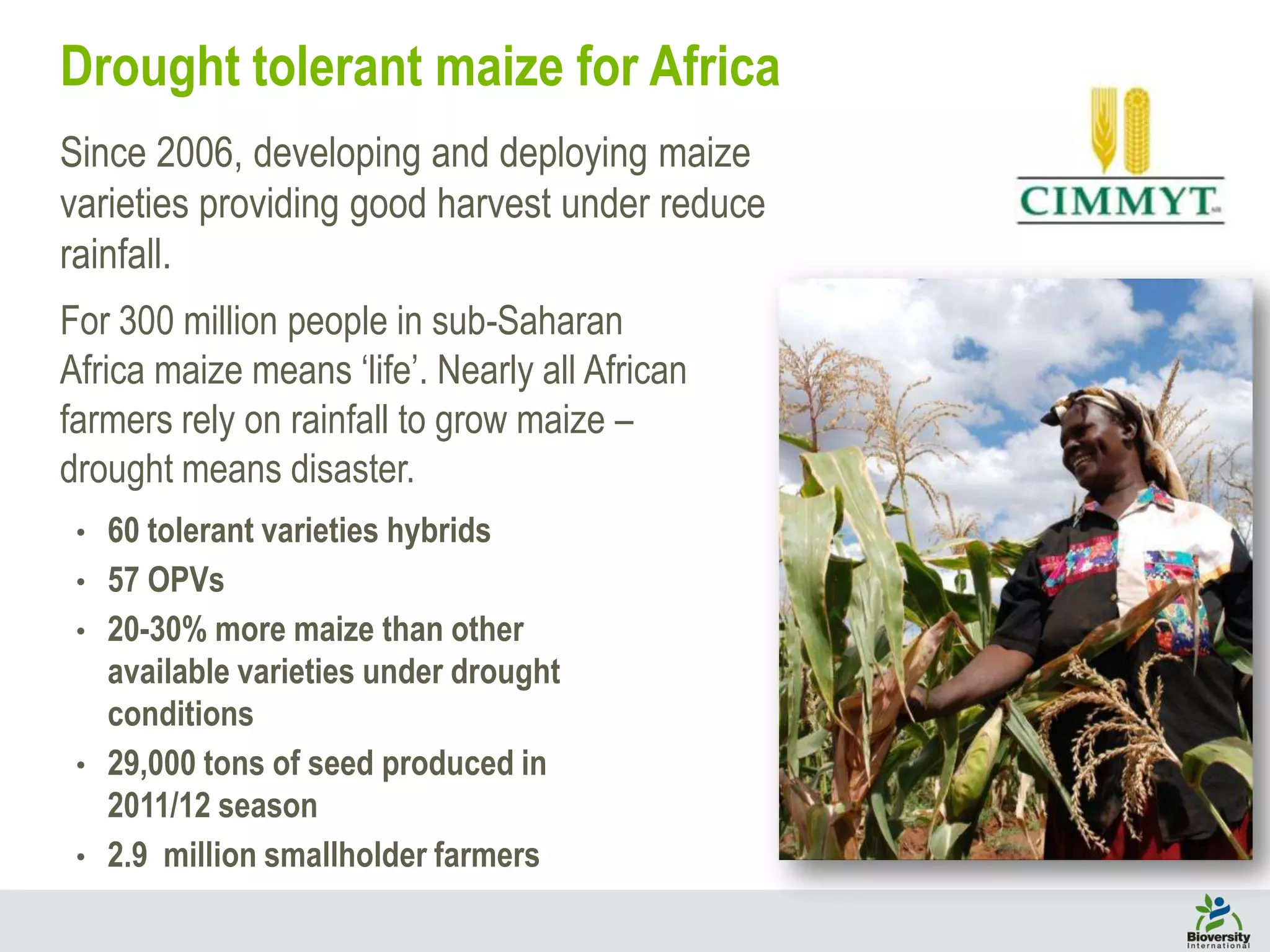
Drought tolerant maize for Africa
• 60 tolerant varieties hybrids
• 57 OPVs
• 20-30% more maize than other
available varieties under drought
conditions
• 29,000 tons of seed produced in
2011/12 season
• 2.9 million smallholder farmers
Since 2006, developing and deploying maize
varieties providing good harvest under reduce
rainfall.
For 300 million people in sub-Saharan
Africa maize means ‘life’. Nearly all African
farmers rely on rainfall to grow maize –
drought means disaster.
An agricultural technology evaluation database for climate
change analysis to:
• facilitate the analysis on the performance of agricultural technologies
under a changing climate
• form the basis for improving models of agricultural production under
current and future conditions and for evaluating the efficacy of trialed
materials for adaptation.
AgTrials
• CIAT is supporting participatory variety selection of beans suited to local climatic
conditions in Uganda. Also working closely with the GCDT to identify major gaps of
wild species in ex situ collections.
• With IRRI and IFPRI, improving modelling framework for cassava, beans, rice and
tropical forages to prioritize technology development in the face of climate change
• ICARDA is using some of the similar suit of tools to identify and characterize
analogue sites in WA, EA and SAsia suitable for testing breeding lines and as
potential sources of climate change adapted germplasm
• IRRI has developed a model to simulate of rice yield losses/gains under different
production situations, injury profiles and improved crop management and protection
technologies.
• ICRISAT has supported farmer knowledge exchanges regarding adaptation
strategies and technologies in Tanzania and Kenya
• Other centres are breeding for traits adapted to climate change, usually in CGIAR
Research Programmes on commodities
• Bioversity International: researching use of traditional crop varietal diversity to
reduce crop loss to pest and disease attacks (under CRP WLE).
Additional initiatives
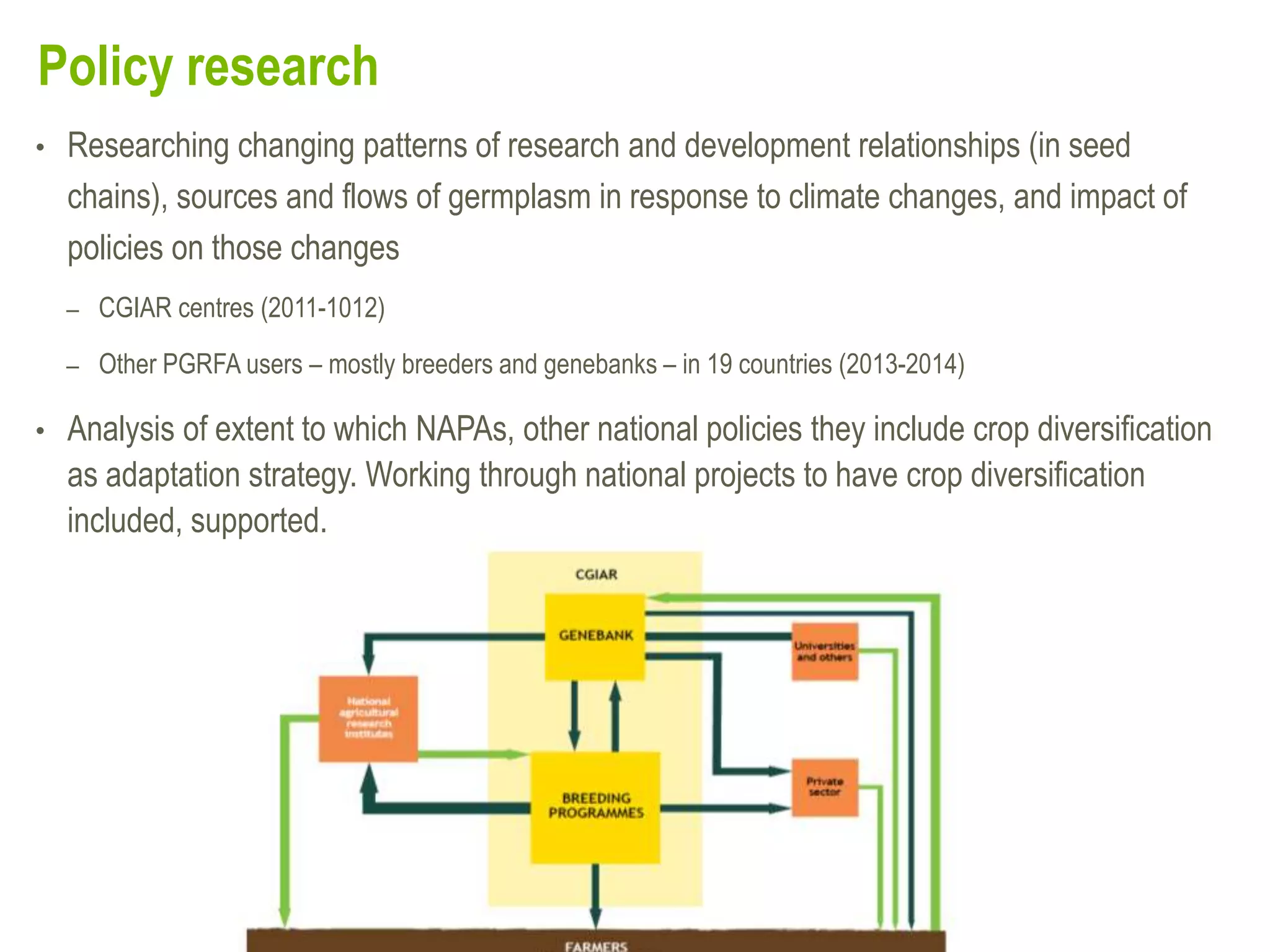
• Researching changing patterns of research and development relationships (in seed
chains), sources and flows of germplasm in response to climate changes, and impact of
policies on those changes
– CGIAR centres (2011-1012)
– Other PGRFA users – mostly breeders and genebanks – in 19 countries (2013-2014)
• Analysis of extent to which NAPAs, other national policies they include crop diversification
as adaptation strategy. Working through national projects to have crop diversification
included, supported.
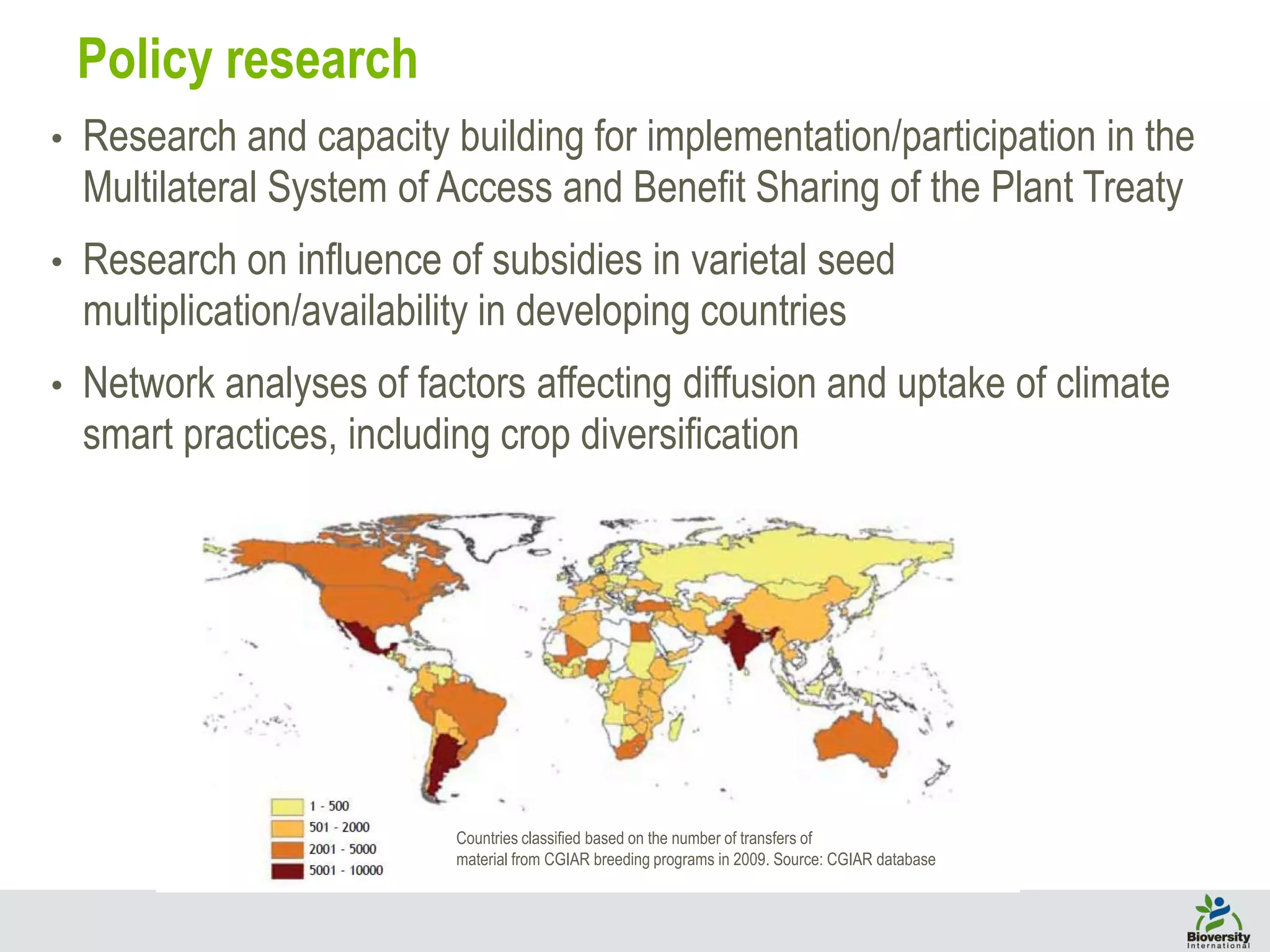
Policy research
• Research and capacity building for implementation/participation in the
Multilateral System of Access and Benefit Sharing of the Plant Treaty
• Research on influence of subsidies in varietal seed
multiplication/availability in developing countries
• Network analyses of factors affecting diffusion and uptake of climate
smart practices, including crop diversification
Policy research
Countries classified based on the number of transfers of
material from CGIAR breeding programs in 2009. Source: CGIAR database
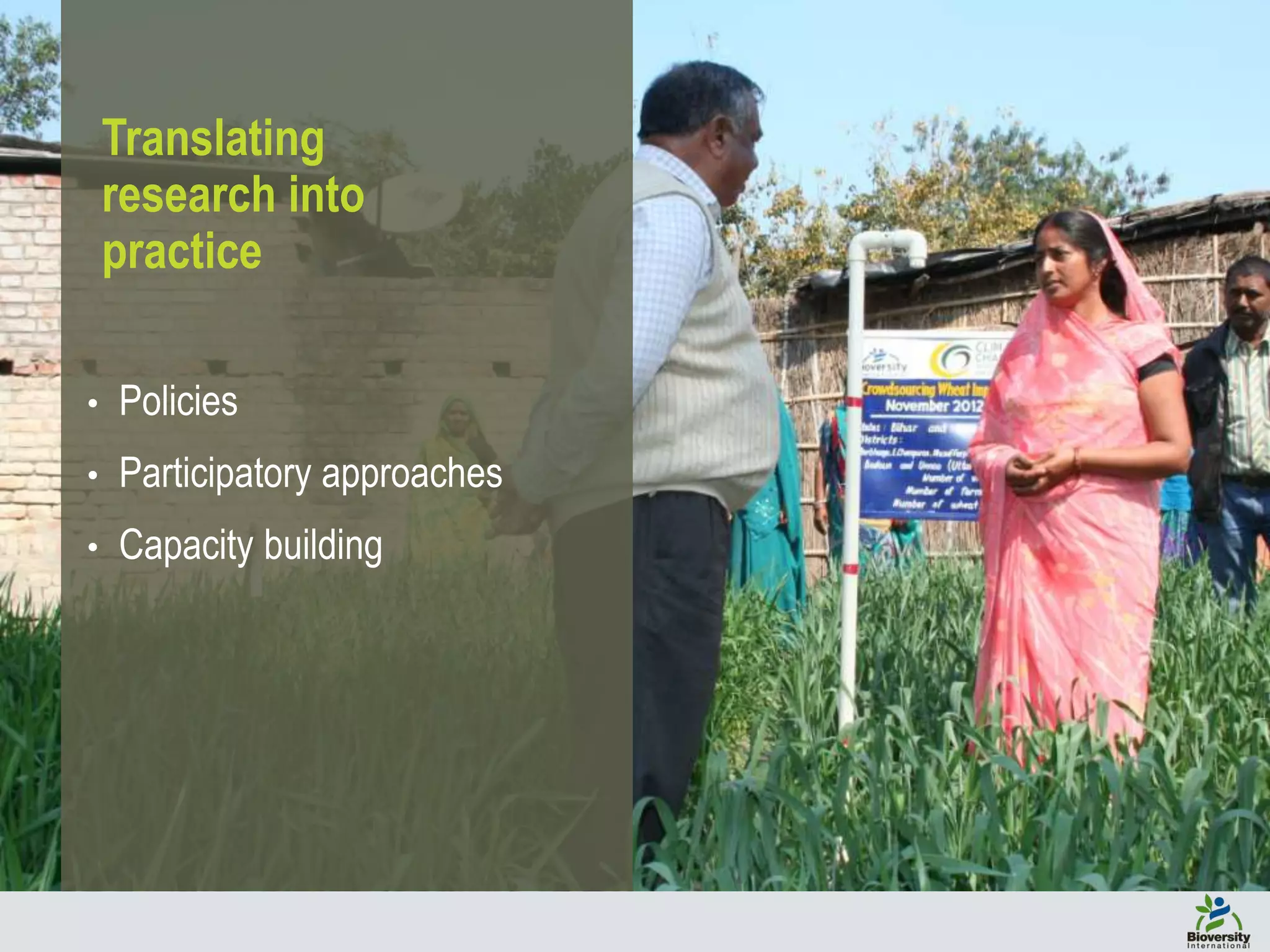
Translating research
into practice
Translating
research into
practice
• Policies
• Participatory approaches
• Capacity building
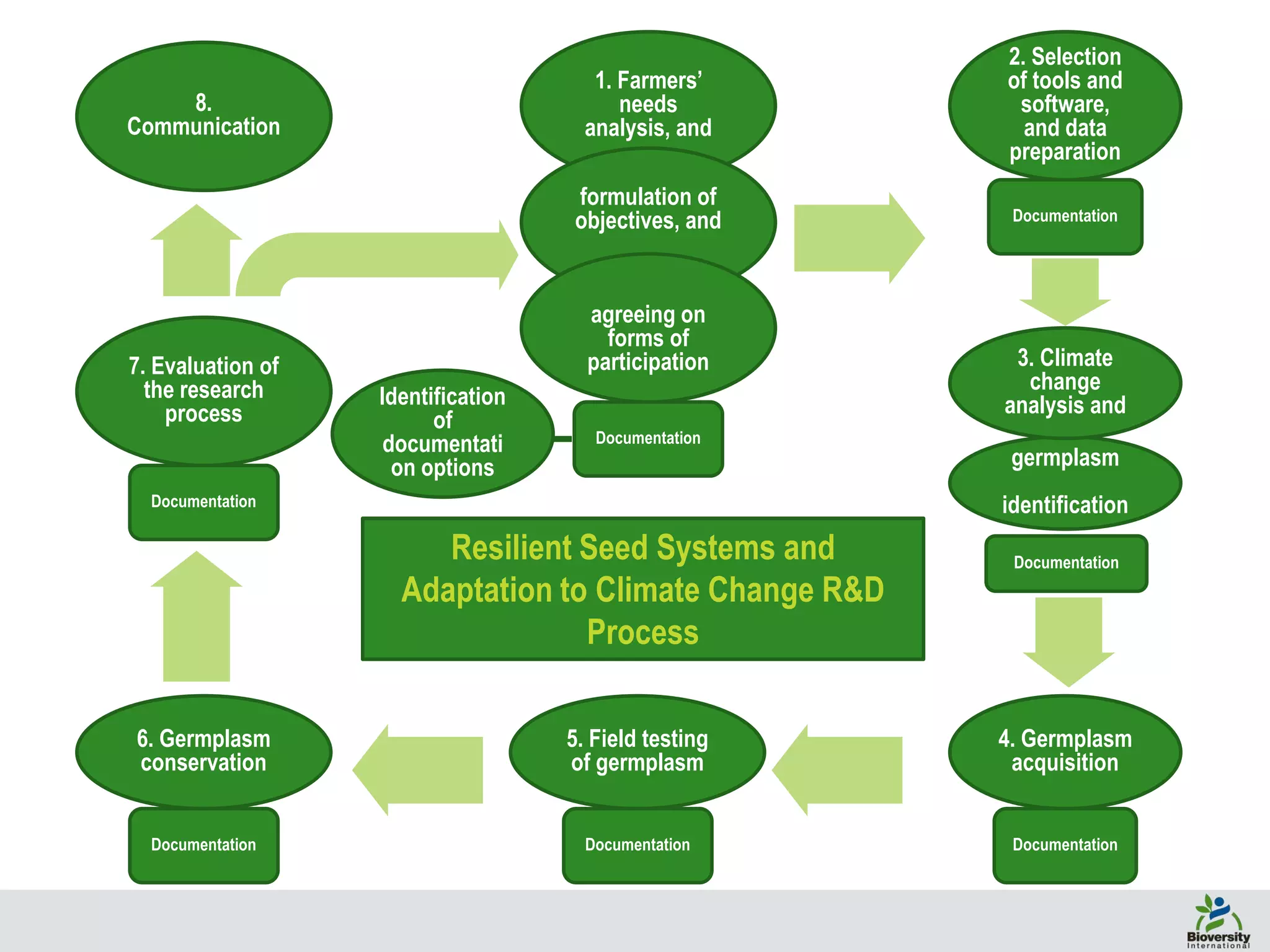
1. Farmers’
needs
analysis, and
2. Selection
of tools and
software,
and data
preparation
germplasm
identification
4. Germplasm
acquisition
5. Field testing
of germplasm
Documentation DocumentationDocumentation
Documentation
3. Climate
change
analysis and
6. Germplasm
conservation
8.
Communication
formulation of
objectives, and
7. Evaluation of
the research
process
Documentation
Resilient Seed Systems and
Adaptation to Climate Change R&D
Process
Identification
of
documentati
on options
Documentation
agreeing on
forms of
participation
Documentation
www.bioversityinternational.org
Thank you

Crop diversity for climate change adaptation

  • 1.
    Crop diversity forclimate change adaptation Michael Halewood, Bioversity International 8 April 2014
  • 2.
    • Led bythe International Center for Tropical Agriculture (CIAT), Program manager from University of Copenhagen, CCAFS is a collaboration among all 15 CGIAR research centres with over 700 partners. Future earth is a founding, executing partner. • The program is carried out with funding support from governments and aid agencies, both through the CGIAR Fund and bilaterally: 57 million in 2013 The CGIAR Research Program on Climate Change, Agriculture and Food Security (CCAFS)
  • 3.
  • 4.
  • 5.
    Table of contents •What do we know about use of crop diversity for adaptation? • What are there knowledge gaps that need to be addressed? • How is CCAFS addressing them? • How will research results be translated into practice? The CGIAR Research Program on Climate Change, Agriculture and Food Security (CCAFS)
  • 6.
  • 7.
    Estimated impact of+3 C change on crop yields by 2050 Source: World resources instituteChanges in the intensity, frequency and seasonality of precipitation Changes in groundwater and river flows Temperature rising between 2-4 C Source: CCAFS
  • 8.
    What we knowabout the role of crop diversity • We know the outer limits of heat/cold, drought/water logging that a number of crops can tolerate • Can increase the resilience of agricultural production systems • Is a source of useful traits to adapt to changing climatic conditions
  • 9.
    A static, one-timeadaptation response is not enough: capacity to continuously adapt is critical Adaptive capacity must be continuous, rolling
  • 10.
    What we know aboutpolicy challenges • Policies and public interventions oriented towards simplified production systems • Public investments on seed often focus on few crops and few varieties • Policies designed with other objectives in mind can have negative effect on availability and use crop diversity • Countries increasing interdependence on plant genetic resources often overlooked. Availability is limited • Rarely integrated into national climate change adaptation strategies
  • 11.
    What we needto investigate
  • 12.
    • How toidentify highest potential (in terms of adaptation) materials in genebanks, farmers fields, breeding programmes? • In what situations does crop diversity have high/low potential to contribute to adaptation and farmers’ livelihoods? • What diversity-based adaptation interventions have the most potential to promote gender equity? • What is the value of the gains that can be made through crop diversification? How can such information be used for trade-off decisions? • How can we scale up projects so that large numbers of farmers can deploy crop diversity to adapt to climate-related stresses?
  • 13.
  • 14.
    The ‘Seeds forNeeds’ approach
  • 15.
    The Seeds forNeeds approach Combining climate change data with data on crop suitability, geographic information and genebank accession collection coordinates to identify genebank materials that can adapt to specific climatic conditions.
  • 16.
    4. Farmers test andreport back by mobile phone 2. Each farmer gets a different combination of varieties 3. Environmental data (GPS, sensors) to assess adaptation 1. A broad set of varieties is evaluated 6. Data are used to detect demand for new varieties and traits 5. Farmers receive tailored variety recommendations and can order seeds Participatory evaluation
  • 17.
  • 18.
    18 Drought tolerant maizefor Africa • 60 tolerant varieties hybrids • 57 OPVs • 20-30% more maize than other available varieties under drought conditions • 29,000 tons of seed produced in 2011/12 season • 2.9 million smallholder farmers Since 2006, developing and deploying maize varieties providing good harvest under reduce rainfall. For 300 million people in sub-Saharan Africa maize means ‘life’. Nearly all African farmers rely on rainfall to grow maize – drought means disaster.
  • 19.
    An agricultural technologyevaluation database for climate change analysis to: • facilitate the analysis on the performance of agricultural technologies under a changing climate • form the basis for improving models of agricultural production under current and future conditions and for evaluating the efficacy of trialed materials for adaptation. AgTrials
  • 20.
    • CIAT issupporting participatory variety selection of beans suited to local climatic conditions in Uganda. Also working closely with the GCDT to identify major gaps of wild species in ex situ collections. • With IRRI and IFPRI, improving modelling framework for cassava, beans, rice and tropical forages to prioritize technology development in the face of climate change • ICARDA is using some of the similar suit of tools to identify and characterize analogue sites in WA, EA and SAsia suitable for testing breeding lines and as potential sources of climate change adapted germplasm • IRRI has developed a model to simulate of rice yield losses/gains under different production situations, injury profiles and improved crop management and protection technologies. • ICRISAT has supported farmer knowledge exchanges regarding adaptation strategies and technologies in Tanzania and Kenya • Other centres are breeding for traits adapted to climate change, usually in CGIAR Research Programmes on commodities • Bioversity International: researching use of traditional crop varietal diversity to reduce crop loss to pest and disease attacks (under CRP WLE). Additional initiatives
  • 21.
    • Researching changingpatterns of research and development relationships (in seed chains), sources and flows of germplasm in response to climate changes, and impact of policies on those changes – CGIAR centres (2011-1012) – Other PGRFA users – mostly breeders and genebanks – in 19 countries (2013-2014) • Analysis of extent to which NAPAs, other national policies they include crop diversification as adaptation strategy. Working through national projects to have crop diversification included, supported. Policy research
  • 22.
    • Research andcapacity building for implementation/participation in the Multilateral System of Access and Benefit Sharing of the Plant Treaty • Research on influence of subsidies in varietal seed multiplication/availability in developing countries • Network analyses of factors affecting diffusion and uptake of climate smart practices, including crop diversification Policy research Countries classified based on the number of transfers of material from CGIAR breeding programs in 2009. Source: CGIAR database
  • 23.
  • 24.
    Translating research into practice • Policies •Participatory approaches • Capacity building
  • 25.
    1. Farmers’ needs analysis, and 2.Selection of tools and software, and data preparation germplasm identification 4. Germplasm acquisition 5. Field testing of germplasm Documentation DocumentationDocumentation Documentation 3. Climate change analysis and 6. Germplasm conservation 8. Communication formulation of objectives, and 7. Evaluation of the research process Documentation Resilient Seed Systems and Adaptation to Climate Change R&D Process Identification of documentati on options Documentation agreeing on forms of participation Documentation
  • 26.