MESH: A new model for Mapping
Ecosystem Services to Human wellbeing for
the Sustainable Development Goals
Justin Andrew Johnson
Co-authors: Sylvia L.R. Wood; Sarah Jones; Fabrice DeClerck
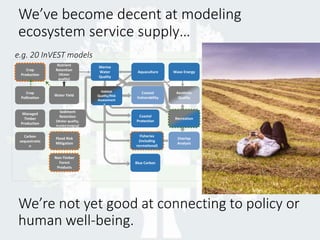
We’ve become decent at modeling
ecosystem service supply…
We’re not yet good at connecting to policy or
human well-being.
Coastal
Vulnerability
Coastal
Protection
Overlap
Analysis
Wave Energy
Habitat
Quality/Risk
Assessment
Water Yield
Carbon
sequestratio
n
Managed
Timber
Production
Crop
Pollination
Nutrient
Retention
(Water
quality)
Aesthetic
Quality
Recreation
Crop
Production
Flood Risk
Mitigation
Sediment
Retention
(Water quality,
Avoided dredging)
Fisheries
(including
recreational)
Aquaculture
Marine
Water
Quality
Non-Timber
Forest
Products
Blue Carbon
e.g. 20 InVEST models
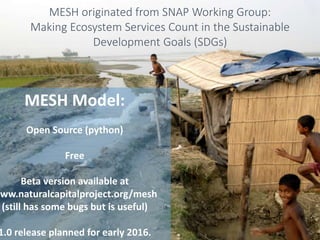
MESH originated from SNAP Working Group:
Making Ecosystem Services Count in the Sustainable
Development Goals (SDGs)
MESH Model:
Open Source (python)
Free
Beta version available at
www.naturalcapitalproject.org/mesh
(still has some bugs but is useful)
1.0 release planned for early 2016.
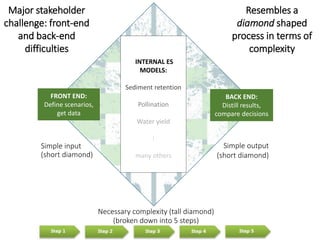
Simple input
FRONT END:
Define scenarios,
get data
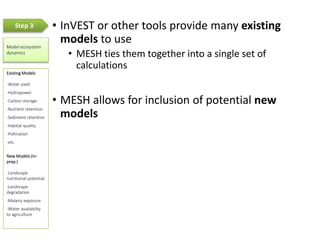
INTERNAL ES
MODELS:
Sediment retention
Pollination
Water yield
⋮
many others
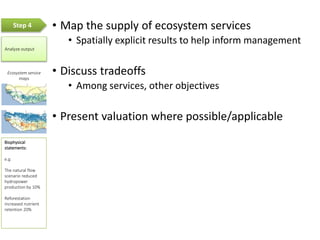
BACK END:
Distill results,
compare decisions
Simple output
Necessary
complexity
Major stakeholder
challenge: front-end
and back-end
difficulties
Resembles a
diamond shaped
process in terms of
complexity
Software demo time!
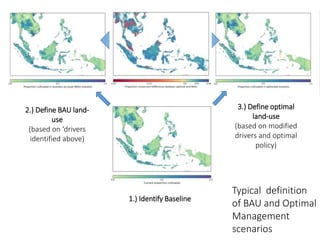
1: Create new project and set area of
interest (AOI) shapefile.
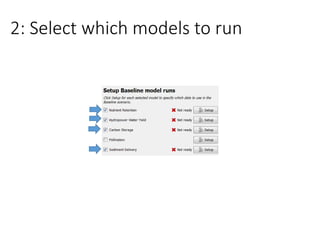
2: Select which models to run
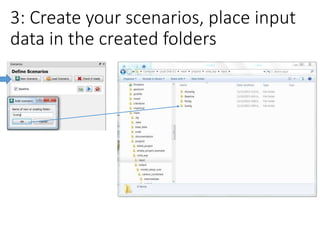
3: Create your scenarios, place input
data in the created folders
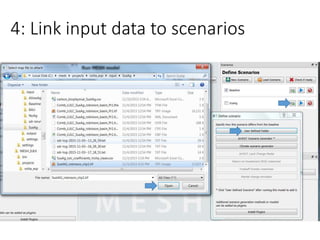
4: Link input data to scenarios
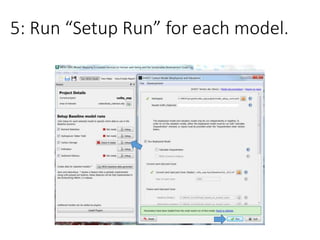
5: Run “Setup Run” for each model.
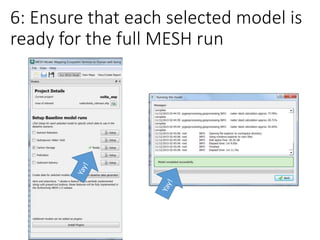
6: Ensure that each selected model is
ready for the full MESH run
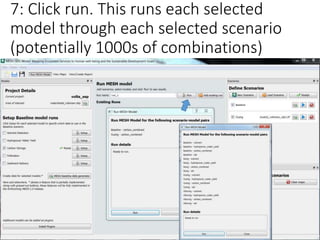
7: Click run. This runs each selected
model through each selected scenario
(potentially 1000s of combinations)
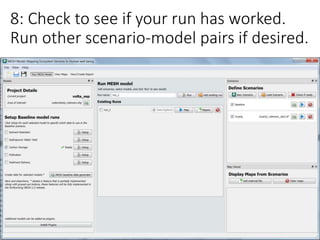
8: Check to see if your run has worked.
Run other scenario-model pairs if desired.
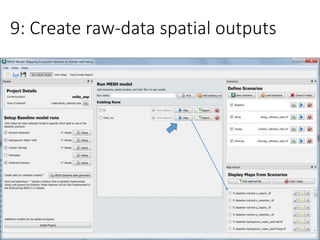
9: Create raw-data spatial outputs
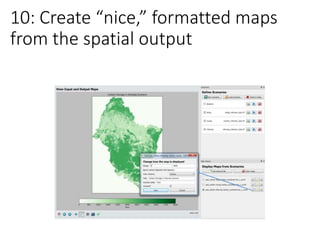
10: Create “nice,” formatted maps
from the spatial output
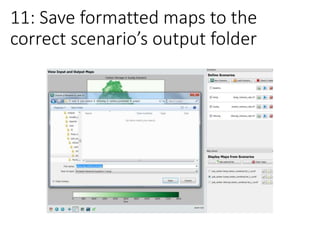
11: Save formatted maps to the
correct scenario’s output folder
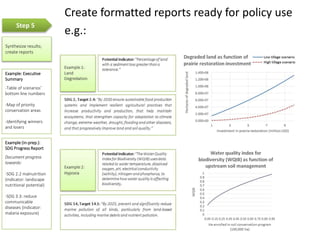
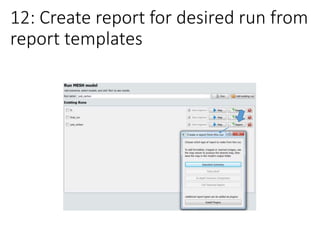
12: Create report for desired run from
report templates
13: Review dynamically created
report
14: Edit in the program or in (for
example) Microsoft’s WORD.
Thank you
Justin Andrew Johnson
Questions?
jandrewjohnson@gmail.com
@jandrewjohns
Justinandrewjohnson.com
www.naturalcapital
project.org/mesh
Co-authors: Sylvia L.R. Wood;
Sarah Jones; Fabrice DeClerck
Appendix
How are the SDGs related to
Ecosystem Services?
SDG 2. End hunger, improve nutrition and promote sustainable agriculture
SDG 3. Attain healthy lives for all
SDG 6. Ensure availability and sustainable use of water and sanitation
SDG 7. Ensure sustainable energy
SDG13. Tackle climate change
SDG14. Conserve and promote sustainable use of oceans, seas and marine resources
SDG15. Protect and promote sustainable use of terrestrial ecosystems, halt
desertification, land degradation and biodiversity loss
Strategic Grants
Private
Sector
$$
Civil
Societ
y $$
Govt
$$
Why do countries care about SDGs?
• Global funds unlock large $$
• Intl. funding will be channeled along
SDGs
• Pooled financing mechanisms
• The Global Fund
• Catalytic Fund for Nutrition
• the Global Financing Facility
• The GEF
*A significant portion of SDG investment will also come from private
companies – key partners in large infrastructure partnerships
Engagement with stakeholders throughout
Engagement with
stakeholders
throughout
(1) Incentives
(2) Actions
Ecological
production
functions
(6) Valuation
(3) Non-
anthropocentric
approaches
Other
considerations
Benefits
and costs
Decisions by firms
and individuals
Policy
decisions
Ecosystems
Ecosystem
services
(7) Economic
efficiency
(5) Biophysical
tradeoffs
(4)
Polasky & Segerson Annual Review of Resource Economics 1: 409-434.

Mapping Ecosystem Services to Human well-being - MESH tool demo

  • 1.
    MESH: A newmodel for Mapping Ecosystem Services to Human wellbeing for the Sustainable Development Goals Justin Andrew Johnson Co-authors: Sylvia L.R. Wood; Sarah Jones; Fabrice DeClerck
  • 2.
    We’ve become decentat modeling ecosystem service supply… We’re not yet good at connecting to policy or human well-being. Coastal Vulnerability Coastal Protection Overlap Analysis Wave Energy Habitat Quality/Risk Assessment Water Yield Carbon sequestratio n Managed Timber Production Crop Pollination Nutrient Retention (Water quality) Aesthetic Quality Recreation Crop Production Flood Risk Mitigation Sediment Retention (Water quality, Avoided dredging) Fisheries (including recreational) Aquaculture Marine Water Quality Non-Timber Forest Products Blue Carbon e.g. 20 InVEST models
  • 3.
    MESH originated fromSNAP Working Group: Making Ecosystem Services Count in the Sustainable Development Goals (SDGs) MESH Model: Open Source (python) Free Beta version available at www.naturalcapitalproject.org/mesh (still has some bugs but is useful) 1.0 release planned for early 2016.
  • 4.
    Simple input FRONT END: Definescenarios, get data INTERNAL ES MODELS: Sediment retention Pollination Water yield ⋮ many others BACK END: Distill results, compare decisions Simple output Necessary complexity Major stakeholder challenge: front-end and back-end difficulties Resembles a diamond shaped process in terms of complexity
  • 5.
  • 6.
    1: Create newproject and set area of interest (AOI) shapefile.
  • 7.
    2: Select whichmodels to run
  • 8.
    3: Create yourscenarios, place input data in the created folders
  • 9.
    4: Link inputdata to scenarios
  • 10.
    5: Run “SetupRun” for each model.
  • 11.
    6: Ensure thateach selected model is ready for the full MESH run
  • 12.
    7: Click run.This runs each selected model through each selected scenario (potentially 1000s of combinations)
  • 13.
    8: Check tosee if your run has worked. Run other scenario-model pairs if desired.
  • 14.
    9: Create raw-dataspatial outputs
  • 15.
    10: Create “nice,”formatted maps from the spatial output
  • 16.
    11: Save formattedmaps to the correct scenario’s output folder
  • 17.
    12: Create reportfor desired run from report templates
  • 18.
    13: Review dynamicallycreated report
  • 19.
    14: Edit inthe program or in (for example) Microsoft’s WORD.
  • 20.
    Thank you Justin AndrewJohnson Questions? jandrewjohnson@gmail.com @jandrewjohns Justinandrewjohnson.com www.naturalcapital project.org/mesh Co-authors: Sylvia L.R. Wood; Sarah Jones; Fabrice DeClerck
  • 21.
  • 22.
    How are theSDGs related to Ecosystem Services? SDG 2. End hunger, improve nutrition and promote sustainable agriculture SDG 3. Attain healthy lives for all SDG 6. Ensure availability and sustainable use of water and sanitation SDG 7. Ensure sustainable energy SDG13. Tackle climate change SDG14. Conserve and promote sustainable use of oceans, seas and marine resources SDG15. Protect and promote sustainable use of terrestrial ecosystems, halt desertification, land degradation and biodiversity loss
  • 23.
    Strategic Grants Private Sector $$ Civil Societ y $$ Govt $$ Whydo countries care about SDGs? • Global funds unlock large $$ • Intl. funding will be channeled along SDGs • Pooled financing mechanisms • The Global Fund • Catalytic Fund for Nutrition • the Global Financing Facility • The GEF *A significant portion of SDG investment will also come from private companies – key partners in large infrastructure partnerships
  • 24.
  • 25.
  • 26.
    (1) Incentives (2) Actions Ecological production functions (6)Valuation (3) Non- anthropocentric approaches Other considerations Benefits and costs Decisions by firms and individuals Policy decisions Ecosystems Ecosystem services (7) Economic efficiency (5) Biophysical tradeoffs (4) Polasky & Segerson Annual Review of Resource Economics 1: 409-434.

Editor's Notes

  • #24 A lot of people have asked why do countries care about the SDGs, they are non-binding commitment, what will incentivate them to actually try to achieve these goals? The key is that the SDGs can unlock large potential source of money for developing countries. Due to the success of the Global Fund to combat HIV, TB and malaria, - new aligned funding structures are going to be put into place to provide resources to countries to fund strategive programs and investments to work towards the SDGs One of the reasons this approach worked so effectively for MDG 6 was that due to the large kitty of $$ available by centralizing funding, Health Ministers could make the case to Finance ministers and other key Ministeries that they needed to work collaboratively to develop strong proposals and unlock large sources of funding for the country. They’re hoping this approach will carry over into other sectors This means that countries will be looking to develop strong proposals that they can bring to these Funding sources that demonstrate the expected impacts of action plans on SDGs Additionally large funding for investment will come from the private sector, many of whom are also aligning their priorities around the SDGs.