Introduction
• Photometry is the most common analytical technique
used in the biochemical laboratory. It is designed to
measure the intensity of a beam of light.
• Photometric principles are applied to the several kinds
of analytical techniques:
(a) where absorbed or transmitted light is measured:
• Colorimetry
• Spectrophotometry
• Atomic absorption, and
• Turbidometry
(b) where emitted light is measured:
• Flame emission photometry
Introduction (cont.)
• The components of most photoelectric colorimeters are
basically the same and the basic method of operation is
also similar for all the instruments.
• In analytical chemistry, Colorimetry is a technique
“used to determine the concentration of colored
compounds (analytes) in sample solution” at visible
spectrum of light (400 – 800 nm).
• Colorimeter is instrument which is used in the
measurement of the luminious intensity of light.
• Invented by Louis Jules Duboscq in 1870.
Colorimetry
Principle:
Colored solutions have the property of absorbing certain
wavelength of light when a monochromatic light is passed
through them.
• The amount of light absorbed or transmitted by a
colored solution is in accordance with two laws:
– Beer’s law
– Lambert’s law
Beer’s law :
• When a monochromatic light passes through a colored
solution, amount of light transmitted decreases
exponentially with increase in concentration of colored
substance.
– i.e. the amount of light absorbed by a colored solution is
directly proportion to the conc. Of substance in the colored
solution.
Beer’s law
Beer’s law
Lambert’s law :
• The amount of light transmitted decreases
exponentially with increase in path length (diameter) of
the cuvette or thickness of colored solution through
which light passes.
– i.e. the amount of light absorbed by a colored solution
depends on path length of cuvette or thickness or depth of
the colored solution.
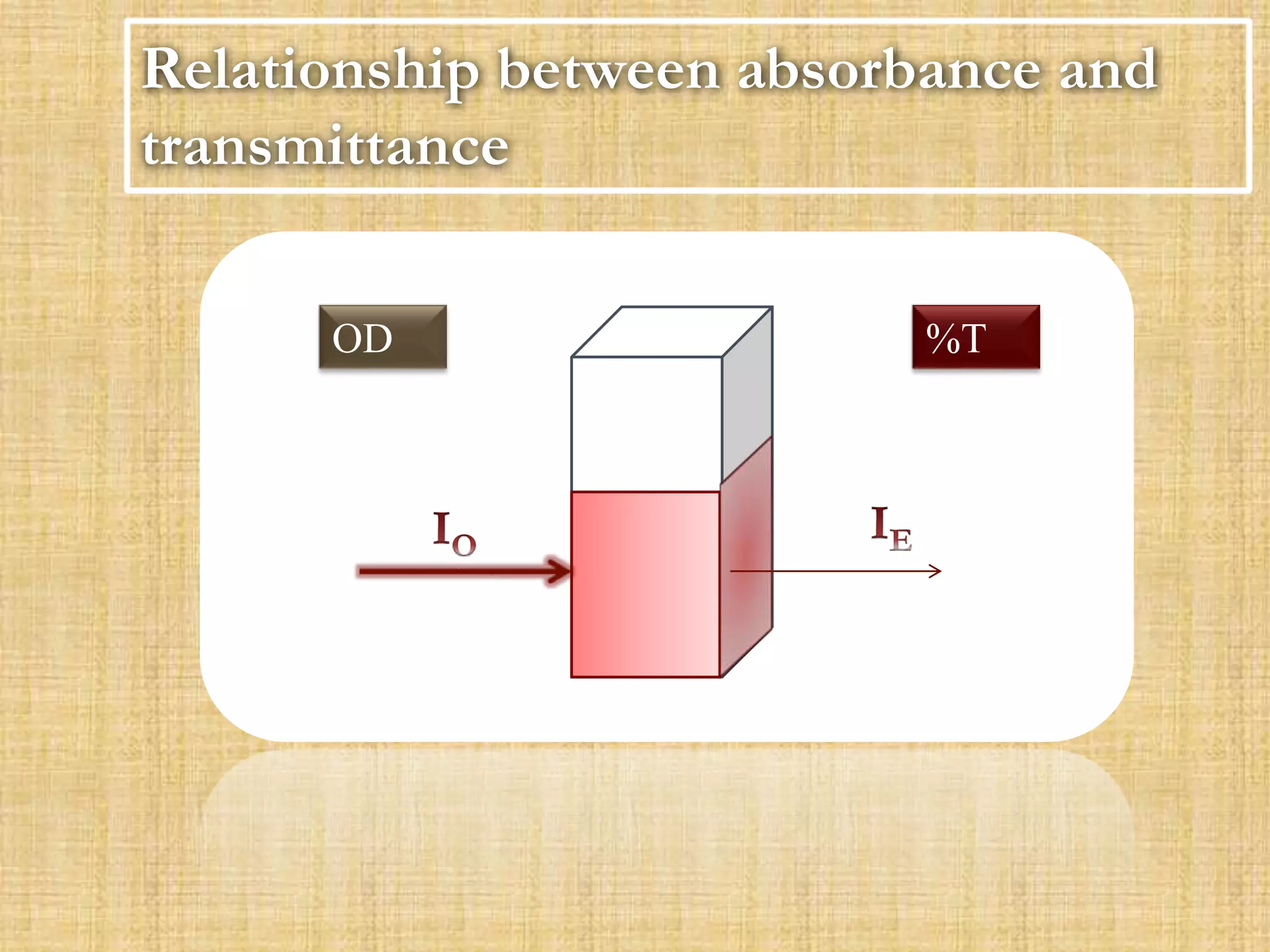
Relationship between absorbance and
transmittance
OD %T
Transmittance of a solution containing light
absorbing substance depends upon
1. The nature of light absorbing substance.
2. Wavelength of light and
3. Amount of light absorbing substance in
the light path, which in turn depends on
the concentration of light absorbing
substance and depth of the solution
through which light passes.
Preparation of solution for investigation
• In colorimetric estimation it is necessary to
prepare 3 solutions:
BLANK(B)
STANDARD(S)
TEST(T)
11/10/2016 12:05 PM
BLANK
To eliminate the effect of light
absorption by the reagent used
Water BLANK
Reagent BLANK
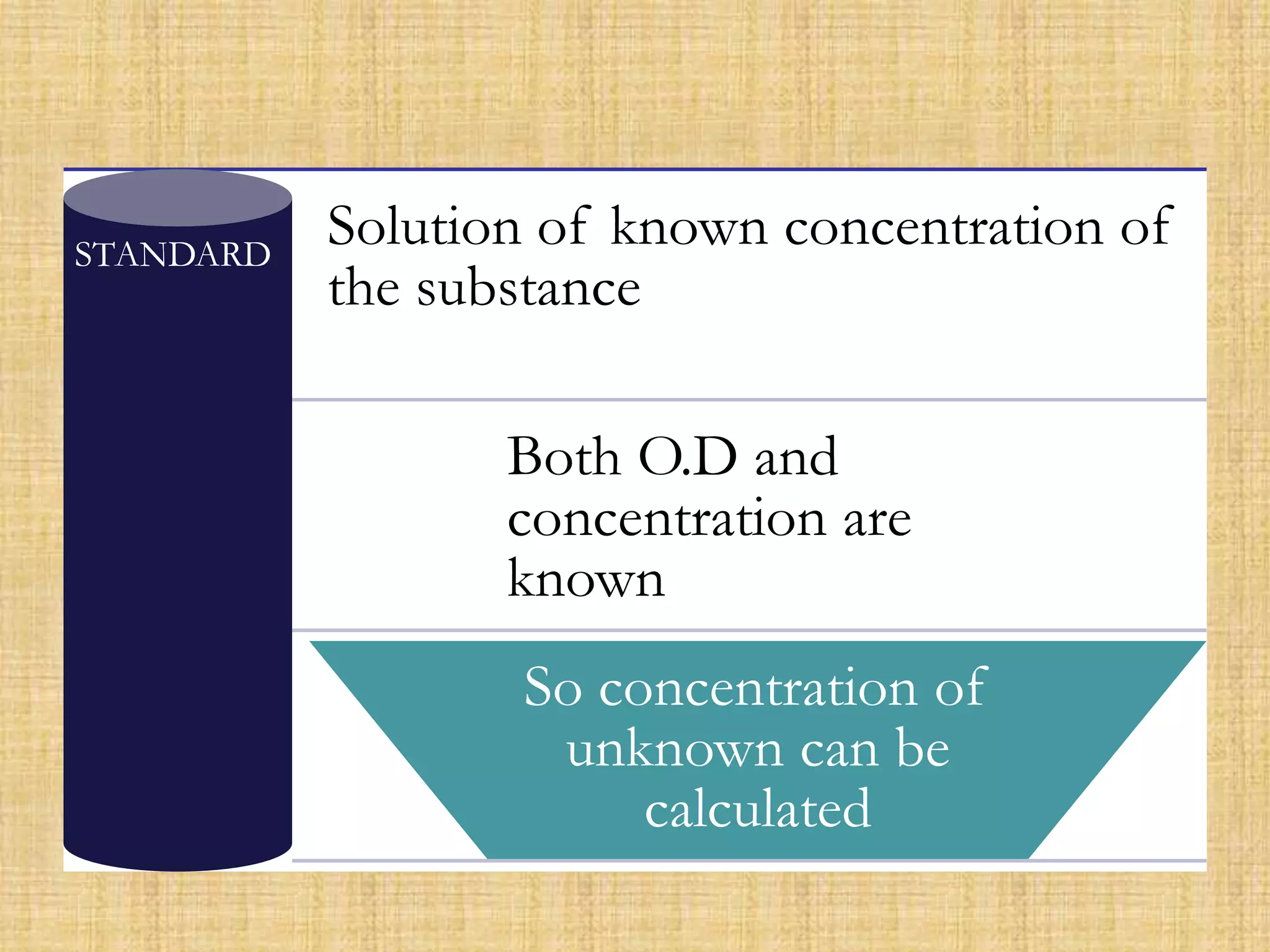
STANDARD
Solution of known concentration of
the substance
Both O.D and
concentration are
known
So concentration of
unknown can be
calculated
TEST
Test solution is made by
treating a specific volume of
the test sample with reagents
As per
procedure
Combined Beer’s- Lambert’s law
• Combined Beer’s- Lambert’s law is thus expressed as
amount of light transmitted through a colored solution
decreases exponentially with increases in conc. Of
colored solution & increase in conc. of colored solution
& increase in the path length of cuvette or thickness of
the colored solution.
• Combining the two laws:
A α C x L
A = K x C x L
Let AT=absorbance of the test solution
CT=concentration of the test solution
AS=absorbance of the standard solution
CS=concentration of the standard solution
AT
AS
K x CT x L
K x CS x L
=
AT
AS
CT
CS
=
CT =
AT
AS
x CS
AS = K x CS x LAT = K x CT x L
CT =
AT
AS
xCS
Concentration
of TEST sol.
Absorbance of TEST
Absorbance of STANDARD
Con. of STANDARDx=
Concentration
of TEST/100ml
Absorbance of TEST
Absorbance of STANDARD
Concn of Std X 100
x=
X ml
=
ODT
ODS
x CS
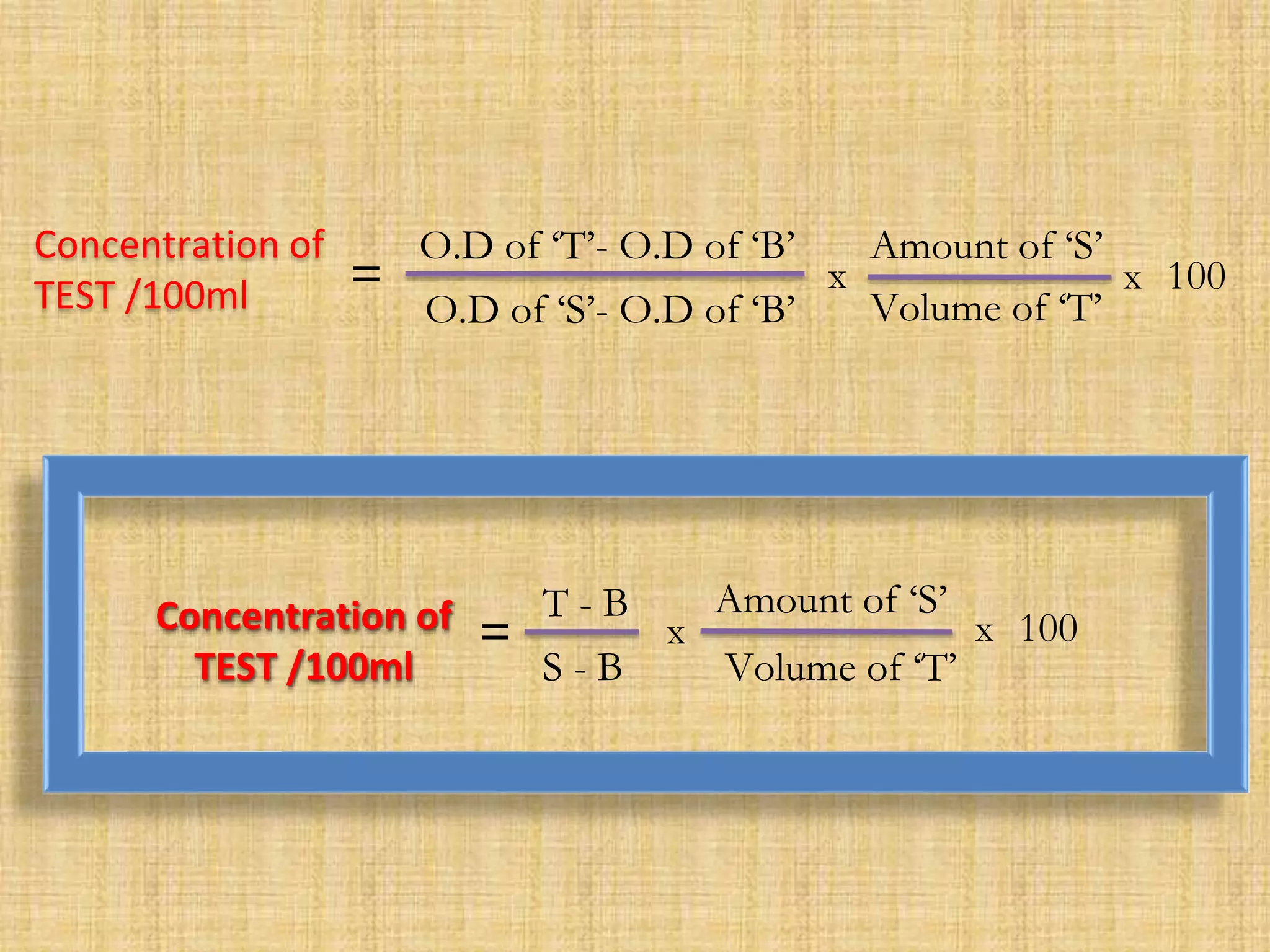
Concentration of
TEST /100ml
O.D of ‘T’- O.D of ‘B’
O.D of ‘S’- O.D of ‘B’
x=
Volume of ‘T’
Amount of ‘S’
Concentration of
TEST /100ml
x=
Volume of ‘T’
Amount of ‘S’T - B
S - B
x 100
x 100
Standard curve (calibration curve)
• The standard curve is prepared to check whether the
method of assaying a particular substance follows
Beer’s Law, i.e. whether the absorbance of the
substance increases in a linear way with its
concentration.
• The standard curve is constructed by plotting a vertical
axis (y – axis, ordinate) for optical densities
(absorbance) and a horizontal axis (x – axis, abscissa)
the concentration of standard solution.
• The concentration of the test/unknown can be
measured from the graph (standard curve).
Verification of Beer’s Law
• Prepare 1% standard solution of glucose, i.e. 1gm/dl
1000mg/100ml.
• Make different dilutions of standard solution using the general
formula given as following for obtaining different concentrations
of a solution by dilution with diluent (DW):
Tube no. Conc. (mg%) Amount of mL needed, (V1)
C1 x V1 = C2 x V2
DW (mL) Total vol. V2 (ml)
1 50 1000 x V1 = 50 x 2, V1= 0.1 1.9 2
2 100 1000 x V1 = 100 x 2, V1= 0.2 1.8 2
3 150 1000 x V1 = 150 x 2, V1= 0.3 1.7 2
4 200 1000 x V1 = 200 x 2, V1= 0.4 1.6 2
5 250 1000 x V1 = 250 x 2, V1= 0.5 1.5 2
6 300 1000 x V1 = 300 x 2, V1= 0.6 1.4 2
7 350 1000 x V1 = 350 x 2, V1= 0.7 1.3 2
8 400 1000 x V1 = 400 x 2, V1= 0.8 1.2 2
0.06 0.12 0.18 0.24 0.3 0.36 0.42 0.48
O.D2 50 100 150 200 250 300 350 400
0
50
100
150
200
250
300
350
400
450
CONC.OFGLUCOSE(mg/dL) OD of solution
Standard Curve / Calibration curve
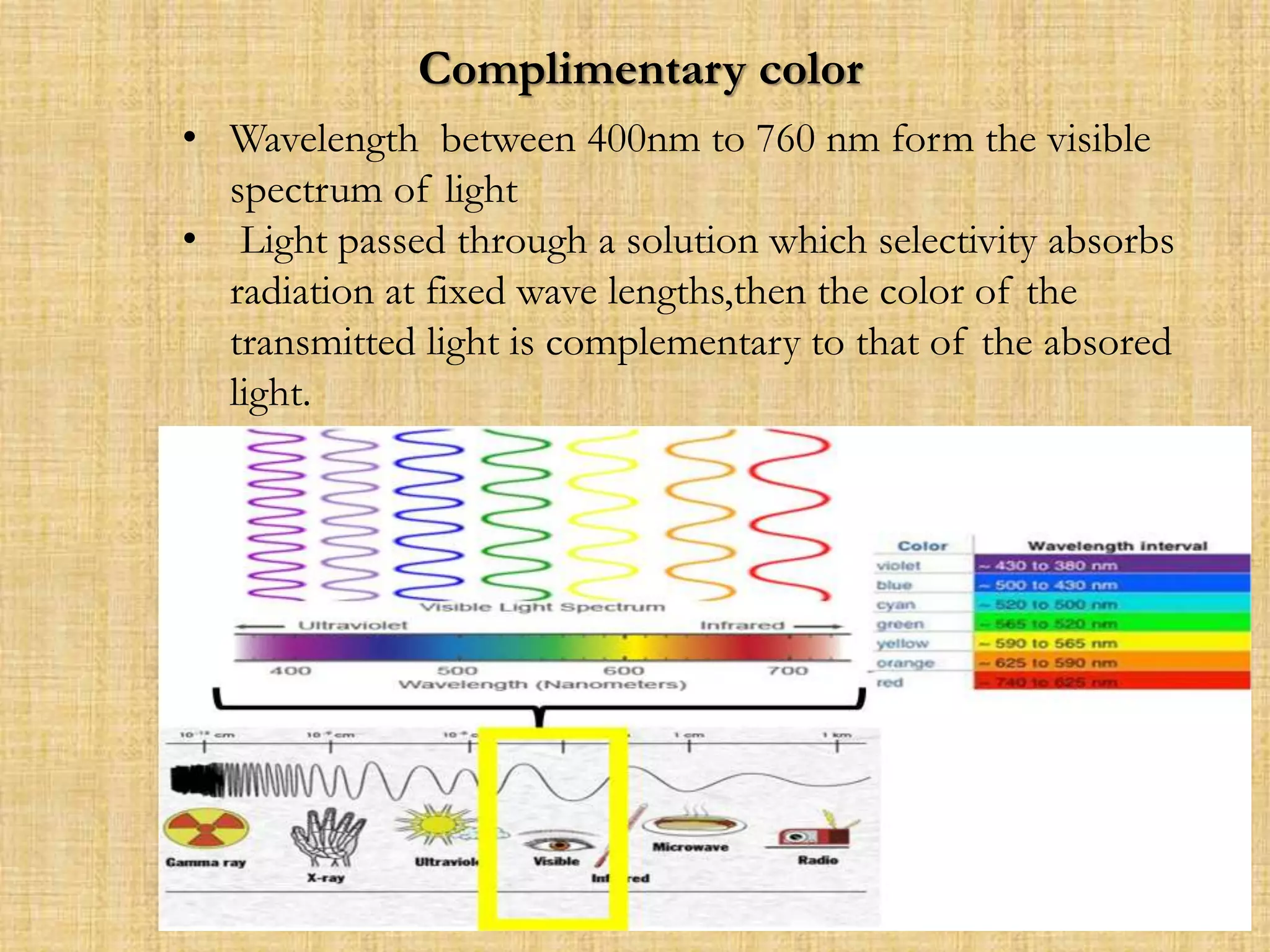
Light spectrum and their wavelengths
Complimentary color
• Wavelength between 400nm to 760 nm form the visible
spectrum of light
• Light passed through a solution which selectivity absorbs
radiation at fixed wave lengths,then the color of the
transmitted light is complementary to that of the absored
light.
Colors and complimentary colors of visible
spectrum
Color of the
solution/ solution
color transmitted
Filter used/ color
absorbed
Wavelength (nm)
Yellow blue Violet 380 – 430
Yellow Blue 430 – 475
Orange Green blue 475 – 495
Red Blue green 495 – 505
Purple Green 505 – 555
Violet Yellow green 555 – 575
Blue yellow 575 – 600
Green blue Orange 600 – 650
Blue green Red 650 - 750
Colorimeter
Components of Colorimetry
1. Light source:
The light source is usually a tungten lamp, for
wavelength in the visible range (320 – 700nm) and a
deutarium or hydrogen lamps for ultraviolet light
(below 350nm).
a) Tungsten lamp  Visible range
b) Deutarium/hydrogen lamp (preferred)  UV Rays
c) Black body radiators (Nerst glower)  Infrared radiations
Light source
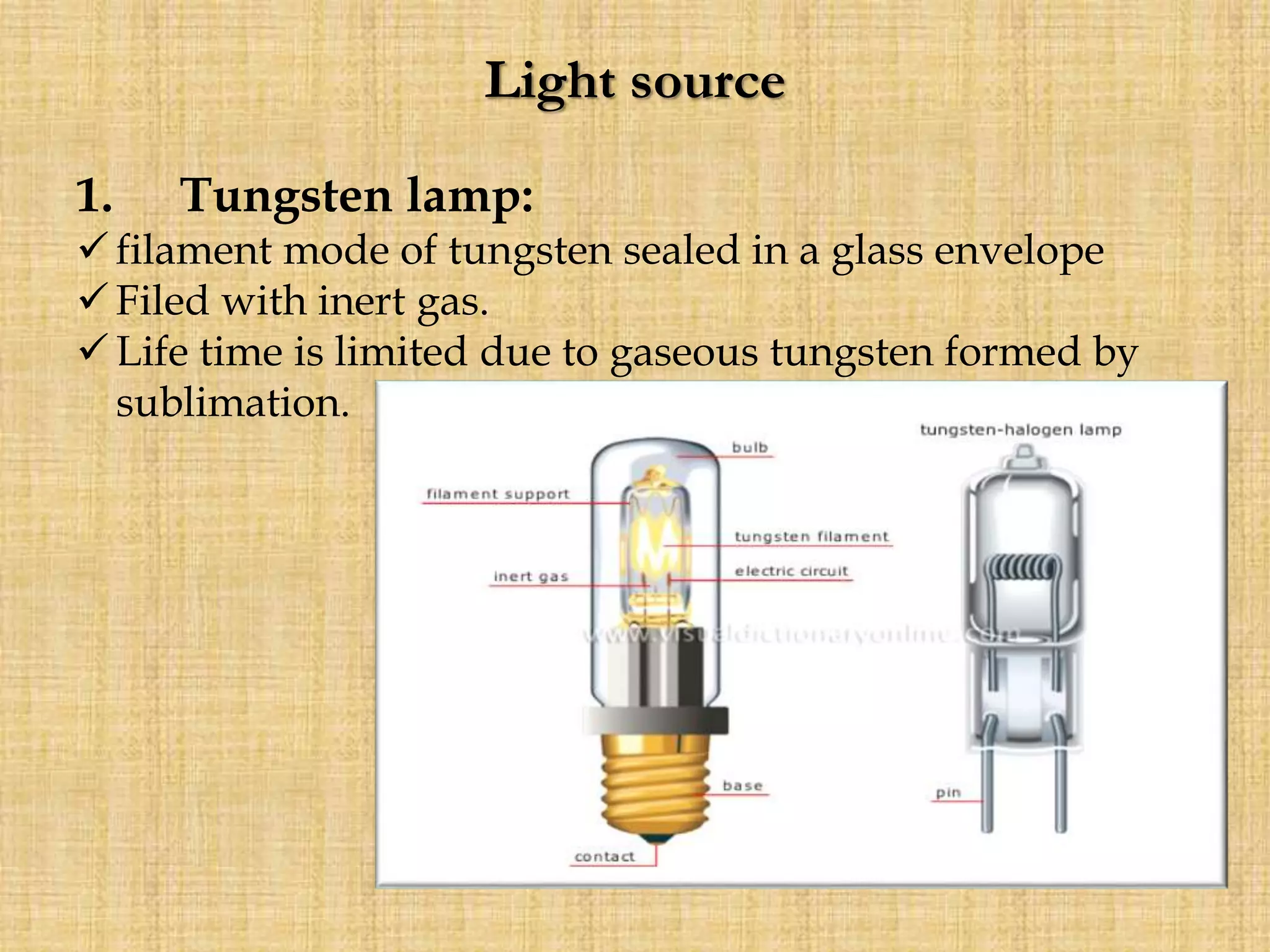
1. Tungsten lamp:
 filament mode of tungsten sealed in a glass envelope
 Filed with inert gas.
 Life time is limited due to gaseous tungsten formed by
sublimation.
Light source
Carbon arc lamp
• If sufficient intensity of light is not obtained
from tungsten lamp then carbon arc lamp can be
use as a source for color measurement.
Monochromators/Filters
• This is a means of selecting a sufficiently narrow wave
band
• Filter will absorb light of unwanted wavelength and
allow only monochromatic light to pass through.
– E.g.: a green filter absorbs all color, except green light which
is allowed to pass through.
Filter
Absorption filter Interference filter
Ex: Glass filter,Gelatin filter
Monochromators
• Early colorimeters used Absorption filters (i.e. glass
filter, Gelatin filter) that transmitted a wide segment of
spectrum (50nm or more).
• Newer instrument use Interface filters that consist of
thin layer of magnesium fluoride crystals with a
semitransparent coating of silver on each side.
• Monochromator consists of:
– Entrance slit
– Absorption/ interface filter and
– Prisms or diffraction grating for wavelength selection
– Exit slit
Sample Holder/ Cuvette
• Cuvettes are rectangular cell , square cell or
circular one.
• Made up of optical glass for visible wavelength
(quartz or fused silica for UV).
• Common one is square, rectangular to avoid
refraction artifacts.
• Optical path (length) of cuvette is always1cm.
• Capacity may be 3ml/2ml/1ml depending upon
the thickness of the wall of the cuvette.
• For accurate and precise reading cuvette must be
transparent, clean, devoid of any scratches and
there should be no bubble adhering to the inner
surface of the filled cuvette.
Photosensitive detectors
• Detectors are the transducers, which convert light
energy to electrical enagery. A detector should be
possess follwing characteristics:
1.Should be sensitive
2.Should have linear response
3.Its noise level Should be low
4.Should have short response time
5.Should stable.
Photosensitive detectors
• Different detectors used are:
1. Barrier layer cells (photocells) – simplest
2. Photoemmisive cells
3. Photomultiplier tube (for low intensity lights)
4. Photoconductive cells (photodiodes) – newest.
Read out devices
• The detector response can be measured by any
of the following devices:
a) Galvanometer
b) Ammeter
c) Recorder
d) Digital readout.
The signal may be transmitted to computer or print
out devices.
Criteria for satisfactory colorimetric
estimations
• Stability of color
Color may be fade of air oxidation,
photochemical decomposition, temperature.
• Intensity of color
The color of the solution should be intense in
order to detect small amount of constituents
and for making accurate result in low
concentration.
Criteria for satisfactory colorimetric
estimations
• Clarity of the solution
Substance under investigation should be completely
soluble in the solvent, since turbid solution,
suspension or colloidal solution absorb as well as
scatter light.
• Reproducibility
The intensity of the colored solution must be
reproducible. The effect of order of adding reagent,
pH and other variable should be clearly studied
Criteria for satisfactory colorimetric
estimations
• Specificity
Color produced should be specific for the desired
constituent. If other constituents interfere with color
reaction they be removed or prevented from or
prevented from functioning through appropriate
treatment like use of other coloring agent, altering
the oxidation state.
• Validity of Beer’s law
The intensity of color should be proportional to
concentration. It can be easily assessed by plotting
absorbance Vs concentration, where a straight line
passing through origin should be obtained.
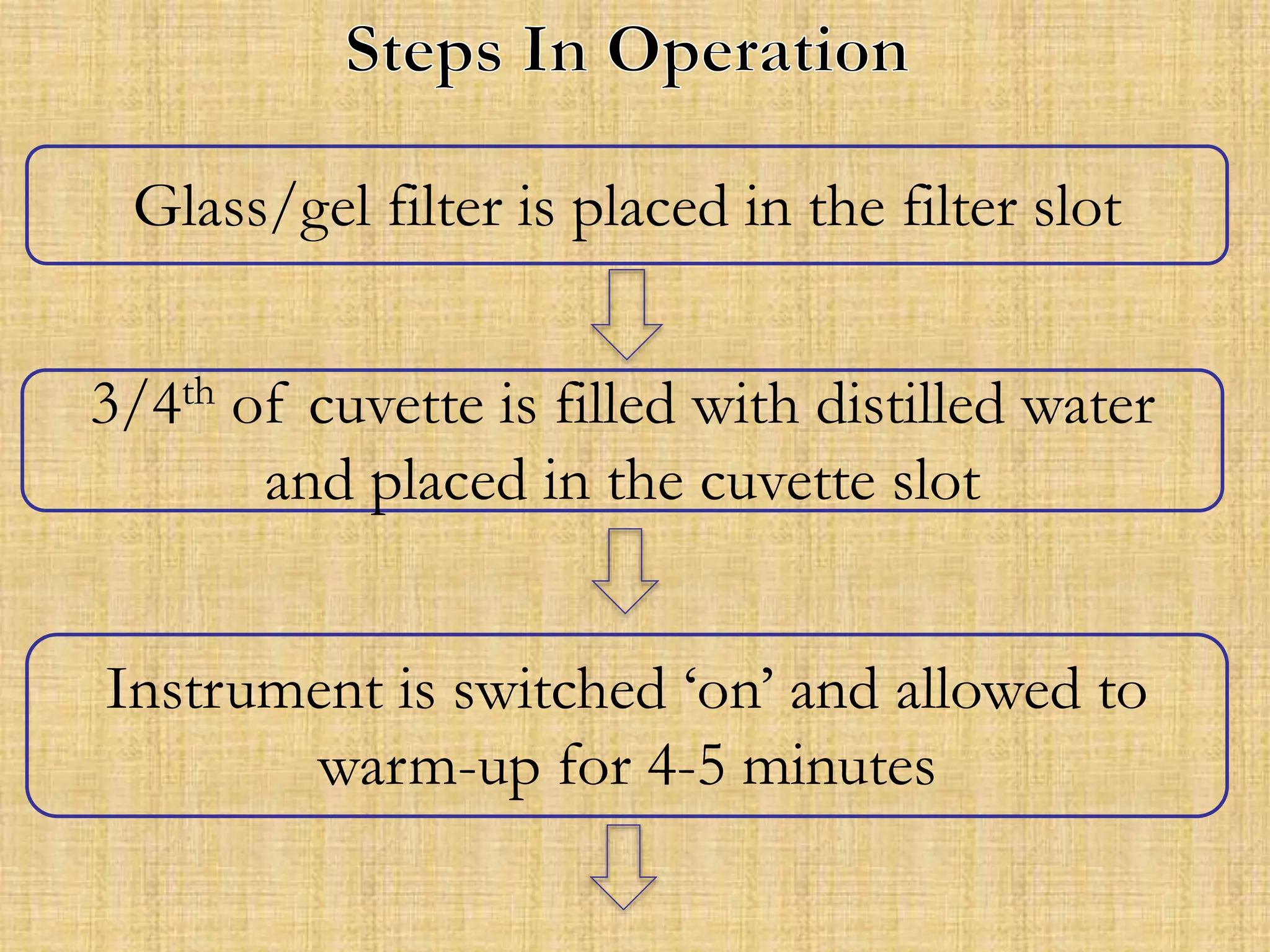
Glass/gel filter is placed in the filter slot
3/4th of cuvette is filled with distilled water
and placed in the cuvette slot
Instrument is switched ‘on’ and allowed to
warm-up for 4-5 minutes
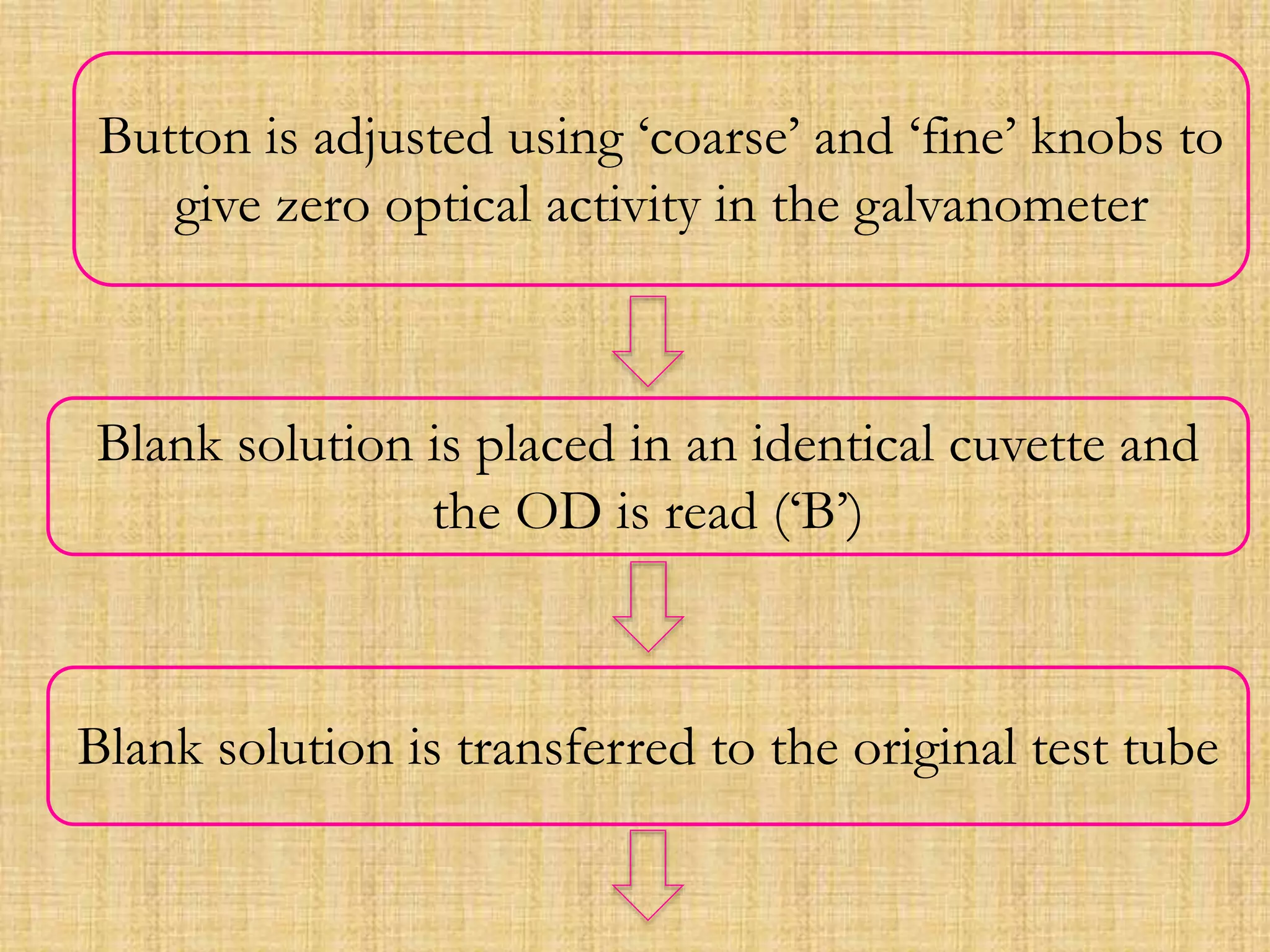
Button is adjusted using ‘coarse’ and ‘fine’ knobs to
give zero optical activity in the galvanometer
Blank solution is placed in an identical cuvette and
the OD is read (‘B’)
Blank solution is transferred to the original test tube
Test solution is taken in the same cuvette and O.D.
is read (‘T’)
Test solution is transferred back to the original test
tube
Standard solution is taken in same cuvette and O.D.
is read (‘S’)
Standard solution is transferred back to the test
tube
Cuvette is washed
Applications Of Colorimeter
• Estimation of biochemical compounds in blood, plasma,
serum, CSF, urine, etc.:
– Glucose
– Urea
– Creatinine
– Uric Acid
– Bilirubin
– Lipids
– Total Proteins
– Enzymes [e.g. ALT, AST, ALP]
– Minerals [Calcium, Phosphorus etc.] etc….
• It is widely used in hospital & laboratory for
estimation of biochemical samples , like plasma,
serum, cerebrospinal fluid ( csf ) , urine.
• It is also used to quantitative estimation of
serum components as well as glucose, proteins
and other various biochemical compound.
• They are used by the food industry and by
manufacturers of paints and textiles
• They are used to test for water quality, by
screening for chemicals such as chlorine,
fluoride, cyanide, dissolved oxygen, iron,
molybdenum, zinc and hydrazine.
• They are also used to determine the
concentrations of plant nutrients (such as
phosphorus, nitrate and ammonia) in the soil or
hemoglobin in the blood and to identify
substandard and counterfeit drugs.
Advantage
It is inexpensive .
Very well applicable for quantitative analysis of
colored compounds.
Easily carriable and transportable.
Disadvantage
Cannot be used for colorless compounds.
 It does not work in UV and IR regions.
We cannot set specific wavelength, as we have
to set a range as a parameter.
Similar colors from interfering substances can
produce errors in results .
Use, care and preventive
maintenance of a Colorimeter:
• Read the user manual carefully.
• Use the correct type of cuvette in the
colorimeter as recommended by the
manufacturer.
• Make sure that the cuvette is clean and it’s
optical surfaces are dry and free from finger
marks and scratches.
• Bring filter in to place before switching on the
colorimeter.
• Before reading the absorbance of a solution,
check that it is clear, there are no air bubbles in
it.
• Remove the cuvettes from the instrument when
not in use
• Clean the outside of the cuvette with tissue
paper to remove any marks from the optical
surfaces.
• To prolong the life of the lamp, switch off the
colorimeter after use.
• At the end of the day, disconnect It from the
main switch and cover the colorimeter with its
protective cover.
• At regular intervals check the mains power
adapter and cable for wear and tear and replace
if damaged.
• Keep in cool place away from corrosive
chemicals or fumes.
References
• Clinical chemistry –Michael bishop
• A book of medical science- J.ochei
• Practical biochemistry- Keith Wilson & john
walker
• Clinical chemistry &molecular diagnostics-Tietz
Colorimetry class
Colorimetry class
Colorimetry class

Colorimetry class

  • 2.
    Introduction • Photometry isthe most common analytical technique used in the biochemical laboratory. It is designed to measure the intensity of a beam of light. • Photometric principles are applied to the several kinds of analytical techniques: (a) where absorbed or transmitted light is measured: • Colorimetry • Spectrophotometry • Atomic absorption, and • Turbidometry (b) where emitted light is measured: • Flame emission photometry
  • 3.
    Introduction (cont.) • Thecomponents of most photoelectric colorimeters are basically the same and the basic method of operation is also similar for all the instruments. • In analytical chemistry, Colorimetry is a technique “used to determine the concentration of colored compounds (analytes) in sample solution” at visible spectrum of light (400 – 800 nm).
  • 4.
    • Colorimeter isinstrument which is used in the measurement of the luminious intensity of light. • Invented by Louis Jules Duboscq in 1870.
  • 5.
    Colorimetry Principle: Colored solutions havethe property of absorbing certain wavelength of light when a monochromatic light is passed through them. • The amount of light absorbed or transmitted by a colored solution is in accordance with two laws: – Beer’s law – Lambert’s law
  • 6.
    Beer’s law : •When a monochromatic light passes through a colored solution, amount of light transmitted decreases exponentially with increase in concentration of colored substance. – i.e. the amount of light absorbed by a colored solution is directly proportion to the conc. Of substance in the colored solution.
  • 7.
  • 8.
    Lambert’s law : •The amount of light transmitted decreases exponentially with increase in path length (diameter) of the cuvette or thickness of colored solution through which light passes. – i.e. the amount of light absorbed by a colored solution depends on path length of cuvette or thickness or depth of the colored solution.
  • 9.
    Relationship between absorbanceand transmittance OD %T
  • 10.
    Transmittance of asolution containing light absorbing substance depends upon 1. The nature of light absorbing substance. 2. Wavelength of light and 3. Amount of light absorbing substance in the light path, which in turn depends on the concentration of light absorbing substance and depth of the solution through which light passes.
  • 11.
    Preparation of solutionfor investigation • In colorimetric estimation it is necessary to prepare 3 solutions: BLANK(B) STANDARD(S) TEST(T) 11/10/2016 12:05 PM
  • 12.
    BLANK To eliminate theeffect of light absorption by the reagent used Water BLANK Reagent BLANK
  • 13.
    STANDARD Solution of knownconcentration of the substance Both O.D and concentration are known So concentration of unknown can be calculated
  • 14.
    TEST Test solution ismade by treating a specific volume of the test sample with reagents As per procedure
  • 15.
    Combined Beer’s- Lambert’slaw • Combined Beer’s- Lambert’s law is thus expressed as amount of light transmitted through a colored solution decreases exponentially with increases in conc. Of colored solution & increase in conc. of colored solution & increase in the path length of cuvette or thickness of the colored solution. • Combining the two laws: A α C x L A = K x C x L Let AT=absorbance of the test solution CT=concentration of the test solution AS=absorbance of the standard solution CS=concentration of the standard solution
  • 16.
    AT AS K x CTx L K x CS x L = AT AS CT CS = CT = AT AS x CS AS = K x CS x LAT = K x CT x L
  • 17.
    CT = AT AS xCS Concentration of TESTsol. Absorbance of TEST Absorbance of STANDARD Con. of STANDARDx= Concentration of TEST/100ml Absorbance of TEST Absorbance of STANDARD Concn of Std X 100 x= X ml = ODT ODS x CS
  • 18.
    Concentration of TEST /100ml O.Dof ‘T’- O.D of ‘B’ O.D of ‘S’- O.D of ‘B’ x= Volume of ‘T’ Amount of ‘S’ Concentration of TEST /100ml x= Volume of ‘T’ Amount of ‘S’T - B S - B x 100 x 100
  • 19.
    Standard curve (calibrationcurve) • The standard curve is prepared to check whether the method of assaying a particular substance follows Beer’s Law, i.e. whether the absorbance of the substance increases in a linear way with its concentration. • The standard curve is constructed by plotting a vertical axis (y – axis, ordinate) for optical densities (absorbance) and a horizontal axis (x – axis, abscissa) the concentration of standard solution. • The concentration of the test/unknown can be measured from the graph (standard curve).
  • 20.
    Verification of Beer’sLaw • Prepare 1% standard solution of glucose, i.e. 1gm/dl 1000mg/100ml. • Make different dilutions of standard solution using the general formula given as following for obtaining different concentrations of a solution by dilution with diluent (DW): Tube no. Conc. (mg%) Amount of mL needed, (V1) C1 x V1 = C2 x V2 DW (mL) Total vol. V2 (ml) 1 50 1000 x V1 = 50 x 2, V1= 0.1 1.9 2 2 100 1000 x V1 = 100 x 2, V1= 0.2 1.8 2 3 150 1000 x V1 = 150 x 2, V1= 0.3 1.7 2 4 200 1000 x V1 = 200 x 2, V1= 0.4 1.6 2 5 250 1000 x V1 = 250 x 2, V1= 0.5 1.5 2 6 300 1000 x V1 = 300 x 2, V1= 0.6 1.4 2 7 350 1000 x V1 = 350 x 2, V1= 0.7 1.3 2 8 400 1000 x V1 = 400 x 2, V1= 0.8 1.2 2
  • 21.
    0.06 0.12 0.180.24 0.3 0.36 0.42 0.48 O.D2 50 100 150 200 250 300 350 400 0 50 100 150 200 250 300 350 400 450 CONC.OFGLUCOSE(mg/dL) OD of solution Standard Curve / Calibration curve
  • 24.
    Light spectrum andtheir wavelengths
  • 25.
    Complimentary color • Wavelengthbetween 400nm to 760 nm form the visible spectrum of light • Light passed through a solution which selectivity absorbs radiation at fixed wave lengths,then the color of the transmitted light is complementary to that of the absored light.
  • 26.
    Colors and complimentarycolors of visible spectrum Color of the solution/ solution color transmitted Filter used/ color absorbed Wavelength (nm) Yellow blue Violet 380 – 430 Yellow Blue 430 – 475 Orange Green blue 475 – 495 Red Blue green 495 – 505 Purple Green 505 – 555 Violet Yellow green 555 – 575 Blue yellow 575 – 600 Green blue Orange 600 – 650 Blue green Red 650 - 750
  • 27.
  • 28.
  • 29.
    Components of Colorimetry 1.Light source: The light source is usually a tungten lamp, for wavelength in the visible range (320 – 700nm) and a deutarium or hydrogen lamps for ultraviolet light (below 350nm). a) Tungsten lamp  Visible range b) Deutarium/hydrogen lamp (preferred)  UV Rays c) Black body radiators (Nerst glower)  Infrared radiations
  • 30.
    Light source 1. Tungstenlamp:  filament mode of tungsten sealed in a glass envelope  Filed with inert gas.  Life time is limited due to gaseous tungsten formed by sublimation.
  • 31.
    Light source Carbon arclamp • If sufficient intensity of light is not obtained from tungsten lamp then carbon arc lamp can be use as a source for color measurement.
  • 32.
    Monochromators/Filters • This isa means of selecting a sufficiently narrow wave band • Filter will absorb light of unwanted wavelength and allow only monochromatic light to pass through. – E.g.: a green filter absorbs all color, except green light which is allowed to pass through. Filter Absorption filter Interference filter Ex: Glass filter,Gelatin filter
  • 33.
    Monochromators • Early colorimetersused Absorption filters (i.e. glass filter, Gelatin filter) that transmitted a wide segment of spectrum (50nm or more). • Newer instrument use Interface filters that consist of thin layer of magnesium fluoride crystals with a semitransparent coating of silver on each side. • Monochromator consists of: – Entrance slit – Absorption/ interface filter and – Prisms or diffraction grating for wavelength selection – Exit slit
  • 34.
    Sample Holder/ Cuvette •Cuvettes are rectangular cell , square cell or circular one. • Made up of optical glass for visible wavelength (quartz or fused silica for UV). • Common one is square, rectangular to avoid refraction artifacts. • Optical path (length) of cuvette is always1cm. • Capacity may be 3ml/2ml/1ml depending upon the thickness of the wall of the cuvette. • For accurate and precise reading cuvette must be transparent, clean, devoid of any scratches and there should be no bubble adhering to the inner surface of the filled cuvette.
  • 36.
    Photosensitive detectors • Detectorsare the transducers, which convert light energy to electrical enagery. A detector should be possess follwing characteristics: 1.Should be sensitive 2.Should have linear response 3.Its noise level Should be low 4.Should have short response time 5.Should stable.
  • 37.
    Photosensitive detectors • Differentdetectors used are: 1. Barrier layer cells (photocells) – simplest 2. Photoemmisive cells 3. Photomultiplier tube (for low intensity lights) 4. Photoconductive cells (photodiodes) – newest.
  • 38.
    Read out devices •The detector response can be measured by any of the following devices: a) Galvanometer b) Ammeter c) Recorder d) Digital readout. The signal may be transmitted to computer or print out devices.
  • 39.
    Criteria for satisfactorycolorimetric estimations • Stability of color Color may be fade of air oxidation, photochemical decomposition, temperature. • Intensity of color The color of the solution should be intense in order to detect small amount of constituents and for making accurate result in low concentration.
  • 40.
    Criteria for satisfactorycolorimetric estimations • Clarity of the solution Substance under investigation should be completely soluble in the solvent, since turbid solution, suspension or colloidal solution absorb as well as scatter light. • Reproducibility The intensity of the colored solution must be reproducible. The effect of order of adding reagent, pH and other variable should be clearly studied
  • 41.
    Criteria for satisfactorycolorimetric estimations • Specificity Color produced should be specific for the desired constituent. If other constituents interfere with color reaction they be removed or prevented from or prevented from functioning through appropriate treatment like use of other coloring agent, altering the oxidation state. • Validity of Beer’s law The intensity of color should be proportional to concentration. It can be easily assessed by plotting absorbance Vs concentration, where a straight line passing through origin should be obtained.
  • 42.
    Glass/gel filter isplaced in the filter slot 3/4th of cuvette is filled with distilled water and placed in the cuvette slot Instrument is switched ‘on’ and allowed to warm-up for 4-5 minutes
  • 43.
    Button is adjustedusing ‘coarse’ and ‘fine’ knobs to give zero optical activity in the galvanometer Blank solution is placed in an identical cuvette and the OD is read (‘B’) Blank solution is transferred to the original test tube
  • 44.
    Test solution istaken in the same cuvette and O.D. is read (‘T’) Test solution is transferred back to the original test tube Standard solution is taken in same cuvette and O.D. is read (‘S’) Standard solution is transferred back to the test tube Cuvette is washed
  • 46.
    Applications Of Colorimeter •Estimation of biochemical compounds in blood, plasma, serum, CSF, urine, etc.: – Glucose – Urea – Creatinine – Uric Acid – Bilirubin – Lipids – Total Proteins – Enzymes [e.g. ALT, AST, ALP] – Minerals [Calcium, Phosphorus etc.] etc….
  • 47.
    • It iswidely used in hospital & laboratory for estimation of biochemical samples , like plasma, serum, cerebrospinal fluid ( csf ) , urine. • It is also used to quantitative estimation of serum components as well as glucose, proteins and other various biochemical compound. • They are used by the food industry and by manufacturers of paints and textiles
  • 48.
    • They areused to test for water quality, by screening for chemicals such as chlorine, fluoride, cyanide, dissolved oxygen, iron, molybdenum, zinc and hydrazine. • They are also used to determine the concentrations of plant nutrients (such as phosphorus, nitrate and ammonia) in the soil or hemoglobin in the blood and to identify substandard and counterfeit drugs.
  • 49.
    Advantage It is inexpensive. Very well applicable for quantitative analysis of colored compounds. Easily carriable and transportable.
  • 50.
    Disadvantage Cannot be usedfor colorless compounds.  It does not work in UV and IR regions. We cannot set specific wavelength, as we have to set a range as a parameter. Similar colors from interfering substances can produce errors in results .
  • 51.
    Use, care andpreventive maintenance of a Colorimeter: • Read the user manual carefully. • Use the correct type of cuvette in the colorimeter as recommended by the manufacturer. • Make sure that the cuvette is clean and it’s optical surfaces are dry and free from finger marks and scratches.
  • 52.
    • Bring filterin to place before switching on the colorimeter. • Before reading the absorbance of a solution, check that it is clear, there are no air bubbles in it. • Remove the cuvettes from the instrument when not in use
  • 53.
    • Clean theoutside of the cuvette with tissue paper to remove any marks from the optical surfaces. • To prolong the life of the lamp, switch off the colorimeter after use. • At the end of the day, disconnect It from the main switch and cover the colorimeter with its protective cover.
  • 54.
    • At regularintervals check the mains power adapter and cable for wear and tear and replace if damaged. • Keep in cool place away from corrosive chemicals or fumes.
  • 55.
    References • Clinical chemistry–Michael bishop • A book of medical science- J.ochei • Practical biochemistry- Keith Wilson & john walker • Clinical chemistry &molecular diagnostics-Tietz