IT3010 / TDT39 
Research Methodology 
Week 7: Research paradigms 
Name, title of the presentation
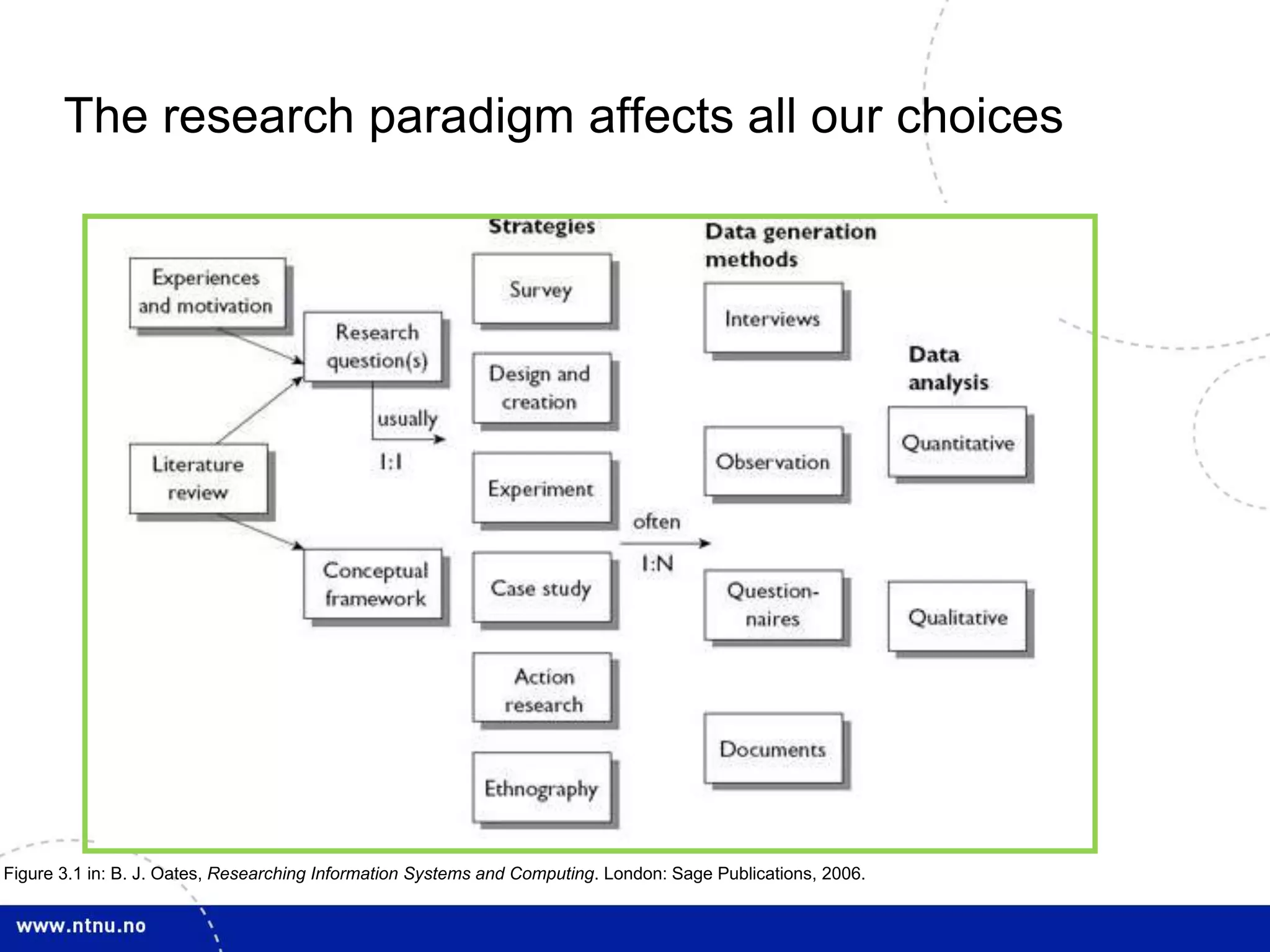
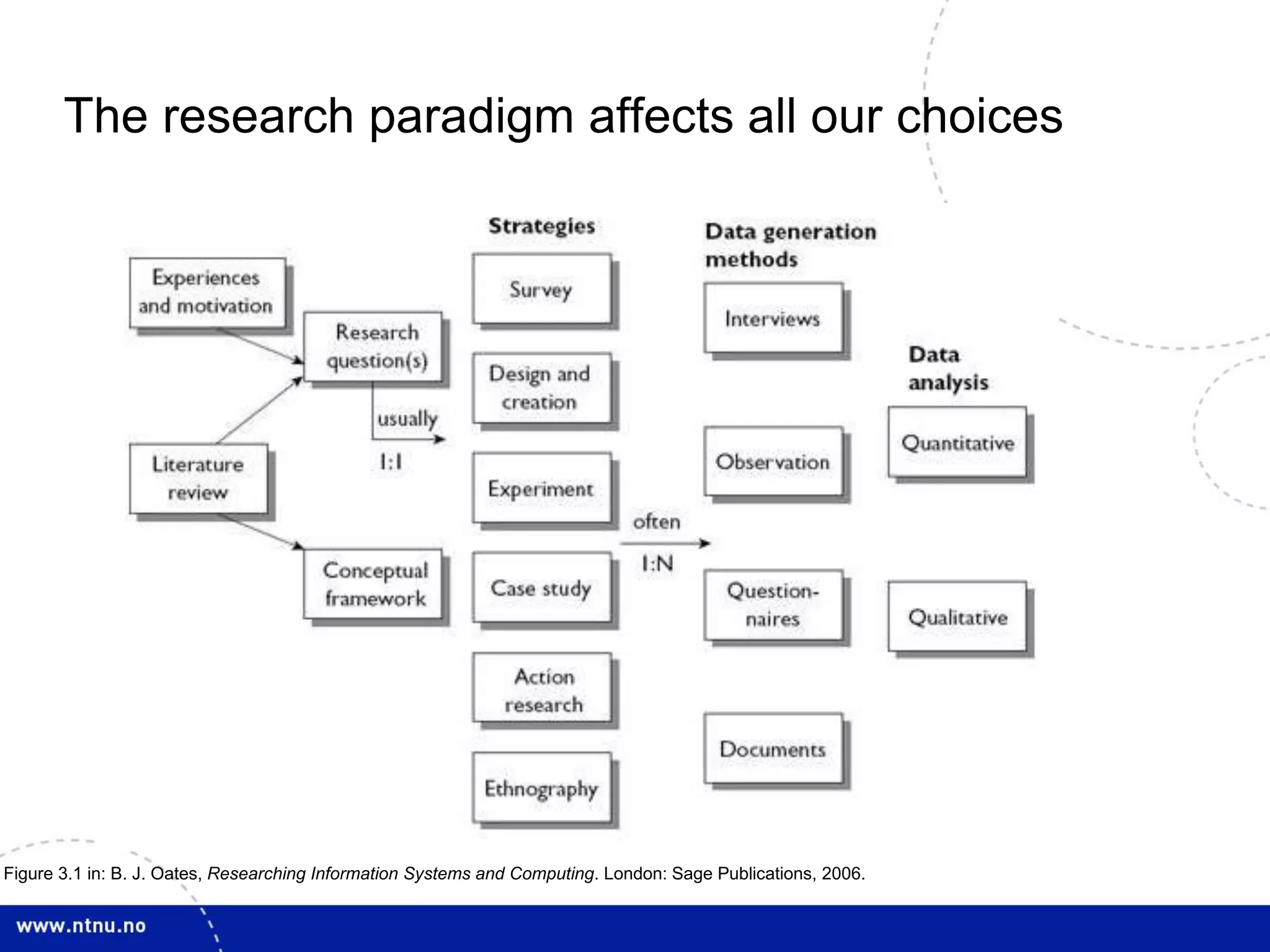
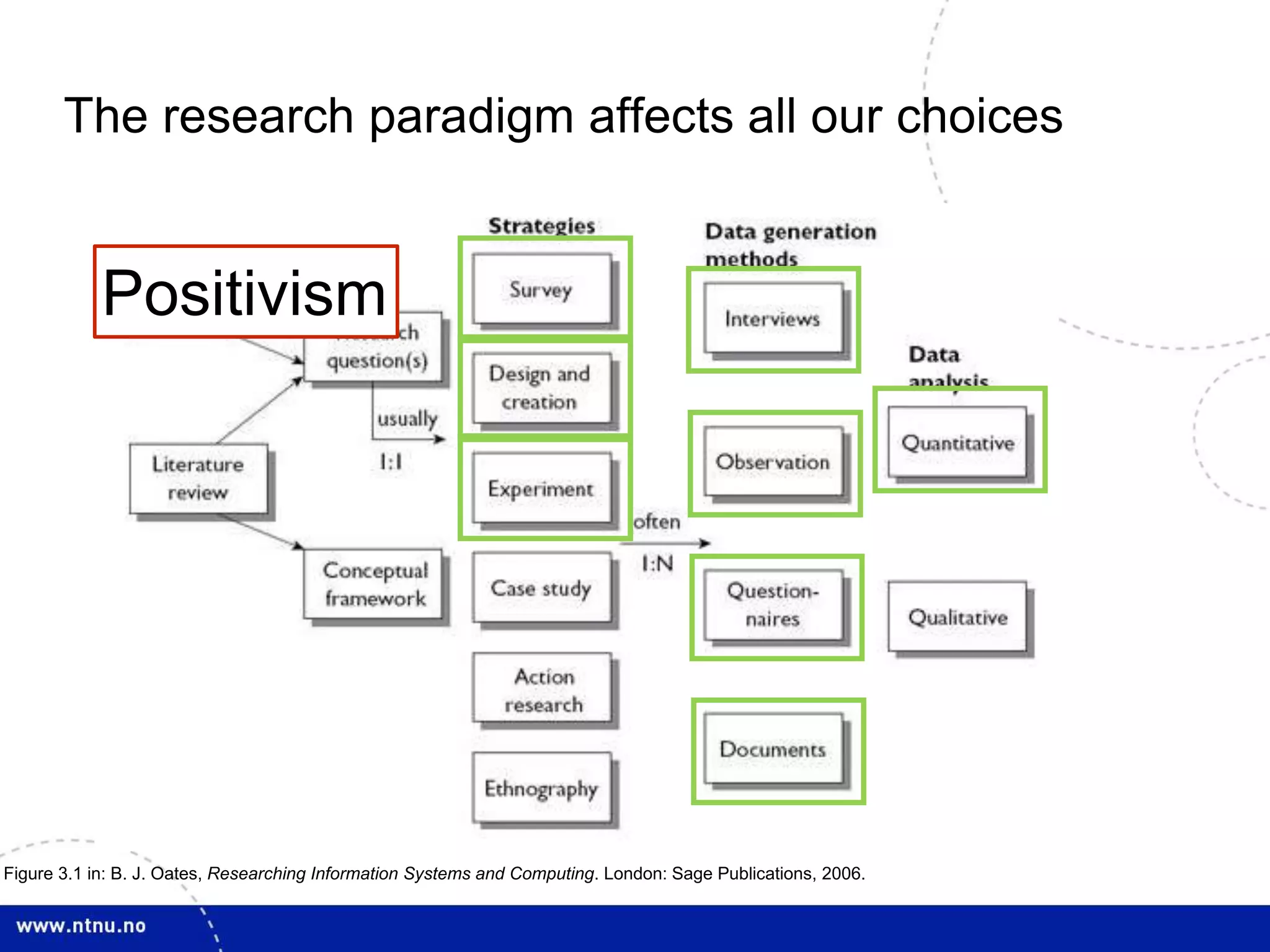
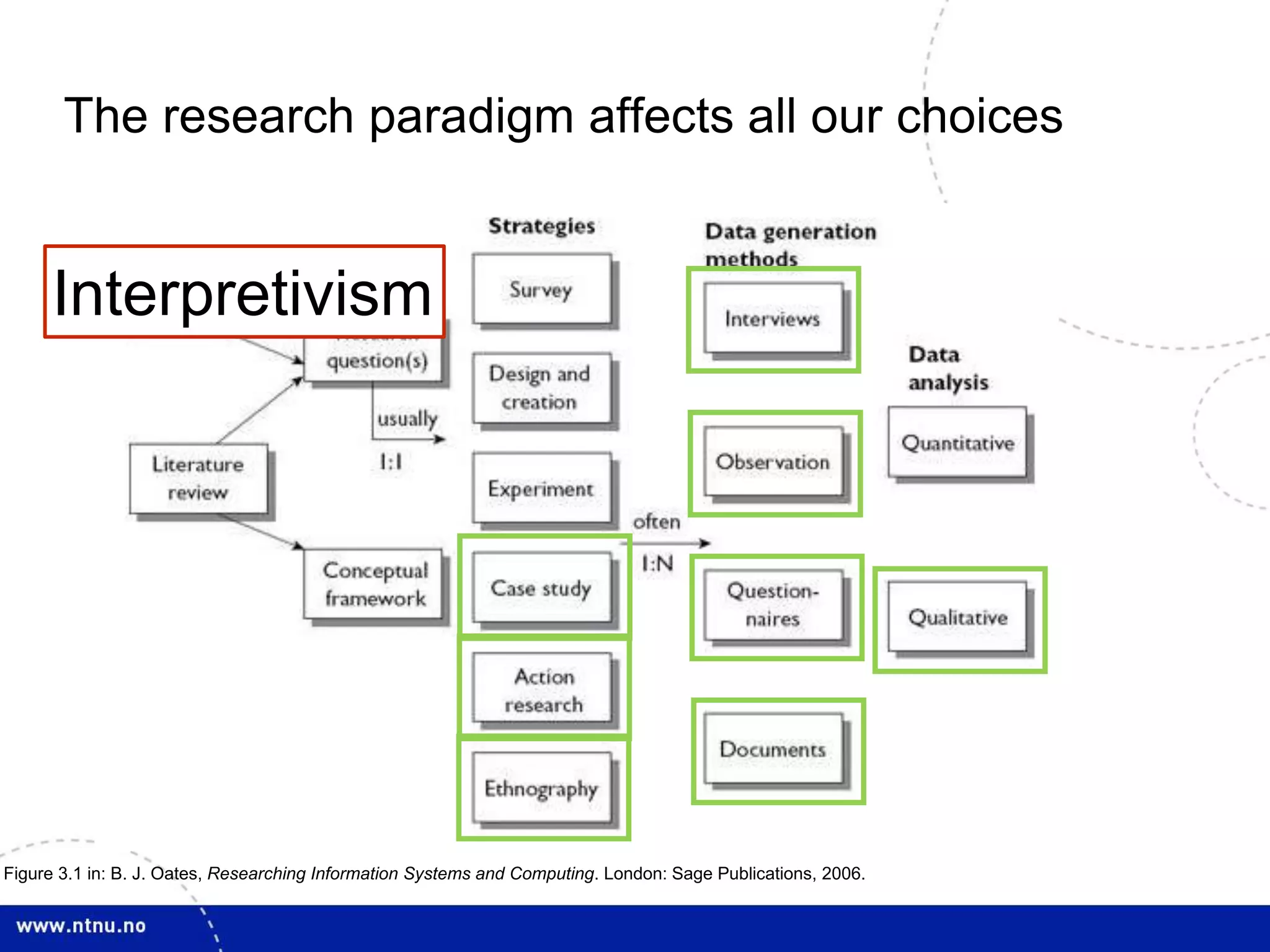
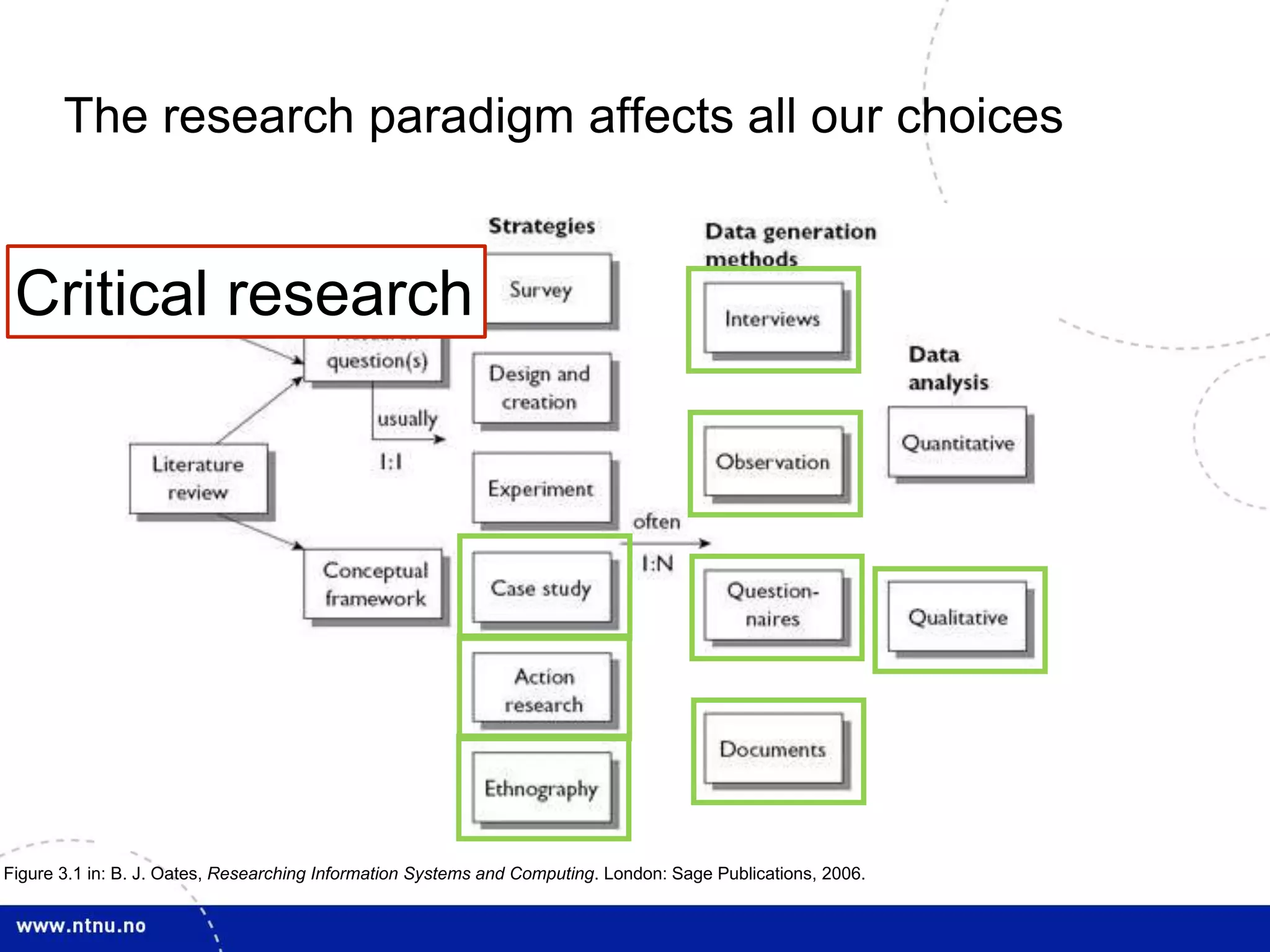
The research paradigm affects all our choices 
Figure 3.1 in: B. J. Oates, Researching Information Systems and Computing. London: Sage Publications, 2006.
Main philosophical paradigms 
• Positivism 
• Interpretivism 
• Critical research 
• Fundamental world views that will affect research 
questions, strategy, data collection and analysis 
methods. 
• Need to know the paradigm in order to properly 
evaluate a research result.
Two properties 
• Ontology: Fundamental beliefs about the empirical 
world we conduct research on. 
• Epistemology: A high level outline of the reasoning 
process by which researcher perform their logical and 
empirical research.
Positivist research (scientific method) 
• Two basic assumptions: 
– Ontologically: Our world is ordered and regular, not random. There 
exist universal laws that can be studied and understood. 
– Epistemologically: We can investigate the world objectively through 
experiments. 
• The scientific method seeks to find all the regular laws 
or patterns in our universe. 
– Mainly through experiments that are design to refute hypotheses. 
– Refuting hypotheses is much more economical than proving them 
(example of the black swan).
Scientific method: Principles 
• Reductionism: breaking complex things down into 
smaller things that are more easily studied. 
• Repeatability: in order to eliminate luck, bias, faulty 
design and equipment, etc. 
• Refutation: either by showing that an experiment is 
not repeatable, or by showing evidence that refutes 
the hypotheses.
The scientific method cycle 
• Formulate theory about some observed aspect of the 
world. 
• Derive hypothesis. 
• Test hypothesis objectively. 
• Observe results. 
• Confirm or refute hypothesis. 
• Accept, modify or reject theory.
Strategies and methods 
common in scientific method 
• Main strategies: 
– Experiments. 
– Surveys. 
• Main data generation methods: 
– Structured interviews and questionnaires. 
– Structured observations. 
• Often quantitative data collection and measurement.
Main philosophical paradigms 
• Positivism 
• Interpretivism 
• Critical research 
• Fundamental world views that will affect research 
questions, strategy, data collection and analysis 
methods. 
• Need to know the paradigm in order to properly 
evaluate a research result.
Interpretive research in IS 
• Concerned with understanding the social context of an 
information system. 
• No proving or refuting of hypotheses. 
• Tries to explain connections among different 
contextual parameters, e.g. influences, power, 
attitudes…
Interpretive research in IS 
• Multiple subjective realities: There is no one truth. 
• Dynamic, socially constructed meaning: Meaning 
passes several "payers" of interpretation. 
• Researcher reflexivity: Researchers are not neutral. 
• Study of people in their natural social settings: 
Artificial settings are not interesting for real 
understanding. 
• Qualitative data analysis: words, metaphors, 
images, stories. 
• Multiple interpretations: researchers offer more than 
one explanation.
Critical research 
• "Concerned with identifying power relations, conflicts 
and contradictions, and empowering people to 
eliminate them as sources of alienation and 
domination." Oates, (2012). 
• Common themes: 
– Emancipation: freeing people from power relations. 
– Critique of tradition: do not accept the status quo, but question and 
challenge it. 
– Non-performative intent: reject managerial benefit as the only 
output. 
– Critique of technological determinism: challenge the view that 
everyone has to adapt to the technology. 
– Reflexivity: question the existence of objective knowledge.
The research paradigm affects all our choices 
Figure 3.1 in: B. J. Oates, Researching Information Systems and Computing. London: Sage Publications, 2006.
The research paradigm affects all our choices 
Positivism 
Figure 3.1 in: B. J. Oates, Researching Information Systems and Computing. London: Sage Publications, 2006.
The research paradigm affects all our choices 
Interpretivism 
Figure 3.1 in: B. J. Oates, Researching Information Systems and Computing. London: Sage Publications, 2006.
The research paradigm affects all our choices 
Critical research 
Figure 3.1 in: B. J. Oates, Researching Information Systems and Computing. London: Sage Publications, 2006.
Next week 
• Book chapter 10. Case studies. 
• Intro assignment 3. 
• Group 7 presents paper 7.

IT3010 Lecture-7 Research Paradigms

  • 1.
    IT3010 / TDT39 Research Methodology Week 7: Research paradigms Name, title of the presentation
  • 2.
    The research paradigmaffects all our choices Figure 3.1 in: B. J. Oates, Researching Information Systems and Computing. London: Sage Publications, 2006.
  • 3.
    Main philosophical paradigms • Positivism • Interpretivism • Critical research • Fundamental world views that will affect research questions, strategy, data collection and analysis methods. • Need to know the paradigm in order to properly evaluate a research result.
  • 4.
    Two properties •Ontology: Fundamental beliefs about the empirical world we conduct research on. • Epistemology: A high level outline of the reasoning process by which researcher perform their logical and empirical research.
  • 5.
    Positivist research (scientificmethod) • Two basic assumptions: – Ontologically: Our world is ordered and regular, not random. There exist universal laws that can be studied and understood. – Epistemologically: We can investigate the world objectively through experiments. • The scientific method seeks to find all the regular laws or patterns in our universe. – Mainly through experiments that are design to refute hypotheses. – Refuting hypotheses is much more economical than proving them (example of the black swan).
  • 6.
    Scientific method: Principles • Reductionism: breaking complex things down into smaller things that are more easily studied. • Repeatability: in order to eliminate luck, bias, faulty design and equipment, etc. • Refutation: either by showing that an experiment is not repeatable, or by showing evidence that refutes the hypotheses.
  • 7.
    The scientific methodcycle • Formulate theory about some observed aspect of the world. • Derive hypothesis. • Test hypothesis objectively. • Observe results. • Confirm or refute hypothesis. • Accept, modify or reject theory.
  • 8.
    Strategies and methods common in scientific method • Main strategies: – Experiments. – Surveys. • Main data generation methods: – Structured interviews and questionnaires. – Structured observations. • Often quantitative data collection and measurement.
  • 9.
    Main philosophical paradigms • Positivism • Interpretivism • Critical research • Fundamental world views that will affect research questions, strategy, data collection and analysis methods. • Need to know the paradigm in order to properly evaluate a research result.
  • 10.
    Interpretive research inIS • Concerned with understanding the social context of an information system. • No proving or refuting of hypotheses. • Tries to explain connections among different contextual parameters, e.g. influences, power, attitudes…
  • 11.
    Interpretive research inIS • Multiple subjective realities: There is no one truth. • Dynamic, socially constructed meaning: Meaning passes several "payers" of interpretation. • Researcher reflexivity: Researchers are not neutral. • Study of people in their natural social settings: Artificial settings are not interesting for real understanding. • Qualitative data analysis: words, metaphors, images, stories. • Multiple interpretations: researchers offer more than one explanation.
  • 12.
    Critical research •"Concerned with identifying power relations, conflicts and contradictions, and empowering people to eliminate them as sources of alienation and domination." Oates, (2012). • Common themes: – Emancipation: freeing people from power relations. – Critique of tradition: do not accept the status quo, but question and challenge it. – Non-performative intent: reject managerial benefit as the only output. – Critique of technological determinism: challenge the view that everyone has to adapt to the technology. – Reflexivity: question the existence of objective knowledge.
  • 13.
    The research paradigmaffects all our choices Figure 3.1 in: B. J. Oates, Researching Information Systems and Computing. London: Sage Publications, 2006.
  • 14.
    The research paradigmaffects all our choices Positivism Figure 3.1 in: B. J. Oates, Researching Information Systems and Computing. London: Sage Publications, 2006.
  • 15.
    The research paradigmaffects all our choices Interpretivism Figure 3.1 in: B. J. Oates, Researching Information Systems and Computing. London: Sage Publications, 2006.
  • 16.
    The research paradigmaffects all our choices Critical research Figure 3.1 in: B. J. Oates, Researching Information Systems and Computing. London: Sage Publications, 2006.
  • 17.
    Next week •Book chapter 10. Case studies. • Intro assignment 3. • Group 7 presents paper 7.