IT3010
Research Methodology
Case study method
Name, title of the presentation
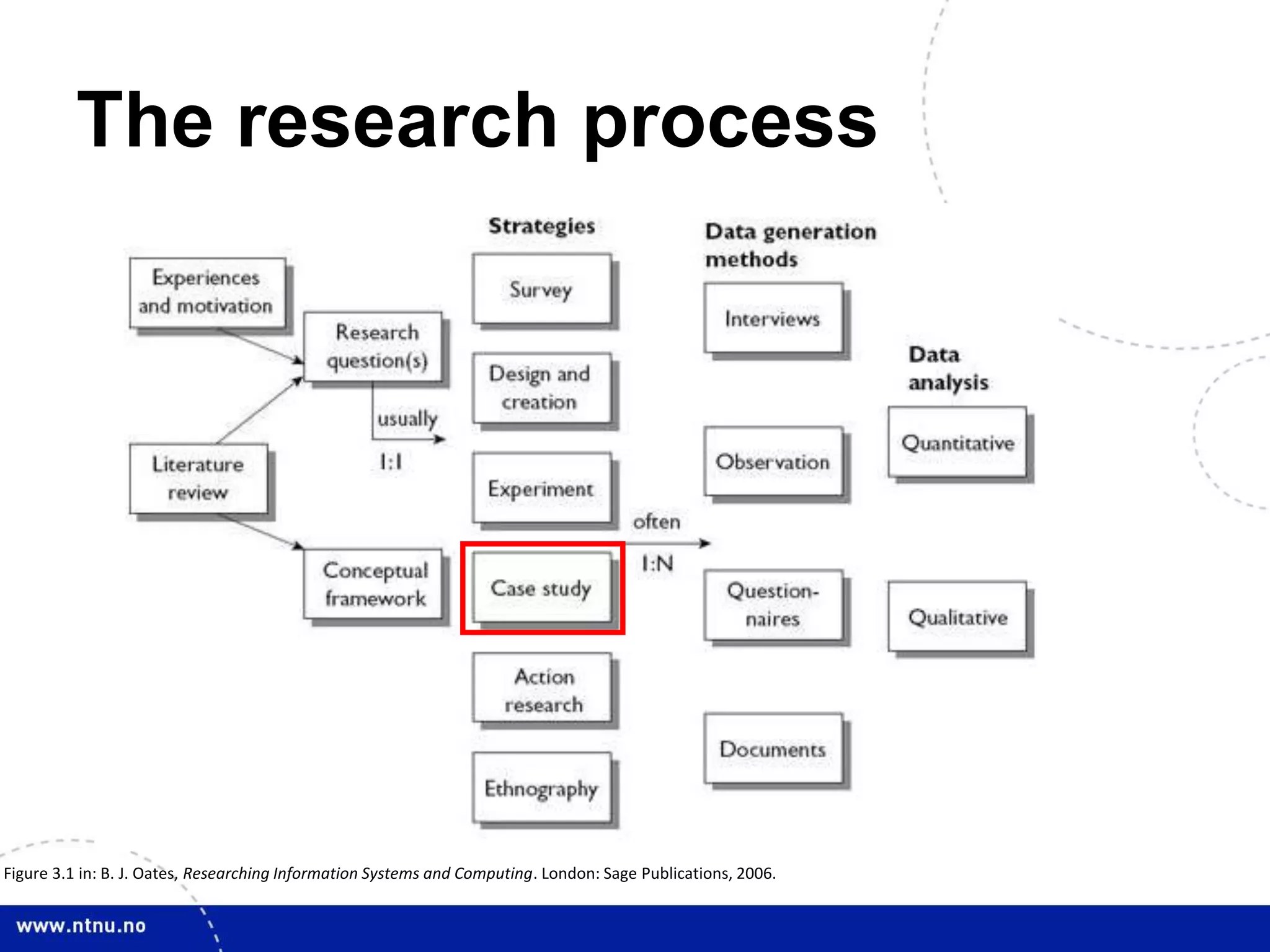
Figure 3.1 in: B. J. Oates, Researching Information Systems and Computing. London: Sage Publications, 2006.
The research process
Case study: Definition
• A case study focuses on one instance (case) of the
‘thing’ that is to be investigated.
– In-depth,
– Using multiple data generation methods,
– The goal: A rich and detailed description of the thing and its
relationships and processes.
• As opposed to surveys and experiments where the goal
is to eliminate complex relationships and focus on few
parameters.
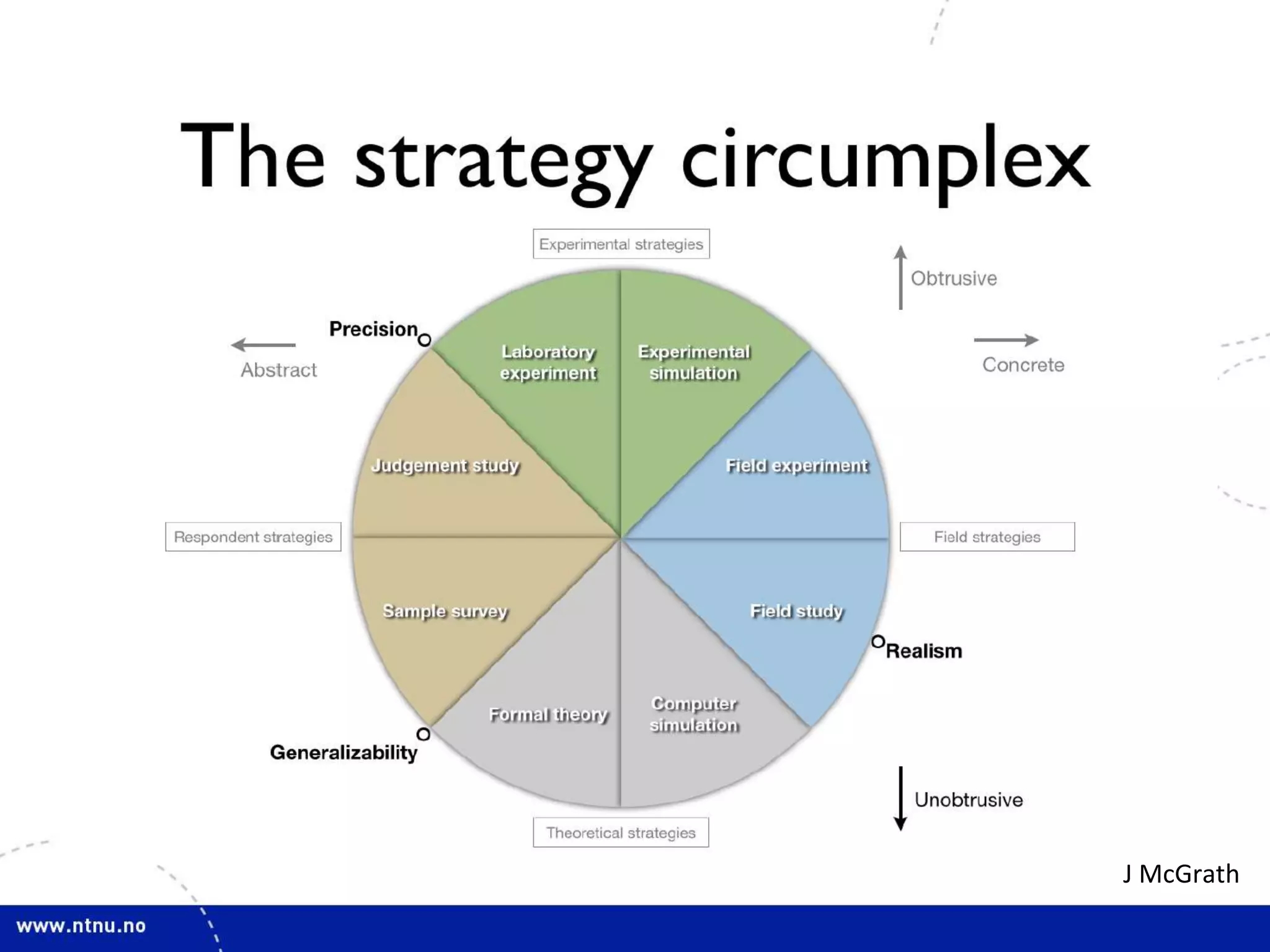
J McGrath
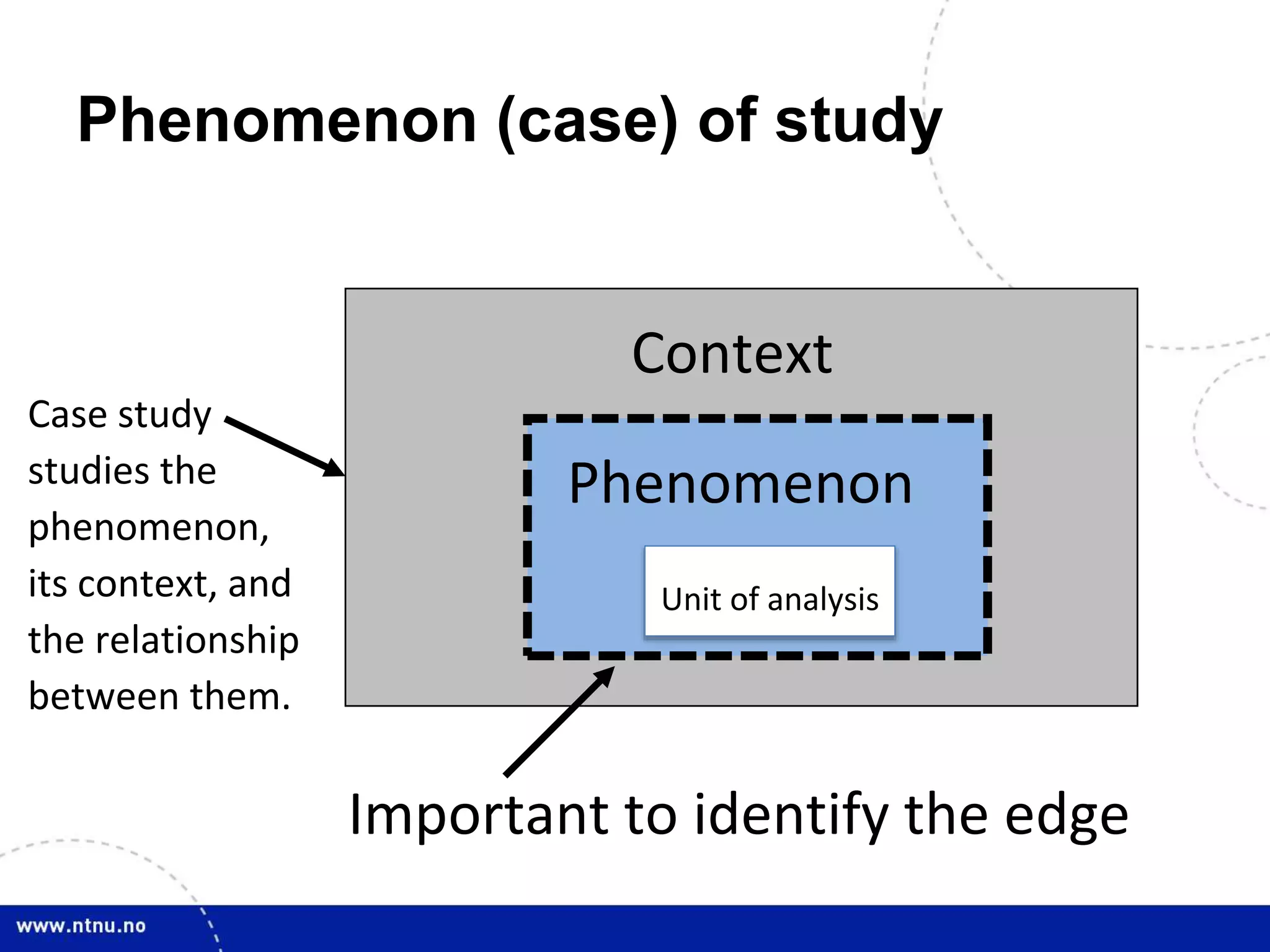
Phenomenon (case) of study
Context
Phenomenon
Important to identify the edge
Case study
studies the
phenomenon,
its context, and
the relationship
between them.
Unit of analysis
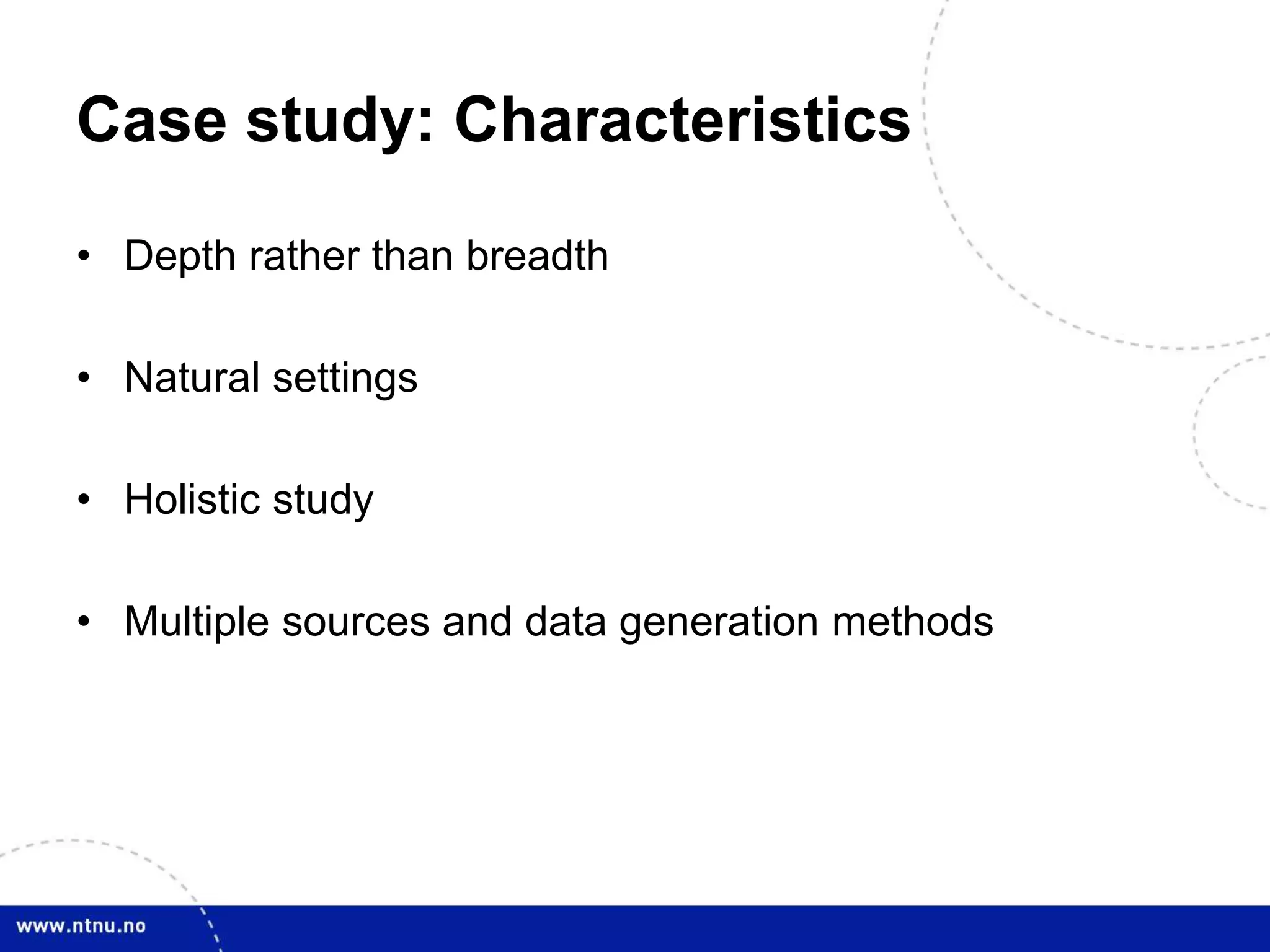
Case study: Characteristics
• Depth rather than breadth
• Natural settings
• Holistic study
• Multiple sources and data generation methods
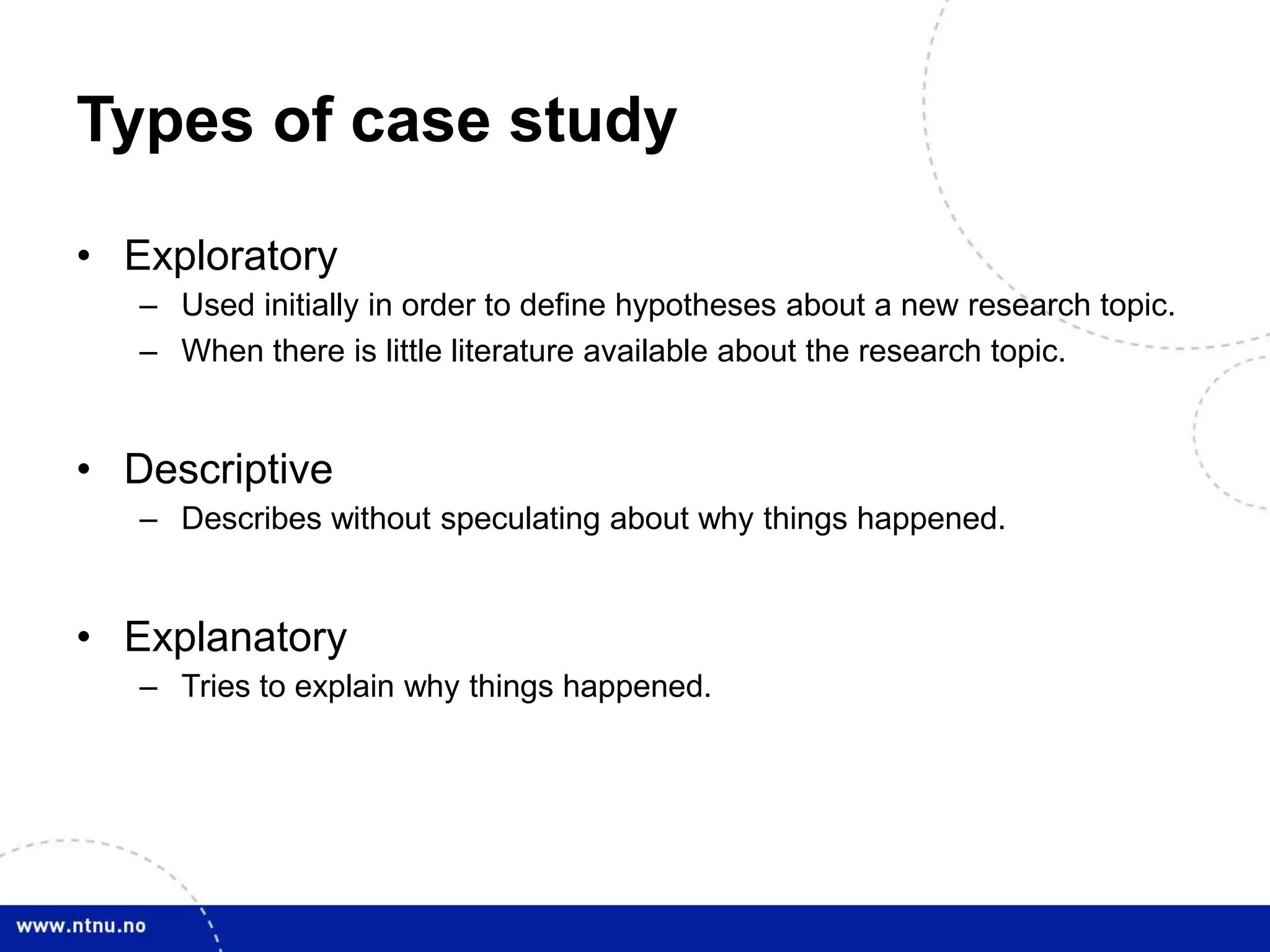
Types of case study
• Exploratory
– Used initially in order to define hypotheses about a new research topic.
– When there is little literature available about the research topic.
• Descriptive
– Describes without speculating about why things happened.
• Explanatory
– Tries to explain why things happened.
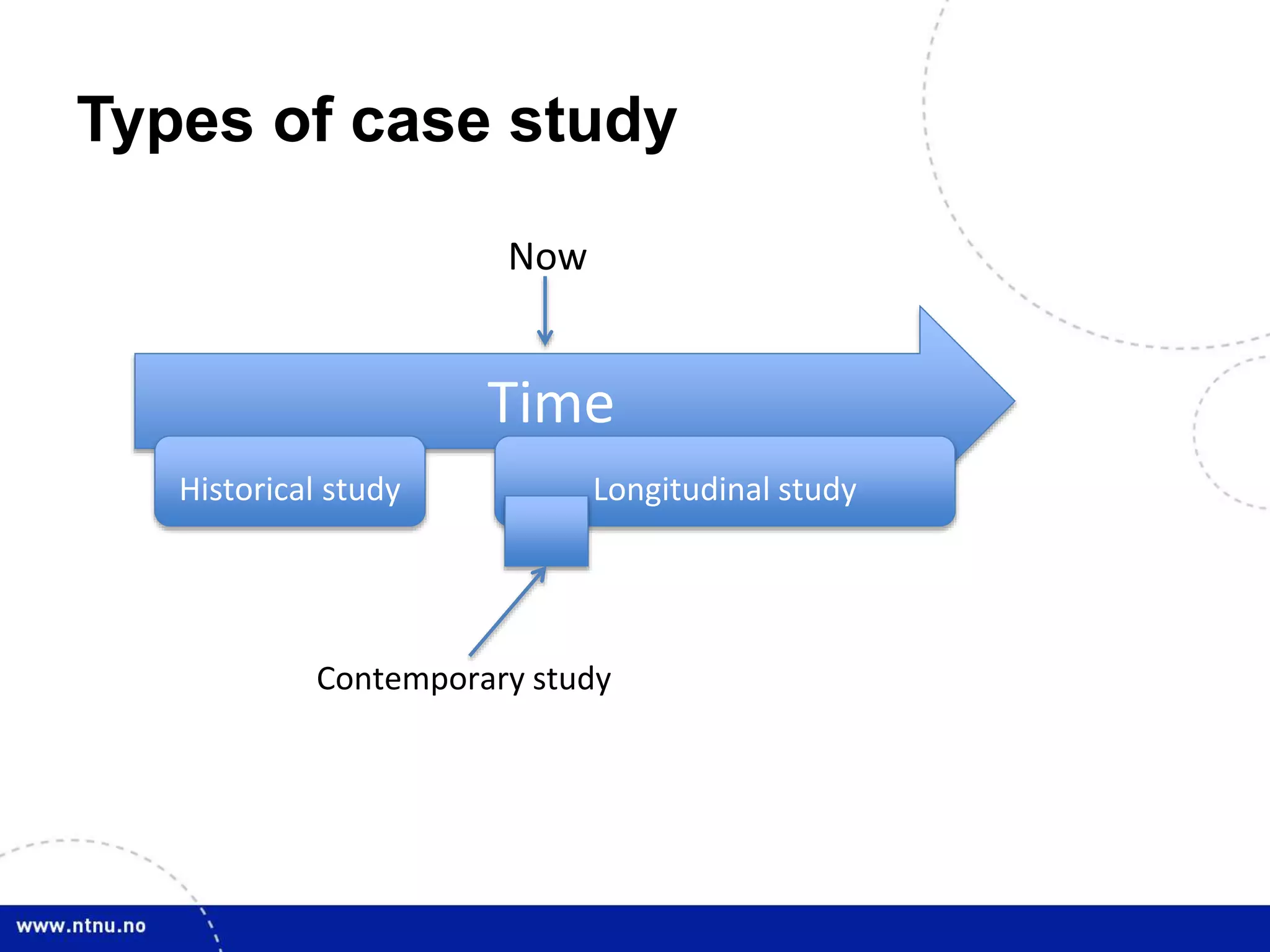
Types of case study
Time
Now
Historical study Longitudinal study
Contemporary study
Types of case study
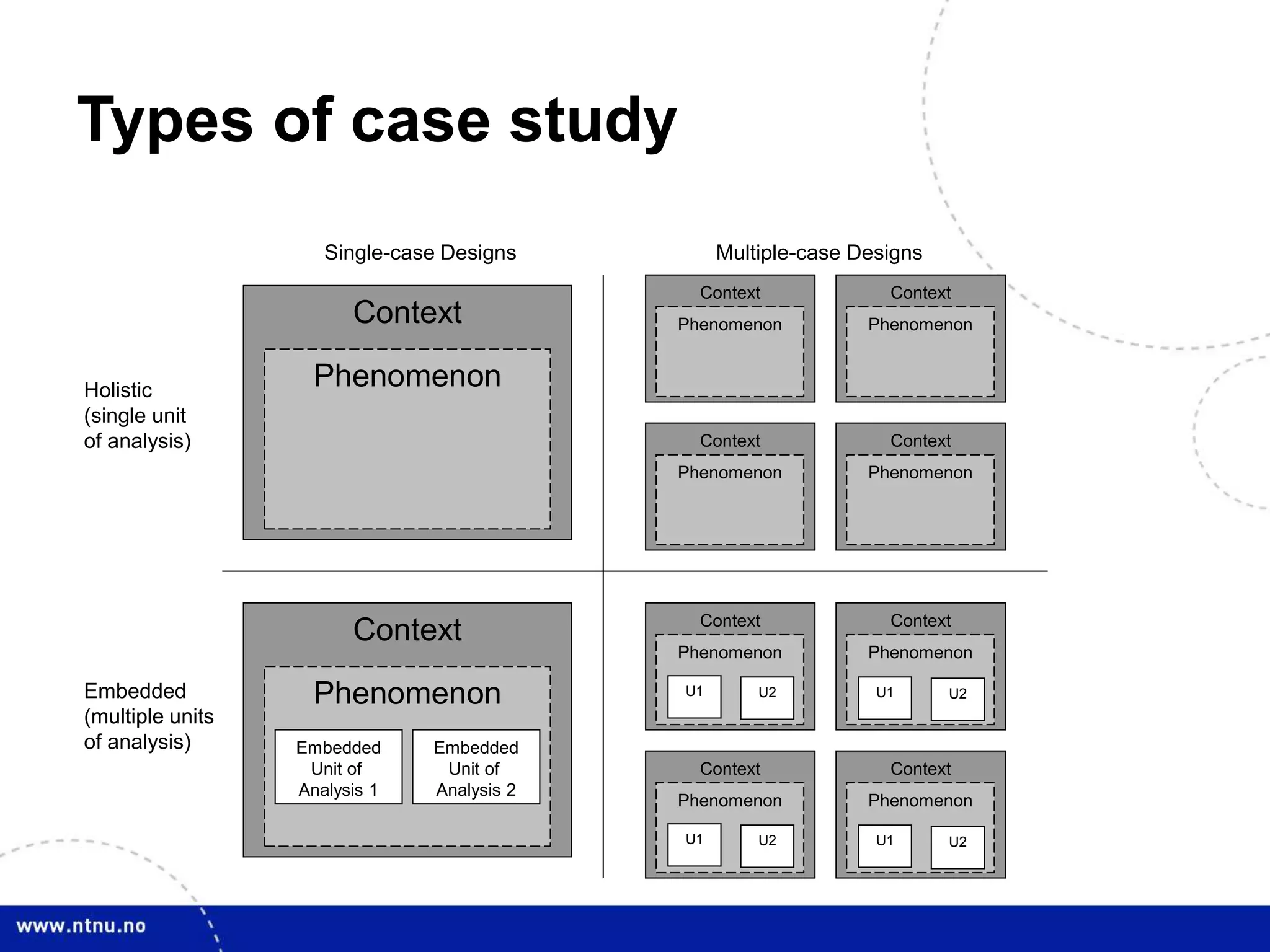
Context
Phenomenon
Context
Phenomenon
Embedded
Unit of
Analysis 1
Embedded
Unit of
Analysis 2
Context
Phenomenon
Context
Phenomenon
Context
Phenomenon
Context
Phenomenon
Context
Phenomenon
Context
Phenomenon
Context
Phenomenon
Context
Phenomenon
U1 U2
U1 U2
U1 U2
U1 U2
Embedded
(multiple units
of analysis)
Holistic
(single unit
of analysis)
Single-case Designs Multiple-case Designs
Types of case study
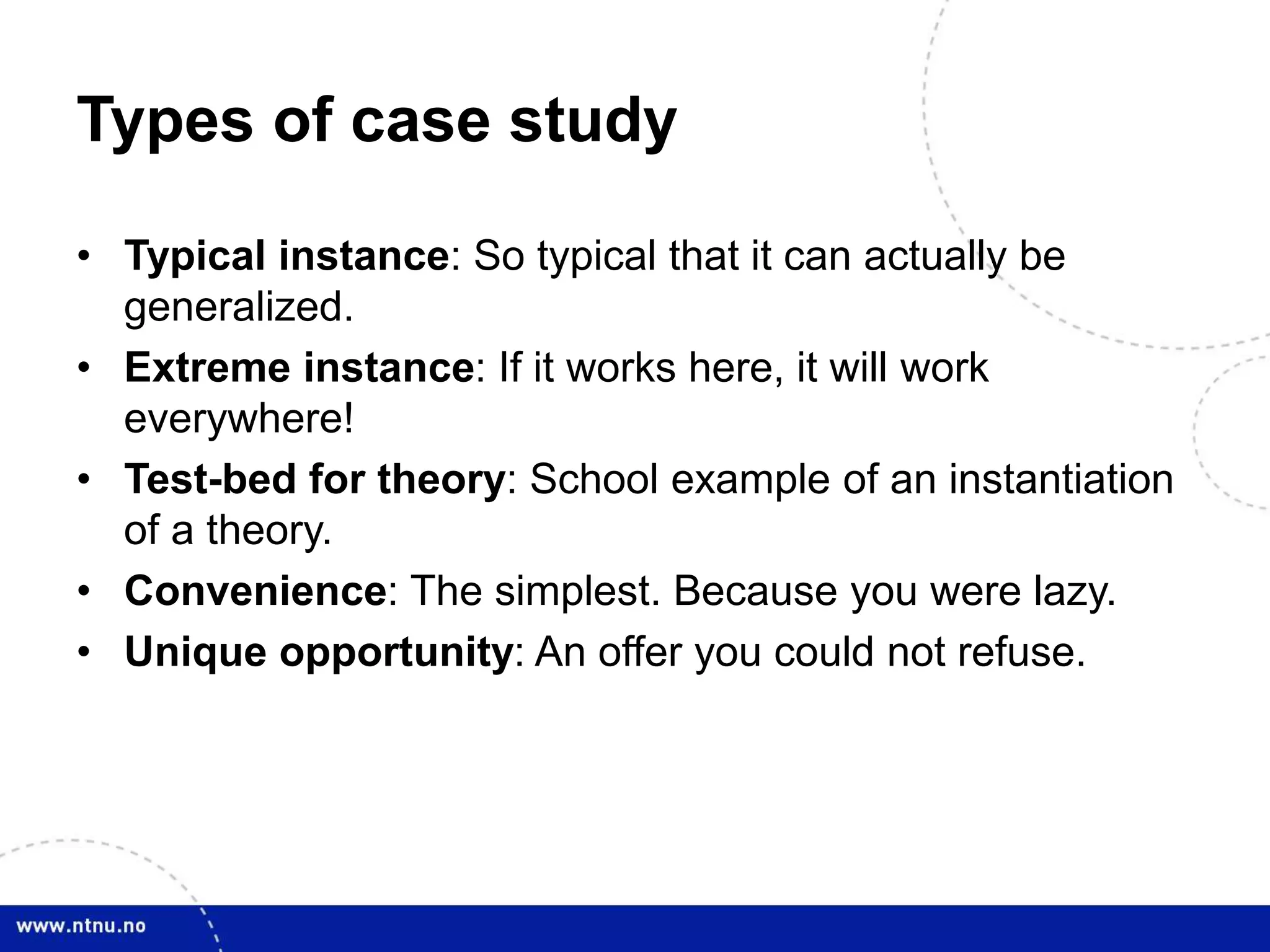
• Typical instance: So typical that it can actually be
generalized.
• Extreme instance: If it works here, it will work
everywhere!
• Test-bed for theory: School example of an instantiation
of a theory.
• Convenience: The simplest. Because you were lazy.
• Unique opportunity: An offer you could not refuse.
Generalization
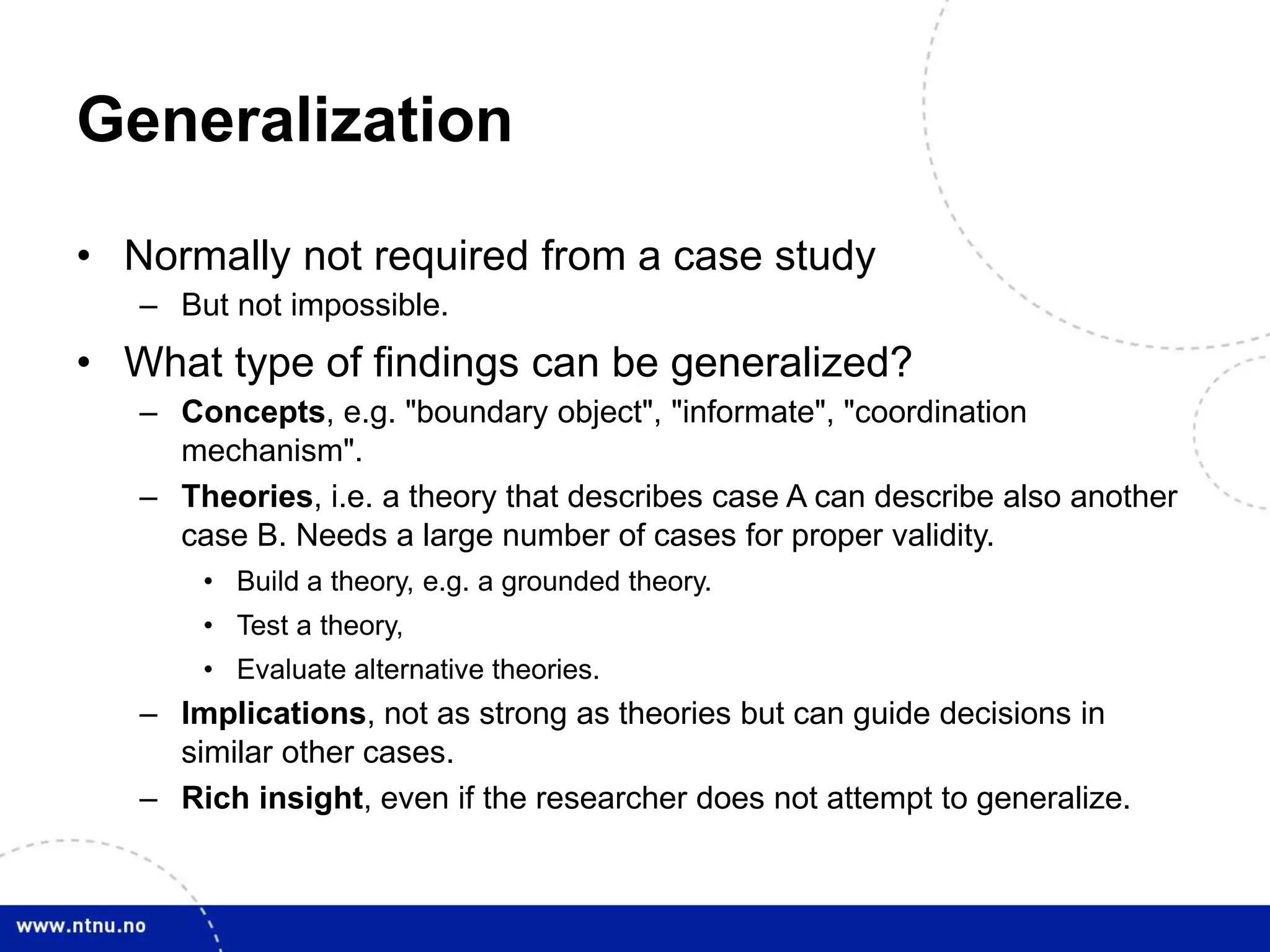
• Normally not required from a case study
– But not impossible.
• What type of findings can be generalized?
– Concepts, e.g. "boundary object", "informate", "coordination
mechanism".
– Theories, i.e. a theory that describes case A can describe also another
case B. Needs a large number of cases for proper validity.
• Build a theory, e.g. a grounded theory.
• Test a theory,
• Evaluate alternative theories.
– Implications, not as strong as theories but can guide decisions in
similar other cases.
– Rich insight, even if the researcher does not attempt to generalize.
Advantages and disadvantages
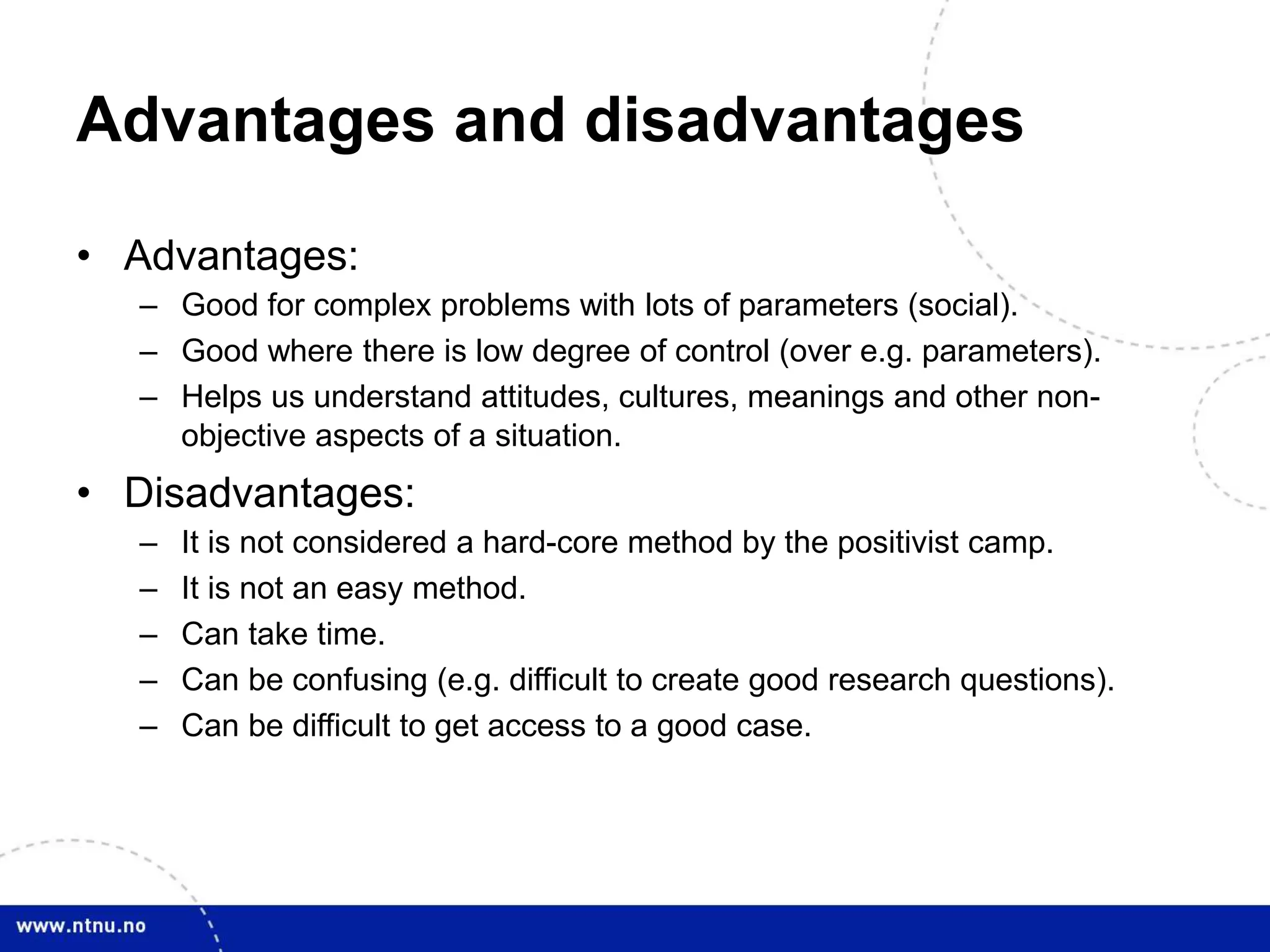
• Advantages:
– Good for complex problems with lots of parameters (social).
– Good where there is low degree of control (over e.g. parameters).
– Helps us understand attitudes, cultures, meanings and other non-
objective aspects of a situation.
• Disadvantages:
– It is not considered a hard-core method by the positivist camp.
– It is not an easy method.
– Can take time.
– Can be confusing (e.g. difficult to create good research questions).
– Can be difficult to get access to a good case.

IT3010 Lecture on Case Study Research

  • 1.
    IT3010 Research Methodology Case studymethod Name, title of the presentation
  • 2.
    Figure 3.1 in:B. J. Oates, Researching Information Systems and Computing. London: Sage Publications, 2006. The research process
  • 3.
    Case study: Definition •A case study focuses on one instance (case) of the ‘thing’ that is to be investigated. – In-depth, – Using multiple data generation methods, – The goal: A rich and detailed description of the thing and its relationships and processes. • As opposed to surveys and experiments where the goal is to eliminate complex relationships and focus on few parameters.
  • 4.
  • 5.
    Phenomenon (case) ofstudy Context Phenomenon Important to identify the edge Case study studies the phenomenon, its context, and the relationship between them. Unit of analysis
  • 6.
    Case study: Characteristics •Depth rather than breadth • Natural settings • Holistic study • Multiple sources and data generation methods
  • 7.
    Types of casestudy • Exploratory – Used initially in order to define hypotheses about a new research topic. – When there is little literature available about the research topic. • Descriptive – Describes without speculating about why things happened. • Explanatory – Tries to explain why things happened.
  • 8.
    Types of casestudy Time Now Historical study Longitudinal study Contemporary study
  • 9.
    Types of casestudy Context Phenomenon Context Phenomenon Embedded Unit of Analysis 1 Embedded Unit of Analysis 2 Context Phenomenon Context Phenomenon Context Phenomenon Context Phenomenon Context Phenomenon Context Phenomenon Context Phenomenon Context Phenomenon U1 U2 U1 U2 U1 U2 U1 U2 Embedded (multiple units of analysis) Holistic (single unit of analysis) Single-case Designs Multiple-case Designs
  • 10.
    Types of casestudy • Typical instance: So typical that it can actually be generalized. • Extreme instance: If it works here, it will work everywhere! • Test-bed for theory: School example of an instantiation of a theory. • Convenience: The simplest. Because you were lazy. • Unique opportunity: An offer you could not refuse.
  • 11.
    Generalization • Normally notrequired from a case study – But not impossible. • What type of findings can be generalized? – Concepts, e.g. "boundary object", "informate", "coordination mechanism". – Theories, i.e. a theory that describes case A can describe also another case B. Needs a large number of cases for proper validity. • Build a theory, e.g. a grounded theory. • Test a theory, • Evaluate alternative theories. – Implications, not as strong as theories but can guide decisions in similar other cases. – Rich insight, even if the researcher does not attempt to generalize.
  • 12.
    Advantages and disadvantages •Advantages: – Good for complex problems with lots of parameters (social). – Good where there is low degree of control (over e.g. parameters). – Helps us understand attitudes, cultures, meanings and other non- objective aspects of a situation. • Disadvantages: – It is not considered a hard-core method by the positivist camp. – It is not an easy method. – Can take time. – Can be confusing (e.g. difficult to create good research questions). – Can be difficult to get access to a good case.

Editor's Notes

  • #6 You study both the context and the phenomenon but make the distinction clear.