IT3010
Research Methodology
Reviewing the literature
Name, title of the presentation
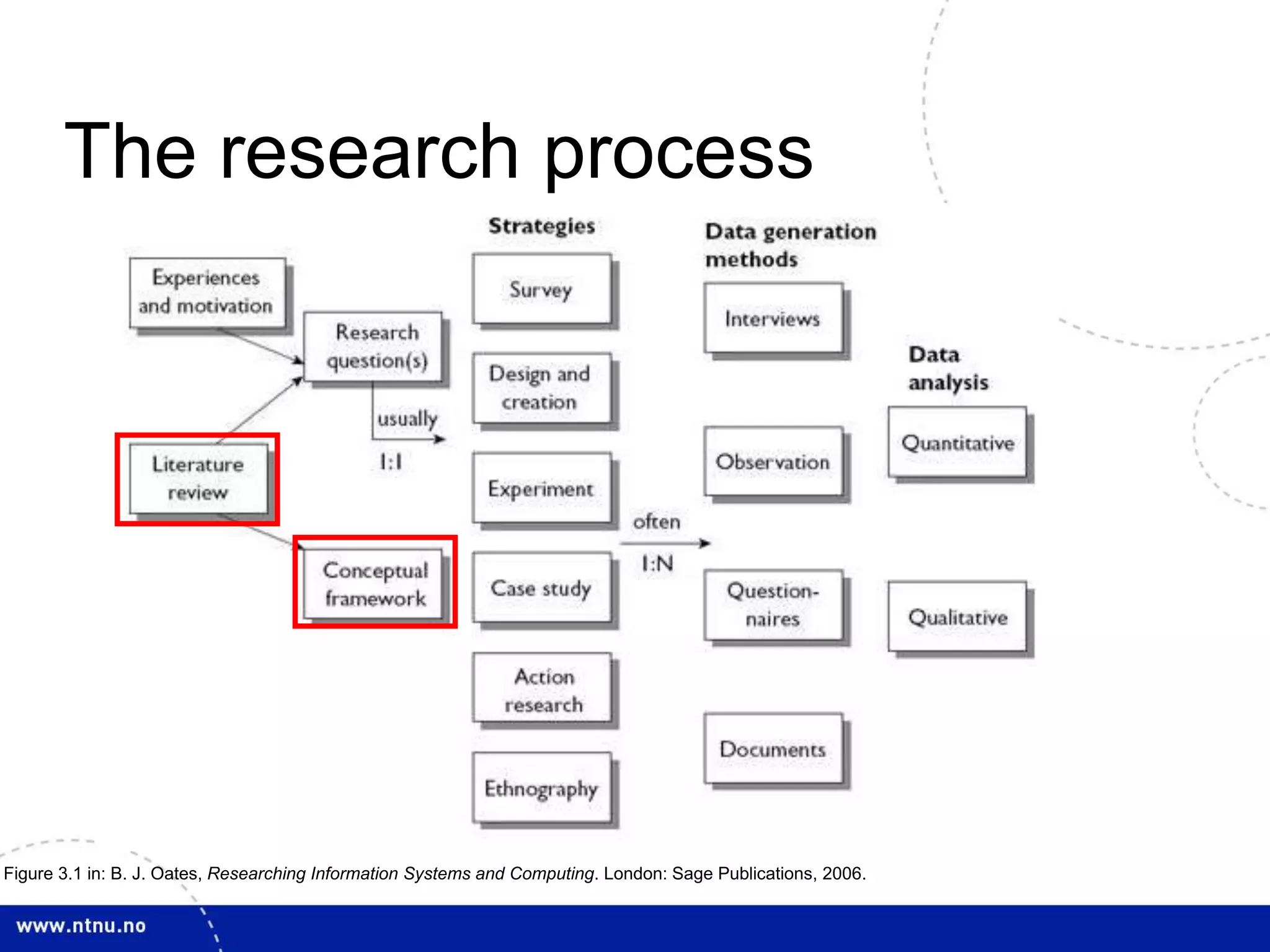
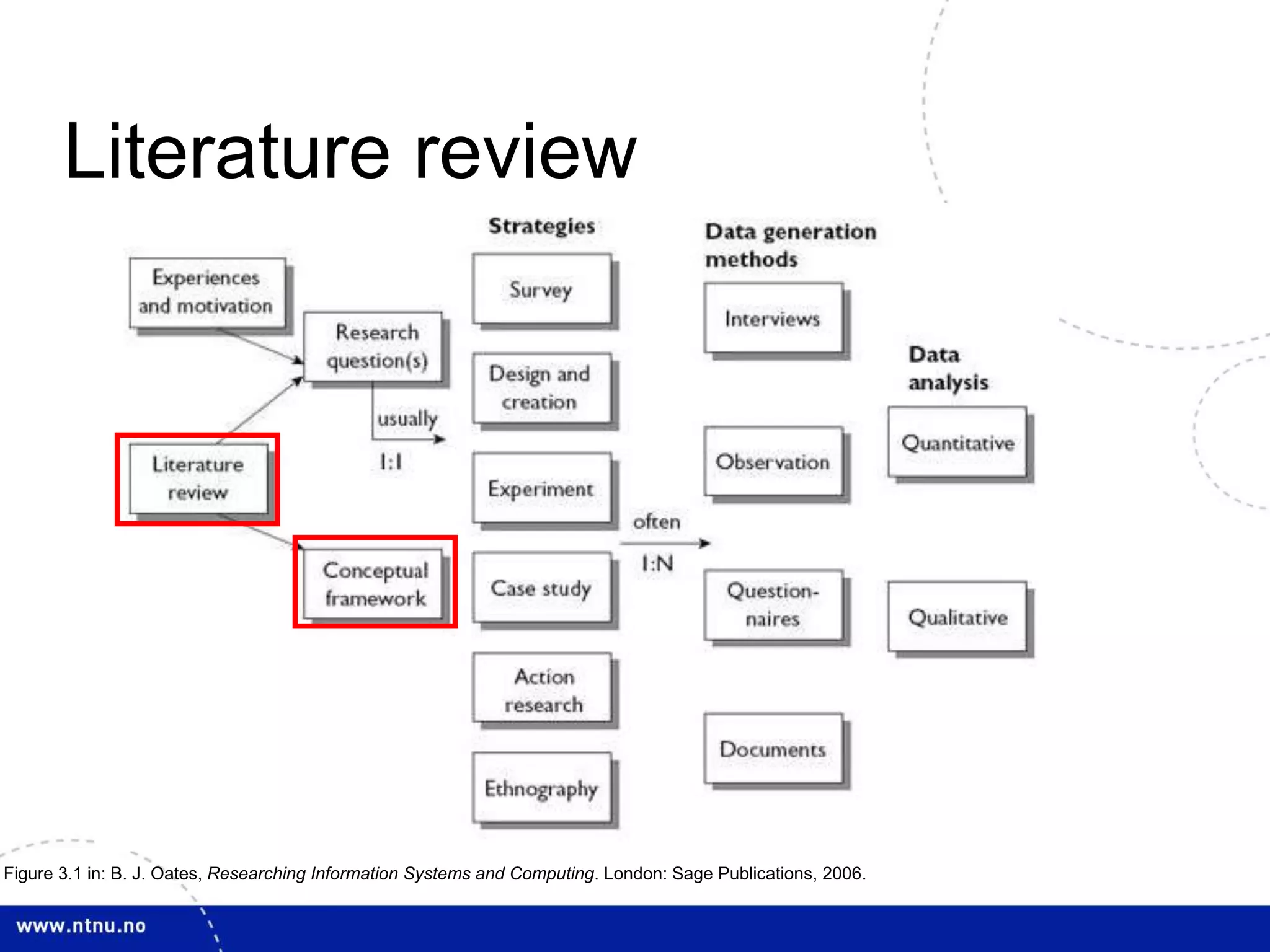
Figure 3.1 in: B. J. Oates, Researching Information Systems and Computing. London: Sage Publications, 2006.
The research process
What is a literature review?
• Definition: A literature review is an assessment of a
body of research that addresses a research question.
(ref: Harvard graduate school).
• Two ways to generate knowledge through research:
– Create your own new knowledge through Primary Studies.
– Synthesize and analyse existing knowledge in a new conceptual
framework through Secondary Studies.
• A literature review can constitute:
– A part of a primary study.
– A secondary study.
Objectives of a literature review
• Show that the researcher is aware of existing work in the chosen topic area.
• Place the researcher’s work in the context of what has already been published.
• Point to strengths, weaknesses, omissions or bias in the previous work.
• Identify key issues or questions that are troubling the research community.
• Point to gaps that have not previously been identified or addressed by
researchers.
• Identify theories that the researcher will test by gathering data from the field.
• Suggest theories that might explain data the researcher has gathered from the
field.
• Identify theories, genres, methods or algorithms that will be incorporated in the
development of a computer application.
• Identify research methods or strategies that the researcher will use in the
research.
• Enable subsequent researchers to understand the field and the researcher’s
work within that field.
Sources of literature
• Main source: Refereed research papers:
– From journals (if peer-reviewed)
– From conferences and workshops (if peer-reviewed)
• Books: Are good for understanding the problem and
building a conceptual framework and theories.
• Manuals: Are good for understanding e.g. a system,
but not as a source of a review.
• Reports: Sometimes good research quality but not
peer-reviewed.
• Newspapers, magazines, radio, television: Can be
good quality "expert opinion" but not peer-reviewed.
Writing a literature review
• Two approaches:
– Ad hoc (State-of-the-art): Searching (e.g. Google scholar) and
reading some papers on the topic. Can result in "cherry picking".
– Systematic: Following a systematic process that is aimed at
producing a scientifically high-quality literature review text. Will
reduce bias.
• Which one to choose?
– Discuss it with your supervisor.
– Systematic approach can take time.
– In most cases: Find a balance.
– Remember: Good literature reviews are by themselves highly
valuable and sorely needed research results in ICT!
Writing the state-of-the-art
• Clearly define the practical problem and the research
question.
– Iterative process, you read some and you write some.
• Should be more than a summary of the articles you
have read.
– Google can do better!
– You need an analysis and synthesis of what you read. Here comes
the conceptual framework.
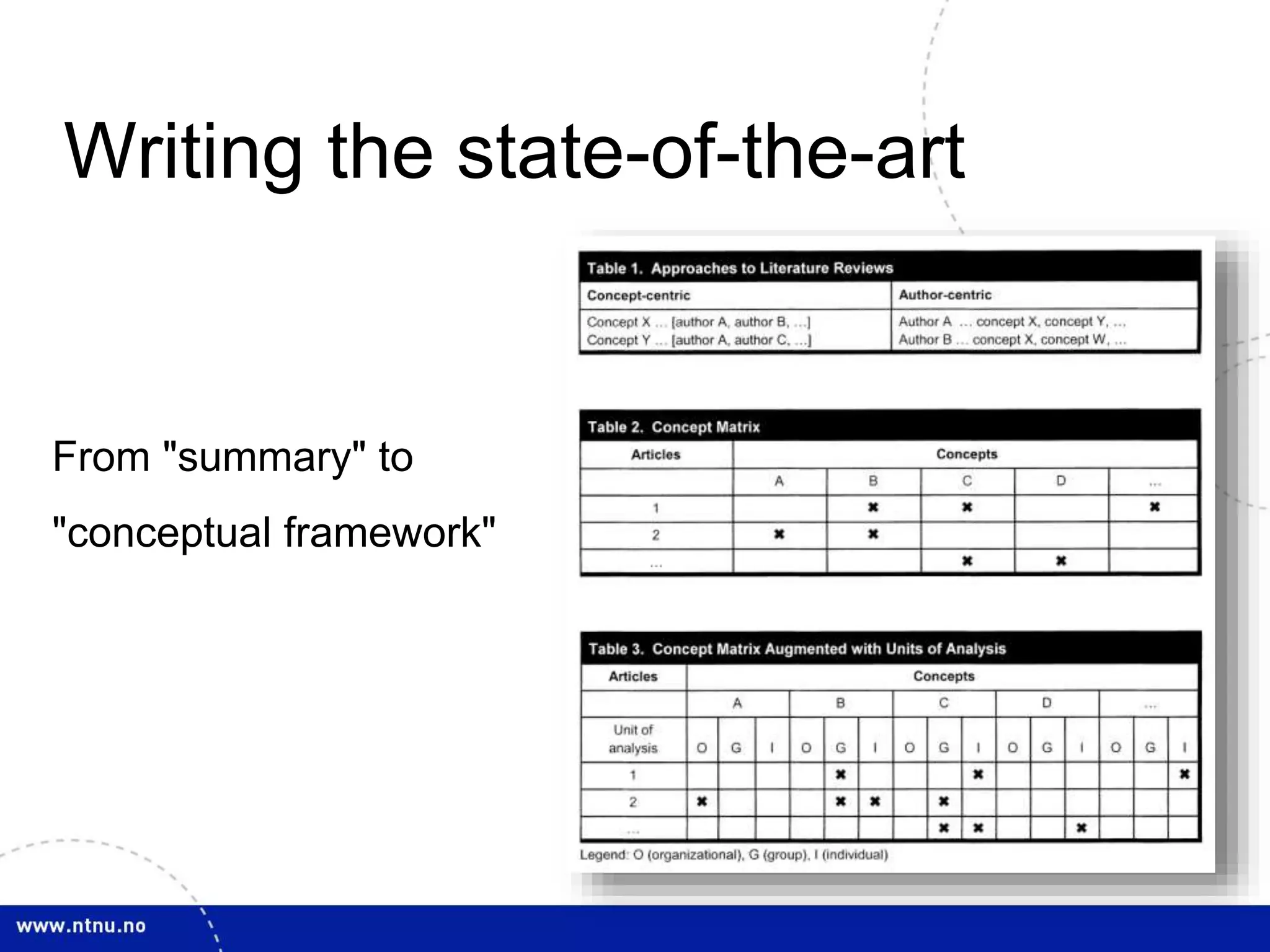
Writing the state-of-the-art
From "summary" to
"conceptual framework"
Figure 3.1 in: B. J. Oates, Researching Information Systems and Computing. London: Sage Publications, 2006.
Literature review
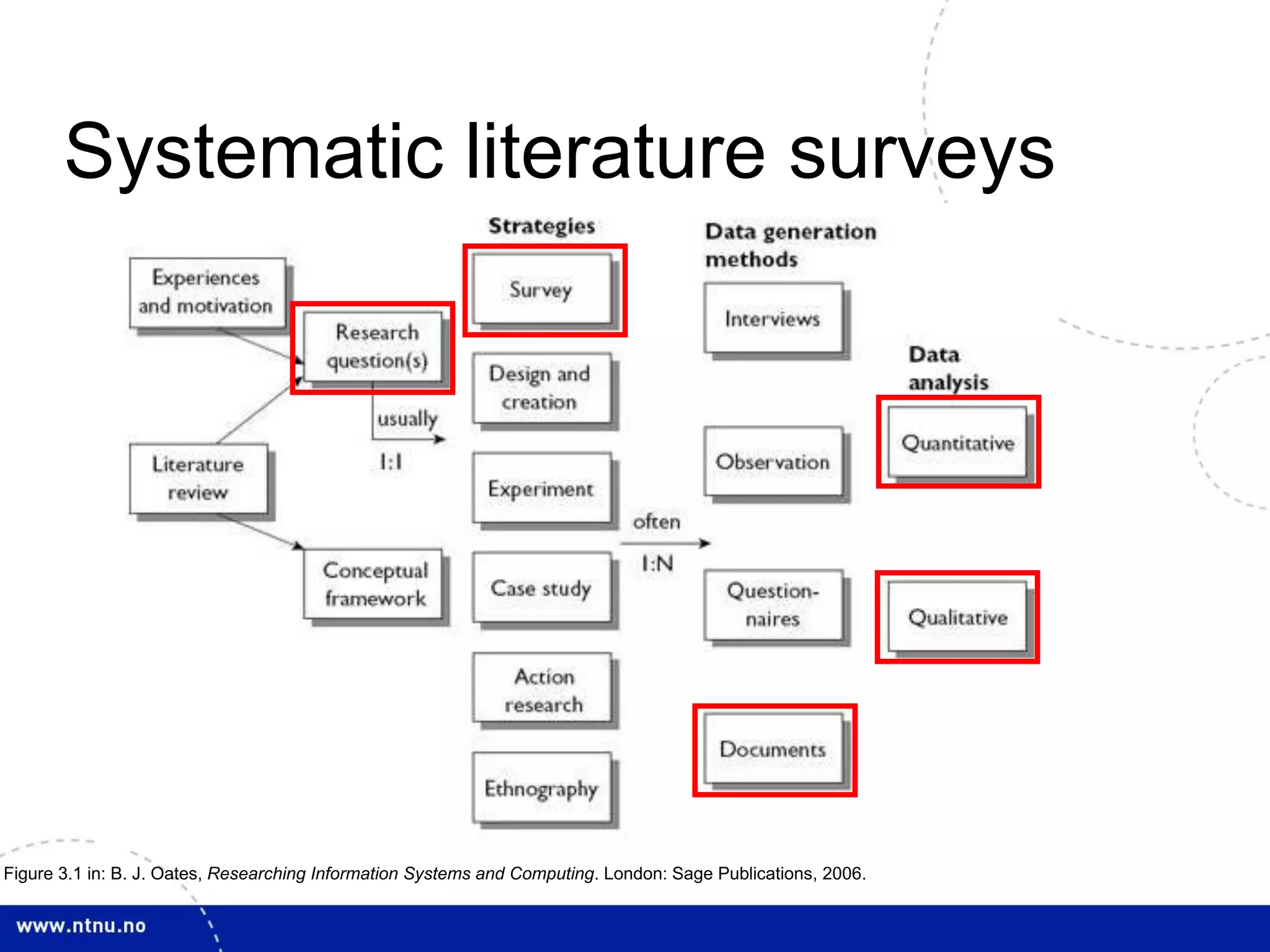
Figure 3.1 in: B. J. Oates, Researching Information Systems and Computing. London: Sage Publications, 2006.
Systematic literature surveys
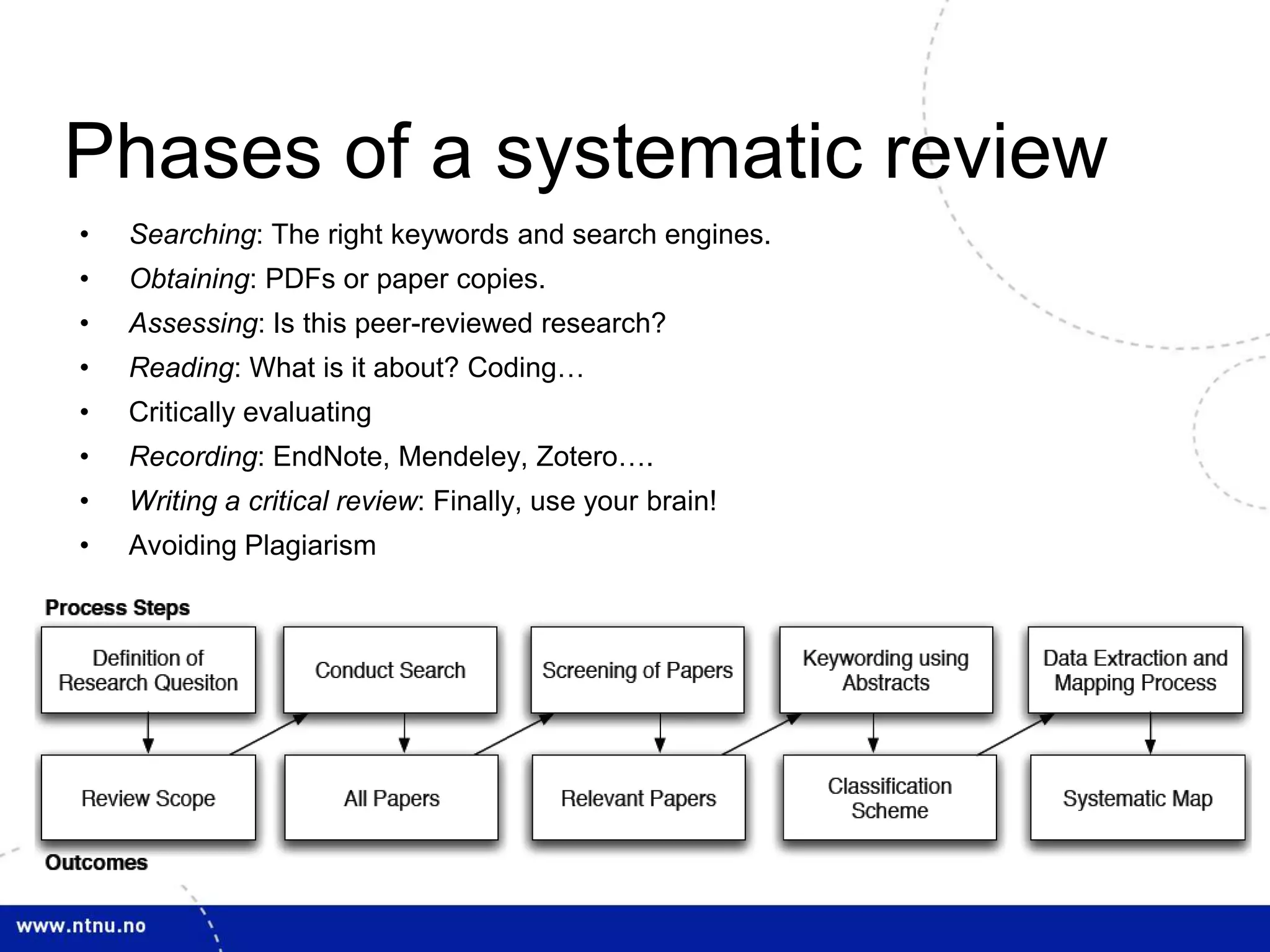
Phases of a systematic review
• Searching: The right keywords and search engines.
• Obtaining: PDFs or paper copies.
• Assessing: Is this peer-reviewed research?
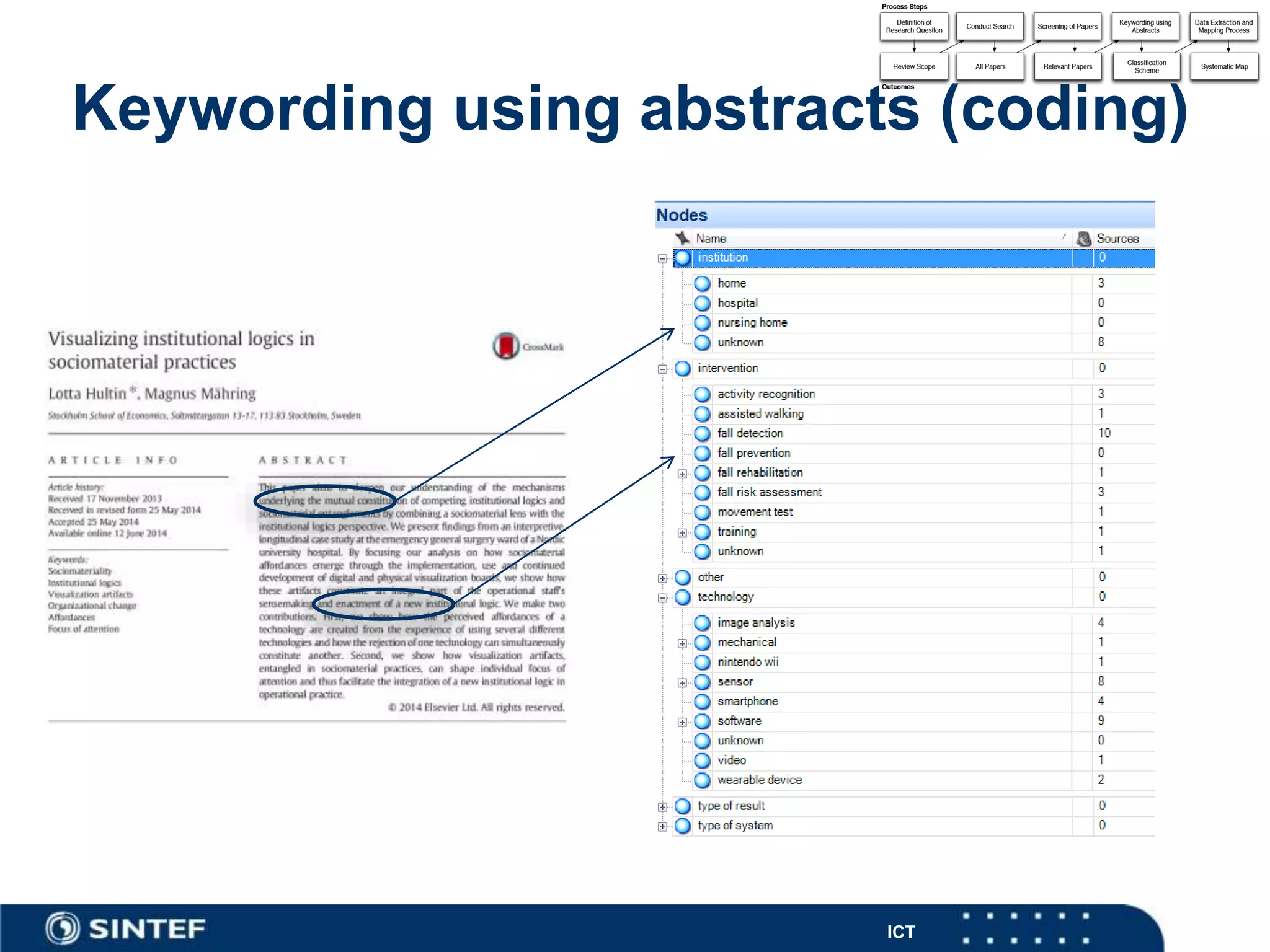
• Reading: What is it about? Coding…
• Critically evaluating
• Recording: EndNote, Mendeley, Zotero….
• Writing a critical review: Finally, use your brain!
• Avoiding Plagiarism
ICT
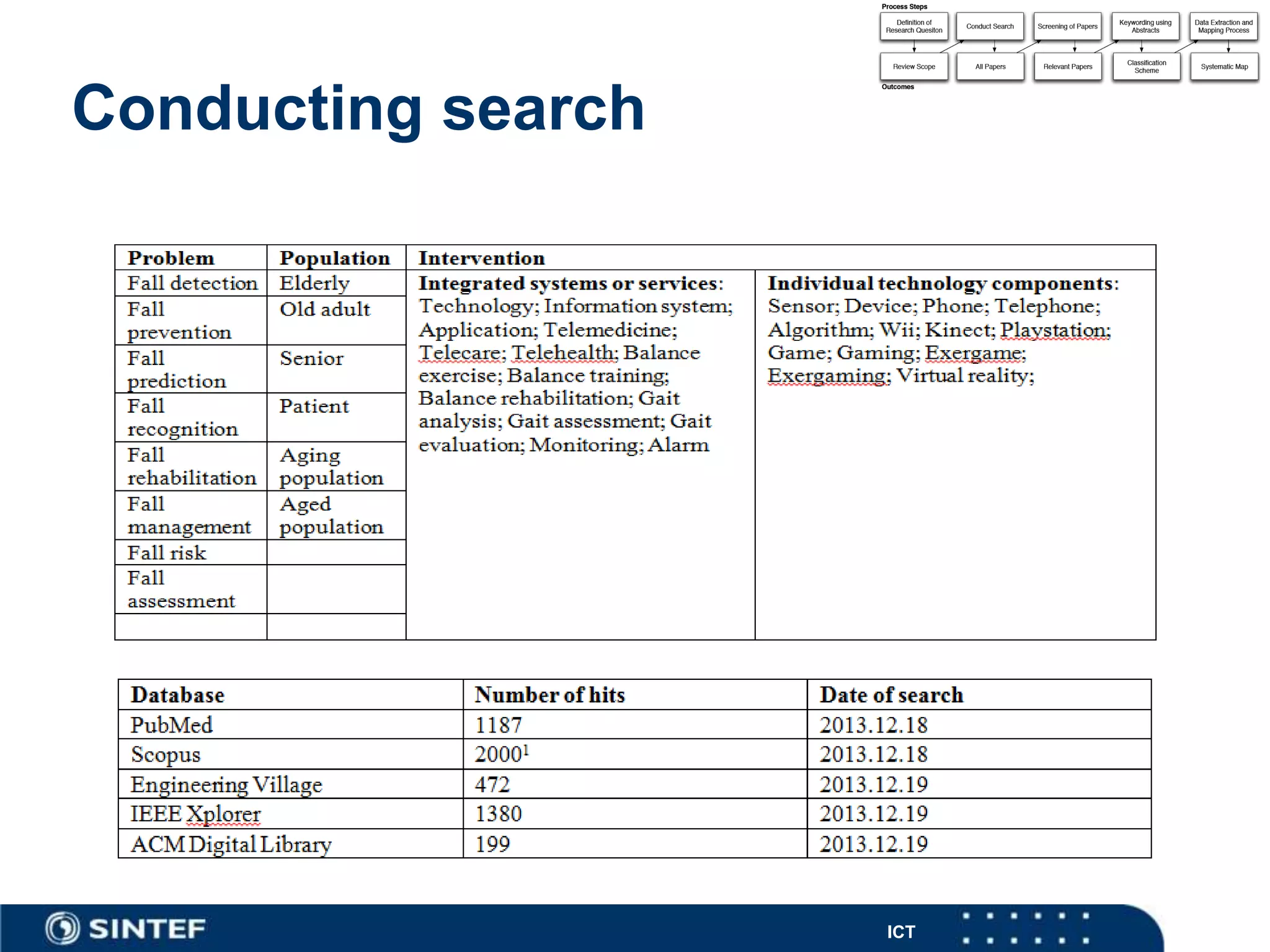
Conducting search
ICT
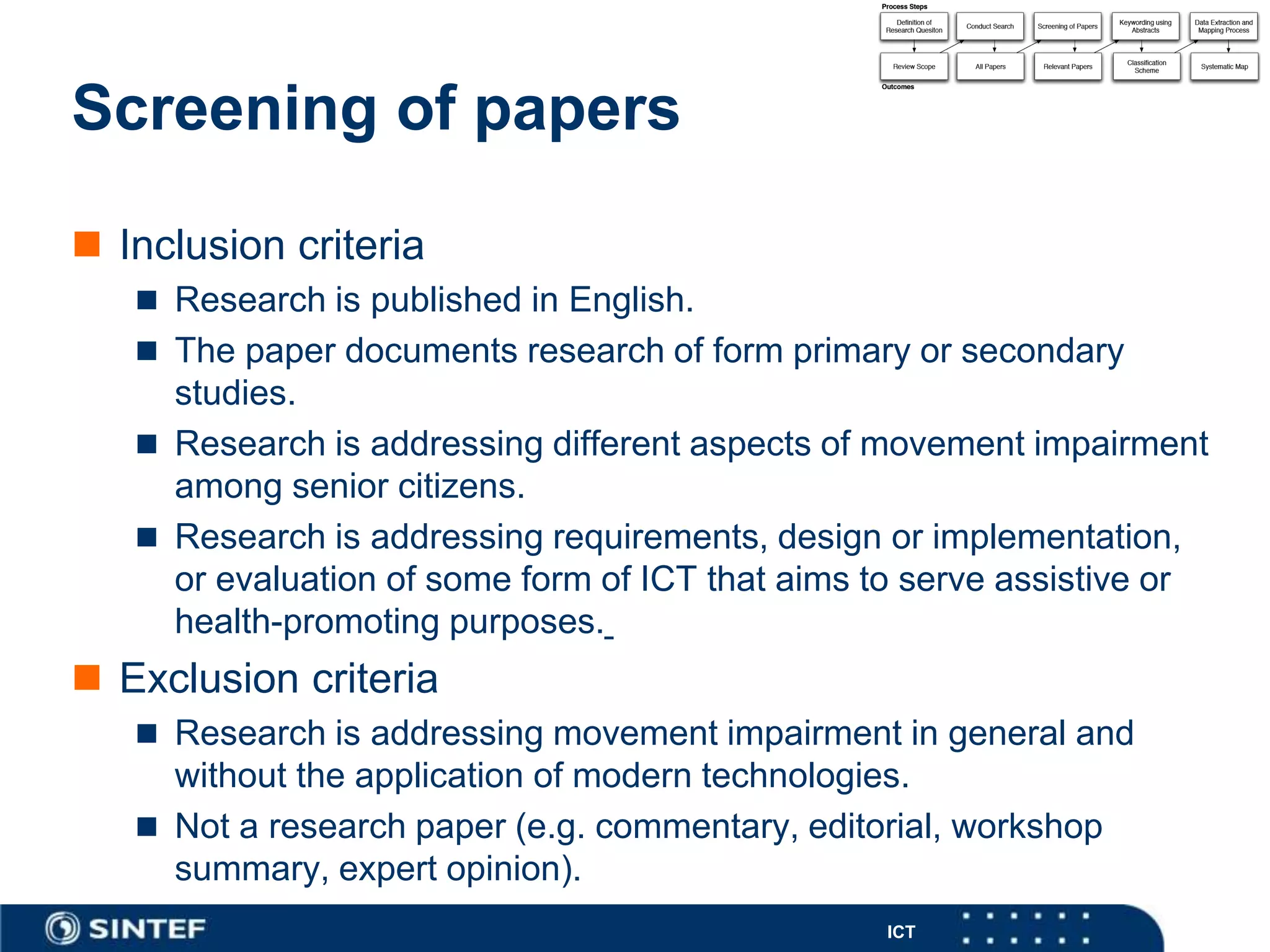
Screening of papers
 Inclusion criteria
 Research is published in English.
 The paper documents research of form primary or secondary
studies.
 Research is addressing different aspects of movement impairment
among senior citizens.
 Research is addressing requirements, design or implementation,
or evaluation of some form of ICT that aims to serve assistive or
health-promoting purposes.
 Exclusion criteria
 Research is addressing movement impairment in general and
without the application of modern technologies.
 Not a research paper (e.g. commentary, editorial, workshop
summary, expert opinion).
ICT
Keywording using abstracts (coding)
ICT
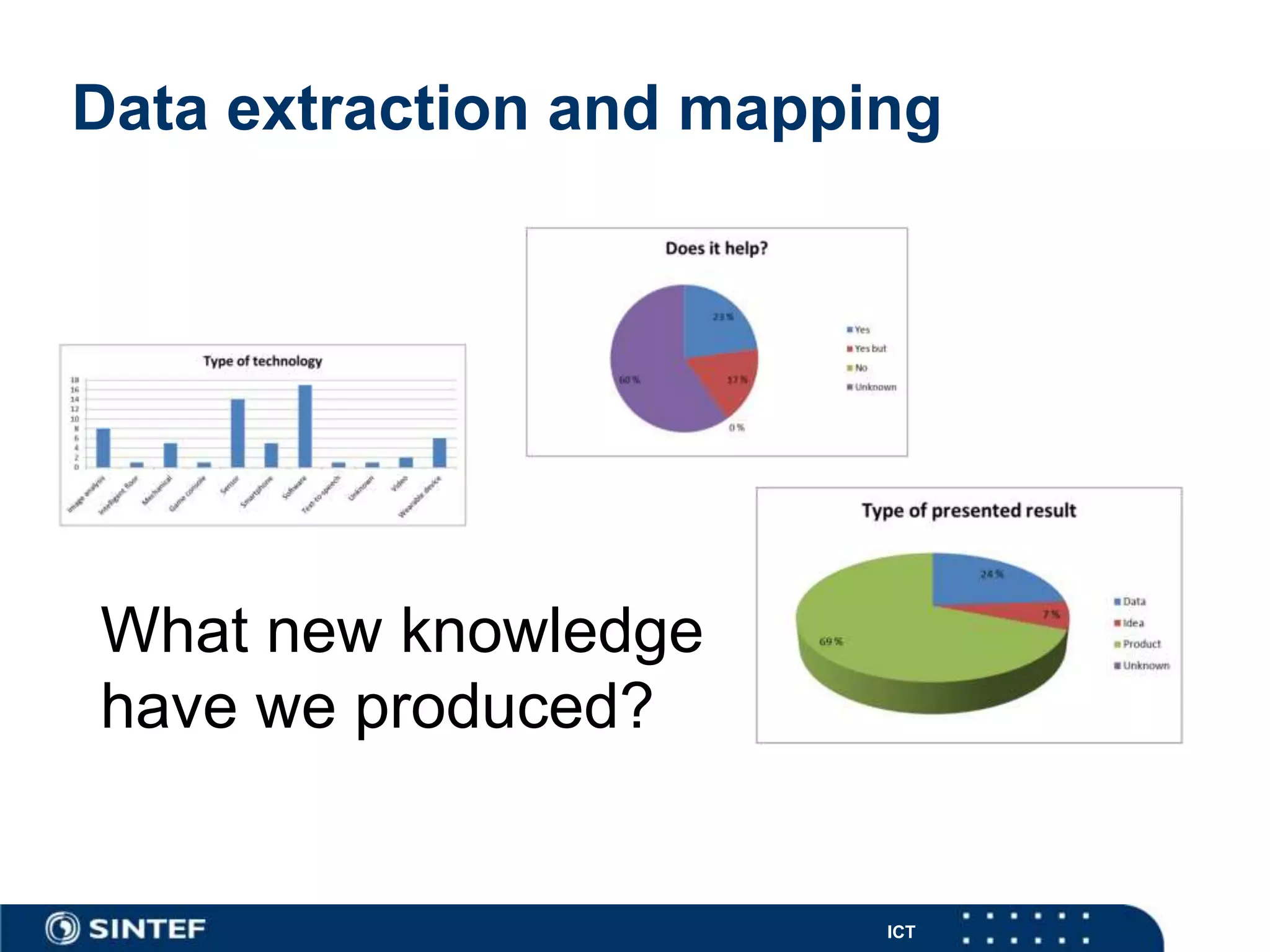
Data extraction and mapping
What new knowledge
have we produced?

IT3010 Lecture on Reviewing the literature

  • 1.
    IT3010 Research Methodology Reviewing theliterature Name, title of the presentation
  • 2.
    Figure 3.1 in:B. J. Oates, Researching Information Systems and Computing. London: Sage Publications, 2006. The research process
  • 3.
    What is aliterature review? • Definition: A literature review is an assessment of a body of research that addresses a research question. (ref: Harvard graduate school). • Two ways to generate knowledge through research: – Create your own new knowledge through Primary Studies. – Synthesize and analyse existing knowledge in a new conceptual framework through Secondary Studies. • A literature review can constitute: – A part of a primary study. – A secondary study.
  • 4.
    Objectives of aliterature review • Show that the researcher is aware of existing work in the chosen topic area. • Place the researcher’s work in the context of what has already been published. • Point to strengths, weaknesses, omissions or bias in the previous work. • Identify key issues or questions that are troubling the research community. • Point to gaps that have not previously been identified or addressed by researchers. • Identify theories that the researcher will test by gathering data from the field. • Suggest theories that might explain data the researcher has gathered from the field. • Identify theories, genres, methods or algorithms that will be incorporated in the development of a computer application. • Identify research methods or strategies that the researcher will use in the research. • Enable subsequent researchers to understand the field and the researcher’s work within that field.
  • 5.
    Sources of literature •Main source: Refereed research papers: – From journals (if peer-reviewed) – From conferences and workshops (if peer-reviewed) • Books: Are good for understanding the problem and building a conceptual framework and theories. • Manuals: Are good for understanding e.g. a system, but not as a source of a review. • Reports: Sometimes good research quality but not peer-reviewed. • Newspapers, magazines, radio, television: Can be good quality "expert opinion" but not peer-reviewed.
  • 6.
    Writing a literaturereview • Two approaches: – Ad hoc (State-of-the-art): Searching (e.g. Google scholar) and reading some papers on the topic. Can result in "cherry picking". – Systematic: Following a systematic process that is aimed at producing a scientifically high-quality literature review text. Will reduce bias. • Which one to choose? – Discuss it with your supervisor. – Systematic approach can take time. – In most cases: Find a balance. – Remember: Good literature reviews are by themselves highly valuable and sorely needed research results in ICT!
  • 7.
    Writing the state-of-the-art •Clearly define the practical problem and the research question. – Iterative process, you read some and you write some. • Should be more than a summary of the articles you have read. – Google can do better! – You need an analysis and synthesis of what you read. Here comes the conceptual framework.
  • 8.
    Writing the state-of-the-art From"summary" to "conceptual framework"
  • 9.
    Figure 3.1 in:B. J. Oates, Researching Information Systems and Computing. London: Sage Publications, 2006. Literature review
  • 10.
    Figure 3.1 in:B. J. Oates, Researching Information Systems and Computing. London: Sage Publications, 2006. Systematic literature surveys
  • 11.
    Phases of asystematic review • Searching: The right keywords and search engines. • Obtaining: PDFs or paper copies. • Assessing: Is this peer-reviewed research? • Reading: What is it about? Coding… • Critically evaluating • Recording: EndNote, Mendeley, Zotero…. • Writing a critical review: Finally, use your brain! • Avoiding Plagiarism
  • 12.
  • 13.
    ICT Screening of papers Inclusion criteria  Research is published in English.  The paper documents research of form primary or secondary studies.  Research is addressing different aspects of movement impairment among senior citizens.  Research is addressing requirements, design or implementation, or evaluation of some form of ICT that aims to serve assistive or health-promoting purposes.  Exclusion criteria  Research is addressing movement impairment in general and without the application of modern technologies.  Not a research paper (e.g. commentary, editorial, workshop summary, expert opinion).
  • 14.
  • 15.
    ICT Data extraction andmapping What new knowledge have we produced?