SELECTIVE BREEDINGSELECTIVE BREEDING
& GENETIC& GENETIC
ENGINEERINGENGINEERING
Selective Breeding & GeneticSelective Breeding & Genetic
EngineeringEngineering
►Selective breeding & genetic engineeringSelective breeding & genetic engineering
are 2 scientific techniques in which humansare 2 scientific techniques in which humans
try to produce offspring with desirable traitstry to produce offspring with desirable traits
What is selective breeding?What is selective breeding?
►DefinitionDefinition::
 Selective breeding is whereSelective breeding is where
humans select (chose) 2 animalshumans select (chose) 2 animals
with desired traits & breed (mate)with desired traits & breed (mate)
them trying to produce offspringthem trying to produce offspring
with the desired traits of bothwith the desired traits of both
parentsparents
Selective BreedingSelective Breeding
►TypicallyTypically, strains which, strains which areare selectively bredselectively bred
areare domesticateddomesticated
►Over many generationsOver many generations, the practice, the practice leadsleads
to the development of strains with theto the development of strains with the
desired characteristicsdesired characteristics
Example of Selective Breeding inExample of Selective Breeding in
CattleCattle
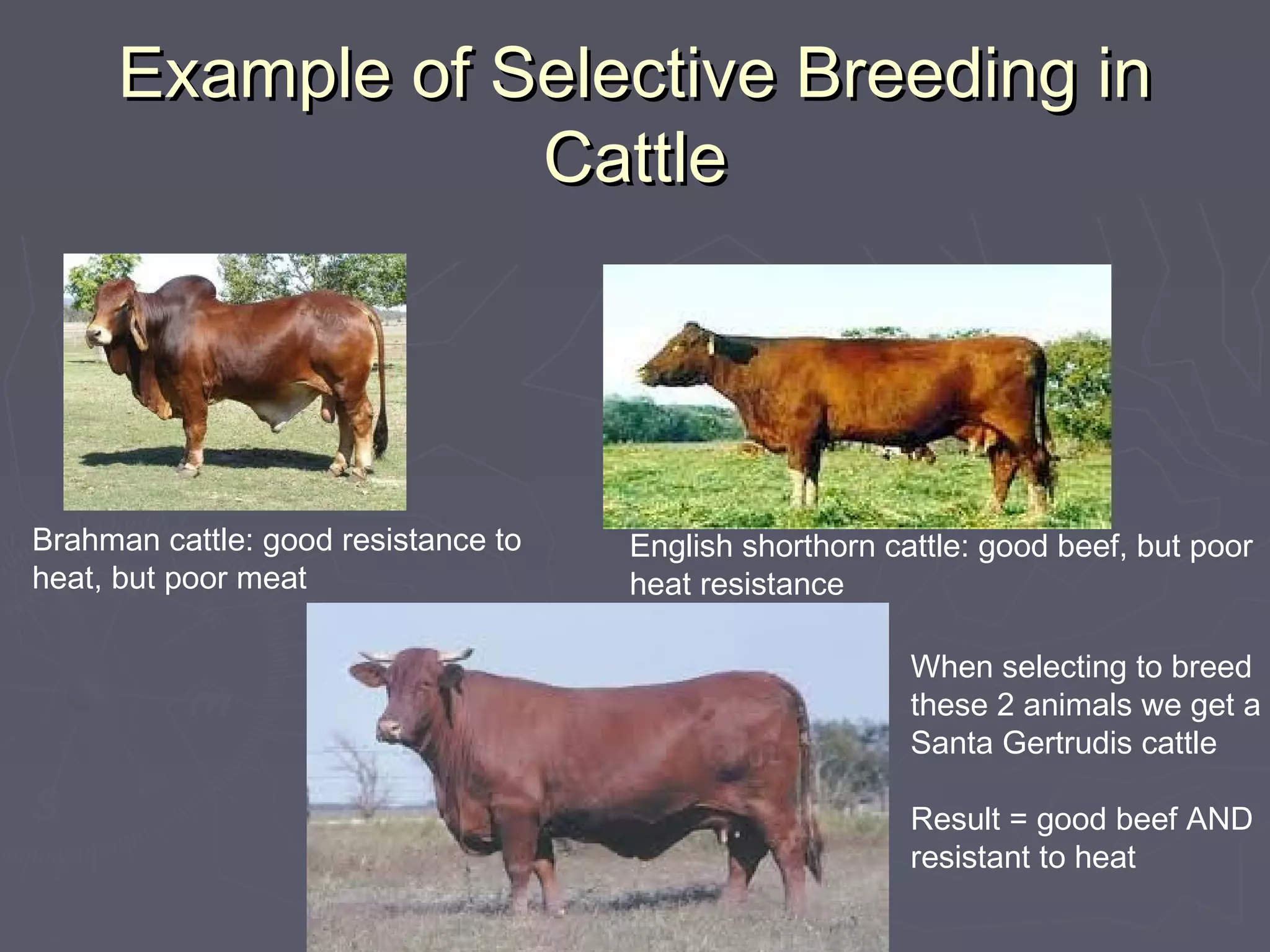
Brahman cattle: good resistance to
heat, but poor meat
English shorthorn cattle: good beef, but poor
heat resistance
When selecting to breed
these 2 animals we get a
Santa Gertrudis cattle
Result = good beef AND
resistant to heat
How did the liger appear?How did the liger appear?
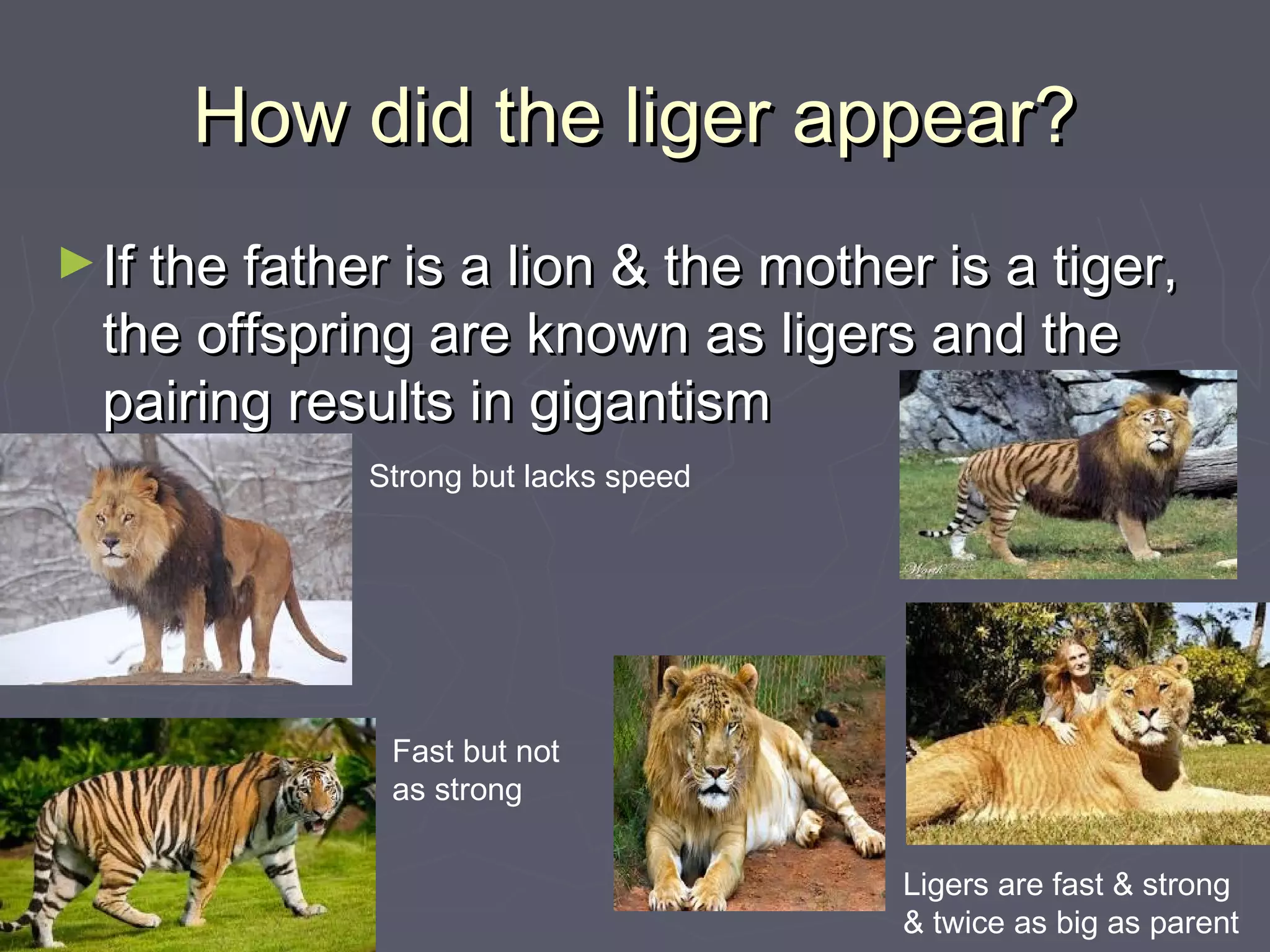
►If the father is a lion & the mother is a tiger,If the father is a lion & the mother is a tiger,
the offspring are known as ligers and thethe offspring are known as ligers and the
pairing results in gigantismpairing results in gigantism
Strong but lacks speed
Fast but not
as strong
Ligers are fast & strong
& twice as big as parent
Pros of Selective BreedingPros of Selective Breeding
►BenefitsBenefits::
 Farmers can produce crops with higher yieldFarmers can produce crops with higher yield
►More fruit or vegetables on a stalkMore fruit or vegetables on a stalk
 Farmers can produce animals that grow moreFarmers can produce animals that grow more
meat, more milk, more eggs, faster & strongermeat, more milk, more eggs, faster & stronger
 Can produce friendlier and prettier petsCan produce friendlier and prettier pets
ConsCons of Selective Breedingof Selective Breeding
►DisadvantagesDisadvantages::
 Loss of genes in a populationLoss of genes in a population
► By not allowing some animals to breed, their genes could be lostBy not allowing some animals to breed, their genes could be lost
forever in a populationforever in a population
► Take Hitler for example, he tried to kill all Jews, therefore, trying toTake Hitler for example, he tried to kill all Jews, therefore, trying to
eliminate the genes and all Jews from the planeteliminate the genes and all Jews from the planet
 Animal discomfortAnimal discomfort
► Farmers breed cows to have large utters, so now some cows haveFarmers breed cows to have large utters, so now some cows have
difficulty walking & have health problemsdifficulty walking & have health problems
► Some chickens are too heavy to stand, so they have to lay down allSome chickens are too heavy to stand, so they have to lay down all
the timethe time
 Can lead to inbreedingCan lead to inbreeding
► In order to create a certain type of animal through selectiveIn order to create a certain type of animal through selective
breeding, sometimes brothers & sisters of a population will mate tobreeding, sometimes brothers & sisters of a population will mate to
pass on favorable traits, and this can lead to bad health problemspass on favorable traits, and this can lead to bad health problems
for children of inbreedingfor children of inbreeding
GENETIC ENGINEERINGGENETIC ENGINEERING
►Genetic engineering is a lot like selectiveGenetic engineering is a lot like selective
breeding but a much faster processbreeding but a much faster process
►Definition: taking favorable genes from oneDefinition: taking favorable genes from one
organism and implanting it into anotherorganism and implanting it into another
organism’s DNAorganism’s DNA
 ThisThis can only be done in a laboratorycan only be done in a laboratory withwith
special equipmentspecial equipment
HOWHOW
AQA Science © Nelson Thornes Ltd 2006 10
AQA Science © Nelson Thornes Ltd 2006
11
Remind me about genes againRemind me about genes again
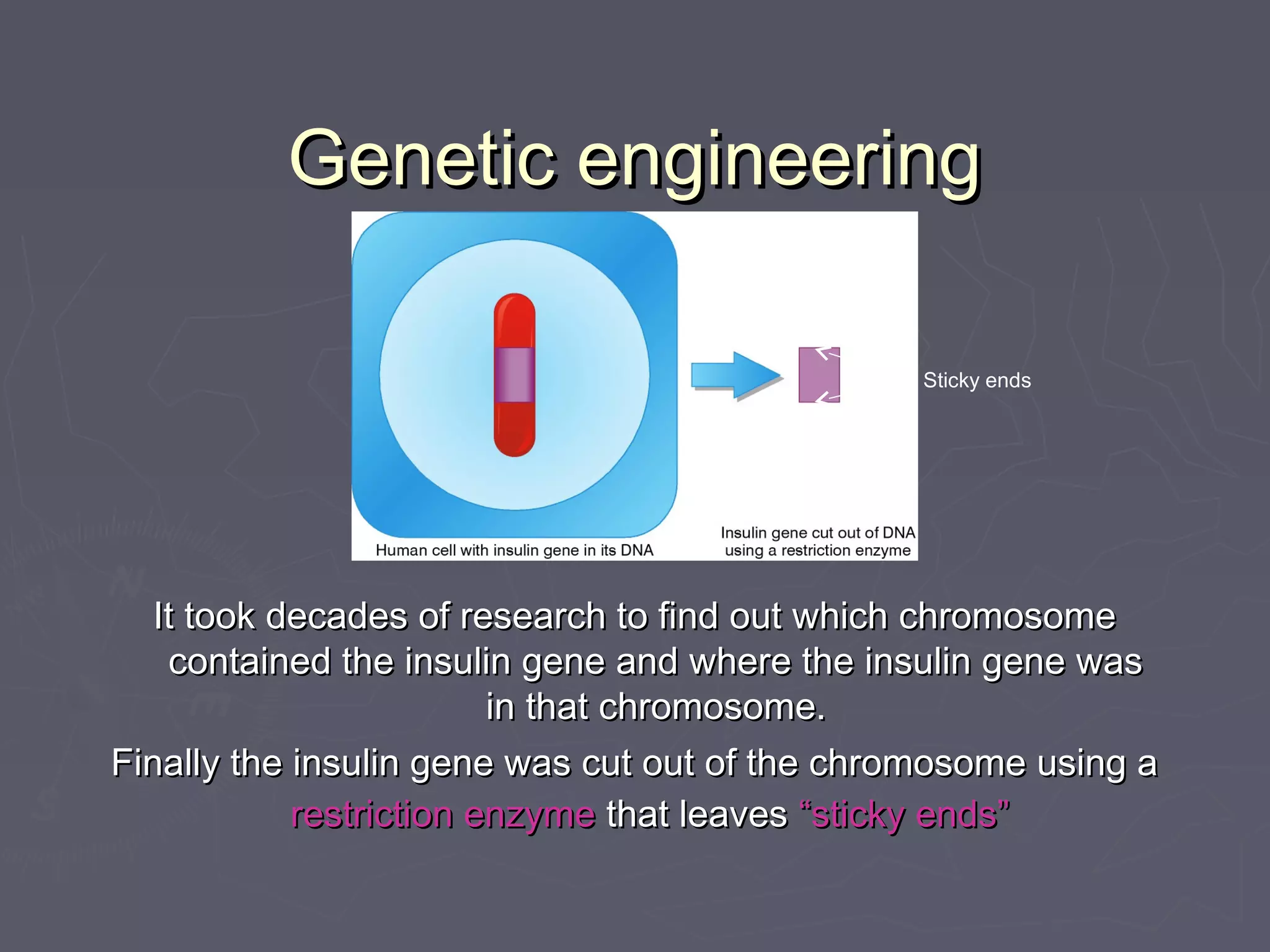
A human cell nucleus contains 46 chromosomes.A human cell nucleus contains 46 chromosomes.
These chromosomes are made from DNA.These chromosomes are made from DNA.
Along the length of the chromosome are genesAlong the length of the chromosome are genes..
One of these genes codes for the hormoneOne of these genes codes for the hormone insulininsulin
AQA Science © Nelson Thornes Ltd 2006
12
It took decades of research to find out which chromosomeIt took decades of research to find out which chromosome
contained the insulin gene and where the insulin gene wascontained the insulin gene and where the insulin gene was
in that chromosome.in that chromosome.
Finally the insulin gene was cut out of the chromosome using aFinally the insulin gene was cut out of the chromosome using a
restriction enzymerestriction enzyme that leavesthat leaves “sticky ends”“sticky ends”
Genetic engineeringGenetic engineering
Sticky ends
AQA Science © Nelson Thornes Ltd 2006
13
Genetic engineeringGenetic engineering
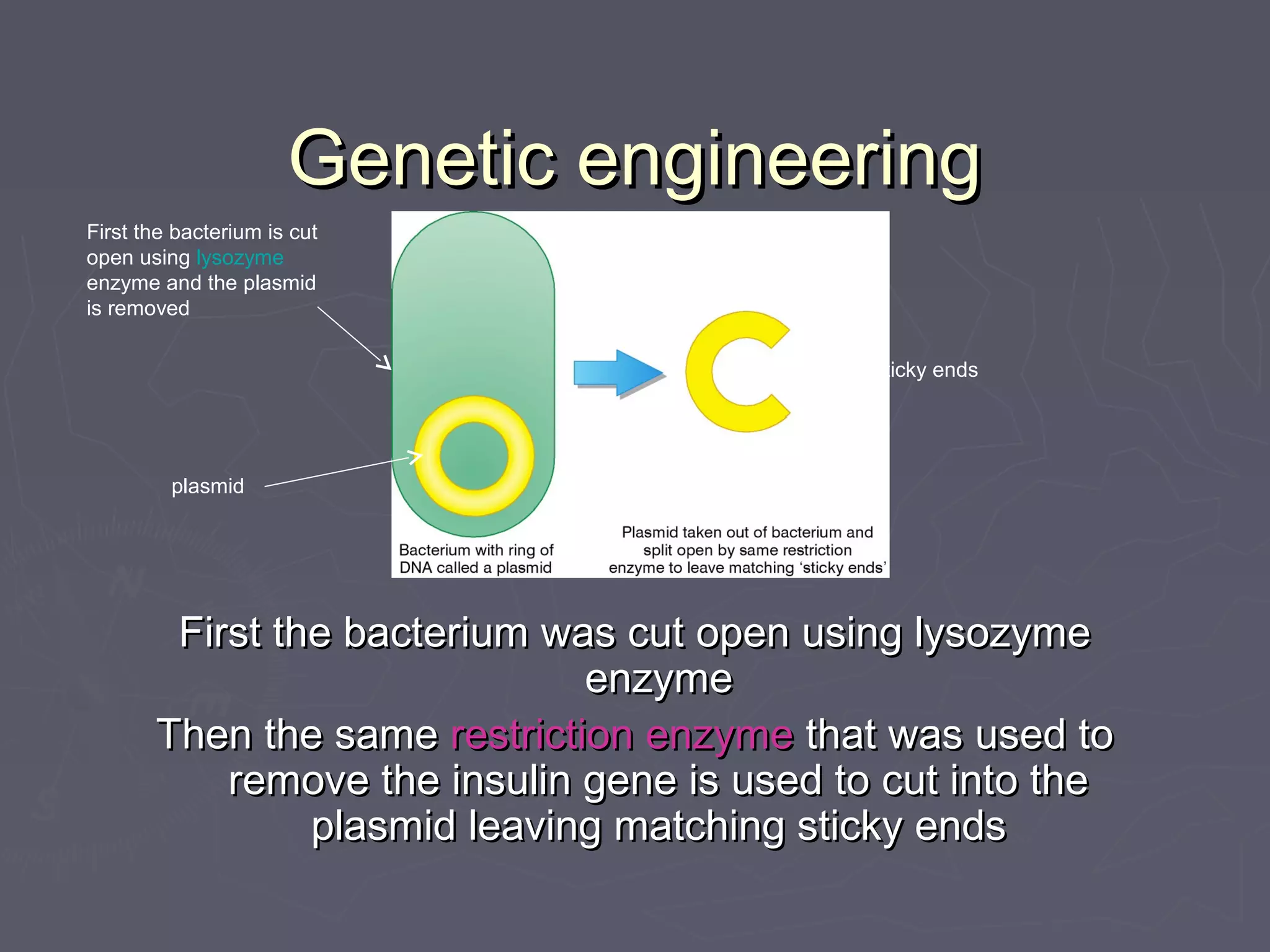
First the bacterium was cut open using lysozymeFirst the bacterium was cut open using lysozyme
enzymeenzyme
Then the sameThen the same restriction enzymerestriction enzyme that was used tothat was used to
remove the insulin gene is used to cut into theremove the insulin gene is used to cut into the
plasmid leaving matching sticky endsplasmid leaving matching sticky ends
First the bacterium is cut
open using lysozyme
enzyme and the plasmid
is removed
plasmid
Sticky ends
AQA Science © Nelson Thornes Ltd 2006
14
Genetic engineeringGenetic engineering
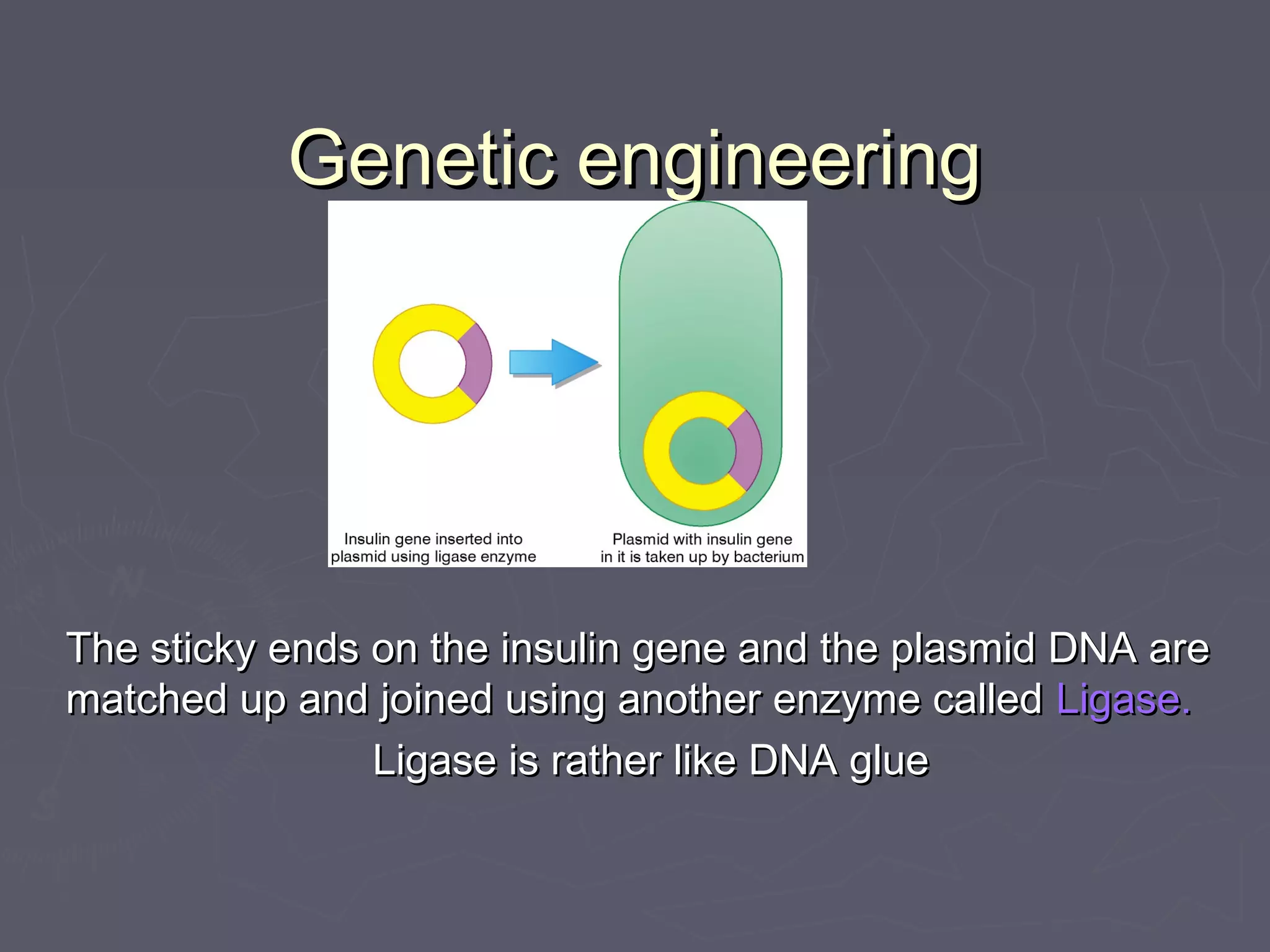
The sticky ends on the insulin gene and the plasmid DNA areThe sticky ends on the insulin gene and the plasmid DNA are
matched up and joined using another enzyme calledmatched up and joined using another enzyme called Ligase.Ligase.
Ligase is rather like DNA glueLigase is rather like DNA glue
AQA Science © Nelson Thornes Ltd 2006
15
Bacteria multiply rapidly and produce many millions ofBacteria multiply rapidly and produce many millions of
copies of themselves, all able to make insulin using thecopies of themselves, all able to make insulin using the
incorporated insulin gene.incorporated insulin gene.
Genetic engineeringGenetic engineering
AQA Science © Nelson Thornes Ltd 2006
16
Bacteria multiply rapidly and produce many millions ofBacteria multiply rapidly and produce many millions of
copies of themselves, all able to make insulin using thecopies of themselves, all able to make insulin using the
incorporated insulin gene.incorporated insulin gene.
Genetic engineeringGenetic engineering
ExamplesExamples of Genetic Engineeringof Genetic Engineering
1.1. People have taken the insulin makingPeople have taken the insulin making
gene from humans and inserted it intogene from humans and inserted it into
bacteria causing bacteria to make humanbacteria causing bacteria to make human
insulininsulin
► Why?Why?
► Bacteria can reproduce quickly causing them toBacteria can reproduce quickly causing them to
produce insulin at a much faster rateproduce insulin at a much faster rate
Examples of Genetic EngineeringExamples of Genetic Engineering
2.2. People have taken bad genes (genesPeople have taken bad genes (genes
which cause cancer and other diseases)which cause cancer and other diseases)
out of a person and inserted healthy genesout of a person and inserted healthy genes
into a person to cure them of diseasesinto a person to cure them of diseases
► However, they may be cured of that diseaseHowever, they may be cured of that disease
but get another worse disease because ofbut get another worse disease because of
being implanted with the other genebeing implanted with the other gene
Examples of Genetic EngineeringExamples of Genetic Engineering
4.4. People have inserted genes into crops toPeople have inserted genes into crops to
make the crops resistant (poisonous) tomake the crops resistant (poisonous) to
pests, but are harmless to humans (wepests, but are harmless to humans (we
think)think)
Genetically Engineered ChickensGenetically Engineered Chickens
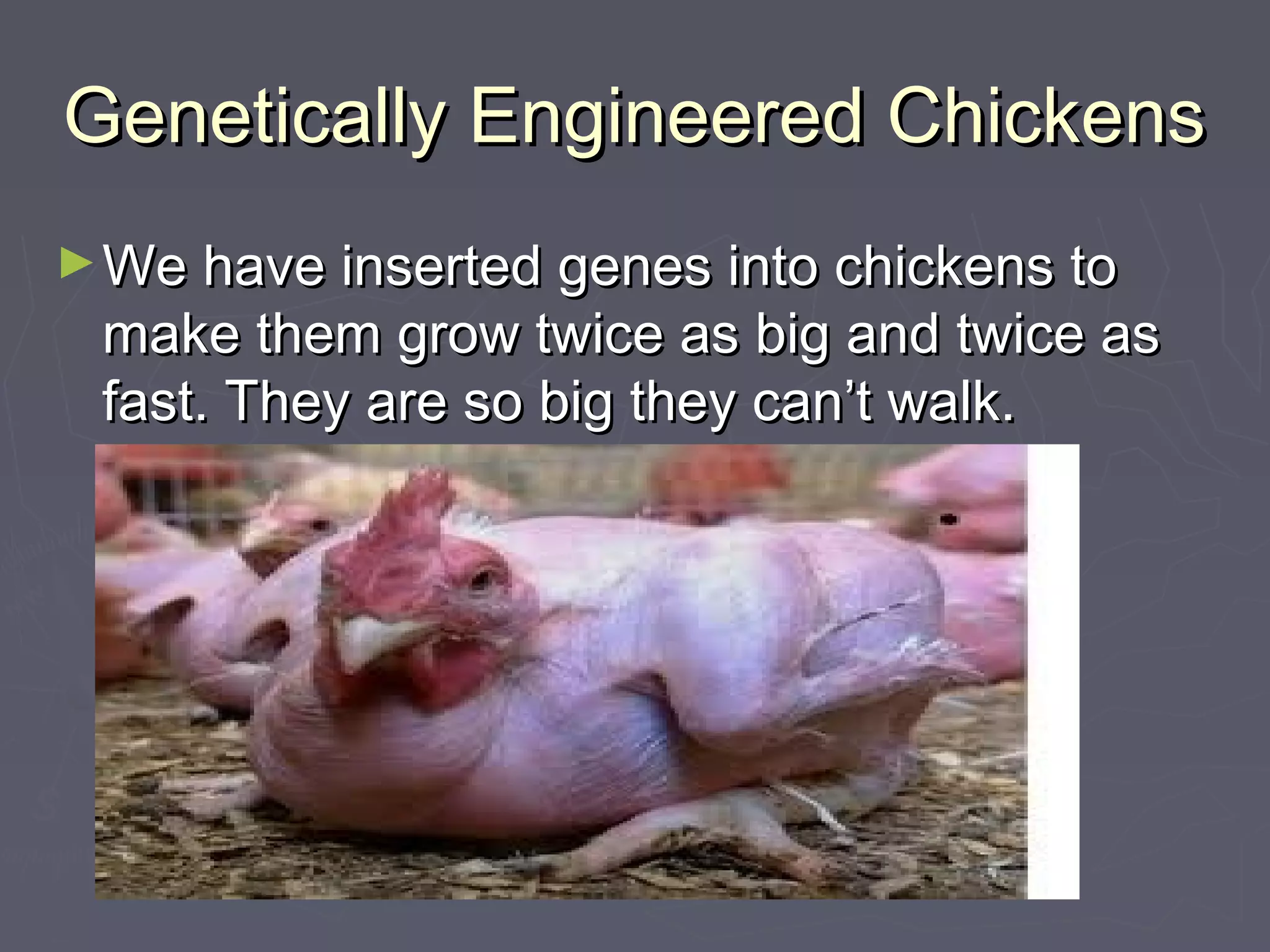
►We have inserted genes into chickens toWe have inserted genes into chickens to
make them grow twice as big and twice asmake them grow twice as big and twice as
fast. They are so big they can’t walk.fast. They are so big they can’t walk.
Genetic EngineeringGenetic Engineering
►Genetic engineeringGenetic engineering may work wonders butmay work wonders but
it is all a process ofit is all a process of manipulating the naturalmanipulating the natural
The Pros & Cons ofThe Pros & Cons of
Genetic EngineeringGenetic Engineering
ProsPros Include:Include:
1.1. Humans have made crops with betterHumans have made crops with better
taste, nutrition, and growth ratetaste, nutrition, and growth rate
2.2. Humans have made pest resistant cropsHumans have made pest resistant crops
and crops with longer shelf lifeand crops with longer shelf life
3.3. Humans have been able to produce newHumans have been able to produce new
foodsfoods
► Foods which couldn’t be reproduced in natureFoods which couldn’t be reproduced in nature
1.1. Humans can help cure certain diseaseHumans can help cure certain disease
2.2. Boosts positive traits and suppressBoosts positive traits and suppress
negative onesnegative ones
ConsCons Include:Include:
1.1. By making plants bigger, taste better, and betterBy making plants bigger, taste better, and better
appearance we have accidentally made someappearance we have accidentally made some
crops allergenic to peoplecrops allergenic to people
2.2. By making plants bigger, taste better, and betterBy making plants bigger, taste better, and better
appearance we have accidentally made someappearance we have accidentally made some
crops have less nutritional valuecrops have less nutritional value
3.3. Accidental gene transferAccidental gene transfer
► Such as when we inserted genes into crops to makeSuch as when we inserted genes into crops to make
them resistant to pest or herbicides, the genes leakedthem resistant to pest or herbicides, the genes leaked
over into weeds and made them resistant to pest andover into weeds and made them resistant to pest and
herbicides tooherbicides too
ConsCons Include:Include:
4.4. Genetic engineering in human beings can haveGenetic engineering in human beings can have
certain side effectscertain side effects
► While treating one defector disease, the geneticWhile treating one defector disease, the genetic
engineering may lead to another disease which couldengineering may lead to another disease which could
be worsebe worse
4.4. What’s next?What’s next?
► Will people try to insert genes into babies to haveWill people try to insert genes into babies to have
children which are smarter, muscular, prettier, certainchildren which are smarter, muscular, prettier, certain
color eyes, certain color hair, and talentedcolor eyes, certain color hair, and talented
4.4. Playing God…Playing God…
QuizQuiz
1.1. Define selective breeding.Define selective breeding.
2.2. List 3 examples of selective breeding.List 3 examples of selective breeding.
3.3. List 2 benefits of selective breeding.List 2 benefits of selective breeding.
4.4. List 2 disadvantages of selective breeding.List 2 disadvantages of selective breeding.
5.5. Define genetic engineering.Define genetic engineering.
6.6. List 3 examples of genetic engineering.List 3 examples of genetic engineering.
7.7. List 2 benefits of genetic engineering.List 2 benefits of genetic engineering.
8.8. List 2 disadvantages of geneticList 2 disadvantages of genetic
engineering.engineering.

selective breeding and genetic engineering

  • 1.
    SELECTIVE BREEDINGSELECTIVE BREEDING &GENETIC& GENETIC ENGINEERINGENGINEERING
  • 2.
    Selective Breeding &GeneticSelective Breeding & Genetic EngineeringEngineering ►Selective breeding & genetic engineeringSelective breeding & genetic engineering are 2 scientific techniques in which humansare 2 scientific techniques in which humans try to produce offspring with desirable traitstry to produce offspring with desirable traits
  • 3.
    What is selectivebreeding?What is selective breeding? ►DefinitionDefinition::  Selective breeding is whereSelective breeding is where humans select (chose) 2 animalshumans select (chose) 2 animals with desired traits & breed (mate)with desired traits & breed (mate) them trying to produce offspringthem trying to produce offspring with the desired traits of bothwith the desired traits of both parentsparents
  • 4.
    Selective BreedingSelective Breeding ►TypicallyTypically,strains which, strains which areare selectively bredselectively bred areare domesticateddomesticated ►Over many generationsOver many generations, the practice, the practice leadsleads to the development of strains with theto the development of strains with the desired characteristicsdesired characteristics
  • 5.
    Example of SelectiveBreeding inExample of Selective Breeding in CattleCattle Brahman cattle: good resistance to heat, but poor meat English shorthorn cattle: good beef, but poor heat resistance When selecting to breed these 2 animals we get a Santa Gertrudis cattle Result = good beef AND resistant to heat
  • 6.
    How did theliger appear?How did the liger appear? ►If the father is a lion & the mother is a tiger,If the father is a lion & the mother is a tiger, the offspring are known as ligers and thethe offspring are known as ligers and the pairing results in gigantismpairing results in gigantism Strong but lacks speed Fast but not as strong Ligers are fast & strong & twice as big as parent
  • 7.
    Pros of SelectiveBreedingPros of Selective Breeding ►BenefitsBenefits::  Farmers can produce crops with higher yieldFarmers can produce crops with higher yield ►More fruit or vegetables on a stalkMore fruit or vegetables on a stalk  Farmers can produce animals that grow moreFarmers can produce animals that grow more meat, more milk, more eggs, faster & strongermeat, more milk, more eggs, faster & stronger  Can produce friendlier and prettier petsCan produce friendlier and prettier pets
  • 8.
    ConsCons of SelectiveBreedingof Selective Breeding ►DisadvantagesDisadvantages::  Loss of genes in a populationLoss of genes in a population ► By not allowing some animals to breed, their genes could be lostBy not allowing some animals to breed, their genes could be lost forever in a populationforever in a population ► Take Hitler for example, he tried to kill all Jews, therefore, trying toTake Hitler for example, he tried to kill all Jews, therefore, trying to eliminate the genes and all Jews from the planeteliminate the genes and all Jews from the planet  Animal discomfortAnimal discomfort ► Farmers breed cows to have large utters, so now some cows haveFarmers breed cows to have large utters, so now some cows have difficulty walking & have health problemsdifficulty walking & have health problems ► Some chickens are too heavy to stand, so they have to lay down allSome chickens are too heavy to stand, so they have to lay down all the timethe time  Can lead to inbreedingCan lead to inbreeding ► In order to create a certain type of animal through selectiveIn order to create a certain type of animal through selective breeding, sometimes brothers & sisters of a population will mate tobreeding, sometimes brothers & sisters of a population will mate to pass on favorable traits, and this can lead to bad health problemspass on favorable traits, and this can lead to bad health problems for children of inbreedingfor children of inbreeding
  • 9.
    GENETIC ENGINEERINGGENETIC ENGINEERING ►Geneticengineering is a lot like selectiveGenetic engineering is a lot like selective breeding but a much faster processbreeding but a much faster process ►Definition: taking favorable genes from oneDefinition: taking favorable genes from one organism and implanting it into anotherorganism and implanting it into another organism’s DNAorganism’s DNA  ThisThis can only be done in a laboratorycan only be done in a laboratory withwith special equipmentspecial equipment
  • 10.
    HOWHOW AQA Science ©Nelson Thornes Ltd 2006 10
  • 11.
    AQA Science ©Nelson Thornes Ltd 2006 11 Remind me about genes againRemind me about genes again A human cell nucleus contains 46 chromosomes.A human cell nucleus contains 46 chromosomes. These chromosomes are made from DNA.These chromosomes are made from DNA. Along the length of the chromosome are genesAlong the length of the chromosome are genes.. One of these genes codes for the hormoneOne of these genes codes for the hormone insulininsulin
  • 12.
    AQA Science ©Nelson Thornes Ltd 2006 12 It took decades of research to find out which chromosomeIt took decades of research to find out which chromosome contained the insulin gene and where the insulin gene wascontained the insulin gene and where the insulin gene was in that chromosome.in that chromosome. Finally the insulin gene was cut out of the chromosome using aFinally the insulin gene was cut out of the chromosome using a restriction enzymerestriction enzyme that leavesthat leaves “sticky ends”“sticky ends” Genetic engineeringGenetic engineering Sticky ends
  • 13.
    AQA Science ©Nelson Thornes Ltd 2006 13 Genetic engineeringGenetic engineering First the bacterium was cut open using lysozymeFirst the bacterium was cut open using lysozyme enzymeenzyme Then the sameThen the same restriction enzymerestriction enzyme that was used tothat was used to remove the insulin gene is used to cut into theremove the insulin gene is used to cut into the plasmid leaving matching sticky endsplasmid leaving matching sticky ends First the bacterium is cut open using lysozyme enzyme and the plasmid is removed plasmid Sticky ends
  • 14.
    AQA Science ©Nelson Thornes Ltd 2006 14 Genetic engineeringGenetic engineering The sticky ends on the insulin gene and the plasmid DNA areThe sticky ends on the insulin gene and the plasmid DNA are matched up and joined using another enzyme calledmatched up and joined using another enzyme called Ligase.Ligase. Ligase is rather like DNA glueLigase is rather like DNA glue
  • 15.
    AQA Science ©Nelson Thornes Ltd 2006 15 Bacteria multiply rapidly and produce many millions ofBacteria multiply rapidly and produce many millions of copies of themselves, all able to make insulin using thecopies of themselves, all able to make insulin using the incorporated insulin gene.incorporated insulin gene. Genetic engineeringGenetic engineering
  • 16.
    AQA Science ©Nelson Thornes Ltd 2006 16 Bacteria multiply rapidly and produce many millions ofBacteria multiply rapidly and produce many millions of copies of themselves, all able to make insulin using thecopies of themselves, all able to make insulin using the incorporated insulin gene.incorporated insulin gene. Genetic engineeringGenetic engineering
  • 17.
    ExamplesExamples of GeneticEngineeringof Genetic Engineering 1.1. People have taken the insulin makingPeople have taken the insulin making gene from humans and inserted it intogene from humans and inserted it into bacteria causing bacteria to make humanbacteria causing bacteria to make human insulininsulin ► Why?Why? ► Bacteria can reproduce quickly causing them toBacteria can reproduce quickly causing them to produce insulin at a much faster rateproduce insulin at a much faster rate
  • 18.
    Examples of GeneticEngineeringExamples of Genetic Engineering 2.2. People have taken bad genes (genesPeople have taken bad genes (genes which cause cancer and other diseases)which cause cancer and other diseases) out of a person and inserted healthy genesout of a person and inserted healthy genes into a person to cure them of diseasesinto a person to cure them of diseases ► However, they may be cured of that diseaseHowever, they may be cured of that disease but get another worse disease because ofbut get another worse disease because of being implanted with the other genebeing implanted with the other gene
  • 19.
    Examples of GeneticEngineeringExamples of Genetic Engineering 4.4. People have inserted genes into crops toPeople have inserted genes into crops to make the crops resistant (poisonous) tomake the crops resistant (poisonous) to pests, but are harmless to humans (wepests, but are harmless to humans (we think)think)
  • 20.
    Genetically Engineered ChickensGeneticallyEngineered Chickens ►We have inserted genes into chickens toWe have inserted genes into chickens to make them grow twice as big and twice asmake them grow twice as big and twice as fast. They are so big they can’t walk.fast. They are so big they can’t walk.
  • 21.
    Genetic EngineeringGenetic Engineering ►GeneticengineeringGenetic engineering may work wonders butmay work wonders but it is all a process ofit is all a process of manipulating the naturalmanipulating the natural
  • 22.
    The Pros &Cons ofThe Pros & Cons of Genetic EngineeringGenetic Engineering
  • 23.
    ProsPros Include:Include: 1.1. Humanshave made crops with betterHumans have made crops with better taste, nutrition, and growth ratetaste, nutrition, and growth rate 2.2. Humans have made pest resistant cropsHumans have made pest resistant crops and crops with longer shelf lifeand crops with longer shelf life 3.3. Humans have been able to produce newHumans have been able to produce new foodsfoods ► Foods which couldn’t be reproduced in natureFoods which couldn’t be reproduced in nature 1.1. Humans can help cure certain diseaseHumans can help cure certain disease 2.2. Boosts positive traits and suppressBoosts positive traits and suppress negative onesnegative ones
  • 24.
    ConsCons Include:Include: 1.1. Bymaking plants bigger, taste better, and betterBy making plants bigger, taste better, and better appearance we have accidentally made someappearance we have accidentally made some crops allergenic to peoplecrops allergenic to people 2.2. By making plants bigger, taste better, and betterBy making plants bigger, taste better, and better appearance we have accidentally made someappearance we have accidentally made some crops have less nutritional valuecrops have less nutritional value 3.3. Accidental gene transferAccidental gene transfer ► Such as when we inserted genes into crops to makeSuch as when we inserted genes into crops to make them resistant to pest or herbicides, the genes leakedthem resistant to pest or herbicides, the genes leaked over into weeds and made them resistant to pest andover into weeds and made them resistant to pest and herbicides tooherbicides too
  • 25.
    ConsCons Include:Include: 4.4. Geneticengineering in human beings can haveGenetic engineering in human beings can have certain side effectscertain side effects ► While treating one defector disease, the geneticWhile treating one defector disease, the genetic engineering may lead to another disease which couldengineering may lead to another disease which could be worsebe worse 4.4. What’s next?What’s next? ► Will people try to insert genes into babies to haveWill people try to insert genes into babies to have children which are smarter, muscular, prettier, certainchildren which are smarter, muscular, prettier, certain color eyes, certain color hair, and talentedcolor eyes, certain color hair, and talented 4.4. Playing God…Playing God…
  • 26.
    QuizQuiz 1.1. Define selectivebreeding.Define selective breeding. 2.2. List 3 examples of selective breeding.List 3 examples of selective breeding. 3.3. List 2 benefits of selective breeding.List 2 benefits of selective breeding. 4.4. List 2 disadvantages of selective breeding.List 2 disadvantages of selective breeding. 5.5. Define genetic engineering.Define genetic engineering. 6.6. List 3 examples of genetic engineering.List 3 examples of genetic engineering. 7.7. List 2 benefits of genetic engineering.List 2 benefits of genetic engineering. 8.8. List 2 disadvantages of geneticList 2 disadvantages of genetic engineering.engineering.