Genetic Engineering
• Genetic engineering: Changing the DNA in
living organisms to create something new.
• This organisms are called Genetically
Modified Organism (GMO)
• Example:
• Bacteria that produce human insulin
• Genetically Modified organism are called
transgenic organism; since genes are
transferred from one organism to another.
Some genetic engineering techniques are
as follows:
1. Artificial selection
A. selective breeding
B. hybridization
C. inbreeding
2. Cloning
3. Gene splicing
4. Gel electrophoresis: analyzing DNA
1. artificial selection: breeders choose which
organism to mate to produce offspring with
desired traits.
• They cannot control what genes are passed.
• When they get offspring with the desired traits,
the maintain them.
Three types of artificial selection:
A. selective breeding
B. hybridization
C. inbreeding
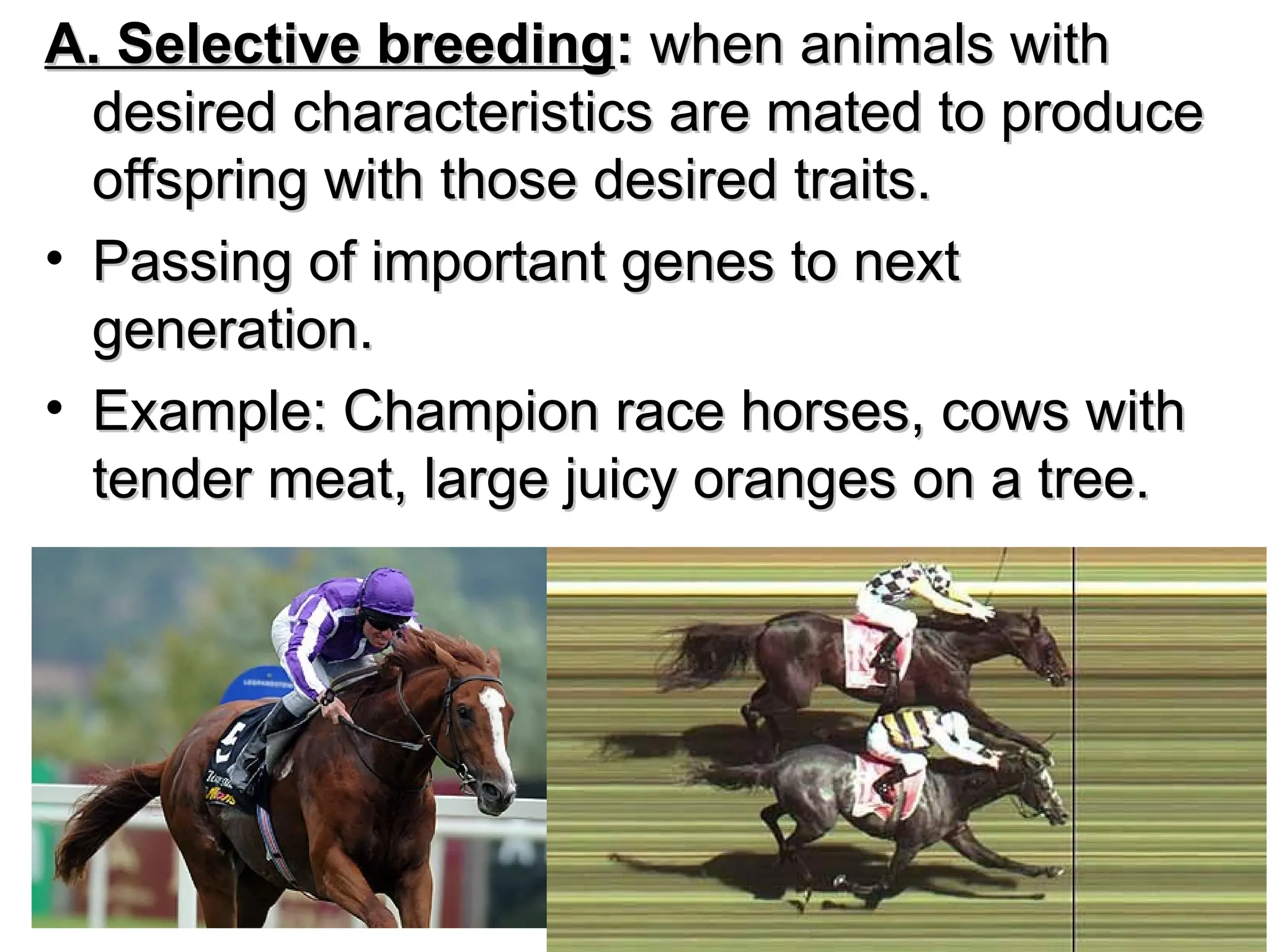
A. Selective breeding
A. Selective breeding:
: when animals with
when animals with
desired characteristics are mated to produce
offspring with those desired traits.
• Passing of important genes to next
Passing of important genes to next
generation.
generation.
• Example: Champion race horses, cows with
Example: Champion race horses, cows with
tender meat, large juicy oranges on a tree.
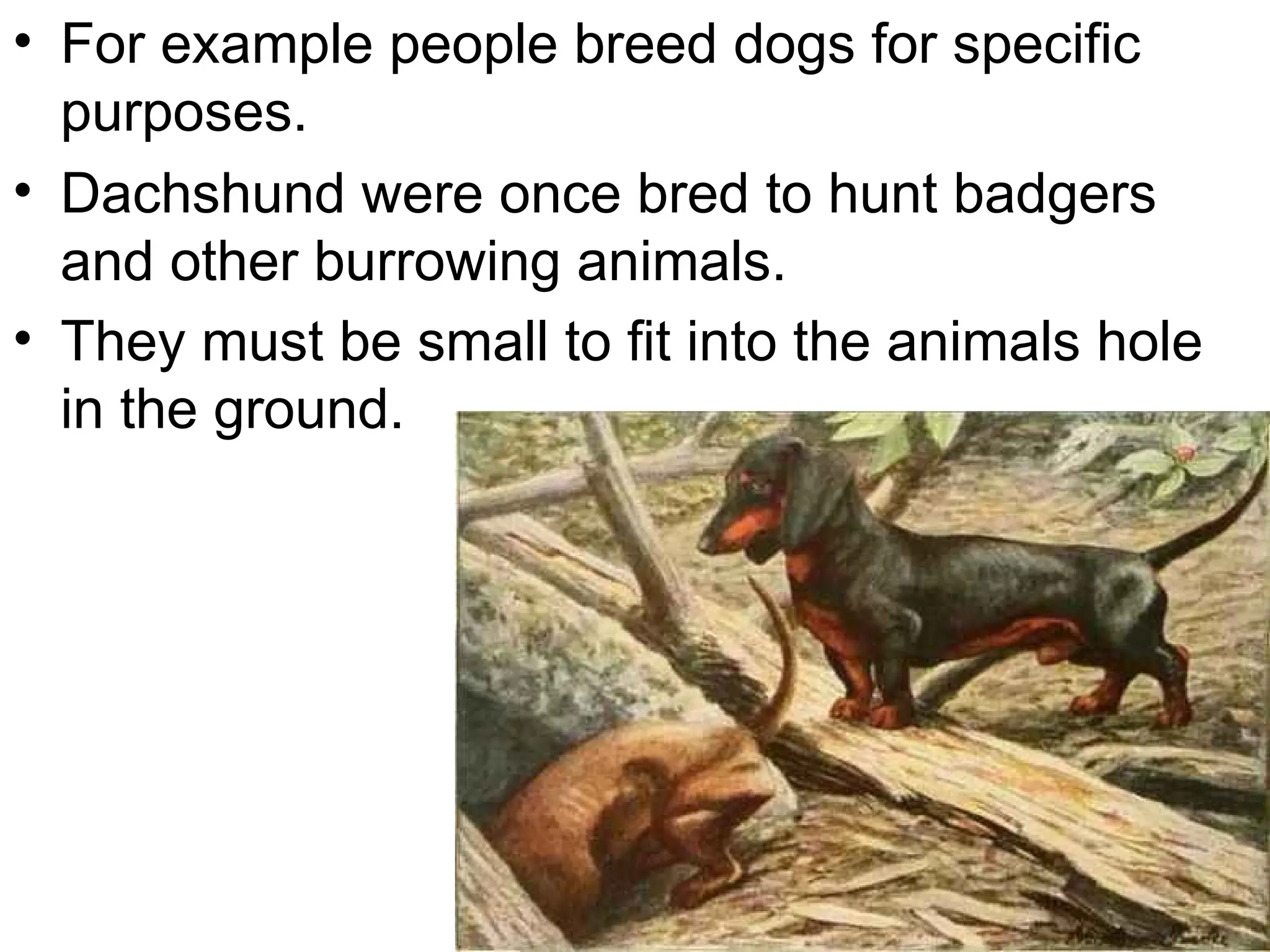
• For example people breed dogs for specific
purposes.
• Dachshund were once bred to hunt badgers
and other burrowing animals.
• They must be small to fit into the animals hole
in the ground.
• Selective breeding occurs when you choose the
best male and female to breed.
• This allows you to fine tune and control the
traits
• The offspring or babies will then have the best
traits.
• Then you continue to breed those organism
with the best traits, those traits will be
maintained.
• Examples of
selective breeding:
• Angus cows are bred to
increase muscle mass so
that we get more meat,
• Egg-Laying Hen-
produces more eggs
than the average hen
• B. Hybridizations
B. Hybridizations: two individuals with unlike
: two individuals with unlike
characteristics are crossed to produce the best in both
organisms.
organisms.
• Example: Luther Burbank created a disease resistant
Example: Luther Burbank created a disease resistant
potato called the Burbank potato.
• He crossed a disease resistant plant with one that had
He crossed a disease resistant plant with one that had
a large food producing capacity.
• Result: disease resistant plant that makes a lot of
Result: disease resistant plant that makes a lot of
potatoes.
potatoes.
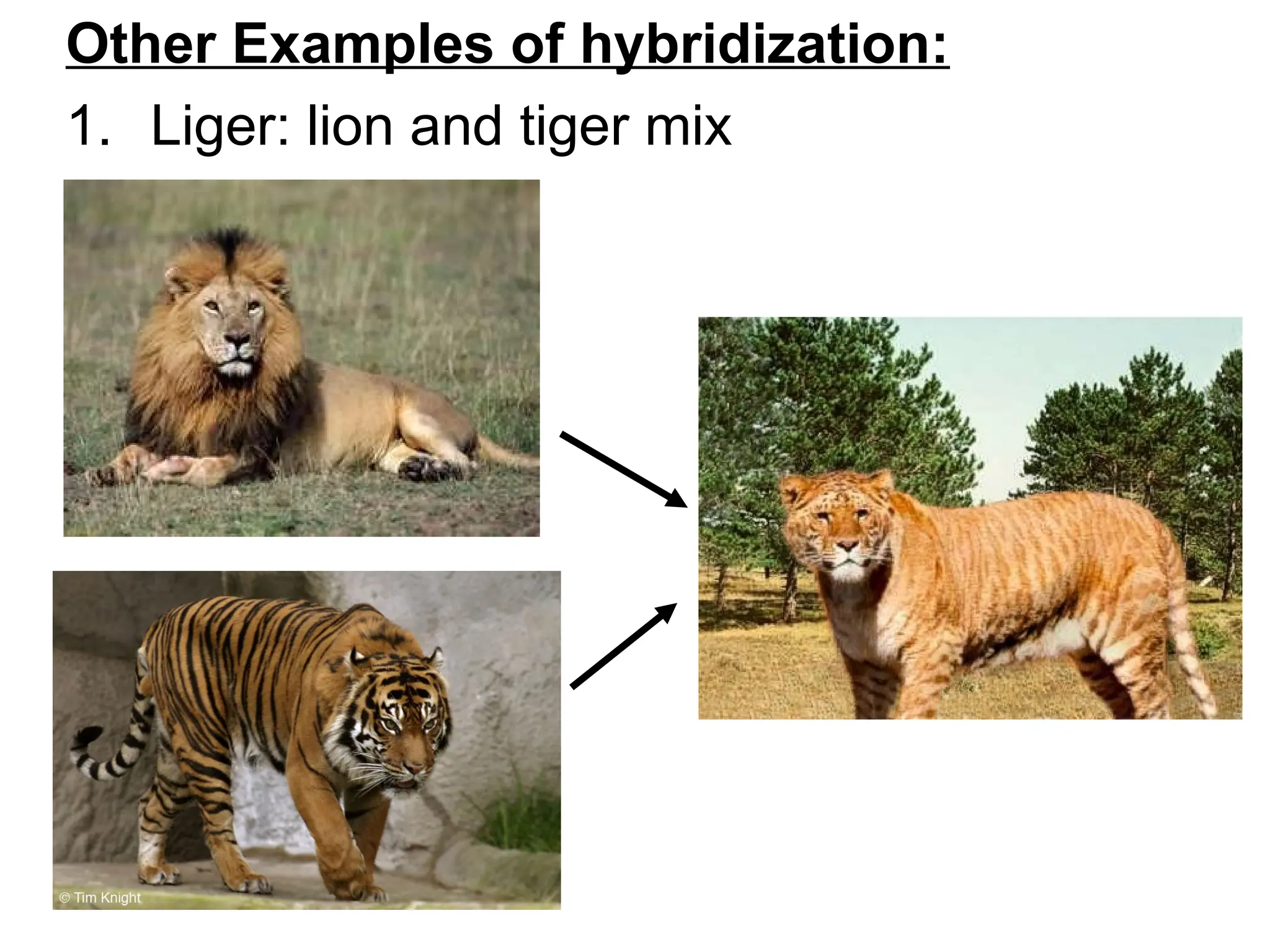
Other Examples of hybridization:
1. Liger: lion and tiger mix
2. Grape + apple= grapple. The fruit
tastes like grapes and looks like apple.
C. Inbreeding breeding of organism that
breeding of organism that
genetically similar to maintain desired traits.
• Dogs breeds are kept pure this way.
Dogs breeds are kept pure this way.
• Its how a Doberman remains a Doberman.
Its how a Doberman remains a Doberman.
• It keeps each breed unique from others.
It keeps each breed unique from others.
• Risk: since both have the same genes, the
Risk: since both have the same genes, the
chance that a baby will get a recessive
genetic disorder is high.
• Risks: blindness, joint deformities.
Risks: blindness, joint deformities.
• Variation:
Variation: difference between
difference between
individuals of a species.
• The differences are in the
The differences are in the
genes but we see the physical
differences.
differences.
• For example: Some humans
For example: Some humans
have blond hair and some
have brown. This is a variation
among humans.
among humans.
• Some finches have short
Some finches have short
beaks, some have long beaks.
• Inbreeding decreases
Inbreeding decreases
variations.
variations.
2. Cloning
2. Cloning: creating an organism that is an
: creating an organism that is an
exact genetic copy of another.
• There are human clones in our school.
There are human clones in our school.
• identical twins are naturally created clones.
identical twins are naturally created clones.
• Clone:
Clone: group of cells or organisms that are
group of cells or organisms that are
genetically identical as a result of
genetically identical as a result of asexual
asexual
reproduction
reproduction
• They will have the same exact DNA as the
They will have the same exact DNA as the
parent.
parent.
How is cloning done?
► A single cell is removed from a parent
A single cell is removed from a parent
organism.
organism.
► An entire individual is grown from that cell.
An entire individual is grown from that cell.
► Remember one cell has all the DNA needed
Remember one cell has all the DNA needed
to make an entire organism.
► Each cell in the body has the same DNA, but
Each cell in the body has the same DNA, but
cells vary because different genes are turned
on in each cell.
on in each cell.
Dolly:
Dolly:
• Dolly was the first
Dolly was the first
mammal cloned.
mammal cloned.
• She had the same exact
She had the same exact
DNA as her mother and
had no father.
had no father.
• Cloning is a form of
Cloning is a form of
asexual reproduction.
• Only one genetic parent.
Only one genetic parent.
http://content.tutorvista.com/biology_11/content/media/cloning.swf
• Since Dolly, cats and other organisms have
Since Dolly, cats and other organisms have
been cloned.
been cloned.
• The cat that was cloned had the same
The cat that was cloned had the same
exact DNA but different color fur than the
mother.
mother.
• How can this be?
How can this be?
• Environment plays a huge part in the way
Environment plays a huge part in the way
organisms develop.
organisms develop.
• Eggs are haploid
• Haploid: half the
chromosomes, 23 in
humans
• Body cells are diploid:
• Diploid: two sets of
chromosomes, one from
mom and one set from
dad 46 in humans.
How could you clone
a human?
• Step 1: An egg is
removed from a female
human
• Eggs are haploid: 23
chromosomes.
• The nucleus of the egg
is removed and is
thrown away.
23
EGG CELL
• Step 2: A body cell is
removed from another
person.
• The nucleus of the
body cell is removed
• Body cells are diploid:
46 chromosomes.
46
Body Cell
• Step 3:
• The nucleus of the
diploid body cell is put
into the egg.
• This egg no longer
needs to be fertilized
since it has all 46
chromosomes.
46
EGG CELL
• Step 4: The egg is then
charged with electricity to
start mitosis.
• Step 5: It is then put into a
surrogate mother so it can
grow.
• Its going to be genetically
identical to the parent of the
body cell.
• But it will be a baby.
• Plants and animals can be
cloned.
Click and clone
Click and clone
• http://learn.genetics.utah.edu/content/tech/cloni
ng/clickandclone/
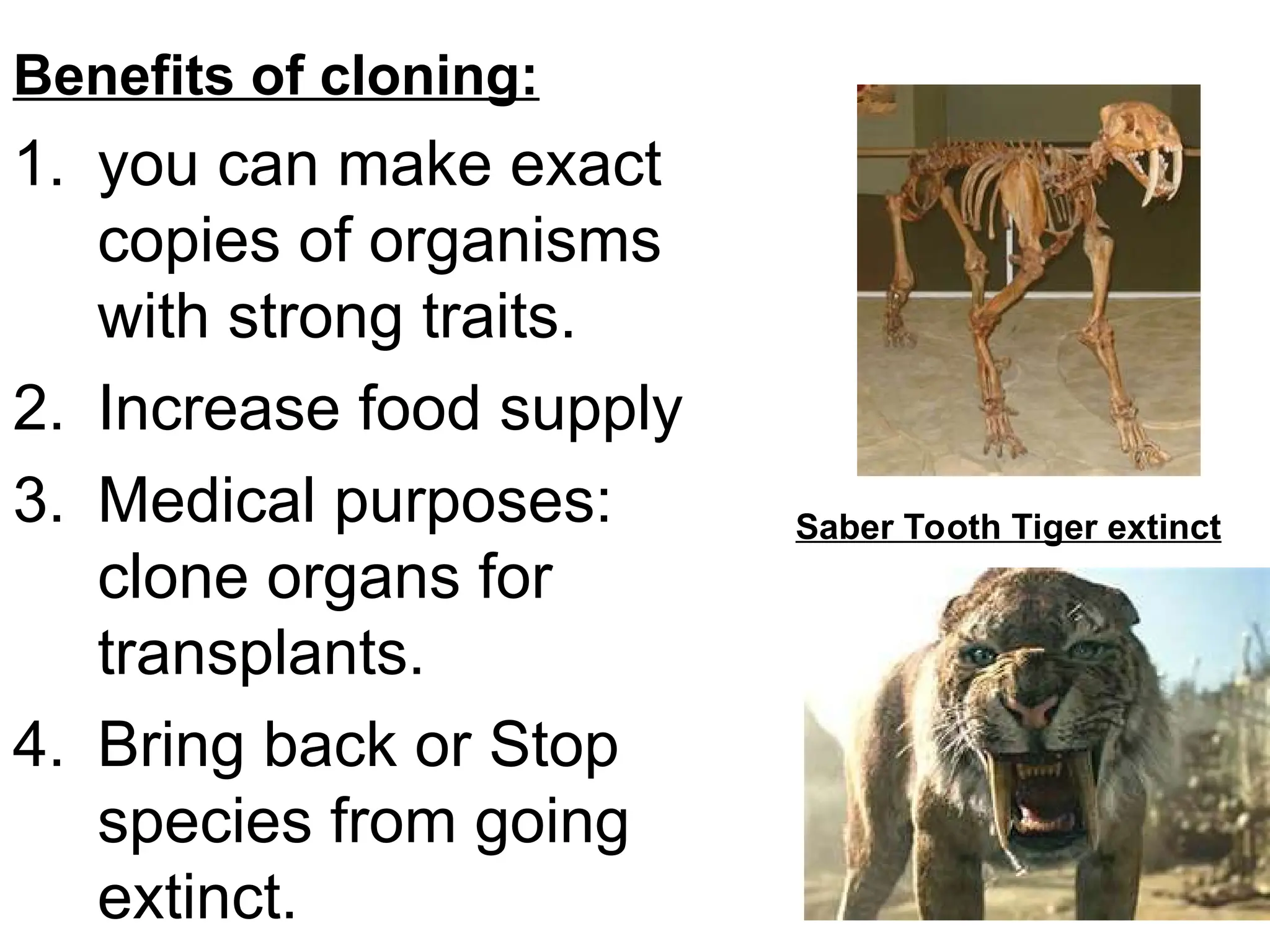
Benefits of cloning:
1. you can make exact
copies of organisms
with strong traits.
2. Increase food supply
3. Medical purposes:
clone organs for
transplants.
4. Bring back or Stop
species from going
extinct.
Saber Tooth Tiger extinct
Risks of cloning:
1. Decreases genetic
diversity
2. If one of your clones
gets a disease, they all
get it: same immune
system.
3. Inefficient: high failure
rate: 90%+
4. Expensive
3. Gene splicing: DNA is cut
out of one organism and put
into another organism
• A trait will be transferred from
one organism to another.
• For example: the human
insulin gene can be removed
from a human cell.
• It can be put into a bacterial
cell.
• The bacterial will now make
human insulin.
• This picture represents gene splicing.
• However, DNA is much smaller.
• Its done with high tech lab equipment since
DNA, is too small to hold or see without a
microscope.
The red piece the woman
is holding is an insulin
gene from a human
being. It is being
combined with DNA from
a bacteria.
Creates recombinant
DNA, something that has
never existed before.
Benefits:
• insulin is cheaper
• There are no side
effects because it
is human insulin.
• We once used pig
insulin but there
are side effects
and it more
expensive.
How are genes cut for gene splicing?
• A bacterial
A bacterial plasmid
plasmid is used.
is used.
• Plasmid:
Plasmid: circular DNA in a bacteria
circular DNA in a bacteria
cell.
cell.
• It is very simple and easy to
It is very simple and easy to
manipulate.
manipulate.
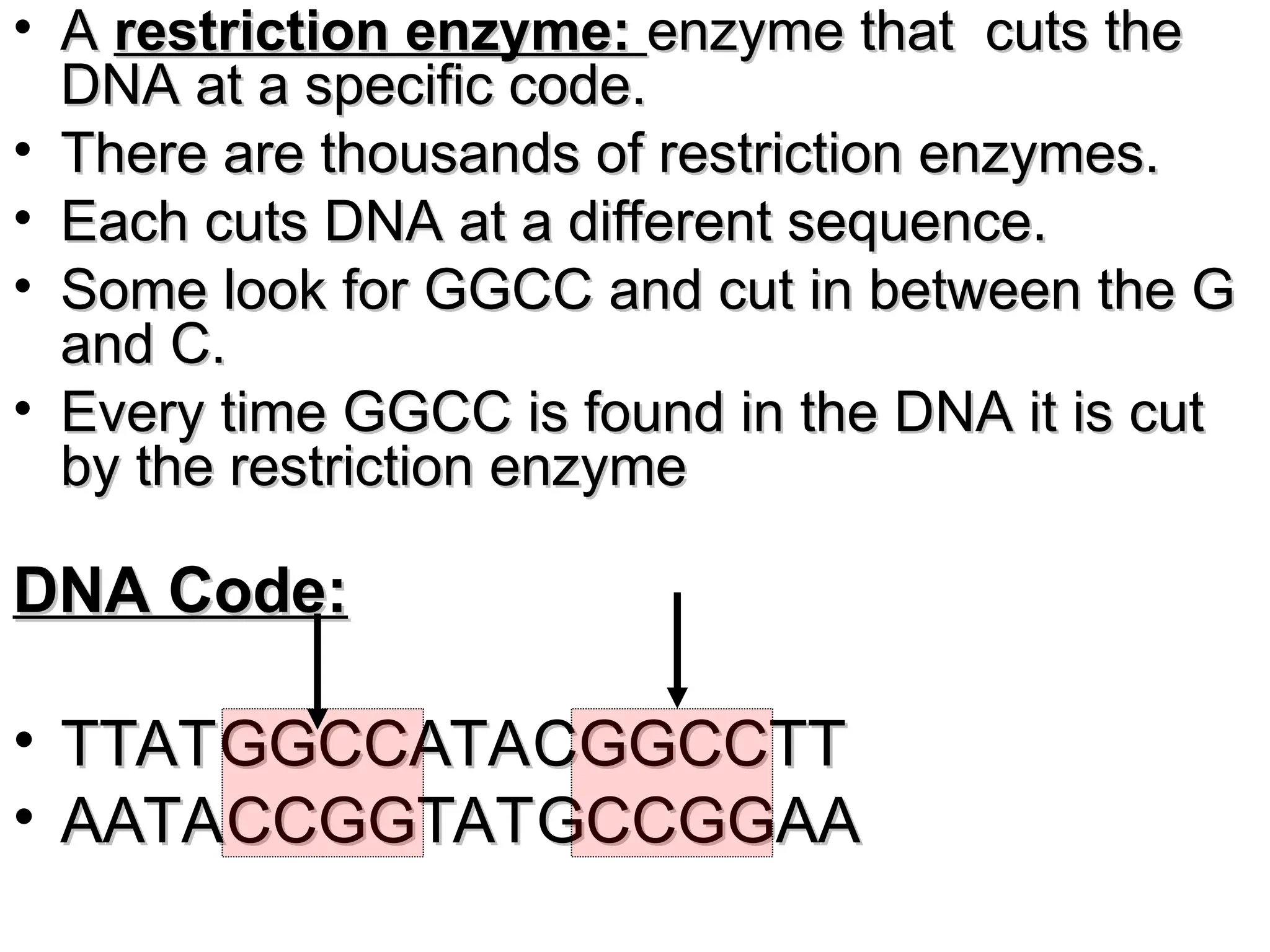
• A
A restriction enzyme:
restriction enzyme: enzyme that cuts the
enzyme that cuts the
DNA at a specific code.
• There are thousands of restriction enzymes.
There are thousands of restriction enzymes.
• Each cuts DNA at a different sequence.
Each cuts DNA at a different sequence.
• Some look for GGCC and cut in between the G
Some look for GGCC and cut in between the G
and C.
and C.
• Every time GGCC is found in the DNA it is cut
Every time GGCC is found in the DNA it is cut
by the restriction enzyme
DNA Code:
DNA Code:
• TTATGGCCATACGGCCTT
TTATGGCCATACGGCCTT
• AATACCGGTATGCCGGAA
AATACCGGTATGCCGGAA
• TTATGGCCATACGGCCTT
TTATGGCCATACGGCCTT
• AATACCGGTATGCCGGAA
AATACCGGTATGCCGGAA
• TTATGG CCATACGG CCTT
TTATGG CCATACGG CCTT
• AATACC GGTATGCC GGAA
AATACC GGTATGCC GGAA
• This DNA segment was cut twice creating three
This DNA segment was cut twice creating three
fragments.
fragments.
• Since every one is different, we all have a
Since every one is different, we all have a
different amount of times GGCC is found.
• My DNA may be cut seven times
My DNA may be cut seven times
• Yours may be cut ten times.
Yours may be cut ten times.
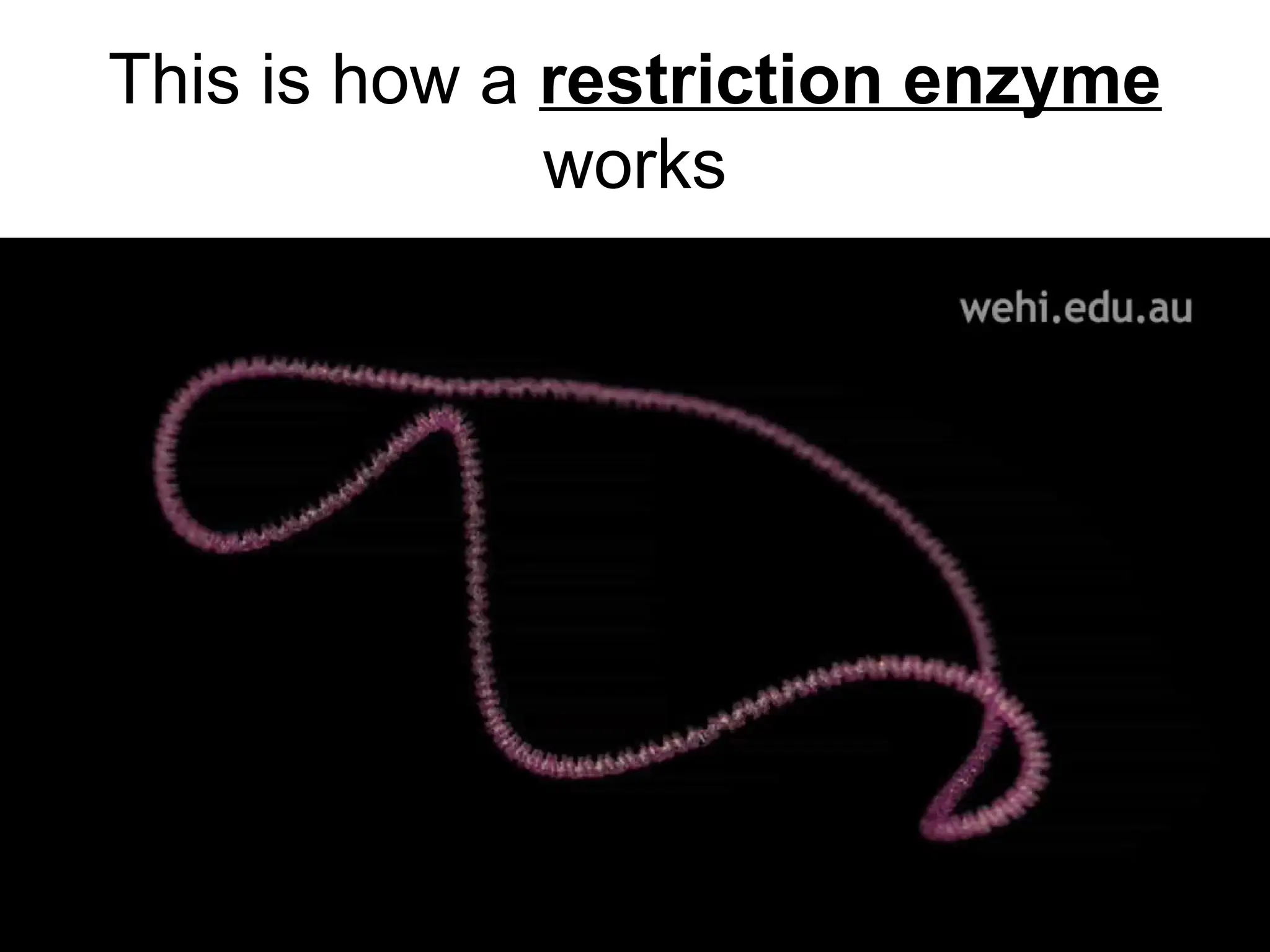
This is how a restriction enzyme
works
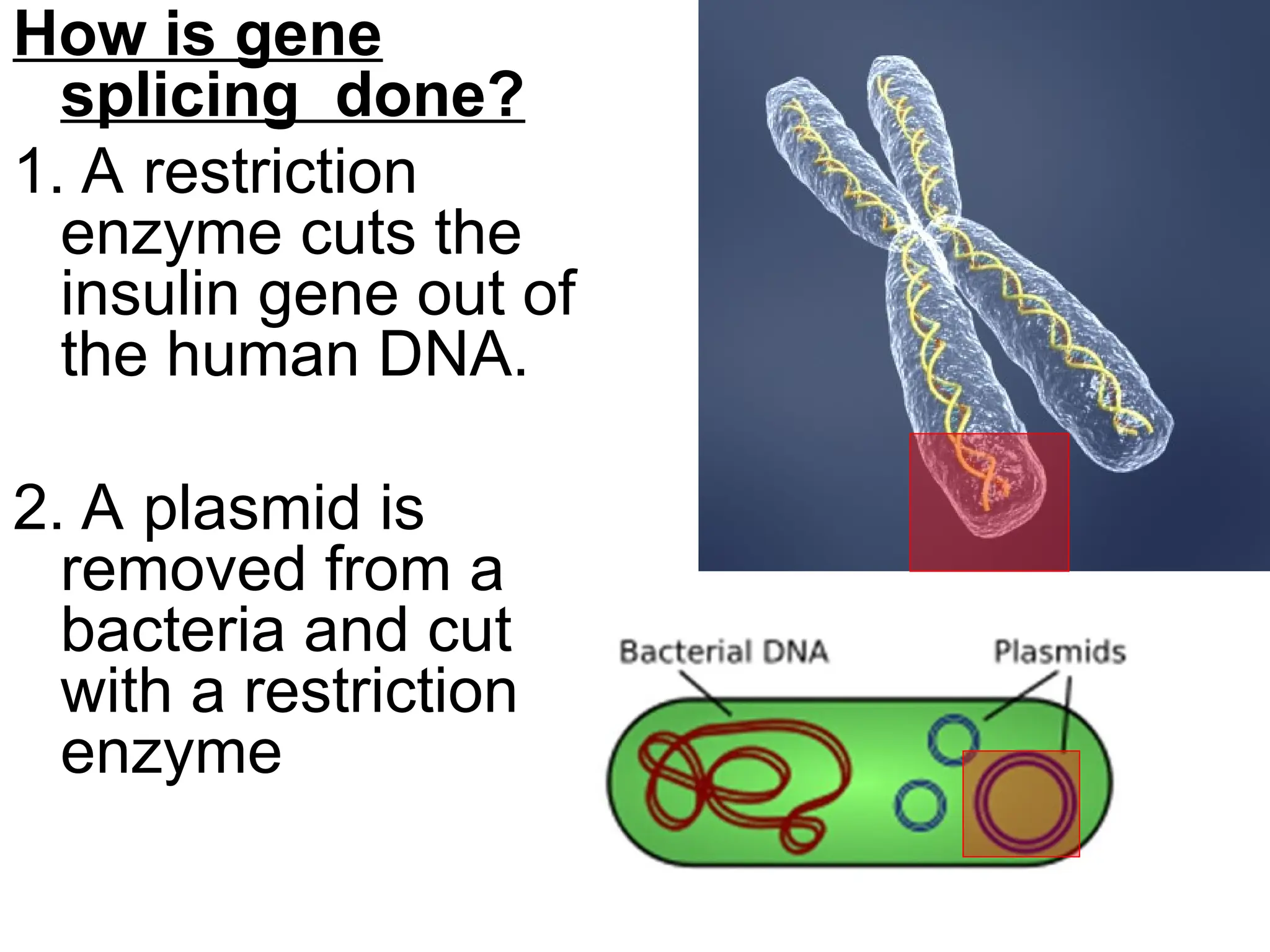
How is gene
splicing done?
1. A restriction
enzyme cuts the
insulin gene out of
the human DNA.
2. A plasmid is
removed from a
bacteria and cut
with a restriction
enzyme
3. The human gene is place into the bacteria
plasmid
4. The plasmid is placed back into the bacteria.
• The cell now has directions (DNA) to make
insulin.
• That's exactly what it does.
• Its human insulin, bacteria do not make insulin
on their own.
Plasmid with
insulin gene
• This is called
This is called transformation:
transformation: when a gene
when a gene
from one organism is transferred to different
organism.
organism.
• The organisms that have DNA transferred to
The organisms that have DNA transferred to
them are called
them are called transgenic organisms
transgenic organisms.
.
• trans
trans: means different,
: means different,
• genic
genic: refers to genes
: refers to genes
• Genetic engineering has given rise to a new
Genetic engineering has given rise to a new
technological field called
technological field called biotechnology
biotechnology
(technology of life).
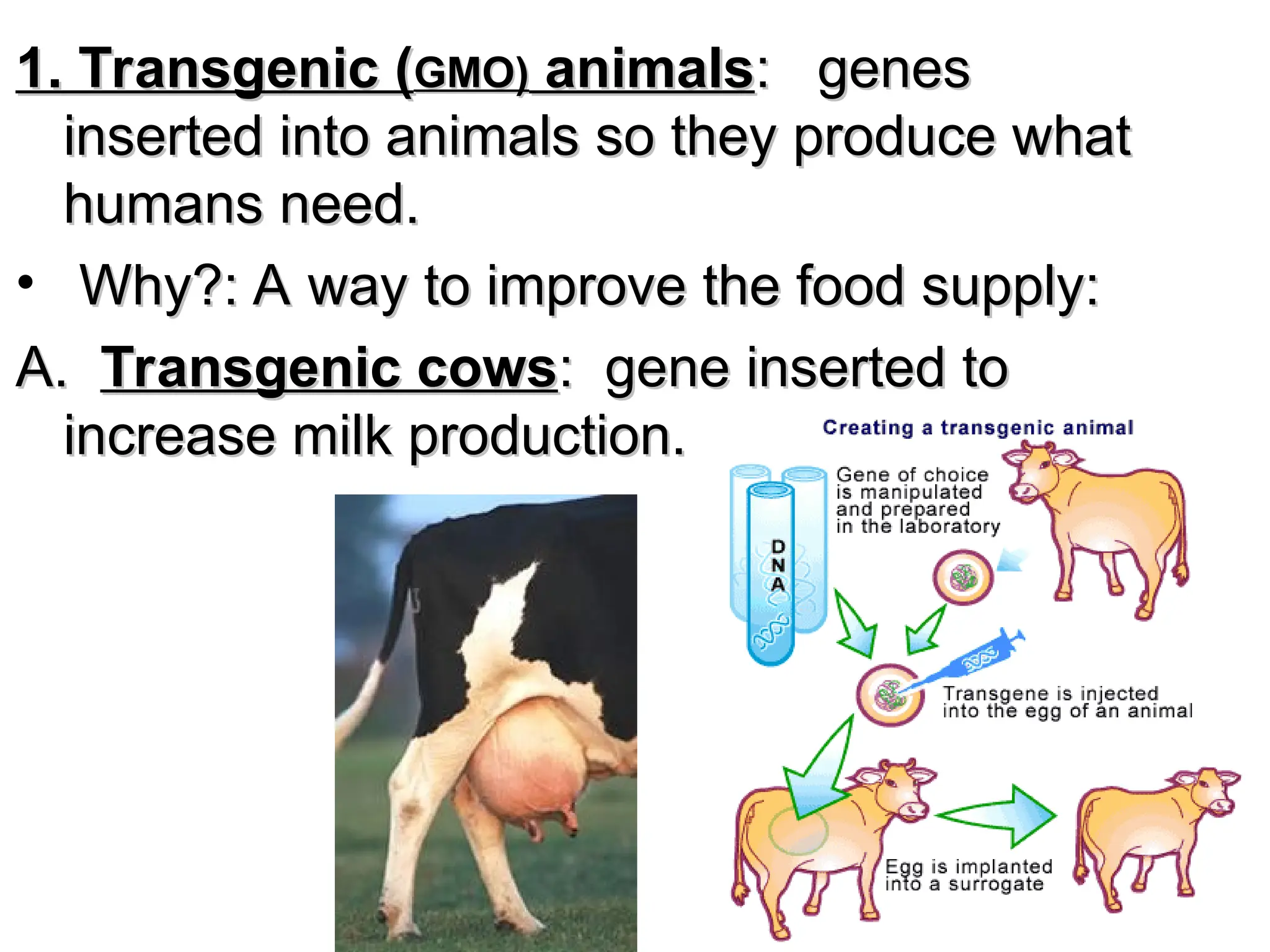
1. Transgenic (
1. Transgenic (GMO)
GMO) animals
animals: genes
: genes
inserted into animals so they produce what
humans need.
humans need.
• Why?: A way to improve the food supply:
Why?: A way to improve the food supply:
A.
A. Transgenic cows
Transgenic cows: gene inserted to
: gene inserted to
increase milk production.
B. Spider goat
B. Spider goat: gene from spider inserted
: gene from spider inserted
into goat.
into goat.
• Goats makes silk of the spider web in their
Goats makes silk of the spider web in their
milk.
milk.
• Flexible, stronger than steel. Used in
Flexible, stronger than steel. Used in
bullet proof jackets.
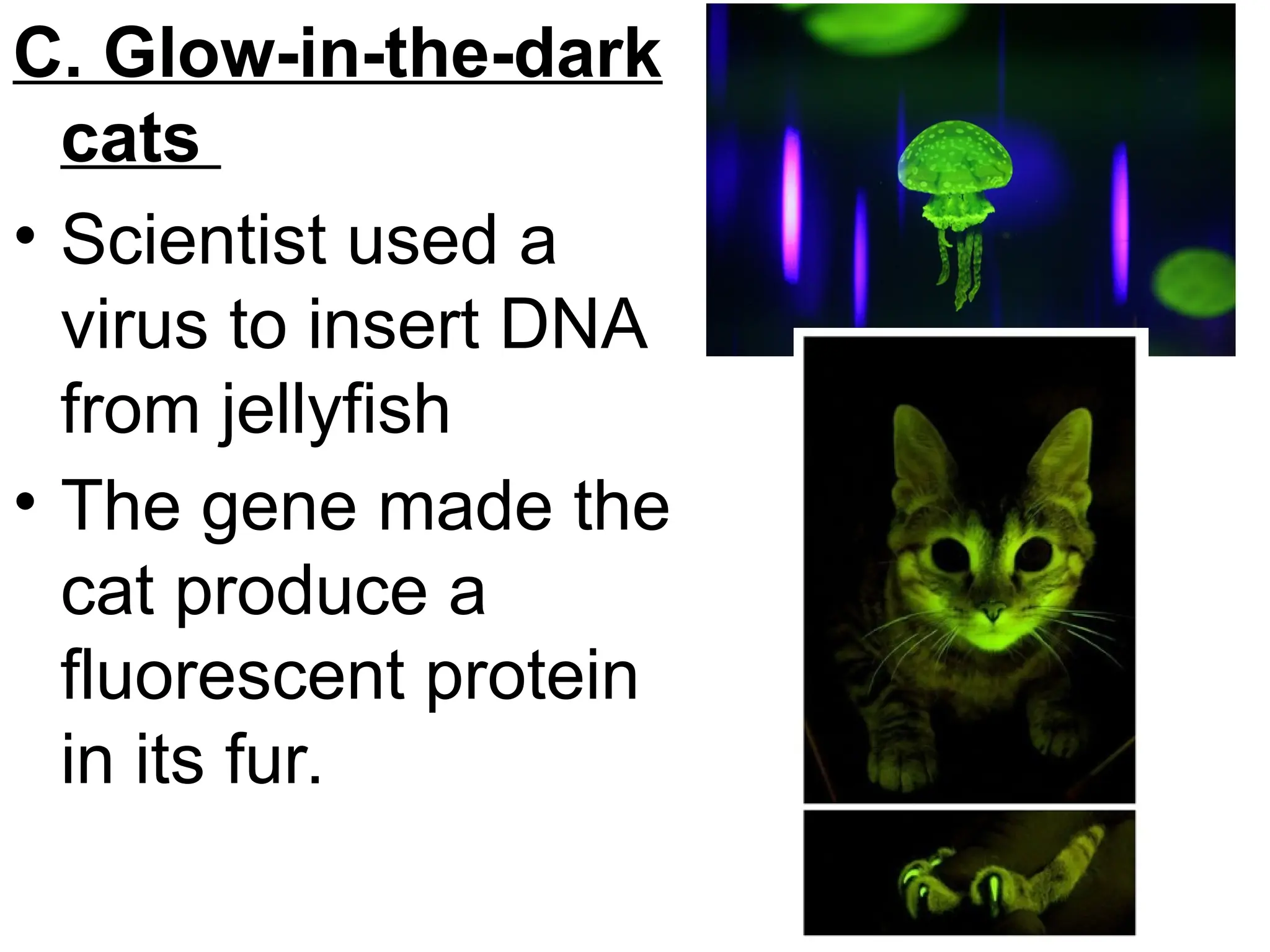
C. Glow-in-the-dark
cats
• Scientist used a
virus to insert DNA
from jellyfish
• The gene made the
cat produce a
fluorescent protein
in its fur.
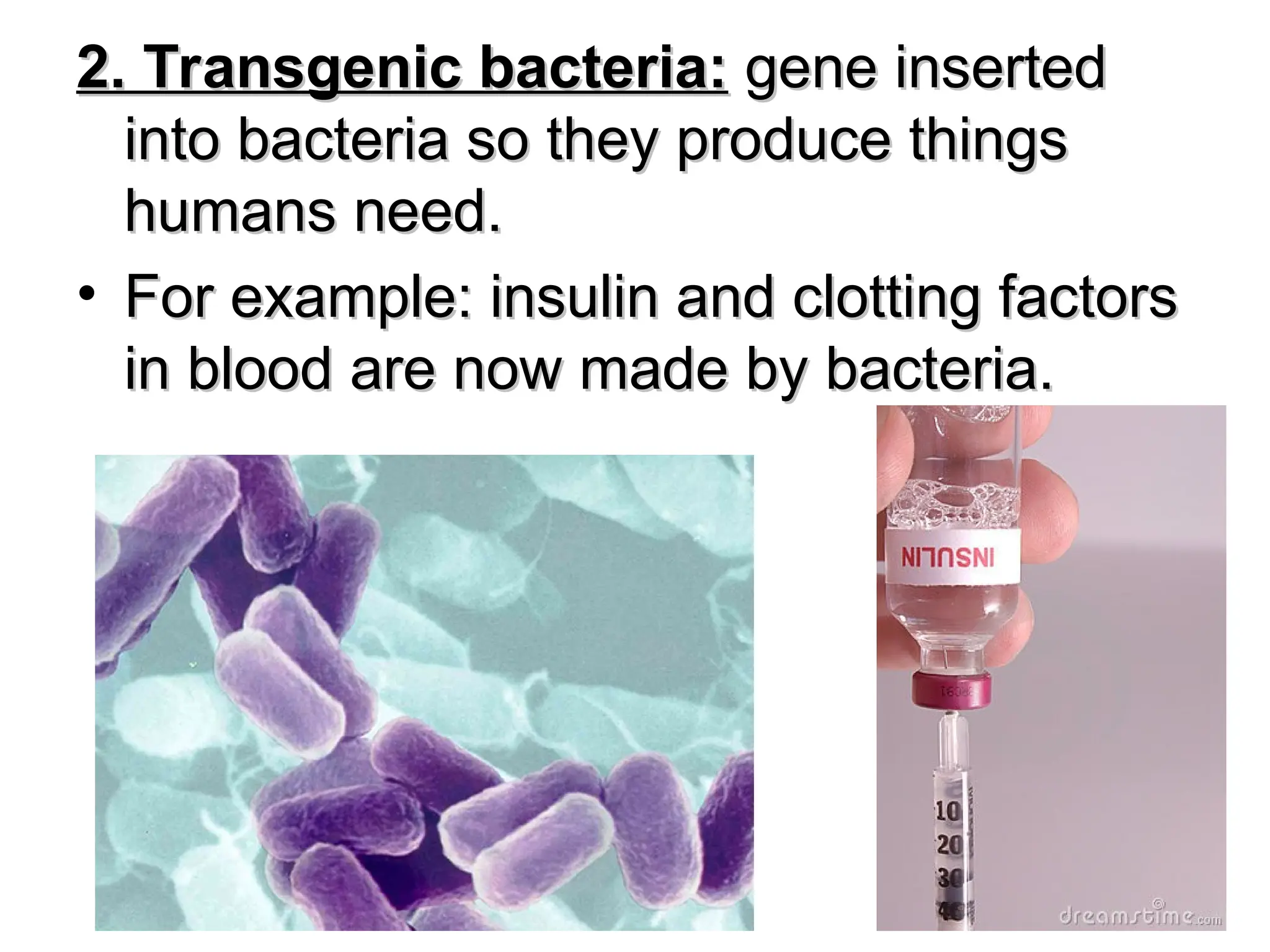
2. Transgenic bacteria:
2. Transgenic bacteria: gene inserted
gene inserted
into bacteria so they produce things
humans need.
humans need.
• For example: insulin and clotting factors
For example: insulin and clotting factors
in blood are now made by bacteria.
3. Transgenic plants:
3. Transgenic plants: plants are given
plants are given
genes so they meet human needs.
A. Transgenic corn:
A. Transgenic corn: given a gene so corn
given a gene so corn
produces a natural pesticide.
Now they don’t have to be sprayed with
cancer causing pesticides.
• 25% of all corn is like this.
25% of all corn is like this.
B. Venomous cabbage
• gene from a scorpion tails
inserted into cabbage.
• Cabbage now produces
that chemical.
• Why? Limit pesticide use
while still preventing
insects from damaging
crops.
• Corporations state the
toxin is modified so it isn’t
harmful to humans.
C. Banana vaccines
• virus is injected into a banana,
the virus DNA becomes part of
the plant.
• As the plant grows, it produces
the virus proteins — but not the
disease part of the virus.
• When people eat a bite, their
immune systems creates
antibodies to fight the disease
— just like a traditional vaccine
• Vaccines for hepatitis and
cholera
• A virus is often used to deliver DNA.
• In the movie “I Am Legend,” A healthy gene was
inserted into a virus.
• The virus invaded the cancer cells and inserts the
healthy gene to cure cancer.
• Worked at first but the virus mutated and became
deadly.
• This is being attempted in real life.
• Gene therapy: when disease causing
genes are cut out and good gene are
inserted.
• Restriction enzymes are used to cut out
bad genes.
• Viruses are used to insert good genes.
• Not approved for human use yet.
• Some possible side effects.
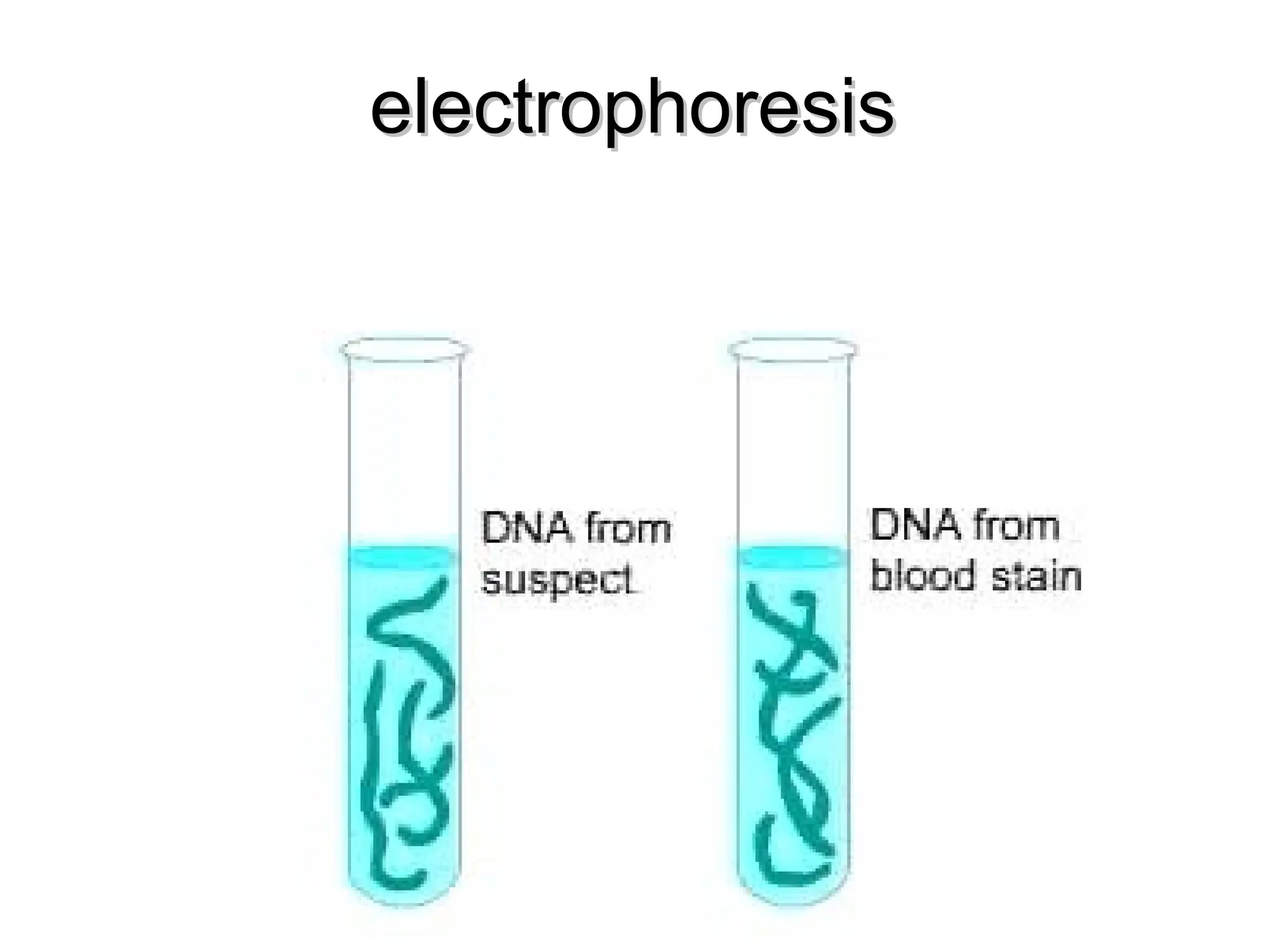
4. Gel electrophoresis: a
technique used to compare
DNA from two or more
organisms.
Why compare DNA:
1. Find your baby’s daddy
2. Who committed a crime.
3. How closely species are
related.
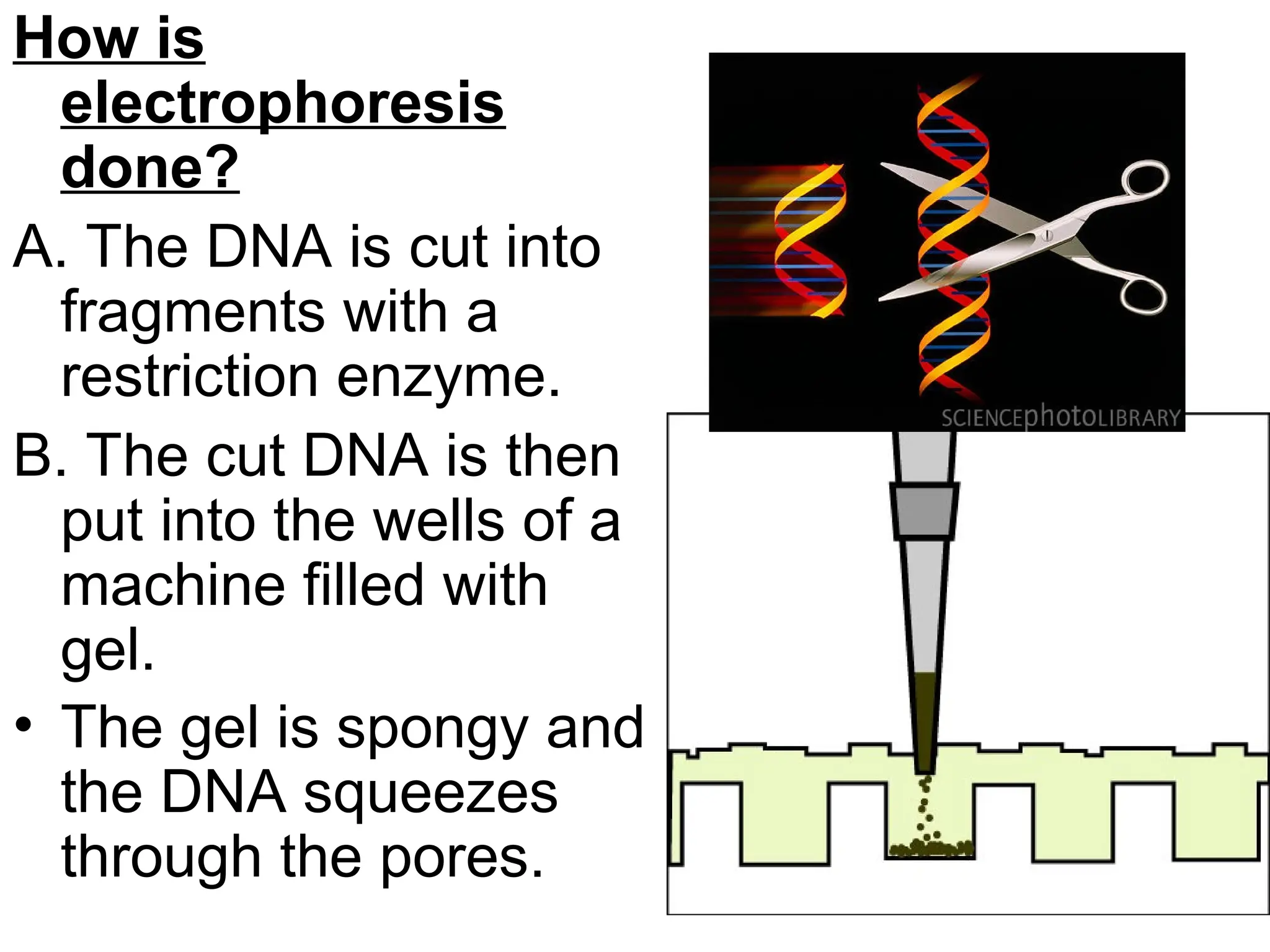
How is
electrophoresis
done?
A. The DNA is cut into
fragments with a
restriction enzyme.
B. The cut DNA is then
put into the wells of a
machine filled with
gel.
• The gel is spongy and
the DNA squeezes
through the pores.
C. The machine is plugged in and the
fragments get separated based on their size.
• The smaller fragments move further than the
large.
• Electrophoresis
results
Separation of DNA based on
size of fragments.
Final result of electrophoresis
• Electricity provides the energy
• Why does DNA move?
• DNA has a negative charge.
• When the machine is plugged it, its moves towards
the positive pole created by the electricity
electrophoresis
electrophoresis
Your DNA is so unique its considered to be a
DNA fingerprint.
Gel electrophoresis will separate your DNA
differently from anyone else.
Nova: who done it
Nova: who done it
http://www.pbs.org/wgbh/nova/sheppard/analyze.html
http://www.teachersdomain.org/asset/tdc02_i
nt_creatednafp2/
• Genetic engineering creates organisms with
recombinant DNA.
• Recombinant DNA: when DNA is
combined from at least two organisms.
Which techniques create recombinant DNA
1. Sexual reproduction: natural
2. selective breeding
3. Hybridization
4. Gene splicing
• Does cloning create organisms with
recombinant DNA?
• No, the DNA from one organism is
copied.
• DNA is not recombined.

GENETIC ENGINEERING for STEM SHS Students.ppt

  • 1.
  • 2.
    • Genetic engineering:Changing the DNA in living organisms to create something new. • This organisms are called Genetically Modified Organism (GMO) • Example: • Bacteria that produce human insulin • Genetically Modified organism are called transgenic organism; since genes are transferred from one organism to another.
  • 3.
    Some genetic engineeringtechniques are as follows: 1. Artificial selection A. selective breeding B. hybridization C. inbreeding 2. Cloning 3. Gene splicing 4. Gel electrophoresis: analyzing DNA
  • 4.
    1. artificial selection:breeders choose which organism to mate to produce offspring with desired traits. • They cannot control what genes are passed. • When they get offspring with the desired traits, the maintain them. Three types of artificial selection: A. selective breeding B. hybridization C. inbreeding
  • 5.
    A. Selective breeding A.Selective breeding: : when animals with when animals with desired characteristics are mated to produce desired characteristics are mated to produce offspring with those desired traits. offspring with those desired traits. • Passing of important genes to next Passing of important genes to next generation. generation. • Example: Champion race horses, cows with Example: Champion race horses, cows with tender meat, large juicy oranges on a tree. tender meat, large juicy oranges on a tree.
  • 6.
    • For examplepeople breed dogs for specific purposes. • Dachshund were once bred to hunt badgers and other burrowing animals. • They must be small to fit into the animals hole in the ground.
  • 7.
    • Selective breedingoccurs when you choose the best male and female to breed. • This allows you to fine tune and control the traits • The offspring or babies will then have the best traits. • Then you continue to breed those organism with the best traits, those traits will be maintained.
  • 8.
    • Examples of selectivebreeding: • Angus cows are bred to increase muscle mass so that we get more meat, • Egg-Laying Hen- produces more eggs than the average hen
  • 9.
    • B. Hybridizations B.Hybridizations: two individuals with unlike : two individuals with unlike characteristics are crossed to produce the best in both characteristics are crossed to produce the best in both organisms. organisms. • Example: Luther Burbank created a disease resistant Example: Luther Burbank created a disease resistant potato called the Burbank potato. potato called the Burbank potato. • He crossed a disease resistant plant with one that had He crossed a disease resistant plant with one that had a large food producing capacity. a large food producing capacity. • Result: disease resistant plant that makes a lot of Result: disease resistant plant that makes a lot of potatoes. potatoes.
  • 10.
    Other Examples ofhybridization: 1. Liger: lion and tiger mix
  • 11.
    2. Grape +apple= grapple. The fruit tastes like grapes and looks like apple.
  • 12.
    C. Inbreeding breedingof organism that breeding of organism that genetically similar to maintain desired traits. genetically similar to maintain desired traits. • Dogs breeds are kept pure this way. Dogs breeds are kept pure this way. • Its how a Doberman remains a Doberman. Its how a Doberman remains a Doberman. • It keeps each breed unique from others. It keeps each breed unique from others. • Risk: since both have the same genes, the Risk: since both have the same genes, the chance that a baby will get a recessive chance that a baby will get a recessive genetic disorder is high. genetic disorder is high. • Risks: blindness, joint deformities. Risks: blindness, joint deformities.
  • 13.
    • Variation: Variation: differencebetween difference between individuals of a species. individuals of a species. • The differences are in the The differences are in the genes but we see the physical genes but we see the physical differences. differences. • For example: Some humans For example: Some humans have blond hair and some have blond hair and some have brown. This is a variation have brown. This is a variation among humans. among humans. • Some finches have short Some finches have short beaks, some have long beaks. beaks, some have long beaks. • Inbreeding decreases Inbreeding decreases variations. variations.
  • 14.
    2. Cloning 2. Cloning:creating an organism that is an : creating an organism that is an exact genetic copy of another. exact genetic copy of another. • There are human clones in our school. There are human clones in our school. • identical twins are naturally created clones. identical twins are naturally created clones. • Clone: Clone: group of cells or organisms that are group of cells or organisms that are genetically identical as a result of genetically identical as a result of asexual asexual reproduction reproduction • They will have the same exact DNA as the They will have the same exact DNA as the parent. parent.
  • 15.
    How is cloningdone? How is cloning done? ► A single cell is removed from a parent A single cell is removed from a parent organism. organism. ► An entire individual is grown from that cell. An entire individual is grown from that cell. ► Remember one cell has all the DNA needed Remember one cell has all the DNA needed to make an entire organism. to make an entire organism. ► Each cell in the body has the same DNA, but Each cell in the body has the same DNA, but cells vary because different genes are turned cells vary because different genes are turned on in each cell. on in each cell.
  • 16.
    Dolly: Dolly: • Dolly wasthe first Dolly was the first mammal cloned. mammal cloned. • She had the same exact She had the same exact DNA as her mother and DNA as her mother and had no father. had no father. • Cloning is a form of Cloning is a form of asexual reproduction. asexual reproduction. • Only one genetic parent. Only one genetic parent. http://content.tutorvista.com/biology_11/content/media/cloning.swf
  • 17.
    • Since Dolly,cats and other organisms have Since Dolly, cats and other organisms have been cloned. been cloned. • The cat that was cloned had the same The cat that was cloned had the same exact DNA but different color fur than the exact DNA but different color fur than the mother. mother. • How can this be? How can this be? • Environment plays a huge part in the way Environment plays a huge part in the way organisms develop. organisms develop.
  • 18.
    • Eggs arehaploid • Haploid: half the chromosomes, 23 in humans • Body cells are diploid: • Diploid: two sets of chromosomes, one from mom and one set from dad 46 in humans.
  • 19.
    How could youclone a human? • Step 1: An egg is removed from a female human • Eggs are haploid: 23 chromosomes. • The nucleus of the egg is removed and is thrown away. 23 EGG CELL
  • 20.
    • Step 2:A body cell is removed from another person. • The nucleus of the body cell is removed • Body cells are diploid: 46 chromosomes. 46 Body Cell
  • 21.
    • Step 3: •The nucleus of the diploid body cell is put into the egg. • This egg no longer needs to be fertilized since it has all 46 chromosomes. 46 EGG CELL
  • 22.
    • Step 4:The egg is then charged with electricity to start mitosis. • Step 5: It is then put into a surrogate mother so it can grow. • Its going to be genetically identical to the parent of the body cell. • But it will be a baby. • Plants and animals can be cloned.
  • 24.
    Click and clone Clickand clone • http://learn.genetics.utah.edu/content/tech/cloni ng/clickandclone/
  • 25.
    Benefits of cloning: 1.you can make exact copies of organisms with strong traits. 2. Increase food supply 3. Medical purposes: clone organs for transplants. 4. Bring back or Stop species from going extinct. Saber Tooth Tiger extinct
  • 26.
    Risks of cloning: 1.Decreases genetic diversity 2. If one of your clones gets a disease, they all get it: same immune system. 3. Inefficient: high failure rate: 90%+ 4. Expensive
  • 27.
    3. Gene splicing:DNA is cut out of one organism and put into another organism • A trait will be transferred from one organism to another. • For example: the human insulin gene can be removed from a human cell. • It can be put into a bacterial cell. • The bacterial will now make human insulin.
  • 28.
    • This picturerepresents gene splicing. • However, DNA is much smaller. • Its done with high tech lab equipment since DNA, is too small to hold or see without a microscope. The red piece the woman is holding is an insulin gene from a human being. It is being combined with DNA from a bacteria. Creates recombinant DNA, something that has never existed before.
  • 29.
    Benefits: • insulin ischeaper • There are no side effects because it is human insulin. • We once used pig insulin but there are side effects and it more expensive.
  • 30.
    How are genescut for gene splicing? How are genes cut for gene splicing? • A bacterial A bacterial plasmid plasmid is used. is used. • Plasmid: Plasmid: circular DNA in a bacteria circular DNA in a bacteria cell. cell. • It is very simple and easy to It is very simple and easy to manipulate. manipulate.
  • 31.
    • A A restrictionenzyme: restriction enzyme: enzyme that cuts the enzyme that cuts the DNA at a specific code. DNA at a specific code. • There are thousands of restriction enzymes. There are thousands of restriction enzymes. • Each cuts DNA at a different sequence. Each cuts DNA at a different sequence. • Some look for GGCC and cut in between the G Some look for GGCC and cut in between the G and C. and C. • Every time GGCC is found in the DNA it is cut Every time GGCC is found in the DNA it is cut by the restriction enzyme by the restriction enzyme DNA Code: DNA Code: • TTATGGCCATACGGCCTT TTATGGCCATACGGCCTT • AATACCGGTATGCCGGAA AATACCGGTATGCCGGAA
  • 32.
    • TTATGGCCATACGGCCTT TTATGGCCATACGGCCTT • AATACCGGTATGCCGGAA AATACCGGTATGCCGGAA •TTATGG CCATACGG CCTT TTATGG CCATACGG CCTT • AATACC GGTATGCC GGAA AATACC GGTATGCC GGAA • This DNA segment was cut twice creating three This DNA segment was cut twice creating three fragments. fragments. • Since every one is different, we all have a Since every one is different, we all have a different amount of times GGCC is found. different amount of times GGCC is found. • My DNA may be cut seven times My DNA may be cut seven times • Yours may be cut ten times. Yours may be cut ten times.
  • 33.
    This is howa restriction enzyme works
  • 34.
    How is gene splicingdone? 1. A restriction enzyme cuts the insulin gene out of the human DNA. 2. A plasmid is removed from a bacteria and cut with a restriction enzyme
  • 35.
    3. The humangene is place into the bacteria plasmid 4. The plasmid is placed back into the bacteria. • The cell now has directions (DNA) to make insulin. • That's exactly what it does. • Its human insulin, bacteria do not make insulin on their own. Plasmid with insulin gene
  • 36.
    • This iscalled This is called transformation: transformation: when a gene when a gene from one organism is transferred to different from one organism is transferred to different organism. organism. • The organisms that have DNA transferred to The organisms that have DNA transferred to them are called them are called transgenic organisms transgenic organisms. . • trans trans: means different, : means different, • genic genic: refers to genes : refers to genes • Genetic engineering has given rise to a new Genetic engineering has given rise to a new technological field called technological field called biotechnology biotechnology (technology of life). (technology of life).
  • 37.
    1. Transgenic ( 1.Transgenic (GMO) GMO) animals animals: genes : genes inserted into animals so they produce what inserted into animals so they produce what humans need. humans need. • Why?: A way to improve the food supply: Why?: A way to improve the food supply: A. A. Transgenic cows Transgenic cows: gene inserted to : gene inserted to increase milk production. increase milk production.
  • 38.
    B. Spider goat B.Spider goat: gene from spider inserted : gene from spider inserted into goat. into goat. • Goats makes silk of the spider web in their Goats makes silk of the spider web in their milk. milk. • Flexible, stronger than steel. Used in Flexible, stronger than steel. Used in bullet proof jackets. bullet proof jackets.
  • 39.
    C. Glow-in-the-dark cats • Scientistused a virus to insert DNA from jellyfish • The gene made the cat produce a fluorescent protein in its fur.
  • 40.
    2. Transgenic bacteria: 2.Transgenic bacteria: gene inserted gene inserted into bacteria so they produce things into bacteria so they produce things humans need. humans need. • For example: insulin and clotting factors For example: insulin and clotting factors in blood are now made by bacteria. in blood are now made by bacteria.
  • 41.
    3. Transgenic plants: 3.Transgenic plants: plants are given plants are given genes so they meet human needs. genes so they meet human needs. A. Transgenic corn: A. Transgenic corn: given a gene so corn given a gene so corn produces a natural pesticide. produces a natural pesticide. Now they don’t have to be sprayed with Now they don’t have to be sprayed with cancer causing pesticides. cancer causing pesticides. • 25% of all corn is like this. 25% of all corn is like this.
  • 42.
    B. Venomous cabbage •gene from a scorpion tails inserted into cabbage. • Cabbage now produces that chemical. • Why? Limit pesticide use while still preventing insects from damaging crops. • Corporations state the toxin is modified so it isn’t harmful to humans.
  • 43.
    C. Banana vaccines •virus is injected into a banana, the virus DNA becomes part of the plant. • As the plant grows, it produces the virus proteins — but not the disease part of the virus. • When people eat a bite, their immune systems creates antibodies to fight the disease — just like a traditional vaccine • Vaccines for hepatitis and cholera
  • 44.
    • A virusis often used to deliver DNA. • In the movie “I Am Legend,” A healthy gene was inserted into a virus. • The virus invaded the cancer cells and inserts the healthy gene to cure cancer. • Worked at first but the virus mutated and became deadly. • This is being attempted in real life.
  • 45.
    • Gene therapy:when disease causing genes are cut out and good gene are inserted. • Restriction enzymes are used to cut out bad genes. • Viruses are used to insert good genes. • Not approved for human use yet. • Some possible side effects.
  • 46.
    4. Gel electrophoresis:a technique used to compare DNA from two or more organisms. Why compare DNA: 1. Find your baby’s daddy 2. Who committed a crime. 3. How closely species are related.
  • 47.
    How is electrophoresis done? A. TheDNA is cut into fragments with a restriction enzyme. B. The cut DNA is then put into the wells of a machine filled with gel. • The gel is spongy and the DNA squeezes through the pores.
  • 48.
    C. The machineis plugged in and the fragments get separated based on their size. • The smaller fragments move further than the large.
  • 49.
    • Electrophoresis results Separation ofDNA based on size of fragments. Final result of electrophoresis
  • 50.
    • Electricity providesthe energy • Why does DNA move? • DNA has a negative charge. • When the machine is plugged it, its moves towards the positive pole created by the electricity
  • 51.
  • 52.
    Your DNA isso unique its considered to be a DNA fingerprint. Gel electrophoresis will separate your DNA differently from anyone else. Nova: who done it Nova: who done it http://www.pbs.org/wgbh/nova/sheppard/analyze.html http://www.teachersdomain.org/asset/tdc02_i nt_creatednafp2/
  • 53.
    • Genetic engineeringcreates organisms with recombinant DNA. • Recombinant DNA: when DNA is combined from at least two organisms. Which techniques create recombinant DNA 1. Sexual reproduction: natural 2. selective breeding 3. Hybridization 4. Gene splicing
  • 54.
    • Does cloningcreate organisms with recombinant DNA? • No, the DNA from one organism is copied. • DNA is not recombined.