Chapter 2.
The Chemistry of Life
2.1 The Nature of Matter
Atoms
 Protons (+)
 Neutrons (0)
 Protons and Neutrons
have the same mass
 Protons and neutrons
form the nucleus, the
center of the atom
 Electrons (-)
 In constant motion
 1/1840 the mass of
proton
 Equal number of
electrons and protons
(atoms remain neutral)
 Forms electron cloud.
2.1 The Nature of Matter
Elements
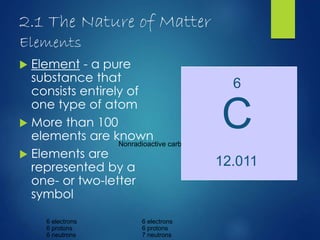
 Element - a pure
substance that
consists entirely of
one type of atom
 More than 100
elements are known
 Elements are
represented by a
one- or two-letter
symbol
Nonradioactive carbon-13 Radioactive carbon-14
6 electrons
6 protons
6 neutrons
6 electrons
6 protons
7 neutrons
6
C
12.011
2.1 The Nature of Matter
Elements
 Atomic Number –
the number of
protons in an atom
of an element
 Mass number – the
sum of protons and
neutrons in the
nucleus of an atom
Radioactive carbon-14
6
CCarbon
12.011
Atomic Number
Element Symbol
Atomic Mass
Element Name
2.1 The Nature of Matter
Isotopes
 Atoms of elements can have different numbers of
neutrons
 Isotopes – atoms of the same element that differ in the
number of neutrons they contain
 Identified by their mass number
 Because they have the same number of electrons, all
isotopes of an element have the same chemical
properties.
Nonradioactive carbon-12 Nonradioactive carbon-13 Radioactive carbon-14
6 electrons
6 protons
6 neutrons
6 electrons
6 protons
8 neutrons
6 electrons
6 protons
7 neutrons
2.1 The Nature of Matter
Radioactive Isotopes
 Some isotopes are radioactive – meaning
their nuclei are unstable and break down
at a constant rate over time
 Radiation can be dangerous, but also
have a number of important scientific
and practical uses
 Examples:
 Geologists determine the age of rocks and
fossils
 Can treat cancer
 Kill bacteria that cause food to spoil
 Can be used as “tracers” to follow the
movements of substances within organisms
2.1 The Nature of Matter
Chemical Compounds
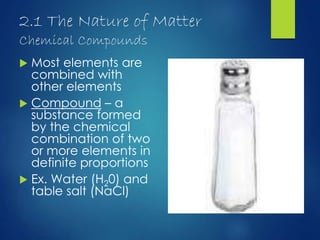
 Most elements are
combined with
other elements
 Compound – a
substance formed
by the chemical
combination of two
or more elements in
definite proportions
 Ex. Water (H20) and
table salt (NaCl)
2.1 The Nature of Matter
Chemical Compounds
 The physical and
chemical properties
of a compound are
usually very
different from those
of the elements
from which it is
formed
 Let’s examine water
and table salt…
2.1 The Nature of Matter
Chemical Bonds
 The atoms of compounds are held together by
chemical bonds
 Bond formation involves the electrons.
 The electrons that are available to form bonds are
called valence electrons.
 The main types of chemical bonds are ionic
bonds and covalent bonds.
2.1 The Nature of Matter
Ionic Bonding
 Ionic Bond – formed when one or more electrons
are transferred from one atom to another
 Atoms are electrically neutral
 Loses an electron – positive charge (cations)
 Gains an electron – negative charge (anions)
 Called ions
Sodium atom (Na) Chlorine atom (Cl) Sodium ion (Na+) Chloride ion (Cl-)
Transfer
of electron
Protons +11
Electrons -11
Charge 0
Protons +17
Electrons -17
Charge 0
Protons +11
Electrons -10
Charge +1
Protons +17
Electrons -18
Charge -1
2.1 The Nature of Matter
Covalent Bonding
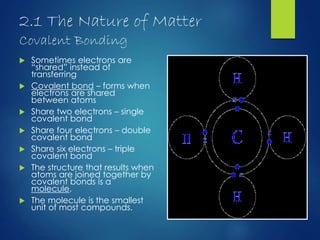
 Sometimes electrons are
“shared” instead of
transferring
 Covalent bond – forms when
electrons are shared
between atoms
 Share two electrons – single
covalent bond
 Share four electrons – double
covalent bond
 Share six electrons – triple
covalent bond
 The structure that results when
atoms are joined together by
covalent bonds is a
molecule,
 The molecule is the smallest
unit of most compounds.
2.1 The Nature of Matter
Van der Waals Forces
 Atoms do not all have
the same ability to
attract electrons
 Creates regions that
may have a tiny positive
or negative charge.
 Van der Waals forces –
when molecules are
close together, a slight
attraction can develop
between the oppositely
charged regions of
nearby molecules.
Section 2
WATER!
2.2 Properties of Water
The Water Molecule
 Earth is called “the
Blue Planet.” How
much water covers
the earth’s surface?
 Water is the single
most abundant
compound in most
living things
 Ice is less dense
than liquid water.
2.2 Properties of Water
The Water Molecule - Polarity
 A molecule in which the
charges are unevenly
distributed is called a
polar molecule
 A water molecule is polar
because there is an
uneven distribution of
electrons between the
oxygen and hydrogen
atoms.
 The negative pole is near
the oxygen atoms and
the positive pole is
between the hydrogen
atoms.
8 protons
1 proton
+
-_
2.2 Properties of Water
The Water Molecule – Hydrogen Bonds
 Because of their partial
positive and negative
charges, polar
molecules can attract
to each other.
 The attraction between
H atom of one water
molecule and the O of
another is an example
of hydrogen bonds.
 Hydrogen bonds are
NOT as strong as
covalent or ionic bonds.
2.2 Properties of Water
The Water Molecule – Hydrogen Bonds
 A single water
molecule can be
involved in as many as
four hydrogen bonds.
 Cohesion – an
attraction between
molecules of the same
substance.
 Adhesion – the
attraction between
molecules of different
substances.
 Ex. Capillary action.Is this cohesion or adhesion???
Cohesion and Surface
Tension.
2.2 Properties of Water
The Water Molecule – Review
1. What kind of bonds
join the atoms in a
water molecule?
2. Are the hydrogen
atoms bonded to
each other?
3. Why is the hydrogen
end of the molecule
positive and the
oxygen end
negative?
PG 40
2.2 Properties of Water
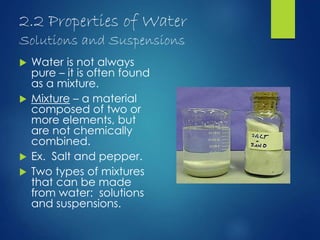
Solutions and Suspensions
 Water is not always
pure – it is often found
as a mixture.
 Mixture – a material
composed of two or
more elements, but
are not chemically
combined.
 Ex. Salt and pepper.
 Two types of mixtures
that can be made
from water: solutions
and suspensions.
2.2 Properties of Water
Solutions
 Look below, sodium and chloride ions are
attracted to the polar water molecules.
 The ions become dispersed in the water,
forming a mixture called a solution.
 Solutions – evenly distributed throughout the
solution.
Cl-
Water
Cl-
Na+
Water
Na+
2.2 Properties of Water
Solutions
 Solute – the substance that is dissolved.
 Solvent – the substance in which the solute
dissolves.
What is the solute and solvent in the saltwater solution?
Cl-
Water
Cl-
Na+
Water
Na+
2.2 Properties of Water
Suspensions
 Some materials do
not dissolve, but
when placed in
water separate into
pieces so small they
do not settle out.
 These mixtures are
known as
suspensions.
 Ex. Blood
2.2 Properties of Water
Acids, Bases, and pH
 Water can react to form ions.
H20 H+ + OH-
(water) hydrogen hydroxide
ion ion
 Water is neutral because the number of
positive hydrogen ions produced is equal to
the number of negative hydroxide ions
produced.
2.2 Properties of Water
The pH Scale
 The pH scale is used to
indicate the concentration of
H+ ions.
 Ranges from 0-14
 7 - neutral
 Below 7 – acidic (more H+)
 Ex. Hydrochloric acid in the
stomach
 Above 7 – basic (more OH-)
 Ex. lye
 Each scale represents a factor
of ten.
 Buffers – weak acids or bases
that can react with strong
acids or bases to prevent
sharp, sudden changes.
 Ex. Maintain homeostasis
Oven cleaner
Bleach
Ammonia solution
Soap
Sea water
Human blood
Pure water
Milk
Normal
rainfall
Acid rain
Tomato
juice
Lemon juice
Stomach acid
Neutral
IncreasinglyBasicIncreasinglyAcidic
Section 3
MACROMOLECULES!
2.3 Carbon Compounds
The Chemistry of Carbon
 Organic chemistry – the study of all compounds that contain bonds
between carbon atoms
 Why is carbon so important?
 Has four valence electrons (forms strong covalent bonds)
 Can bond with: hydrogen, phosphorus, sulfur, and nitrogen
 Can also bond with other carbon atoms (form chains of unlimited length)
 Single, double, or triple covalent bonds
 Can form large and complex structures.
Methane Acetylene Butadiene Benzene Isooctane
2.3 Carbon Compounds
Macromolecules
 Macromolecules –
“giant molecules”
 The smaller units, or
monomers, join
together to form
polymers.
(polymerization)
 Four groups of
organic compounds
found in living things
are carbohydrates,
lipids, nucleic acids,
and proteins.
2.3 Carbon Compounds
Macromolecules
Carbon
Compounds
include
that consist of
which contain
that consist of that consist of that consist of
which contain which contain which contain
Carbohydrates Lipids Nucleic acids Proteins
Sugars and
starches
Fats and oils Nucleotides Amino Acids
Carbon,
hydrogen,
oxygen
Carbon,
hydrogen,
oxygen
Carbon,hydrogen,
oxygen, nitrogen,
phosphorus
Carbon,
hydrogen,oxygen,
nitrogen,
2.3 Carbon Compounds
Carbohydrates
 Carbohydrates are
compounds made
up of carbon,
hydrogen, and
oxygen atoms,
usually in a ratio of
1:2:1.
 Living things use
carbohydrates as a
main source of
energy.
 Plants and some
animals use
carbohydrates for
structural reasons.
Starch
Glucose
What is the monomer? What is the polymer?
2.3 Carbon Compounds
Carbohydrates
 Simple sugars are called
monosaccharides.
 Ex. Glucose (simple sugar),
galactose (found in milk),
and fructose (found in
many fruits)
 The large
macromolecules formed
from monosaccharides
are known as
polysaccharides.
 Ex. Glycogen (animal
starch), plant starch (store
excess sugar), and
cellulose in plants (gives
plants strength and
rigidity)
2.3 Carbon Compounds
Lipids
 Lipids – are made
mostly from carbon
and hydrogen atoms.
(composed of glycerol
and fatty acids)
 Three classes: fats, oils,
and waxes Can be
used for energy,
biological membranes,
and waterproof
coverings.
 Steroids are also
included. Used as a
chemical messenger.
What’s the difference between saturated and unsaturated fats???
2.3 Carbon Compounds
Lipids
 Saturated – fatty
acids contain the
maximum possible
number of hydrogen
atoms.
 Unsaturated – if there
is at least one
carbon-carbon
double bond in a
fatty acid
 Polyunsaturated –
lipids whose fatty
acids contain more
than one double
bond.
Unsaturated
Saturated
2.3 Carbon Compounds
Nucleic Acids
 Nucleic acids – are
macromolecules containing
hydrogen, oxygen, nitrogen,
and phosphorus
 Nucleic acids are polymers
that are composed of
monomers called
nucleotides.
 Nucleotides consist of three
parts: a 5 carbon sugar, a
phosphate group, and
nitrogenous base.
 Nucleic acids store and
transmit heredity, or genetic,
information.
2.3 Carbon Compounds
Proteins
 Proteins – are macromolecules containing
hydrogen, oxygen, nitrogen, carbon, and
phosphorus.
 Proteins are polymers of molecules called amino
acids.
 Amino acids contain an amino group one end and
a carboxyl group on the other.
General structure Alanine Serine
Carboxyl group
Amino
group
2.3 Carbon Compounds
Proteins
 More than 20 amino acids
found in nature
 Amino acid can bond to
any amino acid at the
amino group
 Instructions for arranging
amino acids into a protein is
found in DNA.
 Uses for proteins: control
the rate of reaction
(enzymes), regulate cell
processes, some are used to
form muscle and bone,
others transport substances
in and out of cells
 Van der Waals forces and
hydrogen bonds help
maintain a proteins shape.
Amino
acids
1. Protein chains.
2. Protein can be twisted or folded.
3. Protein chain can fold itself.
2.4 Chemical Reactions and Enzymes
Chemical Reactions
 Chemical Reactions –
a process that
changes, or transforms,
one set of chemicals
into another.
 Reactants – the
elements or
compounds that enter
into a chemical
reaction.
 Products – the
elements or
compounds produced
by a chemical reaction
Chemical reactions always involve changes in chemical bonds that join atoms in compounds.
2.4 Chemical Reactions and Enzymes
Chemical Reactions
 Ex. Conversion of carbon dioxide to
carbonic acid in the human body.
CO2 + H20 H2CO3
H2CO3 CO2 + H20
Reactants
Products
2.4 Chemical Reactions and Enzymes
Energy in Reactions
 Energy is released or
absorbed whenever
chemical bonds form or
are broken
 Chemical reactions that
release energy often
occur spontaneously.
 Chemical reactions that
absorb energy will not
occur without a source
of energy.
 Ex. Hydrogen gas
burning with oxygen to
produce water vapor.
2H2 + 02 2H20
 How is energy
released??
Living organisms need a constant source of energy to survive!!!!
2.4 Chemical Reactions and Enzymes
Activation Energy
 Not all chemical reactions that release
energy occur spontaneously.
 Chemists call the energy needed to get a
reaction started the activation energy.
Energy-Absorbing Reaction Energy-Releasing Reaction
How would you compare the energy of the products and reactants in the two types of reactions?
Reactants
Products
Activation Energy
Reactants
Activation
Energy
Products
2.4 Chemical Reactions and Enzymes
Enzymes
 Some chemical
reactions that are
responsible for life are
too slow.
 These reactions are
helped by catalysts
 Catalyst – a
substance that
speeds up the rate of
a chemical reaction.
 Enzymes – proteins
that act as biological
catalysts. They speed
up chemical
Reaction pathway
without enzyme
Activation energy
without enzyme
Activation
energy
with enzyme
Reaction pathway
with enzyme
Reactants
Products
2.4 Chemical Reactions and Enzymes
Enzymes
 Enzymes end in –ase
(Example. Carbonic
anhydrase)
 Enzymes are very specific
 Enzymes provide a site
where reactants can be
brought together to
react.
 The reactants of enzyme-
catalyzed reactions are
known as substrates.
 The substrates bind to a
site on the enzyme called
the active site.
2.4 Chemical Reactions and Enzymes
Enzymes
Glucose
Substrates
ATP
Substrates
bind to
enzymeSubstrates
are converted
into products
Enzyme-substrate
complex
Enzyme
(hexokinase)
ADP
Products
Glucose-6-
phosphate Products
are released Active site
2.4 Chemical Reactions and Enzymes
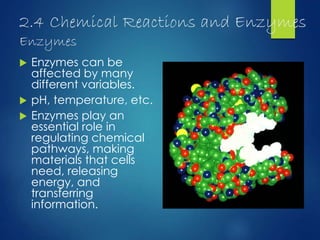
Enzymes
 Enzymes can be
affected by many
different variables.
 pH, temperature, etc.
 Enzymes play an
essential role in
regulating chemical
pathways, making
materials that cells
need, releasing
energy, and
transferring
information.

Chapter 2 chemistry power point

  • 1.
  • 2.
    2.1 The Natureof Matter Atoms  Protons (+)  Neutrons (0)  Protons and Neutrons have the same mass  Protons and neutrons form the nucleus, the center of the atom  Electrons (-)  In constant motion  1/1840 the mass of proton  Equal number of electrons and protons (atoms remain neutral)  Forms electron cloud.
  • 3.
    2.1 The Natureof Matter Elements  Element - a pure substance that consists entirely of one type of atom  More than 100 elements are known  Elements are represented by a one- or two-letter symbol Nonradioactive carbon-13 Radioactive carbon-14 6 electrons 6 protons 6 neutrons 6 electrons 6 protons 7 neutrons 6 C 12.011
  • 4.
    2.1 The Natureof Matter Elements  Atomic Number – the number of protons in an atom of an element  Mass number – the sum of protons and neutrons in the nucleus of an atom Radioactive carbon-14 6 CCarbon 12.011 Atomic Number Element Symbol Atomic Mass Element Name
  • 5.
    2.1 The Natureof Matter Isotopes  Atoms of elements can have different numbers of neutrons  Isotopes – atoms of the same element that differ in the number of neutrons they contain  Identified by their mass number  Because they have the same number of electrons, all isotopes of an element have the same chemical properties. Nonradioactive carbon-12 Nonradioactive carbon-13 Radioactive carbon-14 6 electrons 6 protons 6 neutrons 6 electrons 6 protons 8 neutrons 6 electrons 6 protons 7 neutrons
  • 6.
    2.1 The Natureof Matter Radioactive Isotopes  Some isotopes are radioactive – meaning their nuclei are unstable and break down at a constant rate over time  Radiation can be dangerous, but also have a number of important scientific and practical uses  Examples:  Geologists determine the age of rocks and fossils  Can treat cancer  Kill bacteria that cause food to spoil  Can be used as “tracers” to follow the movements of substances within organisms
  • 7.
    2.1 The Natureof Matter Chemical Compounds  Most elements are combined with other elements  Compound – a substance formed by the chemical combination of two or more elements in definite proportions  Ex. Water (H20) and table salt (NaCl)
  • 8.
    2.1 The Natureof Matter Chemical Compounds  The physical and chemical properties of a compound are usually very different from those of the elements from which it is formed  Let’s examine water and table salt…
  • 9.
    2.1 The Natureof Matter Chemical Bonds  The atoms of compounds are held together by chemical bonds  Bond formation involves the electrons.  The electrons that are available to form bonds are called valence electrons.  The main types of chemical bonds are ionic bonds and covalent bonds.
  • 10.
    2.1 The Natureof Matter Ionic Bonding  Ionic Bond – formed when one or more electrons are transferred from one atom to another  Atoms are electrically neutral  Loses an electron – positive charge (cations)  Gains an electron – negative charge (anions)  Called ions Sodium atom (Na) Chlorine atom (Cl) Sodium ion (Na+) Chloride ion (Cl-) Transfer of electron Protons +11 Electrons -11 Charge 0 Protons +17 Electrons -17 Charge 0 Protons +11 Electrons -10 Charge +1 Protons +17 Electrons -18 Charge -1
  • 11.
    2.1 The Natureof Matter Covalent Bonding  Sometimes electrons are “shared” instead of transferring  Covalent bond – forms when electrons are shared between atoms  Share two electrons – single covalent bond  Share four electrons – double covalent bond  Share six electrons – triple covalent bond  The structure that results when atoms are joined together by covalent bonds is a molecule,  The molecule is the smallest unit of most compounds.
  • 12.
    2.1 The Natureof Matter Van der Waals Forces  Atoms do not all have the same ability to attract electrons  Creates regions that may have a tiny positive or negative charge.  Van der Waals forces – when molecules are close together, a slight attraction can develop between the oppositely charged regions of nearby molecules.
  • 13.
  • 14.
    2.2 Properties ofWater The Water Molecule  Earth is called “the Blue Planet.” How much water covers the earth’s surface?  Water is the single most abundant compound in most living things  Ice is less dense than liquid water.
  • 15.
    2.2 Properties ofWater The Water Molecule - Polarity  A molecule in which the charges are unevenly distributed is called a polar molecule  A water molecule is polar because there is an uneven distribution of electrons between the oxygen and hydrogen atoms.  The negative pole is near the oxygen atoms and the positive pole is between the hydrogen atoms. 8 protons 1 proton + -_
  • 16.
    2.2 Properties ofWater The Water Molecule – Hydrogen Bonds  Because of their partial positive and negative charges, polar molecules can attract to each other.  The attraction between H atom of one water molecule and the O of another is an example of hydrogen bonds.  Hydrogen bonds are NOT as strong as covalent or ionic bonds.
  • 17.
    2.2 Properties ofWater The Water Molecule – Hydrogen Bonds  A single water molecule can be involved in as many as four hydrogen bonds.  Cohesion – an attraction between molecules of the same substance.  Adhesion – the attraction between molecules of different substances.  Ex. Capillary action.Is this cohesion or adhesion???
  • 18.
  • 19.
    2.2 Properties ofWater The Water Molecule – Review 1. What kind of bonds join the atoms in a water molecule? 2. Are the hydrogen atoms bonded to each other? 3. Why is the hydrogen end of the molecule positive and the oxygen end negative? PG 40
  • 20.
    2.2 Properties ofWater Solutions and Suspensions  Water is not always pure – it is often found as a mixture.  Mixture – a material composed of two or more elements, but are not chemically combined.  Ex. Salt and pepper.  Two types of mixtures that can be made from water: solutions and suspensions.
  • 21.
    2.2 Properties ofWater Solutions  Look below, sodium and chloride ions are attracted to the polar water molecules.  The ions become dispersed in the water, forming a mixture called a solution.  Solutions – evenly distributed throughout the solution. Cl- Water Cl- Na+ Water Na+
  • 22.
    2.2 Properties ofWater Solutions  Solute – the substance that is dissolved.  Solvent – the substance in which the solute dissolves. What is the solute and solvent in the saltwater solution? Cl- Water Cl- Na+ Water Na+
  • 23.
    2.2 Properties ofWater Suspensions  Some materials do not dissolve, but when placed in water separate into pieces so small they do not settle out.  These mixtures are known as suspensions.  Ex. Blood
  • 24.
    2.2 Properties ofWater Acids, Bases, and pH  Water can react to form ions. H20 H+ + OH- (water) hydrogen hydroxide ion ion  Water is neutral because the number of positive hydrogen ions produced is equal to the number of negative hydroxide ions produced.
  • 25.
    2.2 Properties ofWater The pH Scale  The pH scale is used to indicate the concentration of H+ ions.  Ranges from 0-14  7 - neutral  Below 7 – acidic (more H+)  Ex. Hydrochloric acid in the stomach  Above 7 – basic (more OH-)  Ex. lye  Each scale represents a factor of ten.  Buffers – weak acids or bases that can react with strong acids or bases to prevent sharp, sudden changes.  Ex. Maintain homeostasis Oven cleaner Bleach Ammonia solution Soap Sea water Human blood Pure water Milk Normal rainfall Acid rain Tomato juice Lemon juice Stomach acid Neutral IncreasinglyBasicIncreasinglyAcidic
  • 26.
  • 27.
    2.3 Carbon Compounds TheChemistry of Carbon  Organic chemistry – the study of all compounds that contain bonds between carbon atoms  Why is carbon so important?  Has four valence electrons (forms strong covalent bonds)  Can bond with: hydrogen, phosphorus, sulfur, and nitrogen  Can also bond with other carbon atoms (form chains of unlimited length)  Single, double, or triple covalent bonds  Can form large and complex structures. Methane Acetylene Butadiene Benzene Isooctane
  • 28.
    2.3 Carbon Compounds Macromolecules Macromolecules – “giant molecules”  The smaller units, or monomers, join together to form polymers. (polymerization)  Four groups of organic compounds found in living things are carbohydrates, lipids, nucleic acids, and proteins.
  • 29.
    2.3 Carbon Compounds Macromolecules Carbon Compounds include thatconsist of which contain that consist of that consist of that consist of which contain which contain which contain Carbohydrates Lipids Nucleic acids Proteins Sugars and starches Fats and oils Nucleotides Amino Acids Carbon, hydrogen, oxygen Carbon, hydrogen, oxygen Carbon,hydrogen, oxygen, nitrogen, phosphorus Carbon, hydrogen,oxygen, nitrogen,
  • 30.
    2.3 Carbon Compounds Carbohydrates Carbohydrates are compounds made up of carbon, hydrogen, and oxygen atoms, usually in a ratio of 1:2:1.  Living things use carbohydrates as a main source of energy.  Plants and some animals use carbohydrates for structural reasons. Starch Glucose What is the monomer? What is the polymer?
  • 31.
    2.3 Carbon Compounds Carbohydrates Simple sugars are called monosaccharides.  Ex. Glucose (simple sugar), galactose (found in milk), and fructose (found in many fruits)  The large macromolecules formed from monosaccharides are known as polysaccharides.  Ex. Glycogen (animal starch), plant starch (store excess sugar), and cellulose in plants (gives plants strength and rigidity)
  • 32.
    2.3 Carbon Compounds Lipids Lipids – are made mostly from carbon and hydrogen atoms. (composed of glycerol and fatty acids)  Three classes: fats, oils, and waxes Can be used for energy, biological membranes, and waterproof coverings.  Steroids are also included. Used as a chemical messenger. What’s the difference between saturated and unsaturated fats???
  • 33.
    2.3 Carbon Compounds Lipids Saturated – fatty acids contain the maximum possible number of hydrogen atoms.  Unsaturated – if there is at least one carbon-carbon double bond in a fatty acid  Polyunsaturated – lipids whose fatty acids contain more than one double bond. Unsaturated Saturated
  • 35.
    2.3 Carbon Compounds NucleicAcids  Nucleic acids – are macromolecules containing hydrogen, oxygen, nitrogen, and phosphorus  Nucleic acids are polymers that are composed of monomers called nucleotides.  Nucleotides consist of three parts: a 5 carbon sugar, a phosphate group, and nitrogenous base.  Nucleic acids store and transmit heredity, or genetic, information.
  • 37.
    2.3 Carbon Compounds Proteins Proteins – are macromolecules containing hydrogen, oxygen, nitrogen, carbon, and phosphorus.  Proteins are polymers of molecules called amino acids.  Amino acids contain an amino group one end and a carboxyl group on the other. General structure Alanine Serine Carboxyl group Amino group
  • 39.
    2.3 Carbon Compounds Proteins More than 20 amino acids found in nature  Amino acid can bond to any amino acid at the amino group  Instructions for arranging amino acids into a protein is found in DNA.  Uses for proteins: control the rate of reaction (enzymes), regulate cell processes, some are used to form muscle and bone, others transport substances in and out of cells  Van der Waals forces and hydrogen bonds help maintain a proteins shape. Amino acids 1. Protein chains. 2. Protein can be twisted or folded. 3. Protein chain can fold itself.
  • 40.
    2.4 Chemical Reactionsand Enzymes Chemical Reactions  Chemical Reactions – a process that changes, or transforms, one set of chemicals into another.  Reactants – the elements or compounds that enter into a chemical reaction.  Products – the elements or compounds produced by a chemical reaction Chemical reactions always involve changes in chemical bonds that join atoms in compounds.
  • 41.
    2.4 Chemical Reactionsand Enzymes Chemical Reactions  Ex. Conversion of carbon dioxide to carbonic acid in the human body. CO2 + H20 H2CO3 H2CO3 CO2 + H20 Reactants Products
  • 42.
    2.4 Chemical Reactionsand Enzymes Energy in Reactions  Energy is released or absorbed whenever chemical bonds form or are broken  Chemical reactions that release energy often occur spontaneously.  Chemical reactions that absorb energy will not occur without a source of energy.  Ex. Hydrogen gas burning with oxygen to produce water vapor. 2H2 + 02 2H20  How is energy released?? Living organisms need a constant source of energy to survive!!!!
  • 43.
    2.4 Chemical Reactionsand Enzymes Activation Energy  Not all chemical reactions that release energy occur spontaneously.  Chemists call the energy needed to get a reaction started the activation energy. Energy-Absorbing Reaction Energy-Releasing Reaction How would you compare the energy of the products and reactants in the two types of reactions? Reactants Products Activation Energy Reactants Activation Energy Products
  • 44.
    2.4 Chemical Reactionsand Enzymes Enzymes  Some chemical reactions that are responsible for life are too slow.  These reactions are helped by catalysts  Catalyst – a substance that speeds up the rate of a chemical reaction.  Enzymes – proteins that act as biological catalysts. They speed up chemical Reaction pathway without enzyme Activation energy without enzyme Activation energy with enzyme Reaction pathway with enzyme Reactants Products
  • 45.
    2.4 Chemical Reactionsand Enzymes Enzymes  Enzymes end in –ase (Example. Carbonic anhydrase)  Enzymes are very specific  Enzymes provide a site where reactants can be brought together to react.  The reactants of enzyme- catalyzed reactions are known as substrates.  The substrates bind to a site on the enzyme called the active site.
  • 46.
    2.4 Chemical Reactionsand Enzymes Enzymes Glucose Substrates ATP Substrates bind to enzymeSubstrates are converted into products Enzyme-substrate complex Enzyme (hexokinase) ADP Products Glucose-6- phosphate Products are released Active site
  • 47.
    2.4 Chemical Reactionsand Enzymes Enzymes  Enzymes can be affected by many different variables.  pH, temperature, etc.  Enzymes play an essential role in regulating chemical pathways, making materials that cells need, releasing energy, and transferring information.