1
1
Chapter 2
Basic Chemistry
Biology
2
Outline
2.1 Chemical Elements
2.2 Molecules and
Compounds
2.3 Chemistry of Water
2.4 Acids and Bases
3
2.1 Chemical Elements
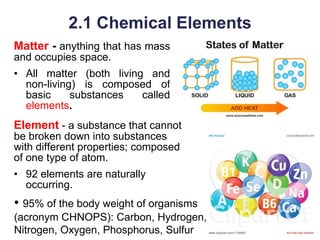
Matter - anything that has mass
and occupies space.
• All matter (both living and
non-living) is composed of
basic substances called
elements.
3
Element - a substance that cannot
be broken down into substances
with different properties; composed
of one type of atom.
• 92 elements are naturally
occurring.
• 95% of the body weight of organisms
(acronym CHNOPS): Carbon, Hydrogen,
Nitrogen, Oxygen, Phosphorus, Sulfur
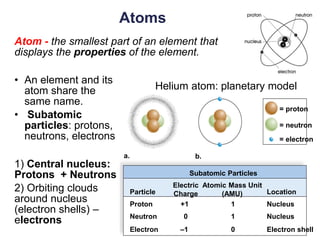
Subatomic Particles
= proton
= neutron
= electron
b.
a.
Particle
Proton
Neutron
Electron
Nucleus
Nucleus
Electron shell
+1
0
–1
1
1
0
Atomic Mass Unit
(AMU) Location
Electric
Charge
Atoms
Atom - the smallest part of an element that
displays the properties of the element.
Helium atom: planetary model
1) Central nucleus:
Protons + Neutrons
2) Orbiting clouds
around nucleus
(electron shells) –
electrons
• An element and its
atom share the
same name.
• Subatomic
particles: protons,
neutrons, electrons
5
Atomic Number and Mass Number
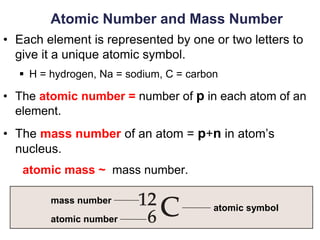
• Each element is represented by one or two letters to
give it a unique atomic symbol.
▪ H = hydrogen, Na = sodium, C = carbon
• The atomic number = number of p in each atom of an
element.
• The mass number of an atom = p+n in atom’s
nucleus.
atomic mass ~ mass number.
5
mass number
atomic number
atomic symbol
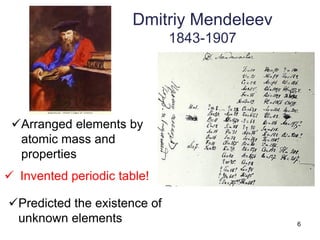
Dmitriy Mendeleev
1843-1907
6
✓Arranged elements by
atomic mass and
properties
✓ Invented periodic table!
✓Predicted the existence of
unknown elements
7
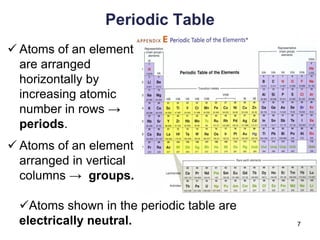
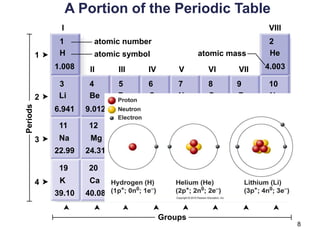
Periodic Table
7
✓ Atoms of an element
are arranged
horizontally by
increasing atomic
number in rows →
periods.
✓ Atoms of an element
arranged in vertical
columns → groups.
✓Atoms shown in the periodic table are
electrically neutral.
8
Groups
Periods
1
2
3
4
atomic number
atomic symbol atomic mass
VIII
20.18
19.00
16.00
14.01
12.01
10.81
9.012
6.941
22.99 24.31 39.95
35.45
32.07
30.97
28.09
26.98
83.60
79.90
78.96
74.92
72.59
69.72
40.08
39.10
Kr
Br
Se
As
Ge
Ga
Ca
K
36
19 20 31 32 33 34 35
11 12 13 14 15 16 17 18
Na Mg Al Si P S Cl Ar
Ne
F
O
N
C
B
Be
Li
10
9
8
7
6
5
4
3
4.003
He
2
VII
VI
V
IV
III
II
1.008
I
1
H
A Portion of the Periodic Table
b.
a.
larynx
thyroid gland
trachea
2.4a: © Southern Illinois University/Science Source; 2.4b(left): ©
Mazzlota et al./Science Source; 2.4b(right): © National Institutes of
Health
9
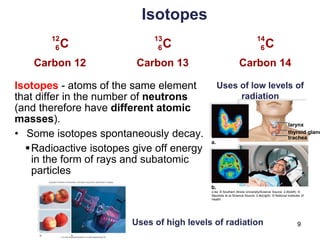
Isotopes
Isotopes - atoms of the same element
that differ in the number of neutrons
(and therefore have different atomic
masses).
• Some isotopes spontaneously decay.
▪Radioactive isotopes give off energy
in the form of rays and subatomic
particles
12
6
Carbon 12
C
13
6
Carbon 13
C
14
6
Carbon 14
C
9
Uses of low levels of
radiation
Uses of high levels of radiation
10
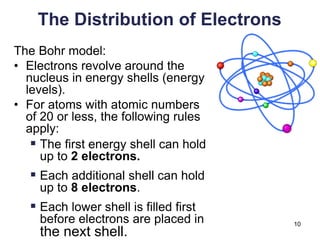
The Distribution of Electrons
The Bohr model:
• Electrons revolve around the
nucleus in energy shells (energy
levels).
• For atoms with atomic numbers
of 20 or less, the following rules
apply:
▪ The first energy shell can hold
up to 2 electrons.
▪ Each additional shell can hold
up to 8 electrons.
▪ Each lower shell is filled first
before electrons are placed in
the next shell.
11
Copyright © The McGraw-Hill Companies, Inc. Permission required for reproduction or display.
H
P S
C
O
N
electron valence shell
nitrogen
carbon
hydrogen
sulfur
phosphorus
32
16
15
31
8
16
14
7
6
12
1
1H N
C
S
P
O
oxygen
electron shell
nucleus
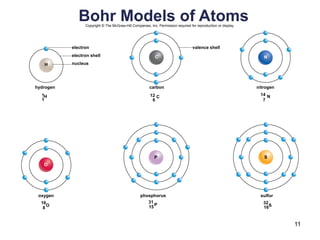
Bohr Models of Atoms
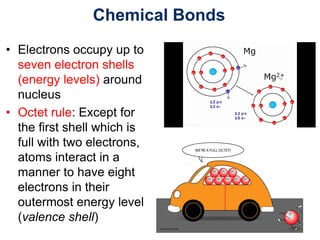
Chemical Bonds
• Electrons occupy up to
seven electron shells
(energy levels) around
nucleus
• Octet rule: Except for
the first shell which is
full with two electrons,
atoms interact in a
manner to have eight
electrons in their
outermost energy level
(valence shell)
13
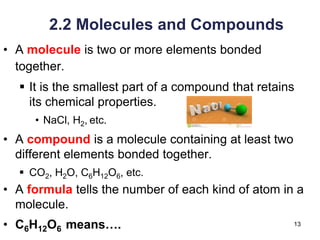
2.2 Molecules and Compounds
• A molecule is two or more elements bonded
together.
▪ It is the smallest part of a compound that retains
its chemical properties.
• NaCl, H2, etc.
• A compound is a molecule containing at least two
different elements bonded together.
▪ CO2, H2O, C6H12O6, etc.
• A formula tells the number of each kind of atom in a
molecule.
• C6H12O6 means….
14
Chemical Bonding
• Bonds that exist between atoms in
molecules contain energy.
• Bonds between atoms are caused by the
interactions between electrons in
outermost energy shells.
• The process of bond formation is called a
chemical reaction.
15
+ –
Na
sodium atom (Na) chlorine atom (Cl)
sodium ion (Na+)
sodium chloride (NaCl)
a. b.
chloride ion (Cl–)
Na Cl
Cl–
Na+
Cl
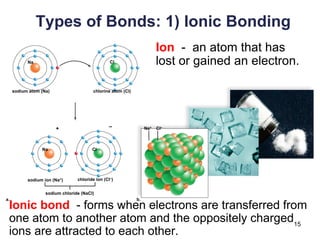
Ion - an atom that has
lost or gained an electron.
Types of Bonds: 1) Ionic Bonding
Ionic bond - forms when electrons are transferred from
one atom to another atom and the oppositely charged
ions are attracted to each other.
16
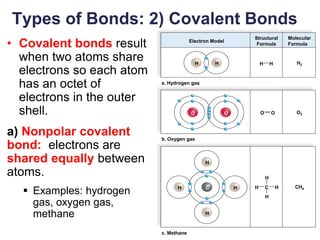
Types of Bonds: 2) Covalent Bonds
• Covalent bonds result
when two atoms share
electrons so each atom
has an octet of
electrons in the outer
shell.
a) Nonpolar covalent
bond: electrons are
shared equally between
atoms.
▪ Examples: hydrogen
gas, oxygen gas,
methane
c. Methane
H
a. Hydrogen gas
b. Oxygen gas
Structural
Formula
Electron Model
H C H
H H
H
H
O O
C
O O
H
H H
H H
CH4
O2
H2
Molecular
Formula
17
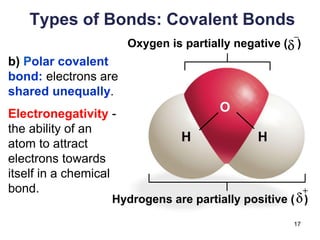
Types of Bonds: Covalent Bonds
b) Polar covalent
bond: electrons are
shared unequally.
Electronegativity -
the ability of an
atom to attract
electrons towards
itself in a chemical
bond.
O
H H
Oxygen is partially negative ( )
Hydrogens are partially positive ( )
18
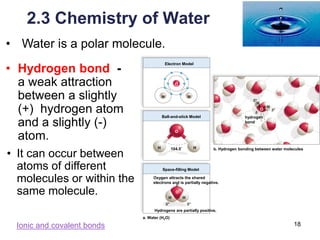
2.3 Chemistry of Water
• Hydrogen bond -
a weak attraction
between a slightly
(+) hydrogen atom
and a slightly (-)
atom.
Electron Model
H
H H
H
H
H
H H
O
O
O
O
Ball-and-stick Model
Space-filling Model
Oxygen attracts the shared
electrons and is partially negative.
b. Hydrogen bonding between water molecules
hydrogen
bond
Hydrogens are partially positive.
a. Water (H2O)
104.5˚
+
+
-
+
+
-
• Water is a polar molecule.
• It can occur between
atoms of different
molecules or within the
same molecule.
Ionic and covalent bonds
Calories
of
Heat
Energy
/
g
0
800
600
400
200
Solid
evaporation occurs
Liquid
540
calories
Gas
80
calories
a. Calories lost when 1 g of liquid water freezes and calories required when
1 g of liquid water evaporates.
b. Bodies of organisms cool when their heat is used to evaporate water.
freezing occurs
Temperature (°C)
120
100
80
0 20 40 60
19
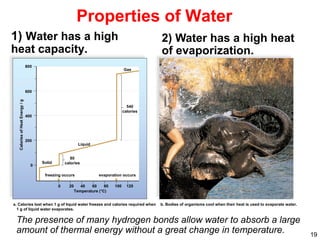
Properties of Water
1) Water has a high
heat capacity.
2) Water has a high heat
of evaporization.
The presence of many hydrogen bonds allow water to absorb a large
amount of thermal energy without a great change in temperature.
20
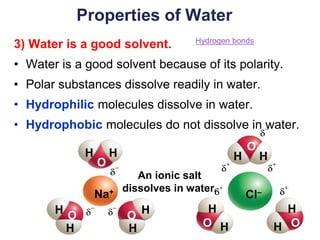
Properties of Water
3) Water is a good solvent.
• Water is a good solvent because of its polarity.
• Polar substances dissolve readily in water.
• Hydrophilic molecules dissolve in water.
• Hydrophobic molecules do not dissolve in water.
H
H
H H H
H H
H H H
H
An ionic salt
dissolves in water.
H H
Cl–
Na+
O
O
O O
O O
Hydrogen bonds
Water
evaporates,
pulling the water
column from the
roots to the
leaves.
Water molecules
cling together and
adhere to sides of
vessels in stems.
Water enters a
plant at root
cells.
H2O
H2O
21
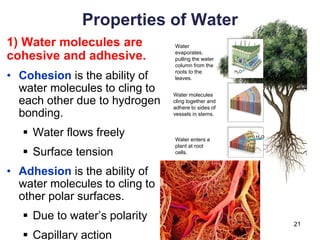
Properties of Water
1) Water molecules are
cohesive and adhesive.
• Cohesion is the ability of
water molecules to cling to
each other due to hydrogen
bonding.
▪ Water flows freely
▪ Surface tension
• Adhesion is the ability of
water molecules to cling to
other polar surfaces.
▪ Due to water’s polarity
▪ Capillary action
22
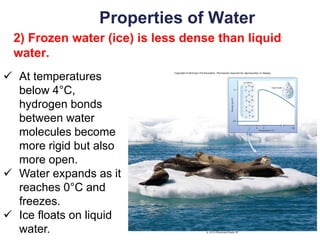
Properties of Water
2) Frozen water (ice) is less dense than liquid
water.
✓ At temperatures
below 4°C,
hydrogen bonds
between water
molecules become
more rigid but also
more open.
✓ Water expands as it
reaches 0°C and
freezes.
✓ Ice floats on liquid
water.
23
2.4 Acids and Bases
• When water ionizes or
dissociates, it releases an
equal number of
hydrogen (H+) ions and
hydroxide (OH-) ions.
✓Acids are substances that
dissociate in water, releasing
H+
✓Bases are substances that
either take up H+ or release
OH−.
pH is a measure of hydrogen ion
concentration in a solution.
24
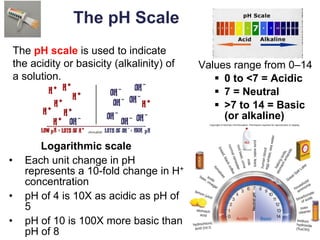
The pH Scale
Values range from 0–14
▪ 0 to <7 = Acidic
▪ 7 = Neutral
▪ >7 to 14 = Basic
(or alkaline)
The pH scale is used to indicate
the acidity or basicity (alkalinity) of
a solution.
Logarithmic scale
• Each unit change in pH
represents a 10-fold change in H+
concentration
• pH of 4 is 10X as acidic as pH of
5
• pH of 10 is 100X more basic than
pH of 8
25
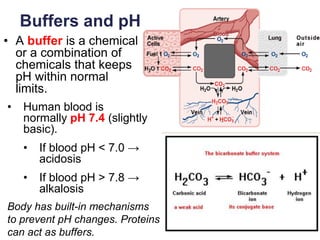
Buffers and pH
• A buffer is a chemical
or a combination of
chemicals that keeps
pH within normal
limits.
• Human blood is
normally pH 7.4 (slightly
basic).
• If blood pH < 7.0 →
acidosis
• If blood pH > 7.8 →
alkalosis
Body has built-in mechanisms
to prevent pH changes. Proteins
can act as buffers.

Lecture 3 Basic chemistry

  • 1.
  • 2.
    2 Outline 2.1 Chemical Elements 2.2Molecules and Compounds 2.3 Chemistry of Water 2.4 Acids and Bases
  • 3.
    3 2.1 Chemical Elements Matter- anything that has mass and occupies space. • All matter (both living and non-living) is composed of basic substances called elements. 3 Element - a substance that cannot be broken down into substances with different properties; composed of one type of atom. • 92 elements are naturally occurring. • 95% of the body weight of organisms (acronym CHNOPS): Carbon, Hydrogen, Nitrogen, Oxygen, Phosphorus, Sulfur
  • 4.
    Subatomic Particles = proton =neutron = electron b. a. Particle Proton Neutron Electron Nucleus Nucleus Electron shell +1 0 –1 1 1 0 Atomic Mass Unit (AMU) Location Electric Charge Atoms Atom - the smallest part of an element that displays the properties of the element. Helium atom: planetary model 1) Central nucleus: Protons + Neutrons 2) Orbiting clouds around nucleus (electron shells) – electrons • An element and its atom share the same name. • Subatomic particles: protons, neutrons, electrons
  • 5.
    5 Atomic Number andMass Number • Each element is represented by one or two letters to give it a unique atomic symbol. ▪ H = hydrogen, Na = sodium, C = carbon • The atomic number = number of p in each atom of an element. • The mass number of an atom = p+n in atom’s nucleus. atomic mass ~ mass number. 5 mass number atomic number atomic symbol
  • 6.
    Dmitriy Mendeleev 1843-1907 6 ✓Arranged elementsby atomic mass and properties ✓ Invented periodic table! ✓Predicted the existence of unknown elements
  • 7.
    7 Periodic Table 7 ✓ Atomsof an element are arranged horizontally by increasing atomic number in rows → periods. ✓ Atoms of an element arranged in vertical columns → groups. ✓Atoms shown in the periodic table are electrically neutral.
  • 8.
    8 Groups Periods 1 2 3 4 atomic number atomic symbolatomic mass VIII 20.18 19.00 16.00 14.01 12.01 10.81 9.012 6.941 22.99 24.31 39.95 35.45 32.07 30.97 28.09 26.98 83.60 79.90 78.96 74.92 72.59 69.72 40.08 39.10 Kr Br Se As Ge Ga Ca K 36 19 20 31 32 33 34 35 11 12 13 14 15 16 17 18 Na Mg Al Si P S Cl Ar Ne F O N C B Be Li 10 9 8 7 6 5 4 3 4.003 He 2 VII VI V IV III II 1.008 I 1 H A Portion of the Periodic Table
  • 9.
    b. a. larynx thyroid gland trachea 2.4a: ©Southern Illinois University/Science Source; 2.4b(left): © Mazzlota et al./Science Source; 2.4b(right): © National Institutes of Health 9 Isotopes Isotopes - atoms of the same element that differ in the number of neutrons (and therefore have different atomic masses). • Some isotopes spontaneously decay. ▪Radioactive isotopes give off energy in the form of rays and subatomic particles 12 6 Carbon 12 C 13 6 Carbon 13 C 14 6 Carbon 14 C 9 Uses of low levels of radiation Uses of high levels of radiation
  • 10.
    10 The Distribution ofElectrons The Bohr model: • Electrons revolve around the nucleus in energy shells (energy levels). • For atoms with atomic numbers of 20 or less, the following rules apply: ▪ The first energy shell can hold up to 2 electrons. ▪ Each additional shell can hold up to 8 electrons. ▪ Each lower shell is filled first before electrons are placed in the next shell.
  • 11.
    11 Copyright © TheMcGraw-Hill Companies, Inc. Permission required for reproduction or display. H P S C O N electron valence shell nitrogen carbon hydrogen sulfur phosphorus 32 16 15 31 8 16 14 7 6 12 1 1H N C S P O oxygen electron shell nucleus Bohr Models of Atoms
  • 12.
    Chemical Bonds • Electronsoccupy up to seven electron shells (energy levels) around nucleus • Octet rule: Except for the first shell which is full with two electrons, atoms interact in a manner to have eight electrons in their outermost energy level (valence shell)
  • 13.
    13 2.2 Molecules andCompounds • A molecule is two or more elements bonded together. ▪ It is the smallest part of a compound that retains its chemical properties. • NaCl, H2, etc. • A compound is a molecule containing at least two different elements bonded together. ▪ CO2, H2O, C6H12O6, etc. • A formula tells the number of each kind of atom in a molecule. • C6H12O6 means….
  • 14.
    14 Chemical Bonding • Bondsthat exist between atoms in molecules contain energy. • Bonds between atoms are caused by the interactions between electrons in outermost energy shells. • The process of bond formation is called a chemical reaction.
  • 15.
    15 + – Na sodium atom(Na) chlorine atom (Cl) sodium ion (Na+) sodium chloride (NaCl) a. b. chloride ion (Cl–) Na Cl Cl– Na+ Cl Ion - an atom that has lost or gained an electron. Types of Bonds: 1) Ionic Bonding Ionic bond - forms when electrons are transferred from one atom to another atom and the oppositely charged ions are attracted to each other.
  • 16.
    16 Types of Bonds:2) Covalent Bonds • Covalent bonds result when two atoms share electrons so each atom has an octet of electrons in the outer shell. a) Nonpolar covalent bond: electrons are shared equally between atoms. ▪ Examples: hydrogen gas, oxygen gas, methane c. Methane H a. Hydrogen gas b. Oxygen gas Structural Formula Electron Model H C H H H H H O O C O O H H H H H CH4 O2 H2 Molecular Formula
  • 17.
    17 Types of Bonds:Covalent Bonds b) Polar covalent bond: electrons are shared unequally. Electronegativity - the ability of an atom to attract electrons towards itself in a chemical bond. O H H Oxygen is partially negative ( ) Hydrogens are partially positive ( )
  • 18.
    18 2.3 Chemistry ofWater • Hydrogen bond - a weak attraction between a slightly (+) hydrogen atom and a slightly (-) atom. Electron Model H H H H H H H H O O O O Ball-and-stick Model Space-filling Model Oxygen attracts the shared electrons and is partially negative. b. Hydrogen bonding between water molecules hydrogen bond Hydrogens are partially positive. a. Water (H2O) 104.5˚ + + - + + - • Water is a polar molecule. • It can occur between atoms of different molecules or within the same molecule. Ionic and covalent bonds
  • 19.
    Calories of Heat Energy / g 0 800 600 400 200 Solid evaporation occurs Liquid 540 calories Gas 80 calories a. Calorieslost when 1 g of liquid water freezes and calories required when 1 g of liquid water evaporates. b. Bodies of organisms cool when their heat is used to evaporate water. freezing occurs Temperature (°C) 120 100 80 0 20 40 60 19 Properties of Water 1) Water has a high heat capacity. 2) Water has a high heat of evaporization. The presence of many hydrogen bonds allow water to absorb a large amount of thermal energy without a great change in temperature.
  • 20.
    20 Properties of Water 3)Water is a good solvent. • Water is a good solvent because of its polarity. • Polar substances dissolve readily in water. • Hydrophilic molecules dissolve in water. • Hydrophobic molecules do not dissolve in water. H H H H H H H H H H H An ionic salt dissolves in water. H H Cl– Na+ O O O O O O Hydrogen bonds
  • 21.
    Water evaporates, pulling the water columnfrom the roots to the leaves. Water molecules cling together and adhere to sides of vessels in stems. Water enters a plant at root cells. H2O H2O 21 Properties of Water 1) Water molecules are cohesive and adhesive. • Cohesion is the ability of water molecules to cling to each other due to hydrogen bonding. ▪ Water flows freely ▪ Surface tension • Adhesion is the ability of water molecules to cling to other polar surfaces. ▪ Due to water’s polarity ▪ Capillary action
  • 22.
    22 Properties of Water 2)Frozen water (ice) is less dense than liquid water. ✓ At temperatures below 4°C, hydrogen bonds between water molecules become more rigid but also more open. ✓ Water expands as it reaches 0°C and freezes. ✓ Ice floats on liquid water.
  • 23.
    23 2.4 Acids andBases • When water ionizes or dissociates, it releases an equal number of hydrogen (H+) ions and hydroxide (OH-) ions. ✓Acids are substances that dissociate in water, releasing H+ ✓Bases are substances that either take up H+ or release OH−. pH is a measure of hydrogen ion concentration in a solution.
  • 24.
    24 The pH Scale Valuesrange from 0–14 ▪ 0 to <7 = Acidic ▪ 7 = Neutral ▪ >7 to 14 = Basic (or alkaline) The pH scale is used to indicate the acidity or basicity (alkalinity) of a solution. Logarithmic scale • Each unit change in pH represents a 10-fold change in H+ concentration • pH of 4 is 10X as acidic as pH of 5 • pH of 10 is 100X more basic than pH of 8
  • 25.
    25 Buffers and pH •A buffer is a chemical or a combination of chemicals that keeps pH within normal limits. • Human blood is normally pH 7.4 (slightly basic). • If blood pH < 7.0 → acidosis • If blood pH > 7.8 → alkalosis Body has built-in mechanisms to prevent pH changes. Proteins can act as buffers.