REVIEW OF THE PREVIOUS LESSON
Direction: Unscramble the following words in each
sentence.
1. ( ntopor) refers to the positively charged particles of
an atom.
2. The particle of an atm that is neither positive nor
negative is (tnruneo).
3. The smallest particle of matter is called (oamt).
4. (tneelorc) is a particle of matter that carries a
negative charge.
5. (nsuulec) is found at the center of the atom that
carries protons and neutrons.
REVIEW OF THE PREVIOUS LESSON
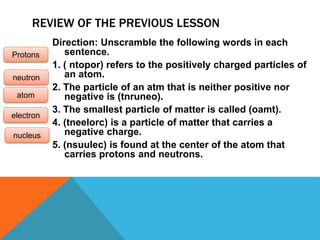
Direction: Unscramble the following words in each
sentence.
1. ( ntopor) refers to the positively charged particles of
an atom.
2. The particle of an atm that is neither positive nor
negative is (tnruneo).
3. The smallest particle of matter is called (oamt).
4. (tneelorc) is a particle of matter that carries a
negative charge.
5. (nsuulec) is found at the center of the atom that
carries protons and neutrons.
Protons
neutron
atom
electron
nucleus
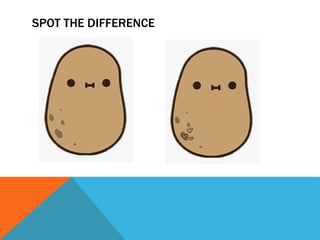
SPOT THE DIFFERENCE
WHAT IS ISOTOPES?
• Isotopes are each of two or more forms of the
same element that contain equal numbers of
protons but different numbers of neutrons in
their nuclei, and hence differ in relative atomic
mass but not in chemical properties; in
particular, a radioactive form of an element,
• Atoms of the same element that have different
masses are called isotopes.
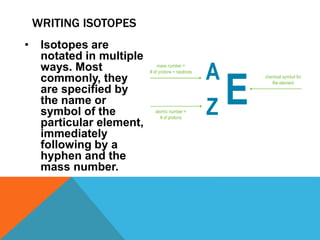
• Isotopes are
notated in multiple
ways. Most
commonly, they
are specified by
the name or
symbol of the
particular element,
immediately
following by a
hyphen and the
mass number.
WRITING ISOTOPES
• Isotopes can either
form spontaneously
(naturally) through
radioactive decay of
a nucleus. ) or
artificially by
bombarding a
stable nucleus with
charged particles
via accelerators or
neutrons in a
nuclear reactor.
HOW DOES ISOTOPES FORM?
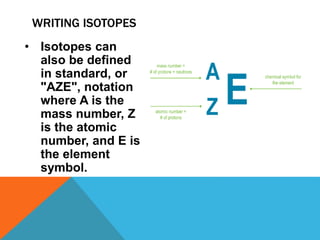
• Isotopes can
also be defined
in standard, or
"AZE", notation
where A is the
mass number, Z
is the atomic
number, and E is
the element
symbol.
WRITING ISOTOPES
• Isotopes are
used in a few
different areas.
14C is an
isotope of the
carbon atom
use in carbon
dating, which
helps scientist
date objects
like fossils.
USES OF ISOTOPES
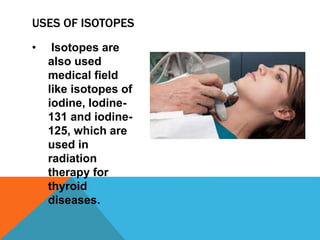
• Isotopes are
also used
medical field
like isotopes of
iodine, Iodine-
131 and iodine-
125, which are
used in
radiation
therapy for
thyroid
diseases.
USES OF ISOTOPES
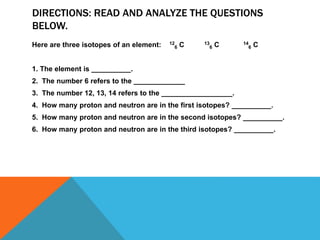
DIRECTIONS: READ AND ANALYZE THE QUESTIONS
BELOW.
Here are three isotopes of an element: 12
6 C 13
6 C 14
6 C
1. The element is __________.
2. The number 6 refers to the _____________
3. The number 12, 13, 14 refers to the __________________.
4. How many proton and neutron are in the first isotopes? __________.
5. How many proton and neutron are in the second isotopes? __________.
6. How many proton and neutron are in the third isotopes? __________.
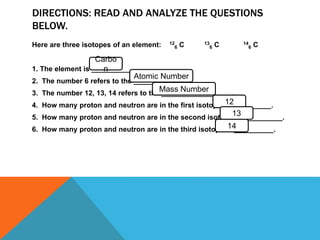
DIRECTIONS: READ AND ANALYZE THE QUESTIONS
BELOW.
Here are three isotopes of an element: 12
6 C 13
6 C 14
6 C
1. The element is __________.
2. The number 6 refers to the _____________
3. The number 12, 13, 14 refers to the __________________.
4. How many proton and neutron are in the first isotopes? __________.
5. How many proton and neutron are in the second isotopes? __________.
6. How many proton and neutron are in the third isotopes? __________.
12
Atomic Number
Mass Number
Carbo
n
13
14
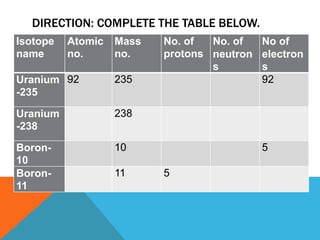
DIRECTION: COMPLETE THE TABLE BELOW.
Isotope
name
Atomic
no.
Mass
no.
No. of
protons
No. of
neutron
s
No of
electron
s
Uranium
-235
92 235 92
Uranium
-238
238
Boron-
10
10 5
Boron-
11
11 5
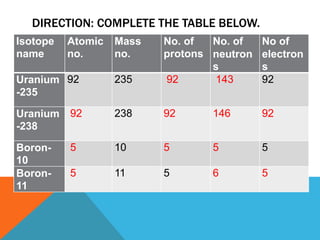
DIRECTION: COMPLETE THE TABLE BELOW.
Isotope
name
Atomic
no.
Mass
no.
No. of
protons
No. of
neutron
s
No of
electron
s
Uranium
-235
92 235 92 143 92
Uranium
-238
92 238 92 146 92
Boron-
10
5 10 5 5 5
Boron-
11
5 11 5 6 5
DIRECTION: CHOOSE THE LETTER OF THE BEST ANSWER. WRITE
THE CHOSEN LETTER ON A SEPARATE SHEET OF PAPER.
1. What do you call two or more forms of the same element that contain
equal numbers of protons but different numbers of neutrons in their
nuclei?
A Atoms b. element c. nuclei d. isotopes
2 . If carbon-14 is an isotope, how many protons does it have?
a. 7 b. 6 c. 8 d. 10
3. If carbon-14 is an isotope, how many neutrons does it have?
a. 7 b. 6 c. 8 d. 10
4. If carbon-14 is an isotope, how many electrons does it have?
a. 7 b. 6 c. 8 d. 10
5. What isotopic element is used to treat thyroid diseases?
a. Carbon b. iodine c. hydrogen d. uranium
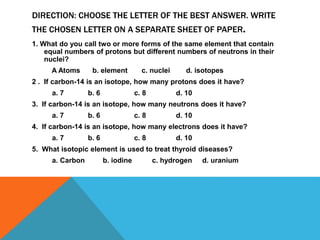
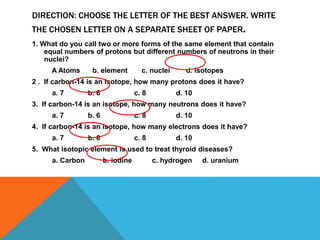
DIRECTION: CHOOSE THE LETTER OF THE BEST ANSWER. WRITE
THE CHOSEN LETTER ON A SEPARATE SHEET OF PAPER.
1. What do you call two or more forms of the same element that contain
equal numbers of protons but different numbers of neutrons in their
nuclei?
A Atoms b. element c. nuclei d. isotopes
2 . If carbon-14 is an isotope, how many protons does it have?
a. 7 b. 6 c. 8 d. 10
3. If carbon-14 is an isotope, how many neutrons does it have?
a. 7 b. 6 c. 8 d. 10
4. If carbon-14 is an isotope, how many electrons does it have?
a. 7 b. 6 c. 8 d. 10
5. What isotopic element is used to treat thyroid diseases?
a. Carbon b. iodine c. hydrogen d. uranium

isotopes

  • 3.
    REVIEW OF THEPREVIOUS LESSON Direction: Unscramble the following words in each sentence. 1. ( ntopor) refers to the positively charged particles of an atom. 2. The particle of an atm that is neither positive nor negative is (tnruneo). 3. The smallest particle of matter is called (oamt). 4. (tneelorc) is a particle of matter that carries a negative charge. 5. (nsuulec) is found at the center of the atom that carries protons and neutrons.
  • 5.
    REVIEW OF THEPREVIOUS LESSON Direction: Unscramble the following words in each sentence. 1. ( ntopor) refers to the positively charged particles of an atom. 2. The particle of an atm that is neither positive nor negative is (tnruneo). 3. The smallest particle of matter is called (oamt). 4. (tneelorc) is a particle of matter that carries a negative charge. 5. (nsuulec) is found at the center of the atom that carries protons and neutrons. Protons neutron atom electron nucleus
  • 6.
  • 8.
    WHAT IS ISOTOPES? •Isotopes are each of two or more forms of the same element that contain equal numbers of protons but different numbers of neutrons in their nuclei, and hence differ in relative atomic mass but not in chemical properties; in particular, a radioactive form of an element, • Atoms of the same element that have different masses are called isotopes.
  • 9.
    • Isotopes are notatedin multiple ways. Most commonly, they are specified by the name or symbol of the particular element, immediately following by a hyphen and the mass number. WRITING ISOTOPES
  • 10.
    • Isotopes caneither form spontaneously (naturally) through radioactive decay of a nucleus. ) or artificially by bombarding a stable nucleus with charged particles via accelerators or neutrons in a nuclear reactor. HOW DOES ISOTOPES FORM?
  • 11.
    • Isotopes can alsobe defined in standard, or "AZE", notation where A is the mass number, Z is the atomic number, and E is the element symbol. WRITING ISOTOPES
  • 12.
    • Isotopes are usedin a few different areas. 14C is an isotope of the carbon atom use in carbon dating, which helps scientist date objects like fossils. USES OF ISOTOPES
  • 13.
    • Isotopes are alsoused medical field like isotopes of iodine, Iodine- 131 and iodine- 125, which are used in radiation therapy for thyroid diseases. USES OF ISOTOPES
  • 15.
    DIRECTIONS: READ ANDANALYZE THE QUESTIONS BELOW. Here are three isotopes of an element: 12 6 C 13 6 C 14 6 C 1. The element is __________. 2. The number 6 refers to the _____________ 3. The number 12, 13, 14 refers to the __________________. 4. How many proton and neutron are in the first isotopes? __________. 5. How many proton and neutron are in the second isotopes? __________. 6. How many proton and neutron are in the third isotopes? __________.
  • 18.
    DIRECTIONS: READ ANDANALYZE THE QUESTIONS BELOW. Here are three isotopes of an element: 12 6 C 13 6 C 14 6 C 1. The element is __________. 2. The number 6 refers to the _____________ 3. The number 12, 13, 14 refers to the __________________. 4. How many proton and neutron are in the first isotopes? __________. 5. How many proton and neutron are in the second isotopes? __________. 6. How many proton and neutron are in the third isotopes? __________. 12 Atomic Number Mass Number Carbo n 13 14
  • 20.
    DIRECTION: COMPLETE THETABLE BELOW. Isotope name Atomic no. Mass no. No. of protons No. of neutron s No of electron s Uranium -235 92 235 92 Uranium -238 238 Boron- 10 10 5 Boron- 11 11 5
  • 23.
    DIRECTION: COMPLETE THETABLE BELOW. Isotope name Atomic no. Mass no. No. of protons No. of neutron s No of electron s Uranium -235 92 235 92 143 92 Uranium -238 92 238 92 146 92 Boron- 10 5 10 5 5 5 Boron- 11 5 11 5 6 5
  • 25.
    DIRECTION: CHOOSE THELETTER OF THE BEST ANSWER. WRITE THE CHOSEN LETTER ON A SEPARATE SHEET OF PAPER. 1. What do you call two or more forms of the same element that contain equal numbers of protons but different numbers of neutrons in their nuclei? A Atoms b. element c. nuclei d. isotopes 2 . If carbon-14 is an isotope, how many protons does it have? a. 7 b. 6 c. 8 d. 10 3. If carbon-14 is an isotope, how many neutrons does it have? a. 7 b. 6 c. 8 d. 10 4. If carbon-14 is an isotope, how many electrons does it have? a. 7 b. 6 c. 8 d. 10 5. What isotopic element is used to treat thyroid diseases? a. Carbon b. iodine c. hydrogen d. uranium
  • 27.
    DIRECTION: CHOOSE THELETTER OF THE BEST ANSWER. WRITE THE CHOSEN LETTER ON A SEPARATE SHEET OF PAPER. 1. What do you call two or more forms of the same element that contain equal numbers of protons but different numbers of neutrons in their nuclei? A Atoms b. element c. nuclei d. isotopes 2 . If carbon-14 is an isotope, how many protons does it have? a. 7 b. 6 c. 8 d. 10 3. If carbon-14 is an isotope, how many neutrons does it have? a. 7 b. 6 c. 8 d. 10 4. If carbon-14 is an isotope, how many electrons does it have? a. 7 b. 6 c. 8 d. 10 5. What isotopic element is used to treat thyroid diseases? a. Carbon b. iodine c. hydrogen d. uranium