PRESENTED
BY
K.VIVEK KUMAR
(EEE)
SENSORS
SENSORS
Intro
Why we learn about Sensors?
What are the selection criteria for Sensors?
Types of Sensors
Applications
Drawbacks of Sensors
Why we switch to Smart Sensors?
Conclusion
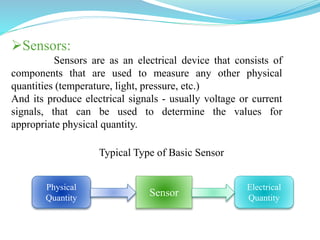
Physical
Quantity
Sensor
Electrical
Quantity
Typical Type of Basic Sensor
Sensors:
Sensors are as an electrical device that consists of
components that are used to measure any other physical
quantities (temperature, light, pressure, etc.)
And its produce electrical signals - usually voltage or current
signals, that can be used to determine the values for
appropriate physical quantity.
Why we learn about Sensors?
 Electrical engineers need to know about sensors because they produce
electrical signals.
 These electric signals are needed to be converted to a digital format.
 Electrical Engineers should need to know about how to design a sensor for
their fields.
 Mechanical, civil, chemical and bio engineers should be used as sensors to
when they make as different measurements (temperature and other
quantities).
 They need to know about them in order to select appropriate sensors to
make measurements of many different physical quantities.
 Engineers should designs a compact size of sensor and it can be used in
various fields of applications.
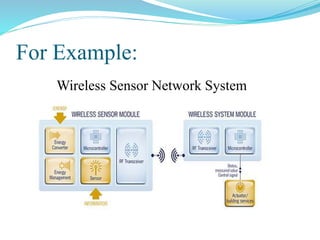
For Example:
Wireless Sensor Network System
What are the selection criteria for
Sensors?
There are certain features which have to be considered when we choose a sensor.
They are as given below:
 Accuracy – should be High
Stability - maintain under abnormal condition
Environmental condition - usually has limits for temperature & humidity
Range - Measurement limit of sensor
Calibration - Essential for most of the measuring devices as the readings changes
with time
Resolution - Smallest increment detected by the sensor
Cost - Should be Low
Power Consumptions - Low
Repeatability - The reading that varies is repeatedly measured under the same
environment
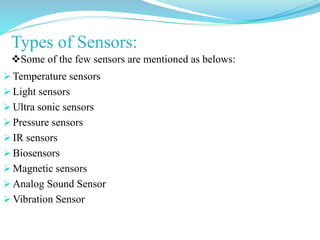
 Temperature sensors
 Light sensors
 Ultra sonic sensors
 Pressure sensors
 IR sensors
 Biosensors
 Magnetic sensors
 Analog Sound Sensor
 Vibration Sensor
Some of the few sensors are mentioned as belows:
Types of Sensors:
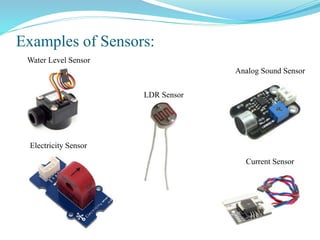
Water Level Sensor
LDR Sensor
Analog Sound Sensor
Electricity Sensor
Current Sensor
Examples of Sensors:
Temperature sensors:
 Temperature is the most common of all physical measurements. We
have temperature measurement-and-control units, called thermostats.
 In our home heating systems, refrigerators, air conditioners, and
ovens.
 Temperature sensors are used on circuit boards, as part of thermal
tests, in industrial controls, and in room controls such as in
calibration labs and data centers.
 Though there are many types of temperature sensors, most are
passive devices:
 Thermocouples
 RTDs (Resistance Temperature Detectors), and
 Thermistors(Thermal Resistors)
Proximity Sensor:
This is a type of sensor which can detect the presence of a
nearby object within a given distance, without any
physical contact.
The working principle of a Proximity sensor is simple. A
transmitter transmits an electromagnetic radiation or
creates an electrostatic field and a receiver receives and
analyzes the return signal for interruptions.
There are different types of Proximity sensors and the
researchers will discuss only a few of them which are
generally used in robots.
Sensor operation:
small prism-shaped sample of single-crystal undoped GaAs attached to ends of
two optical fibers
light energy absorbed by the GaAs crystal depends on temperature
percentage of received vs. transmitted energy is a function of temperature
It can be made small enough for biological implantation
FIBER OPTIC TEMPERATURE SENSOR
Fiber-optic Temperature Sensor
Applications:
 Sensors are used in many industrial and home appliances:
 Wireless Sensor Network
 Water Level Indicator
 Laser Security Alarm
 Firing Alarm Sensor
 Automatic Braking and Speed Control Mechanism
 Smart Phone Touch Screen
 Railway Gate Control Mechanism
 Fully Automation Control System
Drawbacks of Sensors:
Some of the drawbacks occurs in sensors while its in
working condition:
Life time becomes less due to over usages
Easily affected by external source such as noise, magnetic
interference, etc.
Due to noise and any other interference, low Stability &
Sensitivity may leads to system failure.
Some sensor may face complexity while contact with
some physical quantities
More Expensive in RTD sensor than Thermocouples
Why we switch to Smart Sensors?
Smart sensor means a sensor with built-in signal processing &
communication
e.g., combining a “dumb sensor” and a microprocessor
A Smart Sensor can be defined as a sensor with signal conditioning
circuitary with an integrated circuit which is considered as a single device.
Mainly Smart Sensors have some advantages than using ordinary sensors.
Features of Smart Sensor:
Linearize its own output
Includes self calibration facility
Compensates the environmental changes
Typical Smart Sensor:
A Typical Smart Sensor is given as:
SENSOR ADC MICROPROCESSOR
MEMORY
COMPUTER
IZED
CONTROL
ROOM
INPUT
PHYSICAL
QUANTITY
ELECTRICAL
QUANTITY
Sensors are one of the most useful technology for all and
also it is very efficient technology in nowadays. So
Engineers should always keep in mind, while designing or
creating a new type of sensors or any things, that should
be satisfying the followings:
Materials should be avail as Cheap
Simple
Low Cost
Low Power Consumptions
High Reliable
Compact
QUESTIONS……??????
THANKS TO ALL….!!!

Basic Sensors Technology

  • 1.
  • 2.
    SENSORS Intro Why we learnabout Sensors? What are the selection criteria for Sensors? Types of Sensors Applications Drawbacks of Sensors Why we switch to Smart Sensors? Conclusion
  • 3.
    Physical Quantity Sensor Electrical Quantity Typical Type ofBasic Sensor Sensors: Sensors are as an electrical device that consists of components that are used to measure any other physical quantities (temperature, light, pressure, etc.) And its produce electrical signals - usually voltage or current signals, that can be used to determine the values for appropriate physical quantity.
  • 4.
    Why we learnabout Sensors?  Electrical engineers need to know about sensors because they produce electrical signals.  These electric signals are needed to be converted to a digital format.  Electrical Engineers should need to know about how to design a sensor for their fields.  Mechanical, civil, chemical and bio engineers should be used as sensors to when they make as different measurements (temperature and other quantities).  They need to know about them in order to select appropriate sensors to make measurements of many different physical quantities.  Engineers should designs a compact size of sensor and it can be used in various fields of applications.
  • 5.
  • 6.
    What are theselection criteria for Sensors? There are certain features which have to be considered when we choose a sensor. They are as given below:  Accuracy – should be High Stability - maintain under abnormal condition Environmental condition - usually has limits for temperature & humidity Range - Measurement limit of sensor Calibration - Essential for most of the measuring devices as the readings changes with time Resolution - Smallest increment detected by the sensor Cost - Should be Low Power Consumptions - Low Repeatability - The reading that varies is repeatedly measured under the same environment
  • 7.
     Temperature sensors Light sensors  Ultra sonic sensors  Pressure sensors  IR sensors  Biosensors  Magnetic sensors  Analog Sound Sensor  Vibration Sensor Some of the few sensors are mentioned as belows: Types of Sensors:
  • 8.
    Water Level Sensor LDRSensor Analog Sound Sensor Electricity Sensor Current Sensor Examples of Sensors:
  • 9.
    Temperature sensors:  Temperatureis the most common of all physical measurements. We have temperature measurement-and-control units, called thermostats.  In our home heating systems, refrigerators, air conditioners, and ovens.  Temperature sensors are used on circuit boards, as part of thermal tests, in industrial controls, and in room controls such as in calibration labs and data centers.  Though there are many types of temperature sensors, most are passive devices:  Thermocouples  RTDs (Resistance Temperature Detectors), and  Thermistors(Thermal Resistors)
  • 10.
    Proximity Sensor: This isa type of sensor which can detect the presence of a nearby object within a given distance, without any physical contact. The working principle of a Proximity sensor is simple. A transmitter transmits an electromagnetic radiation or creates an electrostatic field and a receiver receives and analyzes the return signal for interruptions. There are different types of Proximity sensors and the researchers will discuss only a few of them which are generally used in robots.
  • 11.
    Sensor operation: small prism-shapedsample of single-crystal undoped GaAs attached to ends of two optical fibers light energy absorbed by the GaAs crystal depends on temperature percentage of received vs. transmitted energy is a function of temperature It can be made small enough for biological implantation FIBER OPTIC TEMPERATURE SENSOR Fiber-optic Temperature Sensor
  • 12.
    Applications:  Sensors areused in many industrial and home appliances:  Wireless Sensor Network  Water Level Indicator  Laser Security Alarm  Firing Alarm Sensor  Automatic Braking and Speed Control Mechanism  Smart Phone Touch Screen  Railway Gate Control Mechanism  Fully Automation Control System
  • 13.
    Drawbacks of Sensors: Someof the drawbacks occurs in sensors while its in working condition: Life time becomes less due to over usages Easily affected by external source such as noise, magnetic interference, etc. Due to noise and any other interference, low Stability & Sensitivity may leads to system failure. Some sensor may face complexity while contact with some physical quantities More Expensive in RTD sensor than Thermocouples
  • 14.
    Why we switchto Smart Sensors? Smart sensor means a sensor with built-in signal processing & communication e.g., combining a “dumb sensor” and a microprocessor A Smart Sensor can be defined as a sensor with signal conditioning circuitary with an integrated circuit which is considered as a single device. Mainly Smart Sensors have some advantages than using ordinary sensors. Features of Smart Sensor: Linearize its own output Includes self calibration facility Compensates the environmental changes
  • 15.
    Typical Smart Sensor: ATypical Smart Sensor is given as: SENSOR ADC MICROPROCESSOR MEMORY COMPUTER IZED CONTROL ROOM INPUT PHYSICAL QUANTITY ELECTRICAL QUANTITY
  • 16.
    Sensors are oneof the most useful technology for all and also it is very efficient technology in nowadays. So Engineers should always keep in mind, while designing or creating a new type of sensors or any things, that should be satisfying the followings: Materials should be avail as Cheap Simple Low Cost Low Power Consumptions High Reliable Compact
  • 17.
  • 18.