Demonstrator: Engr. Maria Panhwar
INTRODUCTION TO
SENSORS
CONTENTS
 What is sensor?
 Working of sensors
 Transducers, actuator and sensor
 Types of sensors
 Active and passive sensors
 Analog and digital sensors
 Fabrication of sensors
 Temperature sensors
 Proximity sensors
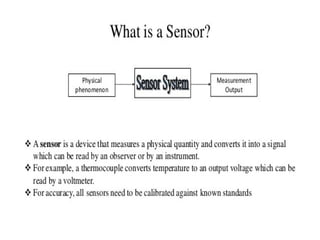
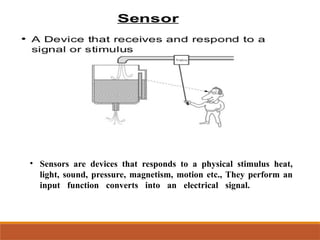
• Sensors are devices that responds to a physical stimulus heat,
light, sound, pressure, magnetism, motion etc., They perform an
input function converts into an electrical signal.
Active and Passive sensors.
• Active Sensors are those which require an external
excitation signal or a power signal.
• Passive Sensors, do not require any external power
signal and directly generates output response.
• These are based on conversion phenomenon i.e. the
input and the output.
• Some of the common conversion phenomena are
Photoelectric, Thermoelectric, Electrochemical,
Electromagnetic, Thermo optic, etc.
The final classification of the sensors are Analog and Digital
Sensors.
 Analog Sensors produce an analog output i.e. a
continuous output signal with respect to the quantity
being measured.
 Digital Sensors, in contrast to Analog Sensors, work with
discrete or digital data. The data in digital sensors, which
is used for conversion and transmission, is digital in
nature.
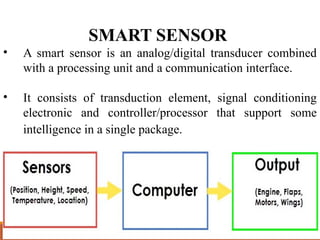
SMART SENSOR
• A smart sensor is an analog/digital transducer combined
with a processing unit and a communication interface.
• It consists of transduction element, signal conditioning
electronic and controller/processor that support some
intelligence in a single package.
• This integrated sensors which has electronics and the
transduction element together on one silicon chip, this
system can be called as system-on-chip (SoC).
• The main aim of integrating the electronics and the sensor
is to make an intelligent sensor, which can be called as
smart sensor.
• Sensor is made with the same technology as integrated
circuit.
• A smart sensor utilizes the transduction properties of one
class of materials and electronic properties of silicon.
Smart sensor signals can be amplified and properly
processed, are multiplexed and are buffered ready to
be received by microprocessor on these signals and
offer a standard data stream to the user thus making
the entire sensing module behave like a system
periphery rather than a passive component.
TYPES OF SENSORS
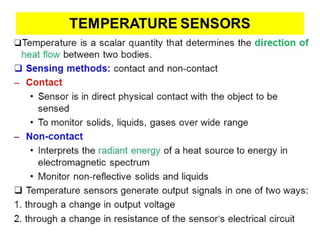
Temperature Sensor.
Proximity Sensor.
IR Sensor (Infrared Sensor)
Pressure Sensor.
Light Sensor.
Ultrasonic Sensor.
TYPES OF SENSORS
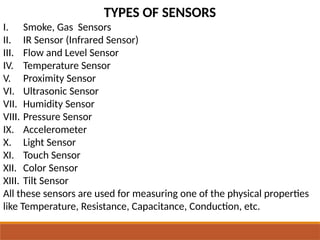
I. Smoke, Gas Sensors
II. IR Sensor (Infrared Sensor)
III. Flow and Level Sensor
IV. Temperature Sensor
V. Proximity Sensor
VI. Ultrasonic Sensor
VII. Humidity Sensor
VIII. Pressure Sensor
IX. Accelerometer
X. Light Sensor
XI. Touch Sensor
XII. Color Sensor
XIII. Tilt Sensor
All these sensors are used for measuring one of the physical properties
like Temperature, Resistance, Capacitance, Conduction, etc.
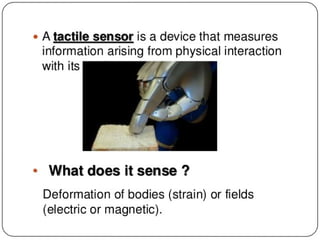
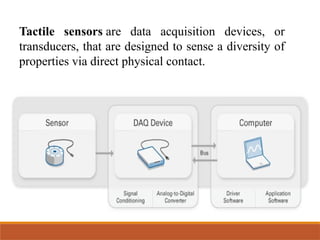
Tactile sensors are data acquisition devices, or
transducers, that are designed to sense a diversity of
properties via direct physical contact.
• A proximity sensor is an electronic sensor that can
detect the presence of objects within its vicinity
without any actual physical contact.
• In order to sense objects, the proximity sensor
radiates or emits a beam of electromagnetic
radiation, usually in the form of infrared light, and
senses the reflection in order to determine the
object's proximity or distance from the sensor.
• Proximity sensors can have a high reliability and
long functional life because of the absence of
mechanical parts and lack of physical contact
between the sensor and the sensed object
THANK YOU

L,# 04,Mechatronics DAQ SYSTEMA DN EXAMPLE.pptx

  • 1.
    Demonstrator: Engr. MariaPanhwar INTRODUCTION TO SENSORS
  • 2.
    CONTENTS  What issensor?  Working of sensors  Transducers, actuator and sensor  Types of sensors  Active and passive sensors  Analog and digital sensors  Fabrication of sensors  Temperature sensors  Proximity sensors
  • 4.
    • Sensors aredevices that responds to a physical stimulus heat, light, sound, pressure, magnetism, motion etc., They perform an input function converts into an electrical signal.
  • 6.
    Active and Passivesensors. • Active Sensors are those which require an external excitation signal or a power signal. • Passive Sensors, do not require any external power signal and directly generates output response. • These are based on conversion phenomenon i.e. the input and the output. • Some of the common conversion phenomena are Photoelectric, Thermoelectric, Electrochemical, Electromagnetic, Thermo optic, etc.
  • 7.
    The final classificationof the sensors are Analog and Digital Sensors.  Analog Sensors produce an analog output i.e. a continuous output signal with respect to the quantity being measured.  Digital Sensors, in contrast to Analog Sensors, work with discrete or digital data. The data in digital sensors, which is used for conversion and transmission, is digital in nature.
  • 8.
    SMART SENSOR • Asmart sensor is an analog/digital transducer combined with a processing unit and a communication interface. • It consists of transduction element, signal conditioning electronic and controller/processor that support some intelligence in a single package.
  • 9.
    • This integratedsensors which has electronics and the transduction element together on one silicon chip, this system can be called as system-on-chip (SoC). • The main aim of integrating the electronics and the sensor is to make an intelligent sensor, which can be called as smart sensor. • Sensor is made with the same technology as integrated circuit. • A smart sensor utilizes the transduction properties of one class of materials and electronic properties of silicon.
  • 10.
    Smart sensor signalscan be amplified and properly processed, are multiplexed and are buffered ready to be received by microprocessor on these signals and offer a standard data stream to the user thus making the entire sensing module behave like a system periphery rather than a passive component. TYPES OF SENSORS Temperature Sensor. Proximity Sensor. IR Sensor (Infrared Sensor) Pressure Sensor. Light Sensor. Ultrasonic Sensor.
  • 11.
    TYPES OF SENSORS I.Smoke, Gas Sensors II. IR Sensor (Infrared Sensor) III. Flow and Level Sensor IV. Temperature Sensor V. Proximity Sensor VI. Ultrasonic Sensor VII. Humidity Sensor VIII. Pressure Sensor IX. Accelerometer X. Light Sensor XI. Touch Sensor XII. Color Sensor XIII. Tilt Sensor All these sensors are used for measuring one of the physical properties like Temperature, Resistance, Capacitance, Conduction, etc.
  • 14.
    Tactile sensors aredata acquisition devices, or transducers, that are designed to sense a diversity of properties via direct physical contact.
  • 15.
    • A proximitysensor is an electronic sensor that can detect the presence of objects within its vicinity without any actual physical contact. • In order to sense objects, the proximity sensor radiates or emits a beam of electromagnetic radiation, usually in the form of infrared light, and senses the reflection in order to determine the object's proximity or distance from the sensor. • Proximity sensors can have a high reliability and long functional life because of the absence of mechanical parts and lack of physical contact between the sensor and the sensed object
  • 16.