Holistic Nursing
1
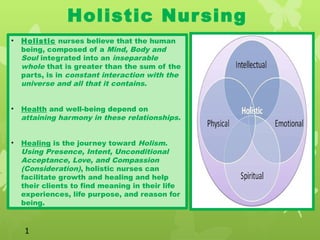
• Holistic nurses believe that the human
being, composed of a Mind, Body and
Soul integrated into an inseparable
whole that is greater than the sum of the
parts, is in constant interaction with the
universe and all that it contains.
• Health and well-being depend on
attaining harmony in these relationships.
• Healing is the journey toward Holism.
Using Presence, Intent, Unconditional
Acceptance, Love, and Compassion
(Consideration), holistic nurses can
facilitate growth and healing and help
their clients to find meaning in their life
experiences, life purpose, and reason for
being.
INTRODUCTION OF
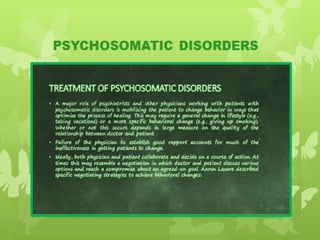
PSYCHOSOMATIC DISORDERS
PSYCHO –SOMA INTERACTION
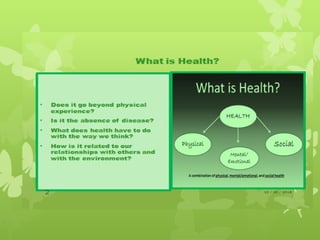
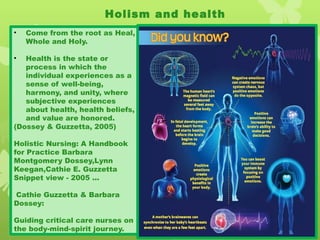
Holism and health
• Come from the root as Heal,
Whole and Holy.
• Health is the state or
process in which the
individual experiences as a
sense of well-being,
harmony, and unity, where
subjective experiences
about health, health beliefs,
and value are honored.
(Dossey & Guzzetta, 2005)
Holistic Nursing: A Handbook
for Practice Barbara
Montgomery Dossey,Lynn
Keegan,Cathie E. Guzzetta
Snippet view - 2005 ...
Cathie Guzzetta & Barbara
Dossey:
Guiding critical care nurses on
the body-mind-spirit journey.
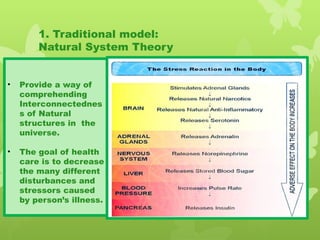
1. Traditional model:
Natural System Theory
• Provide a way of
comprehending
Interconnectednes
s of Natural
structures in the
universe.
• The goal of health
care is to decrease
the many different
disturbances and
stressors caused
by person’s illness.
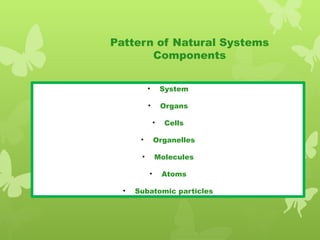
Pattern of Natural Systems
Components
• System
• Organs
• Cells
• Organelles
• Molecules
• Atoms
• Subatomic particles
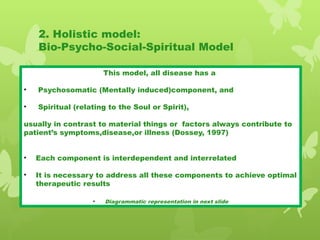
2. Holistic model:
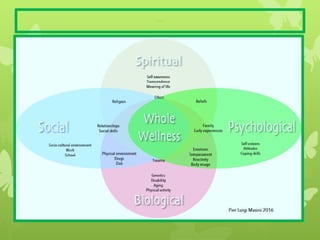
Bio-Psycho-Social-Spiritual Model
This model, all disease has a
• Psychosomatic (Mentally induced)component, and
• Spiritual (relating to the Soul or Spirit),
usually in contrast to material things or factors always contribute to
patient’s symptoms,disease,or illness (Dossey, 1997)
• Each component is interdependent and interrelated
• It is necessary to address all these components to achieve optimal
therapeutic results
• Diagrammatic representation in next slide
Bio-Psych o-Social-Spiritual Model
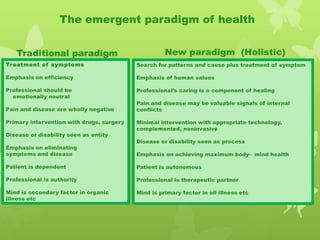
Traditional paradigm
The emergent paradigm of health
New paradigm (Holistic)
Treatment of symptoms
Emphasis on efficiency
Professional should be
emotionally neutral
Pain and disease are wholly negative
Primary intervention with drugs, surgery
Disease or disability seen as entity
Emphasis on eliminating
symptoms and disease
Patient is dependent
Professional is authority
Mind is secondary factor in organic
illness etc
Search for patterns and cause plus treatment of symptom
Emphasis of human values
Professional’s caring is a component of healing
Pain and disease may be valuable signals of internal
conflicts
Minimal intervention with appropriate technology,
complemented, noninvasive
Disease or disability seen as process
Emphasis on achieving maximum body- mind health
Patient is autonomous
Professional is therapeutic partner
Mind is primary factor in all illness etc
What is Holistic Nursing?
Florence Nightingale
 Florence
Nightingale, byname
Lady with the Lamp,
(born May 12,
1820, Florence [Italy]—died
August 13, 1910, London,
England), British nurse,
statistician, and social
reformer who was the
foundational philosopher of
modern nursing.
Who believed in care that
focused on unity, wellness,
and the interrelationship of
human beings and their
environment, is considered to
be one of the first holistic
nurses.
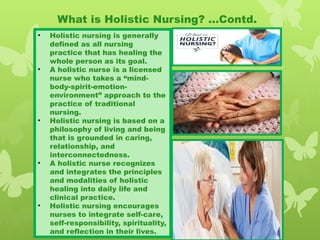
• Holistic nursing is generally
defined as all nursing
practice that has healing the
whole person as its goal.
• A holistic nurse is a licensed
nurse who takes a “mind-
body-spirit-emotion-
environment” approach to the
practice of traditional
nursing.
• Holistic nursing is based on a
philosophy of living and being
that is grounded in caring,
relationship, and
interconnectedness.
• A holistic nurse recognizes
and integrates the principles
and modalities of holistic
healing into daily life and
clinical practice.
• Holistic nursing encourages
nurses to integrate self-care,
self-responsibility, spirituality,
and reflection in their lives.
What is Holistic Nursing? …Contd.
What is the history of holistic nursing?
Present-day holistic nursing is based on the work of Florence Nightingale. It
was not until the mid-20th century that nursing began to emerge as a
profession and became linked to developments in western medicine. Since
1970, many nurse scholars have described nursing as being concerned with
the whole person. Dossey developed a theory of nursing that includes an
integral worldview that builds upon a solid holistic, integrated, and
multidimensional theoretical nursing foundation. Unlike previous theories of
nursing, this theory serves to explain the function of the inner world of the
nurse as a vital component of nursing practice.
These and other influences, such as research linking the mind and body and
an emphasis on patient-centered care, have affected the development of
holistic nursing. The American Holistic Nurses Association (AHNA) was
founded in 1980 to serve as a voice for holistic nurses and to promote the
education of nurses and others in the philosophy, practice, and research of
holistic caring and healing. The American Holistic Nurses Certification
Corporation (AHNCC) was founded in 1997 to credential holistic nurses.
AHNCC has a collaborative relationship with AHNA to advance the role of
holistic nursing and to provide educational opportunities in holistic nursing.
Is holistic nursing a specialty practice?
The American Nurses Association (ANA) officially recognized holistic
nursing as a specialty area of nursing practice in 2006. Specialty
status provides holistic nurses with a foundation for practice. It
provides a clear depiction of who we are to the rest of the world of
nursing, other healthcare professionals, and the public.
• Holistic nursing is a specialty practice that draws on nursing
knowledge, theories, expertise and intuition to guide nurses in
becoming therapeutic partners with people in their care.
• This practice recognizes the totality of the human being – the
interconnectedness of body, mind, emotion, spirit, social / cultural,
relationship, context, and environment.
What is Holistic Nursing? Contd.
Holistic Nursing
• All help with nursing practice the goal is to help recovery of
someone thoroughly
• Nurses see patients as humans in total
where there is a connection between
body, mind, emotion, social / culture,
spirit, relations, context and environment
(American Holistic Nurses’ association)
• The holistic nurse is an instrument of healing and a facilitator in
the healing process.
• Holistic nurses honor each individual's
subjective experience about health,
health beliefs, and values.
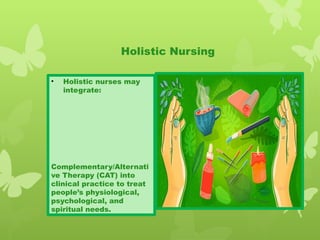
• Holistic nurses may
integrate:
Complementary/Alternati
ve Therapy (CAT) into
clinical practice to treat
people’s physiological,
psychological, and
spiritual needs.
Holistic Nursing
Holistic Nursing
Nurse as Instrument of Healing
The objective is to help clients call forth
their inner resources for healing
The nurse must develop the following
attributes.
*Knowledge base
*Intentionality
*Respect for differences
*Ability to model wellness.
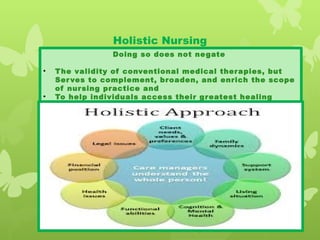
Holistic Nursing
Doing so does not negate
• The validity of conventional medical therapies, but
Serves to complement, broaden, and enrich the scope
of nursing practice and
• To help individuals access their greatest healing
potential.
Complementary and Alternative Therapy
• The terms Complementary and Alternative are often
used interchangeably , but they are equivalent in
meaning.
• Complementary implies a therapy used in conjunction
with a conventional one.
• Alternative therapy refers to one that is utilized
instead of conventional treatment
Complementary and Alternative
Therapy (CAT)
Many Americans use Complementary and
Alternative Therapy (CAT) in pursuit of health
and well-being.
The 2007 National Health Interview Survey
(NHIS), which included a comprehensive survey
of CAT use by Americans, showed that
approximately 38 percent of adults use CAT
Defining CAT
Defining CAT is difficult, because the field is very broad
and constantly changing.
CAT is defined as a group of diverse medical and
health care systems, practices, and products that are
not generally considered part of conventional medicine.
Conventional medicine
Conventional medicine (also called Western or
allopathic medicine) is medicine as practiced by
holders of M.D. (Medical Doctor) and D.O. (Doctor of
Osteopathic Medicine) degrees and by allied health
professionals, such as physical therapists,
psychologists, and registered nurses.
Complementary medicine
"Complementary medicine" refers to use of CAT together
with conventional medicine, such as using accupuncture
in addition to usual care to help lessen pain.
Most use of CAT by Americans is complementary.
"Alternative medicine" refers to use of CAT in place of
conventional medicine.
Integrative medicine
"Integrative medicine" combines treatments from
conventional medicine and CAT for which there is
some high-quality evidence of safety and
effectiveness.
It is also called integrated medicine
Types of Complementary Alternative Therapy
Alternative Therapies are organized in 7 categories:
1.Natural products
2.Mind-body intervention
3.Manipulative and Body-Based Practices
4.Energy therapy
5.Alternative system of medical practice
6.Pharmacologic and biological treatment
7.Diet and nutrition
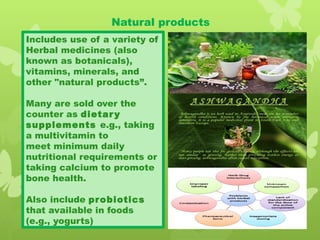
Natural products
Includes use of a variety of
Herbal medicines (also
known as botanicals),
vitamins, minerals, and
other "natural products”.
Many are sold over the
counter as dietary
supplements e.g., taking
a multivitamin to
meet minimum daily
nutritional requirements or
taking calcium to promote
bone health.
Also include probiotics
that available in foods
(e.g., yogurts)
Mind-body intervention
Mind and body practices focus on the
interactions among the brain, mind, body,
and behavior, with the intent to use the
mind to affect physical functioning and
promote health.
For example meditation, guided imagery,
hypnotherapy, deep-breathing exercise,
relaxation, tai chi, etc
Manipulative and Body-
Based Practices
Manipulative and body-based practices focus
primarily on the structures and systems of the
body, including the bones and joints, soft
tissues, and circulatory and lymphatic systems.
Commonly used therapies
1.Spinal manipulation
2.Massage therapy
Energy therapy
Involve the use of energy fields
Two types:
• Bio field therapies and
• penetrate the human body.
Practices based on putative energy fields (also
called biofields) generally reflect the concept that
human beings are infused with subtle forms of
energy; Reiki, and healing touch/Therapeutic
touch are examples of such practices
Alternative system of medical
practice
They are built upon complete system of theory and
practice.
These system have evolved apart from and earlier
than the conventional medical approach used in
the United States.
For example:
1.Acupuncture,
2. Indian Ayurveda
3.Chinese medicine, etc
Pharmacologic and biological treatment
These include substance that are used like
certain pharmaceuticals.
For example shark cartilage therapy for cancer
and chelation therapy for coronary artery
disease , etc
Diet and nutrition
Hippocrates said that food should be used
as medicine.
This category include research on the effects of
diet and dietary supplements on the treatment
and prevention disease.
Standard of holistic nursing
practice
The AHNA (American Holistic Nurses' Association)
standards of holistic nursing practice (AHNA, 2003),
reflects the five core values of holistic nursing.
Each of core values has an accompanying description
and standard of practice action statements.
Standard of holistic nursing
practice
The standard describe a diversity of nursing
activities in which holistic nurses are engaged.
They are based on the philosophy that
nursing is an art and a science for which the
primary purpose is to provide services that
enable individuals, families, and communities to
achieve their inherent wholeness.
The Five Core Values of AHNA
1 Holistic philosophy, theories and ethics
2 Holistic education and research
3 Holistic nurse self care
4 Holistic communication, therapeutic environment,
and cultural
5 Holistic caring process
Core 1:
Holistic philosophy, theories and ethicsEmphasizes that care holistic based on a
Framework Philosophy and Commitment
to
Education, Reflection and
Knowledge
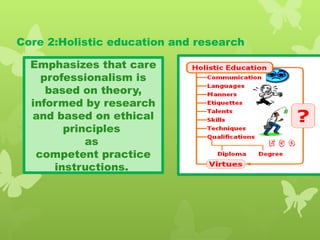
Core 2:Holistic education and research
Emphasizes that care
professionalism is
based on theory,
informed by research
and based on ethical
principles
as
competent practice
instructions.
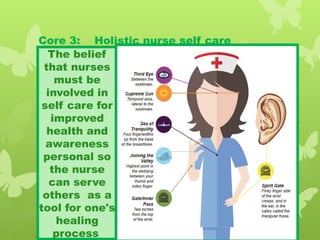
Core 3: Holistic nurse self care
The belief
that nurses
must be
involved in
self care for
improved
health and
awareness
personal so
the nurse
can serve
others as a
tool for one's
healing
process
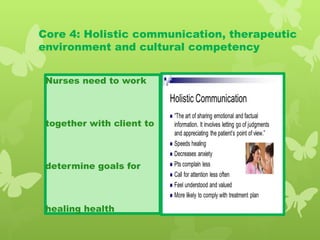
Core 4: Holistic communication, therapeutic
environment and cultural competency
Nurses need to work
together with client to
determine goals for
healing health
Core 5: Holistic caring process
Emphasize development to utilize the assessment
and therapeutic care that refers to patterns,
problems and needs of clients and a supportive
environment the healing process of the patient
1.1 Standard of Practice: Holistic philosophy
Recognize the person’s capacity for self-healing
and the importance of supporting the natural
development and unfolding of that capacity.
Support, share, and recognize expertise and
competency in holistic nursing practice that is
used in many diverse clinical and community
settings.
Participate in person-centered care by being a
partner, coach, and mentor who actively listens
and supports others in reaching personal goals.
Standard cont..
Focus on strategies to bring harmony, unity,
and healing to the nursing profession.
Communicate with traditional health care
practitioners about appropriate referrals to
other holistic practitioners when needed.
Interact with professional organizations in a
leadership or membership capacity at local,
state , national, and international levels to
further expand the knowledge and practice of
holistic nursing and awareness of holistic
health issues.
1.2 Standard of practice holistic theory
Strive to use nursing theories to develop holistic
nursing practice and transformational
leadership.
Interpret, use, and document information
relevant to a person’s care according to a
theoretical framework.
1.3 Standard of practice holistic ethics
Identify the ethics of caring and its
contribution to unity of self, others, nature,
and God/Life Force/Absolute/Transcendent as
central to holistic nursing practice.
Integrate the standards of holistic nursing
practice with applicable state laws and
regulations governing nursing practice.
Standard cont.
Engage in activities that respect, nurture, and
enhance the integral relationship with the
earth, and advocate for the well-being of
the
global community’s economy, education, and
social justice.
Advocate for the rights of patients to have
educated choices in their plan of care.
Standard cont.
Participate in peer evaluation to ensure
knowledge and competency in holistic
nursing practice.
Protect the personal privacy and
confidentiality of individuals, especially
with health care agencies and managed care
organizations.
2.1 Standard of practice holistic education
Participate in activities of continuing
education and related fields that have
relevance to holistic nursing practice.
Identify areas of knowledge from
nursing and various fields such as
biomedical, epidemiology, behavioral
medicine, cultural and social theories.
Standard of practice holistic education cont…
Continually develop and standardize
holistic
nursing guidelines, protocols and practice
to
promote competency in holistic nursing
practice and assure quality of care to
individuals.
Use the results of quality care activities to
initiate change in holistic nursing practice.
May seek certification in holistic nursing as one
means of advancing the philosophy and practice
of holistic nursing.
2.2 Standard of practice Holistic
Nursing and Related Research
Use available research and evidence from
different explanatory models to mutually create a
plan of care with a person.
Use expert clinical judgment to select
appropriate interventions.
Discuss holistic application to
clinical
situations where rigorous research
has not been done.
Standard of practice Holistic Nursing
and Related Research cont…
Create an environment conducive to
systematic
inquiry into healing and health issues by
engaging in research or supporting and utilizing
the research of others.
Disseminate research findings at meetings
and
through publications to further develop the
foundation and practice of holistic nursing.
Provide consultation services on holistic
nursing interventions to persons and
communities based on research.
3.1 Standards of Practice Holistic Nurse Self-care
Recognize that a person’s body mind-spirit
has healing capacities that can be
enhanced and supported through self-care
practices.
Identify and integrate self-care strategies
to
enhance their physical, psychological,
sociological, and spiritual well-being.
Recognize and address at-risk health
patterns
and begin the process of change.
Holistic Nurse Self-Care Standards of Practice cont…
Consciously cultivate awareness and
understanding about the deeper meaning,
purpose, inner strengths, and connections with self,
others, nature, and God/Life Force/Absolute/Transcendent.
use clear intention to care for self and to seek a
sense of balance, harmony, and joy in daily life.
participate in the evolutionary holistic process
with the understanding that crisis creates
opportunity in any setting.
4.1 Holistic Communication Standards of Practice
Develop an awareness of the most
frequently
encountered challenges to holistic
communication.
Increase therapeutic and cultural
competence
skills to enhance their effectiveness through
listening to themselves and others.
Explore with each person those strategies
that
can assist her/him, as desired, to understand the
deeper meaning, purpose
Holistic communication standard cont…
Recognize that holistic communication
and awareness of individuals is a
continuously evolving multilevel Exchange
Respect the person’s health trajectory which
may be incongruent with conventional
wisdom.
4.2 Therapeutic Environment Standards of Practice
Promote environments conducive to
experiencing healing, wholeness and
harmony, and care for the person in as healthy an
environment as possible.
Work toward creating organizations that
value
sacred space and environments that enhance
healing.
Integrate holistic principles, standards,
policies
and procedures in relation to
environmental
safety
Therapeutic Environment Standards of Practice cont…
Recognize that the well-being of the
ecosystem of the planet is a prior determining
condition for the wellbeing of the human.
Promote social networks and social
environments where healing can take place.
4.3 Cultural Diversity Standards of Practice
Assess and incorporate the person’s
cultural practices, values, beliefs, meanings
of health, illness, and risk behaviors in care and
health education.
Use appropriate community resources and
experts to extend their understanding of
different cultures.
Cultural diversity standard cont…
Assess for discriminatory practices and
change as necessary
Identify discriminatory health care
practices as they impact the person and
engage in effective non-discriminatory
practices.
5.1 Assessment Standards of Practice
Use an assessment process including
appropriate traditional and holistic methods
to systematically gather information.
5.2 Patterns/need
5.3 Outcomes
5.4 Standards of Practice therapeutic care plan
Partner with the person in a mutual
decision process to create a health care plan
for each pattern/challenge/need or opportunity
to enhance health and well-being.
Use skills of cultural competence and
communicate acceptance of the person’s
values, belief, culture, religion, and socioeconomic
background.
5.5 Implementation Standards of Practice
Implement the mutually created plan of
care within the context of assisting the
person towards the higher potential of
health and well-being.
Use holistic nursing skills in
implementing care including cultural
competency and all ways of knowing.
5.6 Evaluation Standards of Practice
Collaborate with the person and with other
health care team members when appropriate in
evaluating holistic outcomes.
Explore with the person her/his
understanding
of the cause of any significant deviation
between the responses and the expected
outcomes.
Mutually create with the person and other
team
members a revised plan if needed.

Holistic nursing

  • 1.
    Holistic Nursing 1 • Holisticnurses believe that the human being, composed of a Mind, Body and Soul integrated into an inseparable whole that is greater than the sum of the parts, is in constant interaction with the universe and all that it contains. • Health and well-being depend on attaining harmony in these relationships. • Healing is the journey toward Holism. Using Presence, Intent, Unconditional Acceptance, Love, and Compassion (Consideration), holistic nurses can facilitate growth and healing and help their clients to find meaning in their life experiences, life purpose, and reason for being.
  • 3.
  • 4.
  • 6.
    Holism and health •Come from the root as Heal, Whole and Holy. • Health is the state or process in which the individual experiences as a sense of well-being, harmony, and unity, where subjective experiences about health, health beliefs, and value are honored. (Dossey & Guzzetta, 2005) Holistic Nursing: A Handbook for Practice Barbara Montgomery Dossey,Lynn Keegan,Cathie E. Guzzetta Snippet view - 2005 ... Cathie Guzzetta & Barbara Dossey: Guiding critical care nurses on the body-mind-spirit journey.
  • 7.
    1. Traditional model: NaturalSystem Theory • Provide a way of comprehending Interconnectednes s of Natural structures in the universe. • The goal of health care is to decrease the many different disturbances and stressors caused by person’s illness.
  • 8.
    Pattern of NaturalSystems Components • System • Organs • Cells • Organelles • Molecules • Atoms • Subatomic particles
  • 9.
    2. Holistic model: Bio-Psycho-Social-SpiritualModel This model, all disease has a • Psychosomatic (Mentally induced)component, and • Spiritual (relating to the Soul or Spirit), usually in contrast to material things or factors always contribute to patient’s symptoms,disease,or illness (Dossey, 1997) • Each component is interdependent and interrelated • It is necessary to address all these components to achieve optimal therapeutic results • Diagrammatic representation in next slide
  • 10.
  • 11.
    Traditional paradigm The emergentparadigm of health New paradigm (Holistic) Treatment of symptoms Emphasis on efficiency Professional should be emotionally neutral Pain and disease are wholly negative Primary intervention with drugs, surgery Disease or disability seen as entity Emphasis on eliminating symptoms and disease Patient is dependent Professional is authority Mind is secondary factor in organic illness etc Search for patterns and cause plus treatment of symptom Emphasis of human values Professional’s caring is a component of healing Pain and disease may be valuable signals of internal conflicts Minimal intervention with appropriate technology, complemented, noninvasive Disease or disability seen as process Emphasis on achieving maximum body- mind health Patient is autonomous Professional is therapeutic partner Mind is primary factor in all illness etc
  • 12.
    What is HolisticNursing? Florence Nightingale  Florence Nightingale, byname Lady with the Lamp, (born May 12, 1820, Florence [Italy]—died August 13, 1910, London, England), British nurse, statistician, and social reformer who was the foundational philosopher of modern nursing. Who believed in care that focused on unity, wellness, and the interrelationship of human beings and their environment, is considered to be one of the first holistic nurses.
  • 13.
    • Holistic nursingis generally defined as all nursing practice that has healing the whole person as its goal. • A holistic nurse is a licensed nurse who takes a “mind- body-spirit-emotion- environment” approach to the practice of traditional nursing. • Holistic nursing is based on a philosophy of living and being that is grounded in caring, relationship, and interconnectedness. • A holistic nurse recognizes and integrates the principles and modalities of holistic healing into daily life and clinical practice. • Holistic nursing encourages nurses to integrate self-care, self-responsibility, spirituality, and reflection in their lives. What is Holistic Nursing? …Contd.
  • 14.
    What is thehistory of holistic nursing? Present-day holistic nursing is based on the work of Florence Nightingale. It was not until the mid-20th century that nursing began to emerge as a profession and became linked to developments in western medicine. Since 1970, many nurse scholars have described nursing as being concerned with the whole person. Dossey developed a theory of nursing that includes an integral worldview that builds upon a solid holistic, integrated, and multidimensional theoretical nursing foundation. Unlike previous theories of nursing, this theory serves to explain the function of the inner world of the nurse as a vital component of nursing practice. These and other influences, such as research linking the mind and body and an emphasis on patient-centered care, have affected the development of holistic nursing. The American Holistic Nurses Association (AHNA) was founded in 1980 to serve as a voice for holistic nurses and to promote the education of nurses and others in the philosophy, practice, and research of holistic caring and healing. The American Holistic Nurses Certification Corporation (AHNCC) was founded in 1997 to credential holistic nurses. AHNCC has a collaborative relationship with AHNA to advance the role of holistic nursing and to provide educational opportunities in holistic nursing.
  • 15.
    Is holistic nursinga specialty practice? The American Nurses Association (ANA) officially recognized holistic nursing as a specialty area of nursing practice in 2006. Specialty status provides holistic nurses with a foundation for practice. It provides a clear depiction of who we are to the rest of the world of nursing, other healthcare professionals, and the public. • Holistic nursing is a specialty practice that draws on nursing knowledge, theories, expertise and intuition to guide nurses in becoming therapeutic partners with people in their care. • This practice recognizes the totality of the human being – the interconnectedness of body, mind, emotion, spirit, social / cultural, relationship, context, and environment. What is Holistic Nursing? Contd.
  • 16.
    Holistic Nursing • Allhelp with nursing practice the goal is to help recovery of someone thoroughly • Nurses see patients as humans in total where there is a connection between body, mind, emotion, social / culture, spirit, relations, context and environment (American Holistic Nurses’ association) • The holistic nurse is an instrument of healing and a facilitator in the healing process. • Holistic nurses honor each individual's subjective experience about health, health beliefs, and values.
  • 17.
    • Holistic nursesmay integrate: Complementary/Alternati ve Therapy (CAT) into clinical practice to treat people’s physiological, psychological, and spiritual needs. Holistic Nursing
  • 18.
    Holistic Nursing Nurse asInstrument of Healing The objective is to help clients call forth their inner resources for healing The nurse must develop the following attributes. *Knowledge base *Intentionality *Respect for differences *Ability to model wellness.
  • 19.
    Holistic Nursing Doing sodoes not negate • The validity of conventional medical therapies, but Serves to complement, broaden, and enrich the scope of nursing practice and • To help individuals access their greatest healing potential.
  • 20.
    Complementary and AlternativeTherapy • The terms Complementary and Alternative are often used interchangeably , but they are equivalent in meaning. • Complementary implies a therapy used in conjunction with a conventional one. • Alternative therapy refers to one that is utilized instead of conventional treatment
  • 21.
    Complementary and Alternative Therapy(CAT) Many Americans use Complementary and Alternative Therapy (CAT) in pursuit of health and well-being. The 2007 National Health Interview Survey (NHIS), which included a comprehensive survey of CAT use by Americans, showed that approximately 38 percent of adults use CAT
  • 22.
    Defining CAT Defining CATis difficult, because the field is very broad and constantly changing. CAT is defined as a group of diverse medical and health care systems, practices, and products that are not generally considered part of conventional medicine.
  • 23.
    Conventional medicine Conventional medicine(also called Western or allopathic medicine) is medicine as practiced by holders of M.D. (Medical Doctor) and D.O. (Doctor of Osteopathic Medicine) degrees and by allied health professionals, such as physical therapists, psychologists, and registered nurses.
  • 24.
    Complementary medicine "Complementary medicine"refers to use of CAT together with conventional medicine, such as using accupuncture in addition to usual care to help lessen pain. Most use of CAT by Americans is complementary. "Alternative medicine" refers to use of CAT in place of conventional medicine.
  • 25.
    Integrative medicine "Integrative medicine"combines treatments from conventional medicine and CAT for which there is some high-quality evidence of safety and effectiveness. It is also called integrated medicine
  • 26.
    Types of ComplementaryAlternative Therapy Alternative Therapies are organized in 7 categories: 1.Natural products 2.Mind-body intervention 3.Manipulative and Body-Based Practices 4.Energy therapy 5.Alternative system of medical practice 6.Pharmacologic and biological treatment 7.Diet and nutrition
  • 27.
    Natural products Includes useof a variety of Herbal medicines (also known as botanicals), vitamins, minerals, and other "natural products”. Many are sold over the counter as dietary supplements e.g., taking a multivitamin to meet minimum daily nutritional requirements or taking calcium to promote bone health. Also include probiotics that available in foods (e.g., yogurts)
  • 28.
    Mind-body intervention Mind andbody practices focus on the interactions among the brain, mind, body, and behavior, with the intent to use the mind to affect physical functioning and promote health. For example meditation, guided imagery, hypnotherapy, deep-breathing exercise, relaxation, tai chi, etc
  • 29.
    Manipulative and Body- BasedPractices Manipulative and body-based practices focus primarily on the structures and systems of the body, including the bones and joints, soft tissues, and circulatory and lymphatic systems. Commonly used therapies 1.Spinal manipulation 2.Massage therapy
  • 30.
    Energy therapy Involve theuse of energy fields Two types: • Bio field therapies and • penetrate the human body. Practices based on putative energy fields (also called biofields) generally reflect the concept that human beings are infused with subtle forms of energy; Reiki, and healing touch/Therapeutic touch are examples of such practices
  • 31.
    Alternative system ofmedical practice They are built upon complete system of theory and practice. These system have evolved apart from and earlier than the conventional medical approach used in the United States. For example: 1.Acupuncture, 2. Indian Ayurveda 3.Chinese medicine, etc
  • 32.
    Pharmacologic and biologicaltreatment These include substance that are used like certain pharmaceuticals. For example shark cartilage therapy for cancer and chelation therapy for coronary artery disease , etc
  • 33.
    Diet and nutrition Hippocratessaid that food should be used as medicine. This category include research on the effects of diet and dietary supplements on the treatment and prevention disease.
  • 34.
    Standard of holisticnursing practice The AHNA (American Holistic Nurses' Association) standards of holistic nursing practice (AHNA, 2003), reflects the five core values of holistic nursing. Each of core values has an accompanying description and standard of practice action statements.
  • 35.
    Standard of holisticnursing practice The standard describe a diversity of nursing activities in which holistic nurses are engaged. They are based on the philosophy that nursing is an art and a science for which the primary purpose is to provide services that enable individuals, families, and communities to achieve their inherent wholeness.
  • 36.
    The Five CoreValues of AHNA 1 Holistic philosophy, theories and ethics 2 Holistic education and research 3 Holistic nurse self care 4 Holistic communication, therapeutic environment, and cultural 5 Holistic caring process
  • 37.
    Core 1: Holistic philosophy,theories and ethicsEmphasizes that care holistic based on a Framework Philosophy and Commitment to Education, Reflection and Knowledge
  • 38.
    Core 2:Holistic educationand research Emphasizes that care professionalism is based on theory, informed by research and based on ethical principles as competent practice instructions.
  • 39.
    Core 3: Holisticnurse self care The belief that nurses must be involved in self care for improved health and awareness personal so the nurse can serve others as a tool for one's healing process
  • 40.
    Core 4: Holisticcommunication, therapeutic environment and cultural competency Nurses need to work together with client to determine goals for healing health
  • 41.
    Core 5: Holisticcaring process Emphasize development to utilize the assessment and therapeutic care that refers to patterns, problems and needs of clients and a supportive environment the healing process of the patient
  • 42.
    1.1 Standard ofPractice: Holistic philosophy Recognize the person’s capacity for self-healing and the importance of supporting the natural development and unfolding of that capacity. Support, share, and recognize expertise and competency in holistic nursing practice that is used in many diverse clinical and community settings. Participate in person-centered care by being a partner, coach, and mentor who actively listens and supports others in reaching personal goals.
  • 43.
    Standard cont.. Focus onstrategies to bring harmony, unity, and healing to the nursing profession. Communicate with traditional health care practitioners about appropriate referrals to other holistic practitioners when needed. Interact with professional organizations in a leadership or membership capacity at local, state , national, and international levels to further expand the knowledge and practice of holistic nursing and awareness of holistic health issues.
  • 44.
    1.2 Standard ofpractice holistic theory Strive to use nursing theories to develop holistic nursing practice and transformational leadership. Interpret, use, and document information relevant to a person’s care according to a theoretical framework.
  • 45.
    1.3 Standard ofpractice holistic ethics Identify the ethics of caring and its contribution to unity of self, others, nature, and God/Life Force/Absolute/Transcendent as central to holistic nursing practice. Integrate the standards of holistic nursing practice with applicable state laws and regulations governing nursing practice.
  • 46.
    Standard cont. Engage inactivities that respect, nurture, and enhance the integral relationship with the earth, and advocate for the well-being of the global community’s economy, education, and social justice. Advocate for the rights of patients to have educated choices in their plan of care.
  • 47.
    Standard cont. Participate inpeer evaluation to ensure knowledge and competency in holistic nursing practice. Protect the personal privacy and confidentiality of individuals, especially with health care agencies and managed care organizations.
  • 48.
    2.1 Standard ofpractice holistic education Participate in activities of continuing education and related fields that have relevance to holistic nursing practice. Identify areas of knowledge from nursing and various fields such as biomedical, epidemiology, behavioral medicine, cultural and social theories.
  • 49.
    Standard of practiceholistic education cont… Continually develop and standardize holistic nursing guidelines, protocols and practice to promote competency in holistic nursing practice and assure quality of care to individuals. Use the results of quality care activities to initiate change in holistic nursing practice. May seek certification in holistic nursing as one means of advancing the philosophy and practice of holistic nursing.
  • 50.
    2.2 Standard ofpractice Holistic Nursing and Related Research Use available research and evidence from different explanatory models to mutually create a plan of care with a person. Use expert clinical judgment to select appropriate interventions. Discuss holistic application to clinical situations where rigorous research has not been done.
  • 51.
    Standard of practiceHolistic Nursing and Related Research cont… Create an environment conducive to systematic inquiry into healing and health issues by engaging in research or supporting and utilizing the research of others. Disseminate research findings at meetings and through publications to further develop the foundation and practice of holistic nursing. Provide consultation services on holistic nursing interventions to persons and communities based on research.
  • 52.
    3.1 Standards ofPractice Holistic Nurse Self-care Recognize that a person’s body mind-spirit has healing capacities that can be enhanced and supported through self-care practices. Identify and integrate self-care strategies to enhance their physical, psychological, sociological, and spiritual well-being. Recognize and address at-risk health patterns and begin the process of change.
  • 53.
    Holistic Nurse Self-CareStandards of Practice cont… Consciously cultivate awareness and understanding about the deeper meaning, purpose, inner strengths, and connections with self, others, nature, and God/Life Force/Absolute/Transcendent. use clear intention to care for self and to seek a sense of balance, harmony, and joy in daily life. participate in the evolutionary holistic process with the understanding that crisis creates opportunity in any setting.
  • 54.
    4.1 Holistic CommunicationStandards of Practice Develop an awareness of the most frequently encountered challenges to holistic communication. Increase therapeutic and cultural competence skills to enhance their effectiveness through listening to themselves and others. Explore with each person those strategies that can assist her/him, as desired, to understand the deeper meaning, purpose
  • 55.
    Holistic communication standardcont… Recognize that holistic communication and awareness of individuals is a continuously evolving multilevel Exchange Respect the person’s health trajectory which may be incongruent with conventional wisdom.
  • 56.
    4.2 Therapeutic EnvironmentStandards of Practice Promote environments conducive to experiencing healing, wholeness and harmony, and care for the person in as healthy an environment as possible. Work toward creating organizations that value sacred space and environments that enhance healing. Integrate holistic principles, standards, policies and procedures in relation to environmental safety
  • 57.
    Therapeutic Environment Standardsof Practice cont… Recognize that the well-being of the ecosystem of the planet is a prior determining condition for the wellbeing of the human. Promote social networks and social environments where healing can take place.
  • 58.
    4.3 Cultural DiversityStandards of Practice Assess and incorporate the person’s cultural practices, values, beliefs, meanings of health, illness, and risk behaviors in care and health education. Use appropriate community resources and experts to extend their understanding of different cultures.
  • 59.
    Cultural diversity standardcont… Assess for discriminatory practices and change as necessary Identify discriminatory health care practices as they impact the person and engage in effective non-discriminatory practices.
  • 60.
    5.1 Assessment Standardsof Practice Use an assessment process including appropriate traditional and holistic methods to systematically gather information. 5.2 Patterns/need 5.3 Outcomes
  • 61.
    5.4 Standards ofPractice therapeutic care plan Partner with the person in a mutual decision process to create a health care plan for each pattern/challenge/need or opportunity to enhance health and well-being. Use skills of cultural competence and communicate acceptance of the person’s values, belief, culture, religion, and socioeconomic background.
  • 62.
    5.5 Implementation Standardsof Practice Implement the mutually created plan of care within the context of assisting the person towards the higher potential of health and well-being. Use holistic nursing skills in implementing care including cultural competency and all ways of knowing.
  • 63.
    5.6 Evaluation Standardsof Practice Collaborate with the person and with other health care team members when appropriate in evaluating holistic outcomes. Explore with the person her/his understanding of the cause of any significant deviation between the responses and the expected outcomes. Mutually create with the person and other team members a revised plan if needed.

Editor's Notes

  • #2 It would be very hard to find a nurse who saw only the physical aspect of care as that which defines nursing. We all know that when a person is hurting emotionally, all sorts of physical ailments crop up. On the other hand, physical conditions can affect the mind and spirit. The nursing profession has traditionally viewed the person as holistic, though the term itself was only introduced into the nursing literature in the 1980s by Rogers, Parse, Newman and others. Today we speak of a person as a Bio Psycho Social unit. Restoring wholeness is a legitimate goal of nursing, and so the term 'holistic' from the Greek ‘ Holos ' meaning whole or complete, is a very appropriate way to describe what we aim to do. Yet we may not always stop to consider the full implications of that concept. Holism has been defined as "concerned with the interrelationship of body, mind and spirit in an ever changing environment". See Slide.1 The American Holistic Nurses Association define wellness (health) as “That state of harmony between body, mind and spirit". The essence of holistic care is to help a person attain or maintain wholeness in all dimensions of their being. Consequently nurses need to be prepared to provide care in each of these areas. In this Presentation I wish to consider the spiritual dimension - the nature of Spirituality (Sanctity), the needs of the spirit, and the role of the nurse in caring for the Spirit (Life force). <number> Holistic Nursing
  • #3 The term “psychosomatic disorder” is mainly used to mean “a physical disease that is thought to be caused, or made worse, by mental factors.” ... Some physical diseases are thought to be prone to be made worse by mental factors such as stress and anxiety. Some people also use the term, 'psychosomatic disorder,' when mental factors cause physical symptoms, but where there is no physical disease. A chest pain; for example, might be caused by stress and no physical disease is found. Holistic Nursing <number>
  • #5 Realms-----*an area of interest or activity Holistic Nursing <number>
  • #7 <number> Holistic Nursing
  • #8 Narcotics (Tranquilizers) https://news.nationalgeographic.com/news/2010/04/100426-natural-morphine-drugs-humans-mice/ Serotonin (a chemical derived from the amino acid tryptophan and widely distributed in tissues. It acts as a neurotransmitter, constricts blood vessels at injury sites, and may affect emotional states. Formula: C10H12N2O) Adrenalin (Adrenaline is released into the body of someone feeling extreme emotions, which causes the person to have more energy. Hormone Health Network explains it here!) (An adrenaline rush is an extremely intense feeling. Adrenaline is a natural hormone that is produced by the body and secreted throughout the body when you undergo some type of traumatic experience. Norepinephrine (A hormone, secreted by the adrenal gland and similar to epinephrine, that is the principal neurotransmitter of sympathetic nerve endings supplying the major organs and skin. It increases blood pressure and rate and depth of breathing, raises the level of blood sugar, and decreases the activity of the intestines.) Stored Blood Sugar (The blood sugar level, blood sugar concentration, or blood glucose level is the amount of glucose present in the blood of humans and other animals. Glucose is a simple sugar and approximately 4 grams of glucose are present in the blood of a 70-kilogram (150 lb) human at all times. The body tightly regulates blood glucose levels as a part of metabolic homeostasis.) Insulin (a hormone produced in the pancreas that regulates the level of glucose in the blood) Holistic Nursing <number>
  • #9 Organelles (A specialized part of a cell that has its own function, e.g. the nucleus or the mitochondrion) Molecules (The smallest physical unit of a substance that can exist independently, consisting of one or more atoms held together by chemical forces) Atoms (the smallest portion into which an element can be divided and still retain its properties, made up of a dense, positively charged nucleus surrounded by a system of electrons. Atoms usually do not divide in chemical reactions except for some removal, transfer, or exchange of specific electrons) Subatomic particles (Occurring as part of an atom, or smaller than an atom) Holistic Nursing <number>
  • #10 <number> Holistic Nursing
  • #11 Transcendence…. (In religion, transcendence refers to the aspect of a god's nature and power which is wholly independent of the material universe, beyond all physical laws. This is contrasted with immanence, where a god is said to be fully present in the physical world and thus accessible to creatures in various ways. In religious experience transcendence is a state of being that has overcome the limitations of ...) Trauma…. (an extremely distressing experience that causes severe emotional shock and may have long-lasting psychological effects) Ethics……(a system of moral principles governing the appropriate conduct for a person or group) Holistic Nursing <number>
  • #13 <number> Holistic Nursing
  • #14 Holistic Nursing <number>
  • #15 Holistic…….(Taking into account all of somebody's physical, mental, and social conditions in the treatment of illness) Holistic Nursing <number>
  • #37 <number> Holistic Nursing
  • #40 Sea of Tranquility : the motion and disturbance of a large body of water such as the ocean, or the waves themselves Holistic Nursing <number>