

In the name of Allah Kareem,
Most Beneficent, Most Gracious,
the Most Merciful !
Qualitative Research


Qualitative research is “an informal, subjective, semi systematic research approaches
that usually emphasizes words rather than numbers in the collection and analysis of
data” and that is inductive in nature. In other words it generates theory.


General Aims Of Qualitative Research:

              1- Views of participants
              2- It does not claim to generalize
              3- Theory generation


                                SUPERIOR GROUP OF COLLEGES
THE MAIN PREOCCUPATIONS OF QUALITATIVE
               RESEARCHER

These preoccupations reflect epistemologically grounded believes about
what constitutes acceptable knowledge. The qualitative researchers are
more influenced by interpretivism. In this section five different pre-
occupations among qualitative researchers will be outlined and
examined

     1.   See through the eye of the people been studied
     2.   Emphasis on process of social life
     3.   Description and the emphasis on contexts
     4.   Flexibility and limited structure
     5.   Concept and theory grounded in data
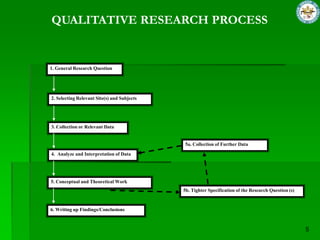
QUALITATIVE RESEARCH PROCESS


1. General Research Question


2. Selecting Relevant Site(s) and Subjects


3. Collection or Relevant Data


                                             5a. Collection of Further Data
4. Analyze and Interpretation of Data


5. Conceptual and Theoretical Work
                                             5b. Tighter Specification of the Research Question (s)


6. Writing up Findings/Conclusions
Reliability and Validity

Validity refers to the issues of whether or not an indicator really measures the
concept that it is devised to measure whereas Reliability is the stability or the
consistency of measurement.


       1.   Member Checking
       2.   Triangulation
       3.   Self-Reflection and Rich thick description
       4.   External audit
       5.   Authenticity
Qualitative Sampling


In qualitative research researcher preferably uses non probability
sampling that includes:

                  1. Convenience sampling
                  2. Snow ball sampling
                  3. Quota sampling

                          Qualitative Methods


In qualitative research four methods are used for data collection that is as
follows:

                  1.   Interview
                  2.   Focus group
                  3.   Document analysis
                  4.   Unstructured observation
What is Interview?


     “A person to person interaction or debate between two or more
             individual with a specific purpose in mind.”


Types of interviews:
        There are several types of interviews that are as follows

                  1.   Telephone Interview
                  2.   Email Interview
                  3.   Ethnographic Interview
                  4.   One-on-one interview
                  5.   Group Interview


                             SUPERIOR GROUP OF COLLEGES
Modes OF INTERVIEWS

1- Structured Interview:
This is a fixed format interview in which all questions are prepared beforehand
and put in the same order to each interviewee.

2- Unstructured Interview:
The interviewer is free to move the conversation in any direction of interest that
may come up. Constantly, unstructured interviewing is particularly useful for
exploring a topic broadly.


3- Semi structured Interview:
In this interview we have a list of questions on fairly specific topics to be covered,
often referred to as an interview guide, but the interviewee has a great deal of
flexibility in how to reply


                                 SUPERIOR GROUP OF COLLEGES
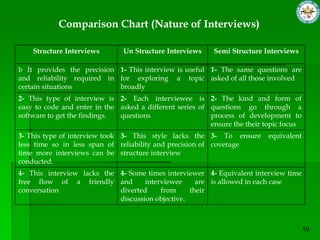
Comparison Chart (Nature of Interviews)

    Structure Interviews       Un Structure Interviews     Semi Structure Interviews

b It provides the precision 1- This interview is useful 1- The same questions are
and reliability required in for exploring a topic asked of all those involved
certain situations          broadly
2- This type of interview is 2- Each interviewee is 2- The kind and form of
easy to code and enter in the asked a different series of questions go through a
software to get the findings. questions                   process of development to
                                                          ensure the their topic focus
3- This type of interview took 3- This style lacks the 3- To ensure        equivalent
less time so in less span of reliability and precision of coverage
time more interviews can be structure interview
conducted.
4- This interview lacks the 4- Some times interviewer 4- Equivalent interview time
free flow of a friendly and         interviewee     are is allowed in each case
conversation                diverted     from     their
                            discussion objective.
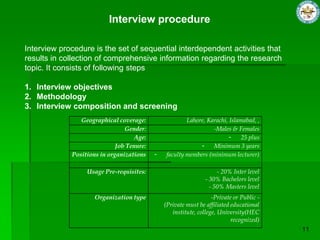
Interview procedure

Interview procedure is the set of sequential interdependent activities that
results in collection of comprehensive information regarding the research
topic. It consists of following steps

1. Interview objectives
2. Methodology
3. Interview composition and screening
                Geographical coverage:                  Lahore, Karachi, Islamabad, ,
                                Gender:                           -Males & Females
                                    Age:                                 -    25 plus
                             Job Tenure:                     -    Minimum 3 years
             Positions in organizations    -    faculty members (minimum lecturer)

                  Usage Pre-requisites:                              - 20% Inter level
                                                                - 30% Bachelors level
                                                                  - 50% Masters level
                     Organization type                             -Private or Public -
                                               (Private must be affiliated educational
                                                  institute, college, University(HEC
                                                                           recognized)
Interview procedure
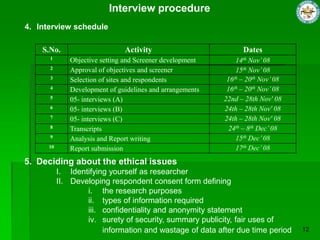
4. Interview schedule

    S.No.                      Activity                          Dates
      1       Objective setting and Screener development       14th Nov’ 08
      2       Approval of objectives and screener              15th Nov’ 08
      3       Selection of sites and respondents            16th – 20th Nov’ 08
      4       Development of guidelines and arrangements    16th – 20th Nov’ 08
      5       05- interviews (A)                           22nd – 28th Nov' 08
      6       05- interviews (B)                           24th – 28th Nov' 08
      7       05- interviews (C)                           24th – 28th Nov' 08
      8       Transcripts                                    24th – 8th Dec’ 08
      9       Analysis and Report writing                      15th Dec’ 08
      10      Report submission                                17th Dec’ 08
5. Deciding about the ethical issues
           I. Identifying yourself as researcher
           II. Developing respondent consent form defining
                   i. the research purposes
                   ii. types of information required
                   iii. confidentiality and anonymity statement
                   iv. surety of security, summary publicity, fair uses of
                        information and wastage of data after due time period
Interview procedure

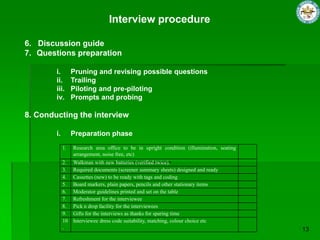
6. Discussion guide
7. Questions preparation

        i.        Pruning and revising possible questions
        ii.       Trailing
        iii.      Piloting and pre-piloting
        iv.       Prompts and probing

8. Conducting the interview

        i.        Preparation phase
             1.   Research area office to be in upright condition (illumination, seating
                  arrangement, noise free, etc)
             2.   Walkman with new batteries (verified twice).
             3.   Required documents (screener summary sheets) designed and ready
             4.   Cassettes (new) to be ready with tags and coding
             5.   Board markers, plain papers, pencils and other stationary items
             6.   Moderator guidelines printed and set on the table
             7.   Refreshment for the interviewee
             8.   Pick n drop facility for the interviewees
             9.   Gifts for the interviews as thanks for sparing time
             10   Interviewee dress code suitability, matching, colour choice etc
             .
Interview procedure

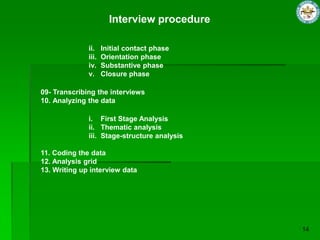
              ii.    Initial contact phase
              iii.   Orientation phase
              iv.    Substantive phase
              v.     Closure phase

09- Transcribing the interviews
10. Analyzing the data

              i. First Stage Analysis
              ii. Thematic analysis
              iii. Stage-structure analysis

11. Coding the data
12. Analysis grid
13. Writing up interview data
Qualitative Data


'Soft„, Nonnumeric, textual intangible or
subjective data that describes but not
measure the attributes, characteristics,
properties, etc., of a thing or
phenomenon.
Example
Conversation, text, audio, video colors,
  smells, tastes, textures, or sounds,

              SUPERIOR GROUP OF COLLEGES
Qualitative Data Analysis: what & why


  Qualitative Data analysis is a process of gathering,
   modeling, and transforming qualitative data with the
   goal of
    highlighting useful information
    suggesting conclusions, and
    supporting decision making.
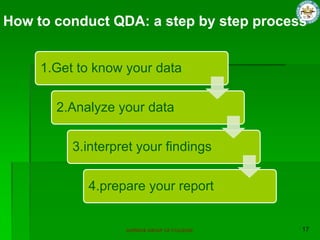
How to conduct QDA: a step by step process


     1.Get to know your data

       2.Analyze your data

          3.interpret your findings

            4.prepare your report


                   SUPERIOR GROUP OF COLLEGES
10.i. Get to know your Data
Good analysis depends on understanding the data.

  • read and re-read the text.
  • listen to the tape recordings several times.
  • Write down any impressions you have. These
    impressions may be useful later.
  • Before beginning any analysis, consider the
    quality of the data and proceed accordingly

                    SUPERIOR GROUP OF COLLEGES
2. Analyze your data

Before proceeding to analysis, review the purpose
of the evaluation and what you want to find out.
Identify a few key questions that you want your
analysis to answer. Write down these questions.
These will help you decide how to begin. The full
process of analyzing a transcription can be split into
different stages that were discussed one by one:
1.   The first step is just to read each transcription, go through them and
     highlighting the important statements from each portion as called
     substantive statements

                            SUPERIOR GROUP OF COLLEGES
EXAMPLE


Excerpt

First of all I would like to say few things before I give an answer to it. This is an organization which
gives you a plenty of (0.2) you see! Opportunities in which you can participate in decision making. I
always:::: been allowed by top management to participate in decision making. Like (0.2) if there are
anything regarding hiring faculty or there is any matter regarding curriculum improvement. They
have always asked me to participate in decision making and I have always give then decisions and
they have always cater those decisions implemented in their systems.

Substantive Statement
This is an organization which gives you a plenty opportunities in which you can participate in
decision making. I always:::: been allowed by top management to participate in decision making.
[For example] if there are anything regarding hiring faculty or there is any matter regarding
curriculum improvement. [The management] always asked me to participate in decision making and
then decisions and they have always catered those decisions implemented in their systems.
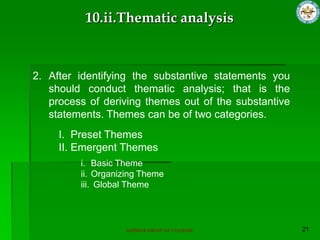
10.ii.Thematic analysis


2. After identifying the substantive statements you
   should conduct thematic analysis; that is the
   process of deriving themes out of the substantive
   statements. Themes can be of two categories.
     I. Preset Themes
     II. Emergent Themes
         i. Basic Theme
         ii. Organizing Theme
         iii. Global Theme


                   SUPERIOR GROUP OF COLLEGES
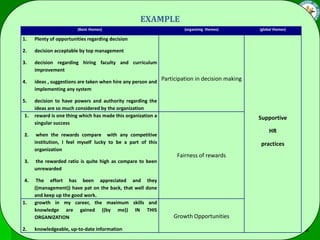
EXAMPLE
                        (Basic themes)                                 (organizing themes)       (global themes)

1.   Plenty of opportunities regarding decision

2.   decision acceptable by top management

3.   decision regarding hiring faculty and curriculum
     improvement

4.   ideas , suggestions are taken when hire any person and
                                                              Participation in decision making
     implementing any system

5.   decision to have powers and authority regarding the
     ideas are so much considered by the organization
1.   reward is one thing which has made this organization a                                      Supportive
     singular success
                                                                                                      HR
2.    when the rewards compare with any competitive
     institution, I feel myself lucky to be a part of this                                       practices
     organization
                                                                    Fairness of rewards
3.   the rewarded ratio is quite high as compare to been
     unrewarded

4.    The effort has been appreciated and they
     ((management)) have pat on the back, that well done
     and keep up the good work.
1.   growth in my career, the maximum skills and
     knowledge are gained ((by me)) IN THIS
     ORGANIZATION                                                 Growth Opportunities

2.   knowledgeable, up-to-date information
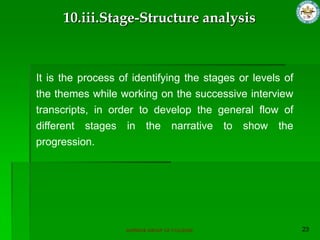
10.iii.Stage-Structure analysis


It is the process of identifying the stages or levels of
the themes while working on the successive interview
transcripts, in order to develop the general flow of
different stages in the narrative to show the
progression.


                   SUPERIOR GROUP OF COLLEGES
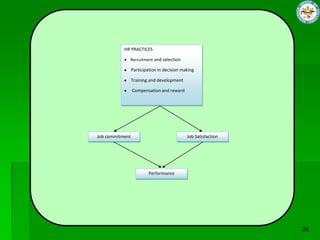
HR PRACTICES

             Recruitment and selection

                 Participation in decision making

                 Training and development

                 Compensation and reward


Job commitment                               Job Satisfaction


                         Performance
11.Coding the Data


It is the process of developing a code book for being
able to refer to certain respondents‟ words in
transcription. In this process the researcher will define
codes for each interviewee, category, subcategory,
question, and substantive statement.


                    SUPERIOR GROUP OF COLLEGES
Code: aA1.2 i
       Global theme Code: Numbers (1,2,3 …...)

   Organizing theme Code: Decimals (.1,.2,.3,….)

        Basic theme Code: Roman Numbers (I,ii,iii…..)

           Question Code: Small letters (a,b,c…..)

         Interviewee Code: Capital letters (A,B,C…..)
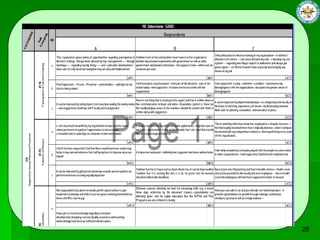
12.Analysis Grid


After having done all the analysis and the code book
the researcher will develop an analysis grid
(spreadsheet) manually or using Microsoft excel
integrating all major categories taking interviewees at
one side and the categories at top. Then reviewing all
the transcripts the researcher will fill in all the
statements with coded reference against each
statement


                   SUPERIOR GROUP OF COLLEGES
Interpret your findings

On getting completed the analysis grid as outcome of the analysis process the
researcher needs to explain his finding using the themes, categories and the
connections between them. Interpreting the data involves attaching meaning
and significance to the analysis.
How to interpret
• Read through the grid
• Develop a list of key points or findings
• Think about what have you learned; the major lessons
• Develop an outline for presenting your findings
• Write down the meanings you derive as per your understanding from the set
  of categories and the quotes from the edited version of transcripts. Stress on
  the more significant findings with the help of excerpts with proper coding.
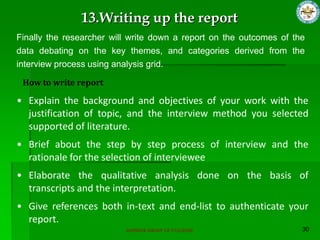
13.Writing up the report
Finally the researcher will write down a report on the outcomes of the
data debating on the key themes, and categories derived from the
interview process using analysis grid.

 How to write report

• Explain the background and objectives of your work with the
  justification of topic, and the interview method you selected
  supported of literature.
• Brief about the step by step process of interview and the
  rationale for the selection of interviewee
• Elaborate the qualitative analysis done on the basis of
  transcripts and the interpretation.
• Give references both in-text and end-list to authenticate your
  report.
                          SUPERIOR GROUP OF COLLEGES
Focus Group

  “A focus group discussion is a tool in which a small group of people (8-10
individuals) engages in a roundtable discussion of selected topics of interest
                       in an informal setting” it can be


1. Group focused
2. Content focused
Document Analysis


It is a systematic process of gathering analyzing,
evaluating and using a very heterogeneous set
of documents including
  i. Personal documents (Diaries, letters, and autobiographies
       etc),
  ii. Public documents (Public inquiry transcripts, magazines,
       newspaper, TV programs etc)
  iii. Organizational documents (Memos, minutes of meeting,
       daily reports etc)
Unstructured Observation

Unstructured observation is the unplanned, informal, watching and recording
of behaviors as they occur in a natural environment.

How to conduct

Take a notebook and pen:

             1.   Note down when you see something interesting.
             2.   Write down theories as you form them.
             3.   Don‟t jump to conclusions straight away.
             4.   Look for more evidence.
             5.   Ask people to confirm things
SUPERIOR GROUP OF COLLEGES   34

QUALITATIVE RESEARCH PROCESS

  • 1.
    In the nameof Allah Kareem, Most Beneficent, Most Gracious, the Most Merciful !
  • 3.
    Qualitative Research Qualitative researchis “an informal, subjective, semi systematic research approaches that usually emphasizes words rather than numbers in the collection and analysis of data” and that is inductive in nature. In other words it generates theory. General Aims Of Qualitative Research: 1- Views of participants 2- It does not claim to generalize 3- Theory generation SUPERIOR GROUP OF COLLEGES
  • 4.
    THE MAIN PREOCCUPATIONSOF QUALITATIVE RESEARCHER These preoccupations reflect epistemologically grounded believes about what constitutes acceptable knowledge. The qualitative researchers are more influenced by interpretivism. In this section five different pre- occupations among qualitative researchers will be outlined and examined 1. See through the eye of the people been studied 2. Emphasis on process of social life 3. Description and the emphasis on contexts 4. Flexibility and limited structure 5. Concept and theory grounded in data
  • 5.
    QUALITATIVE RESEARCH PROCESS 1.General Research Question 2. Selecting Relevant Site(s) and Subjects 3. Collection or Relevant Data 5a. Collection of Further Data 4. Analyze and Interpretation of Data 5. Conceptual and Theoretical Work 5b. Tighter Specification of the Research Question (s) 6. Writing up Findings/Conclusions
  • 6.
    Reliability and Validity Validityrefers to the issues of whether or not an indicator really measures the concept that it is devised to measure whereas Reliability is the stability or the consistency of measurement. 1. Member Checking 2. Triangulation 3. Self-Reflection and Rich thick description 4. External audit 5. Authenticity
  • 7.
    Qualitative Sampling In qualitativeresearch researcher preferably uses non probability sampling that includes: 1. Convenience sampling 2. Snow ball sampling 3. Quota sampling Qualitative Methods In qualitative research four methods are used for data collection that is as follows: 1. Interview 2. Focus group 3. Document analysis 4. Unstructured observation
  • 8.
    What is Interview? “A person to person interaction or debate between two or more individual with a specific purpose in mind.” Types of interviews: There are several types of interviews that are as follows 1. Telephone Interview 2. Email Interview 3. Ethnographic Interview 4. One-on-one interview 5. Group Interview SUPERIOR GROUP OF COLLEGES
  • 9.
    Modes OF INTERVIEWS 1-Structured Interview: This is a fixed format interview in which all questions are prepared beforehand and put in the same order to each interviewee. 2- Unstructured Interview: The interviewer is free to move the conversation in any direction of interest that may come up. Constantly, unstructured interviewing is particularly useful for exploring a topic broadly. 3- Semi structured Interview: In this interview we have a list of questions on fairly specific topics to be covered, often referred to as an interview guide, but the interviewee has a great deal of flexibility in how to reply SUPERIOR GROUP OF COLLEGES
  • 10.
    Comparison Chart (Natureof Interviews) Structure Interviews Un Structure Interviews Semi Structure Interviews b It provides the precision 1- This interview is useful 1- The same questions are and reliability required in for exploring a topic asked of all those involved certain situations broadly 2- This type of interview is 2- Each interviewee is 2- The kind and form of easy to code and enter in the asked a different series of questions go through a software to get the findings. questions process of development to ensure the their topic focus 3- This type of interview took 3- This style lacks the 3- To ensure equivalent less time so in less span of reliability and precision of coverage time more interviews can be structure interview conducted. 4- This interview lacks the 4- Some times interviewer 4- Equivalent interview time free flow of a friendly and interviewee are is allowed in each case conversation diverted from their discussion objective.
  • 11.
    Interview procedure Interview procedureis the set of sequential interdependent activities that results in collection of comprehensive information regarding the research topic. It consists of following steps 1. Interview objectives 2. Methodology 3. Interview composition and screening Geographical coverage: Lahore, Karachi, Islamabad, , Gender: -Males & Females Age: - 25 plus Job Tenure: - Minimum 3 years Positions in organizations - faculty members (minimum lecturer) Usage Pre-requisites: - 20% Inter level - 30% Bachelors level - 50% Masters level Organization type -Private or Public - (Private must be affiliated educational institute, college, University(HEC recognized)
  • 12.
    Interview procedure 4. Interviewschedule S.No. Activity Dates 1 Objective setting and Screener development 14th Nov’ 08 2 Approval of objectives and screener 15th Nov’ 08 3 Selection of sites and respondents 16th – 20th Nov’ 08 4 Development of guidelines and arrangements 16th – 20th Nov’ 08 5 05- interviews (A) 22nd – 28th Nov' 08 6 05- interviews (B) 24th – 28th Nov' 08 7 05- interviews (C) 24th – 28th Nov' 08 8 Transcripts 24th – 8th Dec’ 08 9 Analysis and Report writing 15th Dec’ 08 10 Report submission 17th Dec’ 08 5. Deciding about the ethical issues I. Identifying yourself as researcher II. Developing respondent consent form defining i. the research purposes ii. types of information required iii. confidentiality and anonymity statement iv. surety of security, summary publicity, fair uses of information and wastage of data after due time period
  • 13.
    Interview procedure 6. Discussionguide 7. Questions preparation i. Pruning and revising possible questions ii. Trailing iii. Piloting and pre-piloting iv. Prompts and probing 8. Conducting the interview i. Preparation phase 1. Research area office to be in upright condition (illumination, seating arrangement, noise free, etc) 2. Walkman with new batteries (verified twice). 3. Required documents (screener summary sheets) designed and ready 4. Cassettes (new) to be ready with tags and coding 5. Board markers, plain papers, pencils and other stationary items 6. Moderator guidelines printed and set on the table 7. Refreshment for the interviewee 8. Pick n drop facility for the interviewees 9. Gifts for the interviews as thanks for sparing time 10 Interviewee dress code suitability, matching, colour choice etc .
  • 14.
    Interview procedure ii. Initial contact phase iii. Orientation phase iv. Substantive phase v. Closure phase 09- Transcribing the interviews 10. Analyzing the data i. First Stage Analysis ii. Thematic analysis iii. Stage-structure analysis 11. Coding the data 12. Analysis grid 13. Writing up interview data
  • 15.
    Qualitative Data 'Soft„, Nonnumeric,textual intangible or subjective data that describes but not measure the attributes, characteristics, properties, etc., of a thing or phenomenon. Example Conversation, text, audio, video colors, smells, tastes, textures, or sounds, SUPERIOR GROUP OF COLLEGES
  • 16.
    Qualitative Data Analysis:what & why  Qualitative Data analysis is a process of gathering, modeling, and transforming qualitative data with the goal of  highlighting useful information  suggesting conclusions, and  supporting decision making.
  • 17.
    How to conductQDA: a step by step process 1.Get to know your data 2.Analyze your data 3.interpret your findings 4.prepare your report SUPERIOR GROUP OF COLLEGES
  • 18.
    10.i. Get toknow your Data Good analysis depends on understanding the data. • read and re-read the text. • listen to the tape recordings several times. • Write down any impressions you have. These impressions may be useful later. • Before beginning any analysis, consider the quality of the data and proceed accordingly SUPERIOR GROUP OF COLLEGES
  • 19.
    2. Analyze yourdata Before proceeding to analysis, review the purpose of the evaluation and what you want to find out. Identify a few key questions that you want your analysis to answer. Write down these questions. These will help you decide how to begin. The full process of analyzing a transcription can be split into different stages that were discussed one by one: 1. The first step is just to read each transcription, go through them and highlighting the important statements from each portion as called substantive statements SUPERIOR GROUP OF COLLEGES
  • 20.
    EXAMPLE Excerpt First of allI would like to say few things before I give an answer to it. This is an organization which gives you a plenty of (0.2) you see! Opportunities in which you can participate in decision making. I always:::: been allowed by top management to participate in decision making. Like (0.2) if there are anything regarding hiring faculty or there is any matter regarding curriculum improvement. They have always asked me to participate in decision making and I have always give then decisions and they have always cater those decisions implemented in their systems. Substantive Statement This is an organization which gives you a plenty opportunities in which you can participate in decision making. I always:::: been allowed by top management to participate in decision making. [For example] if there are anything regarding hiring faculty or there is any matter regarding curriculum improvement. [The management] always asked me to participate in decision making and then decisions and they have always catered those decisions implemented in their systems.
  • 21.
    10.ii.Thematic analysis 2. Afteridentifying the substantive statements you should conduct thematic analysis; that is the process of deriving themes out of the substantive statements. Themes can be of two categories. I. Preset Themes II. Emergent Themes i. Basic Theme ii. Organizing Theme iii. Global Theme SUPERIOR GROUP OF COLLEGES
  • 22.
    EXAMPLE (Basic themes) (organizing themes) (global themes) 1. Plenty of opportunities regarding decision 2. decision acceptable by top management 3. decision regarding hiring faculty and curriculum improvement 4. ideas , suggestions are taken when hire any person and Participation in decision making implementing any system 5. decision to have powers and authority regarding the ideas are so much considered by the organization 1. reward is one thing which has made this organization a Supportive singular success HR 2. when the rewards compare with any competitive institution, I feel myself lucky to be a part of this practices organization Fairness of rewards 3. the rewarded ratio is quite high as compare to been unrewarded 4. The effort has been appreciated and they ((management)) have pat on the back, that well done and keep up the good work. 1. growth in my career, the maximum skills and knowledge are gained ((by me)) IN THIS ORGANIZATION Growth Opportunities 2. knowledgeable, up-to-date information
  • 23.
    10.iii.Stage-Structure analysis It isthe process of identifying the stages or levels of the themes while working on the successive interview transcripts, in order to develop the general flow of different stages in the narrative to show the progression. SUPERIOR GROUP OF COLLEGES
  • 24.
    HR PRACTICES Recruitment and selection Participation in decision making Training and development Compensation and reward Job commitment Job Satisfaction Performance
  • 25.
    11.Coding the Data Itis the process of developing a code book for being able to refer to certain respondents‟ words in transcription. In this process the researcher will define codes for each interviewee, category, subcategory, question, and substantive statement. SUPERIOR GROUP OF COLLEGES
  • 26.
    Code: aA1.2 i Global theme Code: Numbers (1,2,3 …...) Organizing theme Code: Decimals (.1,.2,.3,….) Basic theme Code: Roman Numbers (I,ii,iii…..) Question Code: Small letters (a,b,c…..) Interviewee Code: Capital letters (A,B,C…..)
  • 27.
    12.Analysis Grid After havingdone all the analysis and the code book the researcher will develop an analysis grid (spreadsheet) manually or using Microsoft excel integrating all major categories taking interviewees at one side and the categories at top. Then reviewing all the transcripts the researcher will fill in all the statements with coded reference against each statement SUPERIOR GROUP OF COLLEGES
  • 29.
    Interpret your findings Ongetting completed the analysis grid as outcome of the analysis process the researcher needs to explain his finding using the themes, categories and the connections between them. Interpreting the data involves attaching meaning and significance to the analysis. How to interpret • Read through the grid • Develop a list of key points or findings • Think about what have you learned; the major lessons • Develop an outline for presenting your findings • Write down the meanings you derive as per your understanding from the set of categories and the quotes from the edited version of transcripts. Stress on the more significant findings with the help of excerpts with proper coding.
  • 30.
    13.Writing up thereport Finally the researcher will write down a report on the outcomes of the data debating on the key themes, and categories derived from the interview process using analysis grid. How to write report • Explain the background and objectives of your work with the justification of topic, and the interview method you selected supported of literature. • Brief about the step by step process of interview and the rationale for the selection of interviewee • Elaborate the qualitative analysis done on the basis of transcripts and the interpretation. • Give references both in-text and end-list to authenticate your report. SUPERIOR GROUP OF COLLEGES
  • 31.
    Focus Group “A focus group discussion is a tool in which a small group of people (8-10 individuals) engages in a roundtable discussion of selected topics of interest in an informal setting” it can be 1. Group focused 2. Content focused
  • 32.
    Document Analysis It isa systematic process of gathering analyzing, evaluating and using a very heterogeneous set of documents including i. Personal documents (Diaries, letters, and autobiographies etc), ii. Public documents (Public inquiry transcripts, magazines, newspaper, TV programs etc) iii. Organizational documents (Memos, minutes of meeting, daily reports etc)
  • 33.
    Unstructured Observation Unstructured observationis the unplanned, informal, watching and recording of behaviors as they occur in a natural environment. How to conduct Take a notebook and pen: 1. Note down when you see something interesting. 2. Write down theories as you form them. 3. Don‟t jump to conclusions straight away. 4. Look for more evidence. 5. Ask people to confirm things
  • 34.
    SUPERIOR GROUP OFCOLLEGES 34