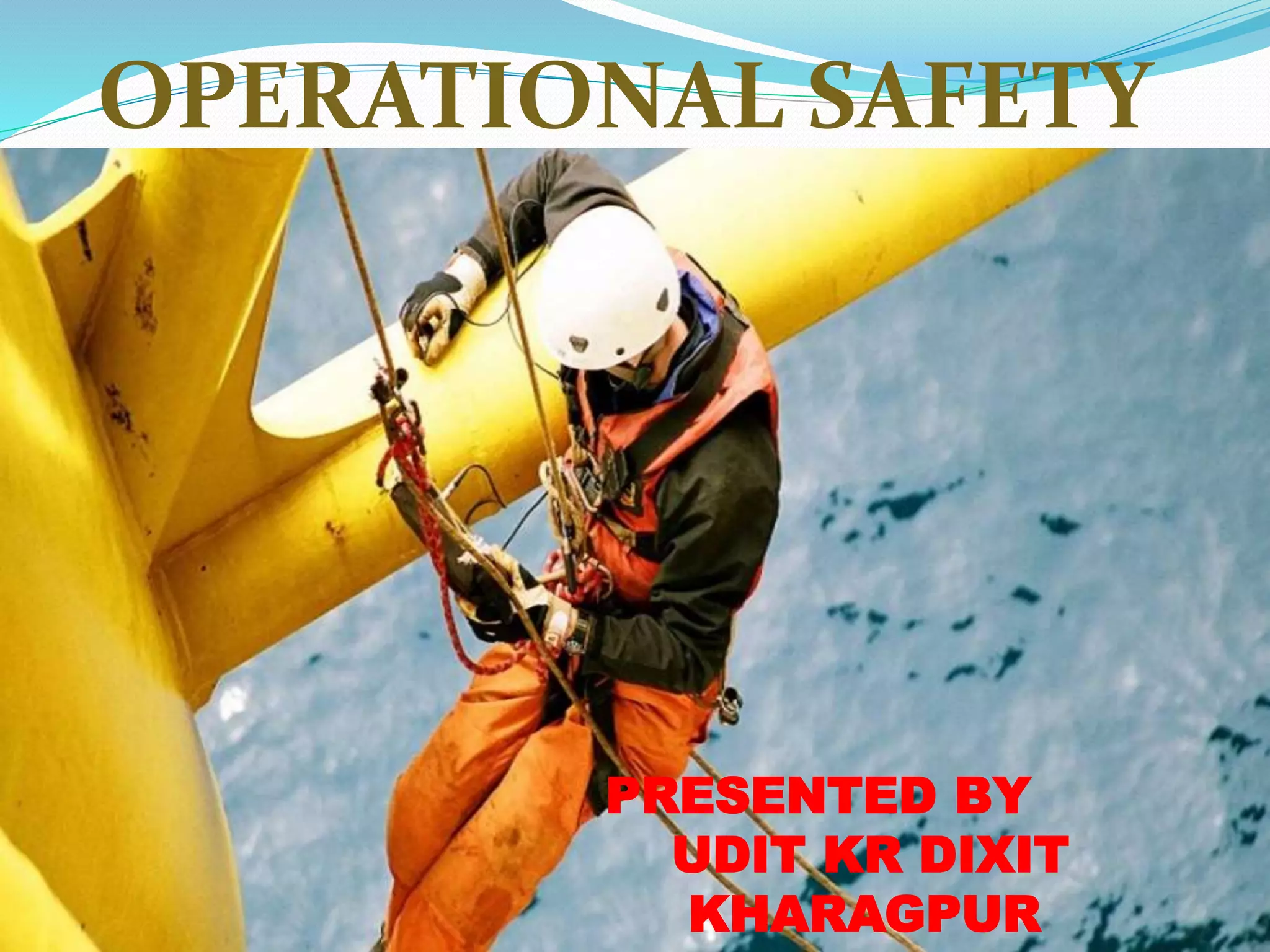
OPERATIONAL SAFETY
PRESENTED BY
UDIT KR DIXIT
KHARAGPUR
OBJECTIVES
At the end of this lesson, you will be able to know about :
1. Safety in a CSSR operation and identify unsafe
actions and unsafe conditions.
2. Describe the CSSR Course safety rules.
3. Describe safety concerns for each phase of a
CSSR operation.
1
OBJECTIVES
4. Describe the function and importance of having
a Safety Officer.
5. . Safety plan and list of the components of the
Safety Briefing .
SAFETY IN A CSSR OPERATION
 CSSR operations are the most complex and
difficult activities that first responder teams face
in the line of duty.
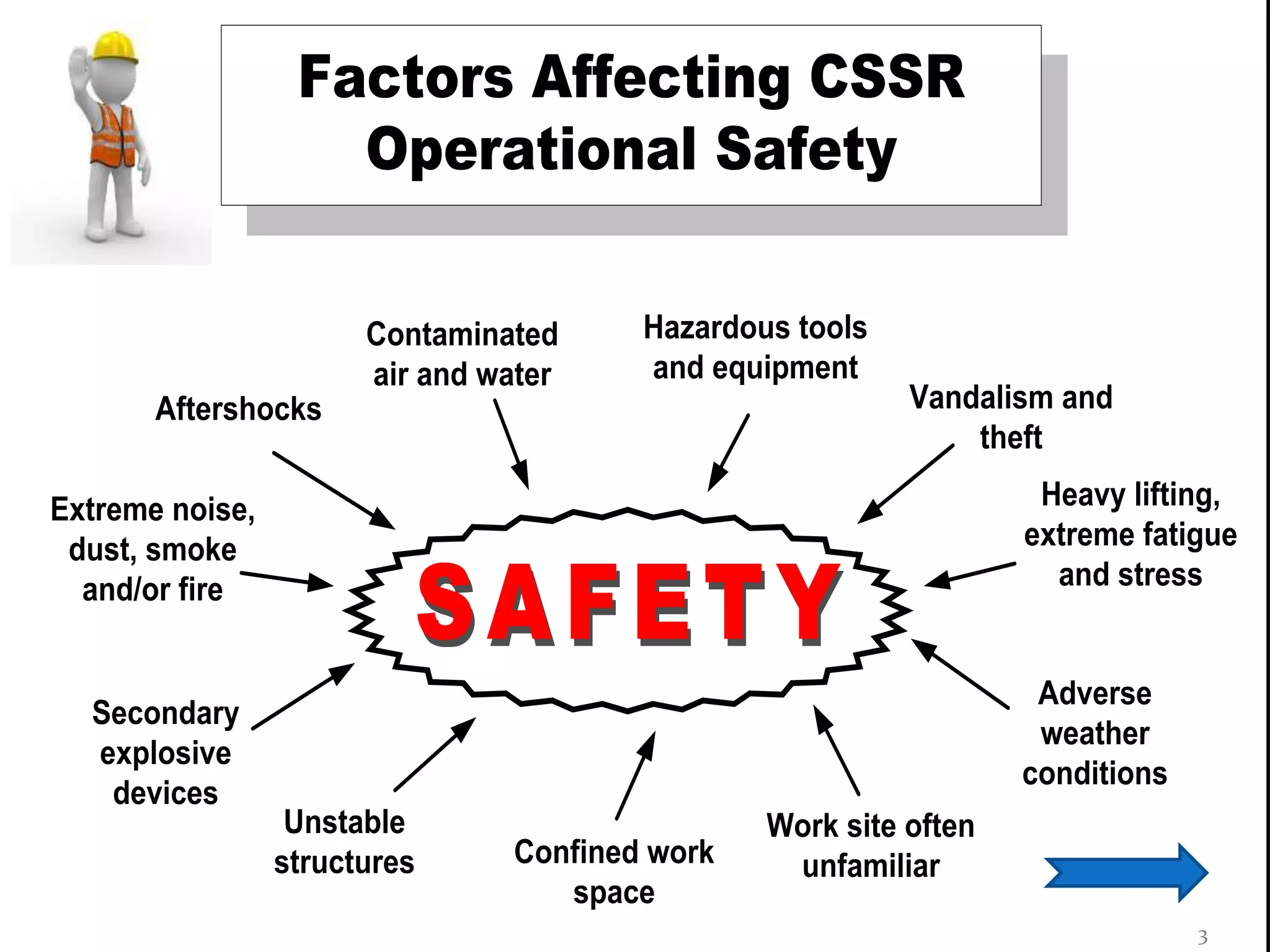
 There may be numerous factors affecting safety
during a CSSR operation, as shown below.
2
Factors Affecting CSSR
Operational Safety
Aftershocks
Contaminated
air and water
Hazardous tools
and equipment
Vandalism and
theft
Heavy lifting,
extreme fatigue
and stress
Adverse
weather
conditions
Work site often
unfamiliarConfined work
space
Extreme noise,
dust, smoke
and/or fire
Unstable
structures
Secondary
explosive
devices
3
SAFE AND UNSAFE ACTIONS AND
CONDITIONS
5
Safe actions and conditions
 Wearing personal protection
equipment (PPE)
 Working in teams
 Using tools correctly
 Taking rest breaks
 Following all recognized safety rules
SAFE AND UNSAFE ACTIONS
AND CONDITIONS
 Unsafe actions and conditions
 A wall beginning to lean
 Overhead structures showing signs of
imminent collapse
 Weather conditions – high wind, rain,
lighting
 Rain can also wash away dirt around
foundations further weakening the
structure
CSSR COURSE SAFETY RULES
all persons involved in any manner with the
course must follow the safety rules outlined
below.
1. Practice areas: No one is allowed to enter
the practice areas without prior
authorisation from the instructor in charge
or the Course Coordinator.
7
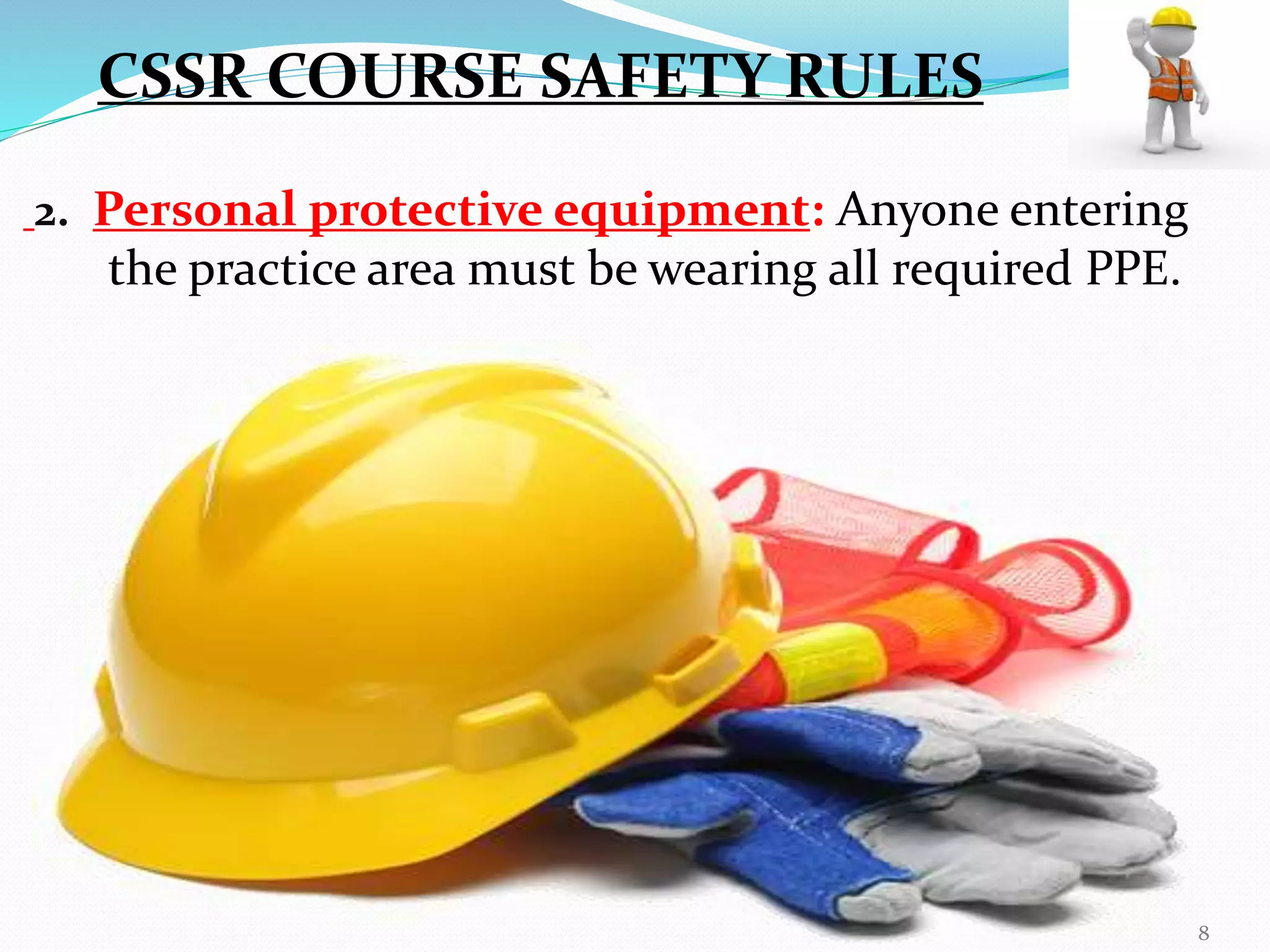
2. Personal protective equipment: Anyone entering
the practice area must be wearing all required PPE.
CSSR COURSE SAFETY RULES
8
CSSR COURSE SAFETY RULES
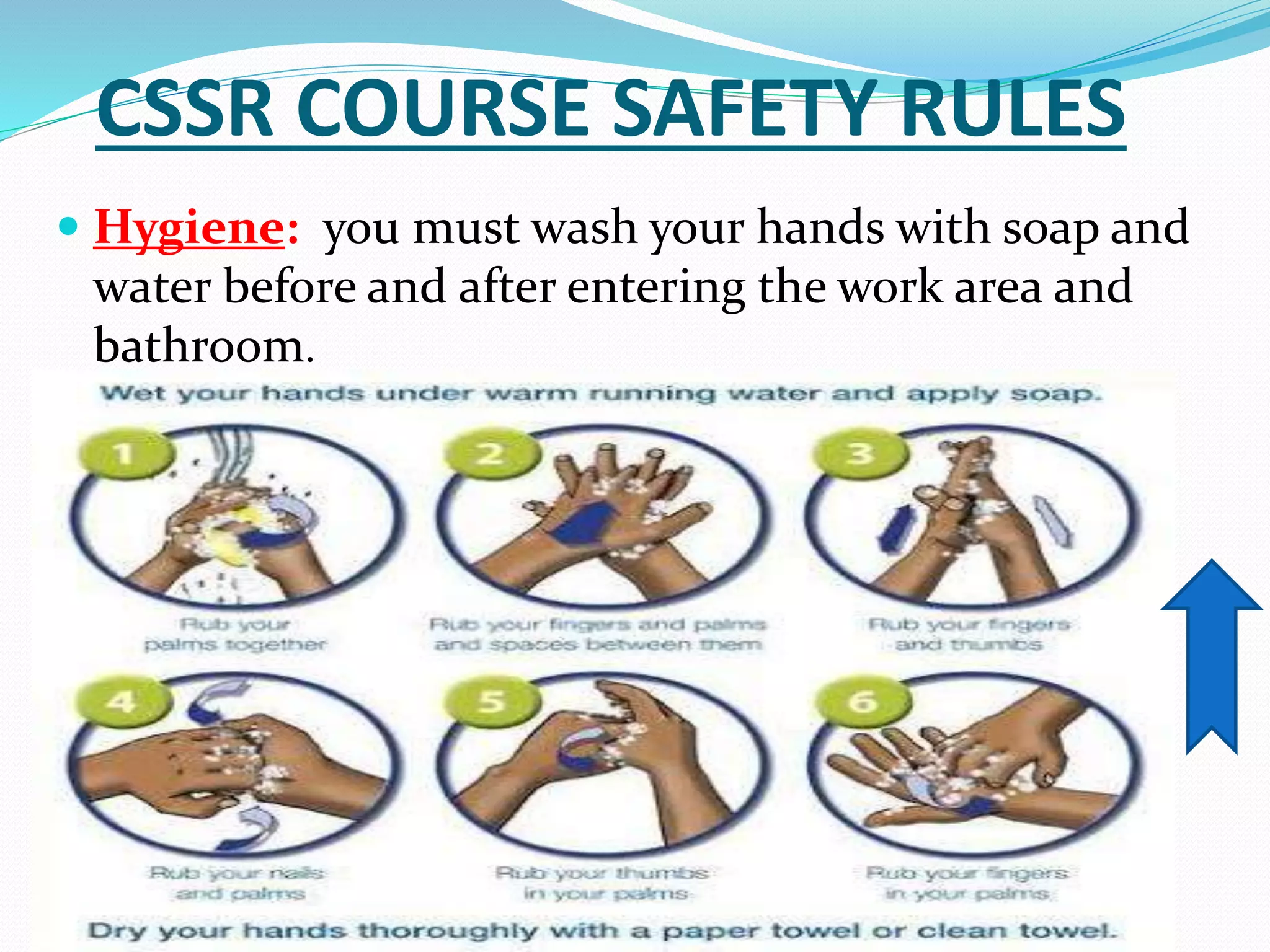
 Hygiene: you must wash your hands with soap and
water before and after entering the work area and
bathroom.
4. Safety officer:
 One individual from the Course personnel will be
the appointed as safety officer.
 This person will be in charge of all safety-related
matters throughout the entire course.
5. Group safety:
 Each instructor and team leader will also be
responsible for the safety of the people in their
respective groups.
 Should you observe any unsafe action or
condition, immediately alert the Safety Officer.
CONT...
9
6. Whistle signals:
 One long signal: stop all work and listen
 One long, one short: continue working.
 Three short signals: evacuate the area immediately
to a previously selected safety zone.
7. Safety Zone:
The Safety Officer will establish a safety zone near
the work area..
CONT...
10
8. Emergency medical services: A MFR kit and a means
of communications must be made available to ensure
EMS arrival within minutes.
9. Fire extinguisher: A portable dry-chemical fire
extinguisher will be available in case of fire out . You
must be aware of its location during the course.
10. Drinking water: During all practical exercises you
must carry a bottle filled with drinking water, to
prevent dehydration.
CONT...
11
11. Maintenance:
You are responsible for maintaining all tools,
equipment and accessories.
12. Rotations:
Each work group must complete personnel rotations
as directed by the Safety Officer.
13. Trash:
All trash must be placed into waste containers.
CONT...
12
14. Smoking and drinking: No smoking or drinking is
allowed in the active work area.
15. Weather conditions: The Safety Officer will decide
whether exercises can continue in the work area
during adverse or threatening weather.
16. Safety markings: All objects or areas in the work
area that may pose a hazard to anyone must be
marked with scene tape or safety cones.
17. Team safety: - All operations involving the use of
tools and equipment must be conducted in pairs.
CONT...
13
18. Safety violations:
 Any participant, who repeatedly violates or
disregards the safety rules of this course, may be
expelled from the course.
19. Miscellaneous: The Course Coordinator will
resolve any other safety issue not specifically covered
in the CSSR Course Safety Rules.
CONT...
14
SAFETY CONSIDERATIONS
DURING MISSION PHASES
 The CSSR Team Leader is responsible for the safety of
his team members.
 Every team member must remain acutely aware of
safety at all times.
15
PREPARATION PHASE
a. A positive attitude toward safety in your team
members during class time and practical exercises.
b. Ensure the safety and well being of our team mates
as well as of those we seek to help.
c. Equipment maintained proper operation, cleaning
and packing.
161
D. Personnel should be well trained and experienced.
They should be prepared physically and mentally.
E. Information well informed of administrative
procedures, functions and problems that may
arise.
F. Also kept up to date on what is happening at
the disaster site if possible.
CONT...
17
ACTIVATION AND MOBILISATION PHASE
 Establish safety procedures and practices from the
start of mission.
 Emphasise safety during briefings.
 Make sure all team members have complete PPE and
are in good mental and physical condition.
 Ensure safety when boarding or air transport.
18
OPERATIONS PHASE
A) Correctly identify the risks in the following:
 Base of Operations
 Work area
B) Include the following in daily briefings:
 Alert and alarm signals.
 Escape routes and meeting places.
 select safety officer, if needed.
 Use of identification vests.
 Medical facility location and transportation
method in case of accident or injury.
19
C) Safety guidelines while working on-site:
 Include safety standards in the work plan.
 Monitor operations and logistical activities for
compliance with safety standards.
 Emphasise accounting for personnel.
 Emphasise personnel rotations.
 Monitor personnel for fatigue and stress.
D) Team leaders must ensure all personnel follow hygiene
rules, especially before and after eating.
E) Report and investigate all injuries and accidents.
CONT...
20
DEACTIVATION AND DEMOBILISATION
PHASE
Similar to the Activation and Mobilisation Phase.
Emphasise fatigue, stress and post-traumatic stress
disorder (PTSD).
22
Post mission activities
As soon as possible, document strong and weak safety
points of mission.
a)Include all info in mission report, including lessons
learned.
b) Hold post-mission evaluation session with all CSSR
team members to evaluate all aspects of mission.
c) Document how to improve specific safety
procedures.
e) Replace all worn or deteriorated PPE and safety
equipment.
SAFETY OFFICER
 The person tasked with this responsibility must
resist the temptation to become involved in the
tactical operations him/herself.
 This requires extreme self-discipline.
 The Safety Officer or Lookout works from a position
of safe and clear visual access just outside of the
direct work area.
23
 This person must not become involved in the
operation.
They should be readily identifiable to all, by their
radio designation and by wearing a “Safety Officer” vest
and identified during the safety briefing.
CONT...
24
 Overall Safety Officer for the entire CSSR
operation.
 Site-Specific Safety Officer is responsible for a
working rescue.
 Special Hazards Safety Officer is a person or a
team assigned to a specific location to monitor a
special hazard.
Categories of Safety Officer
25
 The multi-hazard safety plan is a guide to the
basic elements of safety for a variety of
incidents.
 The acronym used is LCES, which stands for
Lookouts, Communications, Escape Routes,
and Safe Zones.
SAFETY PLAN
26
 This is normally the function of the dedicated
Safety Officer.
 That person is the objective observer not involved
in the hands-on portion of the operation and
watching over the entire operation .
 identifying potentially dangerous situations and
addressing them before they become disastrous.
Lookouts
27
Communications
 The Communications Specialist develops the
formal communications plan.
 This plan will identify the Command, tactical
and special radio channels.
 These are the operations personnel’s lifeline to
the outside for resources, support, and safety.
Escape Routes
An escape route is a pre-established path to an area of
safe refuge.
The safest method of exiting an area may not be the
most direct route.
Safe zones
Safe zones, also referred to as “safe havens” are the pre-established
areas of safe refuge, meaning they are safe from hazards.
 This could be a designated area outside the hot zone or a safe area
agreed upon within the hot zone.
 If the safe zone is within the hot area, rescuers may have to
construct that area around the victims and themselves.
28
 Chain of Command
 Identifying the Safety Officer
 Safety Plan (LCES)
 Communication plan
 Medical plan
 Rehabilitation plan
 Special hazards
 General safety messages
COMPONENTS OF THE SAFETY
BRIEFING
29
REVIEW
After end of this lesson, you are now able to know .
1. Safety in a CSSR operation and identify unsafe
actions and unsafe conditions.
2. About CSSR Course safety rules.
3. safety concerns for each phase of a CSSR
operation.
4. Function and importance of having a Safety
Officer.
5. Safety plan and list of the components of the
Safety Briefing .
30
EVALUATION
Q :- what is the full form of PTSD ?
A :- Post Traumatic Stress Disorder.
Q :- LCES stands for ?
A :- Lookouts , Communications , Escape Routes ,
Safe Zones.
CONCLUSION
 THERE IS VERY IMPORTANT TO OBEY ALL
SAFETY RULES AND PROCEDURES SO THAT CAN
NOT HAPPEN ANY INJURY OR CASUELTY DURING
OPERATION
31
operational safety
operational safety

operational safety

  • 1.
  • 2.
    OBJECTIVES At the endof this lesson, you will be able to know about : 1. Safety in a CSSR operation and identify unsafe actions and unsafe conditions. 2. Describe the CSSR Course safety rules. 3. Describe safety concerns for each phase of a CSSR operation. 1
  • 3.
    OBJECTIVES 4. Describe thefunction and importance of having a Safety Officer. 5. . Safety plan and list of the components of the Safety Briefing .
  • 4.
    SAFETY IN ACSSR OPERATION  CSSR operations are the most complex and difficult activities that first responder teams face in the line of duty.  There may be numerous factors affecting safety during a CSSR operation, as shown below. 2
  • 5.
    Factors Affecting CSSR OperationalSafety Aftershocks Contaminated air and water Hazardous tools and equipment Vandalism and theft Heavy lifting, extreme fatigue and stress Adverse weather conditions Work site often unfamiliarConfined work space Extreme noise, dust, smoke and/or fire Unstable structures Secondary explosive devices 3
  • 6.
    SAFE AND UNSAFEACTIONS AND CONDITIONS 5 Safe actions and conditions  Wearing personal protection equipment (PPE)  Working in teams  Using tools correctly  Taking rest breaks  Following all recognized safety rules
  • 7.
    SAFE AND UNSAFEACTIONS AND CONDITIONS  Unsafe actions and conditions  A wall beginning to lean  Overhead structures showing signs of imminent collapse  Weather conditions – high wind, rain, lighting  Rain can also wash away dirt around foundations further weakening the structure
  • 8.
    CSSR COURSE SAFETYRULES all persons involved in any manner with the course must follow the safety rules outlined below. 1. Practice areas: No one is allowed to enter the practice areas without prior authorisation from the instructor in charge or the Course Coordinator. 7
  • 9.
    2. Personal protectiveequipment: Anyone entering the practice area must be wearing all required PPE. CSSR COURSE SAFETY RULES 8
  • 10.
    CSSR COURSE SAFETYRULES  Hygiene: you must wash your hands with soap and water before and after entering the work area and bathroom.
  • 11.
    4. Safety officer: One individual from the Course personnel will be the appointed as safety officer.  This person will be in charge of all safety-related matters throughout the entire course. 5. Group safety:  Each instructor and team leader will also be responsible for the safety of the people in their respective groups.  Should you observe any unsafe action or condition, immediately alert the Safety Officer. CONT... 9
  • 12.
    6. Whistle signals: One long signal: stop all work and listen  One long, one short: continue working.  Three short signals: evacuate the area immediately to a previously selected safety zone. 7. Safety Zone: The Safety Officer will establish a safety zone near the work area.. CONT... 10
  • 13.
    8. Emergency medicalservices: A MFR kit and a means of communications must be made available to ensure EMS arrival within minutes. 9. Fire extinguisher: A portable dry-chemical fire extinguisher will be available in case of fire out . You must be aware of its location during the course. 10. Drinking water: During all practical exercises you must carry a bottle filled with drinking water, to prevent dehydration. CONT... 11
  • 14.
    11. Maintenance: You areresponsible for maintaining all tools, equipment and accessories. 12. Rotations: Each work group must complete personnel rotations as directed by the Safety Officer. 13. Trash: All trash must be placed into waste containers. CONT... 12
  • 15.
    14. Smoking anddrinking: No smoking or drinking is allowed in the active work area. 15. Weather conditions: The Safety Officer will decide whether exercises can continue in the work area during adverse or threatening weather. 16. Safety markings: All objects or areas in the work area that may pose a hazard to anyone must be marked with scene tape or safety cones. 17. Team safety: - All operations involving the use of tools and equipment must be conducted in pairs. CONT... 13
  • 16.
    18. Safety violations: Any participant, who repeatedly violates or disregards the safety rules of this course, may be expelled from the course. 19. Miscellaneous: The Course Coordinator will resolve any other safety issue not specifically covered in the CSSR Course Safety Rules. CONT... 14
  • 17.
    SAFETY CONSIDERATIONS DURING MISSIONPHASES  The CSSR Team Leader is responsible for the safety of his team members.  Every team member must remain acutely aware of safety at all times. 15
  • 18.
    PREPARATION PHASE a. Apositive attitude toward safety in your team members during class time and practical exercises. b. Ensure the safety and well being of our team mates as well as of those we seek to help. c. Equipment maintained proper operation, cleaning and packing. 161
  • 19.
    D. Personnel shouldbe well trained and experienced. They should be prepared physically and mentally. E. Information well informed of administrative procedures, functions and problems that may arise. F. Also kept up to date on what is happening at the disaster site if possible. CONT... 17
  • 20.
    ACTIVATION AND MOBILISATIONPHASE  Establish safety procedures and practices from the start of mission.  Emphasise safety during briefings.  Make sure all team members have complete PPE and are in good mental and physical condition.  Ensure safety when boarding or air transport. 18
  • 21.
    OPERATIONS PHASE A) Correctlyidentify the risks in the following:  Base of Operations  Work area B) Include the following in daily briefings:  Alert and alarm signals.  Escape routes and meeting places.  select safety officer, if needed.  Use of identification vests.  Medical facility location and transportation method in case of accident or injury. 19
  • 22.
    C) Safety guidelineswhile working on-site:  Include safety standards in the work plan.  Monitor operations and logistical activities for compliance with safety standards.  Emphasise accounting for personnel.  Emphasise personnel rotations.  Monitor personnel for fatigue and stress. D) Team leaders must ensure all personnel follow hygiene rules, especially before and after eating. E) Report and investigate all injuries and accidents. CONT... 20
  • 23.
    DEACTIVATION AND DEMOBILISATION PHASE Similarto the Activation and Mobilisation Phase. Emphasise fatigue, stress and post-traumatic stress disorder (PTSD). 22
  • 24.
    Post mission activities Assoon as possible, document strong and weak safety points of mission. a)Include all info in mission report, including lessons learned. b) Hold post-mission evaluation session with all CSSR team members to evaluate all aspects of mission. c) Document how to improve specific safety procedures. e) Replace all worn or deteriorated PPE and safety equipment.
  • 25.
    SAFETY OFFICER  Theperson tasked with this responsibility must resist the temptation to become involved in the tactical operations him/herself.  This requires extreme self-discipline.  The Safety Officer or Lookout works from a position of safe and clear visual access just outside of the direct work area. 23
  • 26.
     This personmust not become involved in the operation. They should be readily identifiable to all, by their radio designation and by wearing a “Safety Officer” vest and identified during the safety briefing. CONT... 24
  • 28.
     Overall SafetyOfficer for the entire CSSR operation.  Site-Specific Safety Officer is responsible for a working rescue.  Special Hazards Safety Officer is a person or a team assigned to a specific location to monitor a special hazard. Categories of Safety Officer 25
  • 29.
     The multi-hazardsafety plan is a guide to the basic elements of safety for a variety of incidents.  The acronym used is LCES, which stands for Lookouts, Communications, Escape Routes, and Safe Zones. SAFETY PLAN 26
  • 30.
     This isnormally the function of the dedicated Safety Officer.  That person is the objective observer not involved in the hands-on portion of the operation and watching over the entire operation .  identifying potentially dangerous situations and addressing them before they become disastrous. Lookouts 27
  • 31.
    Communications  The CommunicationsSpecialist develops the formal communications plan.  This plan will identify the Command, tactical and special radio channels.  These are the operations personnel’s lifeline to the outside for resources, support, and safety.
  • 32.
    Escape Routes An escaperoute is a pre-established path to an area of safe refuge. The safest method of exiting an area may not be the most direct route. Safe zones Safe zones, also referred to as “safe havens” are the pre-established areas of safe refuge, meaning they are safe from hazards.  This could be a designated area outside the hot zone or a safe area agreed upon within the hot zone.  If the safe zone is within the hot area, rescuers may have to construct that area around the victims and themselves. 28
  • 33.
     Chain ofCommand  Identifying the Safety Officer  Safety Plan (LCES)  Communication plan  Medical plan  Rehabilitation plan  Special hazards  General safety messages COMPONENTS OF THE SAFETY BRIEFING 29
  • 34.
    REVIEW After end ofthis lesson, you are now able to know . 1. Safety in a CSSR operation and identify unsafe actions and unsafe conditions. 2. About CSSR Course safety rules. 3. safety concerns for each phase of a CSSR operation. 4. Function and importance of having a Safety Officer. 5. Safety plan and list of the components of the Safety Briefing . 30


  • 35.
    EVALUATION Q :- whatis the full form of PTSD ? A :- Post Traumatic Stress Disorder. Q :- LCES stands for ? A :- Lookouts , Communications , Escape Routes , Safe Zones.
  • 36.
    CONCLUSION  THERE ISVERY IMPORTANT TO OBEY ALL SAFETY RULES AND PROCEDURES SO THAT CAN NOT HAPPEN ANY INJURY OR CASUELTY DURING OPERATION 31