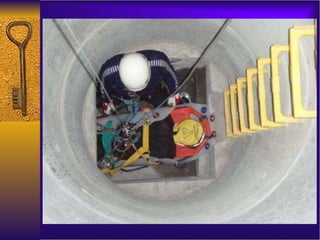
Confined Space Awareness Captain Mo Johnson CRFA
Objectives Recognize a Confined Space Recognize a Permit Required C.S. History of Confined Space Fatalities Understand OSHA, NFPA and C.S. Recognize the hazards of a C.S. Required components
A Confined Space is… An area large enough and so configured that an employee can bodily enter to perform assigned work and: Has limited or restricted means for entry/egress and; Is not designed for continuous employee occupancy
A Permit Required Confined Space… Contains or has the  potential  to contain a hazardous atmosphere  or , Contains a material that has the potential for engulfing an entrant  or , Has an internal configuration such that an entrant could become trapped or asphyxiated by inwardly converging walls or by a floor which slopes downward and tapers to a smaller cross-section  or , Contains any other recognized serious safety or health hazard
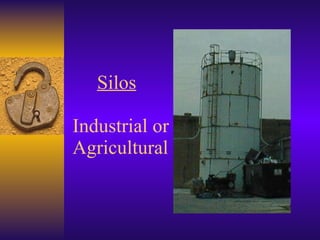
Silos Industrial or Agricultural
 
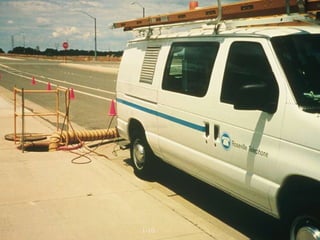
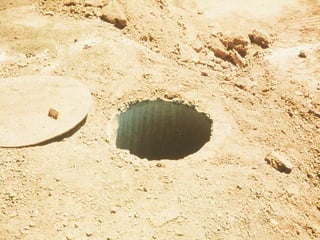
Manholes Sanitary  or  Storm
Types of Confined Spaces Sewers Railroads Cars Vaults and pits Vessels, silos, storage bins Hoppers, pipelines
Reason for Entering A Confined Space Cleaning Inspections Maintenance Training Rescue
1-13 1-13
1-12 1-12
1-10 1-10
1-9 1-9
1-8 1-8
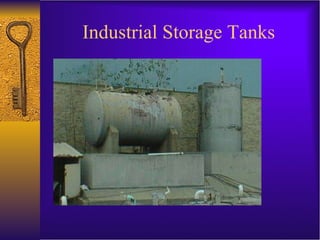
Industrial Storage Tanks


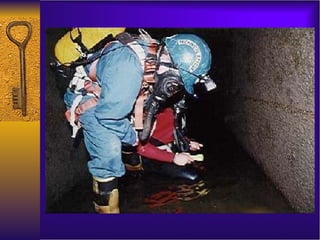
Precious Time
NIOSH “139 Fatalities in 2 years …” 100% had no detector or ventilation 95% had no Confined Space training 89% Management said “it’s safe to enter.” 80% employees “we always did it this way” 66% involved water/wastewater 60% were rescuers
Recognize the Danger: A major cause of confined space injuries/fatalities is the failure to recognize the incident for what it is…. A CONFINED SPACE INCIDENT !
Why is Confined Space Awareness Important? OSHA/NFPA compliant Service to Community Rescuer(s) Deaths
Always  keep in mind Assess Survival Profile of Victim !!!!! According to statistic we are going after victims  not  patients Provision for non-entry rescue Every C.S. incident will be investigated by OSHA. Entry into a C.S. is mission specific
OSHA will be looking for… The C.S. to determine if it meets the requirements for a Permit Required Confined Space (p.r.s.c.) Two permits Training records (authorized) Provision(s) for non-entry rescue
3 Most Common OSHA Citations issued in Calif. Failure to provide hazard(s) communication to rescuers Failure to provide appropriate equipment Failure to provide training on equipment
Regulations vs. Standards OSHA 1910.146 (Federal level) (CCR) Title 8 sec. 5157 (State level) NFPA 1670 ( Standard on Operations and Training for Technical Rescue Incidents)
Regulations AB 111 “ be a manager – go to jail” AB 1127 “The Big One” Jan. 2000 Title 8 CCR GISO 5156, 5157 & 5158 NFPA 1670, 1006
AB 1127 “$$” ■   Enacted in January 2000.  Says we show up, allow something to happen, somebody gets injured/killed, we share responsibility. ■  Employers, managers, or supervisors can be held liable Is Prosecuted as a Felony!!
AB 1127  cont’d ■  State, County, Districts no longer exempt  from civil penalties levied due to Cal-OSHA ■  Time to file increased from 30 to 180 days ■  Increase in fines for misdemeanors from $5,000 to $15,000 ■   Prison terms from 6 months to one year
AB 1127  cont’d Willful misdemeanor or felony violations causing death or permanent or prolonged impairment -   From $70,000 to $250,000 -   Prison terms from 6 months to 3 years -   Repeat penalty $5,000  - $70,000 - Failure to abate up to $30,000 per day
Title 8 CCR GISO 5156  - 8 exclusions 5157 – how to enter a C.S. 5158  - minimum standards for those 8 exclusions
Title 8 CCR, 5156… Grants an exclusion to  Construction operations Agricultural operations Marine terminal operations Shipyard operations Telecommunications manholes/Vaults Grain handling facilities Natural gas distribution Electrical utility operations underground vaults
Title 8 CCR, 5157… Specific requirements on how to enter a Permit Required Confined Space. Applies to Rescue Companies Lists the  mandatory  components Includes appendices that may be enforceable by OSHA
Title 8 CCR, 5158… Lists requirements for those 8 industries that are exempted under 5156(b) (2)
NFPA 1670  - Standard on Operations and Training for Technical Rescue Incidents  1006 Standard for Rescue Technician Professional Qualifications
Hazards to Rescuers…. 65% Atmosphere 13% Engulfment 7% Struck by Falling Objects 6%  Heat Stress/Exposure  4%  All Others
Reasons for Monitoring Assess the survival profile of the victim Atmospheres are the #1 killer of C.S. occupants
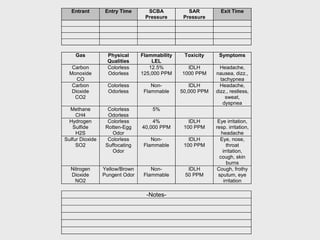
Hazardous Atmospheres Oxygen levels below 19.5%  or above 23.5% Atmosphere at or above 10% of the LEL Airborne combustible dusts which reduce vision to 5’ or less Atmosphere with products/vapors at or above their IDLH levels.
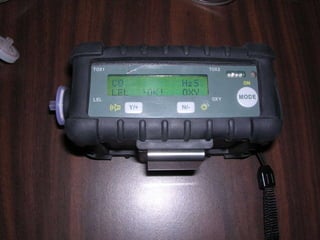
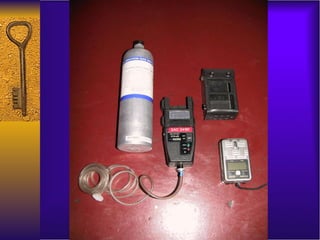
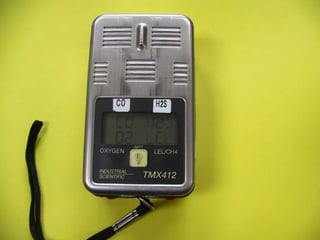
What are we monitoring for ? Oxygen Flammable/Explosive atmospheres Selected toxics Usually CO & H2S
Oxygen Recorded as a % OSHA says 19.5% - 23.5% is acceptable entry range -Oxygen is always checked  first
Percent Oxygen Physiological Effect 19.5% - 16% No visible effect 16% - 12% Respiration  , heartbeat  , thinking,  attention & coordination 14% - 10% Bad judgement, poor muscular coordination,  fatigue,  respiration 10% - 6% Nausea, vomitting, slow to move Below 6% Difficulty breathing, unconsciousness, death
Flammable or Explosive atmospheres Usually recorded as % LEL, ppm or % gas 10% of the LEL is the upper limit for entry Difference between LEL 100% & vapor 100%
Automobile   analogy
Hydrogen Sulfide H2S Colorless, odor of rotten eggs Destroys olfactory senses 10 ppm entry limit Flammable & explosive in high %
Carbon Monoxide (CO) Colorless, odorless, explosive ppm  25 ppm is limit for entry


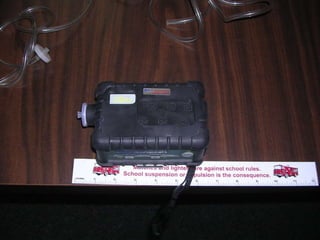
Monitor care Calibration – known gas, monthly Bump test – Daily to check alarm points of monitor Don’t immerse in fluids
How we monitor Prior to entry (approach monitoring) Continuously during entry At 4’ intervals Document!!
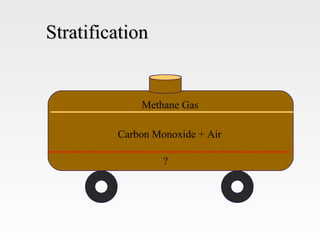
Stratification Methane Gas Carbon Monoxide + Air ?
Real world… You are on the scene of a confined space rescue for a report of a man down in a rail tank car. Witnesses on scene stated the man was cleaning the tank and hasn’t been heard from in 20 minutes. You are sitting on top of the tank car with a 4 gas indicator and your initial readings are 0 for CO, H2S and LEL. O2 reads 21.9%. A few minutes later you have 0 for CO, H2S and LEL and 20.9% O2.  Is the atmosphere safe to breath?
 
 
OSHA Says these are  Mandatory  Positions Entry Supervisor Attendant Entrant Back-up entrant
Entry Supervisor Know the hazards that may be faced during entry and work Verify the appropriate entries have been made on the permit Terminate the entry Verify rescue services are available Deny unauthorized individuals from entering C.S. Determine entry/work is consistent with permit
Attendant Know the hazards that may be faced during entry and work  Know the behavioral effects of exposure Maintain accountability of entrants Communicate with entrants Initiate rescue procedures if needed Prevent unauthorized entry Perform non-entry rescues Perform no conflicting duties
Entrant Know the hazards that may be faced during entry and work  Know the behavioral effects of exposure Communicate with Attendant Alert Attendant of changing conditions
Entry The action by which a person passes through an opening into a permit required confined space, and includes ensuing work activities in that space Considered to have occurred as soon as any part of the entrants body breaks the plane of an opening into the space
Back-up Entrant Know the hazards that may be faced during entry and work  Know the behavioral effects of exposure Communicate with Attendant Alert Attendant of changing conditions Be properly equipped and ready to enter if necessary.
 
Mandatory Components for a C.S. entry Written Policy (including Permit) Lock out/Tag out Provide rescue/standby Atmospheric monitoring Communications Ventilation (unless it increases hazard) Retrieval Line (provision for non-entry rescue) Appropriate harness Mechanical Advantage if  > 5’ fall
Written Policy includes Department SOPs* for C. S. Incidents General outline of operations Procedures Responsibilities Minimum Safety requirements Includes permit * Must be flexible
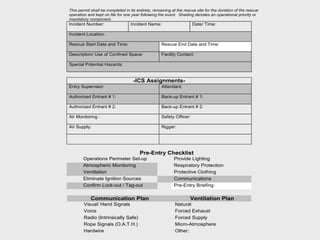
Entry Permit The written or printed document provided by the Authority Having Jurisdiction  (AHJ) to allow and control entry to a permit space
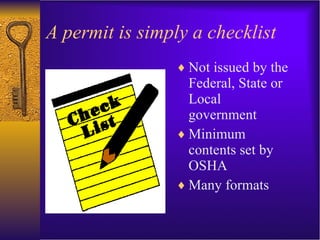
A permit is simply a checklist Not issued by the Federal, State or Local government Minimum contents set by OSHA Many formats
Permit Entry Confined Space Procedure Use of the Permit Entry Confined Space Program: Prevents unauthorized entry Identifies and evaluates hazards before entry
The Entry Permit must provide the following information: Permit Space(s) to be entered Purpose of entry Date and authorized duration of entry permit Authorized entrants Attendants Entry Supervisors, by printed name and signature
Hazards of the permit space Measures required to control hazards of the space Acceptable entry conditions Test results with signature or initials of tester(s) Rescue services, and the means to summon them
Communication procedures and equipment are on site All special equipment and procedures, including personal protective equipment and rescue equipment Any other information needed to ensure safe entry


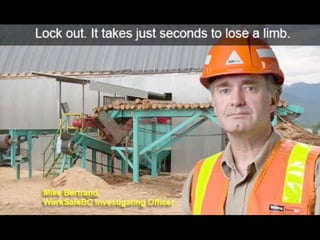
Lock out/Tag out Procedures performed to isolate any potential energy source that may adversely impact the entrant
Lock out/Tag out The  key  to a successful lockout/tagout is retaining someone intimately familiar with the electrical and mechanical systems in the area, plant or space you are making entry.  Allow personnel to brief you on their systems!!
 
Establish Safe Practices… Isolation Purging Inerting Ventilation Barricades Lock-out/Tag-out
Isolation The process by which a permit required confined space is removed from service and completely protected against the release of energy and/or material into the confined space by such means as: Blanking and bleeding Removing sections of lines, pipes or ducts Double block and bleed Lock-out, tag-out, or tryout of all sources of energy Blocking or disconnecting of all linkages
 
Lock-Out/Tag-Out Kit Padlocks Hasps & tags Plug &valve covers Chain Electrical Tester
 
Padlocks & Hasps/Tags
Covers & Limiting Devices
Locking Out a Plug
Lock-Out & Tag-Out of  Electrical Disconnect Switch
 
Use of limiting device on  quarter-turn valve
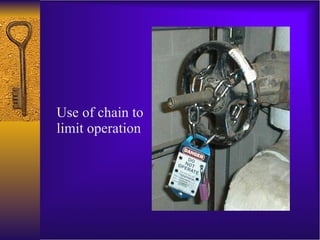
Use of chain to limit operation
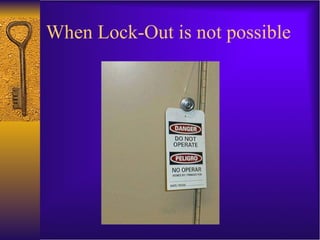
When Lock-Out is not possible
Removing belt and chain drives, mechanical linkages when possible A computer from a remote location can turn on equipment or release a product Blanking and bleeding - pneumatic and hydraulic lines Securing - mechanical moving parts within a confined space with chains, bars, chocks, blocks and other devices Double block and bleed
 
Methods of Communication
Communications 5157 states mandatory between Attendant & Entrant Radio Hardwired Rope signals O.A.T.H.
Radios Won't turn corners Difficulty in thick cement structures Difficulty underground May need to be intrinsically safe
Life Line “OATH” O -  OK, 1 pull of rope A - Advance line, 2 pulls of rope T  - Take up slake, 3 pulls of rope H - HELP! 4 or more pulls of rope
Hand signals Sight Voice
Ventilation The planned and systematic release and removal of gases and the replacement of these gases with a supply of fresh air The same objective as at a structure fire
Ventilation Increases survivability profile - reduces LEL’s to safe levels - temperature conducive for human habitation Replaces contaminated air Air exchanges Reduces explosion chances
Types of Ventilation Positive pressure Negative pressure Positive/negative pressure Micro atmosphere
Consider Characteristics of Gases Vapor densities Stratification
Recirculation  Clean Air Exhaust   Air Contaminated air
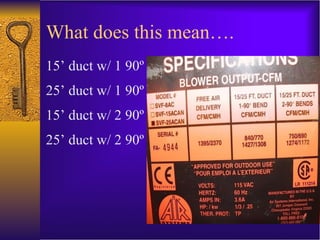
Blower considerations CFM (usually stamped on blower) The length of blower hose and the number of bends will affect the CFM achieved Tubing in hole should not obstruct exhaust gases, should allow one person to enter and exit The blower should not be closer than 5 feet to confined space opening
 
 
What does this mean…. 15’ duct w/ 1 90 º  =  60% 25’ duct w/ 1 90 º  =  55% 15’ duct w/ 2 90 º  =  54% 25’ duct w/ 2 90 º  =  49%
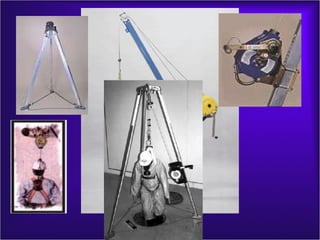
Retrieval System The equipment including a retrieval line, class III harness, wristlets, if appropriate, (and lifting device) used for  non-entry rescue  of workers from a permit-required confined space
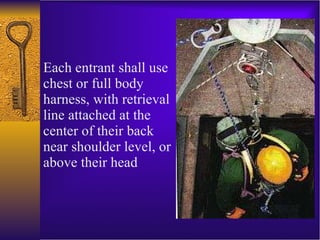
Retrieval Line & Harness Rope attached to M.A. or fixed point outside of C.S. Harness - full body type with connection at center of back at shoulder level. “Smallest possible profile” “ Rules of Dis-engagement”
Each entrant shall use chest or full body harness, with retrieval line attached at the center of their back near shoulder level, or above their head
 
Mechanical Advantage Required for vertical C.S. more than 5’ deep Hand operated, approved winch w/ cable Rope and pulleys with brake Not considered the retrieval line
 
 
Optional C.S. Positions  Monitoring officer Rigger Air Supply Officer Line tender Ventilation officer Safety officer*
Respiratory Protection  When is it mandatory?
Types of Respiratory Protection APR - Air Purifying Respirator SCBA – Self Contained Breathing Apparatus SAR - Supplied Air Respirator
SCBA and Supplied Air Units Compatible air system with supplied air systems Supplied air system 10 minute escape bottle recommended One person with the main system Keep short distances for possible kinking of hose 300 foot maximum


Immediately Dangerous to Life and Health (IDLH)  Any  condition that: Poses an immediate or delayed threat to life Would cause irreversible adverse health effects Would interfere with an individuals ability to self-rescue from a permit space
Weather The environment for time of season and day is extremely influencing: Rain Snow Heat Cold Extremes in Humidity
Recognize overexposure to yourself and co-workers Headache Dizziness Nausea Smell or rotten eggs Euphoria
Personal Protective Equipment Components Hard hats Lights Radios Boots Eye and Hearing protection Splash protection SCBA Turn-outs (fire gear) Hazardous materials protection
Record keeping  Types of records Training Permits Incidents Medical surveillance - can use OSHA's Hazardous Materials Regulations for this Equipment maintenance
Record Retention Must be kept for a minimum of one year (Permits) Exposure records must be kept for 40 years or for 30 years after employment termination
Fire/Rescue Emergency Response Procedures
Initial Operations Recognize it as a Confined Space! Institute Incident Command System Call for appropriate resources Prevent unauthorized personnel from entering area Determine survivability profile of victim
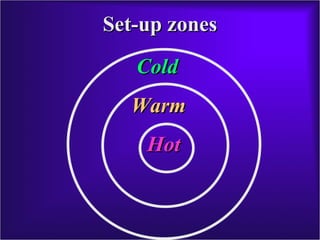
Set-up zones Cold Warm Hot
Hot  = Operations zone is within 15 feet of victim.  No person allowed except rescuers approved by operations officer.  Warm  = Control zone is within 50 feet of victim.  All rescuer staging occurs in this area.  No apparatus allowed in control zone.  Cold =  Exclusion zone is 150 feet of victim.  Apparatus and media are staged in this area.  Public is held outside exclusion zone.
Perimeters designated by barricade tape or rope and police guard Cold Warm Hot Zone distances may be adjusted as appropriate or circumstances allow
Protect portal Visually check for hazards from outside Monitor air quality with meter Ventilate confined space Set-up tri-pod or other fixed point Set-up retrieval system and tag lines Proper PPE Provide adequate lighting Establish communications methods
Re-evaluate the plan when …. Conditions change within the space New hazards are discovered Crews are fatigued Constantly
Planning Establish a confined space training program Make personnel aware of hazards Train personnel in tasks that your department can perform safely Preplan a confined space rescue response Develop a procedure for first in companies Develop a response plan with local area fire departments and industry
The End Any Questions?

Confined Space Awareness

  • 1.
  • 2.
    Confined Space AwarenessCaptain Mo Johnson CRFA
  • 3.
    Objectives Recognize aConfined Space Recognize a Permit Required C.S. History of Confined Space Fatalities Understand OSHA, NFPA and C.S. Recognize the hazards of a C.S. Required components
  • 4.
    A Confined Spaceis… An area large enough and so configured that an employee can bodily enter to perform assigned work and: Has limited or restricted means for entry/egress and; Is not designed for continuous employee occupancy
  • 5.
    A Permit RequiredConfined Space… Contains or has the potential to contain a hazardous atmosphere or , Contains a material that has the potential for engulfing an entrant or , Has an internal configuration such that an entrant could become trapped or asphyxiated by inwardly converging walls or by a floor which slopes downward and tapers to a smaller cross-section or , Contains any other recognized serious safety or health hazard
  • 6.
    Silos Industrial orAgricultural
  • 7.
  • 8.
  • 9.
    Types of ConfinedSpaces Sewers Railroads Cars Vaults and pits Vessels, silos, storage bins Hoppers, pipelines
  • 10.
    Reason for EnteringA Confined Space Cleaning Inspections Maintenance Training Rescue
  • 11.
  • 12.
  • 13.
  • 14.
  • 15.
  • 16.
  • 17.
  • 18.
  • 19.
  • 20.
  • 21.
  • 22.
  • 23.
  • 24.
  • 25.
  • 26.
  • 27.
  • 28.
    NIOSH “139 Fatalitiesin 2 years …” 100% had no detector or ventilation 95% had no Confined Space training 89% Management said “it’s safe to enter.” 80% employees “we always did it this way” 66% involved water/wastewater 60% were rescuers
  • 29.
    Recognize the Danger:A major cause of confined space injuries/fatalities is the failure to recognize the incident for what it is…. A CONFINED SPACE INCIDENT !
  • 30.
    Why is ConfinedSpace Awareness Important? OSHA/NFPA compliant Service to Community Rescuer(s) Deaths
  • 31.
    Always keepin mind Assess Survival Profile of Victim !!!!! According to statistic we are going after victims not patients Provision for non-entry rescue Every C.S. incident will be investigated by OSHA. Entry into a C.S. is mission specific
  • 32.
    OSHA will belooking for… The C.S. to determine if it meets the requirements for a Permit Required Confined Space (p.r.s.c.) Two permits Training records (authorized) Provision(s) for non-entry rescue
  • 33.
    3 Most CommonOSHA Citations issued in Calif. Failure to provide hazard(s) communication to rescuers Failure to provide appropriate equipment Failure to provide training on equipment
  • 34.
    Regulations vs. StandardsOSHA 1910.146 (Federal level) (CCR) Title 8 sec. 5157 (State level) NFPA 1670 ( Standard on Operations and Training for Technical Rescue Incidents)
  • 35.
    Regulations AB 111“ be a manager – go to jail” AB 1127 “The Big One” Jan. 2000 Title 8 CCR GISO 5156, 5157 & 5158 NFPA 1670, 1006
  • 36.
    AB 1127 “$$”■ Enacted in January 2000. Says we show up, allow something to happen, somebody gets injured/killed, we share responsibility. ■ Employers, managers, or supervisors can be held liable Is Prosecuted as a Felony!!
  • 37.
    AB 1127 cont’d ■ State, County, Districts no longer exempt from civil penalties levied due to Cal-OSHA ■ Time to file increased from 30 to 180 days ■ Increase in fines for misdemeanors from $5,000 to $15,000 ■ Prison terms from 6 months to one year
  • 38.
    AB 1127 cont’d Willful misdemeanor or felony violations causing death or permanent or prolonged impairment - From $70,000 to $250,000 - Prison terms from 6 months to 3 years - Repeat penalty $5,000 - $70,000 - Failure to abate up to $30,000 per day
  • 39.
    Title 8 CCRGISO 5156 - 8 exclusions 5157 – how to enter a C.S. 5158 - minimum standards for those 8 exclusions
  • 40.
    Title 8 CCR,5156… Grants an exclusion to Construction operations Agricultural operations Marine terminal operations Shipyard operations Telecommunications manholes/Vaults Grain handling facilities Natural gas distribution Electrical utility operations underground vaults
  • 41.
    Title 8 CCR,5157… Specific requirements on how to enter a Permit Required Confined Space. Applies to Rescue Companies Lists the mandatory components Includes appendices that may be enforceable by OSHA
  • 42.
    Title 8 CCR,5158… Lists requirements for those 8 industries that are exempted under 5156(b) (2)
  • 43.
    NFPA 1670 - Standard on Operations and Training for Technical Rescue Incidents 1006 Standard for Rescue Technician Professional Qualifications
  • 44.
    Hazards to Rescuers….65% Atmosphere 13% Engulfment 7% Struck by Falling Objects 6% Heat Stress/Exposure 4% All Others
  • 45.
    Reasons for MonitoringAssess the survival profile of the victim Atmospheres are the #1 killer of C.S. occupants
  • 46.
    Hazardous Atmospheres Oxygenlevels below 19.5% or above 23.5% Atmosphere at or above 10% of the LEL Airborne combustible dusts which reduce vision to 5’ or less Atmosphere with products/vapors at or above their IDLH levels.
  • 47.
    What are wemonitoring for ? Oxygen Flammable/Explosive atmospheres Selected toxics Usually CO & H2S
  • 48.
    Oxygen Recorded asa % OSHA says 19.5% - 23.5% is acceptable entry range -Oxygen is always checked first
  • 49.
    Percent Oxygen PhysiologicalEffect 19.5% - 16% No visible effect 16% - 12% Respiration , heartbeat , thinking, attention & coordination 14% - 10% Bad judgement, poor muscular coordination, fatigue, respiration 10% - 6% Nausea, vomitting, slow to move Below 6% Difficulty breathing, unconsciousness, death
  • 50.
    Flammable or Explosiveatmospheres Usually recorded as % LEL, ppm or % gas 10% of the LEL is the upper limit for entry Difference between LEL 100% & vapor 100%
  • 51.
    Automobile analogy
  • 52.
    Hydrogen Sulfide H2SColorless, odor of rotten eggs Destroys olfactory senses 10 ppm entry limit Flammable & explosive in high %
  • 53.
    Carbon Monoxide (CO)Colorless, odorless, explosive ppm 25 ppm is limit for entry
  • 54.
  • 55.
  • 56.
  • 57.
  • 58.
  • 59.
    Monitor care Calibration– known gas, monthly Bump test – Daily to check alarm points of monitor Don’t immerse in fluids
  • 60.
    How we monitorPrior to entry (approach monitoring) Continuously during entry At 4’ intervals Document!!
  • 61.
    Stratification Methane GasCarbon Monoxide + Air ?
  • 62.
    Real world… Youare on the scene of a confined space rescue for a report of a man down in a rail tank car. Witnesses on scene stated the man was cleaning the tank and hasn’t been heard from in 20 minutes. You are sitting on top of the tank car with a 4 gas indicator and your initial readings are 0 for CO, H2S and LEL. O2 reads 21.9%. A few minutes later you have 0 for CO, H2S and LEL and 20.9% O2. Is the atmosphere safe to breath?
  • 63.
  • 64.
  • 65.
    OSHA Says theseare Mandatory Positions Entry Supervisor Attendant Entrant Back-up entrant
  • 66.
    Entry Supervisor Knowthe hazards that may be faced during entry and work Verify the appropriate entries have been made on the permit Terminate the entry Verify rescue services are available Deny unauthorized individuals from entering C.S. Determine entry/work is consistent with permit
  • 67.
    Attendant Know thehazards that may be faced during entry and work Know the behavioral effects of exposure Maintain accountability of entrants Communicate with entrants Initiate rescue procedures if needed Prevent unauthorized entry Perform non-entry rescues Perform no conflicting duties
  • 68.
    Entrant Know thehazards that may be faced during entry and work Know the behavioral effects of exposure Communicate with Attendant Alert Attendant of changing conditions
  • 69.
    Entry The actionby which a person passes through an opening into a permit required confined space, and includes ensuing work activities in that space Considered to have occurred as soon as any part of the entrants body breaks the plane of an opening into the space
  • 70.
    Back-up Entrant Knowthe hazards that may be faced during entry and work Know the behavioral effects of exposure Communicate with Attendant Alert Attendant of changing conditions Be properly equipped and ready to enter if necessary.
  • 71.
  • 72.
    Mandatory Components fora C.S. entry Written Policy (including Permit) Lock out/Tag out Provide rescue/standby Atmospheric monitoring Communications Ventilation (unless it increases hazard) Retrieval Line (provision for non-entry rescue) Appropriate harness Mechanical Advantage if > 5’ fall
  • 73.
    Written Policy includesDepartment SOPs* for C. S. Incidents General outline of operations Procedures Responsibilities Minimum Safety requirements Includes permit * Must be flexible
  • 74.
    Entry Permit Thewritten or printed document provided by the Authority Having Jurisdiction (AHJ) to allow and control entry to a permit space
  • 75.
    A permit issimply a checklist Not issued by the Federal, State or Local government Minimum contents set by OSHA Many formats
  • 76.
    Permit Entry ConfinedSpace Procedure Use of the Permit Entry Confined Space Program: Prevents unauthorized entry Identifies and evaluates hazards before entry
  • 77.
    The Entry Permitmust provide the following information: Permit Space(s) to be entered Purpose of entry Date and authorized duration of entry permit Authorized entrants Attendants Entry Supervisors, by printed name and signature
  • 78.
    Hazards of thepermit space Measures required to control hazards of the space Acceptable entry conditions Test results with signature or initials of tester(s) Rescue services, and the means to summon them
  • 79.
    Communication procedures andequipment are on site All special equipment and procedures, including personal protective equipment and rescue equipment Any other information needed to ensure safe entry
  • 80.
  • 81.
  • 82.
  • 83.
  • 84.
    Lock out/Tag outProcedures performed to isolate any potential energy source that may adversely impact the entrant
  • 85.
    Lock out/Tag outThe key to a successful lockout/tagout is retaining someone intimately familiar with the electrical and mechanical systems in the area, plant or space you are making entry. Allow personnel to brief you on their systems!!
  • 86.
  • 87.
    Establish Safe Practices…Isolation Purging Inerting Ventilation Barricades Lock-out/Tag-out
  • 88.
    Isolation The processby which a permit required confined space is removed from service and completely protected against the release of energy and/or material into the confined space by such means as: Blanking and bleeding Removing sections of lines, pipes or ducts Double block and bleed Lock-out, tag-out, or tryout of all sources of energy Blocking or disconnecting of all linkages
  • 89.
  • 90.
    Lock-Out/Tag-Out Kit PadlocksHasps & tags Plug &valve covers Chain Electrical Tester
  • 91.
  • 92.
  • 93.
  • 94.
  • 95.
    Lock-Out & Tag-Outof Electrical Disconnect Switch
  • 96.
  • 97.
    Use of limitingdevice on quarter-turn valve
  • 98.
    Use of chainto limit operation
  • 99.
    When Lock-Out isnot possible
  • 100.
    Removing belt andchain drives, mechanical linkages when possible A computer from a remote location can turn on equipment or release a product Blanking and bleeding - pneumatic and hydraulic lines Securing - mechanical moving parts within a confined space with chains, bars, chocks, blocks and other devices Double block and bleed
  • 101.
  • 102.
  • 103.
    Communications 5157 statesmandatory between Attendant & Entrant Radio Hardwired Rope signals O.A.T.H.
  • 104.
    Radios Won't turncorners Difficulty in thick cement structures Difficulty underground May need to be intrinsically safe
  • 105.
    Life Line “OATH”O - OK, 1 pull of rope A - Advance line, 2 pulls of rope T - Take up slake, 3 pulls of rope H - HELP! 4 or more pulls of rope
  • 106.
  • 107.
    Ventilation The plannedand systematic release and removal of gases and the replacement of these gases with a supply of fresh air The same objective as at a structure fire
  • 108.
    Ventilation Increases survivabilityprofile - reduces LEL’s to safe levels - temperature conducive for human habitation Replaces contaminated air Air exchanges Reduces explosion chances
  • 109.
    Types of VentilationPositive pressure Negative pressure Positive/negative pressure Micro atmosphere
  • 110.
    Consider Characteristics ofGases Vapor densities Stratification
  • 111.
    Recirculation CleanAir Exhaust Air Contaminated air
  • 112.
    Blower considerations CFM(usually stamped on blower) The length of blower hose and the number of bends will affect the CFM achieved Tubing in hole should not obstruct exhaust gases, should allow one person to enter and exit The blower should not be closer than 5 feet to confined space opening
  • 113.
  • 114.
  • 115.
    What does thismean…. 15’ duct w/ 1 90 º = 60% 25’ duct w/ 1 90 º = 55% 15’ duct w/ 2 90 º = 54% 25’ duct w/ 2 90 º = 49%
  • 116.
    Retrieval System Theequipment including a retrieval line, class III harness, wristlets, if appropriate, (and lifting device) used for non-entry rescue of workers from a permit-required confined space
  • 117.
    Retrieval Line &Harness Rope attached to M.A. or fixed point outside of C.S. Harness - full body type with connection at center of back at shoulder level. “Smallest possible profile” “ Rules of Dis-engagement”
  • 118.
    Each entrant shalluse chest or full body harness, with retrieval line attached at the center of their back near shoulder level, or above their head
  • 119.
  • 120.
    Mechanical Advantage Requiredfor vertical C.S. more than 5’ deep Hand operated, approved winch w/ cable Rope and pulleys with brake Not considered the retrieval line
  • 121.
  • 122.
  • 123.
    Optional C.S. Positions Monitoring officer Rigger Air Supply Officer Line tender Ventilation officer Safety officer*
  • 124.
    Respiratory Protection When is it mandatory?
  • 125.
    Types of RespiratoryProtection APR - Air Purifying Respirator SCBA – Self Contained Breathing Apparatus SAR - Supplied Air Respirator
  • 126.
    SCBA and SuppliedAir Units Compatible air system with supplied air systems Supplied air system 10 minute escape bottle recommended One person with the main system Keep short distances for possible kinking of hose 300 foot maximum
  • 127.
  • 128.
  • 129.
  • 130.
    Immediately Dangerous toLife and Health (IDLH) Any condition that: Poses an immediate or delayed threat to life Would cause irreversible adverse health effects Would interfere with an individuals ability to self-rescue from a permit space
  • 131.
    Weather The environmentfor time of season and day is extremely influencing: Rain Snow Heat Cold Extremes in Humidity
  • 132.
    Recognize overexposure toyourself and co-workers Headache Dizziness Nausea Smell or rotten eggs Euphoria
  • 133.
    Personal Protective EquipmentComponents Hard hats Lights Radios Boots Eye and Hearing protection Splash protection SCBA Turn-outs (fire gear) Hazardous materials protection
  • 134.
    Record keeping Types of records Training Permits Incidents Medical surveillance - can use OSHA's Hazardous Materials Regulations for this Equipment maintenance
  • 135.
    Record Retention Mustbe kept for a minimum of one year (Permits) Exposure records must be kept for 40 years or for 30 years after employment termination
  • 136.
  • 137.
    Initial Operations Recognizeit as a Confined Space! Institute Incident Command System Call for appropriate resources Prevent unauthorized personnel from entering area Determine survivability profile of victim
  • 138.
  • 139.
    Hot =Operations zone is within 15 feet of victim. No person allowed except rescuers approved by operations officer. Warm = Control zone is within 50 feet of victim. All rescuer staging occurs in this area. No apparatus allowed in control zone. Cold = Exclusion zone is 150 feet of victim. Apparatus and media are staged in this area. Public is held outside exclusion zone.
  • 140.
    Perimeters designated bybarricade tape or rope and police guard Cold Warm Hot Zone distances may be adjusted as appropriate or circumstances allow
  • 141.
    Protect portal Visuallycheck for hazards from outside Monitor air quality with meter Ventilate confined space Set-up tri-pod or other fixed point Set-up retrieval system and tag lines Proper PPE Provide adequate lighting Establish communications methods
  • 142.
    Re-evaluate the planwhen …. Conditions change within the space New hazards are discovered Crews are fatigued Constantly
  • 143.
    Planning Establish aconfined space training program Make personnel aware of hazards Train personnel in tasks that your department can perform safely Preplan a confined space rescue response Develop a procedure for first in companies Develop a response plan with local area fire departments and industry
  • 144.
    The End AnyQuestions?