Vishwanathan G
Consultant
Risk & Safety Studies
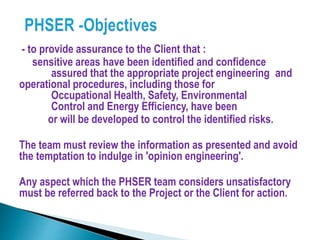
- to provide assurance to the Client that :
sensitive areas have been identified and confidence
assured that the appropriate project engineering and
operational procedures, including those for
Occupational Health, Safety, Environmental
Control and Energy Efficiency, have been
or will be developed to control the identified risks.
The team must review the information as presented and avoid
the temptation to indulge in 'opinion engineering'.
Any aspect which the PHSER team considers unsatisfactory
must be referred back to the Project or the Client for action.
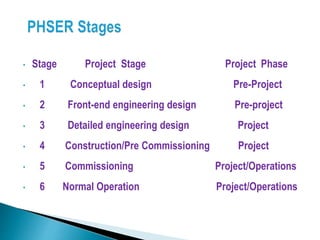
• Stage Project Stage Project Phase
• 1 Conceptual design Pre-Project
• 2 Front-end engineering design Pre-project
• 3 Detailed engineering design Project
• 4 Construction/Pre Commissioning Project
• 5 Commissioning Project/Operations
• 6 Normal Operation Project/Operations
a) Description of the proposed development including the processing route if applicable and
Statement of Requirements if available.
(b) Project location.
(c) Proposed Standards and Recommended Practices for Engineering.
(d) Where applicable, acceptability criteria for quantified risk assessment.
(e) Substances/Materials used, properties and inventories.
(f) Drawings, plans, if relevant at this stage. (g) Studies concluded regarding choice of plant, process
and location and Concept Safety Evaluations.
(h) Information on similar projects, if applicable. Past PHSER reports of the same stage on similar
developments.
(i) General statement of policy and requirements on Occupational Health and Safety during
construction.
(j) Environmental Impact Assessment or equivalent.
(k) Client's HSE policy for the proposed development.
(l) HSE compliance standards. (m) Energy efficiency studies on the selected processes.
 Accessibility
 Disposal,Venting
 Siting, Spacing, Population distribution
 Flooding
 Meteorological
 Adjacent activities
 Utilities
 Occupational Health
 Noise
 Transportation
 New Process - health, safety and environmental hazards identified
 Similar facilities – feedback
 Deviation from normal operation
 HSE legislation
 Local labour restrictions
 Inventories
 Innovation
 Visual impact
 Special operating techniques
 Special construction techniques
 Timing of phases
 Modification to live plant
 . Environment
 Environmental Impact Assessment
 Occupational Health and Safety during Construction
 Incident Prevention
 (a)Project organisation and schedule.
 (b) Stage 1 PHSER report and Project responses.
 (c) Statement of Requirements.
 (d) Location and layout of facilities.
 (e) Technical Specifications, including process design package.
 (f) Individual study reports, e.g. surge analysis, reliability analysis, surveys (soil, flooding,
etc.), mass and energy balances, properties of process substances,
corrosion/environmental aspects, occupational health aspects, QRA.
 (g) Identification of package units.
 (h) Operation and Maintenance Philosophy.
 (i) HSE philosophy.
 (j) HSE plan .
 (k) Environmental Impact Assessment.
 (l) Preliminary or coarse HAZOP study report and follow up information.
 (m) Relief philosophy.
 (n) Isolation philosophy.
 (o) Emergency shutdown philosophy.
 (p) Fire and Gas detection philosophy.
 (q) Fire Protection philosophy.
 (r) Concept Safety Evaluation.
 (s) Outline Registrar of Safety Related Devices.
 (t) Hazardous Area Classification Drawings.
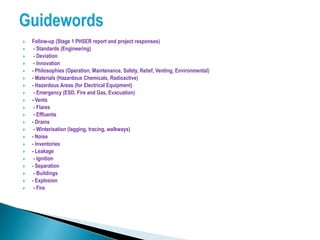
 Follow-up (Stage 1 PHSER report and project responses)
 - Standards (Engineering)
 - Deviation
 - Innovation
 - Philosophies (Operation, Maintenance, Safety, Relief, Venting, Environmental)
 - Materials (Hazardous Chemicals, Radioactive)
 - Hazardous Areas (for Electrical Equipment)
 - Emergency (ESD, Fire and Gas, Evacuation)
 - Vents
 - Flares
 - Effluents
 - Drains
 - Winterisation (lagging, tracing, walkways)
 - Noise
 - Inventories
 - Leakage
 - Ignition
 - Separation
 - Buildings
 - Explosion
 - Fire
 Instrument Control
 - Electrical Control
 - Utilities (Steam, Air, Nitrogen, Water, Fuels)
 - Machinery
 - Mechanical Handling (Cranes, Hoists, Fork Lift Trucks)
 - Safe Site Access
 -Egress
 - Exclusion of the Public
 - Perimeter Fencing
 - Welfare Facilities
 - Adjacent Hazardous Plant
 - Buried Services
 - Overhead Cables
 - Impact on Community of Construction
 - Soil Conditions
 - Temperature
 - Barometric Pressure
 - Freezing Fog
 - Chill Effects
 - Prevailing Wind
 - Tides
 - Wave Height
 - Rainfall
 - Flooding
 - Discharges
 - Gaseous and Liquid
 - Solid waste disposal.
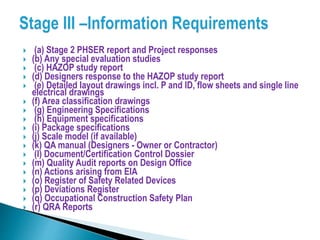
 (a) Stage 2 PHSER report and Project responses
 (b) Any special evaluation studies
 (c) HAZOP study report
 (d) Designers response to the HAZOP study report
 (e) Detailed layout drawings incl. P and ID, flow sheets and single line
electrical drawings
 (f) Area classification drawings
 (g) Engineering Specifications
 (h) Equipment specifications
 (i) Package specifications
 (j) Scale model (if available)
 (k) QA manual (Designers - Owner or Contractor)
 (l) Document/Certification Control Dossier
 (m) Quality Audit reports on Design Office
 (n) Actions arising from EIA
 (o) Register of Safety Related Devices
 (p) Deviations Register
 (q) Occupational Construction Safety Plan
 (r) QRA Reports
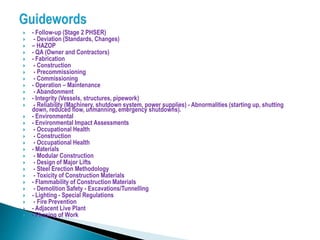
 - Follow-up (Stage 2 PHSER)
 - Deviation (Standards, Changes)
 – HAZOP
 - QA (Owner and Contractors)
 - Fabrication
 - Construction
 - Precommissioning
 - Commissioning
 - Operation – Maintenance
 - Abandonment
 - Integrity (Vessels, structures, pipework)
 - Reliability (Machinery, shutdown system, power supplies) - Abnormalities (starting up, shutting
down, reduced flow, unmanning, emergency shutdowns).
 - Environmental
 - Environmental Impact Assessments
 - Occupational Health
 - Construction
 - Occupational Health
 - Materials
 - Modular Construction
 - Design of Major Lifts
 - Steel Erection Methodology
 - Toxicity of Construction Materials
 - Flammability of Construction Materials
 - Demolition Safety - Excavations/Tunnelling
 - Lighting - Special Regulations
 - Fire Prevention
 - Adjacent Live Plant
 - Phasing of Work
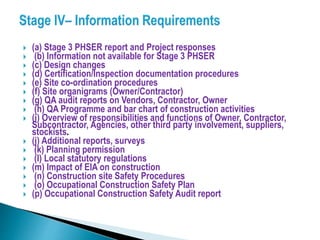
 (a) Stage 3 PHSER report and Project responses
 (b) Information not available for Stage 3 PHSER
 (c) Design changes
 (d) Certification/Inspection documentation procedures
 (e) Site co-ordination procedures
 (f) Site organigrams (Owner/Contractor)
 (g) QA audit reports on Vendors, Contractor, Owner
 (h) QA Programme and bar chart of construction activities
 (i) Overview of responsibilities and functions of Owner, Contractor,
Subcontractor, Agencies, other third party involvement, suppliers,
stockists.
 (j) Additional reports, surveys
 (k) Planning permission
 (l) Local statutory regulations
 (m) Impact of EIA on construction
 (n) Construction site Safety Procedures
 (o) Occupational Construction Safety Plan
 (p) Occupational Construction Safety Audit report
 - Follow-up (Stage 3)
 - Changes (Design)
 - Punch Lists
 - Procedures (QA, Co-ordinating, etc.)
 - Documentation (Control)
 - Inspection
 - Certification
 - Weight Control
 - Dimensional Control
 - Statutory
 - Precommissioning
 - Liaison (Stage 5)
 - Construction Regulations
 - Enforcement Agency
 - Prohibition/Improvement Notices
 - Contractor Pre qualification and Control
 - Health and Safety Training
 - Scaffolding Standards
 - Safe System of Work
 - Incident Rate
 - Substances Hazardous to Health
 - Safe Access/Egress
 - Electrical Safety
 - Housekeeping
 - Fire Protection Standards
 - Cranes and Lifting Gear
 - Work over Live Plant
 - Permits to Work
 - Noise Control
 - Personal Protective Equipment
 - First Aid
 - Excavation Safety
 - Demolition
 - Site Radiography
 (a) Stage 4 PHSER report and Project responses
 (b) Precommissioning and test dossier.
 (c) Plant/facilities organisation and manning.
 (d) Commissioning plan.
 (e) Operating instructions.
 (f) Maintenance instructions.
 (g) Emergency procedures (internal and external).
 (h) Safety and firefighting procedures and instructions. (i)
Punch list of incomplete construction items.
 (j) List of items unaccepted by Operations
 (k) Project commissioning engineers report.
 (l) Operator training manual.
 (m) Operator selection and training records.
 Follow-up (Previous stages)
 Liaison (Stage 4)
 Precommissioning (Test results)
 Procedures (Commissioning, Operating, Maintenance)
Instruction (Safety, accident, firefighting)
 Punch List
 Permits (Hot work, vehicle access)
 Safety Audit Support (Laboratory, workshops, stores, spares)
Manning Training (Operation, maintenance, emergency,
health, safety and environment, support services)
Compliance (Local statutory requirements)
 Access Documentation (Completeness of hand over package
from Project)
 Design (Changes to and problems with design experienced
during commissioning and running).
 The threat of a battery room explosion is a real hazard. The
aftermath of such an explosion can be devastating.
 Hydrogen Gas produced by the battery can be explosive.
 Maintain adequate ventilation.
 Monthly battery inspection should include condition of
ventilation equipment.
 Charging batteries, even supposedly sealed batteries
(simply check the battery safety data sheet or owner’s
manual), particularly batteries in a fault or overcharge
condition, can generate hydrogen, a highly flammable
gas that accumulates and becomes highly explosive
particularly when confined in a room such as a battery or
UPS room.
 A mixture of hydrogen in air of as little as 4%
poses a significant risk of fire and explosion. It is
recommended that hydrogen concentrations be
maintained below 1% with a properly designed and
periodically surveyed ventilation system.
 Confirm that the room contains a acid spill kit (to neutralize any spilled acid), fire
extinguisher and an ANSI-approved eye wash and safety shower.
 Inspect air supply and exhaust for any malfunction or blockage, such as
equipment pushed up against a vent or animal nesting material inside a vent.
 Verify proper signage on the entrance containing message such as “Battery
Room: Authorized Personnel Only,” “No Smoking-Flammable Gas”, “Caution:
Acid” (check local codes and applicable regulations for a complete list).
 Ensure that appropriate rubber gloves, rubber apron, chemical resistant face
shield, a SDS sheet and other protective measures are available when servicing
batteries.
 Make sure the battery room exhaust and supply vents are not located together
where exhaust is re-entrained into the battery room or into other areas of the
building.
 Air flow surveys must not only cover air flow through all air supply and exhaust
vents, but must also measure vent dimensions as well as the dimensions of the
battery room, battery trailer or battery shed.
Thank you
for your attention!

Process Hazards analysis presentation for beginners

  • 1.
  • 2.
    - to provideassurance to the Client that : sensitive areas have been identified and confidence assured that the appropriate project engineering and operational procedures, including those for Occupational Health, Safety, Environmental Control and Energy Efficiency, have been or will be developed to control the identified risks. The team must review the information as presented and avoid the temptation to indulge in 'opinion engineering'. Any aspect which the PHSER team considers unsatisfactory must be referred back to the Project or the Client for action.
  • 3.
    • Stage ProjectStage Project Phase • 1 Conceptual design Pre-Project • 2 Front-end engineering design Pre-project • 3 Detailed engineering design Project • 4 Construction/Pre Commissioning Project • 5 Commissioning Project/Operations • 6 Normal Operation Project/Operations
  • 4.
    a) Description ofthe proposed development including the processing route if applicable and Statement of Requirements if available. (b) Project location. (c) Proposed Standards and Recommended Practices for Engineering. (d) Where applicable, acceptability criteria for quantified risk assessment. (e) Substances/Materials used, properties and inventories. (f) Drawings, plans, if relevant at this stage. (g) Studies concluded regarding choice of plant, process and location and Concept Safety Evaluations. (h) Information on similar projects, if applicable. Past PHSER reports of the same stage on similar developments. (i) General statement of policy and requirements on Occupational Health and Safety during construction. (j) Environmental Impact Assessment or equivalent. (k) Client's HSE policy for the proposed development. (l) HSE compliance standards. (m) Energy efficiency studies on the selected processes.
  • 5.
     Accessibility  Disposal,Venting Siting, Spacing, Population distribution  Flooding  Meteorological  Adjacent activities  Utilities  Occupational Health  Noise  Transportation  New Process - health, safety and environmental hazards identified  Similar facilities – feedback  Deviation from normal operation  HSE legislation  Local labour restrictions  Inventories  Innovation  Visual impact  Special operating techniques  Special construction techniques  Timing of phases  Modification to live plant  . Environment  Environmental Impact Assessment  Occupational Health and Safety during Construction  Incident Prevention
  • 6.
     (a)Project organisationand schedule.  (b) Stage 1 PHSER report and Project responses.  (c) Statement of Requirements.  (d) Location and layout of facilities.  (e) Technical Specifications, including process design package.  (f) Individual study reports, e.g. surge analysis, reliability analysis, surveys (soil, flooding, etc.), mass and energy balances, properties of process substances, corrosion/environmental aspects, occupational health aspects, QRA.  (g) Identification of package units.  (h) Operation and Maintenance Philosophy.  (i) HSE philosophy.  (j) HSE plan .  (k) Environmental Impact Assessment.  (l) Preliminary or coarse HAZOP study report and follow up information.  (m) Relief philosophy.  (n) Isolation philosophy.  (o) Emergency shutdown philosophy.  (p) Fire and Gas detection philosophy.  (q) Fire Protection philosophy.  (r) Concept Safety Evaluation.  (s) Outline Registrar of Safety Related Devices.  (t) Hazardous Area Classification Drawings.
  • 7.
     Follow-up (Stage1 PHSER report and project responses)  - Standards (Engineering)  - Deviation  - Innovation  - Philosophies (Operation, Maintenance, Safety, Relief, Venting, Environmental)  - Materials (Hazardous Chemicals, Radioactive)  - Hazardous Areas (for Electrical Equipment)  - Emergency (ESD, Fire and Gas, Evacuation)  - Vents  - Flares  - Effluents  - Drains  - Winterisation (lagging, tracing, walkways)  - Noise  - Inventories  - Leakage  - Ignition  - Separation  - Buildings  - Explosion  - Fire
  • 8.
     Instrument Control - Electrical Control  - Utilities (Steam, Air, Nitrogen, Water, Fuels)  - Machinery  - Mechanical Handling (Cranes, Hoists, Fork Lift Trucks)  - Safe Site Access  -Egress  - Exclusion of the Public  - Perimeter Fencing  - Welfare Facilities  - Adjacent Hazardous Plant  - Buried Services  - Overhead Cables  - Impact on Community of Construction  - Soil Conditions
  • 9.
     - Temperature - Barometric Pressure  - Freezing Fog  - Chill Effects  - Prevailing Wind  - Tides  - Wave Height  - Rainfall  - Flooding  - Discharges  - Gaseous and Liquid  - Solid waste disposal.
  • 10.
     (a) Stage2 PHSER report and Project responses  (b) Any special evaluation studies  (c) HAZOP study report  (d) Designers response to the HAZOP study report  (e) Detailed layout drawings incl. P and ID, flow sheets and single line electrical drawings  (f) Area classification drawings  (g) Engineering Specifications  (h) Equipment specifications  (i) Package specifications  (j) Scale model (if available)  (k) QA manual (Designers - Owner or Contractor)  (l) Document/Certification Control Dossier  (m) Quality Audit reports on Design Office  (n) Actions arising from EIA  (o) Register of Safety Related Devices  (p) Deviations Register  (q) Occupational Construction Safety Plan  (r) QRA Reports
  • 11.
     - Follow-up(Stage 2 PHSER)  - Deviation (Standards, Changes)  – HAZOP  - QA (Owner and Contractors)  - Fabrication  - Construction  - Precommissioning  - Commissioning  - Operation – Maintenance  - Abandonment  - Integrity (Vessels, structures, pipework)  - Reliability (Machinery, shutdown system, power supplies) - Abnormalities (starting up, shutting down, reduced flow, unmanning, emergency shutdowns).  - Environmental  - Environmental Impact Assessments  - Occupational Health  - Construction  - Occupational Health  - Materials  - Modular Construction  - Design of Major Lifts  - Steel Erection Methodology  - Toxicity of Construction Materials  - Flammability of Construction Materials  - Demolition Safety - Excavations/Tunnelling  - Lighting - Special Regulations  - Fire Prevention  - Adjacent Live Plant  - Phasing of Work
  • 12.
     (a) Stage3 PHSER report and Project responses  (b) Information not available for Stage 3 PHSER  (c) Design changes  (d) Certification/Inspection documentation procedures  (e) Site co-ordination procedures  (f) Site organigrams (Owner/Contractor)  (g) QA audit reports on Vendors, Contractor, Owner  (h) QA Programme and bar chart of construction activities  (i) Overview of responsibilities and functions of Owner, Contractor, Subcontractor, Agencies, other third party involvement, suppliers, stockists.  (j) Additional reports, surveys  (k) Planning permission  (l) Local statutory regulations  (m) Impact of EIA on construction  (n) Construction site Safety Procedures  (o) Occupational Construction Safety Plan  (p) Occupational Construction Safety Audit report
  • 13.
     - Follow-up(Stage 3)  - Changes (Design)  - Punch Lists  - Procedures (QA, Co-ordinating, etc.)  - Documentation (Control)  - Inspection  - Certification  - Weight Control  - Dimensional Control  - Statutory  - Precommissioning  - Liaison (Stage 5)  - Construction Regulations  - Enforcement Agency  - Prohibition/Improvement Notices  - Contractor Pre qualification and Control  - Health and Safety Training  - Scaffolding Standards  - Safe System of Work  - Incident Rate  - Substances Hazardous to Health  - Safe Access/Egress  - Electrical Safety  - Housekeeping  - Fire Protection Standards  - Cranes and Lifting Gear  - Work over Live Plant  - Permits to Work  - Noise Control  - Personal Protective Equipment  - First Aid  - Excavation Safety  - Demolition  - Site Radiography
  • 14.
     (a) Stage4 PHSER report and Project responses  (b) Precommissioning and test dossier.  (c) Plant/facilities organisation and manning.  (d) Commissioning plan.  (e) Operating instructions.  (f) Maintenance instructions.  (g) Emergency procedures (internal and external).  (h) Safety and firefighting procedures and instructions. (i) Punch list of incomplete construction items.  (j) List of items unaccepted by Operations  (k) Project commissioning engineers report.  (l) Operator training manual.  (m) Operator selection and training records.
  • 15.
     Follow-up (Previousstages)  Liaison (Stage 4)  Precommissioning (Test results)  Procedures (Commissioning, Operating, Maintenance) Instruction (Safety, accident, firefighting)  Punch List  Permits (Hot work, vehicle access)  Safety Audit Support (Laboratory, workshops, stores, spares) Manning Training (Operation, maintenance, emergency, health, safety and environment, support services) Compliance (Local statutory requirements)  Access Documentation (Completeness of hand over package from Project)  Design (Changes to and problems with design experienced during commissioning and running).
  • 18.
     The threatof a battery room explosion is a real hazard. The aftermath of such an explosion can be devastating.  Hydrogen Gas produced by the battery can be explosive.  Maintain adequate ventilation.  Monthly battery inspection should include condition of ventilation equipment.
  • 19.
     Charging batteries,even supposedly sealed batteries (simply check the battery safety data sheet or owner’s manual), particularly batteries in a fault or overcharge condition, can generate hydrogen, a highly flammable gas that accumulates and becomes highly explosive particularly when confined in a room such as a battery or UPS room.  A mixture of hydrogen in air of as little as 4% poses a significant risk of fire and explosion. It is recommended that hydrogen concentrations be maintained below 1% with a properly designed and periodically surveyed ventilation system.
  • 20.
     Confirm thatthe room contains a acid spill kit (to neutralize any spilled acid), fire extinguisher and an ANSI-approved eye wash and safety shower.  Inspect air supply and exhaust for any malfunction or blockage, such as equipment pushed up against a vent or animal nesting material inside a vent.  Verify proper signage on the entrance containing message such as “Battery Room: Authorized Personnel Only,” “No Smoking-Flammable Gas”, “Caution: Acid” (check local codes and applicable regulations for a complete list).  Ensure that appropriate rubber gloves, rubber apron, chemical resistant face shield, a SDS sheet and other protective measures are available when servicing batteries.  Make sure the battery room exhaust and supply vents are not located together where exhaust is re-entrained into the battery room or into other areas of the building.  Air flow surveys must not only cover air flow through all air supply and exhaust vents, but must also measure vent dimensions as well as the dimensions of the battery room, battery trailer or battery shed.
  • 24.