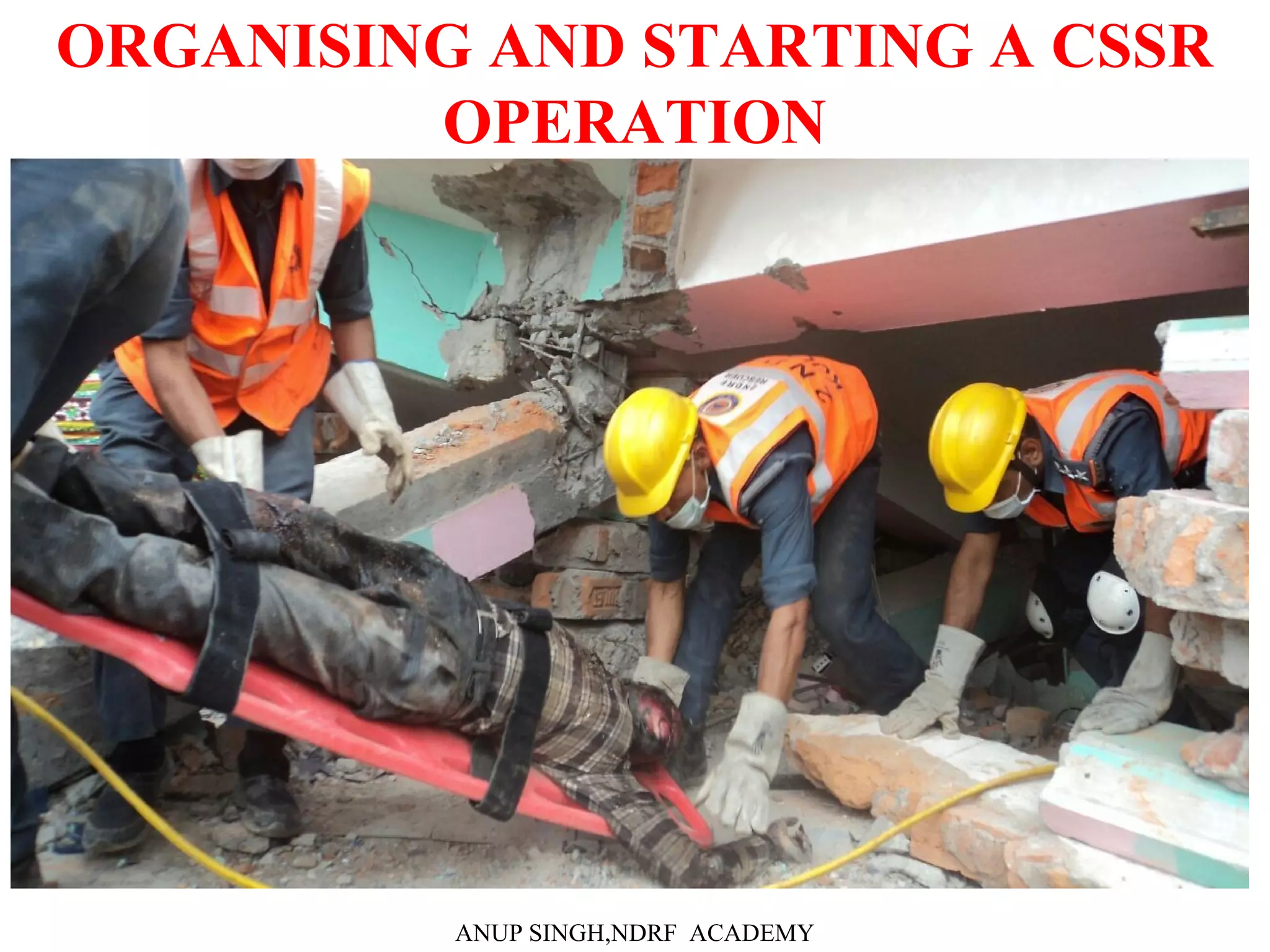

ORGANISING AND STARTING A CSSR
OPERATION
ANUP SINGH,NDRF ACADEMY
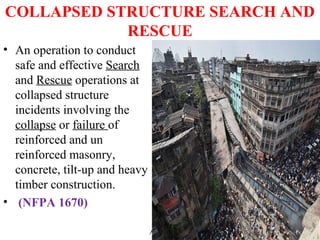
COLLAPSED STRUCTURE SEARCH AND
RESCUE
• An operation to conduct
safe and effective Search
and Rescue operations at
collapsed structure
incidents involving the
collapse or failure of
reinforced and un
reinforced masonry,
concrete, tilt-up and heavy
timber construction.
• (NFPA 1670)
ANUP SINGH,NDRF ACADEMY
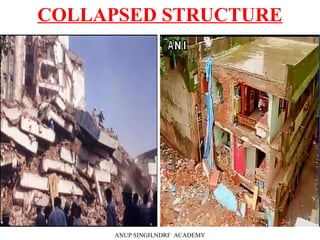
COLLAPSED STRUCTURE
ANUP SINGH,NDRF ACADEMY
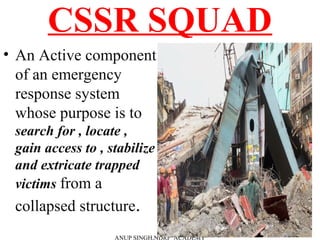
CSSR SQUAD
• An Active component
of an emergency
response system
whose purpose is to
search for , locate ,
gain access to , stabilize
and extricate trapped
victims from a
collapsed structure.
ANUP SINGH,NDRF ACADEMY
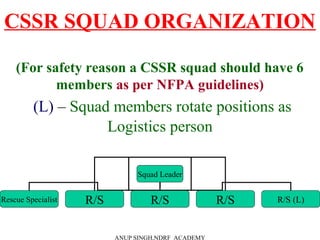
CSSR SQUAD ORGANIZATION
(For safety reason a CSSR squad should have 6
members as per NFPA guidelines)
(L) – Squad members rotate positions as
Logistics person
Squad Leader
Rescue Specialist R/S R/S (L)R/SR/S
ANUP SINGH,NDRF ACADEMY
A manageable span of control is defined as
the number of individuals one supervisor can
manage effectively.
In the Incident Command System (ICS), the
span of control for any supervisor falls within
a range of three to seven resources, with five
being the optimum.
SPAN OF CONTROL
ANUP SINGH,NDRF ACADEMY
TASKS OF A SQUAD LEADER
• Remain in contact of CP or EOC
• Receive work instructions
• Assign task to Rescuer
• Decide which specific TEA is to be used
• Monitor work rotation
• Update the CP on progress & completed task
• Safety officer for the squad
• Maintain a log of all events, actions & expenditures
ANUP SINGH,NDRF ACADEMY
Tasks of Rescuers
• Carry out work instructions from the Leader
• Correctly & safely use of TEA
• Info the progress of task to SL
• Request SL for resources for completing task
• As Logistic Position ( A rotating position within squad
responsible for TEA & other resources)
• Note- Work in pairs provide physical sp, monitoring
safety & rest.
ANUP SINGH,NDRF ACADEMY
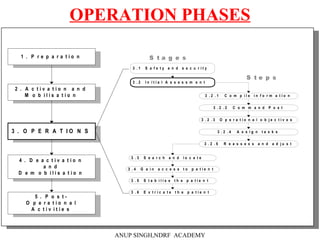
1 . P r e p a r a t i o n
2 . A c t i v a t i o n a n d
M o b i l i s a t i o n
3 . O P E R A T I O N S
3 . 2 . 1 C o m p i l e i n f o r m a t i o n
3 . 2 . 2 C o m m a n d P o s t
3 . 2 . 3 O p e r a t i o n a l o b j e c t i v e s
3 . 2 . 4 A s s i g n t a s k s
3 . 2 . 5 R e a s s e s s a n d a d j u s t
3 . 3 S e a r c h a n d l o c a t e
3 . 4 G a i n a c c e s s t o p a t i e n t
3 . 5 S t a b i l i s e t h e p a t i e n t
3 . 6 E x t r i c a t e t h e p a t i e n t
3 . 1 S a f e t y a n d s e c u r i t y
4 . D e a c t i v a t i o n
a n d
D e m o b i l i s a t i o n
5 . P o s t -
O p e r a t i o n a l
A c t i v i t i e s
3 . 2 I n i t i a l A s s e s s m e n t
S t a g e s
S t e p s
OPERATION PHASES
ANUP SINGH,NDRF ACADEMY
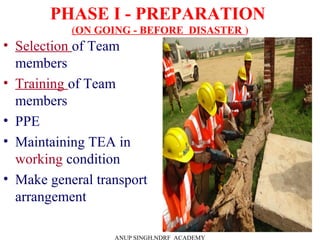
PHASE I - PREPARATION
(ON GOING - BEFORE DISASTER )
• Selection of Team
members
• Training of Team
members
• PPE
• Maintaining TEA in
working condition
• Make general transport
arrangement
ANUP SINGH,NDRF ACADEMY
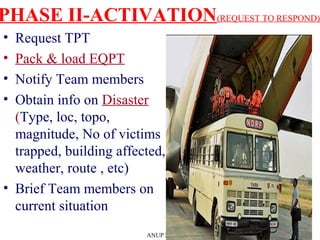
PHASE II-ACTIVATION(REQUEST TO RESPOND)
• Request TPT
• Pack & load EQPT
• Notify Team members
• Obtain info on Disaster
(Type, loc, topo,
magnitude, No of victims
trapped, building affected,
weather, route , etc)
• Brief Team members on
current situation
ANUP SINGH,NDRF ACADEMY
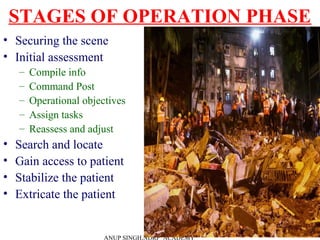
STAGES OF OPERATION PHASE
• Securing the scene
• Initial assessment
– Compile info
– Command Post
– Operational objectives
– Assign tasks
– Reassess and adjust
• Search and locate
• Gain access to patient
• Stabilize the patient
• Extricate the patient
ANUP SINGH,NDRF ACADEMY
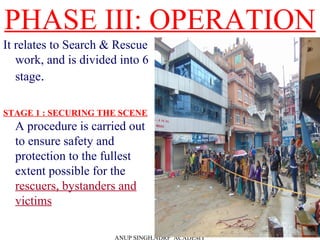
PHASE III: OPERATION
It relates to Search & Rescue
work, and is divided into 6
stage.
STAGE 1 : SECURING THE SCENE
A procedure is carried out
to ensure safety and
protection to the fullest
extent possible for the
rescuers, bystanders and
victims
ANUP SINGH,NDRF ACADEMY
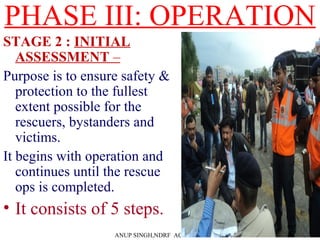
PHASE III: OPERATION
STAGE 2 : INITIAL
ASSESSMENT –
Purpose is to ensure safety &
protection to the fullest
extent possible for the
rescuers, bystanders and
victims.
It begins with operation and
continues until the rescue
ops is completed.
• It consists of 5 steps.
ANUP SINGH,NDRF ACADEMY
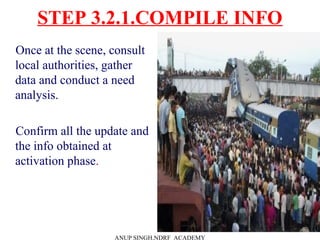
STEP 3.2.1.COMPILE INFO
Once at the scene, consult
local authorities, gather
data and conduct a need
analysis.
Confirm all the update and
the info obtained at
activation phase.
ANUP SINGH,NDRF ACADEMY
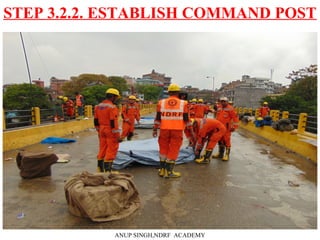
STEP 3.2.2. ESTABLISH COMMAND POST
ANUP SINGH,NDRF ACADEMY
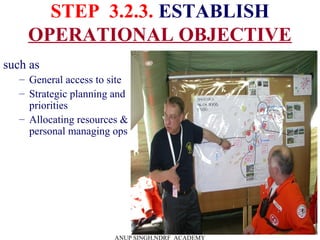
STEP 3.2.3. ESTABLISH
OPERATIONAL OBJECTIVE
such as
– General access to site
– Strategic planning and
priorities
– Allocating resources &
personal managing ops
ANUP SINGH,NDRF ACADEMY
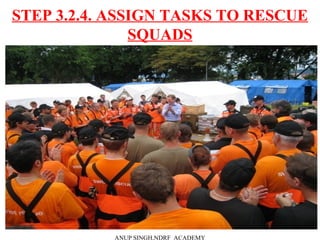
STEP 3.2.4. ASSIGN TASKS TO RESCUE
SQUADS
ANUP SINGH,NDRF ACADEMY
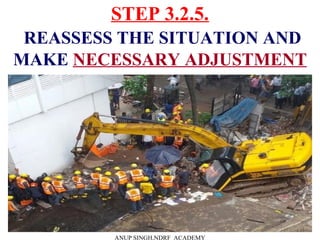
STEP 3.2.5.
REASSESS THE SITUATION AND
MAKE NECESSARY ADJUSTMENT
ANUP SINGH,NDRF ACADEMY
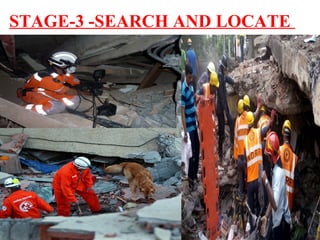
STAGE-3 -SEARCH AND LOCATE
ANUP SINGH,NDRF ACADEMY
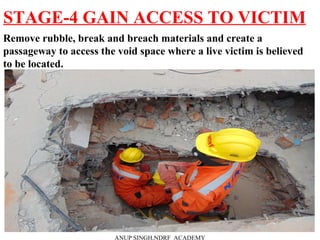
STAGE-4 GAIN ACCESS TO VICTIM
ANUP SINGH,NDRF ACADEMY
Remove rubble, break and breach materials and create a
passageway to access the void space where a live victim is believed
to be located.
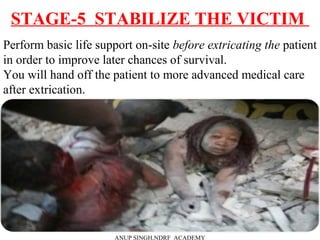
STAGE-5 STABILIZE THE VICTIM
ANUP SINGH,NDRF ACADEMY
Perform basic life support on-site before extricating the patient
in order to improve later chances of survival.
You will hand off the patient to more advanced medical care
after extrication.
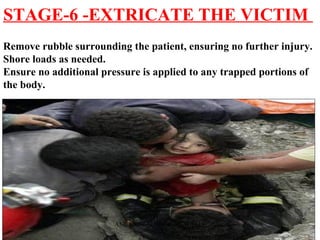
STAGE-6 -EXTRICATE THE VICTIM
Remove rubble surrounding the patient, ensuring no further injury.
Shore loads as needed.
Ensure no additional pressure is applied to any trapped portions of
the body.
ANUP SINGH,NDRF ACADEMY
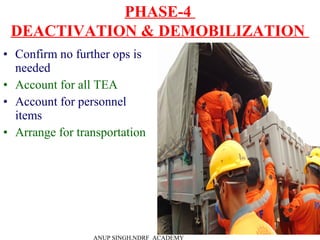
PHASE-4
DEACTIVATION & DEMOBILIZATION
ANUP SINGH,NDRF ACADEMY
• Confirm no further ops is
needed
• Account for all TEA
• Account for personnel
items
• Arrange for transportation
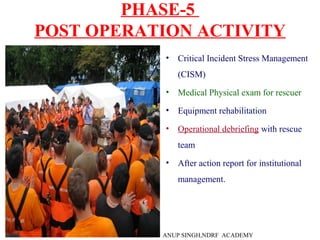
PHASE-5
POST OPERATION ACTIVITY
• Critical Incident Stress Management
(CISM)
• Medical Physical exam for rescuer
• Equipment rehabilitation
• Operational debriefing with rescue
team
• After action report for institutional
management.
ANUP SINGH,NDRF ACADEMY
INCIDENT RESPONSE SYSTEM
• IRS/ICS provides a clear management framework
for all type small & large incidents
• It is built around five major activities;
COMMAND, OPERATIONS, LOGISTICS,
PLANNING & FINANCE
• The most commonly used elements are the Incident
Commander and Operations Section.
ANUP SINGH,NDRF ACADEMY
HISTORY OF ICS
• 1970 in US California’s catastrophic
wildfire.
• Response problems often related to Comn
& Mgt deficiencies rather than lack of
resource or failure of tactics.
ANUP SINGH,NDRF ACADEMY
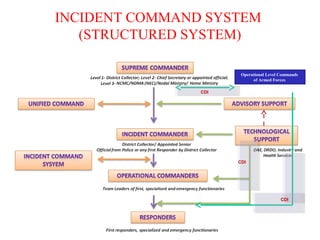
INCIDENT COMMAND SYSTEM
A systematic tool used for the command, control and
coordination of emergency response.
A set of personnel, policies, procedures, facilities, and
equipment, integrated into a common organizational
structure designed to improve emergency response
operations of all types and complexities.
A flexible, scalable response organization providing a
common framework within which people can work
together effectively
ANUP SINGH,NDRF ACADEMY
• A flexible system for managing people and
resources.
• A management system to be used for
incidents of various kinds and sizes such as
earthquakes, floods, landslides etc.
• It can be both for routine emergencies such
as road accidents and for large multi
jurisdictional disasters like the recent
tsunami.
ANUP SINGH,NDRF ACADEMY
Key Concepts
• Unity of Command
• Common terminology
• Management by Objective
• Flexible & Modular Organisation
• Span of Control
ANUP SINGH,NDRF ACADEMY
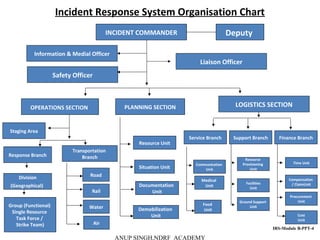
Incident Response System Organisation Chart
INCIDENT COMMANDER Deputy
Information & Medial Officer
Safety Officer
Liaison Officer
OPERATIONS SECTION PLANNING SECTION LOGISTICS SECTION
Staging Area
Response Branch
Division
(Geographical)
Group (Functional)
Single Resource
Task Force /
Strike Team)
Transportation
Branch
Road
Rail
Water
Air
Resource Unit
Situation Unit
Documentation
Unit
Demobilization
Unit
Service Branch Support Branch Finance Branch
Communication
Unit
Medical
Unit
Food
Unit
Resource
Provisioning
Unit
Facilities
Unit
Ground Support
Unit
Time Unit
Compensation
/ ClaimUnit
Procurement
Unit
Cost
Unit
IRS-Module B-PPT-4
ANUP SINGH,NDRF ACADEMY
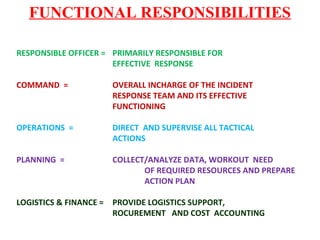
RESPONSIBLE OFFICER = PRIMARILY RESPONSIBLE FOR
EFFECTIVE RESPONSE
COMMAND = OVERALL INCHARGE OF THE INCIDENT
RESPONSE TEAM AND ITS EFFECTIVE
FUNCTIONING
OPERATIONS = DIRECT AND SUPERVISE ALL TACTICAL
ACTIONS
PLANNING = COLLECT/ANALYZE DATA, WORKOUT NEED
OF REQUIRED RESOURCES AND PREPARE
ACTION PLAN
LOGISTICS & FINANCE = PROVIDE LOGISTICS SUPPORT,
ROCUREMENT AND COST ACCOUNTING
FUNCTIONAL RESPONSIBILITIES
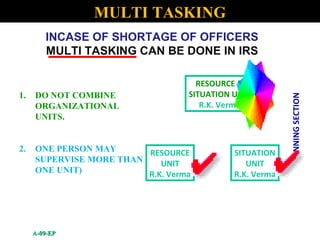
INCASE OF SHORTAGE OF OFFICERS
MULTI TASKING CAN BE DONE IN IRS
PLANNINGSECTION
RESOURCE &
SITUATION UNIT
R.K. Verma
RESOURCE
UNIT
R.K. Verma
SITUATION
UNIT
R.K. Verma
A-09-EPA-09-EP
1. DO NOT COMBINE
ORGANIZATIONAL
UNITS.
2. ONE PERSON MAY
SUPERVISE MORE THAN
ONE UNIT)
MULTI TASKING
Forms and formats
1. Incident Briefing forms
2. Communication Plan
3. Incident Action Plan
4. Medical Plan
5. Check-in Form
6. Organization Assignment List
7. Incident Check-in & Deployment List
ACCOUNTABILITY
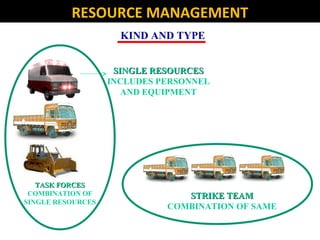
TASK FORCESTASK FORCES
COMBINATION OF
SINGLE RESOURCES
STRIKE TEAMSTRIKE TEAM
COMBINATION OF SAME
SINGLE RESOURCESSINGLE RESOURCES
INCLUDES PERSONNEL
AND EQUIPMENT
KIND AND TYPE
RESOURCE MANAGEMENT
INCIDENT COMMAND SYSTEM
(STRUCTURED SYSTEM)
Operational Level Commands
of Armed Forces
CDI
CDI
CDI
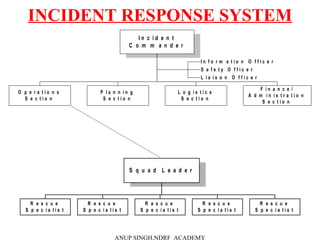
INCIDENT RESPONSE SYSTEM
I n c i d e n t
C o m m a n d e r
O p e r a t i o n s
S e c t i o n
P l a n n i n g
S e c t i o n
L o g i s t i c s
S e c t i o n
F i n a n c e /
A d m i n i s t r a t i o n
S e c t i o n
I n f o r m a t i o n O f f i c e r
S a f e t y O f f i c e r
L i a i s o n O f f i c e r
S q u a d L e a d e r
R e s c u e
S p e c i a l i s t
R e s c u e
S p e c i a l i s t
R e s c u e
S p e c i a l i s t
R e s c u e
S p e c i a l i s t
R e s c u e
S p e c i a l i s t
ANUP SINGH,NDRF ACADEMY
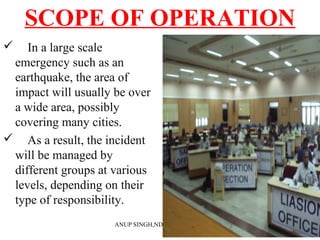
SCOPE OF OPERATION
 In a large scale
emergency such as an
earthquake, the area of
impact will usually be over
a wide area, possibly
covering many cities.
 As a result, the incident
will be managed by
different groups at various
levels, depending on their
type of responsibility.
ANUP SINGH,NDRF ACADEMY
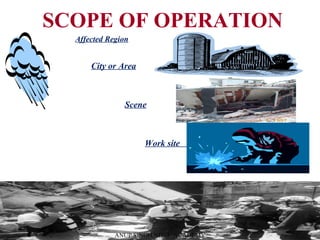
SCOPE OF OPERATION
Affected Region
City or Area
Scene
Work site
ANUP SINGH,NDRF ACADEMY
SCOPE OF OPERATION
• AFFECTED REGION : It refers to the overall area of
impact, such as country or cities affected
• CITY OR AREA : It refers to a smaller section of the
affected region, such as city or area with many collapsed
buildings
• SCENE : It refers to a particular building or collapsed
structure
• SPECIFIC WORK SITE : Specific area within the
building or collapsed structure where a rescue squad is
assigned to work.
• THE WORK SITE IS THE SCOPE FOR A CSSR SQUAD
ANUP SINGH,NDRF ACADEMY
1. THE ---------IS THE SCOPE FOR A CSSR SQUAD
A. WORK SITE
B. SCENE
C. CITY OR AREA
D. AFFECTED REGION
ANUP SINGH,NDRF ACADEMY
2.WRITE DOWN RESPONSIBILITIES OF THE
FOLLOWING
ANUP SINGH,NDRF ACADEMY
• RESPONSIBLE OFFICER = PRIMARILY RESPONSIBLE FOR EFFECTIVE RESPONSE
• COMMAND = OVERALL INCHARGE OF THE INCIDENT RESPONSE TEAM AND ITS
EFFECTIVE FUNCTIONING
• OPERATIONS = DIRECT AND SUPERVISE ALL TACTICAL ACTIONS
• PLANNING = COLLECT/ANALYZE DATA, WORKOUT NEED OF
REQUIRED RESOURCES AND PREPARE ACTION PLAN
• LOGISTICS & FINANCE = PROVIDE LOGISTICS SUPPORT, PROCUREMENT AND
COST ACCOUNTING
3. A CSSR squad have..............members.
a) 5
b) 4
c)6
d) 8
ANUP SINGH,NDRF ACADEMY
4.CSSR operation have how many phases?
a.2
b.8
c.5
d.1
ANUP SINGH,NDRF ACADEMY
5. You are removing rubble from a collapsed
structure. If you have any questions about
what you should or should not remove,
who should you consult?
• a. safety officer
• b. structural engineer
• c. incident commander
• d. disaster engineer
ANUP SINGH,NDRF ACADEMY
6.What information will be obtained while
initial contact with a located victim?
ANUP SINGH,NDRF ACADEMY

ORGANISING AND STARTING A CSSR OPERATION

  • 1.
    ORGANISING AND STARTINGA CSSR OPERATION ANUP SINGH,NDRF ACADEMY
  • 2.
    COLLAPSED STRUCTURE SEARCHAND RESCUE • An operation to conduct safe and effective Search and Rescue operations at collapsed structure incidents involving the collapse or failure of reinforced and un reinforced masonry, concrete, tilt-up and heavy timber construction. • (NFPA 1670) ANUP SINGH,NDRF ACADEMY
  • 3.
  • 4.
    CSSR SQUAD • AnActive component of an emergency response system whose purpose is to search for , locate , gain access to , stabilize and extricate trapped victims from a collapsed structure. ANUP SINGH,NDRF ACADEMY
  • 5.
    CSSR SQUAD ORGANIZATION (Forsafety reason a CSSR squad should have 6 members as per NFPA guidelines) (L) – Squad members rotate positions as Logistics person Squad Leader Rescue Specialist R/S R/S (L)R/SR/S ANUP SINGH,NDRF ACADEMY
  • 6.
    A manageable spanof control is defined as the number of individuals one supervisor can manage effectively. In the Incident Command System (ICS), the span of control for any supervisor falls within a range of three to seven resources, with five being the optimum. SPAN OF CONTROL ANUP SINGH,NDRF ACADEMY
  • 7.
    TASKS OF ASQUAD LEADER • Remain in contact of CP or EOC • Receive work instructions • Assign task to Rescuer • Decide which specific TEA is to be used • Monitor work rotation • Update the CP on progress & completed task • Safety officer for the squad • Maintain a log of all events, actions & expenditures ANUP SINGH,NDRF ACADEMY
  • 8.
    Tasks of Rescuers •Carry out work instructions from the Leader • Correctly & safely use of TEA • Info the progress of task to SL • Request SL for resources for completing task • As Logistic Position ( A rotating position within squad responsible for TEA & other resources) • Note- Work in pairs provide physical sp, monitoring safety & rest. ANUP SINGH,NDRF ACADEMY
  • 9.
    1 . Pr e p a r a t i o n 2 . A c t i v a t i o n a n d M o b i l i s a t i o n 3 . O P E R A T I O N S 3 . 2 . 1 C o m p i l e i n f o r m a t i o n 3 . 2 . 2 C o m m a n d P o s t 3 . 2 . 3 O p e r a t i o n a l o b j e c t i v e s 3 . 2 . 4 A s s i g n t a s k s 3 . 2 . 5 R e a s s e s s a n d a d j u s t 3 . 3 S e a r c h a n d l o c a t e 3 . 4 G a i n a c c e s s t o p a t i e n t 3 . 5 S t a b i l i s e t h e p a t i e n t 3 . 6 E x t r i c a t e t h e p a t i e n t 3 . 1 S a f e t y a n d s e c u r i t y 4 . D e a c t i v a t i o n a n d D e m o b i l i s a t i o n 5 . P o s t - O p e r a t i o n a l A c t i v i t i e s 3 . 2 I n i t i a l A s s e s s m e n t S t a g e s S t e p s OPERATION PHASES ANUP SINGH,NDRF ACADEMY
  • 10.
    PHASE I -PREPARATION (ON GOING - BEFORE DISASTER ) • Selection of Team members • Training of Team members • PPE • Maintaining TEA in working condition • Make general transport arrangement ANUP SINGH,NDRF ACADEMY
  • 11.
    PHASE II-ACTIVATION(REQUEST TORESPOND) • Request TPT • Pack & load EQPT • Notify Team members • Obtain info on Disaster (Type, loc, topo, magnitude, No of victims trapped, building affected, weather, route , etc) • Brief Team members on current situation ANUP SINGH,NDRF ACADEMY
  • 12.
    STAGES OF OPERATIONPHASE • Securing the scene • Initial assessment – Compile info – Command Post – Operational objectives – Assign tasks – Reassess and adjust • Search and locate • Gain access to patient • Stabilize the patient • Extricate the patient ANUP SINGH,NDRF ACADEMY
  • 13.
    PHASE III: OPERATION Itrelates to Search & Rescue work, and is divided into 6 stage. STAGE 1 : SECURING THE SCENE A procedure is carried out to ensure safety and protection to the fullest extent possible for the rescuers, bystanders and victims ANUP SINGH,NDRF ACADEMY
  • 14.
    PHASE III: OPERATION STAGE2 : INITIAL ASSESSMENT – Purpose is to ensure safety & protection to the fullest extent possible for the rescuers, bystanders and victims. It begins with operation and continues until the rescue ops is completed. • It consists of 5 steps. ANUP SINGH,NDRF ACADEMY
  • 15.
    STEP 3.2.1.COMPILE INFO Onceat the scene, consult local authorities, gather data and conduct a need analysis. Confirm all the update and the info obtained at activation phase. ANUP SINGH,NDRF ACADEMY
  • 16.
    STEP 3.2.2. ESTABLISHCOMMAND POST ANUP SINGH,NDRF ACADEMY
  • 17.
    STEP 3.2.3. ESTABLISH OPERATIONALOBJECTIVE such as – General access to site – Strategic planning and priorities – Allocating resources & personal managing ops ANUP SINGH,NDRF ACADEMY
  • 18.
    STEP 3.2.4. ASSIGNTASKS TO RESCUE SQUADS ANUP SINGH,NDRF ACADEMY
  • 19.
    STEP 3.2.5. REASSESS THESITUATION AND MAKE NECESSARY ADJUSTMENT ANUP SINGH,NDRF ACADEMY
  • 20.
    STAGE-3 -SEARCH ANDLOCATE ANUP SINGH,NDRF ACADEMY
  • 21.
    STAGE-4 GAIN ACCESSTO VICTIM ANUP SINGH,NDRF ACADEMY Remove rubble, break and breach materials and create a passageway to access the void space where a live victim is believed to be located.
  • 22.
    STAGE-5 STABILIZE THEVICTIM ANUP SINGH,NDRF ACADEMY Perform basic life support on-site before extricating the patient in order to improve later chances of survival. You will hand off the patient to more advanced medical care after extrication.
  • 23.
    STAGE-6 -EXTRICATE THEVICTIM Remove rubble surrounding the patient, ensuring no further injury. Shore loads as needed. Ensure no additional pressure is applied to any trapped portions of the body. ANUP SINGH,NDRF ACADEMY
  • 24.
    PHASE-4 DEACTIVATION & DEMOBILIZATION ANUPSINGH,NDRF ACADEMY • Confirm no further ops is needed • Account for all TEA • Account for personnel items • Arrange for transportation
  • 25.
    PHASE-5 POST OPERATION ACTIVITY •Critical Incident Stress Management (CISM) • Medical Physical exam for rescuer • Equipment rehabilitation • Operational debriefing with rescue team • After action report for institutional management. ANUP SINGH,NDRF ACADEMY
  • 26.
    INCIDENT RESPONSE SYSTEM •IRS/ICS provides a clear management framework for all type small & large incidents • It is built around five major activities; COMMAND, OPERATIONS, LOGISTICS, PLANNING & FINANCE • The most commonly used elements are the Incident Commander and Operations Section. ANUP SINGH,NDRF ACADEMY
  • 27.
    HISTORY OF ICS •1970 in US California’s catastrophic wildfire. • Response problems often related to Comn & Mgt deficiencies rather than lack of resource or failure of tactics. ANUP SINGH,NDRF ACADEMY
  • 28.
    INCIDENT COMMAND SYSTEM Asystematic tool used for the command, control and coordination of emergency response. A set of personnel, policies, procedures, facilities, and equipment, integrated into a common organizational structure designed to improve emergency response operations of all types and complexities. A flexible, scalable response organization providing a common framework within which people can work together effectively ANUP SINGH,NDRF ACADEMY
  • 29.
    • A flexiblesystem for managing people and resources. • A management system to be used for incidents of various kinds and sizes such as earthquakes, floods, landslides etc. • It can be both for routine emergencies such as road accidents and for large multi jurisdictional disasters like the recent tsunami. ANUP SINGH,NDRF ACADEMY
  • 30.
    Key Concepts • Unityof Command • Common terminology • Management by Objective • Flexible & Modular Organisation • Span of Control ANUP SINGH,NDRF ACADEMY
  • 31.
    Incident Response SystemOrganisation Chart INCIDENT COMMANDER Deputy Information & Medial Officer Safety Officer Liaison Officer OPERATIONS SECTION PLANNING SECTION LOGISTICS SECTION Staging Area Response Branch Division (Geographical) Group (Functional) Single Resource Task Force / Strike Team) Transportation Branch Road Rail Water Air Resource Unit Situation Unit Documentation Unit Demobilization Unit Service Branch Support Branch Finance Branch Communication Unit Medical Unit Food Unit Resource Provisioning Unit Facilities Unit Ground Support Unit Time Unit Compensation / ClaimUnit Procurement Unit Cost Unit IRS-Module B-PPT-4 ANUP SINGH,NDRF ACADEMY
  • 32.
    RESPONSIBLE OFFICER =PRIMARILY RESPONSIBLE FOR EFFECTIVE RESPONSE COMMAND = OVERALL INCHARGE OF THE INCIDENT RESPONSE TEAM AND ITS EFFECTIVE FUNCTIONING OPERATIONS = DIRECT AND SUPERVISE ALL TACTICAL ACTIONS PLANNING = COLLECT/ANALYZE DATA, WORKOUT NEED OF REQUIRED RESOURCES AND PREPARE ACTION PLAN LOGISTICS & FINANCE = PROVIDE LOGISTICS SUPPORT, ROCUREMENT AND COST ACCOUNTING FUNCTIONAL RESPONSIBILITIES
  • 33.
    INCASE OF SHORTAGEOF OFFICERS MULTI TASKING CAN BE DONE IN IRS PLANNINGSECTION RESOURCE & SITUATION UNIT R.K. Verma RESOURCE UNIT R.K. Verma SITUATION UNIT R.K. Verma A-09-EPA-09-EP 1. DO NOT COMBINE ORGANIZATIONAL UNITS. 2. ONE PERSON MAY SUPERVISE MORE THAN ONE UNIT) MULTI TASKING
  • 34.
    Forms and formats 1.Incident Briefing forms 2. Communication Plan 3. Incident Action Plan 4. Medical Plan 5. Check-in Form 6. Organization Assignment List 7. Incident Check-in & Deployment List ACCOUNTABILITY
  • 35.
    TASK FORCESTASK FORCES COMBINATIONOF SINGLE RESOURCES STRIKE TEAMSTRIKE TEAM COMBINATION OF SAME SINGLE RESOURCESSINGLE RESOURCES INCLUDES PERSONNEL AND EQUIPMENT KIND AND TYPE RESOURCE MANAGEMENT
  • 36.
    INCIDENT COMMAND SYSTEM (STRUCTUREDSYSTEM) Operational Level Commands of Armed Forces CDI CDI CDI
  • 37.
    INCIDENT RESPONSE SYSTEM In c i d e n t C o m m a n d e r O p e r a t i o n s S e c t i o n P l a n n i n g S e c t i o n L o g i s t i c s S e c t i o n F i n a n c e / A d m i n i s t r a t i o n S e c t i o n I n f o r m a t i o n O f f i c e r S a f e t y O f f i c e r L i a i s o n O f f i c e r S q u a d L e a d e r R e s c u e S p e c i a l i s t R e s c u e S p e c i a l i s t R e s c u e S p e c i a l i s t R e s c u e S p e c i a l i s t R e s c u e S p e c i a l i s t ANUP SINGH,NDRF ACADEMY
  • 38.
    SCOPE OF OPERATION In a large scale emergency such as an earthquake, the area of impact will usually be over a wide area, possibly covering many cities.  As a result, the incident will be managed by different groups at various levels, depending on their type of responsibility. ANUP SINGH,NDRF ACADEMY
  • 39.
    SCOPE OF OPERATION AffectedRegion City or Area Scene Work site ANUP SINGH,NDRF ACADEMY
  • 40.
    SCOPE OF OPERATION •AFFECTED REGION : It refers to the overall area of impact, such as country or cities affected • CITY OR AREA : It refers to a smaller section of the affected region, such as city or area with many collapsed buildings • SCENE : It refers to a particular building or collapsed structure • SPECIFIC WORK SITE : Specific area within the building or collapsed structure where a rescue squad is assigned to work. • THE WORK SITE IS THE SCOPE FOR A CSSR SQUAD ANUP SINGH,NDRF ACADEMY
  • 41.
    1. THE ---------ISTHE SCOPE FOR A CSSR SQUAD A. WORK SITE B. SCENE C. CITY OR AREA D. AFFECTED REGION ANUP SINGH,NDRF ACADEMY
  • 42.
    2.WRITE DOWN RESPONSIBILITIESOF THE FOLLOWING ANUP SINGH,NDRF ACADEMY • RESPONSIBLE OFFICER = PRIMARILY RESPONSIBLE FOR EFFECTIVE RESPONSE • COMMAND = OVERALL INCHARGE OF THE INCIDENT RESPONSE TEAM AND ITS EFFECTIVE FUNCTIONING • OPERATIONS = DIRECT AND SUPERVISE ALL TACTICAL ACTIONS • PLANNING = COLLECT/ANALYZE DATA, WORKOUT NEED OF REQUIRED RESOURCES AND PREPARE ACTION PLAN • LOGISTICS & FINANCE = PROVIDE LOGISTICS SUPPORT, PROCUREMENT AND COST ACCOUNTING
  • 43.
    3. A CSSRsquad have..............members. a) 5 b) 4 c)6 d) 8 ANUP SINGH,NDRF ACADEMY
  • 44.
    4.CSSR operation havehow many phases? a.2 b.8 c.5 d.1 ANUP SINGH,NDRF ACADEMY
  • 45.
    5. You areremoving rubble from a collapsed structure. If you have any questions about what you should or should not remove, who should you consult? • a. safety officer • b. structural engineer • c. incident commander • d. disaster engineer ANUP SINGH,NDRF ACADEMY
  • 46.
    6.What information willbe obtained while initial contact with a located victim? ANUP SINGH,NDRF ACADEMY
  • 47.

Editor's Notes

  • #6 (L) – Squad members rotate positions as Logistics person