TAKING SAFETY MEASURES FORWARD
ZERO INCIDENTS
VERSION 1
APRIL 11, 2018
PRESENTED BY: GARETH ASHWORTH
GREEN FLAG COMPLIANCE
23 CORPORATE PLAZA DR, SUITE 150, NEWPORT BEACH CA
4/11/2018 Taking safety measures forward 1
TAKING SAFETY MEASURES FORWARD
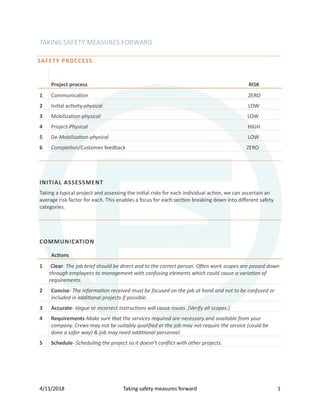
SAFETY PROCCESS
Project process RISK
1 Communica�on ZERO
2 Ini�al ac�vity-physical LOW
3 Mobiliza�on-physical LOW
4 Project-Physical HIGH
5 De-Mobiliza�on-physical LOW
6 Comple�on/Customer feedback ZERO
INITIAL ASSESSMENT
Taking a typical project and assessing the ini�al risks for each individual ac�on, we can ascertain an
average risk factor for each. This enables a focus for each sec�on breaking down into different safety
categories.
COMMUNICATION
Ac�ons
1 Clear- The job brief should be direct and to the correct person. Often work scopes are passed down
through employees to management with confusing elements which could cause a variation of
requirements.
2 Concise- The information received must be focused on the job at hand and not to be confused or
included in additional projects if possible.
3 Accurate- Vague or incorrect instructions will cause issues. (Verify all scopes.)
4 Requirements-Make sure that the services required are necessary and available from your
company. Crews may not be suitably qualified or the job may not require the service (could be
done a safer way) & job may need additional personnel.
5 Schedule- Scheduling the project so it doesn’t conflict with other projects.
4/11/2018 Taking safety measures forward 2
INITIAL ACTIVITY (PHYSICAL)
Ac�ons
1 Informa�on collec�on- Visiting the site with an informed person to verify the initial scope and
understand better any physical risks.
2 Environmental risks- Rain, snow, ice, wind, sun, chemicals, physical matter (asbestos etc)
3 Physical risks- Analyzing the physical environment for dangers and review past incidents.
4 Opera�on guidelines- Review operational requirements that may conflict, increase time or
disallow certain procedures.
5 Rela�onships- Build healthy relationships with the customer so that communication flows
smoothly.
6 Prac�cal Solu�ons- Make sure the client is aware of the safest most efficient procedure for
performing the task. There may be a better alternative that he/she is not aware of.
3.MOBILIZATION
Ac�ons
1 Equipment- Making sure fully inspected & correct type of equipment is made available for the
project
2 Travel- Sending your technicians to the correct location via suitable transport
3 Employee selec�on- Selecting appropriate, available personnel that can fulfil the project
requirements.
4 Environmental- Geographical elements and weather may cause fatigue, extended travel times.
5 Training/Fitness for work- Send employees that are capable and fit enough to perform
mobilization and project in work scope. Avoid change outs if possible and allow time for site safety
training etc.
4. PROJECT EXECUTION
Ac�on
1 Site Orienta�on- Understanding the physical nature, processes, culture & safety history of the site.
2 Meet & Greet- Sharing knowledge, processes & site project conflicts as well as building
relationships.
4/11/2018 Taking safety measures forward 3
Ac�on
3 Project assessment- Verifying the project ties in with risk assessment and method statement and
that no new changes have happened. Reviewing all pertinent permits and that the work being
performed is understood by all.
4 Daily safety documenta�on- Analyzing local risk and mitigation. (Create dialog to discover risk.)
5 Pre-task equipment Inspec�on- Physical inspection of equipment prior to use to evaluate that its
in good working order and the correct type.
6 Execute project- Stick with the plan and if any changes occur, stop, review and mitigate.
7 Con�nuous risk review- Risks evolve and climates change so constant evaluation is required.
5. DE-MOBILIZATION
Ac�on
1 Equipment- Manifesting and inspection will show missing or damaged equipment allowing an
easier transition. Evaluation of the type of equipment used and its appropriateness for future
similar projects.
2 Travel- Timing and distance of travel arrangements can cause fatigue, especially after a long
project. Allow for rest and recuperation before sending crews on a long drive or plane trip.
6. COMPLETION
Ac�on
1 Lessons Learned- Project review from all the crew involved will maintain a higher standard for the
next time and can remove delays and speed up processes. (More hours at risk can create
additional safety issues.)
2 Communication/Follow up- Conversations with the customer can uncover unknown issues and
problems as well as learn how well the project went from their perspective. Some new customers
may have expected something different even if the project went well.
3 Equipment- Warehouse inspection to update database of any lost/broken or quarantined
equipment.
4 Project records- When a similar project is performed or redone there should be historical records.
This allows knowledge of technicians, equipment and safety measures used in order to continue
providing safe, quality work.
4/11/2018 Taking safety measures forward 4
SAFETY DOCUMENTATION & HOW IT WORKS:
With all projects that involve working at height there are processes we can u�lize to mi�gate safety
hazards.
Most safety incidents that occur are a culmina�on of several smaller issues. We call this a “Cascade of
Errors” and there is no “one” single process that can fully mi�gate this. These cascades can require
many assessments and processes to atempt to control.
These controls start before the project and con�nues well a�er comple�on. Our processes are not finite
or exhaus�ve but a good base to work from and learn. We start with our management of documents
right through to signing off and leaving site.
Control of Documents:
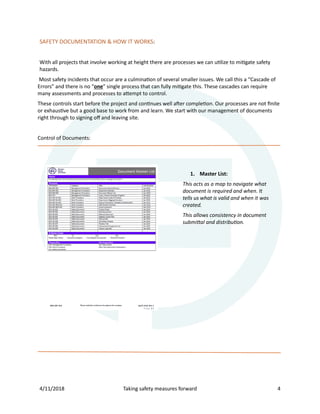
1. Master List:
This acts as a map to navigate what
document is required and when. It
tells us what is valid and when it was
created.
This allows consistency in document
submittal and distribution.
4/11/2018 Taking safety measures forward 5
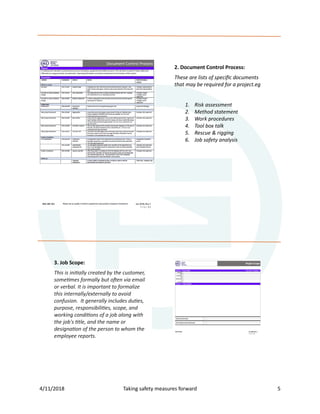
2. Document Control Process:
These are lists of specific documents
that may be required for a project.eg
1. Risk assessment
2. Method statement
3. Work procedures
4. Tool box talk
5. Rescue & rigging
6. Job safety analysis
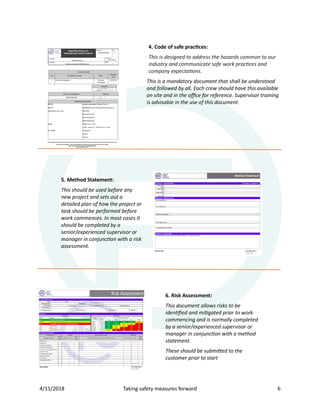
3. Job Scope:
This is initially created by the customer,
sometimes formally but often via email
or verbal. It is important to formalize
this internally/externally to avoid
confusion. It generally includes duties,
purpose, responsibilities, scope, and
working conditions of a job along with
the job's title, and the name or
designation of the person to whom the
employee reports.
4/11/2018 Taking safety measures forward 6
5. Method Statement:
This should be used before any
new project and sets out a
detailed plan of how the project or
task should be performed before
work commences. In most cases it
should be completed by a
senior/experienced supervisor or
manager in conjunction with a risk
assessment.
6. Risk Assessment:
This document allows risks to be
identified and mitigated prior to work
commencing and is normally completed
by a senior/experienced supervisor or
manager in conjunction with a method
statement.
These should be submitted to the
customer prior to start
4. Code of safe prac�ces:
This is designed to address the hazards common to our
industry and communicate safe work practices and
company expectations.
This is a mandatory document that shall be understood
and followed by all. Each crew should have this available
on site and in the office for reference. Supervisor training
is advisable in the use of this document.
4/11/2018 Taking safety measures forward 7
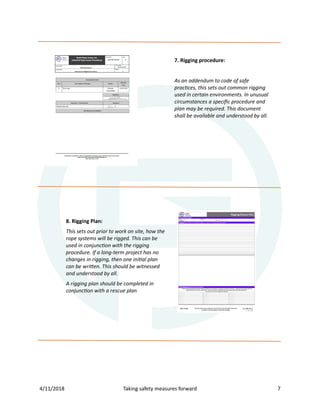
7. Rigging procedure:
As an addendum to code of safe
practices, this sets out common rigging
used in certain environments. In unusual
circumstances a specific procedure and
plan may be required. This document
shall be available and understood by all.
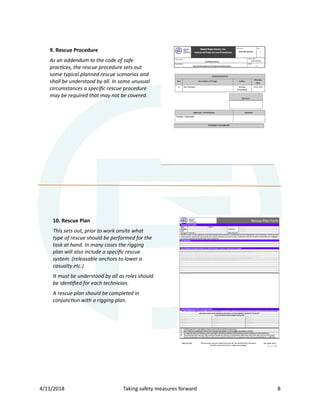
8. Rigging Plan:
This sets out prior to work on site, how the
rope systems will be rigged. This can be
used in conjunction with the rigging
procedure. If a long-term project has no
changes in rigging, then one initial plan
can be written. This should be witnessed
and understood by all.
A rigging plan should be completed in
conjunction with a rescue plan
4/11/2018 Taking safety measures forward 8
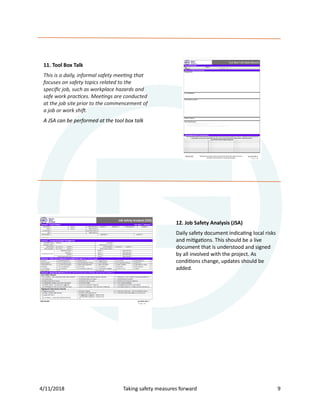
9. Rescue Procedure
As an addendum to the code of safe
practices, the rescue procedure sets out
some typical planned rescue scenarios and
shall be understood by all. In some unusual
circumstances a specific rescue procedure
may be required that may not be covered.
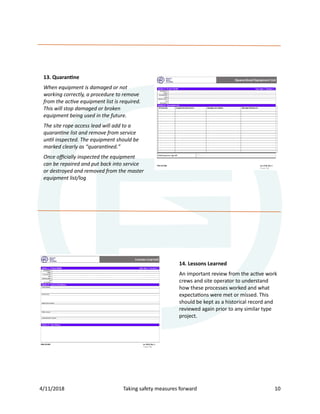
10. Rescue Plan
This sets out, prior to work onsite what
type of rescue should be performed for the
task at hand. In many cases the rigging
plan will also include a specific rescue
system. (releasable anchors to lower a
casualty etc.)
It must be understood by all as roles should
be identified for each technician.
A rescue plan should be completed in
conjunction with a rigging plan.
4/11/2018 Taking safety measures forward 9
11. Tool Box Talk
This is a daily, informal safety meeting that
focuses on safety topics related to the
specific job, such as workplace hazards and
safe work practices. Meetings are conducted
at the job site prior to the commencement of
a job or work shift.
A JSA can be performed at the tool box talk
12. Job Safety Analysis (JSA)
Daily safety document indica�ng local risks
and mi�ga�ons. This should be a live
document that is understood and signed
by all involved with the project. As
condi�ons change, updates should be
added.
4/11/2018 Taking safety measures forward 10
13. Quaran�ne
When equipment is damaged or not
working correctly, a procedure to remove
from the active equipment list is required.
This will stop damaged or broken
equipment being used in the future.
The site rope access lead will add to a
quarantine list and remove from service
until inspected. The equipment should be
marked clearly as “quarantined.”
Once officially inspected the equipment
can be repaired and put back into service
or destroyed and removed from the master
equipment list/log
14. Lessons Learned
An important review from the ac�ve work
crews and site operator to understand
how these processes worked and what
expecta�ons were met or missed. This
should be kept as a historical record and
reviewed again prior to any similar type
project.
4/11/2018 Taking safety measures forward 11
Conclusion:
Some of these documents you may already have, for example most companies will have a job safety
analysis JSA, JHA etc but using different safety documents for different sites will and can cause
confusion with rope access. Its good prac�ce to familiarize rope access crews with the same documents
for each project. For Audit purposes and compliance, (ISO, IRATA, Green Fag etc) all the rope access
documents need to be consistant throughout your rope access program. We recommend keeping your
dedicated rope access documents separate from your exis�ng sa�ey documents.
We believe that our safety documents and management system is fully inclusive and a solid founda�on
for new or exis�ng companies to help contol their rope access program safely and efficiently while they
grow.
TAKING SAFETY FORWARD.

Taking safety measures forward: Zero Incidents

  • 1.
    TAKING SAFETY MEASURESFORWARD ZERO INCIDENTS VERSION 1 APRIL 11, 2018 PRESENTED BY: GARETH ASHWORTH GREEN FLAG COMPLIANCE 23 CORPORATE PLAZA DR, SUITE 150, NEWPORT BEACH CA
  • 2.
    4/11/2018 Taking safetymeasures forward 1 TAKING SAFETY MEASURES FORWARD SAFETY PROCCESS Project process RISK 1 Communica�on ZERO 2 Ini�al ac�vity-physical LOW 3 Mobiliza�on-physical LOW 4 Project-Physical HIGH 5 De-Mobiliza�on-physical LOW 6 Comple�on/Customer feedback ZERO INITIAL ASSESSMENT Taking a typical project and assessing the ini�al risks for each individual ac�on, we can ascertain an average risk factor for each. This enables a focus for each sec�on breaking down into different safety categories. COMMUNICATION Ac�ons 1 Clear- The job brief should be direct and to the correct person. Often work scopes are passed down through employees to management with confusing elements which could cause a variation of requirements. 2 Concise- The information received must be focused on the job at hand and not to be confused or included in additional projects if possible. 3 Accurate- Vague or incorrect instructions will cause issues. (Verify all scopes.) 4 Requirements-Make sure that the services required are necessary and available from your company. Crews may not be suitably qualified or the job may not require the service (could be done a safer way) & job may need additional personnel. 5 Schedule- Scheduling the project so it doesn’t conflict with other projects.
  • 3.
    4/11/2018 Taking safetymeasures forward 2 INITIAL ACTIVITY (PHYSICAL) Ac�ons 1 Informa�on collec�on- Visiting the site with an informed person to verify the initial scope and understand better any physical risks. 2 Environmental risks- Rain, snow, ice, wind, sun, chemicals, physical matter (asbestos etc) 3 Physical risks- Analyzing the physical environment for dangers and review past incidents. 4 Opera�on guidelines- Review operational requirements that may conflict, increase time or disallow certain procedures. 5 Rela�onships- Build healthy relationships with the customer so that communication flows smoothly. 6 Prac�cal Solu�ons- Make sure the client is aware of the safest most efficient procedure for performing the task. There may be a better alternative that he/she is not aware of. 3.MOBILIZATION Ac�ons 1 Equipment- Making sure fully inspected & correct type of equipment is made available for the project 2 Travel- Sending your technicians to the correct location via suitable transport 3 Employee selec�on- Selecting appropriate, available personnel that can fulfil the project requirements. 4 Environmental- Geographical elements and weather may cause fatigue, extended travel times. 5 Training/Fitness for work- Send employees that are capable and fit enough to perform mobilization and project in work scope. Avoid change outs if possible and allow time for site safety training etc. 4. PROJECT EXECUTION Ac�on 1 Site Orienta�on- Understanding the physical nature, processes, culture & safety history of the site. 2 Meet & Greet- Sharing knowledge, processes & site project conflicts as well as building relationships.
  • 4.
    4/11/2018 Taking safetymeasures forward 3 Ac�on 3 Project assessment- Verifying the project ties in with risk assessment and method statement and that no new changes have happened. Reviewing all pertinent permits and that the work being performed is understood by all. 4 Daily safety documenta�on- Analyzing local risk and mitigation. (Create dialog to discover risk.) 5 Pre-task equipment Inspec�on- Physical inspection of equipment prior to use to evaluate that its in good working order and the correct type. 6 Execute project- Stick with the plan and if any changes occur, stop, review and mitigate. 7 Con�nuous risk review- Risks evolve and climates change so constant evaluation is required. 5. DE-MOBILIZATION Ac�on 1 Equipment- Manifesting and inspection will show missing or damaged equipment allowing an easier transition. Evaluation of the type of equipment used and its appropriateness for future similar projects. 2 Travel- Timing and distance of travel arrangements can cause fatigue, especially after a long project. Allow for rest and recuperation before sending crews on a long drive or plane trip. 6. COMPLETION Ac�on 1 Lessons Learned- Project review from all the crew involved will maintain a higher standard for the next time and can remove delays and speed up processes. (More hours at risk can create additional safety issues.) 2 Communication/Follow up- Conversations with the customer can uncover unknown issues and problems as well as learn how well the project went from their perspective. Some new customers may have expected something different even if the project went well. 3 Equipment- Warehouse inspection to update database of any lost/broken or quarantined equipment. 4 Project records- When a similar project is performed or redone there should be historical records. This allows knowledge of technicians, equipment and safety measures used in order to continue providing safe, quality work.
  • 5.
    4/11/2018 Taking safetymeasures forward 4 SAFETY DOCUMENTATION & HOW IT WORKS: With all projects that involve working at height there are processes we can u�lize to mi�gate safety hazards. Most safety incidents that occur are a culmina�on of several smaller issues. We call this a “Cascade of Errors” and there is no “one” single process that can fully mi�gate this. These cascades can require many assessments and processes to atempt to control. These controls start before the project and con�nues well a�er comple�on. Our processes are not finite or exhaus�ve but a good base to work from and learn. We start with our management of documents right through to signing off and leaving site. Control of Documents: 1. Master List: This acts as a map to navigate what document is required and when. It tells us what is valid and when it was created. This allows consistency in document submittal and distribution.
  • 6.
    4/11/2018 Taking safetymeasures forward 5 2. Document Control Process: These are lists of specific documents that may be required for a project.eg 1. Risk assessment 2. Method statement 3. Work procedures 4. Tool box talk 5. Rescue & rigging 6. Job safety analysis 3. Job Scope: This is initially created by the customer, sometimes formally but often via email or verbal. It is important to formalize this internally/externally to avoid confusion. It generally includes duties, purpose, responsibilities, scope, and working conditions of a job along with the job's title, and the name or designation of the person to whom the employee reports.
  • 7.
    4/11/2018 Taking safetymeasures forward 6 5. Method Statement: This should be used before any new project and sets out a detailed plan of how the project or task should be performed before work commences. In most cases it should be completed by a senior/experienced supervisor or manager in conjunction with a risk assessment. 6. Risk Assessment: This document allows risks to be identified and mitigated prior to work commencing and is normally completed by a senior/experienced supervisor or manager in conjunction with a method statement. These should be submitted to the customer prior to start 4. Code of safe prac�ces: This is designed to address the hazards common to our industry and communicate safe work practices and company expectations. This is a mandatory document that shall be understood and followed by all. Each crew should have this available on site and in the office for reference. Supervisor training is advisable in the use of this document.
  • 8.
    4/11/2018 Taking safetymeasures forward 7 7. Rigging procedure: As an addendum to code of safe practices, this sets out common rigging used in certain environments. In unusual circumstances a specific procedure and plan may be required. This document shall be available and understood by all. 8. Rigging Plan: This sets out prior to work on site, how the rope systems will be rigged. This can be used in conjunction with the rigging procedure. If a long-term project has no changes in rigging, then one initial plan can be written. This should be witnessed and understood by all. A rigging plan should be completed in conjunction with a rescue plan
  • 9.
    4/11/2018 Taking safetymeasures forward 8 9. Rescue Procedure As an addendum to the code of safe practices, the rescue procedure sets out some typical planned rescue scenarios and shall be understood by all. In some unusual circumstances a specific rescue procedure may be required that may not be covered. 10. Rescue Plan This sets out, prior to work onsite what type of rescue should be performed for the task at hand. In many cases the rigging plan will also include a specific rescue system. (releasable anchors to lower a casualty etc.) It must be understood by all as roles should be identified for each technician. A rescue plan should be completed in conjunction with a rigging plan.
  • 10.
    4/11/2018 Taking safetymeasures forward 9 11. Tool Box Talk This is a daily, informal safety meeting that focuses on safety topics related to the specific job, such as workplace hazards and safe work practices. Meetings are conducted at the job site prior to the commencement of a job or work shift. A JSA can be performed at the tool box talk 12. Job Safety Analysis (JSA) Daily safety document indica�ng local risks and mi�ga�ons. This should be a live document that is understood and signed by all involved with the project. As condi�ons change, updates should be added.
  • 11.
    4/11/2018 Taking safetymeasures forward 10 13. Quaran�ne When equipment is damaged or not working correctly, a procedure to remove from the active equipment list is required. This will stop damaged or broken equipment being used in the future. The site rope access lead will add to a quarantine list and remove from service until inspected. The equipment should be marked clearly as “quarantined.” Once officially inspected the equipment can be repaired and put back into service or destroyed and removed from the master equipment list/log 14. Lessons Learned An important review from the ac�ve work crews and site operator to understand how these processes worked and what expecta�ons were met or missed. This should be kept as a historical record and reviewed again prior to any similar type project.
  • 12.
    4/11/2018 Taking safetymeasures forward 11 Conclusion: Some of these documents you may already have, for example most companies will have a job safety analysis JSA, JHA etc but using different safety documents for different sites will and can cause confusion with rope access. Its good prac�ce to familiarize rope access crews with the same documents for each project. For Audit purposes and compliance, (ISO, IRATA, Green Fag etc) all the rope access documents need to be consistant throughout your rope access program. We recommend keeping your dedicated rope access documents separate from your exis�ng sa�ey documents. We believe that our safety documents and management system is fully inclusive and a solid founda�on for new or exis�ng companies to help contol their rope access program safely and efficiently while they grow. TAKING SAFETY FORWARD.