3/11/2019 1
HCM City, Nov 2019
Truyen Tran
Deakin University
@truyenoz
truyentran.github.io
truyen.tran@deakin.edu.au
letdataspeak.blogspot.com
goo.gl/3jJ1O0
Modern AI for Drug Discovery
3/11/2019 2
https://scitechdaily.com/novel-molecules-designed-by-artificial-intelligence-may-accelerate-drug-discovery/
3/11/2019 3
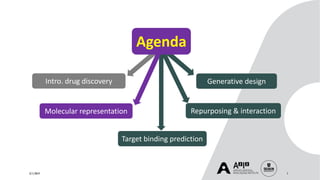
Molecular representation
Target binding prediction
Intro. drug discovery Generative design
Agenda
Repurposing & interaction
Source: c4xdiscovery.com
3/11/2019 4
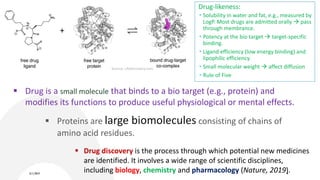
 Drug is a small molecule that binds to a bio target (e.g., protein) and
modifies its functions to produce useful physiological or mental effects.
 Drug discovery is the process through which potential new medicines
are identified. It involves a wide range of scientific disciplines,
including biology, chemistry and pharmacology (Nature, 2019).
 Proteins are large biomolecules consisting of chains of
amino acid residues.
Drug-likeness:
 Solubility in water and fat, e.g., measured by
LogP. Most drugs are admitted orally  pass
through membrance.
 Potency at the bio target  target-specific
binding.
 Ligand efficiency (low energy binding) and
lipophilic efficiency.
 Small molecular weight  affect diffusion
 Rule of Five
3/11/2019 5
#REF: Roses, Allen D. "Pharmacogenetics in drug discovery and
development: a translational perspective." Nature reviews Drug
discovery 7.10 (2008): 807-817.
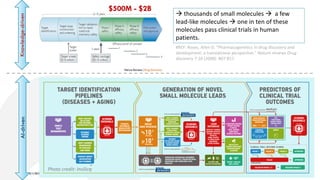
$500M - $2B
 thousands of small molecules  a few
lead-like molecules  one in ten of these
molecules pass clinical trials in human
patients.
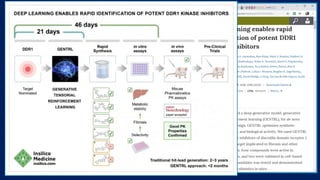
Photo credit: Insilico
Knowledge-drivenAI-driven
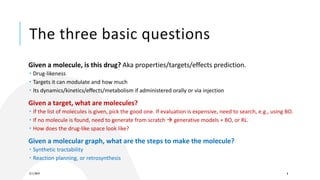
The three basic questions
Given a molecule, is this drug? Aka properties/targets/effects prediction.
 Drug-likeness
 Targets it can modulate and how much
 Its dynamics/kinetics/effects/metabolism if administered orally or via injection
Given a target, what are molecules?
 If the list of molecules is given, pick the good one. If evaluation is expensive, need to search, e.g., using BO.
 If no molecule is found, need to generate from scratch  generative models + BO, or RL.
 How does the drug-like space look like?
Given a molecular graph, what are the steps to make the molecule?
 Synthetic tractability
 Reaction planning, or retrosynthesis
3/11/2019 6
3/11/2019 7
Molecular representation
Target binding prediction
Intro. drug discovery Generative design
Agenda
Repurposing & interaction
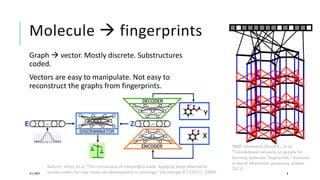
Molecule  fingerprints
3/11/2019 8
#REF: Duvenaud, David K., et al.
"Convolutional networks on graphs for
learning molecular fingerprints." Advances
in neural information processing systems.
2015.
Graph  vector. Mostly discrete. Substructures
coded.
Vectors are easy to manipulate. Not easy to
reconstruct the graphs from fingerprints.
Kadurin, Artur, et al. "The cornucopia of meaningful leads: Applying deep adversarial
autoencoders for new molecule development in oncology." Oncotarget 8.7 (2017): 10883.
Source: wikipedia.org
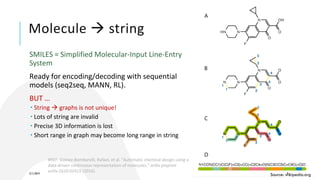
Molecule  string
SMILES = Simplified Molecular-Input Line-Entry
System
Ready for encoding/decoding with sequential
models (seq2seq, MANN, RL).
BUT …
 String  graphs is not unique!
 Lots of string are invalid
 Precise 3D information is lost
 Short range in graph may become long range in string
3/11/2019 9
#REF: Gómez-Bombarelli, Rafael, et al. "Automatic chemical design using a
data-driven continuous representation of molecules." arXiv preprint
arXiv:1610.02415 (2016).
Molecule  graphs
No regular, fixed-size structures
Graphs are permutation invariant:
#permutations are exponential function of #nodes
The probability of a generated graph G need to be marginalized over
all possible permutations
Multiple objectives:
Diversity of generated graphs
Smoothness of latent space
Agreement with or optimization of multiple “drug-like” objectives
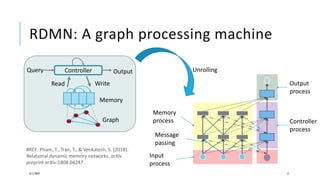
RDMN: A graph processing machine
3/11/2019 11
#REF: Pham, T., Tran, T., & Venkatesh, S. (2018).
Relational dynamic memory networks. arXiv
preprint arXiv:1808.04247.
Input
process
Memory
process
Output
process
Controller
process
Message
passing
UnrollingController
Memory
Graph
Query Output
Read Write
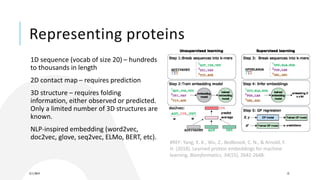
Representing proteins
1D sequence (vocab of size 20) – hundreds
to thousands in length
2D contact map – requires prediction
3D structure – requires folding
information, either observed or predicted.
Only a limited number of 3D structures are
known.
NLP-inspired embedding (word2vec,
doc2vec, glove, seq2vec, ELMo, BERT, etc).
3/11/2019 12
#REF: Yang, K. K., Wu, Z., Bedbrook, C. N., & Arnold, F.
H. (2018). Learned protein embeddings for machine
learning. Bioinformatics, 34(15), 2642-2648.
3/11/2019 13
Molecular representation
Target binding prediction
Intro. drug discovery Generative design
Agenda
Repurposing & interaction
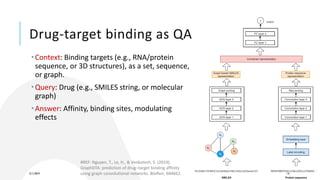
Drug-target binding as QA
 Context: Binding targets (e.g., RNA/protein
sequence, or 3D structures), as a set, sequence,
or graph.
 Query: Drug (e.g., SMILES string, or molecular
graph)
 Answer: Affinity, binding sites, modulating
effects
3/11/2019 14
#REF: Nguyen, T., Le, H., & Venkatesh, S. (2019).
GraphDTA: prediction of drug–target binding affinity
using graph convolutional networks. BioRxiv, 684662.
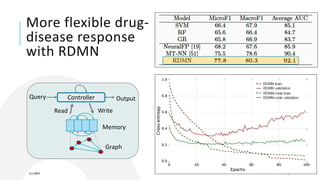
More flexible drug-
disease response
with RDMN
3/11/2019 15
Controller
Memory
Graph
Query Output
Read Write
3/11/2019 16
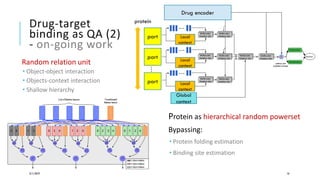
Drug-target
binding as QA (2)
- on-going work
part
part
part
Drug encoder
Global
context
protein
Local
context
Local
context
Local
context
Protein as hierarchical random powerset
Bypassing:
 Protein folding estimation
 Binding site estimation
Random relation unit
 Object-object interaction
 Objects-context interaction
 Shallow hierarchy
3/11/2019 17
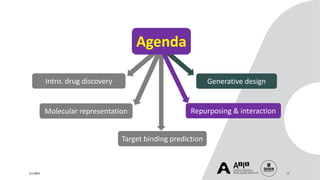
Molecular representation
Target binding prediction
Intro. drug discovery Generative design
Agenda
Repurposing & interaction
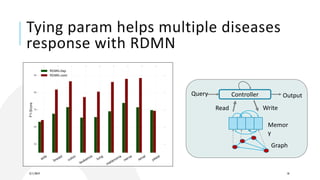
Tying param helps multiple diseases
response with RDMN
3/11/2019 18
Controller
Memor
y
Graph
Query Output
Read Write
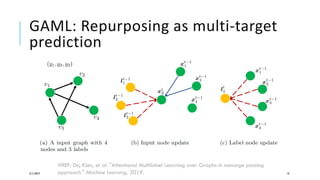
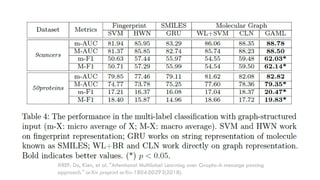
GAML: Repurposing as multi-target
prediction
3/11/2019 19
#REF: Do, Kien, et al. "Attentional Multilabel Learning over Graphs-A message passing
approach." Machine Learning, 2019.
#REF: Do, Kien, et al. "Attentional Multilabel Learning over Graphs-A message passing
approach." arXiv preprint arXiv:1804.00293(2018).
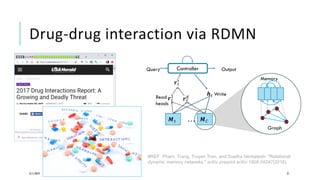
Drug-drug interaction via RDMN
3/11/2019 21
𝑴𝑴1 … 𝑴𝑴𝐶𝐶
𝒓𝒓𝑡𝑡
1
…𝒓𝒓𝑡𝑡
𝐾𝐾
𝒓𝒓𝑡𝑡
∗
Controller
Write𝒉𝒉𝑡𝑡
Memory
Graph
Query Output
Read
heads
#REF: Pham, Trang, Truyen Tran, and Svetha Venkatesh. "Relational
dynamic memory networks." arXiv preprint arXiv:1808.04247(2018).
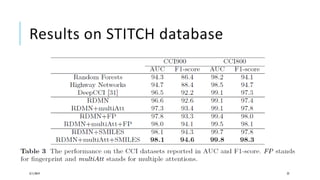
Results on STITCH database
3/11/2019 22
3/11/2019 23
Molecular representation
Target binding prediction
Intro. drug discovery Generative design
Agenda
Repurposing & interaction
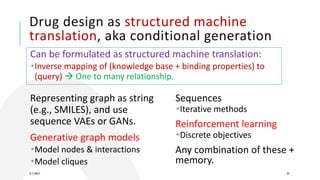
Drug design as structured machine
translation, aka conditional generation
Can be formulated as structured machine translation:
Inverse mapping of (knowledge base + binding properties) to
(query)  One to many relationship.
3/11/2019 24
Representing graph as string
(e.g., SMILES), and use
sequence VAEs or GANs.
Generative graph models
Model nodes & interactions
Model cliques
Sequences
Iterative methods
Reinforcement learning
Discrete objectives
Any combination of these +
memory.
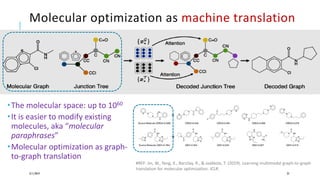
Molecular optimization as machine translation
The molecular space: up to 1060
It is easier to modify existing
molecules, aka “molecular
paraphrases”
Molecular optimization as graph-
to-graph translation
3/11/2019 25
#REF: Jin, W., Yang, K., Barzilay, R., & Jaakkola, T. (2019). Learning multimodal graph-to-graph
translation for molecular optimization. ICLR.
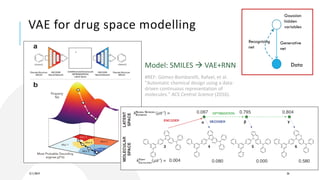
VAE for drug space modelling
3/11/2019 26
Model: SMILES  VAE+RNN
#REF: Gómez-Bombarelli, Rafael, et al.
"Automatic chemical design using a data-
driven continuous representation of
molecules." ACS Central Science (2016).
Gaussian
hidden
variables
Data
Generative
net
Recognising
net
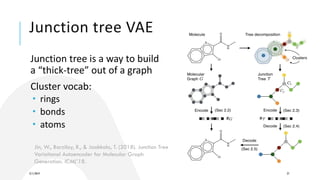
Junction tree VAE
3/11/2019 27
Jin, W., Barzilay, R., & Jaakkola, T. (2018). Junction Tree
Variational Autoencoder for Molecular Graph
Generation. ICML’18.
Junction tree is a way to build
a “thick-tree” out of a graph
Cluster vocab:
 rings
 bonds
 atoms
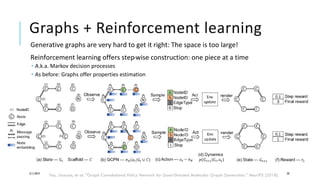
Graphs + Reinforcement learning
Generative graphs are very hard to get it right: The space is too large!
Reinforcement learning offers step-wise construction: one piece at a time
 A.k.a. Markov decision processes
 As before: Graphs offer properties estimation
3/11/2019 28
You, Jiaxuan, et al. "Graph Convolutional Policy Network for Goal-Directed Molecular Graph Generation." NeurIPS (2018).
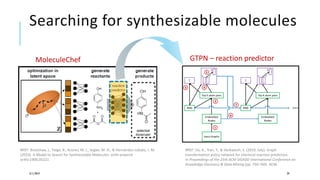
Searching for synthesizable molecules
3/11/2019 29
#REF: Bradshaw, J., Paige, B., Kusner, M. J., Segler, M. H., & Hernández-Lobato, J. M.
(2019). A Model to Search for Synthesizable Molecules. arXiv preprint
arXiv:1906.05221.
MoleculeChef
#REF: Do, K., Tran, T., & Venkatesh, S. (2019, July). Graph
transformation policy network for chemical reaction prediction.
In Proceedings of the 25th ACM SIGKDD International Conference on
Knowledge Discovery & Data Mining (pp. 750-760). ACM.
GTPN – reaction predictor
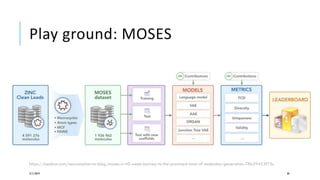
Play ground: MOSES
3/11/2019 30
https://medium.com/neuromation-io-blog/moses-a-40-week-journey-to-the-promised-land-of-molecular-generation-78b29453f75c
3/11/2019 31
Thank you Truyen Tran
@truyenoz
truyentran.github.io
truyen.tran@deakin.edu.au
letdataspeak.blogspot.com
goo.gl/3jJ1O0

AI for drug discovery

  • 1.
    3/11/2019 1 HCM City,Nov 2019 Truyen Tran Deakin University @truyenoz truyentran.github.io truyen.tran@deakin.edu.au letdataspeak.blogspot.com goo.gl/3jJ1O0 Modern AI for Drug Discovery
  • 2.
  • 3.
    3/11/2019 3 Molecular representation Targetbinding prediction Intro. drug discovery Generative design Agenda Repurposing & interaction
  • 4.
    Source: c4xdiscovery.com 3/11/2019 4 Drug is a small molecule that binds to a bio target (e.g., protein) and modifies its functions to produce useful physiological or mental effects.  Drug discovery is the process through which potential new medicines are identified. It involves a wide range of scientific disciplines, including biology, chemistry and pharmacology (Nature, 2019).  Proteins are large biomolecules consisting of chains of amino acid residues. Drug-likeness:  Solubility in water and fat, e.g., measured by LogP. Most drugs are admitted orally  pass through membrance.  Potency at the bio target  target-specific binding.  Ligand efficiency (low energy binding) and lipophilic efficiency.  Small molecular weight  affect diffusion  Rule of Five
  • 5.
    3/11/2019 5 #REF: Roses,Allen D. "Pharmacogenetics in drug discovery and development: a translational perspective." Nature reviews Drug discovery 7.10 (2008): 807-817. $500M - $2B  thousands of small molecules  a few lead-like molecules  one in ten of these molecules pass clinical trials in human patients. Photo credit: Insilico Knowledge-drivenAI-driven
  • 6.
    The three basicquestions Given a molecule, is this drug? Aka properties/targets/effects prediction.  Drug-likeness  Targets it can modulate and how much  Its dynamics/kinetics/effects/metabolism if administered orally or via injection Given a target, what are molecules?  If the list of molecules is given, pick the good one. If evaluation is expensive, need to search, e.g., using BO.  If no molecule is found, need to generate from scratch  generative models + BO, or RL.  How does the drug-like space look like? Given a molecular graph, what are the steps to make the molecule?  Synthetic tractability  Reaction planning, or retrosynthesis 3/11/2019 6
  • 7.
    3/11/2019 7 Molecular representation Targetbinding prediction Intro. drug discovery Generative design Agenda Repurposing & interaction
  • 8.
    Molecule  fingerprints 3/11/20198 #REF: Duvenaud, David K., et al. "Convolutional networks on graphs for learning molecular fingerprints." Advances in neural information processing systems. 2015. Graph  vector. Mostly discrete. Substructures coded. Vectors are easy to manipulate. Not easy to reconstruct the graphs from fingerprints. Kadurin, Artur, et al. "The cornucopia of meaningful leads: Applying deep adversarial autoencoders for new molecule development in oncology." Oncotarget 8.7 (2017): 10883.
  • 9.
    Source: wikipedia.org Molecule string SMILES = Simplified Molecular-Input Line-Entry System Ready for encoding/decoding with sequential models (seq2seq, MANN, RL). BUT …  String  graphs is not unique!  Lots of string are invalid  Precise 3D information is lost  Short range in graph may become long range in string 3/11/2019 9 #REF: Gómez-Bombarelli, Rafael, et al. "Automatic chemical design using a data-driven continuous representation of molecules." arXiv preprint arXiv:1610.02415 (2016).
  • 10.
    Molecule  graphs Noregular, fixed-size structures Graphs are permutation invariant: #permutations are exponential function of #nodes The probability of a generated graph G need to be marginalized over all possible permutations Multiple objectives: Diversity of generated graphs Smoothness of latent space Agreement with or optimization of multiple “drug-like” objectives
  • 11.
    RDMN: A graphprocessing machine 3/11/2019 11 #REF: Pham, T., Tran, T., & Venkatesh, S. (2018). Relational dynamic memory networks. arXiv preprint arXiv:1808.04247. Input process Memory process Output process Controller process Message passing UnrollingController Memory Graph Query Output Read Write
  • 12.
    Representing proteins 1D sequence(vocab of size 20) – hundreds to thousands in length 2D contact map – requires prediction 3D structure – requires folding information, either observed or predicted. Only a limited number of 3D structures are known. NLP-inspired embedding (word2vec, doc2vec, glove, seq2vec, ELMo, BERT, etc). 3/11/2019 12 #REF: Yang, K. K., Wu, Z., Bedbrook, C. N., & Arnold, F. H. (2018). Learned protein embeddings for machine learning. Bioinformatics, 34(15), 2642-2648.
  • 13.
    3/11/2019 13 Molecular representation Targetbinding prediction Intro. drug discovery Generative design Agenda Repurposing & interaction
  • 14.
    Drug-target binding asQA  Context: Binding targets (e.g., RNA/protein sequence, or 3D structures), as a set, sequence, or graph.  Query: Drug (e.g., SMILES string, or molecular graph)  Answer: Affinity, binding sites, modulating effects 3/11/2019 14 #REF: Nguyen, T., Le, H., & Venkatesh, S. (2019). GraphDTA: prediction of drug–target binding affinity using graph convolutional networks. BioRxiv, 684662.
  • 15.
    More flexible drug- diseaseresponse with RDMN 3/11/2019 15 Controller Memory Graph Query Output Read Write
  • 16.
    3/11/2019 16 Drug-target binding asQA (2) - on-going work part part part Drug encoder Global context protein Local context Local context Local context Protein as hierarchical random powerset Bypassing:  Protein folding estimation  Binding site estimation Random relation unit  Object-object interaction  Objects-context interaction  Shallow hierarchy
  • 17.
    3/11/2019 17 Molecular representation Targetbinding prediction Intro. drug discovery Generative design Agenda Repurposing & interaction
  • 18.
    Tying param helpsmultiple diseases response with RDMN 3/11/2019 18 Controller Memor y Graph Query Output Read Write
  • 19.
    GAML: Repurposing asmulti-target prediction 3/11/2019 19 #REF: Do, Kien, et al. "Attentional Multilabel Learning over Graphs-A message passing approach." Machine Learning, 2019.
  • 20.
    #REF: Do, Kien,et al. "Attentional Multilabel Learning over Graphs-A message passing approach." arXiv preprint arXiv:1804.00293(2018).
  • 21.
    Drug-drug interaction viaRDMN 3/11/2019 21 𝑴𝑴1 … 𝑴𝑴𝐶𝐶 𝒓𝒓𝑡𝑡 1 …𝒓𝒓𝑡𝑡 𝐾𝐾 𝒓𝒓𝑡𝑡 ∗ Controller Write𝒉𝒉𝑡𝑡 Memory Graph Query Output Read heads #REF: Pham, Trang, Truyen Tran, and Svetha Venkatesh. "Relational dynamic memory networks." arXiv preprint arXiv:1808.04247(2018).
  • 22.
    Results on STITCHdatabase 3/11/2019 22
  • 23.
    3/11/2019 23 Molecular representation Targetbinding prediction Intro. drug discovery Generative design Agenda Repurposing & interaction
  • 24.
    Drug design asstructured machine translation, aka conditional generation Can be formulated as structured machine translation: Inverse mapping of (knowledge base + binding properties) to (query)  One to many relationship. 3/11/2019 24 Representing graph as string (e.g., SMILES), and use sequence VAEs or GANs. Generative graph models Model nodes & interactions Model cliques Sequences Iterative methods Reinforcement learning Discrete objectives Any combination of these + memory.
  • 25.
    Molecular optimization asmachine translation The molecular space: up to 1060 It is easier to modify existing molecules, aka “molecular paraphrases” Molecular optimization as graph- to-graph translation 3/11/2019 25 #REF: Jin, W., Yang, K., Barzilay, R., & Jaakkola, T. (2019). Learning multimodal graph-to-graph translation for molecular optimization. ICLR.
  • 26.
    VAE for drugspace modelling 3/11/2019 26 Model: SMILES  VAE+RNN #REF: Gómez-Bombarelli, Rafael, et al. "Automatic chemical design using a data- driven continuous representation of molecules." ACS Central Science (2016). Gaussian hidden variables Data Generative net Recognising net
  • 27.
    Junction tree VAE 3/11/201927 Jin, W., Barzilay, R., & Jaakkola, T. (2018). Junction Tree Variational Autoencoder for Molecular Graph Generation. ICML’18. Junction tree is a way to build a “thick-tree” out of a graph Cluster vocab:  rings  bonds  atoms
  • 28.
    Graphs + Reinforcementlearning Generative graphs are very hard to get it right: The space is too large! Reinforcement learning offers step-wise construction: one piece at a time  A.k.a. Markov decision processes  As before: Graphs offer properties estimation 3/11/2019 28 You, Jiaxuan, et al. "Graph Convolutional Policy Network for Goal-Directed Molecular Graph Generation." NeurIPS (2018).
  • 29.
    Searching for synthesizablemolecules 3/11/2019 29 #REF: Bradshaw, J., Paige, B., Kusner, M. J., Segler, M. H., & Hernández-Lobato, J. M. (2019). A Model to Search for Synthesizable Molecules. arXiv preprint arXiv:1906.05221. MoleculeChef #REF: Do, K., Tran, T., & Venkatesh, S. (2019, July). Graph transformation policy network for chemical reaction prediction. In Proceedings of the 25th ACM SIGKDD International Conference on Knowledge Discovery & Data Mining (pp. 750-760). ACM. GTPN – reaction predictor
  • 30.
    Play ground: MOSES 3/11/201930 https://medium.com/neuromation-io-blog/moses-a-40-week-journey-to-the-promised-land-of-molecular-generation-78b29453f75c
  • 31.
    3/11/2019 31 Thank youTruyen Tran @truyenoz truyentran.github.io truyen.tran@deakin.edu.au letdataspeak.blogspot.com goo.gl/3jJ1O0