Presented by :
Nikita Savita
M.Pharm 3rd semester
Pharmacognosy dept.
Guided by :
Mrs. Manju Vyas
Associate Professor
DIPSAR, New Delhi
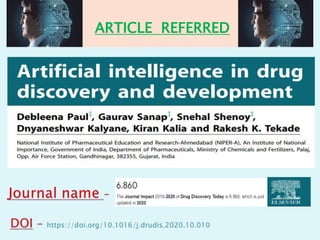
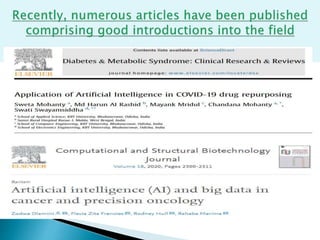
ARTICLE REFERRED
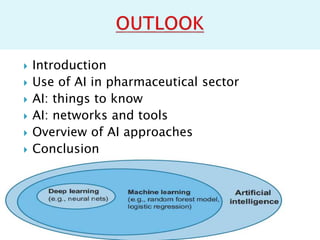
 Introduction
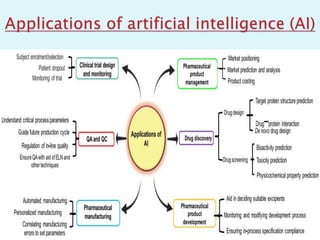
 Use of AI in pharmaceutical sector
 AI: things to know
 AI: networks and tools
 Overview of AI approaches
 Conclusion
Over the past few years, there has been a drastic increase in
data digitalization in the pharmaceutical sector.
Artificial Intelligence (AI) plays a pivotal role in drug
discovery.
In particular artificial neural networks such as deep neural
networks or recurrent networks drive this area.
 Drug discovery and development
 Drug repurposing
 Improving pharmaceutical productivity
 Activity predictions like :
1) Physicochemical properties
2) ADMET properties
 QSAR
 Clinical trials, etc.
 AI is being introduced in the medical field to keep
a medical record in digital format and conduct
patient checkup using smart technologies.
 It provides solutions, especially in targeted
treatments, uniquely composed drugs and
personalized therapies.
 AI is an innovative technology that helps to guide
the surgeon during medication, treatment and
operation.
 The main application of this technology is for
better decision-making for complicated cases.
 It can also help to track, detect, investigate and
control the infection in the hospital.
 This technology develops and optimizes online
patient appointment platforms.
 Assist in decision making.
 Determine the right therapy for a patient, including
personalized medicines.
 Manage the clinical data generated and use it for
future drug development.
Thus, AI helps in reducing the human workload as well
as achieving targets in a short period.
One tool developed is International Business Machine
(IBM) Watson supercomputer (IBM, New York, USA) in
February 14, 2011.
It was designed to assist in the
 analysis of a patient’s medical information
 its correlation with a vast database
 resulting in suggesting treatment strategies for
cancer.
This system can also be used for the rapid detection of
diseases. This was demonstrated by its ability to detect
breast cancer [14,15].
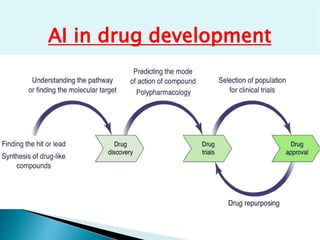
AI in drug development
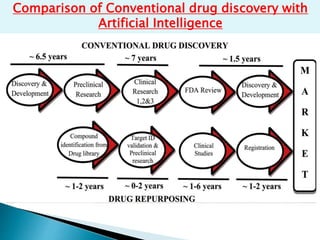
Comparison of Conventional drug discovery with
Artificial Intelligence
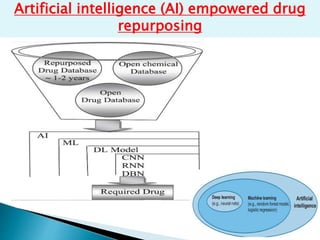
Artificial intelligence (AI) empowered drug
repurposing
 AI is a technology based system involving various
advanced tools and networks that can mimic
human intelligence.
 Artificial intelligence is considered as intelligence
demonstrated by machines.
 AI can handle large volumes of data with
enhanced automation [2].
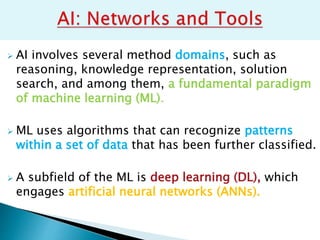
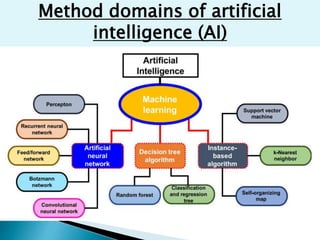
 AI involves several method domains, such as
reasoning, knowledge representation, solution
search, and among them, a fundamental paradigm
of machine learning (ML).
 ML uses algorithms that can recognize patterns
within a set of data that has been further classified.
 A subfield of the ML is deep learning (DL), which
engages artificial neural networks (ANNs).
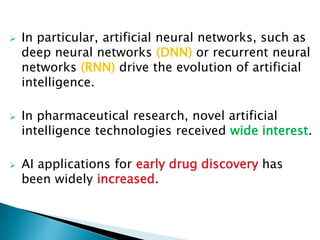
 In particular, artificial neural networks, such as
deep neural networks (DNN) or recurrent neural
networks (RNN) drive the evolution of artificial
intelligence.
 In pharmaceutical research, novel artificial
intelligence technologies received wide interest.
 AI applications for early drug discovery has
been widely increased.
Method domains of artificial
intelligence (AI)
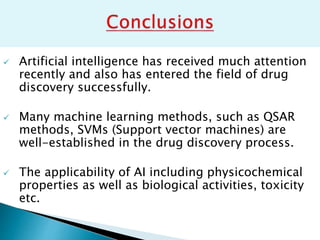
 Artificial intelligence has received much attention
recently and also has entered the field of drug
discovery successfully.
 Many machine learning methods, such as QSAR
methods, SVMs (Support vector machines) are
well-established in the drug discovery process.
 The applicability of AI including physicochemical
properties as well as biological activities, toxicity
etc.
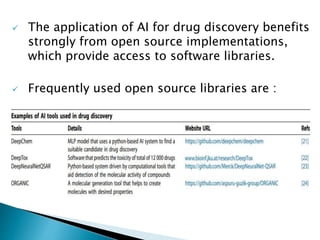
 The application of AI for drug discovery benefits
strongly from open source implementations,
which provide access to software libraries.
 Frequently used open source libraries are :
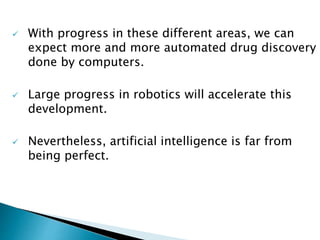
 With progress in these different areas, we can
expect more and more automated drug discovery
done by computers.
 Large progress in robotics will accelerate this
development.
 Nevertheless, artificial intelligence is far from
being perfect.
1. Ramesh, A. et al. (2004) Artificial intelligence in medicine. Ann. R. Coll. Surg. Engl. 86, 334–338
2. Miles, J. and Walker, A. (2006) The potential application of artificial intelligence in transport. IEE
Proc.-Intell. Transport Syst. 153, 183–198
3. Yang, Y. and Siau, K. (2018) A Qualitative Research on Marketing and Sales in the Artificial
Intelligence Age. MWAIS
4. Wirtz, B.W. et al. (2019) Artificial intelligence and the public sector—applications and challenges.
Int. J. Public Adm. 42, 596–615
5. Smith, R.G. and Farquhar, A. (2000) The road ahead for knowledge management: an AI
perspective. AI Mag. 21 17–17
6. Lamberti, M.J. et al. (2019) A study on the application and use of artificial intelligence to support
drug development. Clin. Ther. 41, 1414–1426
7. Beneke, F. and Mackenrodt, M.-O. (2019) Artificial intelligence and collusion. IIC Int. Rev.
Intellectual Property Competition Law 50, 109–134
8. Steels, L. and Brooks, R. (2018) The Artificial Life Route to Artificial Intelligence: Building
Embodied, Situated Agents. Routledge
9. Bielecki, A. and Bielecki, A. (2019) Foundations of artificial neural networks. In Models of
Neurons and Perceptrons: Selected Problems and Challenges (Kacprzyk, Janusz, ed.), pp. 15–28,
Springer International Publishing
10. Kalyane, D. et al. (2020) Artificial intelligence in the pharmaceutical sector: current scene and
future prospect. In The Future of Pharmaceutical Product Development and Research (Tekade,
Rakesh K., ed.), pp. 73–107, Elsevier
11. Da Silva, I.N. et al. (2017) Artificial Neural Networks. Springer
12. Medsker, L. and Jain, L.C. (1999) Recurrent Neural Networks: Design and Applications. CRC Press
13. Hašnggi, M. and Moschytz, G.S. (2000) Cellular Neural Networks: Analysis, Design and
Optimization. Springer Science & Business Media
14. Rouse, M. (2017) IBM Watson Supercomputer. 2017 . Accessed 13 October 2020
https://searchenterpriseai.techtarget.com/definition/ IBM-Watson-supercomputer
15. Vyas, M. et al. (2018) Artificial intelligence:the beginning of a new era in pharmacy profession.
Asian J. Pharm. 12, 72–76 1
16. Duch, W. et al. (2007) Artificial intelligence approaches for rational drug design and discovery.
Curr. Pharm. Des. 13, 1497–1508
17. Blasiak, A. et al. (2020) CURATE. AI: optimizing personalized medicine with artificial intelligence.
SLAS Technol. 25, 95–105
18. Baronzio, G. et al. (2015) Overview of methods for overcoming hindrance to drug delivery to
tumors, with special attention to tumor interstitial fluid. Front. Oncol. 5, 165
19. Mak, K.-K. and Pichika, M.R. (2019) Artificial intelligence in drug development: present status
and future prospects. Drug Discovery Today 24, 773–780
20. Sellwood, M.A. et al. (2018) Artificial intelligence in drug discovery. Fut. Sci. 10, 2025–2028
21. Zhu, H. (2020) Big data and artificial intelligence modeling for drug discovery. Annu. Rev.
Pharmacol. Toxicol. 60, 573–589
22. Ciallella, H.L. and Zhu, H. (2019) Advancing computational toxicology in the big data era by
artificial intelligence: data-driven and mechanism-driven modeling for chemical toxicity. Chem.
Res. Toxicol. 32, 536–547
23. Chan, H.S. et al. (2019) Advancing drug discovery via artificial intelligence. Trends Pharmacol.
Sci. 40 (8), 592–604
24. Brown, N. (2015) Silico Medicinal Chemistry: Computational Methods to Support Drug Design.
Royal Society of Chemistry
25. Pereira, J.C. et al. (2016) Boosting docking-based virtual screening with deep learning. J. Chem.
Inf. Model. 56, 2495–2506
Artificial intelligence in drug discovery and development

Artificial intelligence in drug discovery and development

  • 1.
    Presented by : NikitaSavita M.Pharm 3rd semester Pharmacognosy dept. Guided by : Mrs. Manju Vyas Associate Professor DIPSAR, New Delhi
  • 2.
  • 3.
     Introduction  Useof AI in pharmaceutical sector  AI: things to know  AI: networks and tools  Overview of AI approaches  Conclusion
  • 4.
    Over the pastfew years, there has been a drastic increase in data digitalization in the pharmaceutical sector. Artificial Intelligence (AI) plays a pivotal role in drug discovery. In particular artificial neural networks such as deep neural networks or recurrent networks drive this area.
  • 5.
     Drug discoveryand development  Drug repurposing  Improving pharmaceutical productivity  Activity predictions like : 1) Physicochemical properties 2) ADMET properties  QSAR  Clinical trials, etc.
  • 6.
     AI isbeing introduced in the medical field to keep a medical record in digital format and conduct patient checkup using smart technologies.  It provides solutions, especially in targeted treatments, uniquely composed drugs and personalized therapies.  AI is an innovative technology that helps to guide the surgeon during medication, treatment and operation.  The main application of this technology is for better decision-making for complicated cases.
  • 7.
     It canalso help to track, detect, investigate and control the infection in the hospital.  This technology develops and optimizes online patient appointment platforms.  Assist in decision making.  Determine the right therapy for a patient, including personalized medicines.  Manage the clinical data generated and use it for future drug development. Thus, AI helps in reducing the human workload as well as achieving targets in a short period.
  • 8.
    One tool developedis International Business Machine (IBM) Watson supercomputer (IBM, New York, USA) in February 14, 2011. It was designed to assist in the  analysis of a patient’s medical information  its correlation with a vast database  resulting in suggesting treatment strategies for cancer. This system can also be used for the rapid detection of diseases. This was demonstrated by its ability to detect breast cancer [14,15].
  • 10.
    AI in drugdevelopment
  • 11.
    Comparison of Conventionaldrug discovery with Artificial Intelligence
  • 12.
    Artificial intelligence (AI)empowered drug repurposing
  • 14.
     AI isa technology based system involving various advanced tools and networks that can mimic human intelligence.  Artificial intelligence is considered as intelligence demonstrated by machines.  AI can handle large volumes of data with enhanced automation [2].
  • 15.
     AI involvesseveral method domains, such as reasoning, knowledge representation, solution search, and among them, a fundamental paradigm of machine learning (ML).  ML uses algorithms that can recognize patterns within a set of data that has been further classified.  A subfield of the ML is deep learning (DL), which engages artificial neural networks (ANNs).
  • 16.
     In particular,artificial neural networks, such as deep neural networks (DNN) or recurrent neural networks (RNN) drive the evolution of artificial intelligence.  In pharmaceutical research, novel artificial intelligence technologies received wide interest.  AI applications for early drug discovery has been widely increased.
  • 17.
    Method domains ofartificial intelligence (AI)
  • 18.
     Artificial intelligencehas received much attention recently and also has entered the field of drug discovery successfully.  Many machine learning methods, such as QSAR methods, SVMs (Support vector machines) are well-established in the drug discovery process.  The applicability of AI including physicochemical properties as well as biological activities, toxicity etc.
  • 19.
     The applicationof AI for drug discovery benefits strongly from open source implementations, which provide access to software libraries.  Frequently used open source libraries are :
  • 21.
     With progressin these different areas, we can expect more and more automated drug discovery done by computers.  Large progress in robotics will accelerate this development.  Nevertheless, artificial intelligence is far from being perfect.
  • 22.
    1. Ramesh, A.et al. (2004) Artificial intelligence in medicine. Ann. R. Coll. Surg. Engl. 86, 334–338 2. Miles, J. and Walker, A. (2006) The potential application of artificial intelligence in transport. IEE Proc.-Intell. Transport Syst. 153, 183–198 3. Yang, Y. and Siau, K. (2018) A Qualitative Research on Marketing and Sales in the Artificial Intelligence Age. MWAIS 4. Wirtz, B.W. et al. (2019) Artificial intelligence and the public sector—applications and challenges. Int. J. Public Adm. 42, 596–615 5. Smith, R.G. and Farquhar, A. (2000) The road ahead for knowledge management: an AI perspective. AI Mag. 21 17–17 6. Lamberti, M.J. et al. (2019) A study on the application and use of artificial intelligence to support drug development. Clin. Ther. 41, 1414–1426 7. Beneke, F. and Mackenrodt, M.-O. (2019) Artificial intelligence and collusion. IIC Int. Rev. Intellectual Property Competition Law 50, 109–134 8. Steels, L. and Brooks, R. (2018) The Artificial Life Route to Artificial Intelligence: Building Embodied, Situated Agents. Routledge 9. Bielecki, A. and Bielecki, A. (2019) Foundations of artificial neural networks. In Models of Neurons and Perceptrons: Selected Problems and Challenges (Kacprzyk, Janusz, ed.), pp. 15–28, Springer International Publishing 10. Kalyane, D. et al. (2020) Artificial intelligence in the pharmaceutical sector: current scene and future prospect. In The Future of Pharmaceutical Product Development and Research (Tekade, Rakesh K., ed.), pp. 73–107, Elsevier 11. Da Silva, I.N. et al. (2017) Artificial Neural Networks. Springer
  • 23.
    12. Medsker, L.and Jain, L.C. (1999) Recurrent Neural Networks: Design and Applications. CRC Press 13. Ha¹nggi, M. and Moschytz, G.S. (2000) Cellular Neural Networks: Analysis, Design and Optimization. Springer Science & Business Media 14. Rouse, M. (2017) IBM Watson Supercomputer. 2017 . Accessed 13 October 2020 https://searchenterpriseai.techtarget.com/definition/ IBM-Watson-supercomputer 15. Vyas, M. et al. (2018) Artificial intelligence:the beginning of a new era in pharmacy profession. Asian J. Pharm. 12, 72–76 1 16. Duch, W. et al. (2007) Artificial intelligence approaches for rational drug design and discovery. Curr. Pharm. Des. 13, 1497–1508 17. Blasiak, A. et al. (2020) CURATE. AI: optimizing personalized medicine with artificial intelligence. SLAS Technol. 25, 95–105 18. Baronzio, G. et al. (2015) Overview of methods for overcoming hindrance to drug delivery to tumors, with special attention to tumor interstitial fluid. Front. Oncol. 5, 165 19. Mak, K.-K. and Pichika, M.R. (2019) Artificial intelligence in drug development: present status and future prospects. Drug Discovery Today 24, 773–780 20. Sellwood, M.A. et al. (2018) Artificial intelligence in drug discovery. Fut. Sci. 10, 2025–2028 21. Zhu, H. (2020) Big data and artificial intelligence modeling for drug discovery. Annu. Rev. Pharmacol. Toxicol. 60, 573–589 22. Ciallella, H.L. and Zhu, H. (2019) Advancing computational toxicology in the big data era by artificial intelligence: data-driven and mechanism-driven modeling for chemical toxicity. Chem. Res. Toxicol. 32, 536–547 23. Chan, H.S. et al. (2019) Advancing drug discovery via artificial intelligence. Trends Pharmacol. Sci. 40 (8), 592–604 24. Brown, N. (2015) Silico Medicinal Chemistry: Computational Methods to Support Drug Design. Royal Society of Chemistry 25. Pereira, J.C. et al. (2016) Boosting docking-based virtual screening with deep learning. J. Chem. Inf. Model. 56, 2495–2506