ARTIFICIAL
INTELLIGENCE
Presented by-
SWASTIK JYOTI PAL
M.Pharm 2nd sem
Roll.no-01
Bengal School of Technology
Hooghly
ARTIFICIAL INTELLIGENCE (AI)
‱ Artificial intelligence refers to the ability of a computer or a computer
enabled robotic system to process information and produce outcomes in
a manner similar to the thought process of humans in learning, decision
making and solving problems. By extension, the goal of AI systems is
to develop systems capable of tacking complex problems in ways
similar to human logic and reasoning.
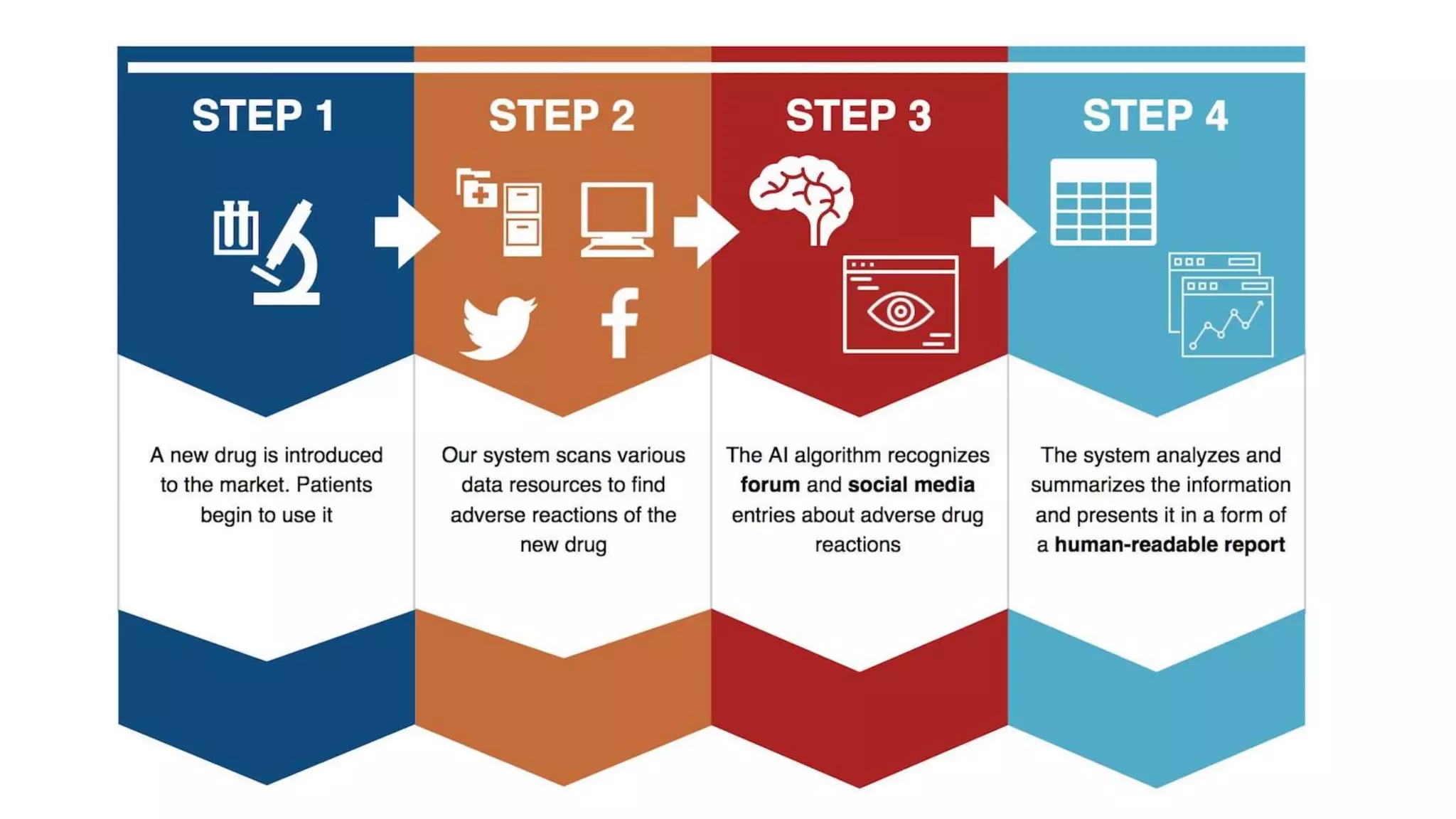
‱ Artificial intelligence – AI – is getting increasingly sophisticated at
doing what humans do, albeit more efficiently, more quickly, and more
cheaply. While AI and robotics are becoming a natural part of our
everyday lives, their potential within healthcare is vast.
APPLICATIONS OFAI IN PHARMACEUTICALS
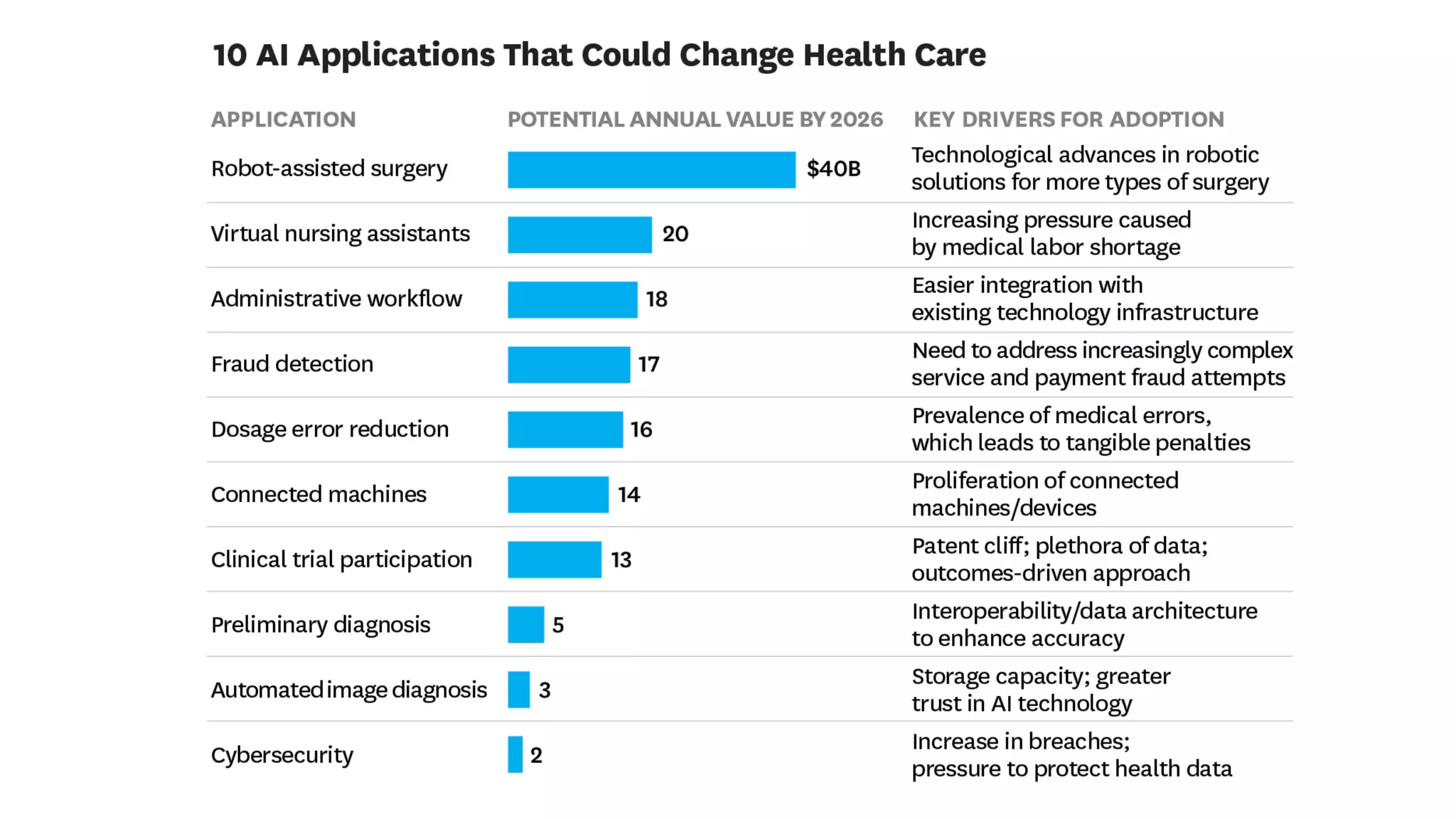
AI have various applications in health care and pharmacy which are as follows.
‱ Disease Identification
‱ Personalize treatment
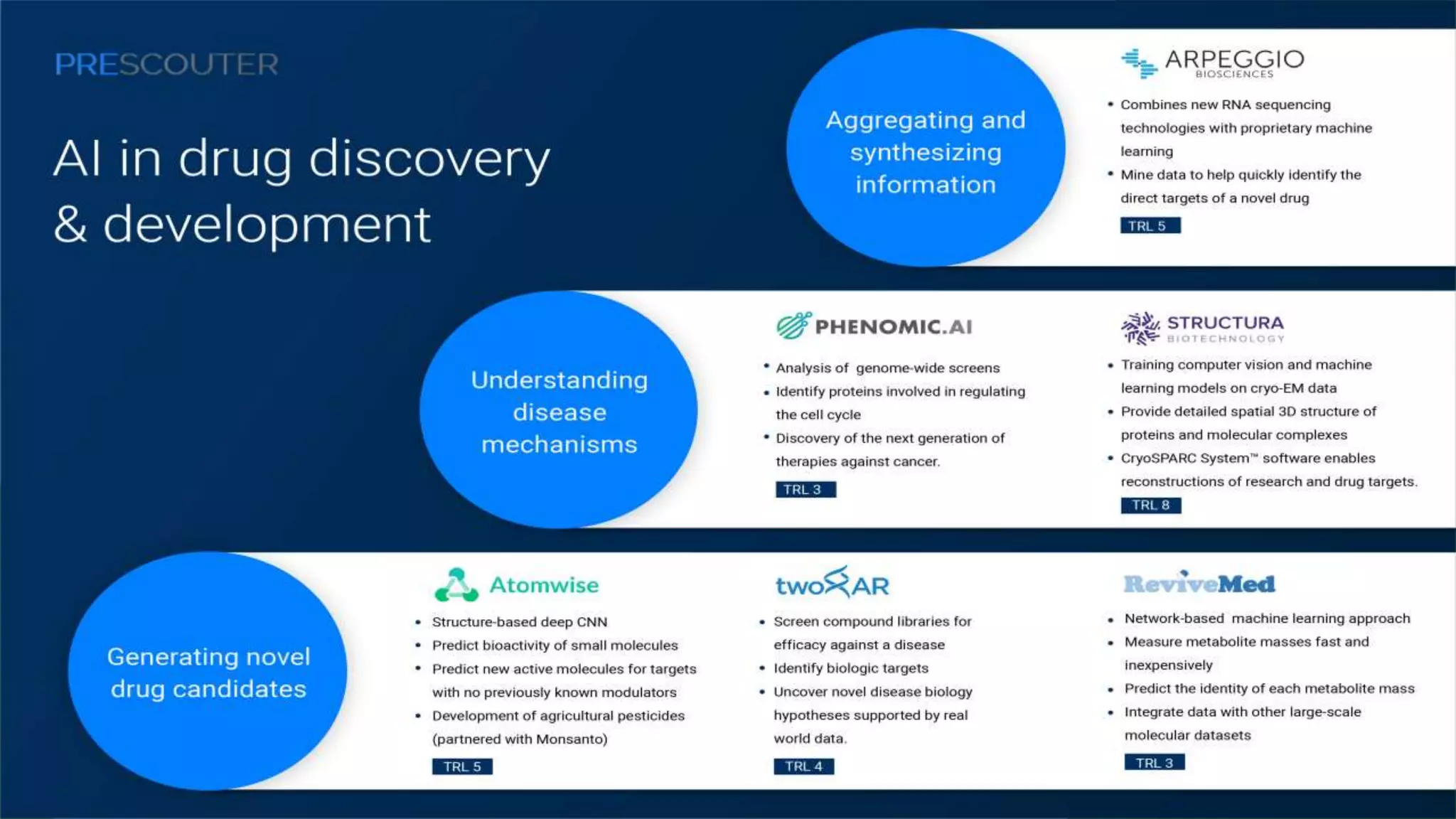
‱ Drug Discovery/Manufacturing
‱ Clinical Trial Research
‱ Radiology and Radiotherapy
‱ Smart electronic health record
DISEASE IDENTIFICATION
‱ 2015- Report by Pharmaceutical Research and Manufacturers of
America- more than 800 drugs and vaccines are in trial phase to
treat cancer.
‱ Google’s DeepMind Health, announced multiple partnerships
including some eye hospitals in which they are developing
technology to address macular degeneration in aging eyes.
‱ Oxford’s Pivital¼ Predicting Response to Depression Treatment
(PReDicT) project is aiming to produce commercially-available
emotional test battery for use in clinical setting.
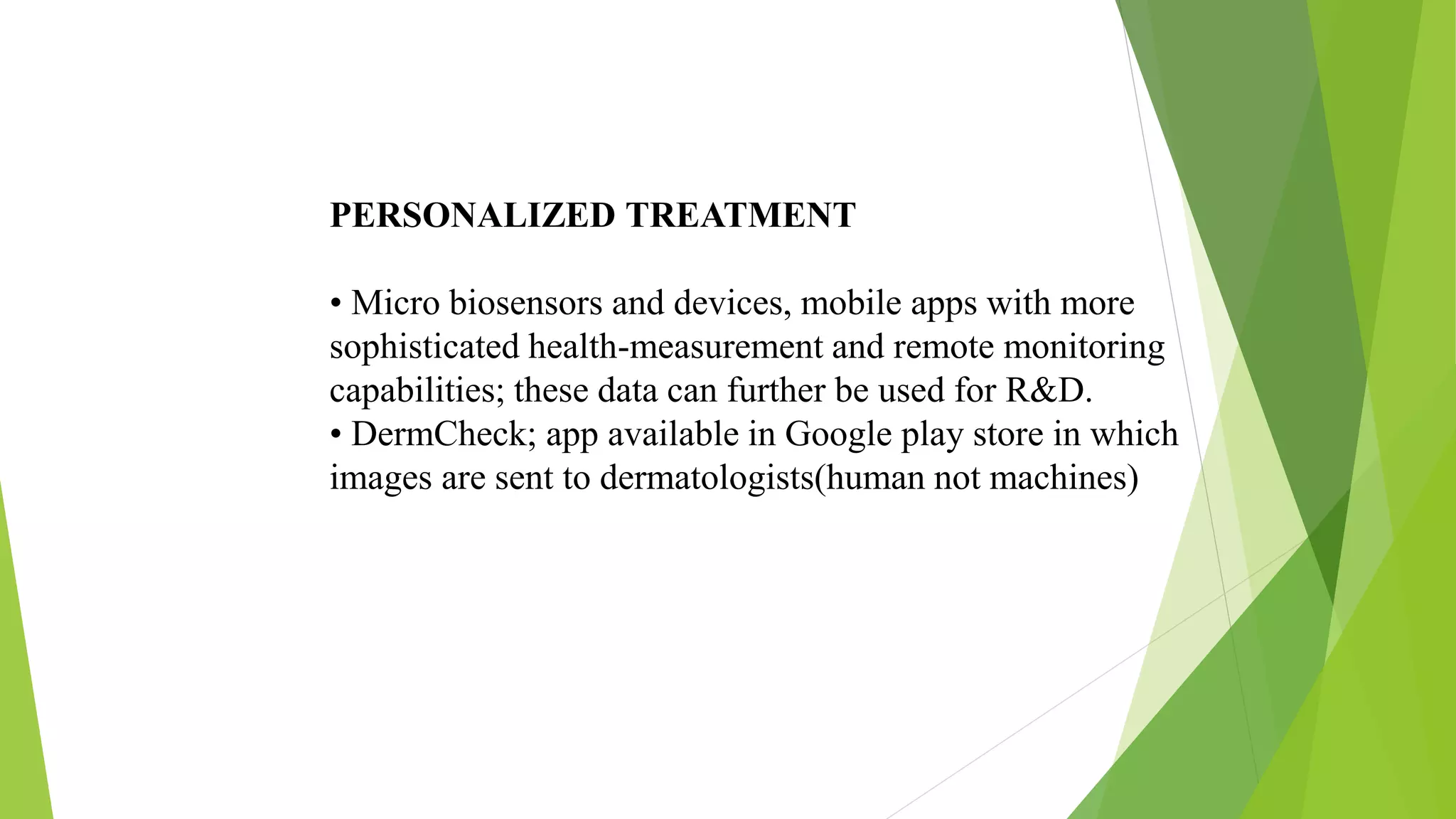
PERSONALIZED TREATMENT
‱ Micro biosensors and devices, mobile apps with more
sophisticated health-measurement and remote monitoring
capabilities; these data can further be used for R&D.
‱ DermCheck; app available in Google play store in which
images are sent to dermatologists(human not machines)
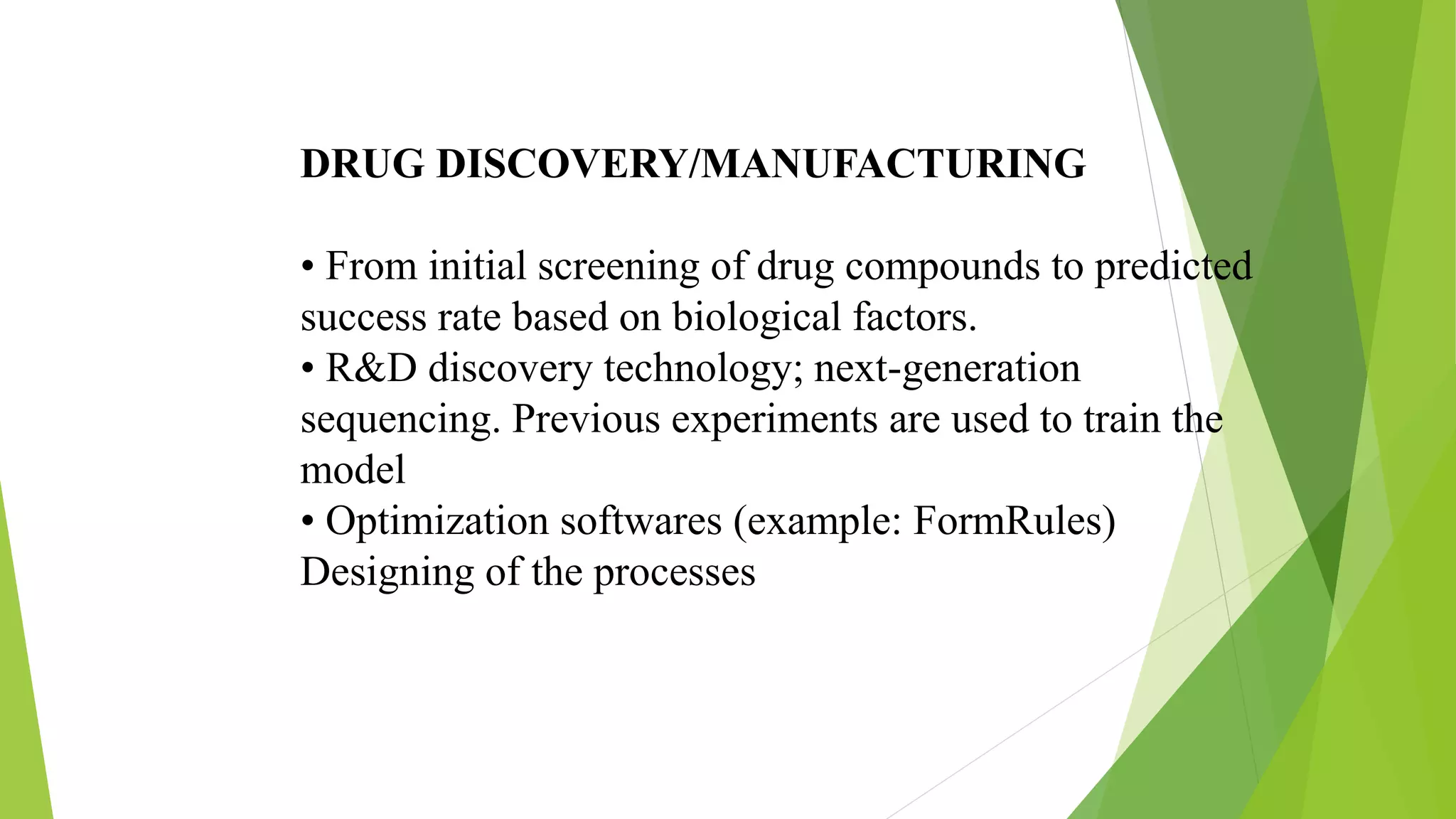
DRUG DISCOVERY/MANUFACTURING
‱ From initial screening of drug compounds to predicted
success rate based on biological factors.
‱ R&D discovery technology; next-generation
sequencing. Previous experiments are used to train the
model
‱ Optimization softwares (example: FormRules)
Designing of the processes
CLINICAL TRIAL RESEARCH
‱ Machine learning- to shape, direct clinical trials
‱ Advanced predictive analysis in identifying candidates
for clinical trials
‱ Remote monitoring and real time data access for
increased safety; biological and other signals for any sign
of harm or death to participants.
‱ Finding best sample sizes for increased efficiency;
addressing and adapting to differences in sites for patient
recruitments; using electronic medical records to reduce
data errors.
RADIOLOGY AND RADIOTHERAPY
‱ Google’s DeepMind Health is working with
University College London Hospital (UCLH) to
develop machine learning algorithms capable of
detecting differences in healthy and cancerous
tissues.
SMART ELECTRONIC HEALTH RECORDS
‱ AI to help diagnosis, clinical decisions, and
personalized treatment suggestions.
‱ Handwriting recognition and transforming cursive
or other sketched handwriting into digitized
characters.
ADVANTAGES OF ARTIFICIAL INTELLIGENCE
‱ 1. Error Reduction:Artificial intelligence helps us in reducing the error and the chance of
reaching accuracy with a greater degree of precision is a possibility.
‱ 2. Difficult Exploration:Artificial intelligence and the science of robotics can be put to use in
mining and other fuel exploration processes.
‱ 3. Daily Application: Computed methods for automated reasoning, learning and perception
have become a common phenomenon in our everyday live
‱ 4. Digital Assistants:Highly advanced organizations use ‘avatars’ which are replicas or
digital assistants who can actually interact with the users, thus saving the need of human
resources.
‱ 5. Repetitive Jobs:Repetitive jobs which are monotonous in nature can be carried out with
the help of machine intelligence. Machines think faster than humans and can be put to multi-
tasking. Machine intelligence can be employed to carry out dangerous tasks
‱ 6. Medical Applications:In the medical field also, we will find the wide application of AI.
Doctors assess the patients and their health risks with the help of artificial machine
intelligence. It educates them about the side effects of various medicines.
DISADVANTAGES OF ARTIFICIAL
INTELLIGENCE:
‱ 1. High Cost:Creation of artificial intelligence requires huge costs as they are very
complex machines. Their repair and maintenance require huge costs.
‱ 2. No Replicating Humans:Intelligence is believed to be a gift of nature. An ethical
argument continues, whether human intelligence is to be replicated or not.
‱ 3. No Improvement with Experience:Unlike humans, artificial intelligence cannot be
improved with experience. With time, it can lead to wear and tear. It stores a lot of data but
the way it can be accessed and used is very different
from human intelligence.
‱ 4. No Original Creativity: These are not the forte of artificial intelligence. While they can
help you design and create, they are no match for the power of thinking that the human
brain has or even the originality of a creative mind.
‱ 5. Unemployment: Unemployment is a socially undesirable phenomenon. People with
nothing to do can lead to the destructive use of their creative minds.
CURRENT CHALLENGES/ FUTURE ASPECT
‱ Many big Pharmaceutical companies began investing in AI in order
to develop better diagnostics or biomarkers, to identify drug targets
and to design new drugs and products.
‱ Merck partnership with Numerate in March 2012 focusing on
generating novel small molecule drug leads for unnamed
cardiovascular disease target.
‱ In december, 2016 Pfizer and IBM announced partnership to
accelerate drug discovery in immunooncology.
CONCLUSION:
AI is an emerging field in today’s technology in all
aspects whether in pharmaceutical or non
pharmaceutical means.
It has immense capability to guide mankind in
right direction and help us achieve our goals in an
easier and systematic manner. As a technologist,
one who develops it , must programe the AI in a
manner so that its capacity is used as a boon and
not as a curse.
REFERENCES-
Online references:
1. https://blog.benchsci.com/pharma-companies-using-
artificial-intelligence-in-drug-discovery
2. https://emerj.com/ai-sector-overviews/artificial-
intelligence-for-pharmacies-an-overview-of-innovations/
3. https://www.slideshare.net/girishnaik/artificial-
intelligence-3638681
4. https://www.slideshare.net/AfifAlMamun/artificial-
intelligence-presentation-64343907

Artificial intelligence ppt

  • 1.
    ARTIFICIAL INTELLIGENCE Presented by- SWASTIK JYOTIPAL M.Pharm 2nd sem Roll.no-01 Bengal School of Technology Hooghly
  • 2.
    ARTIFICIAL INTELLIGENCE (AI) ‱Artificial intelligence refers to the ability of a computer or a computer enabled robotic system to process information and produce outcomes in a manner similar to the thought process of humans in learning, decision making and solving problems. By extension, the goal of AI systems is to develop systems capable of tacking complex problems in ways similar to human logic and reasoning. ‱ Artificial intelligence – AI – is getting increasingly sophisticated at doing what humans do, albeit more efficiently, more quickly, and more cheaply. While AI and robotics are becoming a natural part of our everyday lives, their potential within healthcare is vast.
  • 4.
    APPLICATIONS OFAI INPHARMACEUTICALS AI have various applications in health care and pharmacy which are as follows. ‱ Disease Identification ‱ Personalize treatment ‱ Drug Discovery/Manufacturing ‱ Clinical Trial Research ‱ Radiology and Radiotherapy ‱ Smart electronic health record
  • 6.
    DISEASE IDENTIFICATION ‱ 2015-Report by Pharmaceutical Research and Manufacturers of America- more than 800 drugs and vaccines are in trial phase to treat cancer. ‱ Google’s DeepMind Health, announced multiple partnerships including some eye hospitals in which they are developing technology to address macular degeneration in aging eyes. ‱ Oxford’s Pivital¼ Predicting Response to Depression Treatment (PReDicT) project is aiming to produce commercially-available emotional test battery for use in clinical setting.
  • 7.
    PERSONALIZED TREATMENT ‱ Microbiosensors and devices, mobile apps with more sophisticated health-measurement and remote monitoring capabilities; these data can further be used for R&D. ‱ DermCheck; app available in Google play store in which images are sent to dermatologists(human not machines)
  • 9.
    DRUG DISCOVERY/MANUFACTURING ‱ Frominitial screening of drug compounds to predicted success rate based on biological factors. ‱ R&D discovery technology; next-generation sequencing. Previous experiments are used to train the model ‱ Optimization softwares (example: FormRules) Designing of the processes
  • 11.
    CLINICAL TRIAL RESEARCH ‱Machine learning- to shape, direct clinical trials ‱ Advanced predictive analysis in identifying candidates for clinical trials ‱ Remote monitoring and real time data access for increased safety; biological and other signals for any sign of harm or death to participants. ‱ Finding best sample sizes for increased efficiency; addressing and adapting to differences in sites for patient recruitments; using electronic medical records to reduce data errors.
  • 12.
    RADIOLOGY AND RADIOTHERAPY ‱Google’s DeepMind Health is working with University College London Hospital (UCLH) to develop machine learning algorithms capable of detecting differences in healthy and cancerous tissues.
  • 13.
    SMART ELECTRONIC HEALTHRECORDS ‱ AI to help diagnosis, clinical decisions, and personalized treatment suggestions. ‱ Handwriting recognition and transforming cursive or other sketched handwriting into digitized characters.
  • 14.
    ADVANTAGES OF ARTIFICIALINTELLIGENCE ‱ 1. Error Reduction:Artificial intelligence helps us in reducing the error and the chance of reaching accuracy with a greater degree of precision is a possibility. ‱ 2. Difficult Exploration:Artificial intelligence and the science of robotics can be put to use in mining and other fuel exploration processes. ‱ 3. Daily Application: Computed methods for automated reasoning, learning and perception have become a common phenomenon in our everyday live ‱ 4. Digital Assistants:Highly advanced organizations use ‘avatars’ which are replicas or digital assistants who can actually interact with the users, thus saving the need of human resources. ‱ 5. Repetitive Jobs:Repetitive jobs which are monotonous in nature can be carried out with the help of machine intelligence. Machines think faster than humans and can be put to multi- tasking. Machine intelligence can be employed to carry out dangerous tasks ‱ 6. Medical Applications:In the medical field also, we will find the wide application of AI. Doctors assess the patients and their health risks with the help of artificial machine intelligence. It educates them about the side effects of various medicines.
  • 15.
    DISADVANTAGES OF ARTIFICIAL INTELLIGENCE: ‱1. High Cost:Creation of artificial intelligence requires huge costs as they are very complex machines. Their repair and maintenance require huge costs. ‱ 2. No Replicating Humans:Intelligence is believed to be a gift of nature. An ethical argument continues, whether human intelligence is to be replicated or not. ‱ 3. No Improvement with Experience:Unlike humans, artificial intelligence cannot be improved with experience. With time, it can lead to wear and tear. It stores a lot of data but the way it can be accessed and used is very different from human intelligence. ‱ 4. No Original Creativity: These are not the forte of artificial intelligence. While they can help you design and create, they are no match for the power of thinking that the human brain has or even the originality of a creative mind. ‱ 5. Unemployment: Unemployment is a socially undesirable phenomenon. People with nothing to do can lead to the destructive use of their creative minds.
  • 16.
    CURRENT CHALLENGES/ FUTUREASPECT ‱ Many big Pharmaceutical companies began investing in AI in order to develop better diagnostics or biomarkers, to identify drug targets and to design new drugs and products. ‱ Merck partnership with Numerate in March 2012 focusing on generating novel small molecule drug leads for unnamed cardiovascular disease target. ‱ In december, 2016 Pfizer and IBM announced partnership to accelerate drug discovery in immunooncology.
  • 17.
    CONCLUSION: AI is anemerging field in today’s technology in all aspects whether in pharmaceutical or non pharmaceutical means. It has immense capability to guide mankind in right direction and help us achieve our goals in an easier and systematic manner. As a technologist, one who develops it , must programe the AI in a manner so that its capacity is used as a boon and not as a curse.
  • 18.
    REFERENCES- Online references: 1. https://blog.benchsci.com/pharma-companies-using- artificial-intelligence-in-drug-discovery 2.https://emerj.com/ai-sector-overviews/artificial- intelligence-for-pharmacies-an-overview-of-innovations/ 3. https://www.slideshare.net/girishnaik/artificial- intelligence-3638681 4. https://www.slideshare.net/AfifAlMamun/artificial- intelligence-presentation-64343907