11/07/2019 1
Jakarta, July 2019
Truyen Tran
Deakin University @truyenoz
truyentran.github.io
truyen.tran@deakin.edu.au
letdataspeak.blogspot.com
goo.gl/3jJ1O0
Deep Learning for Biomedicine
11/07/2019 2
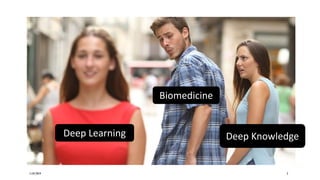
Deep Learning
Biomedicine
Deep Knowledge
11/07/2019 3
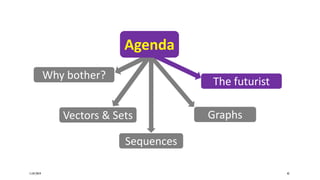
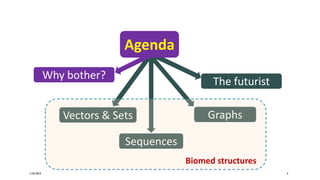
Vectors & Sets
Sequences
Why bother?
The futurist
Graphs
Agenda
Biomed structures
11/07/2019 4
Recent AI/ML/KDD activities
Conference on Machine Learning for Healthcare (MLHC), 2019
ICML/IJCAI/AAAI (2019)
 Health Intelligence
 Workshop on Computational Biology
 Knowledge Discovery in Healthcare III: Towards Learning Healthcare Systems (KDH)
KDD/SDM/ICDM (2018-2019)
 Health Day at KDD’18
 epiDAMIK: Epidemiology meets Data Mining and Knowledge discovery
 17th International Workshop on Data Mining in Bioinformatics
 Workshop on Data Mining in Bioinformatics (BIOKDD 2019)
 [DsHealth 2019] 2019 KDD workshop on Applied data science in Healthcare: bridging the gap
between data and knowledge
11/07/2019 5
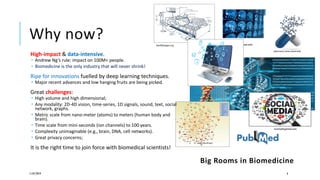
Why now?
11/07/2019 6
Big Rooms in Biomedicine
healthpages.org engineering.case.edu
pharmacy.umaryland.edu
openi.nlm.nih.gov
marketingland.com
High-impact & data-intensive.
 Andrew Ng’s rule: impact on 100M+ people.
 Biomedicine is the only industry that will never shrink!
Ripe for innovations fuelled by deep learning techniques.
 Major recent advances and low hanging fruits are being picked.
Great challenges:
 High volume and high dimensional;
 Any modality: 2D-4D vision, time-series, 1D signals, sound, text, social
network, graphs.
 Metric scale from nano-meter (atoms) to meters (human body and
brain).
 Time scale from mini-seconds (ion channels) to 100 years.
 Complexity unimaginable (e.g., brain, DNA, cell networks).
 Great privacy concerns;
It is the right time to join force with biomedical scientists!
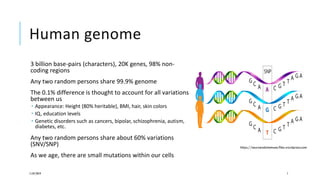
Human genome
3 billion base-pairs (characters), 20K genes, 98% non-
coding regions
Any two random persons share 99.9% genome
The 0.1% difference is thought to account for all variations
between us
 Appearance: Height (80% heritable), BMI, hair, skin colors
 IQ, education levels
 Genetic disorders such as cancers, bipolar, schizophrenia, autism,
diabetes, etc.
Any two random persons share about 60% variations
(SNV/SNP)
As we age, there are small mutations within our cells
11/07/2019 7
https://neuroendoimmune.files.wordpress.com
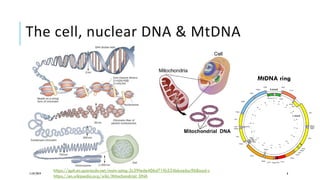
The cell, nuclear DNA & MtDNA
11/07/2019 8
https://qph.ec.quoracdn.net/main-qimg-2c39fede406d71fb534bbae6cc9b8aad-c
https://en.wikipedia.org/wiki/Mitochondrial_DNA
MtDNA ring
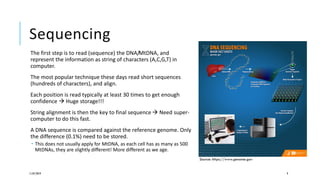
Sequencing
The first step is to read (sequence) the DNA/MtDNA, and
represent the information as string of characters (A,C,G,T) in
computer.
The most popular technique these days read short sequences
(hundreds of characters), and align.
Each position is read typically at least 30 times to get enough
confidence  Huge storage!!!
String alignment is then the key to final sequence  Need super-
computer to do this fast.
A DNA sequence is compared against the reference genome. Only
the difference (0.1%) need to be stored.
 This does not usually apply for MtDNA, as each cell has as many as 500
MtDNAs, they are slightly different! More different as we age.
11/07/2019 9
Source: https://www.genome.gov
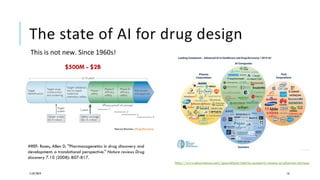
The state of AI for drug design
This is not new. Since 1960s!
11/07/2019 10
http://www.pharmexec.com/specialized-metrics-properly-assess-ai-pharma-startups
#REF: Roses, Allen D. "Pharmacogenetics in drug discovery and
development: a translational perspective." Nature reviews Drug
discovery 7.10 (2008): 807-817.
$500M - $2B
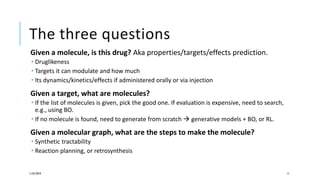
The three questions
Given a molecule, is this drug? Aka properties/targets/effects prediction.
 Druglikeness
 Targets it can modulate and how much
 Its dynamics/kinetics/effects if administered orally or via injection
Given a target, what are molecules?
 If the list of molecules is given, pick the good one. If evaluation is expensive, need to search,
e.g., using BO.
 If no molecule is found, need to generate from scratch  generative models + BO, or RL.
Given a molecular graph, what are the steps to make the molecule?
 Synthetic tractability
 Reaction planning, or retrosynthesis
11/07/2019 11
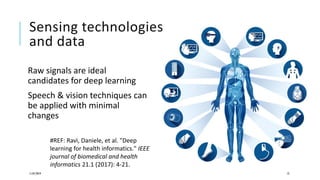
Sensing technologies
and data
11/07/2019 12
#REF: Ravì, Daniele, et al. "Deep
learning for health informatics." IEEE
journal of biomedical and health
informatics 21.1 (2017): 4-21.
Raw signals are ideal
candidates for deep learning
Speech & vision techniques can
be applied with minimal
changes
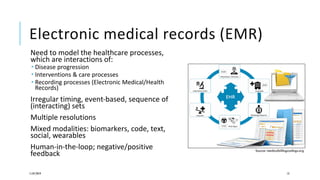
Electronic medical records (EMR)
Need to model the healthcare processes,
which are interactions of:
 Disease progression
 Interventions & care processes
 Recording processes (Electronic Medical/Health
Records)
Irregular timing, event-based, sequence of
(interacting) sets
Multiple resolutions
Mixed modalities: biomarkers, code, text,
social, wearables
Human-in-the-loop; negative/positive
feedback
11/07/2019 13
Source: medicalbillingcodings.org
11/07/2019 14
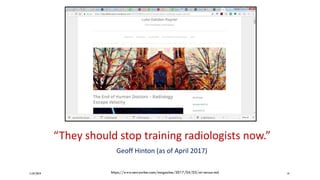
“They should stop training radiologists now.”
Geoff Hinton (as of April 2017)
https://www.newyorker.com/magazine/2017/04/03/ai-versus-md
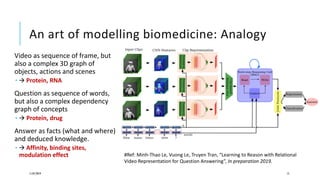
An art of modelling biomedicine: Analogy
Video as sequence of frame, but
also a complex 3D graph of
objects, actions and scenes
  Protein, RNA
Question as sequence of words,
but also a complex dependency
graph of concepts
  Protein, drug
Answer as facts (what and where)
and deduced knowledge.
  Affinity, binding sites,
modulation effect
11/07/2019 15
#Ref: Minh-Thao Le, Vuong Le, Truyen Tran, “Learning to Reason with Relational
Video Representation for Question Answering”, In preparation 2019.
11/07/2019 16
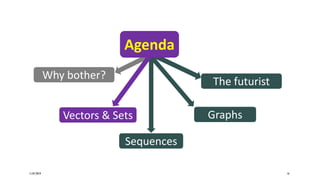
Vectors & Sets
Sequences
Why bother?
The futurist
Graphs
Agenda
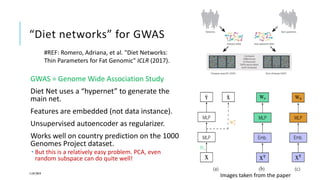
“Diet networks” for GWAS
11/07/2019 17
GWAS = Genome Wide Association Study
Diet Net uses a “hypernet” to generate the
main net.
Features are embedded (not data instance).
Unsupervised autoencoder as regularizer.
Works well on country prediction on the 1000
Genomes Project dataset.
 But this is a relatively easy problem. PCA, even
random subspace can do quite well!
Images taken from the paper
#REF: Romero, Adriana, et al. "Diet Networks:
Thin Parameters for Fat Genomic" ICLR (2017).
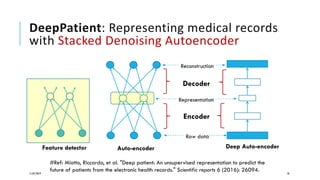
DeepPatient: Representing medical records
with Stacked Denoising Autoencoder
11/07/2019 18
Auto-encoderFeature detector
Representation
Raw data
Reconstruction
Deep Auto-encoder
Encoder
Decoder
#Ref: Miotto, Riccardo, et al. "Deep patient: An unsupervised representation to predict the
future of patients from the electronic health records." Scientific reports 6 (2016): 26094.
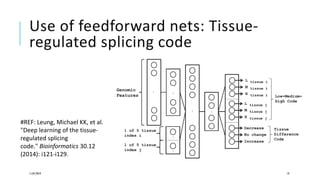
Use of feedforward nets: Tissue-
regulated splicing code
11/07/2019 19
#REF: Leung, Michael KK, et al.
"Deep learning of the tissue-
regulated splicing
code." Bioinformatics 30.12
(2014): i121-i129.
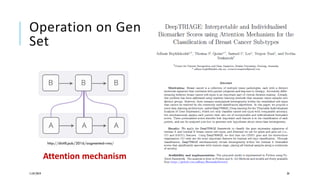
Operation on Gen
Set
11/07/2019 20
http://distill.pub/2016/augmented-rnns/
Attention mechanism
11/07/2019 21
Vectors & Sets
Sequences
Why bother?
The futurist
Graphs
Agenda
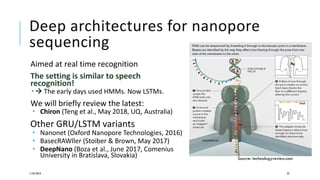
Deep architectures for nanopore
sequencing
Aimed at real time recognition
The setting is similar to speech
recognition!
  The early days used HMMs. Now LSTMs.
We will briefly review the latest:
 Chiron (Teng et al., May 2018, UQ, Australia)
Other GRU/LSTM variants
 Nanonet (Oxford Nanopore Technologies, 2016)
 BasecRAWller (Stoiber & Brown, May 2017)
 DeepNano (Boza et al., June 2017, Comenius
University in Bratislava, Slovakia)
11/07/2019 22
Source: technologyreview.com
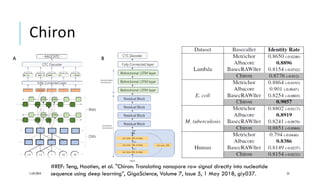
Chiron
11/07/2019 23
#REF: Teng, Haotien, et al. "Chiron: Translating nanopore raw signal directly into nucleotide
sequence using deep learning”, GigaScience, Volume 7, Issue 5, 1 May 2018, giy037.
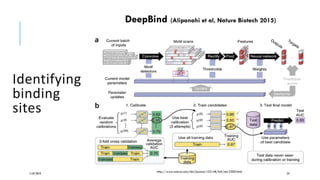
Identifying
binding
sites
11/07/2019 24
http://www.nature.com/nbt/journal/v33/n8/full/nbt.3300.html
DeepBind (Alipanahi et al, Nature Biotech 2015)
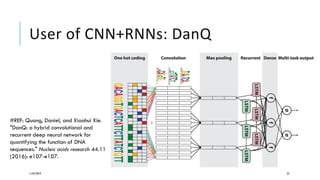
User of CNN+RNNs: DanQ
11/07/2019 25
#REF: Quang, Daniel, and Xiaohui Xie.
"DanQ: a hybrid convolutional and
recurrent deep neural network for
quantifying the function of DNA
sequences." Nucleic acids research 44.11
(2016): e107-e107.
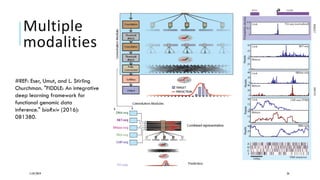
Multiple
modalities
11/07/2019 26
#REF: Eser, Umut, and L. Stirling
Churchman. "FIDDLE: An integrative
deep learning framework for
functional genomic data
inference." bioRxiv (2016):
081380.
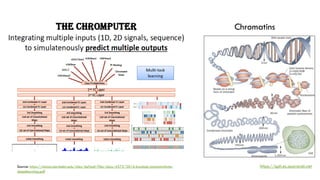
Source: https://simons.berkeley.edu/sites/default/files/docs/4575/2016-kundaje-simonsinstitute-
deeplearning.pdf
https://qph.ec.quoracdn.net
Chromatins
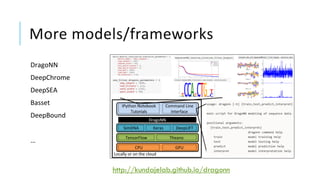
More models/frameworks
DragoNN
DeepChrome
DeepSEA
Basset
DeepBound
…
http://kundajelab.github.io/dragonn
11/07/2019 29
Vectors & Sets
Sequences
Why bother?
The futurist
Graphs
Agenda
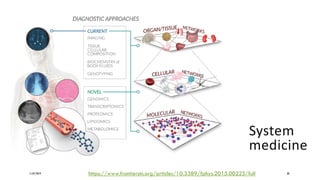
System
medicine
11/07/2019 30https://www.frontiersin.org/articles/10.3389/fphys.2015.00225/full
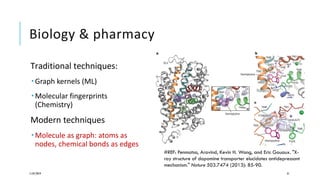
Biology & pharmacy
Traditional techniques:
 Graph kernels (ML)
 Molecular fingerprints
(Chemistry)
Modern techniques
 Molecule as graph: atoms as
nodes, chemical bonds as edges
11/07/2019 31
#REF: Penmatsa, Aravind, Kevin H. Wang, and Eric Gouaux. "X-
ray structure of dopamine transporter elucidates antidepressant
mechanism." Nature 503.7474 (2013): 85-90.
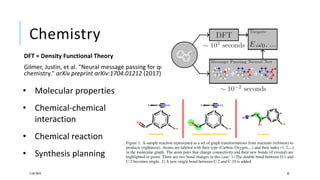
Chemistry
DFT = Density Functional Theory
Gilmer, Justin, et al. "Neural message passing for quantum
chemistry." arXiv preprint arXiv:1704.01212 (2017).
11/07/2019 32
• Molecular properties
• Chemical-chemical
interaction
• Chemical reaction
• Synthesis planning
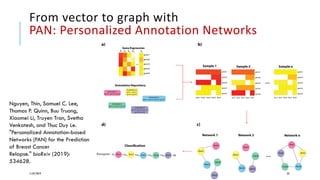
From vector to graph with
PAN: Personalized Annotation Networks
11/07/2019 33
Nguyen, Thin, Samuel C. Lee,
Thomas P. Quinn, Buu Truong,
Xiaomei Li, Truyen Tran, Svetha
Venkatesh, and Thuc Duy Le.
"Personalized Annotation-based
Networks (PAN) for the Prediction
of Breast Cancer
Relapse." bioRxiv (2019):
534628.
#REF: Penmatsa, Aravind, Kevin H. Wang, and Eric Gouaux. "X-
ray structure of dopamine transporter elucidates antidepressant
mechanism." Nature 503.7474 (2013): 85-90.
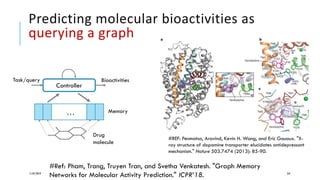
Predicting molecular bioactivities as
querying a graph
11/07/2019 34
Controller
… Memory
Drug
molecule
Task/query Bioactivities
#Ref: Pham, Trang, Truyen Tran, and Svetha Venkatesh. "Graph Memory
Networks for Molecular Activity Prediction." ICPR’18.
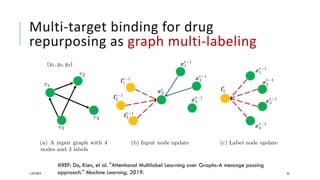
Multi-target binding for drug
repurposing as graph multi-labeling
11/07/2019 35
#REF: Do, Kien, et al. "Attentional Multilabel Learning over Graphs-A message passing
approach." Machine Learning, 2019.
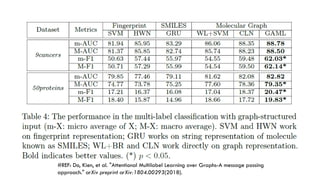
#REF: Do, Kien, et al. "Attentional Multilabel Learning over Graphs-A message passing
approach." arXiv preprint arXiv:1804.00293(2018).
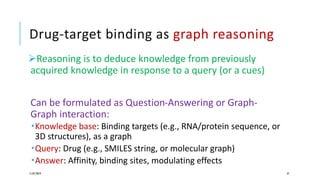
Drug-target binding as graph reasoning
Reasoning is to deduce knowledge from previously
acquired knowledge in response to a query (or a cues)
Can be formulated as Question-Answering or Graph-
Graph interaction:
Knowledge base: Binding targets (e.g., RNA/protein sequence, or
3D structures), as a graph
Query: Drug (e.g., SMILES string, or molecular graph)
Answer: Affinity, binding sites, modulating effects
11/07/2019 37
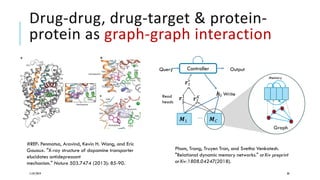
Drug-drug, drug-target & protein-
protein as graph-graph interaction
11/07/2019 38
𝑴𝑴1
…
𝑴𝑴𝐶𝐶
𝒓𝒓𝑡𝑡
1
…𝒓𝒓𝑡𝑡
𝐾𝐾
𝒓𝒓𝑡𝑡
∗
Controller
Write𝒉𝒉𝑡𝑡
Memory
Graph
Query Output
Read
heads
Pham, Trang, Truyen Tran, and Svetha Venkatesh.
"Relational dynamic memory networks." arXiv preprint
arXiv:1808.04247(2018).
#REF: Penmatsa, Aravind, Kevin H. Wang, and Eric
Gouaux. "X-ray structure of dopamine transporter
elucidates antidepressant
mechanism." Nature 503.7474 (2013): 85-90.
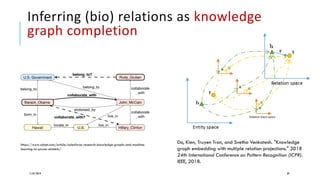
Inferring (bio) relations as knowledge
graph completion
11/07/2019 39
https://www.zdnet.com/article/salesforce-research-knowledge-graphs-and-machine-
learning-to-power-einstein/
Do, Kien, Truyen Tran, and Svetha Venkatesh. "Knowledge
graph embedding with multiple relation projections." 2018
24th International Conference on Pattern Recognition (ICPR).
IEEE, 2018.
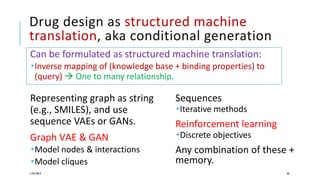
Drug design as structured machine
translation, aka conditional generation
Can be formulated as structured machine translation:
Inverse mapping of (knowledge base + binding properties) to
(query)  One to many relationship.
11/07/2019 40
Representing graph as string
(e.g., SMILES), and use
sequence VAEs or GANs.
Graph VAE & GAN
Model nodes & interactions
Model cliques
Sequences
Iterative methods
Reinforcement learning
Discrete objectives
Any combination of these +
memory.
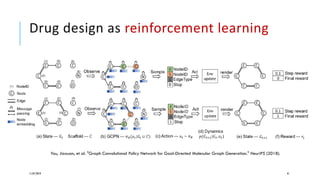
Drug design as reinforcement learning
11/07/2019 41
You, Jiaxuan, et al. "Graph Convolutional Policy Network for Goal-Directed Molecular Graph Generation." NeurIPS (2018).
11/07/2019 42
Vectors & Sets
Sequences
Why bother?
The futurist
Graphs
Agenda
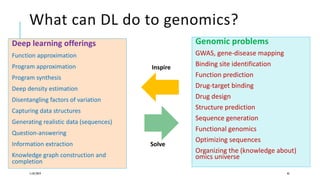
What can DL do to genomics?
Deep learning offerings
Function approximation
Program approximation
Program synthesis
Deep density estimation
Disentangling factors of variation
Capturing data structures
Generating realistic data (sequences)
Question-answering
Information extraction
Knowledge graph construction and
completion
11/07/2019 43
Genomic problems
GWAS, gene-disease mapping
Binding site identification
Function prediction
Drug-target binding
Drug design
Structure prediction
Sequence generation
Functional genomics
Optimizing sequences
Organizing the (knowledge about)
omics universe
Inspire
Solve
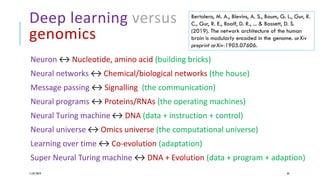
Deep learning versus
genomics
Neuron ↔ Nucleotide, amino acid (building bricks)
Neural networks ↔ Chemical/biological networks (the house)
Message passing ↔ Signalling (the communication)
Neural programs ↔ Proteins/RNAs (the operating machines)
Neural Turing machine ↔ DNA (data + instruction + control)
Neural universe ↔ Omics universe (the computational universe)
Learning over time ↔ Co-evolution (adaptation)
Super Neural Turing machine ↔ DNA + Evolution (data + program + adaption)
11/07/2019 44
Bertolero, M. A., Blevins, A. S., Baum, G. L., Gur, R.
C., Gur, R. E., Roalf, D. R., ... & Bassett, D. S.
(2019). The network architecture of the human
brain is modularly encoded in the genome. arXiv
preprint arXiv:1905.07606.
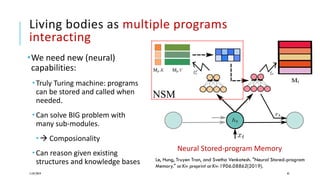
Living bodies as multiple programs
interacting
11/07/2019 45
We need new (neural)
capabilities:
 Truly Turing machine: programs
can be stored and called when
needed.
 Can solve BIG problem with
many sub-modules.
  Composionality
 Can reason given existing
structures and knowledge bases
Neural Stored-program Memory
Le, Hung, Truyen Tran, and Svetha Venkatesh. "Neural Stored-program
Memory." arXiv preprint arXiv:1906.08862(2019).
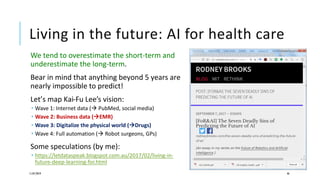
Living in the future: AI for health care
We tend to overestimate the short-term and
underestimate the long-term.
Bear in mind that anything beyond 5 years are
nearly impossible to predict!
Let’s map Kai-Fu Lee’s vision:
 Wave 1: Internet data ( PubMed, social media)
 Wave 2: Business data (EMR)
 Wave 3: Digitalize the physical world (Drugs)
 Wave 4: Full automation ( Robot surgeons, GPs)
Some speculations (by me):
 https://letdataspeak.blogspot.com.au/2017/02/living-in-
future-deep-learning-for.html
11/07/2019 46
11/07/2019 47
The team
11/07/2019 48
http://ahsanqawl.com/2015/10/qa/
We’re hiring
PhD & Postdocs
truyen.tran@deakin.edu.au
https://truyentran.github.io/scholarship.html

Deep learning for biomedicine

  • 1.
    11/07/2019 1 Jakarta, July2019 Truyen Tran Deakin University @truyenoz truyentran.github.io truyen.tran@deakin.edu.au letdataspeak.blogspot.com goo.gl/3jJ1O0 Deep Learning for Biomedicine
  • 2.
  • 3.
    11/07/2019 3 Vectors &Sets Sequences Why bother? The futurist Graphs Agenda Biomed structures
  • 4.
  • 5.
    Recent AI/ML/KDD activities Conferenceon Machine Learning for Healthcare (MLHC), 2019 ICML/IJCAI/AAAI (2019)  Health Intelligence  Workshop on Computational Biology  Knowledge Discovery in Healthcare III: Towards Learning Healthcare Systems (KDH) KDD/SDM/ICDM (2018-2019)  Health Day at KDD’18  epiDAMIK: Epidemiology meets Data Mining and Knowledge discovery  17th International Workshop on Data Mining in Bioinformatics  Workshop on Data Mining in Bioinformatics (BIOKDD 2019)  [DsHealth 2019] 2019 KDD workshop on Applied data science in Healthcare: bridging the gap between data and knowledge 11/07/2019 5
  • 6.
    Why now? 11/07/2019 6 BigRooms in Biomedicine healthpages.org engineering.case.edu pharmacy.umaryland.edu openi.nlm.nih.gov marketingland.com High-impact & data-intensive.  Andrew Ng’s rule: impact on 100M+ people.  Biomedicine is the only industry that will never shrink! Ripe for innovations fuelled by deep learning techniques.  Major recent advances and low hanging fruits are being picked. Great challenges:  High volume and high dimensional;  Any modality: 2D-4D vision, time-series, 1D signals, sound, text, social network, graphs.  Metric scale from nano-meter (atoms) to meters (human body and brain).  Time scale from mini-seconds (ion channels) to 100 years.  Complexity unimaginable (e.g., brain, DNA, cell networks).  Great privacy concerns; It is the right time to join force with biomedical scientists!
  • 7.
    Human genome 3 billionbase-pairs (characters), 20K genes, 98% non- coding regions Any two random persons share 99.9% genome The 0.1% difference is thought to account for all variations between us  Appearance: Height (80% heritable), BMI, hair, skin colors  IQ, education levels  Genetic disorders such as cancers, bipolar, schizophrenia, autism, diabetes, etc. Any two random persons share about 60% variations (SNV/SNP) As we age, there are small mutations within our cells 11/07/2019 7 https://neuroendoimmune.files.wordpress.com
  • 8.
    The cell, nuclearDNA & MtDNA 11/07/2019 8 https://qph.ec.quoracdn.net/main-qimg-2c39fede406d71fb534bbae6cc9b8aad-c https://en.wikipedia.org/wiki/Mitochondrial_DNA MtDNA ring
  • 9.
    Sequencing The first stepis to read (sequence) the DNA/MtDNA, and represent the information as string of characters (A,C,G,T) in computer. The most popular technique these days read short sequences (hundreds of characters), and align. Each position is read typically at least 30 times to get enough confidence  Huge storage!!! String alignment is then the key to final sequence  Need super- computer to do this fast. A DNA sequence is compared against the reference genome. Only the difference (0.1%) need to be stored.  This does not usually apply for MtDNA, as each cell has as many as 500 MtDNAs, they are slightly different! More different as we age. 11/07/2019 9 Source: https://www.genome.gov
  • 10.
    The state ofAI for drug design This is not new. Since 1960s! 11/07/2019 10 http://www.pharmexec.com/specialized-metrics-properly-assess-ai-pharma-startups #REF: Roses, Allen D. "Pharmacogenetics in drug discovery and development: a translational perspective." Nature reviews Drug discovery 7.10 (2008): 807-817. $500M - $2B
  • 11.
    The three questions Givena molecule, is this drug? Aka properties/targets/effects prediction.  Druglikeness  Targets it can modulate and how much  Its dynamics/kinetics/effects if administered orally or via injection Given a target, what are molecules?  If the list of molecules is given, pick the good one. If evaluation is expensive, need to search, e.g., using BO.  If no molecule is found, need to generate from scratch  generative models + BO, or RL. Given a molecular graph, what are the steps to make the molecule?  Synthetic tractability  Reaction planning, or retrosynthesis 11/07/2019 11
  • 12.
    Sensing technologies and data 11/07/201912 #REF: Ravì, Daniele, et al. "Deep learning for health informatics." IEEE journal of biomedical and health informatics 21.1 (2017): 4-21. Raw signals are ideal candidates for deep learning Speech & vision techniques can be applied with minimal changes
  • 13.
    Electronic medical records(EMR) Need to model the healthcare processes, which are interactions of:  Disease progression  Interventions & care processes  Recording processes (Electronic Medical/Health Records) Irregular timing, event-based, sequence of (interacting) sets Multiple resolutions Mixed modalities: biomarkers, code, text, social, wearables Human-in-the-loop; negative/positive feedback 11/07/2019 13 Source: medicalbillingcodings.org
  • 14.
    11/07/2019 14 “They shouldstop training radiologists now.” Geoff Hinton (as of April 2017) https://www.newyorker.com/magazine/2017/04/03/ai-versus-md
  • 15.
    An art ofmodelling biomedicine: Analogy Video as sequence of frame, but also a complex 3D graph of objects, actions and scenes   Protein, RNA Question as sequence of words, but also a complex dependency graph of concepts   Protein, drug Answer as facts (what and where) and deduced knowledge.   Affinity, binding sites, modulation effect 11/07/2019 15 #Ref: Minh-Thao Le, Vuong Le, Truyen Tran, “Learning to Reason with Relational Video Representation for Question Answering”, In preparation 2019.
  • 16.
    11/07/2019 16 Vectors &Sets Sequences Why bother? The futurist Graphs Agenda
  • 17.
    “Diet networks” forGWAS 11/07/2019 17 GWAS = Genome Wide Association Study Diet Net uses a “hypernet” to generate the main net. Features are embedded (not data instance). Unsupervised autoencoder as regularizer. Works well on country prediction on the 1000 Genomes Project dataset.  But this is a relatively easy problem. PCA, even random subspace can do quite well! Images taken from the paper #REF: Romero, Adriana, et al. "Diet Networks: Thin Parameters for Fat Genomic" ICLR (2017).
  • 18.
    DeepPatient: Representing medicalrecords with Stacked Denoising Autoencoder 11/07/2019 18 Auto-encoderFeature detector Representation Raw data Reconstruction Deep Auto-encoder Encoder Decoder #Ref: Miotto, Riccardo, et al. "Deep patient: An unsupervised representation to predict the future of patients from the electronic health records." Scientific reports 6 (2016): 26094.
  • 19.
    Use of feedforwardnets: Tissue- regulated splicing code 11/07/2019 19 #REF: Leung, Michael KK, et al. "Deep learning of the tissue- regulated splicing code." Bioinformatics 30.12 (2014): i121-i129.
  • 20.
    Operation on Gen Set 11/07/201920 http://distill.pub/2016/augmented-rnns/ Attention mechanism
  • 21.
    11/07/2019 21 Vectors &Sets Sequences Why bother? The futurist Graphs Agenda
  • 22.
    Deep architectures fornanopore sequencing Aimed at real time recognition The setting is similar to speech recognition!   The early days used HMMs. Now LSTMs. We will briefly review the latest:  Chiron (Teng et al., May 2018, UQ, Australia) Other GRU/LSTM variants  Nanonet (Oxford Nanopore Technologies, 2016)  BasecRAWller (Stoiber & Brown, May 2017)  DeepNano (Boza et al., June 2017, Comenius University in Bratislava, Slovakia) 11/07/2019 22 Source: technologyreview.com
  • 23.
    Chiron 11/07/2019 23 #REF: Teng,Haotien, et al. "Chiron: Translating nanopore raw signal directly into nucleotide sequence using deep learning”, GigaScience, Volume 7, Issue 5, 1 May 2018, giy037.
  • 24.
  • 25.
    User of CNN+RNNs:DanQ 11/07/2019 25 #REF: Quang, Daniel, and Xiaohui Xie. "DanQ: a hybrid convolutional and recurrent deep neural network for quantifying the function of DNA sequences." Nucleic acids research 44.11 (2016): e107-e107.
  • 26.
    Multiple modalities 11/07/2019 26 #REF: Eser,Umut, and L. Stirling Churchman. "FIDDLE: An integrative deep learning framework for functional genomic data inference." bioRxiv (2016): 081380.
  • 27.
  • 28.
  • 29.
    11/07/2019 29 Vectors &Sets Sequences Why bother? The futurist Graphs Agenda
  • 30.
  • 31.
    Biology & pharmacy Traditionaltechniques:  Graph kernels (ML)  Molecular fingerprints (Chemistry) Modern techniques  Molecule as graph: atoms as nodes, chemical bonds as edges 11/07/2019 31 #REF: Penmatsa, Aravind, Kevin H. Wang, and Eric Gouaux. "X- ray structure of dopamine transporter elucidates antidepressant mechanism." Nature 503.7474 (2013): 85-90.
  • 32.
    Chemistry DFT = DensityFunctional Theory Gilmer, Justin, et al. "Neural message passing for quantum chemistry." arXiv preprint arXiv:1704.01212 (2017). 11/07/2019 32 • Molecular properties • Chemical-chemical interaction • Chemical reaction • Synthesis planning
  • 33.
    From vector tograph with PAN: Personalized Annotation Networks 11/07/2019 33 Nguyen, Thin, Samuel C. Lee, Thomas P. Quinn, Buu Truong, Xiaomei Li, Truyen Tran, Svetha Venkatesh, and Thuc Duy Le. "Personalized Annotation-based Networks (PAN) for the Prediction of Breast Cancer Relapse." bioRxiv (2019): 534628.
  • 34.
    #REF: Penmatsa, Aravind,Kevin H. Wang, and Eric Gouaux. "X- ray structure of dopamine transporter elucidates antidepressant mechanism." Nature 503.7474 (2013): 85-90. Predicting molecular bioactivities as querying a graph 11/07/2019 34 Controller … Memory Drug molecule Task/query Bioactivities #Ref: Pham, Trang, Truyen Tran, and Svetha Venkatesh. "Graph Memory Networks for Molecular Activity Prediction." ICPR’18.
  • 35.
    Multi-target binding fordrug repurposing as graph multi-labeling 11/07/2019 35 #REF: Do, Kien, et al. "Attentional Multilabel Learning over Graphs-A message passing approach." Machine Learning, 2019.
  • 36.
    #REF: Do, Kien,et al. "Attentional Multilabel Learning over Graphs-A message passing approach." arXiv preprint arXiv:1804.00293(2018).
  • 37.
    Drug-target binding asgraph reasoning Reasoning is to deduce knowledge from previously acquired knowledge in response to a query (or a cues) Can be formulated as Question-Answering or Graph- Graph interaction: Knowledge base: Binding targets (e.g., RNA/protein sequence, or 3D structures), as a graph Query: Drug (e.g., SMILES string, or molecular graph) Answer: Affinity, binding sites, modulating effects 11/07/2019 37
  • 38.
    Drug-drug, drug-target &protein- protein as graph-graph interaction 11/07/2019 38 𝑴𝑴1 … 𝑴𝑴𝐶𝐶 𝒓𝒓𝑡𝑡 1 …𝒓𝒓𝑡𝑡 𝐾𝐾 𝒓𝒓𝑡𝑡 ∗ Controller Write𝒉𝒉𝑡𝑡 Memory Graph Query Output Read heads Pham, Trang, Truyen Tran, and Svetha Venkatesh. "Relational dynamic memory networks." arXiv preprint arXiv:1808.04247(2018). #REF: Penmatsa, Aravind, Kevin H. Wang, and Eric Gouaux. "X-ray structure of dopamine transporter elucidates antidepressant mechanism." Nature 503.7474 (2013): 85-90.
  • 39.
    Inferring (bio) relationsas knowledge graph completion 11/07/2019 39 https://www.zdnet.com/article/salesforce-research-knowledge-graphs-and-machine- learning-to-power-einstein/ Do, Kien, Truyen Tran, and Svetha Venkatesh. "Knowledge graph embedding with multiple relation projections." 2018 24th International Conference on Pattern Recognition (ICPR). IEEE, 2018.
  • 40.
    Drug design asstructured machine translation, aka conditional generation Can be formulated as structured machine translation: Inverse mapping of (knowledge base + binding properties) to (query)  One to many relationship. 11/07/2019 40 Representing graph as string (e.g., SMILES), and use sequence VAEs or GANs. Graph VAE & GAN Model nodes & interactions Model cliques Sequences Iterative methods Reinforcement learning Discrete objectives Any combination of these + memory.
  • 41.
    Drug design asreinforcement learning 11/07/2019 41 You, Jiaxuan, et al. "Graph Convolutional Policy Network for Goal-Directed Molecular Graph Generation." NeurIPS (2018).
  • 42.
    11/07/2019 42 Vectors &Sets Sequences Why bother? The futurist Graphs Agenda
  • 43.
    What can DLdo to genomics? Deep learning offerings Function approximation Program approximation Program synthesis Deep density estimation Disentangling factors of variation Capturing data structures Generating realistic data (sequences) Question-answering Information extraction Knowledge graph construction and completion 11/07/2019 43 Genomic problems GWAS, gene-disease mapping Binding site identification Function prediction Drug-target binding Drug design Structure prediction Sequence generation Functional genomics Optimizing sequences Organizing the (knowledge about) omics universe Inspire Solve
  • 44.
    Deep learning versus genomics Neuron↔ Nucleotide, amino acid (building bricks) Neural networks ↔ Chemical/biological networks (the house) Message passing ↔ Signalling (the communication) Neural programs ↔ Proteins/RNAs (the operating machines) Neural Turing machine ↔ DNA (data + instruction + control) Neural universe ↔ Omics universe (the computational universe) Learning over time ↔ Co-evolution (adaptation) Super Neural Turing machine ↔ DNA + Evolution (data + program + adaption) 11/07/2019 44 Bertolero, M. A., Blevins, A. S., Baum, G. L., Gur, R. C., Gur, R. E., Roalf, D. R., ... & Bassett, D. S. (2019). The network architecture of the human brain is modularly encoded in the genome. arXiv preprint arXiv:1905.07606.
  • 45.
    Living bodies asmultiple programs interacting 11/07/2019 45 We need new (neural) capabilities:  Truly Turing machine: programs can be stored and called when needed.  Can solve BIG problem with many sub-modules.   Composionality  Can reason given existing structures and knowledge bases Neural Stored-program Memory Le, Hung, Truyen Tran, and Svetha Venkatesh. "Neural Stored-program Memory." arXiv preprint arXiv:1906.08862(2019).
  • 46.
    Living in thefuture: AI for health care We tend to overestimate the short-term and underestimate the long-term. Bear in mind that anything beyond 5 years are nearly impossible to predict! Let’s map Kai-Fu Lee’s vision:  Wave 1: Internet data ( PubMed, social media)  Wave 2: Business data (EMR)  Wave 3: Digitalize the physical world (Drugs)  Wave 4: Full automation ( Robot surgeons, GPs) Some speculations (by me):  https://letdataspeak.blogspot.com.au/2017/02/living-in- future-deep-learning-for.html 11/07/2019 46
  • 47.
  • 48.
    11/07/2019 48 http://ahsanqawl.com/2015/10/qa/ We’re hiring PhD& Postdocs truyen.tran@deakin.edu.au https://truyentran.github.io/scholarship.html