20/08/2020 1
@FIT, Monash Uni, August 2020
A/Prof Truyen Tran
Vuong Le, Thao Le, Hung Le,
Dung Nguyen, Tin Pham
@truyenoz
truyentran.github.io
truyen.tran@deakin.edu.au
letdataspeak.blogspot.com
goo.gl/3jJ1O0
Machine reasoning
linkedin.com/in/truyen-tran
20/08/2020 2
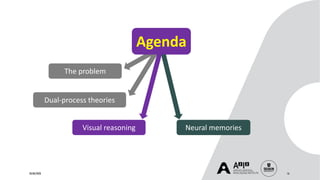
Dual-process theories
The problem
Neural memories
Agenda
Visual reasoning
20/08/2020 3
Among the most challenging scientific questions of our
time are the corresponding analytic and synthetic
problems:
• How does the brain function?
• Can we design a machine which will simulate a brain?
-- Automata Studies, 1956.
20/08/2020 4
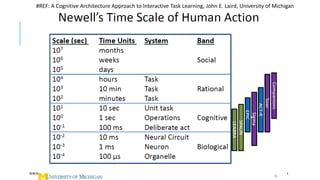
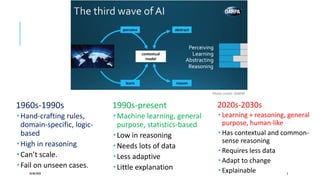
#REF: A Cognitive Architecture Approach to Interactive Task Learning, John E. Laird, University of Michigan
1960s-1990s
 Hand-crafting rules,
domain-specific, logic-
based
 High in reasoning
 Can’t scale.
 Fail on unseen cases.
20/08/2020 5
2020s-2030s
 Learning + reasoning, general
purpose, human-like
 Has contextual and common-
sense reasoning
 Requires less data
 Adapt to change
 Explainable
1990s-present
 Machine learning, general
purpose, statistics-based
 Low in reasoning
 Needs lots of data
 Less adaptive
 Little explanation
Photo credit: DARPA
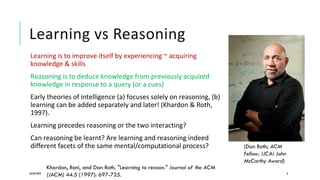
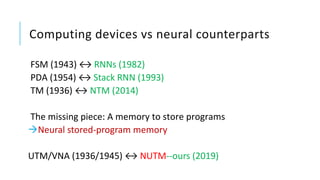
Learning vs Reasoning
Learning is to improve itself by experiencing ~ acquiring
knowledge & skills
Reasoning is to deduce knowledge from previously acquired
knowledge in response to a query (or a cues)
Early theories of intelligence (a) focuses solely on reasoning, (b)
learning can be added separately and later! (Khardon & Roth,
1997).
Learning precedes reasoning or the two interacting?
Can reasoning be learnt? Are learning and reasoning indeed
different facets of the same mental/computational process?
20/08/2020 6
Khardon, Roni, and Dan Roth. "Learning to reason." Journal of the ACM
(JACM) 44.5 (1997): 697-725.
(Dan Roth; ACM
Fellow; IJCAI John
McCarthy Award)
Rich Sutton’s Bitter Lesson
20/08/2020 7
“The biggest lesson that can be read from
70 years of AI research is that general
methods that leverage computation are
ultimately the most effective, and by a
large margin. ”
“The two methods that seem to scale
arbitrarily in this way
are search and learning.”
http://www.incompleteideas.net/IncIdeas/BitterLesson.html
Bottou’s vision of reasoning
Reasoning is not necessarily achieved by
making logical inferences
There is a continuity between algebraically
rich inference and connecting together
trainable learning systems
Central to reasoning is composition rules to
guide the combinations of modules to
address new tasks
20/08/2020 8
“When we observe a visual scene, when we
hear a complex sentence, we are able to
explain in formal terms the relation of the
objects in the scene, or the precise meaning of
the sentence components. However, there is no
evidence that such a formal analysis
necessarily takes place: we see a scene, we
hear a sentence, and we just know what they
mean. This suggests the existence of a middle
layer, already a form of reasoning, but not
yet formal or logical.”
Bottou, Léon. "From machine learning to machine reasoning." Machine learning 94.2
(2014): 133-149.
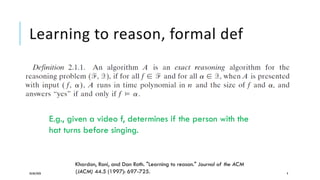
Learning to reason, formal def
20/08/2020 9
Khardon, Roni, and Dan Roth. "Learning to reason." Journal of the ACM
(JACM) 44.5 (1997): 697-725.
E.g., given a video f, determines if the person with the
hat turns before singing.
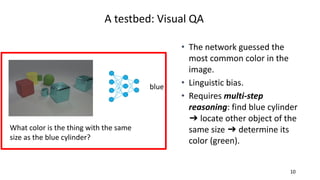
10
What color is the thing with the same
size as the blue cylinder?
blue
• The network guessed the
most common color in the
image.
• Linguistic bias.
• Requires multi-step
reasoning: find blue cylinder
➔ locate other object of the
same size ➔ determine its
color (green).
A testbed: Visual QA
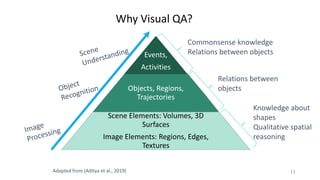
11Adapted from (Aditya et al., 2019)
Events,
Activities
Objects, Regions,
Trajectories
Scene Elements: Volumes, 3D
Surfaces
Image Elements: Regions, Edges,
Textures
Knowledge about
shapes
Qualitative spatial
reasoning
Relations between
objects
Commonsense knowledge
Relations between objects
Why Visual QA?
20/08/2020 12
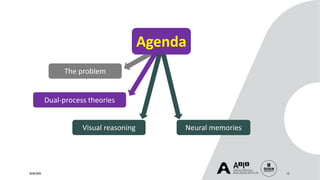
Dual-process theories
The problem
Neural memories
Agenda
Visual reasoning
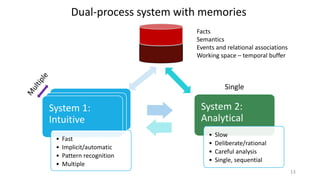
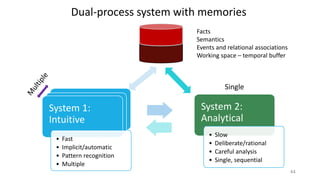
Dual-process system with memories
13
System 1:
Intuitive
System 1:
Intuitive
System 1:
Intuitive
• Fast
• Implicit/automatic
• Pattern recognition
• Multiple
System 2:
Analytical
• Slow
• Deliberate/rational
• Careful analysis
• Single, sequential
Facts
Semantics
Events and relational associations
Working space – temporal buffer
Single
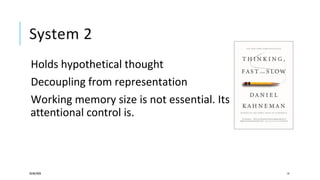
System 2
Holds hypothetical thought
Decoupling from representation
Working memory size is not essential. Its
attentional control is.
20/08/2020 14
Hypotheses
Reasoning as just-in-time program synthesis.
It employs conditional computation.
Reasoning is recursive, e.g., mental travel.
20/08/2020 15
20/08/2020 16
Dual-process theories
The problem
Neural memories
Agenda
Visual reasoning
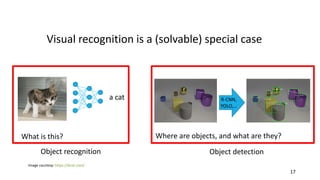
Visual recognition is a (solvable) special case
17
Image courtesy: https://dcist.com/
What is this?
a cat R-CNN,
YOLO,…
Object recognition Object detection
Where are objects, and what are they?
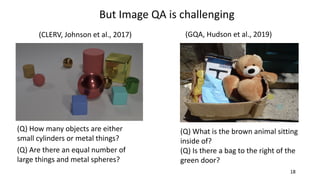
But Image QA is challenging
18
(CLERV, Johnson et al., 2017)
(Q) How many objects are either
small cylinders or metal things?
(Q) Are there an equal number of
large things and metal spheres?
(GQA, Hudson et al., 2019)
(Q) What is the brown animal sitting
inside of?
(Q) Is there a bag to the right of the
green door?
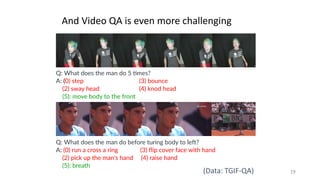
And Video QA is even more challenging
19(Data: TGIF-QA)
20
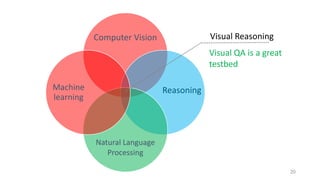
Reasoning
Computer Vision
Natural Language
Processing
Machine
learning
Visual Reasoning
Visual QA is a great
testbed
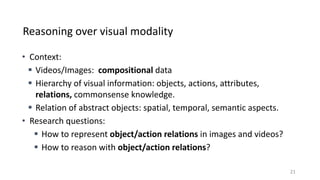
Reasoning over visual modality
• Context:
 Videos/Images: compositional data
 Hierarchy of visual information: objects, actions, attributes,
relations, commonsense knowledge.
 Relation of abstract objects: spatial, temporal, semantic aspects.
• Research questions:
 How to represent object/action relations in images and videos?
 How to reason with object/action relations?
21
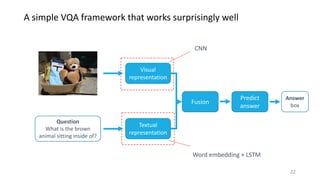
A simple VQA framework that works surprisingly well
22
Visual
representation
Question
What is the brown
animal sitting inside of?
Textual
representation
Fusion
Predict
answer
Answer
box
CNN
Word embedding + LSTM
20/08/2020 23
A Prelim Dual-System Model
Le, Thao Minh, Vuong Le, Svetha Venkatesh, and Truyen Tran. "Neural
Reasoning, Fast and Slow, for Video Question Answering." IJCNN (2020).
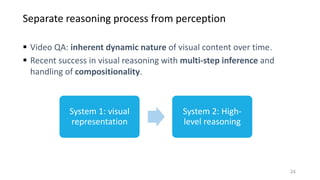
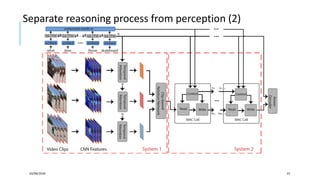
Separate reasoning process from perception
24
 Video QA: inherent dynamic nature of visual content over time.
 Recent success in visual reasoning with multi-step inference and
handling of compositionality.
System 1: visual
representation
System 2: High-
level reasoning
20/08/2020 25
Separate reasoning process from perception (2)
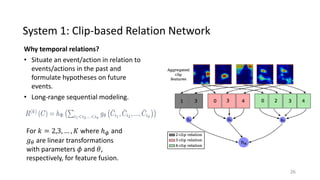
System 1: Clip-based Relation Network
26
For 𝑘𝑘 = 2,3, … , 𝐾𝐾 where ℎ𝜙𝜙 and
𝑔𝑔𝜃𝜃 are linear transformations
with parameters 𝜙𝜙 and 𝜃𝜃,
respectively, for feature fusion.
Why temporal relations?
• Situate an event/action in relation to
events/actions in the past and
formulate hypotheses on future
events.
• Long-range sequential modeling.
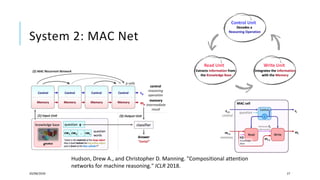
System 2: MAC Net
20/08/2020 27
Hudson, Drew A., and Christopher D. Manning. "Compositional attention
networks for machine reasoning." ICLR 2018.
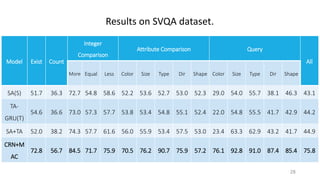
Results on SVQA dataset.
28
Model Exist Count
Integer
Comparison
Attribute Comparison Query
All
More Equal Less Color Size Type Dir Shape Color Size Type Dir Shape
SA(S) 51.7 36.3 72.7 54.8 58.6 52.2 53.6 52.7 53.0 52.3 29.0 54.0 55.7 38.1 46.3 43.1
TA-
GRU(T)
54.6 36.6 73.0 57.3 57.7 53.8 53.4 54.8 55.1 52.4 22.0 54.8 55.5 41.7 42.9 44.2
SA+TA 52.0 38.2 74.3 57.7 61.6 56.0 55.9 53.4 57.5 53.0 23.4 63.3 62.9 43.2 41.7 44.9
CRN+M
AC
72.8 56.7 84.5 71.7 75.9 70.5 76.2 90.7 75.9 57.2 76.1 92.8 91.0 87.4 85.4 75.8
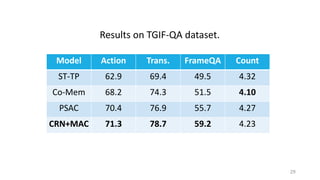
Results on TGIF-QA dataset.
29
Model Action Trans. FrameQA Count
ST-TP 62.9 69.4 49.5 4.32
Co-Mem 68.2 74.3 51.5 4.10
PSAC 70.4 76.9 55.7 4.27
CRN+MAC 71.3 78.7 59.2 4.23
20/08/2020 30
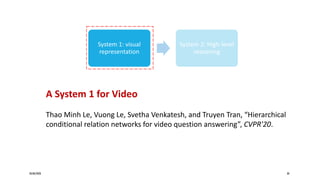
A System 1 for Video
Thao Minh Le, Vuong Le, Svetha Venkatesh, and Truyen Tran, “Hierarchical
conditional relation networks for video question answering”, CVPR'20.
System 1: visual
representation
System 2: High-level
reasoning
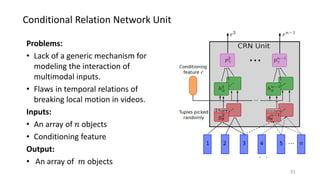
Conditional Relation Network Unit
31
Problems:
• Lack of a generic mechanism for
modeling the interaction of
multimodal inputs.
• Flaws in temporal relations of
breaking local motion in videos.
Inputs:
• An array of 𝑛𝑛 objects
• Conditioning feature
Output:
• An array of 𝑚𝑚 objects
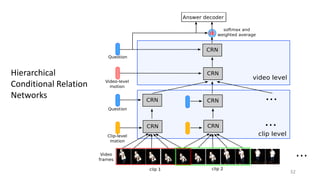
Hierarchical
Conditional Relation
Networks
32
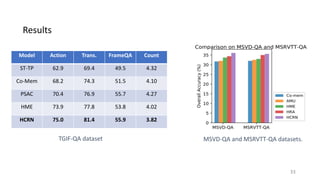
Results
33
Model Action Trans. FrameQA Count
ST-TP 62.9 69.4 49.5 4.32
Co-Mem 68.2 74.3 51.5 4.10
PSAC 70.4 76.9 55.7 4.27
HME 73.9 77.8 53.8 4.02
HCRN 75.0 81.4 55.9 3.82
TGIF-QA dataset MSVD-QA and MSRVTT-QA datasets.
20/08/2020 34
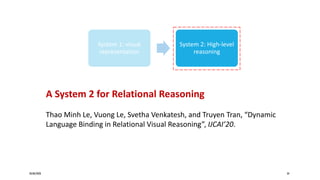
A System 2 for Relational Reasoning
Thao Minh Le, Vuong Le, Svetha Venkatesh, and Truyen Tran, “Dynamic
Language Binding in Relational Visual Reasoning”, IJCAI’20.
System 1: visual
representation
System 2: High-level
reasoning
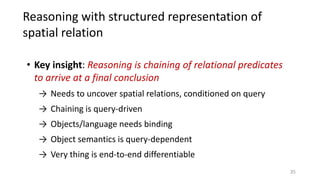
Reasoning with structured representation of
spatial relation
35
• Key insight: Reasoning is chaining of relational predicates
to arrive at a final conclusion
→ Needs to uncover spatial relations, conditioned on query
→ Chaining is query-driven
→ Objects/language needs binding
→ Object semantics is query-dependent
→ Very thing is end-to-end differentiable
36
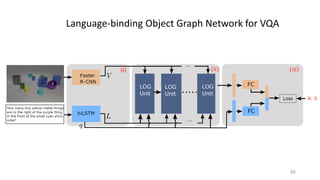
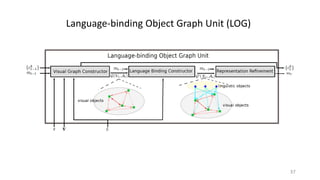
Language-binding Object Graph Network for VQA
37
Language-binding Object Graph Unit (LOG)
20/08/2020 38
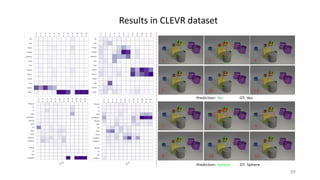
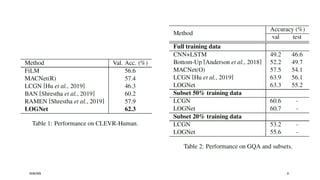
Results in CLEVR dataset
39
40
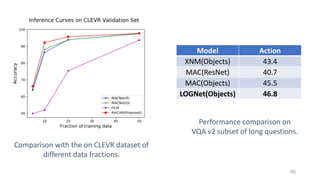
Comparison with the on CLEVR dataset of
different data fractions.
Performance comparison on
VQA v2 subset of long questions.
Model Action
XNM(Objects) 43.4
MAC(ResNet) 40.7
MAC(Objects) 45.5
LOGNet(Objects) 46.8
20/08/2020 41
20/08/2020 42
Dual-process theories
The problem
Neural memoriesVisual reasoning
Agenda
“[…] one cannot hope to understand
reasoning without understanding the memory
processes […]”
(Thompson and Feeney, 2014)
20/08/2020 43
Dual-process system with memories
44
System 1:
Intuitive
System 1:
Intuitive
System 1:
Intuitive
• Fast
• Implicit/automatic
• Pattern recognition
• Multiple
System 2:
Analytical
• Slow
• Deliberate/rational
• Careful analysis
• Single, sequential
Facts
Semantics
Events and relational associations
Working space – temporal buffer
Single
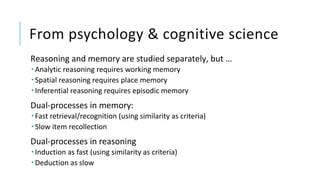
From psychology & cognitive science
Reasoning and memory are studied separately, but …
 Analytic reasoning requires working memory
 Spatial reasoning requires place memory
 Inferential reasoning requires episodic memory
Dual-processes in memory:
 Fast retrieval/recognition (using similarity as criteria)
 Slow item recollection
Dual-processes in reasoning
 Induction as fast (using similarity as criteria)
 Deduction as slow
Reasoning as memory
Expert reasoning was enabled by a large long-term memory,
acquired through experience
Working memory for analytic reasoning
 WM capacity predicts IQ
 Higher order cognition = creating & manipulating relations  representation of
premises, temporarily stored in WM
 WM is a system to support information binding to a coordinate system
 Reasoning as deliberative hypothesis testing  memory-retrieval based hypothesis
generation
Knowledge structures support reasoning
Fuzzy-trace theory: gist ( intuition) and verbatim memory (
analytic processing)
Memory is critical for episodic future thinking (mental simulation)
20/08/2020 46
20/08/2020 47
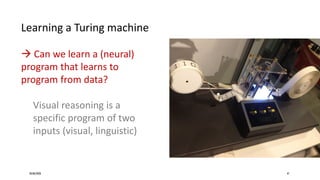
Learning a Turing machine
 Can we learn a (neural)
program that learns to
program from data?
Visual reasoning is a
specific program of two
inputs (visual, linguistic)
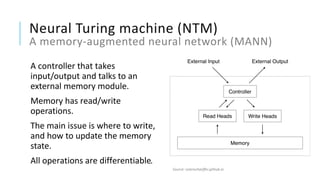
Neural Turing machine (NTM)
A memory-augmented neural network (MANN)
A controller that takes
input/output and talks to an
external memory module.
Memory has read/write
operations.
The main issue is where to write,
and how to update the memory
state.
All operations are differentiable.
Source: rylanschaeffer.github.io
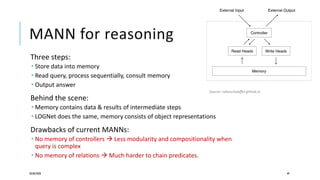
MANN for reasoning
Three steps:
 Store data into memory
 Read query, process sequentially, consult memory
 Output answer
Behind the scene:
 Memory contains data & results of intermediate steps
 LOGNet does the same, memory consists of object representations
Drawbacks of current MANNs:
 No memory of controllers  Less modularity and compositionality when
query is complex
 No memory of relations  Much harder to chain predicates.
20/08/2020 49
Source: rylanschaeffer.github.io
20/08/2020 50
Universal Neural Turing Machines
Hung Le, Truyen Tran, Svetha Venkatesh, “Neural stored-program
memory”, ICLR'20.
Hung Le, Truyen Tran, Svetha Venkatesh, “Neurocoder: Learning General-
Purpose Computation Using Stored Neural Programs”, Work in progress.
Computing devices vs neural counterparts
FSM (1943) ↔ RNNs (1982)
PDA (1954) ↔ Stack RNN (1993)
TM (1936) ↔ NTM (2014)
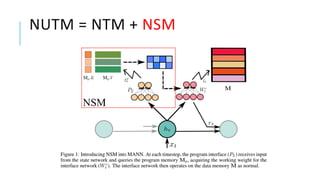
The missing piece: A memory to store programs
Neural stored-program memory
UTM/VNA (1936/1945) ↔ NUTM--ours (2019)
NUTM = NTM + NSM
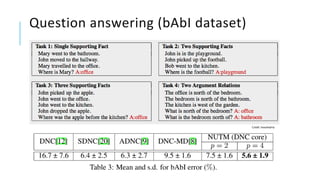
Question answering (bAbI dataset)
Credit: hexahedria
Neurocoder
Flexible programs are essential for intelligence
Cognitive science: Meta-level process controls object-level process
Instance-specific program vs Task-specific program
In QA, program is query-specific
 On-demand program synthesis
Idea: A program to generate programs
Previous works: Fast weights, HyperNetworks, Neural Module
Networks, Adaptive Mixture of Experts
Current work: Programs are generated by combining basis sub-
programs
 The hope: Basis programs span the space of all possible programs
20/08/2020 54
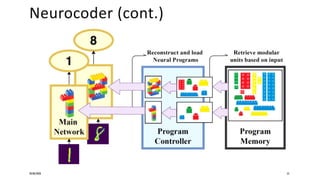
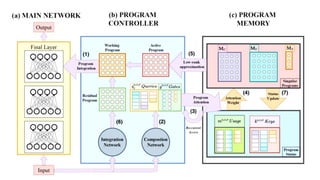
Neurocoder (cont.)
20/08/2020 55
20/08/2020 56
20/08/2020 57
Neural relational memory
Hung Le, Truyen Tran, Svetha Venkatesh, “Self-attentive associative
memory”, ICML'20.
Failures of current MANNs for reasoning
Relational representationis NOT stored  Can’t reuse later in the
chain
A single memory of items and relations  Can’t understand how
relational reasoning occurs
The memory-memory relationship is coarse since it is represented as
either dot product, or weighted sum.
20/08/2020 58
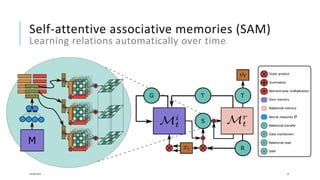
Self-attentive associative memories (SAM)
Learning relations automatically over time
20/08/2020 59
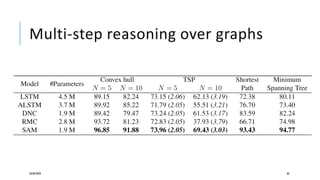
Multi-step reasoning over graphs
20/08/2020 60
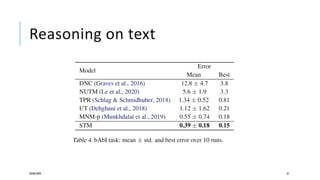
Reasoning on text
20/08/2020 61
20/08/2020 62
Thank you Truyen Tran
@truyenoz
truyentran.github.io
truyen.tran@deakin.edu.au
letdataspeak.blogspot.com
goo.gl/3jJ1O0
linkedin.com/in/truyen-tran

Machine reasoning

  • 1.
    20/08/2020 1 @FIT, MonashUni, August 2020 A/Prof Truyen Tran Vuong Le, Thao Le, Hung Le, Dung Nguyen, Tin Pham @truyenoz truyentran.github.io truyen.tran@deakin.edu.au letdataspeak.blogspot.com goo.gl/3jJ1O0 Machine reasoning linkedin.com/in/truyen-tran
  • 2.
    20/08/2020 2 Dual-process theories Theproblem Neural memories Agenda Visual reasoning
  • 3.
    20/08/2020 3 Among themost challenging scientific questions of our time are the corresponding analytic and synthetic problems: • How does the brain function? • Can we design a machine which will simulate a brain? -- Automata Studies, 1956.
  • 4.
    20/08/2020 4 #REF: ACognitive Architecture Approach to Interactive Task Learning, John E. Laird, University of Michigan
  • 5.
    1960s-1990s  Hand-crafting rules, domain-specific,logic- based  High in reasoning  Can’t scale.  Fail on unseen cases. 20/08/2020 5 2020s-2030s  Learning + reasoning, general purpose, human-like  Has contextual and common- sense reasoning  Requires less data  Adapt to change  Explainable 1990s-present  Machine learning, general purpose, statistics-based  Low in reasoning  Needs lots of data  Less adaptive  Little explanation Photo credit: DARPA
  • 6.
    Learning vs Reasoning Learningis to improve itself by experiencing ~ acquiring knowledge & skills Reasoning is to deduce knowledge from previously acquired knowledge in response to a query (or a cues) Early theories of intelligence (a) focuses solely on reasoning, (b) learning can be added separately and later! (Khardon & Roth, 1997). Learning precedes reasoning or the two interacting? Can reasoning be learnt? Are learning and reasoning indeed different facets of the same mental/computational process? 20/08/2020 6 Khardon, Roni, and Dan Roth. "Learning to reason." Journal of the ACM (JACM) 44.5 (1997): 697-725. (Dan Roth; ACM Fellow; IJCAI John McCarthy Award)
  • 7.
    Rich Sutton’s BitterLesson 20/08/2020 7 “The biggest lesson that can be read from 70 years of AI research is that general methods that leverage computation are ultimately the most effective, and by a large margin. ” “The two methods that seem to scale arbitrarily in this way are search and learning.” http://www.incompleteideas.net/IncIdeas/BitterLesson.html
  • 8.
    Bottou’s vision ofreasoning Reasoning is not necessarily achieved by making logical inferences There is a continuity between algebraically rich inference and connecting together trainable learning systems Central to reasoning is composition rules to guide the combinations of modules to address new tasks 20/08/2020 8 “When we observe a visual scene, when we hear a complex sentence, we are able to explain in formal terms the relation of the objects in the scene, or the precise meaning of the sentence components. However, there is no evidence that such a formal analysis necessarily takes place: we see a scene, we hear a sentence, and we just know what they mean. This suggests the existence of a middle layer, already a form of reasoning, but not yet formal or logical.” Bottou, Léon. "From machine learning to machine reasoning." Machine learning 94.2 (2014): 133-149.
  • 9.
    Learning to reason,formal def 20/08/2020 9 Khardon, Roni, and Dan Roth. "Learning to reason." Journal of the ACM (JACM) 44.5 (1997): 697-725. E.g., given a video f, determines if the person with the hat turns before singing.
  • 10.
    10 What color isthe thing with the same size as the blue cylinder? blue • The network guessed the most common color in the image. • Linguistic bias. • Requires multi-step reasoning: find blue cylinder ➔ locate other object of the same size ➔ determine its color (green). A testbed: Visual QA
  • 11.
    11Adapted from (Adityaet al., 2019) Events, Activities Objects, Regions, Trajectories Scene Elements: Volumes, 3D Surfaces Image Elements: Regions, Edges, Textures Knowledge about shapes Qualitative spatial reasoning Relations between objects Commonsense knowledge Relations between objects Why Visual QA?
  • 12.
    20/08/2020 12 Dual-process theories Theproblem Neural memories Agenda Visual reasoning
  • 13.
    Dual-process system withmemories 13 System 1: Intuitive System 1: Intuitive System 1: Intuitive • Fast • Implicit/automatic • Pattern recognition • Multiple System 2: Analytical • Slow • Deliberate/rational • Careful analysis • Single, sequential Facts Semantics Events and relational associations Working space – temporal buffer Single
  • 14.
    System 2 Holds hypotheticalthought Decoupling from representation Working memory size is not essential. Its attentional control is. 20/08/2020 14
  • 15.
    Hypotheses Reasoning as just-in-timeprogram synthesis. It employs conditional computation. Reasoning is recursive, e.g., mental travel. 20/08/2020 15
  • 16.
    20/08/2020 16 Dual-process theories Theproblem Neural memories Agenda Visual reasoning
  • 17.
    Visual recognition isa (solvable) special case 17 Image courtesy: https://dcist.com/ What is this? a cat R-CNN, YOLO,… Object recognition Object detection Where are objects, and what are they?
  • 18.
    But Image QAis challenging 18 (CLERV, Johnson et al., 2017) (Q) How many objects are either small cylinders or metal things? (Q) Are there an equal number of large things and metal spheres? (GQA, Hudson et al., 2019) (Q) What is the brown animal sitting inside of? (Q) Is there a bag to the right of the green door?
  • 19.
    And Video QAis even more challenging 19(Data: TGIF-QA)
  • 20.
  • 21.
    Reasoning over visualmodality • Context:  Videos/Images: compositional data  Hierarchy of visual information: objects, actions, attributes, relations, commonsense knowledge.  Relation of abstract objects: spatial, temporal, semantic aspects. • Research questions:  How to represent object/action relations in images and videos?  How to reason with object/action relations? 21
  • 22.
    A simple VQAframework that works surprisingly well 22 Visual representation Question What is the brown animal sitting inside of? Textual representation Fusion Predict answer Answer box CNN Word embedding + LSTM
  • 23.
    20/08/2020 23 A PrelimDual-System Model Le, Thao Minh, Vuong Le, Svetha Venkatesh, and Truyen Tran. "Neural Reasoning, Fast and Slow, for Video Question Answering." IJCNN (2020).
  • 24.
    Separate reasoning processfrom perception 24  Video QA: inherent dynamic nature of visual content over time.  Recent success in visual reasoning with multi-step inference and handling of compositionality. System 1: visual representation System 2: High- level reasoning
  • 25.
    20/08/2020 25 Separate reasoningprocess from perception (2)
  • 26.
    System 1: Clip-basedRelation Network 26 For 𝑘𝑘 = 2,3, … , 𝐾𝐾 where ℎ𝜙𝜙 and 𝑔𝑔𝜃𝜃 are linear transformations with parameters 𝜙𝜙 and 𝜃𝜃, respectively, for feature fusion. Why temporal relations? • Situate an event/action in relation to events/actions in the past and formulate hypotheses on future events. • Long-range sequential modeling.
  • 27.
    System 2: MACNet 20/08/2020 27 Hudson, Drew A., and Christopher D. Manning. "Compositional attention networks for machine reasoning." ICLR 2018.
  • 28.
    Results on SVQAdataset. 28 Model Exist Count Integer Comparison Attribute Comparison Query All More Equal Less Color Size Type Dir Shape Color Size Type Dir Shape SA(S) 51.7 36.3 72.7 54.8 58.6 52.2 53.6 52.7 53.0 52.3 29.0 54.0 55.7 38.1 46.3 43.1 TA- GRU(T) 54.6 36.6 73.0 57.3 57.7 53.8 53.4 54.8 55.1 52.4 22.0 54.8 55.5 41.7 42.9 44.2 SA+TA 52.0 38.2 74.3 57.7 61.6 56.0 55.9 53.4 57.5 53.0 23.4 63.3 62.9 43.2 41.7 44.9 CRN+M AC 72.8 56.7 84.5 71.7 75.9 70.5 76.2 90.7 75.9 57.2 76.1 92.8 91.0 87.4 85.4 75.8
  • 29.
    Results on TGIF-QAdataset. 29 Model Action Trans. FrameQA Count ST-TP 62.9 69.4 49.5 4.32 Co-Mem 68.2 74.3 51.5 4.10 PSAC 70.4 76.9 55.7 4.27 CRN+MAC 71.3 78.7 59.2 4.23
  • 30.
    20/08/2020 30 A System1 for Video Thao Minh Le, Vuong Le, Svetha Venkatesh, and Truyen Tran, “Hierarchical conditional relation networks for video question answering”, CVPR'20. System 1: visual representation System 2: High-level reasoning
  • 31.
    Conditional Relation NetworkUnit 31 Problems: • Lack of a generic mechanism for modeling the interaction of multimodal inputs. • Flaws in temporal relations of breaking local motion in videos. Inputs: • An array of 𝑛𝑛 objects • Conditioning feature Output: • An array of 𝑚𝑚 objects
  • 32.
  • 33.
    Results 33 Model Action Trans.FrameQA Count ST-TP 62.9 69.4 49.5 4.32 Co-Mem 68.2 74.3 51.5 4.10 PSAC 70.4 76.9 55.7 4.27 HME 73.9 77.8 53.8 4.02 HCRN 75.0 81.4 55.9 3.82 TGIF-QA dataset MSVD-QA and MSRVTT-QA datasets.
  • 34.
    20/08/2020 34 A System2 for Relational Reasoning Thao Minh Le, Vuong Le, Svetha Venkatesh, and Truyen Tran, “Dynamic Language Binding in Relational Visual Reasoning”, IJCAI’20. System 1: visual representation System 2: High-level reasoning
  • 35.
    Reasoning with structuredrepresentation of spatial relation 35 • Key insight: Reasoning is chaining of relational predicates to arrive at a final conclusion → Needs to uncover spatial relations, conditioned on query → Chaining is query-driven → Objects/language needs binding → Object semantics is query-dependent → Very thing is end-to-end differentiable
  • 36.
  • 37.
  • 38.
  • 39.
    Results in CLEVRdataset 39
  • 40.
    40 Comparison with theon CLEVR dataset of different data fractions. Performance comparison on VQA v2 subset of long questions. Model Action XNM(Objects) 43.4 MAC(ResNet) 40.7 MAC(Objects) 45.5 LOGNet(Objects) 46.8
  • 41.
  • 42.
    20/08/2020 42 Dual-process theories Theproblem Neural memoriesVisual reasoning Agenda
  • 43.
    “[…] one cannothope to understand reasoning without understanding the memory processes […]” (Thompson and Feeney, 2014) 20/08/2020 43
  • 44.
    Dual-process system withmemories 44 System 1: Intuitive System 1: Intuitive System 1: Intuitive • Fast • Implicit/automatic • Pattern recognition • Multiple System 2: Analytical • Slow • Deliberate/rational • Careful analysis • Single, sequential Facts Semantics Events and relational associations Working space – temporal buffer Single
  • 45.
    From psychology &cognitive science Reasoning and memory are studied separately, but …  Analytic reasoning requires working memory  Spatial reasoning requires place memory  Inferential reasoning requires episodic memory Dual-processes in memory:  Fast retrieval/recognition (using similarity as criteria)  Slow item recollection Dual-processes in reasoning  Induction as fast (using similarity as criteria)  Deduction as slow
  • 46.
    Reasoning as memory Expertreasoning was enabled by a large long-term memory, acquired through experience Working memory for analytic reasoning  WM capacity predicts IQ  Higher order cognition = creating & manipulating relations  representation of premises, temporarily stored in WM  WM is a system to support information binding to a coordinate system  Reasoning as deliberative hypothesis testing  memory-retrieval based hypothesis generation Knowledge structures support reasoning Fuzzy-trace theory: gist ( intuition) and verbatim memory ( analytic processing) Memory is critical for episodic future thinking (mental simulation) 20/08/2020 46
  • 47.
    20/08/2020 47 Learning aTuring machine  Can we learn a (neural) program that learns to program from data? Visual reasoning is a specific program of two inputs (visual, linguistic)
  • 48.
    Neural Turing machine(NTM) A memory-augmented neural network (MANN) A controller that takes input/output and talks to an external memory module. Memory has read/write operations. The main issue is where to write, and how to update the memory state. All operations are differentiable. Source: rylanschaeffer.github.io
  • 49.
    MANN for reasoning Threesteps:  Store data into memory  Read query, process sequentially, consult memory  Output answer Behind the scene:  Memory contains data & results of intermediate steps  LOGNet does the same, memory consists of object representations Drawbacks of current MANNs:  No memory of controllers  Less modularity and compositionality when query is complex  No memory of relations  Much harder to chain predicates. 20/08/2020 49 Source: rylanschaeffer.github.io
  • 50.
    20/08/2020 50 Universal NeuralTuring Machines Hung Le, Truyen Tran, Svetha Venkatesh, “Neural stored-program memory”, ICLR'20. Hung Le, Truyen Tran, Svetha Venkatesh, “Neurocoder: Learning General- Purpose Computation Using Stored Neural Programs”, Work in progress.
  • 51.
    Computing devices vsneural counterparts FSM (1943) ↔ RNNs (1982) PDA (1954) ↔ Stack RNN (1993) TM (1936) ↔ NTM (2014) The missing piece: A memory to store programs Neural stored-program memory UTM/VNA (1936/1945) ↔ NUTM--ours (2019)
  • 52.
  • 53.
    Question answering (bAbIdataset) Credit: hexahedria
  • 54.
    Neurocoder Flexible programs areessential for intelligence Cognitive science: Meta-level process controls object-level process Instance-specific program vs Task-specific program In QA, program is query-specific  On-demand program synthesis Idea: A program to generate programs Previous works: Fast weights, HyperNetworks, Neural Module Networks, Adaptive Mixture of Experts Current work: Programs are generated by combining basis sub- programs  The hope: Basis programs span the space of all possible programs 20/08/2020 54
  • 55.
  • 56.
  • 57.
    20/08/2020 57 Neural relationalmemory Hung Le, Truyen Tran, Svetha Venkatesh, “Self-attentive associative memory”, ICML'20.
  • 58.
    Failures of currentMANNs for reasoning Relational representationis NOT stored  Can’t reuse later in the chain A single memory of items and relations  Can’t understand how relational reasoning occurs The memory-memory relationship is coarse since it is represented as either dot product, or weighted sum. 20/08/2020 58
  • 59.
    Self-attentive associative memories(SAM) Learning relations automatically over time 20/08/2020 59
  • 60.
    Multi-step reasoning overgraphs 20/08/2020 60
  • 61.
  • 62.
    20/08/2020 62 Thank youTruyen Tran @truyenoz truyentran.github.io truyen.tran@deakin.edu.au letdataspeak.blogspot.com goo.gl/3jJ1O0 linkedin.com/in/truyen-tran