17/1/17 1
Source: rdn consulting
Hanoi, Jan 17th 2017
Trần Thế Truyền
Deakin University
@truyenoz
prada-research.net/~truyen
truyen.tran@deakin.edu.au
letdataspeak.blogspot.com
goo.gl/3jJ1O0
DEEP LEARNING FOR
DETECTING ANOMALIES AND
SOFTWARE VULNERABILITIES
tranthetruyen
REAL-WORLD FAILURE OF ANOMALY DETECTION
London, July
7, 2005
17/1/17 2
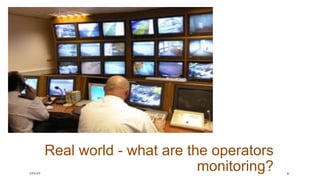
Real world - what are the operators
monitoring?17/1/17 3
PRADA @ DEAKIN, MELBOURNE
17/1/17 4
OUR APPROACH TO SECURITY: (DEEP)
MACHINE LEARNING
 Usual detection of attacks are based on profiling and human skills
 But attacking tactics change overtime, creating zero-day attacks
 Systems are very complex now, and no humans can cover all
 à It is best to use machine to learn continuously and automatically.
 à Humans can provide feedbacks for the machine to correct itself.
 à Deep learning is on the rise.
 For now: It is best for human and machine to co-operate.
17/1/17 5
SOLVING REAL WORLD PROBLEMS IS
REWARDING
17/1/17 6
Startups Contracts
AGENDA
 Part I: Introduction to deep learning
­ A brief history
­ Top 3 architectures
­ Unsupervised learning
 Part II: Anomaly detection
 Part III: Software vulnerabilities
17/1/17 7
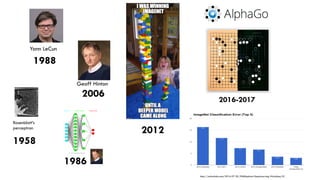
2012
Geoff Hinton
2006
Yann LeCun
1988
1986
http://blog.refu.co/wp-content/uploads/2009/05/mlp.png
2016-2017
Rosenblatt’s
perceptron
1958
http://redcatlabs.com/2016-07-30_FifthElephant-DeepLearning-Workshop/#/
DEEP LEARNING IS SUPER HOT
17/1/17 9
“deep learning”
+ data
“deep
learning” +
intelligence
Dec, 2016
2016
DEEP LEARNING IS NEURAL NETS, BUT …
http://blog.refu.co/wp-content/uploads/2009/05/mlp.png
1986
17/1/17 10
TWO LEARNING PARADIGMS
 Supervised learning
 (mostly machine)
A à B
 Unsupervised learning
 (mostly human)
Will be quickly solved for “easy”
problems (Andrew Ng)
17/1/17 11
KEY IN MACHINE LEARNING: FEATURE
ENGINEERING
 In typical machine learning projects, 80-90% effort is on feature engineering
­ A right feature representation doesn’t need much work. Simple linear methods often work
well.
 Text: BOW, n-gram, POS, topics, stemming, tf-idf, etc.
 Software: token, LOC, API calls, #loops, developer reputation, team complexity,
report readability, discussion length, etc.
 Try yourself on Kaggle.com!
17/1/17 12
FEEDFORWARD NETS: FEATURE DETECTION
Integrate-and-fire neuron
andreykurenkov.com
Feature detector
Block representation17/1/17 13
RECURRENT NEURAL NETWORKS:
TEMPORAL DYNAMICS
Classification
Image captioning
Sentence classification
Neural machine translation
Sequence labelling
Source: http://karpathy.github.io/assets/rnn/diags.jpeg
17/1/17 14
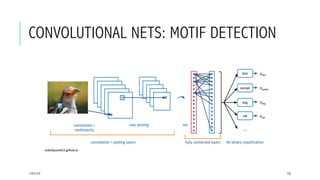
CONVOLUTIONAL NETS: MOTIF DETECTION
adeshpande3.github.io
17/1/17 15
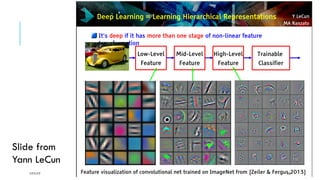
17/1/17 16
Slide from
Yann LeCun
UNSUPERVISED LEARNING
17/1/17 17
Photo credit: Brandon/Flickr
WE WILL BRIEFLY COVER
 Word embedding
 Deep autoencoder
 RBM à DBN à DBM
 Generative Adversarial Net (GAN)
17/1/17 18
WORD EMBEDDING
(Mikolov et al, 2013)
DEEP AUTOENCODER – SELF
RECONSTRUCTION OF DATA
17/1/17
20
Auto-encoderFeature detector
Representation
Raw data
Reconstruction
Deep Auto-encoder
Encoder
Decoder
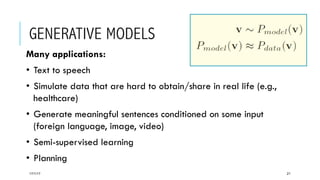
GENERATIVE MODELS
17/1/17 21
Many applications:
•  Text to speech
•  Simulate data that are hard to obtain/share in real life (e.g.,
healthcare)
•  Generate meaningful sentences conditioned on some input
(foreign language, image, video)
•  Semi-supervised learning
•  Planning
A FAMILY: RBM à DBN à DBM
17/1/17 22
energy
Restricted Boltzmann Machine
(~1994, 2001)
Deep Belief Net
(2006)
Deep Boltzmann Machine
(2009)
GAN: GENERATIVE ADVERSARIAL NETS
(GOODFELLOW ET AL, 2014)
 Yann LeCun: GAN is one of best idea in past 10 years!
 Instead of modeling the entire distribution of data, learns to map ANY random distribution into the
region of data, so that there is no discriminator that can distinguish sampled data
from real data.
Any random distribution
in any space
Binary discriminator,
usually a neural
classifier
Neural net that maps
z à x
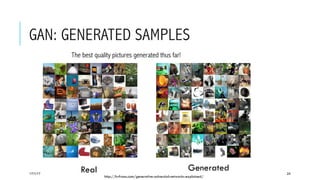
GAN: GENERATED SAMPLES
 The best quality pictures generated thus far!
17/1/17 24
Real Generated
http://kvfrans.com/generative-adversial-networks-explained/
DEEP LEARNING IN COGNITIVE DOMAINS
17/1/17 25
http://media.npr.org/
http://cdn.cultofmac.com/
Where human can
recognise, act or answer
accurately within seconds
blogs.technet.microsoft.com
dbta.com
DEEP LEARNING IN NON-COGNITIVE DOMAINS
­  Where humans need extensive training to do well
­  Domains that demand transparency & interpretability.
  … healthcare
  … security
  … genetics, foods, water …
17/1/17 26
 TEKsystems
END OF PART I
17/1/17 27
ANOMALY DETECTION
USING UNSUPERVISED LEARNING
17/1/17 28
dbta.com
This work is partially supported by the Telstra-Deakin Centre of Excellence in Big Data and Machine Learning
AGENDA
 Part I: Introduction to deep learning
 Part II: Anomaly detection
­ Multichannel
­ Unusual mixed-data co-occurrence
­ Object lifetime model
 Part III: Software vulnerabilities
17/1/17 29
BUT – we cannot
define anomaly
apriori
Strategy: learn normality, anything does not fit in is abnormal
17/1/17 30
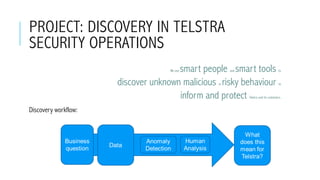
PROJECT: DISCOVERY IN TELSTRA
SECURITY OPERATIONS
We use smart people and smart tools to
discover unknown malicious or risky behaviour to
inform and protect Telstra and its customers.
Discovery workflow:
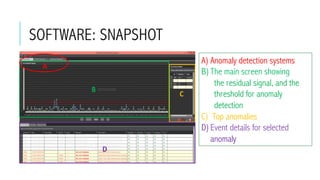
SOFTWARE: SNAPSHOT
A) Anomaly detection systems
B) The main screen showing
the residual signal, and the
threshold for anomaly
detection
C) Top anomalies
D) Event details for selected
anomaly
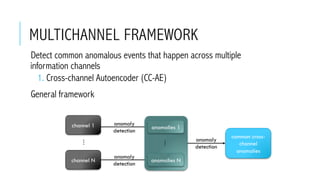
MULTICHANNEL FRAMEWORK
 Detect common anomalous events that happen across multiple
information channels
1. Cross-channel Autoencoder (CC-AE)
 General framework
channel 1
channel N
anomaly
detection
anomaly
detection
…
…
anomalies 1
anomalies N
anomaly
detection
common cross-
channel
anomalies
DETECTION METHOD: AUTOENCODER
17/1/17 34
External
outlier
detector?
Reconstruction
error
METHOD: CROSS-CHANNEL AUTOENCODER
1.  Single channel anomaly detection
­ For each channel, model the data with an autoencoder
­ Determine the anomalies by analysing the reconstruction errors
2.  Augmenting the reconstruction errors
­ Augment the reconstruction errors across channels
­ Model the reconstruction errors with an autoencoder
3.  Cross-channel anomaly detection
­ Determine the cross-channel anomalies by analysing the reconstruction errors
RESULTS 1 – NEWS DATA
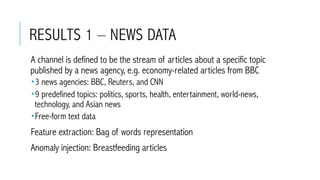
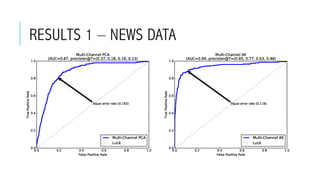
 A channel is defined to be the stream of articles about a specific topic
published by a news agency, e.g. economy-related articles from BBC
­ 3 news agencies: BBC, Reuters, and CNN
­ 9 predefined topics: politics, sports, health, entertainment, world-news,
technology, and Asian news
­ Free-form text data
 Feature extraction: Bag of words representation
 Anomaly injection: Breastfeeding articles
RESULTS 1 – NEWS DATA
RESULTS 2 – DEAKIN SQUID DATA
 Squid is a caching and forwarding web proxy.
­ Each server is defined to be a channel
­ 7 channels with inbound and outbound network data
­ Sample datapoint:
­ Bag of words representation
­ Anomaly Injection: URLs from URLBlackList.com
1469032590.233 19 10.132.169.158 TCP_HIT/200 4771 GET http://Europe.cnn.com/
EUROPE/potd/2001/04/17/tz.pulltizer.ap.jp - NONE/- image/jpeg
1 32 4 5 6 7
7 cont’d 8 9 10
RESULTS 2 – DEAKIN SQUID DATA
AGENDA
 Part I: Introduction to deep learning
 Part II: Anomaly detection
­ Multichannel
­ Unusual mixed-data co-occurrence
­ Object lifetime model
 Part III: Software vulnerabilities
17/1/17 40
MIXED DATA
17/1/17 41
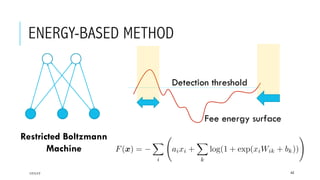
ENERGY-BASED METHOD
17/1/17 42
Restricted Boltzmann
Machine
Detection threshold
Fee energy surface
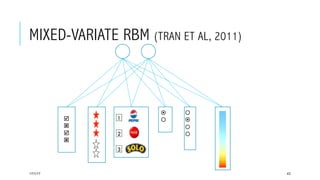
MIXED-VARIATE RBM (TRAN ET AL, 2011)
17/1/17 43
þ
ý
þ
ý
¤
¡
¡
¤
¡
¡
1
2
3
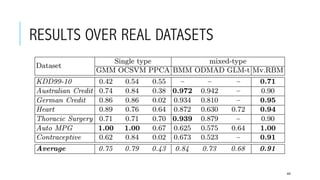
RESULTS OVER REAL DATASETS
44
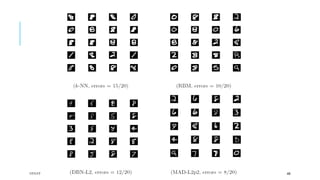
ABNORMALITY ACROSS
ABSTRACTIONS
17/1/17 45
F1(x1)
F2(x2)
Rank 1 Rank 2
F3(x3)
Rank 3
Rank aggregation
Mv.RBM Mv.DBN-L2 Mv.DBN-L3
WA1 WA1
WA2
WD1
WD2
WD3
17/1/17 46
AGENDA
 Part I: Introduction to deep learning
 Part II: Anomaly detection
­ Multichannel
­ Unusual mixed-data co-occurrence
­ Object lifetime model
 Part III: Software vulnerabilities
17/1/17 47
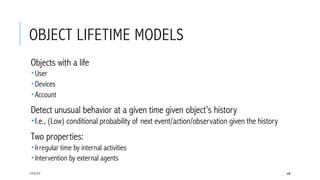
OBJECT LIFETIME MODELS
 Objects with a life
­ User
­ Devices
­ Account
 Detect unusual behavior at a given time given object’s history
­ I.e., (Low) conditional probability of next event/action/observation given the history
 Two properties:
­ Irregular time by internal activities
­ Intervention by external agents
17/1/17 48
DEEPEVOLVE: A MODEL OF EVOLVING BODY
 States are a dynamic memory process → LSTM moderated by time and
intervention
 Discrete observations → vector embedding
 Time and previous intervention → “forgetting” of old states
 Current intervention → controlling the current states
17/1/17 49
DEEPEVOLVE: DYNAMICS
17/1/17 50
memory
*
input
gate
forget
gate
prev. memory
output
gate
*
*
input
aggregation over
time → prediction
previous
intervention
history
states
current
data
time
gap
current
intervention
current
state
New in DeepEvolve
END OF PART II
17/1/17 51
AGENDA
 Part I: Introduction to deep learning
 Part II: Anomaly detection
 Part III: Software vulnerabilities
­ Malicious URL detection
­ Unusual source code
­ Code vulnerabilities
17/1/17 52
MALICIOUS URL CLASSIFICATION
17/1/17 53
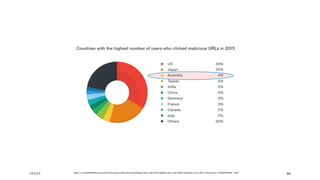
17/1/17 54http://www.indiainfoline.com/article/news-sector-information-technology/india-ranks-4th-in-highest-users-who-clicked-malicious-urls-in-2015-trend-micro-116052700684_1.html
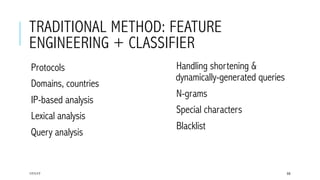
TRADITIONAL METHOD: FEATURE
ENGINEERING + CLASSIFIER
 Protocols
 Domains, countries
 IP-based analysis
 Lexical analysis
 Query analysis
17/1/17 55
 Handling shortening &
dynamically-generated queries
 N-grams
 Special characters
 Blacklist
NEW METHOD: LEARNABLE CONVOLUTION AS
FEATURE DETECTOR
17/1/17
56
http://colah.github.io/posts/2015-09-NN-Types-FP/
Learnable kernels
andreykurenkov.com
Feature detector,
often many
END-TO-END MODEL OF MALICIOUS URLS
17/1/17 57
Safe/Unsafe
max-pooling
convolution --
motif detection
Embedding (may
be one-hot)
Prediction with FFN
1
2
3
4
record
vector
char
vector
h t t p : / / w w w . s
Train on 900K malicious URLs
1,000K good URLs
Accuracy: 96%
No feature engineering!
AGENDA
 Part I: Introduction to deep learning
 Part II: Anomaly detection
 Part III: Software vulnerabilities
­ Malicious URL detection
­ Unusual source code
­ Code vulnerabilities
17/1/17 58
17/1/17 59http://www.bentoaktechnologies.com/Images/code_scrn.jpg
SOFTWARE ANALYTICS
DATA-DRIVEN SOFTWARE ENGINEERING
PROJECT: SAMSUNG GLOBAL REACH
MOTIVATIONS
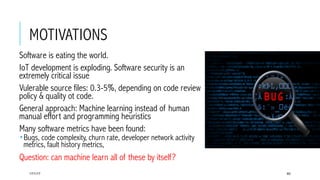
 Software is eating the world.
 IoT development is exploding. Software security is an
extremely critical issue
 Vulerable source files: 0.3-5%, depending on code review
policy & quality ot code.
 General approach: Machine learning instead of human
manual effort and programming heuristics
 Many software metrics have been found:
­ Bugs, code complexity, churn rate, developer network activity
metrics, fault history metrics,
 Question: can machine learn all of these by itself?
17/1/17 60
APPROACH: CODE MODELING
 Open source code is massive
 Bad coding is often the sign of bugs and security holes
 Malicious code may be different from the safe code
 Ideas:
­  A code model assigns probability to a piece of code
­  Given the code context, if conditional probability of a code piece per token is
low compared to the rest à unusual code à more likely to contain defects
or security vulnerability
17/1/17 61
A DEEP LANGUAGE MODEL FOR
SOFTWARE CODE (DAM ET AL, FSE’16 SE+NL)
 A good language model for source code would capture the long-term
dependencies
 The model can be used for various prediction tasks, e.g. defect
prediction, code duplication, bug localization, etc.
17/1/17 62
Slide by Hoa Khanh Dam
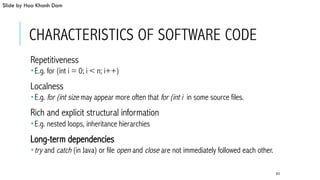
CHARACTERISTICS OF SOFTWARE CODE
 Repetitiveness
­ E.g. for (int i = 0; i < n; i++)
 Localness
­ E.g. for (int size may appear more often that for (int i in some source files.
 Rich and explicit structural information
­ E.g. nested loops, inheritance hierarchies
 Long-term dependencies
­ try and catch (in Java) or file open and close are not immediately followed each other.
63
Slide by Hoa Khanh Dam
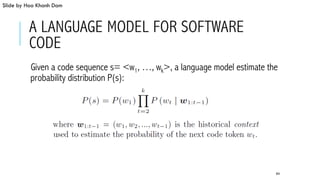
A LANGUAGE MODEL FOR SOFTWARE
CODE
 Given a code sequence s= <w1, …, wk>, a language model estimate the
probability distribution P(s):
64
Slide by Hoa Khanh Dam
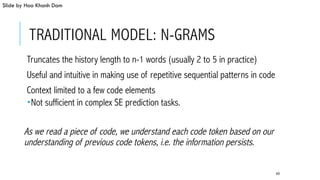
TRADITIONAL MODEL: N-GRAMS
 Truncates the history length to n-1 words (usually 2 to 5 in practice)
 Useful and intuitive in making use of repetitive sequential patterns in code
 Context limited to a few code elements
­ Not sufficient in complex SE prediction tasks.
As we read a piece of code, we understand each code token based on our
understanding of previous code tokens, i.e. the information persists.
65
Slide by Hoa Khanh Dam
NEW METHOD: LONG SHORT-TERM
MEMORY (LSTM)
17/1/17 66
ct
it
ft
Input
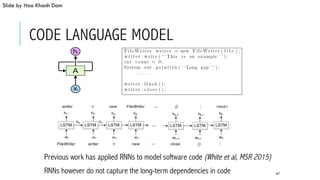
CODE LANGUAGE MODEL
67
 Previous work has applied RNNs to model software code (White et al, MSR 2015)
 RNNs however do not capture the long-term dependencies in code
Slide by Hoa Khanh Dam
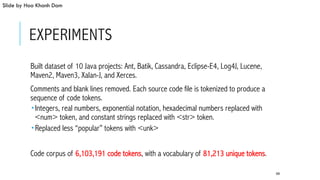
EXPERIMENTS
 Built dataset of 10 Java projects: Ant, Batik, Cassandra, Eclipse-E4, Log4J, Lucene,
Maven2, Maven3, Xalan-J, and Xerces.
 Comments and blank lines removed. Each source code file is tokenized to produce a
sequence of code tokens.
­ Integers, real numbers, exponential notation, hexadecimal numbers replaced with
<num> token, and constant strings replaced with <str> token.
­ Replaced less “popular” tokens with <unk>
 Code corpus of 6,103,191 code tokens, with a vocabulary of 81,213 unique tokens.
68
Slide by Hoa Khanh Dam
EXPERIMENTS (CONT.)
69
 Both RNN and LSTM improve with more training data (whose size grows with sequence length).
 LSTM consistently performs better than RNN: 4.7% improvement to 27.2% (varying sequence
length), 10.7% to 37.9% (varying embedding size).
Slide by Hoa Khanh Dam
AGENDA
 Part I: Introduction to deep learning
 Part II: Anomaly detection
 Part III: Software vulnerabilities
­ Malicious URL detection
­ Unusual source code
­ Code vulnerabilities
17/1/17 70
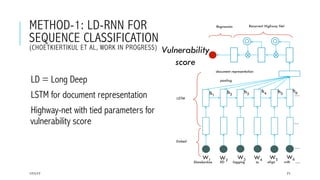
METHOD-1: LD-RNN FOR
SEQUENCE CLASSIFICATION
(CHOETKIERTIKUL ET AL, WORK IN PROGRESS)
 LD = Long Deep
 LSTM for document representation
 Highway-net with tied parameters for
vulnerability score
17/1/17 71
pooling
Embed
LSTM
Vulnerability
score
W1 W2 W3 W4 W5 W6
Recurrent Highway NetRegression
Standardize XD logging to align with
document representation
h1
h2 h3
h4 h5
h6
….
….
….
….
METHOD-2: DEEP SEQUENTIAL MULTI-
INSTANCE LEARNING
 Code file as a bag
 Methods as instances
 Data are sequential
17/1/17 72
Headers
Method 1
Method 2
Method N
Vulnerability
level
.
.
.
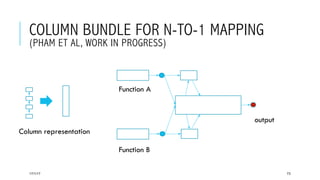
COLUMN BUNDLE FOR N-TO-1 MAPPING
(PHAM ET AL, WORK IN PROGRESS)
17/1/17 73
Function A
Function B
output
Column representation
17/1/17 74
Thank you!
http://ahsanqawl.com/2015/10/qa/
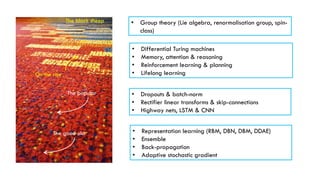
The popular
On the rise
The black sheep
The good old •  Representation learning (RBM, DBN, DBM, DDAE)
•  Ensemble
•  Back-propagation
•  Adaptive stochastic gradient
•  Dropouts & batch-norm
•  Rectifier linear transforms & skip-connections
•  Highway nets, LSTM & CNN
•  Differential Turing machines
•  Memory, attention & reasoning
•  Reinforcement learning & planning
•  Lifelong learning
•  Group theory (Lie algebra, renormalisation group, spin-
class)
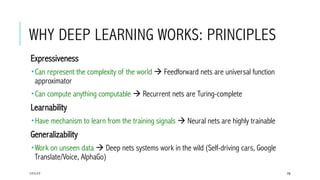
WHY DEEP LEARNING WORKS: PRINCIPLES
 Expressiveness
­ Can represent the complexity of the world à Feedforward nets are universal function
approximator
­ Can compute anything computable à Recurrent nets are Turing-complete
 Learnability
­ Have mechanism to learn from the training signals à Neural nets are highly trainable
 Generalizability
­ Work on unseen data à Deep nets systems work in the wild (Self-driving cars, Google
Translate/Voice, AlphaGo)
17/1/17 76
WHEN DEEP LEARNING WORKS
 Lots of data (e.g., millions)
 Strong, clean training signals (e.g., when human can provide correct labels –
cognitive domains).
­ Andrew Ng of Baidu: When humans do well within sub-second.
 Data structures are well-defined (e.g., image, speech, NLP, video)
 Data is compositional (luckily, most data are like this)
 The more primitive (raw) the data, the more benefit of using deep learning.
17/1/17 77
BONUS: HOW TO POSITION
17/1/17 78
 “[…] the dynamics of the game will evolve. In the long
run, the right way of playing football is to position yourself
intelligently and to wait for the ball to come to you. You’ll
need to run up and down a bit, either to respond to how
the play is evolving or to get out of the way of the scrum
when it looks like it might flatten you.” (Neil Lawrence,
7/2015, now with Amazon)
http://inverseprobability.com/2015/07/12/Thoughts-on-ICML-2015/
THE ROOM IS WIDE OPEN
 Architecture engineering
 Non-cognitive apps
 Unsupervised learning
 Graphs
 Learning while preserving privacy
 Modelling of domain invariance
 Better data efficiency
 Multimodality
 Learning under adversarial stress
 Better optimization
 Going Bayesian
http://smerity.com/articles/2016/architectures_are_the_new_feature_engineering.html

Deep learning for detecting anomalies and software vulnerabilities

  • 1.
    17/1/17 1 Source: rdnconsulting Hanoi, Jan 17th 2017 Trần Thế Truyền Deakin University @truyenoz prada-research.net/~truyen truyen.tran@deakin.edu.au letdataspeak.blogspot.com goo.gl/3jJ1O0 DEEP LEARNING FOR DETECTING ANOMALIES AND SOFTWARE VULNERABILITIES tranthetruyen
  • 2.
    REAL-WORLD FAILURE OFANOMALY DETECTION London, July 7, 2005 17/1/17 2
  • 3.
    Real world -what are the operators monitoring?17/1/17 3
  • 4.
    PRADA @ DEAKIN,MELBOURNE 17/1/17 4
  • 5.
    OUR APPROACH TOSECURITY: (DEEP) MACHINE LEARNING  Usual detection of attacks are based on profiling and human skills  But attacking tactics change overtime, creating zero-day attacks  Systems are very complex now, and no humans can cover all  à It is best to use machine to learn continuously and automatically.  à Humans can provide feedbacks for the machine to correct itself.  à Deep learning is on the rise.  For now: It is best for human and machine to co-operate. 17/1/17 5
  • 6.
    SOLVING REAL WORLDPROBLEMS IS REWARDING 17/1/17 6 Startups Contracts
  • 7.
    AGENDA  Part I: Introductionto deep learning ­ A brief history ­ Top 3 architectures ­ Unsupervised learning  Part II: Anomaly detection  Part III: Software vulnerabilities 17/1/17 7
  • 8.
  • 9.
    DEEP LEARNING ISSUPER HOT 17/1/17 9 “deep learning” + data “deep learning” + intelligence Dec, 2016
  • 10.
    2016 DEEP LEARNING ISNEURAL NETS, BUT … http://blog.refu.co/wp-content/uploads/2009/05/mlp.png 1986 17/1/17 10
  • 11.
    TWO LEARNING PARADIGMS  Supervisedlearning  (mostly machine) A à B  Unsupervised learning  (mostly human) Will be quickly solved for “easy” problems (Andrew Ng) 17/1/17 11
  • 12.
    KEY IN MACHINELEARNING: FEATURE ENGINEERING  In typical machine learning projects, 80-90% effort is on feature engineering ­ A right feature representation doesn’t need much work. Simple linear methods often work well.  Text: BOW, n-gram, POS, topics, stemming, tf-idf, etc.  Software: token, LOC, API calls, #loops, developer reputation, team complexity, report readability, discussion length, etc.  Try yourself on Kaggle.com! 17/1/17 12
  • 13.
    FEEDFORWARD NETS: FEATUREDETECTION Integrate-and-fire neuron andreykurenkov.com Feature detector Block representation17/1/17 13
  • 14.
    RECURRENT NEURAL NETWORKS: TEMPORALDYNAMICS Classification Image captioning Sentence classification Neural machine translation Sequence labelling Source: http://karpathy.github.io/assets/rnn/diags.jpeg 17/1/17 14
  • 15.
    CONVOLUTIONAL NETS: MOTIFDETECTION adeshpande3.github.io 17/1/17 15
  • 16.
  • 17.
  • 18.
    WE WILL BRIEFLYCOVER  Word embedding  Deep autoencoder  RBM à DBN à DBM  Generative Adversarial Net (GAN) 17/1/17 18
  • 19.
  • 20.
    DEEP AUTOENCODER –SELF RECONSTRUCTION OF DATA 17/1/17 20 Auto-encoderFeature detector Representation Raw data Reconstruction Deep Auto-encoder Encoder Decoder
  • 21.
    GENERATIVE MODELS 17/1/17 21 Manyapplications: •  Text to speech •  Simulate data that are hard to obtain/share in real life (e.g., healthcare) •  Generate meaningful sentences conditioned on some input (foreign language, image, video) •  Semi-supervised learning •  Planning
  • 22.
    A FAMILY: RBMà DBN à DBM 17/1/17 22 energy Restricted Boltzmann Machine (~1994, 2001) Deep Belief Net (2006) Deep Boltzmann Machine (2009)
  • 23.
    GAN: GENERATIVE ADVERSARIALNETS (GOODFELLOW ET AL, 2014)  Yann LeCun: GAN is one of best idea in past 10 years!  Instead of modeling the entire distribution of data, learns to map ANY random distribution into the region of data, so that there is no discriminator that can distinguish sampled data from real data. Any random distribution in any space Binary discriminator, usually a neural classifier Neural net that maps z à x
  • 24.
    GAN: GENERATED SAMPLES  Thebest quality pictures generated thus far! 17/1/17 24 Real Generated http://kvfrans.com/generative-adversial-networks-explained/
  • 25.
    DEEP LEARNING INCOGNITIVE DOMAINS 17/1/17 25 http://media.npr.org/ http://cdn.cultofmac.com/ Where human can recognise, act or answer accurately within seconds blogs.technet.microsoft.com
  • 26.
    dbta.com DEEP LEARNING INNON-COGNITIVE DOMAINS ­  Where humans need extensive training to do well ­  Domains that demand transparency & interpretability.   … healthcare   … security   … genetics, foods, water … 17/1/17 26  TEKsystems
  • 27.
    END OF PARTI 17/1/17 27
  • 28.
    ANOMALY DETECTION USING UNSUPERVISEDLEARNING 17/1/17 28 dbta.com This work is partially supported by the Telstra-Deakin Centre of Excellence in Big Data and Machine Learning
  • 29.
    AGENDA  Part I: Introductionto deep learning  Part II: Anomaly detection ­ Multichannel ­ Unusual mixed-data co-occurrence ­ Object lifetime model  Part III: Software vulnerabilities 17/1/17 29
  • 30.
    BUT – wecannot define anomaly apriori Strategy: learn normality, anything does not fit in is abnormal 17/1/17 30
  • 31.
    PROJECT: DISCOVERY INTELSTRA SECURITY OPERATIONS We use smart people and smart tools to discover unknown malicious or risky behaviour to inform and protect Telstra and its customers. Discovery workflow:
  • 32.
    SOFTWARE: SNAPSHOT A) Anomaly detectionsystems B) The main screen showing the residual signal, and the threshold for anomaly detection C) Top anomalies D) Event details for selected anomaly
  • 33.
    MULTICHANNEL FRAMEWORK  Detect commonanomalous events that happen across multiple information channels 1. Cross-channel Autoencoder (CC-AE)  General framework channel 1 channel N anomaly detection anomaly detection … … anomalies 1 anomalies N anomaly detection common cross- channel anomalies
  • 34.
    DETECTION METHOD: AUTOENCODER 17/1/1734 External outlier detector? Reconstruction error
  • 35.
    METHOD: CROSS-CHANNEL AUTOENCODER 1. Single channel anomaly detection ­ For each channel, model the data with an autoencoder ­ Determine the anomalies by analysing the reconstruction errors 2.  Augmenting the reconstruction errors ­ Augment the reconstruction errors across channels ­ Model the reconstruction errors with an autoencoder 3.  Cross-channel anomaly detection ­ Determine the cross-channel anomalies by analysing the reconstruction errors
  • 36.
    RESULTS 1 –NEWS DATA  A channel is defined to be the stream of articles about a specific topic published by a news agency, e.g. economy-related articles from BBC ­ 3 news agencies: BBC, Reuters, and CNN ­ 9 predefined topics: politics, sports, health, entertainment, world-news, technology, and Asian news ­ Free-form text data  Feature extraction: Bag of words representation  Anomaly injection: Breastfeeding articles
  • 37.
    RESULTS 1 –NEWS DATA
  • 38.
    RESULTS 2 –DEAKIN SQUID DATA  Squid is a caching and forwarding web proxy. ­ Each server is defined to be a channel ­ 7 channels with inbound and outbound network data ­ Sample datapoint: ­ Bag of words representation ­ Anomaly Injection: URLs from URLBlackList.com 1469032590.233 19 10.132.169.158 TCP_HIT/200 4771 GET http://Europe.cnn.com/ EUROPE/potd/2001/04/17/tz.pulltizer.ap.jp - NONE/- image/jpeg 1 32 4 5 6 7 7 cont’d 8 9 10
  • 39.
    RESULTS 2 –DEAKIN SQUID DATA
  • 40.
    AGENDA  Part I: Introductionto deep learning  Part II: Anomaly detection ­ Multichannel ­ Unusual mixed-data co-occurrence ­ Object lifetime model  Part III: Software vulnerabilities 17/1/17 40
  • 41.
  • 42.
    ENERGY-BASED METHOD 17/1/17 42 RestrictedBoltzmann Machine Detection threshold Fee energy surface
  • 43.
    MIXED-VARIATE RBM (TRANET AL, 2011) 17/1/17 43 þ ý þ ý ¤ ¡ ¡ ¤ ¡ ¡ 1 2 3
  • 44.
    RESULTS OVER REALDATASETS 44
  • 45.
    ABNORMALITY ACROSS ABSTRACTIONS 17/1/17 45 F1(x1) F2(x2) Rank1 Rank 2 F3(x3) Rank 3 Rank aggregation Mv.RBM Mv.DBN-L2 Mv.DBN-L3 WA1 WA1 WA2 WD1 WD2 WD3
  • 46.
  • 47.
    AGENDA  Part I: Introductionto deep learning  Part II: Anomaly detection ­ Multichannel ­ Unusual mixed-data co-occurrence ­ Object lifetime model  Part III: Software vulnerabilities 17/1/17 47
  • 48.
    OBJECT LIFETIME MODELS  Objectswith a life ­ User ­ Devices ­ Account  Detect unusual behavior at a given time given object’s history ­ I.e., (Low) conditional probability of next event/action/observation given the history  Two properties: ­ Irregular time by internal activities ­ Intervention by external agents 17/1/17 48
  • 49.
    DEEPEVOLVE: A MODELOF EVOLVING BODY  States are a dynamic memory process → LSTM moderated by time and intervention  Discrete observations → vector embedding  Time and previous intervention → “forgetting” of old states  Current intervention → controlling the current states 17/1/17 49
  • 50.
    DEEPEVOLVE: DYNAMICS 17/1/17 50 memory * input gate forget gate prev.memory output gate * * input aggregation over time → prediction previous intervention history states current data time gap current intervention current state New in DeepEvolve
  • 51.
    END OF PARTII 17/1/17 51
  • 52.
    AGENDA  Part I: Introductionto deep learning  Part II: Anomaly detection  Part III: Software vulnerabilities ­ Malicious URL detection ­ Unusual source code ­ Code vulnerabilities 17/1/17 52
  • 53.
  • 54.
  • 55.
    TRADITIONAL METHOD: FEATURE ENGINEERING+ CLASSIFIER  Protocols  Domains, countries  IP-based analysis  Lexical analysis  Query analysis 17/1/17 55  Handling shortening & dynamically-generated queries  N-grams  Special characters  Blacklist
  • 56.
    NEW METHOD: LEARNABLECONVOLUTION AS FEATURE DETECTOR 17/1/17 56 http://colah.github.io/posts/2015-09-NN-Types-FP/ Learnable kernels andreykurenkov.com Feature detector, often many
  • 57.
    END-TO-END MODEL OFMALICIOUS URLS 17/1/17 57 Safe/Unsafe max-pooling convolution -- motif detection Embedding (may be one-hot) Prediction with FFN 1 2 3 4 record vector char vector h t t p : / / w w w . s Train on 900K malicious URLs 1,000K good URLs Accuracy: 96% No feature engineering!
  • 58.
    AGENDA  Part I: Introductionto deep learning  Part II: Anomaly detection  Part III: Software vulnerabilities ­ Malicious URL detection ­ Unusual source code ­ Code vulnerabilities 17/1/17 58
  • 59.
  • 60.
    MOTIVATIONS  Software is eatingthe world.  IoT development is exploding. Software security is an extremely critical issue  Vulerable source files: 0.3-5%, depending on code review policy & quality ot code.  General approach: Machine learning instead of human manual effort and programming heuristics  Many software metrics have been found: ­ Bugs, code complexity, churn rate, developer network activity metrics, fault history metrics,  Question: can machine learn all of these by itself? 17/1/17 60
  • 61.
    APPROACH: CODE MODELING  Opensource code is massive  Bad coding is often the sign of bugs and security holes  Malicious code may be different from the safe code  Ideas: ­  A code model assigns probability to a piece of code ­  Given the code context, if conditional probability of a code piece per token is low compared to the rest à unusual code à more likely to contain defects or security vulnerability 17/1/17 61
  • 62.
    A DEEP LANGUAGEMODEL FOR SOFTWARE CODE (DAM ET AL, FSE’16 SE+NL)  A good language model for source code would capture the long-term dependencies  The model can be used for various prediction tasks, e.g. defect prediction, code duplication, bug localization, etc. 17/1/17 62 Slide by Hoa Khanh Dam
  • 63.
    CHARACTERISTICS OF SOFTWARECODE  Repetitiveness ­ E.g. for (int i = 0; i < n; i++)  Localness ­ E.g. for (int size may appear more often that for (int i in some source files.  Rich and explicit structural information ­ E.g. nested loops, inheritance hierarchies  Long-term dependencies ­ try and catch (in Java) or file open and close are not immediately followed each other. 63 Slide by Hoa Khanh Dam
  • 64.
    A LANGUAGE MODELFOR SOFTWARE CODE  Given a code sequence s= <w1, …, wk>, a language model estimate the probability distribution P(s): 64 Slide by Hoa Khanh Dam
  • 65.
    TRADITIONAL MODEL: N-GRAMS  Truncatesthe history length to n-1 words (usually 2 to 5 in practice)  Useful and intuitive in making use of repetitive sequential patterns in code  Context limited to a few code elements ­ Not sufficient in complex SE prediction tasks. As we read a piece of code, we understand each code token based on our understanding of previous code tokens, i.e. the information persists. 65 Slide by Hoa Khanh Dam
  • 66.
    NEW METHOD: LONGSHORT-TERM MEMORY (LSTM) 17/1/17 66 ct it ft Input
  • 67.
    CODE LANGUAGE MODEL 67  Previouswork has applied RNNs to model software code (White et al, MSR 2015)  RNNs however do not capture the long-term dependencies in code Slide by Hoa Khanh Dam
  • 68.
    EXPERIMENTS  Built dataset of10 Java projects: Ant, Batik, Cassandra, Eclipse-E4, Log4J, Lucene, Maven2, Maven3, Xalan-J, and Xerces.  Comments and blank lines removed. Each source code file is tokenized to produce a sequence of code tokens. ­ Integers, real numbers, exponential notation, hexadecimal numbers replaced with <num> token, and constant strings replaced with <str> token. ­ Replaced less “popular” tokens with <unk>  Code corpus of 6,103,191 code tokens, with a vocabulary of 81,213 unique tokens. 68 Slide by Hoa Khanh Dam
  • 69.
    EXPERIMENTS (CONT.) 69  Both RNNand LSTM improve with more training data (whose size grows with sequence length).  LSTM consistently performs better than RNN: 4.7% improvement to 27.2% (varying sequence length), 10.7% to 37.9% (varying embedding size). Slide by Hoa Khanh Dam
  • 70.
    AGENDA  Part I: Introductionto deep learning  Part II: Anomaly detection  Part III: Software vulnerabilities ­ Malicious URL detection ­ Unusual source code ­ Code vulnerabilities 17/1/17 70
  • 71.
    METHOD-1: LD-RNN FOR SEQUENCECLASSIFICATION (CHOETKIERTIKUL ET AL, WORK IN PROGRESS)  LD = Long Deep  LSTM for document representation  Highway-net with tied parameters for vulnerability score 17/1/17 71 pooling Embed LSTM Vulnerability score W1 W2 W3 W4 W5 W6 Recurrent Highway NetRegression Standardize XD logging to align with document representation h1 h2 h3 h4 h5 h6 …. …. …. ….
  • 72.
    METHOD-2: DEEP SEQUENTIALMULTI- INSTANCE LEARNING  Code file as a bag  Methods as instances  Data are sequential 17/1/17 72 Headers Method 1 Method 2 Method N Vulnerability level . . .
  • 73.
    COLUMN BUNDLE FORN-TO-1 MAPPING (PHAM ET AL, WORK IN PROGRESS) 17/1/17 73 Function A Function B output Column representation
  • 74.
  • 75.
    The popular On therise The black sheep The good old •  Representation learning (RBM, DBN, DBM, DDAE) •  Ensemble •  Back-propagation •  Adaptive stochastic gradient •  Dropouts & batch-norm •  Rectifier linear transforms & skip-connections •  Highway nets, LSTM & CNN •  Differential Turing machines •  Memory, attention & reasoning •  Reinforcement learning & planning •  Lifelong learning •  Group theory (Lie algebra, renormalisation group, spin- class)
  • 76.
    WHY DEEP LEARNINGWORKS: PRINCIPLES  Expressiveness ­ Can represent the complexity of the world à Feedforward nets are universal function approximator ­ Can compute anything computable à Recurrent nets are Turing-complete  Learnability ­ Have mechanism to learn from the training signals à Neural nets are highly trainable  Generalizability ­ Work on unseen data à Deep nets systems work in the wild (Self-driving cars, Google Translate/Voice, AlphaGo) 17/1/17 76
  • 77.
    WHEN DEEP LEARNINGWORKS  Lots of data (e.g., millions)  Strong, clean training signals (e.g., when human can provide correct labels – cognitive domains). ­ Andrew Ng of Baidu: When humans do well within sub-second.  Data structures are well-defined (e.g., image, speech, NLP, video)  Data is compositional (luckily, most data are like this)  The more primitive (raw) the data, the more benefit of using deep learning. 17/1/17 77
  • 78.
    BONUS: HOW TOPOSITION 17/1/17 78  “[…] the dynamics of the game will evolve. In the long run, the right way of playing football is to position yourself intelligently and to wait for the ball to come to you. You’ll need to run up and down a bit, either to respond to how the play is evolving or to get out of the way of the scrum when it looks like it might flatten you.” (Neil Lawrence, 7/2015, now with Amazon) http://inverseprobability.com/2015/07/12/Thoughts-on-ICML-2015/
  • 79.
    THE ROOM ISWIDE OPEN  Architecture engineering  Non-cognitive apps  Unsupervised learning  Graphs  Learning while preserving privacy  Modelling of domain invariance  Better data efficiency  Multimodality  Learning under adversarial stress  Better optimization  Going Bayesian http://smerity.com/articles/2016/architectures_are_the_new_feature_engineering.html