Fuzzy Logic
Presented by: Mahesh Todkar
Content
 What is Fuzzy?
 Sets Theory
 What is Fuzzy Logic?
 Why use Fuzzy Logic?
 Theory of Fuzzy Sets
 Vocabulary
 Fuzzy if-then Rules
 Fuzzy Logic Operations
 Fuzzy Inference Systems (FIS)
 Fuzzy Inference Process
 References
What is Fuzzy?
 Fuzzy means

 not clear, distinct or precise;

 not crisp (well defined);

 blurred (with unclear outline).
Sets Theory
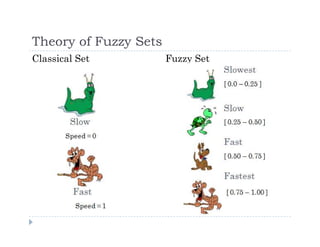
Classical Set: An element either belongs or does not
belong to a sets that have been defined.
Fuzzy Set: An element belongs partially or gradually to
the sets that have been defined.
What is Fuzzy Logic?
 It has two different meanings as,
 In narrow sense: Fuzzy logic is a logical system,
 which is an extension of multi-valued logic.
 In a wider sense: Fuzzy logic (FL) is almost
 synonymous with the theory of fuzzy sets, a theory
 which relates to classes of objects with unsharp
 boundaries in which membership is a matter of
 degree.

 Fuzzy logic (FL) should be interpreted in its wider
 sense
What is Fuzzy Logic?
 A way to represent variation or imprecision in logic

 A way to make use of natural language in logic

 Approximate reasoning

 Definition of Fuzzy Logic:
      A form of knowledge representation suitable for
 notions that cannot be defined precisely, but which
 depend upon their contexts.

 Superset of conventional (Boolean) logic that has been
 extended to handle the concept of partial truth - the truth
 values between "completely true & completely false".
Why use Fuzzy Logic?
 Conceptually easy to understand

 Flexible

 Tolerant of imprecise data

 FL can model nonlinear functions of arbitrary complexity

 FL can be built on top of the experience of experts

 FL can be blended with conventional control techniques

 FL is based on natural language
Theory of Fuzzy Sets
Classical Set          Fuzzy Set
Theory of Fuzzy Sets
 Theory which relates to classes of objects with unsharp
 boundaries in which membership is matter of degree
 Thus every problem can be presented in terms of
 Fuzzy Sets
 A set without crisp
 Fuzzy set describes vague concepts
 Fuzzy set admits the possibility of partial membership
 in it
 Degree of an object belongs to Fuzzy Set is denoted by
 membership value between 0 to 1
 Membership Function (MF) associated with a given
 Fuzzy Set maps an input value to its appropriate
 membership value
Vocabulary
 Linguistic Variable: Variable whose values are words
 or sentences rather than numbers

 It represent qualities spanning a particular spectrum

 Example: Speed, Service, Tip, Temperature, etc.

 Linguistic Value or Term: Values or Terms used to
 describe Linguistic Variable

 Example: For Speed (Slowest, Slow, Fast, Fastest), For
 Service (Poor, Good, Excellent), For Temperature
 (Freezing, Cool, Warm, Hot), etc.
Vocabulary
 Universe of Discourse or Universe or Input Space (U):
 Set of all possible elements that can come into
 consideration, confer the set U in (1).

 It depends on context.

 Elements of a fuzzy set are taken from a Universe of
 Discourse.

 An application of the universe is to suppress faulty
 measurement data.

 Example:
 Set of x >> 1 could have as a universe of all real numbers,
 alternatively all positive integer.
Vocabulary
 Membership Function (MF) is a curve that defines how
 each point in the input space is mapped to a membership
 value between 0 and 1.
 It is denoted by µ.
 Membership value is also called as degree of membership
 or membership grade or degree of truth of proposal.
 Types of Membership Functions:
 Piece-wise linear functions
 Gaussian distribution function
 Sigmoid curve
 Quadratic and cubic polynomial curves
 Singleton Membership Function
Membership Functions
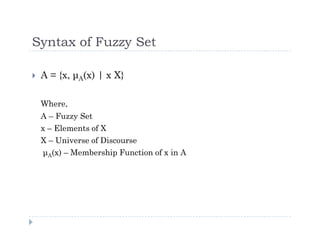
Syntax of Fuzzy Set

 A = {x, µA(x) | x X}

 Where,
 A – Fuzzy Set
 x – Elements of X
 X – Universe of Discourse
  µA(x) – Membership Function of x in A
Fuzzy if-then Rules
 Statements used to formulate the conditional statements
 that comprise fuzzy logic
 Example:
 if x is A then y is B
 where,
 A & B – Linguistic values
 x – Element of Fuzzy set X
 y – Element of Fuzzy set Y
 In above example,
 Antecedent (or Premise)– if part of rule (i.e. x is A)
 Consequent (or Conclusion) – then part of rule (i.e. y is B)
 Antecedent is interpretation & Consequent is assignment
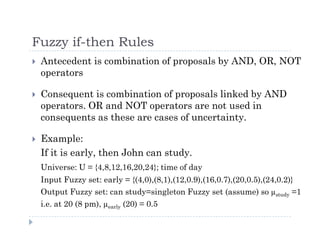
Fuzzy if-then Rules
 Antecedent is combination of proposals by AND, OR, NOT
 operators

 Consequent is combination of proposals linked by AND
 operators. OR and NOT operators are not used in
 consequents as these are cases of uncertainty.

 Example:
 If it is early, then John can study.
 Universe: U = {4,8,12,16,20,24}; time of day
 Input Fuzzy set: early = {(4,0),(8,1),(12,0.9),(16,0.7),(20,0.5),(24,0.2)}
 Output Fuzzy set: can study=singleton Fuzzy set (assume) so study =1
 i.e. at 20 (8 pm), early (20) = 0.5
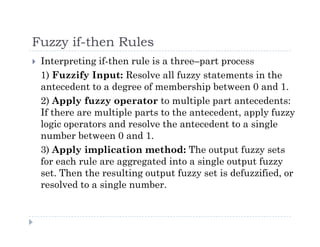
Fuzzy if-then Rules
 Interpreting if-then rule is a three–part process
 1) Fuzzify Input: Resolve all fuzzy statements in the
 antecedent to a degree of membership between 0 and 1.
 2) Apply fuzzy operator to multiple part antecedents:
 If there are multiple parts to the antecedent, apply fuzzy
 logic operators and resolve the antecedent to a single
 number between 0 and 1.
 3) Apply implication method: The output fuzzy sets
 for each rule are aggregated into a single output fuzzy
 set. Then the resulting output fuzzy set is defuzzified, or
 resolved to a single number.
Fuzzy if-then Rules
Interpreting if-then rule is a three–part process:
Fuzzy Logic Operations
 Fuzzy Logic Operators are used to write logic
 combinations between fuzzy notions (i.e. to perform
 computations on degree of membership)
 Zadeh operators
 1) Intersection: The logic operator corresponding to
 the intersection of sets is AND.
  (A AND B)   = MIN(     (A),   (B))

 2) Union: The logic operator corresponding to the
 union of sets is OR.
  (A OR B)   = MAX(      (A),   (B))

 3) Negation: The logic operator corresponding to the
 complement of a set is the negation.
  (NOT A)    =1-   (A)
Fuzzy Logic Operations
Fuzzy Inference Systems (FIS)
 Fuzzy Inference is the process of formulating the mapping
 from a given input to an output using fuzzy logic.
 Process of fuzzy inference involves Membership Functions
 (MF), Logical Operations and If-Then Rules.
 FIS having multidisciplinary nature, so cab called as
 fuzzy-rule-based systems, fuzzy expert systems, fuzzy
 modeling, fuzzy associative memory, fuzzy logic
 controllers, and simply (and ambiguously) fuzzy systems.
 Types of FIS:
 1) Mamdani-type: Most commonly used. Expects the output MF’s to
 be fuzzy sets.
 2) Sugeno-type: Output MF’s are either linear or constant.
Fuzzy Inference Process
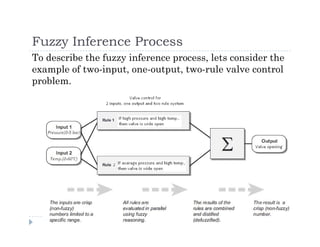
To describe the fuzzy inference process, lets consider the
example of two-input, one-output, two-rule valve control
problem.
Fuzzy Inference Process
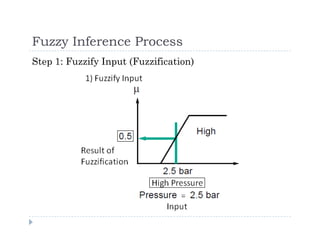
Step 1: Fuzzify Input (Fuzzification)
  Take the inputs and determine the degree to which they
  belong to each of the appropriate fuzzy sets via
  membership functions.

 Input is always a crisp numerical value limited to the
 universe of discourse of the input variable.

 Output is a fuzzy degree of membership in the
 qualifying linguistic set.

 Each input is fuzzified over all the qualifying
 membership functions required by the rules.
Fuzzy Inference Process
Step 1: Fuzzify Input (Fuzzification)
Fuzzy Inference Process
Step 2 : Apply Fuzzy Operator
  If the antecedent of a given rule has more than one
  part, the fuzzy operator is applied to obtain one
  number that represents the result of the antecedent
  for that rule.

 The input to the fuzzy operator is two or more
 membership values from fuzzified input variables.

 The output is a single truth value.
Fuzzy Inference Process
Step 2 : Apply Fuzzy Operator
Fuzzy Inference Process
Step 3: Apply Implication Method
  First must determine the rule’s weight.

 Operation in which the result of fuzzy operator is used to
 determine the conclusion of the rule is called as
 implication.

 The input for the implication process is a single number
 given by the antecedent.

 The output of the implication process is a fuzzy set.

 Implication is implemented for each rule.
Fuzzy Inference Process
Step 3: Apply Implication Method

        Antecedent                 Consequent
Fuzzy Inference Process
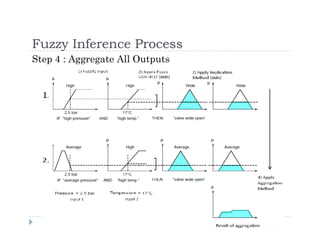
Step 4 : Aggregate All Outputs
  Aggregation is the process by which the fuzzy sets that
  represent the outputs of each rule are combined into a
  single fuzzy set.

 Aggregation only occurs once for each output variable.

 The input of the aggregation process is the list of
 truncated output functions returned by the implication
 process for each rule.

 The output of the aggregation process is one fuzzy set
 for each output variable.
Fuzzy Inference Process
Step 4 : Aggregate All Outputs
Fuzzy Inference Process
Step 5: Defuzzify
  Move from the “fuzzy world” to the “real world” is
  known as defuzzification.
  The input for the defuzzification process is a fuzzy set.
  The output is a single number.
  The most popular defuzzification method is the
  centroid calculation, which returns the center of area
  under the curve
  Other methods are bisector, middle of maximum (the
  average of the maximum value of the output set),
  largest of maximum, and smallest of maximum.
Fuzzy Inference Process
Step 5: Defuzzify
References
 Fuzzy Logic Toolbox™ 2 User’s Guide

 Tutorial On Fuzzy Logic by Jan Jantzen

 Fuzzy Logic by Cahier Technique Schneider
Thank You…
Any Questions?

Fuzzy+logic

  • 1.
  • 2.
    Content What isFuzzy? Sets Theory What is Fuzzy Logic? Why use Fuzzy Logic? Theory of Fuzzy Sets Vocabulary Fuzzy if-then Rules Fuzzy Logic Operations Fuzzy Inference Systems (FIS) Fuzzy Inference Process References
  • 3.
    What is Fuzzy? Fuzzy means not clear, distinct or precise; not crisp (well defined); blurred (with unclear outline).
  • 4.
    Sets Theory Classical Set:An element either belongs or does not belong to a sets that have been defined. Fuzzy Set: An element belongs partially or gradually to the sets that have been defined.
  • 5.
    What is FuzzyLogic? It has two different meanings as, In narrow sense: Fuzzy logic is a logical system, which is an extension of multi-valued logic. In a wider sense: Fuzzy logic (FL) is almost synonymous with the theory of fuzzy sets, a theory which relates to classes of objects with unsharp boundaries in which membership is a matter of degree. Fuzzy logic (FL) should be interpreted in its wider sense
  • 6.
    What is FuzzyLogic? A way to represent variation or imprecision in logic A way to make use of natural language in logic Approximate reasoning Definition of Fuzzy Logic: A form of knowledge representation suitable for notions that cannot be defined precisely, but which depend upon their contexts. Superset of conventional (Boolean) logic that has been extended to handle the concept of partial truth - the truth values between "completely true & completely false".
  • 7.
    Why use FuzzyLogic? Conceptually easy to understand Flexible Tolerant of imprecise data FL can model nonlinear functions of arbitrary complexity FL can be built on top of the experience of experts FL can be blended with conventional control techniques FL is based on natural language
  • 8.
    Theory of FuzzySets Classical Set Fuzzy Set
  • 9.
    Theory of FuzzySets Theory which relates to classes of objects with unsharp boundaries in which membership is matter of degree Thus every problem can be presented in terms of Fuzzy Sets A set without crisp Fuzzy set describes vague concepts Fuzzy set admits the possibility of partial membership in it Degree of an object belongs to Fuzzy Set is denoted by membership value between 0 to 1 Membership Function (MF) associated with a given Fuzzy Set maps an input value to its appropriate membership value
  • 10.
    Vocabulary Linguistic Variable:Variable whose values are words or sentences rather than numbers It represent qualities spanning a particular spectrum Example: Speed, Service, Tip, Temperature, etc. Linguistic Value or Term: Values or Terms used to describe Linguistic Variable Example: For Speed (Slowest, Slow, Fast, Fastest), For Service (Poor, Good, Excellent), For Temperature (Freezing, Cool, Warm, Hot), etc.
  • 11.
    Vocabulary Universe ofDiscourse or Universe or Input Space (U): Set of all possible elements that can come into consideration, confer the set U in (1). It depends on context. Elements of a fuzzy set are taken from a Universe of Discourse. An application of the universe is to suppress faulty measurement data. Example: Set of x >> 1 could have as a universe of all real numbers, alternatively all positive integer.
  • 12.
    Vocabulary Membership Function(MF) is a curve that defines how each point in the input space is mapped to a membership value between 0 and 1. It is denoted by µ. Membership value is also called as degree of membership or membership grade or degree of truth of proposal. Types of Membership Functions: Piece-wise linear functions Gaussian distribution function Sigmoid curve Quadratic and cubic polynomial curves Singleton Membership Function
  • 13.
  • 14.
    Syntax of FuzzySet A = {x, µA(x) | x X} Where, A – Fuzzy Set x – Elements of X X – Universe of Discourse µA(x) – Membership Function of x in A
  • 15.
    Fuzzy if-then Rules Statements used to formulate the conditional statements that comprise fuzzy logic Example: if x is A then y is B where, A & B – Linguistic values x – Element of Fuzzy set X y – Element of Fuzzy set Y In above example, Antecedent (or Premise)– if part of rule (i.e. x is A) Consequent (or Conclusion) – then part of rule (i.e. y is B) Antecedent is interpretation & Consequent is assignment
  • 16.
    Fuzzy if-then Rules Antecedent is combination of proposals by AND, OR, NOT operators Consequent is combination of proposals linked by AND operators. OR and NOT operators are not used in consequents as these are cases of uncertainty. Example: If it is early, then John can study. Universe: U = {4,8,12,16,20,24}; time of day Input Fuzzy set: early = {(4,0),(8,1),(12,0.9),(16,0.7),(20,0.5),(24,0.2)} Output Fuzzy set: can study=singleton Fuzzy set (assume) so study =1 i.e. at 20 (8 pm), early (20) = 0.5
  • 17.
    Fuzzy if-then Rules Interpreting if-then rule is a three–part process 1) Fuzzify Input: Resolve all fuzzy statements in the antecedent to a degree of membership between 0 and 1. 2) Apply fuzzy operator to multiple part antecedents: If there are multiple parts to the antecedent, apply fuzzy logic operators and resolve the antecedent to a single number between 0 and 1. 3) Apply implication method: The output fuzzy sets for each rule are aggregated into a single output fuzzy set. Then the resulting output fuzzy set is defuzzified, or resolved to a single number.
  • 18.
    Fuzzy if-then Rules Interpretingif-then rule is a three–part process:
  • 19.
    Fuzzy Logic Operations Fuzzy Logic Operators are used to write logic combinations between fuzzy notions (i.e. to perform computations on degree of membership) Zadeh operators 1) Intersection: The logic operator corresponding to the intersection of sets is AND. (A AND B) = MIN( (A), (B)) 2) Union: The logic operator corresponding to the union of sets is OR. (A OR B) = MAX( (A), (B)) 3) Negation: The logic operator corresponding to the complement of a set is the negation. (NOT A) =1- (A)
  • 20.
  • 21.
    Fuzzy Inference Systems(FIS) Fuzzy Inference is the process of formulating the mapping from a given input to an output using fuzzy logic. Process of fuzzy inference involves Membership Functions (MF), Logical Operations and If-Then Rules. FIS having multidisciplinary nature, so cab called as fuzzy-rule-based systems, fuzzy expert systems, fuzzy modeling, fuzzy associative memory, fuzzy logic controllers, and simply (and ambiguously) fuzzy systems. Types of FIS: 1) Mamdani-type: Most commonly used. Expects the output MF’s to be fuzzy sets. 2) Sugeno-type: Output MF’s are either linear or constant.
  • 22.
    Fuzzy Inference Process Todescribe the fuzzy inference process, lets consider the example of two-input, one-output, two-rule valve control problem.
  • 23.
    Fuzzy Inference Process Step1: Fuzzify Input (Fuzzification) Take the inputs and determine the degree to which they belong to each of the appropriate fuzzy sets via membership functions. Input is always a crisp numerical value limited to the universe of discourse of the input variable. Output is a fuzzy degree of membership in the qualifying linguistic set. Each input is fuzzified over all the qualifying membership functions required by the rules.
  • 24.
    Fuzzy Inference Process Step1: Fuzzify Input (Fuzzification)
  • 25.
    Fuzzy Inference Process Step2 : Apply Fuzzy Operator If the antecedent of a given rule has more than one part, the fuzzy operator is applied to obtain one number that represents the result of the antecedent for that rule. The input to the fuzzy operator is two or more membership values from fuzzified input variables. The output is a single truth value.
  • 26.
    Fuzzy Inference Process Step2 : Apply Fuzzy Operator
  • 27.
    Fuzzy Inference Process Step3: Apply Implication Method First must determine the rule’s weight. Operation in which the result of fuzzy operator is used to determine the conclusion of the rule is called as implication. The input for the implication process is a single number given by the antecedent. The output of the implication process is a fuzzy set. Implication is implemented for each rule.
  • 28.
    Fuzzy Inference Process Step3: Apply Implication Method Antecedent Consequent
  • 29.
    Fuzzy Inference Process Step4 : Aggregate All Outputs Aggregation is the process by which the fuzzy sets that represent the outputs of each rule are combined into a single fuzzy set. Aggregation only occurs once for each output variable. The input of the aggregation process is the list of truncated output functions returned by the implication process for each rule. The output of the aggregation process is one fuzzy set for each output variable.
  • 30.
    Fuzzy Inference Process Step4 : Aggregate All Outputs
  • 31.
    Fuzzy Inference Process Step5: Defuzzify Move from the “fuzzy world” to the “real world” is known as defuzzification. The input for the defuzzification process is a fuzzy set. The output is a single number. The most popular defuzzification method is the centroid calculation, which returns the center of area under the curve Other methods are bisector, middle of maximum (the average of the maximum value of the output set), largest of maximum, and smallest of maximum.
  • 32.
  • 33.
    References Fuzzy LogicToolbox™ 2 User’s Guide Tutorial On Fuzzy Logic by Jan Jantzen Fuzzy Logic by Cahier Technique Schneider
  • 34.
  • 35.