Angle Pairs
Complementary AnglesComplementary angles are two angles whose measures have a sum of 90°.
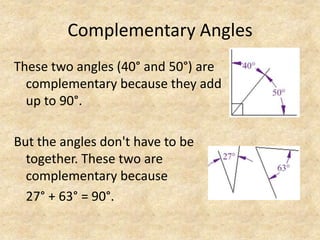
Complementary AnglesThese two angles (40° and 50°) are complementary because they add up to 90°. But the angles don't have to be together.These two are complementary because27° + 63° = 90°.
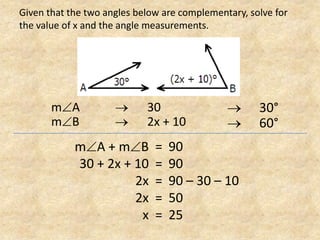
Given that the two angles below are complementary, solve for the value of x and the angle measurements.mA	30mB	 	 	2x + 10 	30° 	60°mA + mB30 + 2x + 102x2xx909090 – 30 – 105025=====
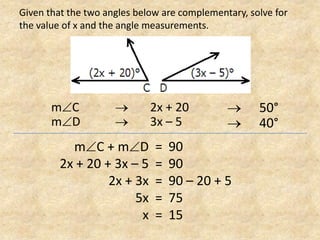
Given that the two angles below are complementary, solve for the value of x and the angle measurements.mC	 2x + 20mD	 	 	 3x – 5 	50° 	40°mC + mD2x + 20 + 3x – 52x + 3x5xx909090 – 20 + 57515=====
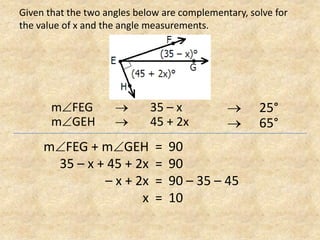
Given that the two angles below are complementary, solve for the value of x and the angle measurements.mFEG	 35 – xmGEH 	 	45 + 2x 	25° 	65°mFEG + mGEH35 – x + 45 + 2x– x + 2xx909090 – 35 – 4510====
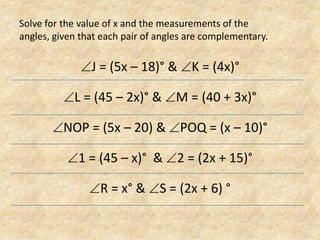
Solve for the value of x and the measurements of the angles, given that each pair of angles are complementary.J = (5x – 18)° & K = (4x)°L = (45 – 2x)° & M = (40 + 3x)°NOP = (5x – 20) & POQ = (x – 10)°1 = (45 – x)°  & 2 = (2x + 15)°R = x° & S = (2x + 6) °
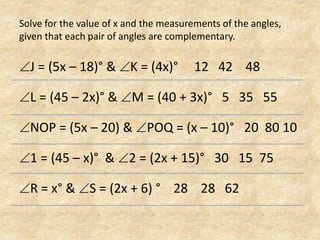
Solve for the value of x and the measurements of the angles, given that each pair of angles are complementary.J = (5x – 18)° & K = (4x)°     12   42    48L = (45 – 2x)° & M = (40 + 3x)°   5   35   55NOP = (5x – 20) & POQ = (x – 10)°   20  80 101 = (45 – x)°  & 2 = (2x + 15)°   30   15  75R = x° & S = (2x + 6) °    28    28   62
Supplementary AnglesSupplementary angles are two angles whose measures have a sum of 180°.
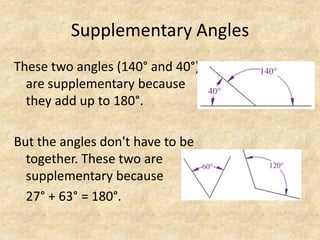
Supplementary AnglesThese two angles (140° and 40°) are supplementary because they add up to 180°. But the angles don't have to be together.These two are supplementary because27° + 63° = 180°.
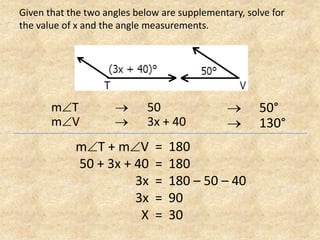
Given that the two angles below are supplementary, solve for the value of x and the angle measurements.mT	50mV	 	 	3x + 40 	50° 	130°mT + mV50 + 3x + 403x3xX180180180 – 50 – 409030=====
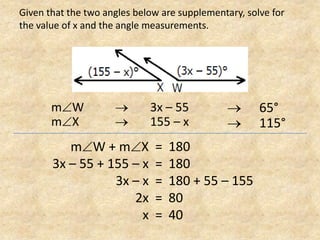
Given that the two angles below are supplementary, solve for the value of x and the angle measurements.mW	 3x – 55mX	 	 	155 – x 	65° 	115°mW + mX3x – 55 + 155 – x3x – x2xx180180180 + 55 – 1558040=====
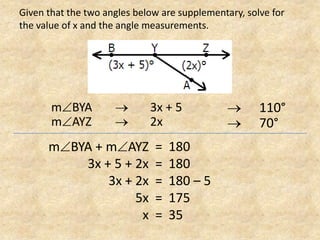
Given that the two angles below are supplementary, solve for the value of x and the angle measurements.mBYA	 3x + 5mAYZ 	 	2x 	110° 	70°mBYA + mAYZ3x + 5 + 2x3x + 2x5xx180180180 – 517535=====
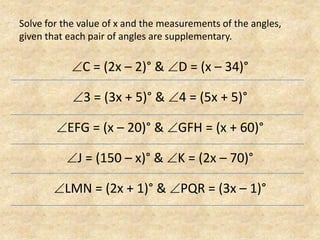
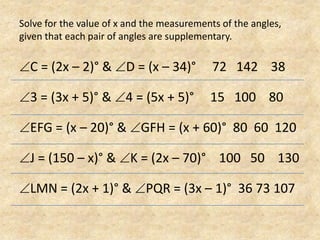
Solve for the value of x and the measurements of the angles, given that each pair of angles are supplementary.C = (2x – 2)° & D = (x – 34)°3 = (3x + 5)° & 4 = (5x + 5)°EFG = (x – 20)° & GFH = (x + 60)°J = (150 – x)° & K = (2x – 70)°LMN = (2x + 1)° & PQR = (3x – 1)°
Solve for the value of x and the measurements of the angles, given that each pair of angles are supplementary.C = (2x – 2)° & D = (x – 34)°     72   142    383 = (3x + 5)° & 4 = (5x + 5)°     15   100    80EFG = (x – 20)° & GFH = (x + 60)°  80  60  120J = (150 – x)° & K = (2x – 70)°    100   50    130LMN = (2x + 1)° & PQR = (3x – 1)°  36 73 107
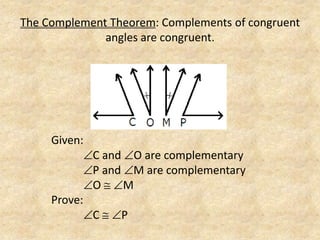
The Complement Theorem: Complements of congruent angles are congruent.		Given:C and O are complementary			P and M are complementary			O  M		Prove:			C  P
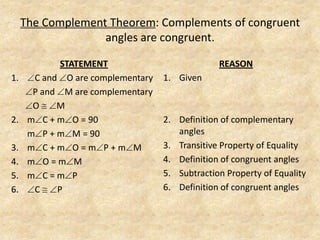
The Complement Theorem: Complements of congruent angles are congruent.STATEMENTC and O are complementaryP and M are complementaryO  MmC + mO = 90mP + mM = 90mC + mO = mP + mMmO = mMmC = mPC  PREASONGivenDefinition of complementary anglesTransitive Property of EqualityDefinition of congruent anglesSubtraction Property of EqualityDefinition of congruent angles
Theorem: If two angles are complementary and adjacent, then they form a right angle.
The Supplement Theorem: Supplements of congruent angles are congruent.
Linear PairA linear pair consists of two adjacent angles whose noncommon sides are opposite rays.Linear Pair Postulate: If two angles form a linear pair, then they are supplementary.
Vertical AnglesVertical angles are two nonadjacent angles formed by two intersecting lines.
Vertical Angle Theorem: Vertical angles are congruent.

Angle Pairs

  • 1.
  • 2.
    Complementary AnglesComplementary anglesare two angles whose measures have a sum of 90°.
  • 3.
    Complementary AnglesThese twoangles (40° and 50°) are complementary because they add up to 90°. But the angles don't have to be together.These two are complementary because27° + 63° = 90°.
  • 4.
    Given that thetwo angles below are complementary, solve for the value of x and the angle measurements.mA 30mB  2x + 10 30° 60°mA + mB30 + 2x + 102x2xx909090 – 30 – 105025=====
  • 5.
    Given that thetwo angles below are complementary, solve for the value of x and the angle measurements.mC 2x + 20mD  3x – 5 50° 40°mC + mD2x + 20 + 3x – 52x + 3x5xx909090 – 20 + 57515=====
  • 6.
    Given that thetwo angles below are complementary, solve for the value of x and the angle measurements.mFEG 35 – xmGEH  45 + 2x 25° 65°mFEG + mGEH35 – x + 45 + 2x– x + 2xx909090 – 35 – 4510====
  • 7.
    Solve for thevalue of x and the measurements of the angles, given that each pair of angles are complementary.J = (5x – 18)° & K = (4x)°L = (45 – 2x)° & M = (40 + 3x)°NOP = (5x – 20) & POQ = (x – 10)°1 = (45 – x)° & 2 = (2x + 15)°R = x° & S = (2x + 6) °
  • 8.
    Solve for thevalue of x and the measurements of the angles, given that each pair of angles are complementary.J = (5x – 18)° & K = (4x)° 12 42 48L = (45 – 2x)° & M = (40 + 3x)° 5 35 55NOP = (5x – 20) & POQ = (x – 10)° 20 80 101 = (45 – x)° & 2 = (2x + 15)° 30 15 75R = x° & S = (2x + 6) ° 28 28 62
  • 9.
    Supplementary AnglesSupplementary anglesare two angles whose measures have a sum of 180°.
  • 10.
    Supplementary AnglesThese twoangles (140° and 40°) are supplementary because they add up to 180°. But the angles don't have to be together.These two are supplementary because27° + 63° = 180°.
  • 11.
    Given that thetwo angles below are supplementary, solve for the value of x and the angle measurements.mT 50mV  3x + 40 50° 130°mT + mV50 + 3x + 403x3xX180180180 – 50 – 409030=====
  • 12.
    Given that thetwo angles below are supplementary, solve for the value of x and the angle measurements.mW 3x – 55mX  155 – x 65° 115°mW + mX3x – 55 + 155 – x3x – x2xx180180180 + 55 – 1558040=====
  • 13.
    Given that thetwo angles below are supplementary, solve for the value of x and the angle measurements.mBYA 3x + 5mAYZ  2x 110° 70°mBYA + mAYZ3x + 5 + 2x3x + 2x5xx180180180 – 517535=====
  • 14.
    Solve for thevalue of x and the measurements of the angles, given that each pair of angles are supplementary.C = (2x – 2)° & D = (x – 34)°3 = (3x + 5)° & 4 = (5x + 5)°EFG = (x – 20)° & GFH = (x + 60)°J = (150 – x)° & K = (2x – 70)°LMN = (2x + 1)° & PQR = (3x – 1)°
  • 15.
    Solve for thevalue of x and the measurements of the angles, given that each pair of angles are supplementary.C = (2x – 2)° & D = (x – 34)° 72 142 383 = (3x + 5)° & 4 = (5x + 5)° 15 100 80EFG = (x – 20)° & GFH = (x + 60)° 80 60 120J = (150 – x)° & K = (2x – 70)° 100 50 130LMN = (2x + 1)° & PQR = (3x – 1)° 36 73 107
  • 16.
    The Complement Theorem:Complements of congruent angles are congruent. Given:C and O are complementary P and M are complementary O  M Prove: C  P
  • 17.
    The Complement Theorem:Complements of congruent angles are congruent.STATEMENTC and O are complementaryP and M are complementaryO  MmC + mO = 90mP + mM = 90mC + mO = mP + mMmO = mMmC = mPC  PREASONGivenDefinition of complementary anglesTransitive Property of EqualityDefinition of congruent anglesSubtraction Property of EqualityDefinition of congruent angles
  • 18.
    Theorem: If twoangles are complementary and adjacent, then they form a right angle.
  • 19.
    The Supplement Theorem:Supplements of congruent angles are congruent.
  • 20.
    Linear PairA linearpair consists of two adjacent angles whose noncommon sides are opposite rays.Linear Pair Postulate: If two angles form a linear pair, then they are supplementary.
  • 21.
    Vertical AnglesVertical anglesare two nonadjacent angles formed by two intersecting lines.
  • 22.
    Vertical Angle Theorem:Vertical angles are congruent.