M.G. 2.1 Identify angles as adjacent, vertical,
complementary and supplementary.
Objective-- Students will identify angles as complementary
and supplementary and solve problems with an unknown
angle from given information about them by finding a
missing angle and scoring an 80% proficiency on an exit slip.
Warm Up
Identify the type of angle.
1. 70°
2. 90°
3. 140°
4. 180°
acute
right
obtuse
straight
Vocabulary
congruent
vertical angles
adjacent angles
complementary angles
supplementary angles
Congruent angles have the same measure.
Vertical angles are formed opposite each other
when two lines intersect. Vertical angles have
the same measure, so they are always
congruent.
MRP and NRQ are vertical angles.
MRN and PRQ are vertical angles
Adjacent angles are side by side and have a
common vertex and ray. Adjacent angles may or
may not be congruent.
MRN and NRQ are adjacent angles. They
share vertex R and RN.
NRQ and QRP are adjacent angles. They
share vertex R and RQ.
Adjacent angles are “side by side”
and share a common ray.
45º
15º
These are examples of adjacent
angles.
55º
35º
50º
130
º
80º 45º
85º
20º
These angles are NOT adjacent.
45º
55º
50º
100
º 35º
35º
When 2 lines intersect, they make
vertical angles.
75º
75º
105
º
105
º
Vertical angles are opposite one another.
75º
75º
105
º
105
º
Vertical angles are opposite one another.
75º
75º
105
º
105
º
Vertical angles are congruent (equal).
30º
150
º
150
º
30º
Supplementary angles add up to
180º.
60º
120º
40º
140º
Adjacent and Supplementary
Angles
Supplementary Angles
but not Adjacent
How can I remember that?
• Draw the S in Supplementary
S
• Since supplementary angles equal 180*, turn that S into a
number 8 by drawing a line diagonal, then add a 1 in front
of that and a 0 after to make it 180.
• So you change the S in supplementary into 180*!!
S S 1S0*
Complementary angles add up to
90º.
60º
30º
40º
50º
Adjacent and Complementary
Angles
Complementary Angles
but not Adjacent
How can I remember that?
• Draw the C in Complementary
C
• Since complementary angles equal 90*, turn that C into a
number 9 by drawing a line, then add a 0 after that to make
it 90.
• So you change the C in complementary into 90*!!
C C C
Remember our Objective…
Students will identify angles as
complementary and
supplementary and solve problems with
an unknown angle from given information about
them by finding a missing angle and scoring an
80% proficiency on an exit slip.
Remember: Two angles are supplementary if the sum
of their measures is 180 degrees. Each angle is the
supplement of the other.
1 2
20
160
These are supplements of each other
because their angles add up to 180.
3 STEPS for Finding Missing
Angles:
1) First, create an addition equation by adding both angles.
1) The sum of the two angles will equal
90° for Complementary Angles and
180° for Supplementary Angles.
3) Solve the equation using the inverse rules!
x
Example 1 Find the value of x by making
an equation.
x  
+ = 180
20
x 
= 160
20
x
Example 2 Find the value of x by writing
your equation.
65
x  
+ = 180
65
x 
= 115
Two angles are complementary if the sum of their
measures is 90 degrees. Each angle is the
complement of the other.
1
2
30
60
These are complements of each other
because their angles add up to be 90.
Example 3 Find the value of x.
x
15
x  
+ = 90
15
x = 75
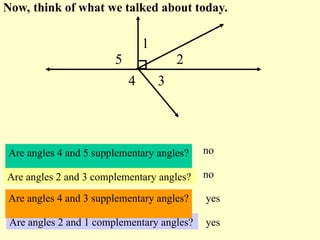
1
2
3
5
Are angles 4 and 5 supplementary angles?
Are angles 2 and 3 complementary angles?
Are angles 2 and 1 complementary angles?
Are angles 4 and 3 supplementary angles?
no
no
yes
yes
Now, think of what we talked about today.
4
Example 4 Find the value of x.
(4x + 3)
(x - 8)
(4x + 3) + (x - 8) = 90
  
x = 19
5x  
- 5 = 90
5x 
= 95
Example 5 Find the value of x.
(7x 10)
  3x
(7x + 10) + 3x = 180
  
10x  
+ 10 = 180
10x 
= 170
x = 17
1
2
3
5
Are angles 1 and 2 a linear pair?
Are angles 1 and 3 adjacent angles?
Are angles 2 and 3 adjacent angles?
Are angles 3 and 4 a linear pair?
no
no
yes
yes
Think back to last class…
4
Remember…Students will identify
angles as complementary
and supplementary and solve
problems with an unknown angle from
given information about them by finding
a missing angle and scoring an 80%
proficiency on an exit slip.
Figure 1find the missing angles you may use a
protractor to draw it!
X
Z
Q
S
T
V
Y
40
50
40
R
S

complementary_and_supplementary_angles.ppt

  • 1.
    M.G. 2.1 Identifyangles as adjacent, vertical, complementary and supplementary. Objective-- Students will identify angles as complementary and supplementary and solve problems with an unknown angle from given information about them by finding a missing angle and scoring an 80% proficiency on an exit slip.
  • 2.
    Warm Up Identify thetype of angle. 1. 70° 2. 90° 3. 140° 4. 180° acute right obtuse straight
  • 3.
  • 4.
    Congruent angles havethe same measure. Vertical angles are formed opposite each other when two lines intersect. Vertical angles have the same measure, so they are always congruent. MRP and NRQ are vertical angles. MRN and PRQ are vertical angles
  • 5.
    Adjacent angles areside by side and have a common vertex and ray. Adjacent angles may or may not be congruent. MRN and NRQ are adjacent angles. They share vertex R and RN. NRQ and QRP are adjacent angles. They share vertex R and RQ.
  • 6.
    Adjacent angles are“side by side” and share a common ray. 45º 15º
  • 7.
    These are examplesof adjacent angles. 55º 35º 50º 130 º 80º 45º 85º 20º
  • 8.
    These angles areNOT adjacent. 45º 55º 50º 100 º 35º 35º
  • 9.
    When 2 linesintersect, they make vertical angles. 75º 75º 105 º 105 º
  • 10.
    Vertical angles areopposite one another. 75º 75º 105 º 105 º
  • 11.
    Vertical angles areopposite one another. 75º 75º 105 º 105 º
  • 12.
    Vertical angles arecongruent (equal). 30º 150 º 150 º 30º
  • 13.
    Supplementary angles addup to 180º. 60º 120º 40º 140º Adjacent and Supplementary Angles Supplementary Angles but not Adjacent
  • 14.
    How can Iremember that? • Draw the S in Supplementary S • Since supplementary angles equal 180*, turn that S into a number 8 by drawing a line diagonal, then add a 1 in front of that and a 0 after to make it 180. • So you change the S in supplementary into 180*!! S S 1S0*
  • 15.
    Complementary angles addup to 90º. 60º 30º 40º 50º Adjacent and Complementary Angles Complementary Angles but not Adjacent
  • 16.
    How can Iremember that? • Draw the C in Complementary C • Since complementary angles equal 90*, turn that C into a number 9 by drawing a line, then add a 0 after that to make it 90. • So you change the C in complementary into 90*!! C C C
  • 17.
    Remember our Objective… Studentswill identify angles as complementary and supplementary and solve problems with an unknown angle from given information about them by finding a missing angle and scoring an 80% proficiency on an exit slip.
  • 18.
    Remember: Two anglesare supplementary if the sum of their measures is 180 degrees. Each angle is the supplement of the other. 1 2 20 160 These are supplements of each other because their angles add up to 180.
  • 19.
    3 STEPS forFinding Missing Angles: 1) First, create an addition equation by adding both angles. 1) The sum of the two angles will equal 90° for Complementary Angles and 180° for Supplementary Angles. 3) Solve the equation using the inverse rules!
  • 20.
    x Example 1 Findthe value of x by making an equation. x   + = 180 20 x  = 160 20
  • 21.
    x Example 2 Findthe value of x by writing your equation. 65 x   + = 180 65 x  = 115
  • 22.
    Two angles arecomplementary if the sum of their measures is 90 degrees. Each angle is the complement of the other. 1 2 30 60 These are complements of each other because their angles add up to be 90.
  • 23.
    Example 3 Findthe value of x. x 15 x   + = 90 15 x = 75
  • 24.
    1 2 3 5 Are angles 4and 5 supplementary angles? Are angles 2 and 3 complementary angles? Are angles 2 and 1 complementary angles? Are angles 4 and 3 supplementary angles? no no yes yes Now, think of what we talked about today. 4
  • 25.
    Example 4 Findthe value of x. (4x + 3) (x - 8) (4x + 3) + (x - 8) = 90    x = 19 5x   - 5 = 90 5x  = 95
  • 26.
    Example 5 Findthe value of x. (7x 10)   3x (7x + 10) + 3x = 180    10x   + 10 = 180 10x  = 170 x = 17
  • 27.
    1 2 3 5 Are angles 1and 2 a linear pair? Are angles 1 and 3 adjacent angles? Are angles 2 and 3 adjacent angles? Are angles 3 and 4 a linear pair? no no yes yes Think back to last class… 4
  • 28.
    Remember…Students will identify anglesas complementary and supplementary and solve problems with an unknown angle from given information about them by finding a missing angle and scoring an 80% proficiency on an exit slip.
  • 29.
    Figure 1find themissing angles you may use a protractor to draw it! X Z Q S T V Y 40 50 40 R S

Editor's Notes

  • #20 This is on p. 16 of the Study Guide problem #2.
  • #21 This is on p. 16 of the Study Guide problem #3.
  • #23 This is on p. 16 of the Study Guide problem #1.
  • #25 This is on p. 16 of the Study Guide problem #6.
  • #26 This is on p. 16 of the Study Guide problem #3.
  • #29 This is the 2nd figure in the practice workbook p.16