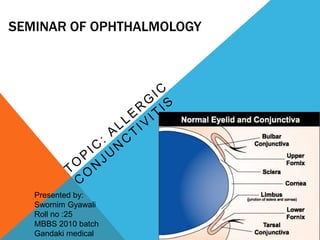
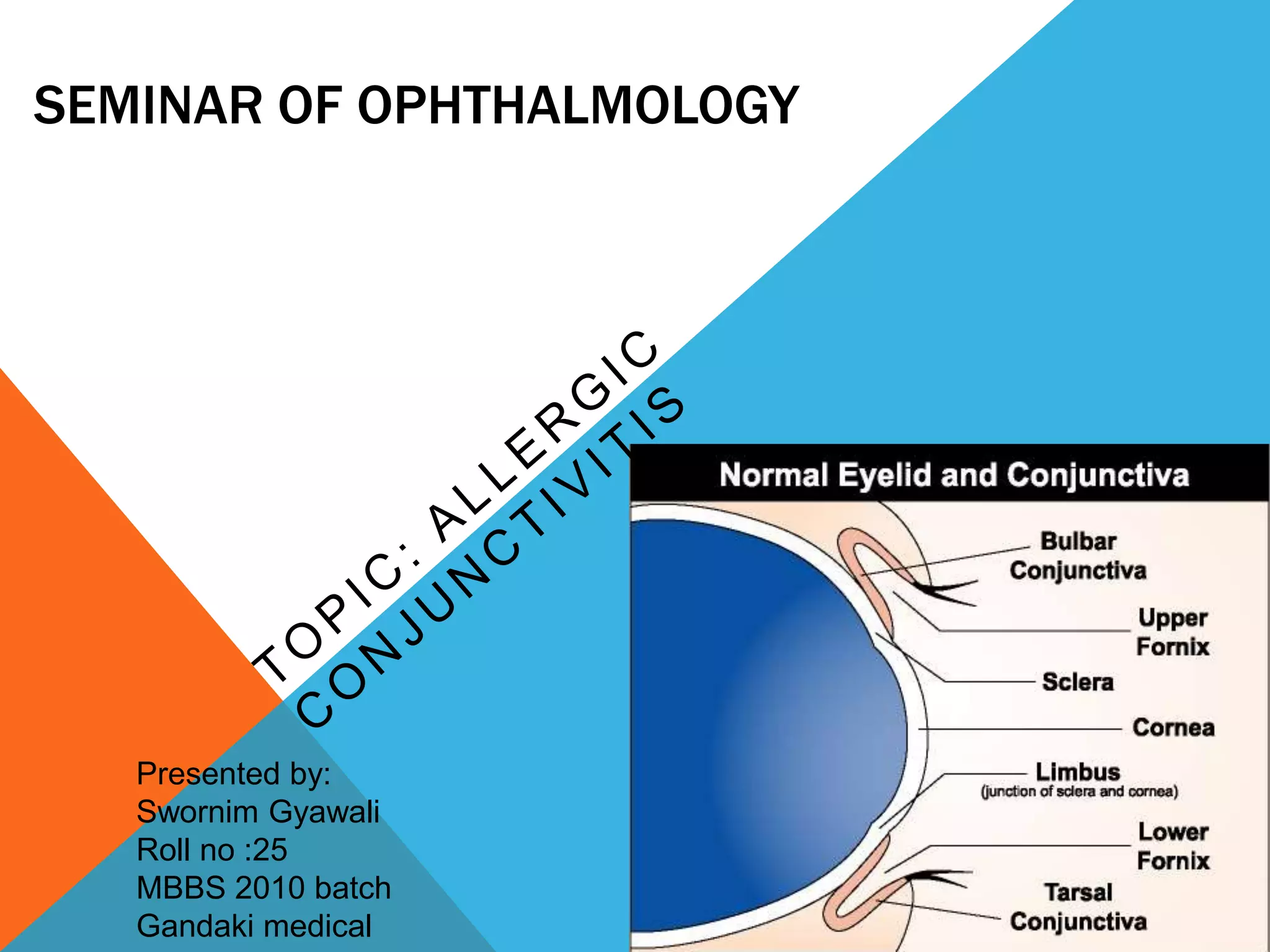
SEMINAR OF OPHTHALMOLOGY
Presented by:
Swornim Gyawali
Roll no :25
MBBS 2010 batch
Gandaki medical
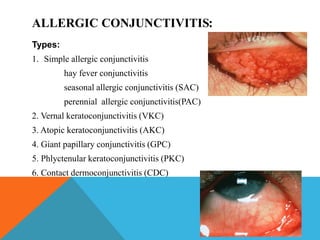
ALLERGIC CONJUNCTIVITIS:
Types:
1. Simple allergic conjunctivitis
hay fever conjunctivitis
seasonal allergic conjunctivitis (SAC)
perennial allergic conjunctivitis(PAC)
2. Vernal keratoconjunctivitis (VKC)
3. Atopic keratoconjunctivitis (AKC)
4. Giant papillary conjunctivitis (GPC)
5. Phlyctenular keratoconjunctivitis (PKC)
6. Contact dermoconjunctivitis (CDC)
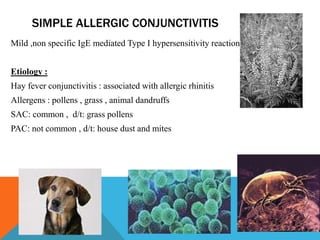
SIMPLE ALLERGIC CONJUNCTIVITIS
Mild ,non specific IgE mediated Type I hypersensitivity reaction
Etiology :
Hay fever conjunctivitis : associated with allergic rhinitis
Allergens : pollens , grass , animal dandruffs
SAC: common , d/t: grass pollens
PAC: not common , d/t: house dust and mites
SAC PATHOLOGY:
Vascular response: vasodilation increased vessel permeability exudation
Cellular response: Conjunctival infiltration (eosinophil , plasma cells and mast cells )
and exudation
producing histamine and histamine like substance
Conjunctival response: boggy swelling , increase connective tissue formation and
mild papillary hyperplasia
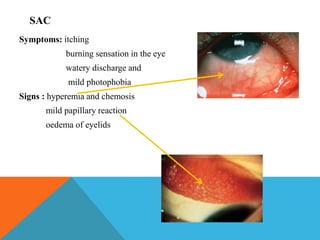
Symptoms: itching
burning sensation in the eye
watery discharge and
mild photophobia
Signs : hyperemia and chemosis
mild papillary reaction
oedema of eyelids
SAC
MANAGEMENT :
• Exposure to allergens should be reduced as far as possible
• Cold compresses
• Topical tear substitutes to flush out allergens
medications:
• vasoconstrictors
• Mast cell stabilizer: sodium chromoglycate 2% [QID]
• severe and non-responsive: steroids
• Systemic antihistamines : Cetirizine 10 mg OD(acute with marked
itching)
VERNAL KERATOCONJUNCTIVITIS
Recurrent , bilateral , interstitial ,self limiting,
Age : 4- 20 yrs , sex: boys> girls
Season: Summer hence the name SPRING CATARRH
Etiology : IgE mediated hypersensitivity reaction
Personal family history of hay fever, eczema , asthma
Peripheral blood shows : eosinophilia increased IgE
VKC PATHOLOGY:
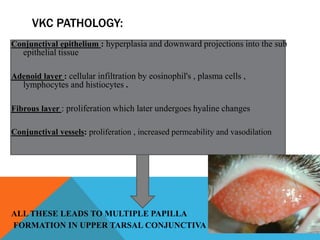
Conjunctival epithelium : hyperplasia and downward projections into the sub
epithelial tissue
Adenoid layer : cellular infiltration by eosinophil's , plasma cells ,
lymphocytes and histiocytes .
Fibrous layer : proliferation which later undergoes hyaline changes
Conjunctival vessels: proliferation , increased permeability and vasodilation
ALL THESE LEADS TO MULTIPLE PAPILLA
FORMATION IN UPPER TARSAL CONJUNCTIVA
VKC SYMPTOMS
• Intense itching & burning sensation
• Lacrimation
• Foreign body sensation
• Photophobia,
• Thick mucous discharge [ropy]
3 clinical form
• palpebral
• bulbar
• mixed form
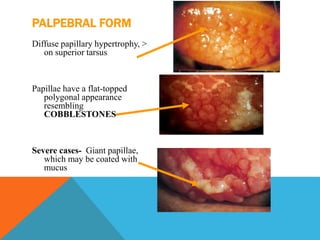
PALPEBRAL FORM
Diffuse papillary hypertrophy, >
on superior tarsus
Papillae have a flat-topped
polygonal appearance
resembling
COBBLESTONES
Severe cases- Giant papillae,
which may be coated with
mucus
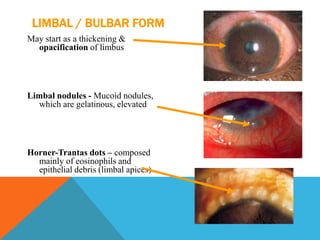
LIMBAL / BULBAR FORM
May start as a thickening &
opacification of limbus
Limbal nodules - Mucoid nodules,
which are gelatinous, elevated
Horner-Trantas dots – composed
mainly of eosinophils and
epithelial debris (limbal apices)
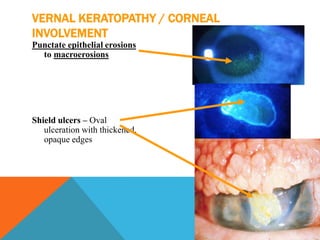
VERNAL KERATOPATHY / CORNEAL
INVOLVEMENT
Punctate epithelial erosions
to macroerosions
Shield ulcers – Oval
ulceration with thickened,
opaque edges
Plaque formation – Occur when ulcer base
becomes coated with desiccated mucus
Results in –
Subepithelial ring scarring
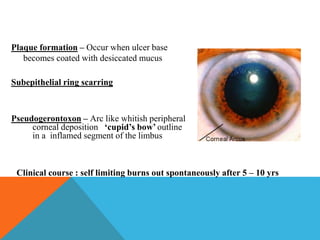
Pseudogerontoxon – Arc like whitish peripheral
corneal deposition ‘cupid’s bow’ outline
in a inflamed segment of the limbus
Clinical course : self limiting burns out spontaneously after 5 – 10 yrs
TREATMENT
Local:
• Topical steroid : Every 4 hrs. for 2 days followed by 3-4 times a day
for 2 weeks .
MONITOR IOP TO PREVENT STEROID INDUCED GLAUCOMA
• Mast cell stabilizers : sodium chromoglycate 2 % drops 4-5 times/day
• Topical antihistamine
• Acetyl cysteine (0.5%)
• Topical cyclosporine (1%): severe unresponsive case
SYSTEMIC :
I. Oral antihistamine : for itching
II. Oral steroid : short course for very severe non responsive case
Treatment of large papilla supratarsal injection of long acting steroid
or cryo application or surgical removal
General measures: dark goggles , cold compress , change
of place from hot to cold
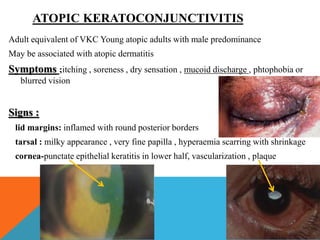
ATOPIC KERATOCONJUNCTIVITIS
Adult equivalent of VKC Young atopic adults with male predominance
May be associated with atopic dermatitis
Symptoms ;itching , soreness , dry sensation , mucoid discharge , phtophobia or
blurred vision
Signs :
lid margins: inflamed with round posterior borders
tarsal : milky appearance , very fine papilla , hyperaemia scarring with shrinkage
cornea-punctate epithelial keratitis in lower half, vascularization , plaque
Treatment :
• treat facial eczema and lid margin disease
• sodium chromoglycate
• steroids and
• tear drops
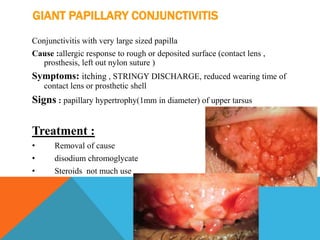
GIANT PAPILLARY CONJUNCTIVITIS
Conjunctivitis with very large sized papilla
Cause :allergic response to rough or deposited surface (contact lens ,
prosthesis, left out nylon suture )
Symptoms: itching , STRINGY DISCHARGE, reduced wearing time of
contact lens or prosthetic shell
Signs : papillary hypertrophy(1mm in diameter) of upper tarsus
Treatment :
• Removal of cause
• disodium chromoglycate
• Steroids not much use
PHLYCTENULAR CONJUNCTIVITIS
Characteristic nodular affection (an allergic response) Conjunctival and corneal
epithelium to some endogenous allergens to which they have become
sensitized.
Etiology:
Delayed type hypersensitivity in response to endogenous microbial protein.
Previously tuberculus protein ,now staphylococcus
other allergens :Moraxella axenfield and certain parasites.
Predisposing factors: age – ( 3 to 15 yrs. ) , sex : F>M , undernourished
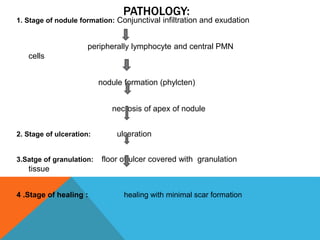
PATHOLOGY:
1. Stage of nodule formation: Conjunctival infiltration and exudation
peripherally lymphocyte and central PMN
cells
nodule formation (phylcten)
necrosis of apex of nodule
2. Stage of ulceration: ulceration
3.Satge of granulation: floor of ulcer covered with granulation
tissue
4 .Stage of healing : healing with minimal scar formation
SYMPTOMS :
Discomfort in eye
MUCOPURULENT conjunctivitis d/t secondary infection
Reflex watering
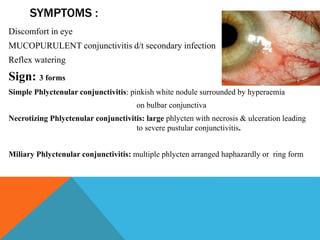
Sign: 3 forms
Simple Phlyctenular conjunctivitis: pinkish white nodule surrounded by hyperaemia
on bulbar conjunctiva
Necrotizing Phlyctenular conjunctivitis: large phlycten with necrosis & ulceration leading
to severe pustular conjunctivitis.
Miliary Phlyctenular conjunctivitis: multiple phlycten arranged haphazardly or ring form
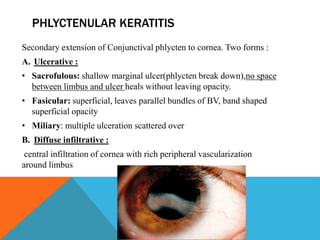
PHLYCTENULAR KERATITIS
Secondary extension of Conjunctival phlycten to cornea. Two forms :
A. Ulcerative :
• Sacrofulous: shallow marginal ulcer(phlycten break down),no space
between limbus and ulcer heals without leaving opacity.
• Fasicular: superficial, leaves parallel bundles of BV, band shaped
superficial opacity
• Miliary: multiple ulceration scattered over
B. Diffuse infiltrative :
central infiltration of cornea with rich peripheral vascularization
around limbus
MANAGEMENT OF PHLYCTENULAR CONJUNCTIVITIS
A. Local
• Topical steroid
• Antibiotic drops
• Atropine 1% eye ointment
B. Specific
• Tuberculous infection ruled out
• Septic focus treated
• Parasitic infestation eradicated
C. General
Protein rich diet, vitamin A and vitamin D
CONTACT DERMOCONJUNCTIVITIS
Allergic d/o, involvement of conjunctiva & skin lid along with some facial area
Etiology: delayed type hyper sensitivity response to prolong contact with chemicals and
ophthalmic medicines( atropine, neomycin, soframycin)
C/F:
Cutaneous involvement: weeping eczema around the area involved with medication
Conjunctival response: lower fornix and lower palpebral conjunctiva
Treatment: hyperaemia, papillary response
• Discontinuing of causative chemical or medications
• Topical steroid eye drops
• Steroid ointment in involved surrounding area
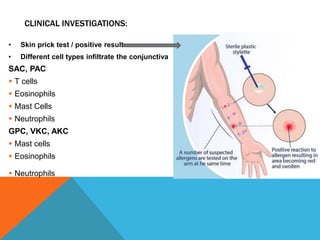
CLINICAL INVESTIGATIONS:
• Skin prick test / positive result
• Different cell types infiltrate the conjunctiva
SAC, PAC
 T cells
 Eosinophils
 Mast Cells
 Neutrophils
GPC, VKC, AKC
 Mast cells
 Eosinophils
 Neutrophils
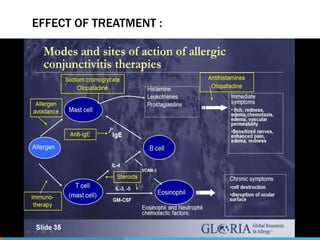
EFFECT OF TREATMENT :
THANK YOU FOR THE PATIENCE!!!

Allergic conjunctivitis

  • 1.
    SEMINAR OF OPHTHALMOLOGY Presentedby: Swornim Gyawali Roll no :25 MBBS 2010 batch Gandaki medical
  • 2.
    ALLERGIC CONJUNCTIVITIS: Types: 1. Simpleallergic conjunctivitis hay fever conjunctivitis seasonal allergic conjunctivitis (SAC) perennial allergic conjunctivitis(PAC) 2. Vernal keratoconjunctivitis (VKC) 3. Atopic keratoconjunctivitis (AKC) 4. Giant papillary conjunctivitis (GPC) 5. Phlyctenular keratoconjunctivitis (PKC) 6. Contact dermoconjunctivitis (CDC)
  • 3.
    SIMPLE ALLERGIC CONJUNCTIVITIS Mild,non specific IgE mediated Type I hypersensitivity reaction Etiology : Hay fever conjunctivitis : associated with allergic rhinitis Allergens : pollens , grass , animal dandruffs SAC: common , d/t: grass pollens PAC: not common , d/t: house dust and mites
  • 4.
    SAC PATHOLOGY: Vascular response:vasodilation increased vessel permeability exudation Cellular response: Conjunctival infiltration (eosinophil , plasma cells and mast cells ) and exudation producing histamine and histamine like substance Conjunctival response: boggy swelling , increase connective tissue formation and mild papillary hyperplasia
  • 5.
    Symptoms: itching burning sensationin the eye watery discharge and mild photophobia Signs : hyperemia and chemosis mild papillary reaction oedema of eyelids SAC
  • 6.
    MANAGEMENT : • Exposureto allergens should be reduced as far as possible • Cold compresses • Topical tear substitutes to flush out allergens medications: • vasoconstrictors • Mast cell stabilizer: sodium chromoglycate 2% [QID] • severe and non-responsive: steroids • Systemic antihistamines : Cetirizine 10 mg OD(acute with marked itching)
  • 7.
    VERNAL KERATOCONJUNCTIVITIS Recurrent ,bilateral , interstitial ,self limiting, Age : 4- 20 yrs , sex: boys> girls Season: Summer hence the name SPRING CATARRH Etiology : IgE mediated hypersensitivity reaction Personal family history of hay fever, eczema , asthma Peripheral blood shows : eosinophilia increased IgE
  • 8.
    VKC PATHOLOGY: Conjunctival epithelium: hyperplasia and downward projections into the sub epithelial tissue Adenoid layer : cellular infiltration by eosinophil's , plasma cells , lymphocytes and histiocytes . Fibrous layer : proliferation which later undergoes hyaline changes Conjunctival vessels: proliferation , increased permeability and vasodilation ALL THESE LEADS TO MULTIPLE PAPILLA FORMATION IN UPPER TARSAL CONJUNCTIVA
  • 9.
    VKC SYMPTOMS • Intenseitching & burning sensation • Lacrimation • Foreign body sensation • Photophobia, • Thick mucous discharge [ropy] 3 clinical form • palpebral • bulbar • mixed form
  • 10.
    PALPEBRAL FORM Diffuse papillaryhypertrophy, > on superior tarsus Papillae have a flat-topped polygonal appearance resembling COBBLESTONES Severe cases- Giant papillae, which may be coated with mucus
  • 11.
    LIMBAL / BULBARFORM May start as a thickening & opacification of limbus Limbal nodules - Mucoid nodules, which are gelatinous, elevated Horner-Trantas dots – composed mainly of eosinophils and epithelial debris (limbal apices)
  • 12.
    VERNAL KERATOPATHY /CORNEAL INVOLVEMENT Punctate epithelial erosions to macroerosions Shield ulcers – Oval ulceration with thickened, opaque edges
  • 13.
    Plaque formation –Occur when ulcer base becomes coated with desiccated mucus Results in – Subepithelial ring scarring Pseudogerontoxon – Arc like whitish peripheral corneal deposition ‘cupid’s bow’ outline in a inflamed segment of the limbus Clinical course : self limiting burns out spontaneously after 5 – 10 yrs
  • 14.
    TREATMENT Local: • Topical steroid: Every 4 hrs. for 2 days followed by 3-4 times a day for 2 weeks . MONITOR IOP TO PREVENT STEROID INDUCED GLAUCOMA • Mast cell stabilizers : sodium chromoglycate 2 % drops 4-5 times/day • Topical antihistamine • Acetyl cysteine (0.5%) • Topical cyclosporine (1%): severe unresponsive case
  • 15.
    SYSTEMIC : I. Oralantihistamine : for itching II. Oral steroid : short course for very severe non responsive case Treatment of large papilla supratarsal injection of long acting steroid or cryo application or surgical removal General measures: dark goggles , cold compress , change of place from hot to cold
  • 16.
    ATOPIC KERATOCONJUNCTIVITIS Adult equivalentof VKC Young atopic adults with male predominance May be associated with atopic dermatitis Symptoms ;itching , soreness , dry sensation , mucoid discharge , phtophobia or blurred vision Signs : lid margins: inflamed with round posterior borders tarsal : milky appearance , very fine papilla , hyperaemia scarring with shrinkage cornea-punctate epithelial keratitis in lower half, vascularization , plaque
  • 17.
    Treatment : • treatfacial eczema and lid margin disease • sodium chromoglycate • steroids and • tear drops
  • 18.
    GIANT PAPILLARY CONJUNCTIVITIS Conjunctivitiswith very large sized papilla Cause :allergic response to rough or deposited surface (contact lens , prosthesis, left out nylon suture ) Symptoms: itching , STRINGY DISCHARGE, reduced wearing time of contact lens or prosthetic shell Signs : papillary hypertrophy(1mm in diameter) of upper tarsus Treatment : • Removal of cause • disodium chromoglycate • Steroids not much use
  • 19.
    PHLYCTENULAR CONJUNCTIVITIS Characteristic nodularaffection (an allergic response) Conjunctival and corneal epithelium to some endogenous allergens to which they have become sensitized. Etiology: Delayed type hypersensitivity in response to endogenous microbial protein. Previously tuberculus protein ,now staphylococcus other allergens :Moraxella axenfield and certain parasites. Predisposing factors: age – ( 3 to 15 yrs. ) , sex : F>M , undernourished
  • 20.
    PATHOLOGY: 1. Stage ofnodule formation: Conjunctival infiltration and exudation peripherally lymphocyte and central PMN cells nodule formation (phylcten) necrosis of apex of nodule 2. Stage of ulceration: ulceration 3.Satge of granulation: floor of ulcer covered with granulation tissue 4 .Stage of healing : healing with minimal scar formation
  • 21.
    SYMPTOMS : Discomfort ineye MUCOPURULENT conjunctivitis d/t secondary infection Reflex watering Sign: 3 forms Simple Phlyctenular conjunctivitis: pinkish white nodule surrounded by hyperaemia on bulbar conjunctiva Necrotizing Phlyctenular conjunctivitis: large phlycten with necrosis & ulceration leading to severe pustular conjunctivitis. Miliary Phlyctenular conjunctivitis: multiple phlycten arranged haphazardly or ring form
  • 22.
    PHLYCTENULAR KERATITIS Secondary extensionof Conjunctival phlycten to cornea. Two forms : A. Ulcerative : • Sacrofulous: shallow marginal ulcer(phlycten break down),no space between limbus and ulcer heals without leaving opacity. • Fasicular: superficial, leaves parallel bundles of BV, band shaped superficial opacity • Miliary: multiple ulceration scattered over B. Diffuse infiltrative : central infiltration of cornea with rich peripheral vascularization around limbus
  • 23.
    MANAGEMENT OF PHLYCTENULARCONJUNCTIVITIS A. Local • Topical steroid • Antibiotic drops • Atropine 1% eye ointment B. Specific • Tuberculous infection ruled out • Septic focus treated • Parasitic infestation eradicated C. General Protein rich diet, vitamin A and vitamin D
  • 24.
    CONTACT DERMOCONJUNCTIVITIS Allergic d/o,involvement of conjunctiva & skin lid along with some facial area Etiology: delayed type hyper sensitivity response to prolong contact with chemicals and ophthalmic medicines( atropine, neomycin, soframycin) C/F: Cutaneous involvement: weeping eczema around the area involved with medication Conjunctival response: lower fornix and lower palpebral conjunctiva Treatment: hyperaemia, papillary response • Discontinuing of causative chemical or medications • Topical steroid eye drops • Steroid ointment in involved surrounding area
  • 25.
    CLINICAL INVESTIGATIONS: • Skinprick test / positive result • Different cell types infiltrate the conjunctiva SAC, PAC  T cells  Eosinophils  Mast Cells  Neutrophils GPC, VKC, AKC  Mast cells  Eosinophils  Neutrophils
  • 26.
  • 27.
    THANK YOU FORTHE PATIENCE!!!