CONJUNCTIVA
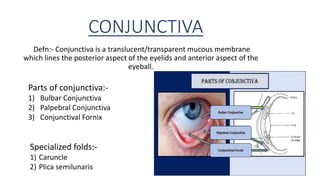
Defn:- Conjunctiva is a translucent/transparent mucous membrane
which lines the posterior aspect of the eyelids and anterior aspect of the
eyeball.
Parts of conjunctiva:-
1) Bulbar Conjunctiva
2) Palpebral Conjunctiva
3) Conjunctival Fornix
Specialized folds:-
1) Caruncle
2) Plica semilunaris
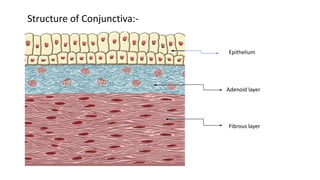
Structure of Conjunctiva:-
Epithelium
Adenoid layer
Fibrous layer
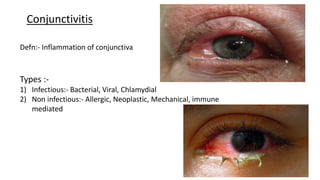
Conjunctivitis
Defn:- Inflammation of conjunctiva
Types :-
1) Infectious:- Bacterial, Viral, Chlamydial
2) Non infectious:- Allergic, Neoplastic, Mechanical, immune
mediated
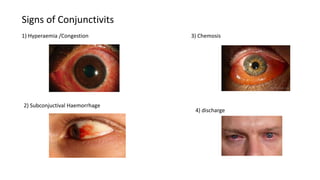
Signs of Conjunctivits
1) Hyperaemia /Congestion
2) Subconjuctival Haemorrhage
3) Chemosis
4) discharge
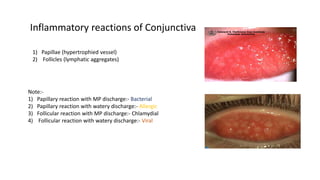
Inflammatory reactions of Conjunctiva
1) Papillae (hypertrophied vessel)
2) Follicles (lymphatic aggregates)
Note:-
1) Papillary reaction with MP discharge:- Bacterial
2) Papillary reaction with watery discharge:- Allergic
3) Follicular reaction with MP discharge:- Chlamydial
4) Follicular reaction with watery discharge:- Viral
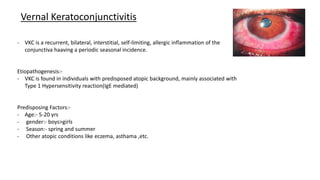
Vernal Keratoconjunctivitis
- VKC is a recurrent, bilateral, interstitial, self-limiting, allergic inflammation of the
conjunctiva haaving a periodic seasonal incidence.
Etiopathogenesis:-
- VKC is found in individuals with predisposed atopic background, mainly associated with
Type 1 Hypersensitivity reaction(IgE mediated)
Predisposing Factors:-
- Age:- 5-20 yrs
- gender:- boys>girls
- Season:- spring and summer
- Other atopic conditions like eczema, asthama ,etc.
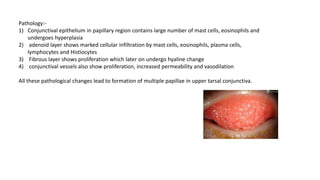
Pathology:-
1) Conjunctival epithelium in papillary region contains large number of mast cells, eosinophils and
undergoes hyperplasia
2) adenoid layer shows marked cellular infiltration by mast cells, eosinophils, plasma cells,
lymphocytes and Histiocytes
3) Fibrous layer shows proliferation which later on undergo hyaline change
4) conjunctival vessels also show proliferation, increased permeability and vasodilation
All these pathological changes lead to formation of multiple papillae in upper tarsal conjunctiva.
Symptoms:-
1) Marked burning and itching sensation
2) lacrimation
3) ropy discharge
4) heaviness of leads
5) Mild photophobia
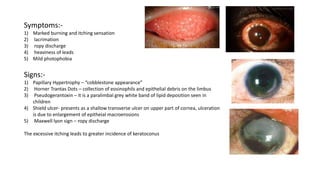
Signs:-
1) Papillary Hypertrophy – “cobblestone appearance”
2) Horner Trantas Dots – collection of eosinophils and epithelial debris on the limbus
3) Pseudogerantoxin – it is a paralimbal grey white band of lipid deposition seen in
children
4) Shield ulcer- presents as a shallow transverse ulcer on upper part of cornea, ulceration
is due to enlargement of epitheial macroerosions
5) Maxwell lyon sign – ropy discharge
The excessive itching leads to greater incidence of keratoconus
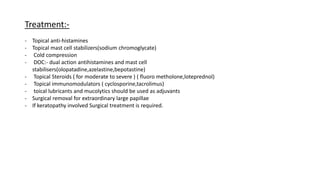
Treatment:-
- Topical anti-histamines
- Topical mast cell stabilizers(sodium chromoglycate)
- Cold compression
- DOC:- dual action antihistamines and mast cell
stabilisers(olopatadine,azelastine,bepotastine)
- Topical Steroids ( for moderate to severe ) ( fluoro metholone,loteprednol)
- Topical immunomodulators ( cyclosporine,tacrolimus)
- toical lubricants and mucolytics should be used as adjuvants
- Surgical removal for extraordinary large papillae
- If keratopathy involved Surgical treatment is required.

CONJUNCTIVA.pptx

  • 1.
    CONJUNCTIVA Defn:- Conjunctiva isa translucent/transparent mucous membrane which lines the posterior aspect of the eyelids and anterior aspect of the eyeball. Parts of conjunctiva:- 1) Bulbar Conjunctiva 2) Palpebral Conjunctiva 3) Conjunctival Fornix Specialized folds:- 1) Caruncle 2) Plica semilunaris
  • 2.
  • 3.
    Conjunctivitis Defn:- Inflammation ofconjunctiva Types :- 1) Infectious:- Bacterial, Viral, Chlamydial 2) Non infectious:- Allergic, Neoplastic, Mechanical, immune mediated
  • 4.
    Signs of Conjunctivits 1)Hyperaemia /Congestion 2) Subconjuctival Haemorrhage 3) Chemosis 4) discharge
  • 5.
    Inflammatory reactions ofConjunctiva 1) Papillae (hypertrophied vessel) 2) Follicles (lymphatic aggregates) Note:- 1) Papillary reaction with MP discharge:- Bacterial 2) Papillary reaction with watery discharge:- Allergic 3) Follicular reaction with MP discharge:- Chlamydial 4) Follicular reaction with watery discharge:- Viral
  • 6.
    Vernal Keratoconjunctivitis - VKCis a recurrent, bilateral, interstitial, self-limiting, allergic inflammation of the conjunctiva haaving a periodic seasonal incidence. Etiopathogenesis:- - VKC is found in individuals with predisposed atopic background, mainly associated with Type 1 Hypersensitivity reaction(IgE mediated) Predisposing Factors:- - Age:- 5-20 yrs - gender:- boys>girls - Season:- spring and summer - Other atopic conditions like eczema, asthama ,etc.
  • 7.
    Pathology:- 1) Conjunctival epitheliumin papillary region contains large number of mast cells, eosinophils and undergoes hyperplasia 2) adenoid layer shows marked cellular infiltration by mast cells, eosinophils, plasma cells, lymphocytes and Histiocytes 3) Fibrous layer shows proliferation which later on undergo hyaline change 4) conjunctival vessels also show proliferation, increased permeability and vasodilation All these pathological changes lead to formation of multiple papillae in upper tarsal conjunctiva.
  • 8.
    Symptoms:- 1) Marked burningand itching sensation 2) lacrimation 3) ropy discharge 4) heaviness of leads 5) Mild photophobia Signs:- 1) Papillary Hypertrophy – “cobblestone appearance” 2) Horner Trantas Dots – collection of eosinophils and epithelial debris on the limbus 3) Pseudogerantoxin – it is a paralimbal grey white band of lipid deposition seen in children 4) Shield ulcer- presents as a shallow transverse ulcer on upper part of cornea, ulceration is due to enlargement of epitheial macroerosions 5) Maxwell lyon sign – ropy discharge The excessive itching leads to greater incidence of keratoconus
  • 9.
    Treatment:- - Topical anti-histamines -Topical mast cell stabilizers(sodium chromoglycate) - Cold compression - DOC:- dual action antihistamines and mast cell stabilisers(olopatadine,azelastine,bepotastine) - Topical Steroids ( for moderate to severe ) ( fluoro metholone,loteprednol) - Topical immunomodulators ( cyclosporine,tacrolimus) - toical lubricants and mucolytics should be used as adjuvants - Surgical removal for extraordinary large papillae - If keratopathy involved Surgical treatment is required.