Amblyopia
Surendra sah
2nd
January, 2015
BHUBANESWAR
BHUBANESWAR
Definition
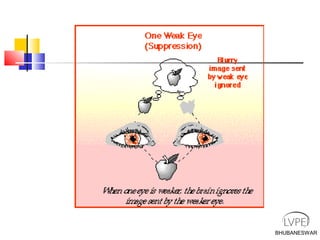
 Amblyopia means “Dullness of vision”
(Ambly = dull + ops = vision)
 A condition of visual acuity not correctable
by refractive means and not attributable to
obvious structural and/or pathological
ocular anomalies
BHUBANESWAR
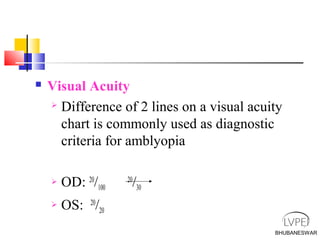
 Visual Acuity
 Difference of 2 lines on a visual acuity
chart is commonly used as diagnostic
criteria for amblyopia
 OD: 20
/100
20
/30
 OS: 20
/20
BHUBANESWAR
BHUBANESWAR
BHUBANESWAR
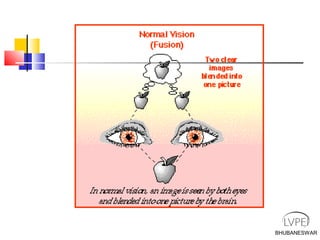
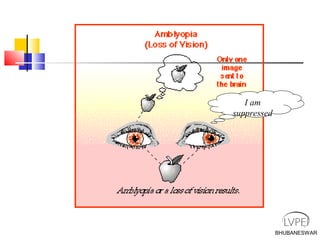
I am
suppressed
BHUBANESWAR
Classifications
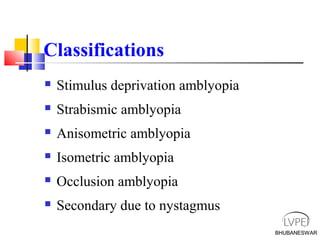
 Stimulus deprivation amblyopia
 Strabismic amblyopia
 Anisometric amblyopia
 Isometric amblyopia
 Occlusion amblyopia
 Secondary due to nystagmus
BHUBANESWAR
BHUBANESWAR
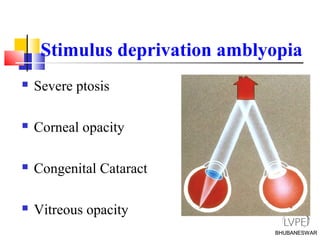
Stimulus deprivation amblyopia
 Severe ptosis
 Corneal opacity
 Congenital Cataract
 Vitreous opacity
BHUBANESWAR
BHUBANESWAR
Strabismic amblyopia
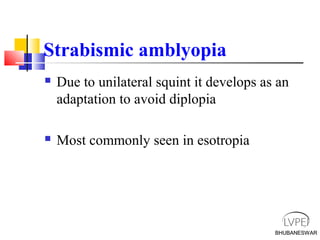
 Due to unilateral squint it develops as an
adaptation to avoid diplopia
 Most commonly seen in esotropia
BHUBANESWAR
BHUBANESWAR
Clinical tests for Strabismic
amblyopia
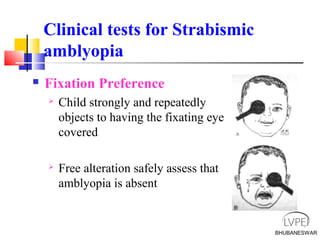
 Fixation Preference
 Child strongly and repeatedly
objects to having the fixating eye
covered
 Free alteration safely assess that
amblyopia is absent
BHUBANESWAR
Anisometric amblyopia
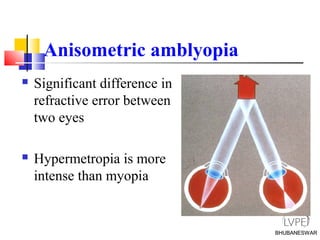
 Significant difference in
refractive error between
two eyes
 Hypermetropia is more
intense than myopia
BHUBANESWAR
BHUBANESWAR
Isometric amblyopia
 Secondary to approximately equal high
refractive errors in both eyes
 Hypermetropia is more intense than myopia
BHUBANESWAR
BHUBANESWAR
Occlusion amblyopia
 Prolonged occlusion therapy of
preferred eye
BHUBANESWAR
BHUBANESWAR
Secondary to Nystagmus
 Latent or manifest nystagmus may decrease
vision
 In micronystagmus horizontal oscillation of
the eye is present
BHUBANESWAR
Clinical Features
 Visual acuity decreased
 Crowding phenomenon
 Decreased contrast sensitivity
 Decreased accommodation
 Decreased visual field
BHUBANESWAR
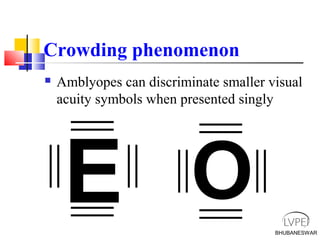
Crowding phenomenon
 Amblyopes can discriminate smaller visual
acuity symbols when presented singly
E O
BHUBANESWAR
Investigations
 History
 Visual acuity testing
 Fixation evaluation
 Perfect refraction
 Eye disease evaluation
 Visual field testing
 Neutral density filter
 Test of retinal function
BHUBANESWAR
BHUBANESWAR
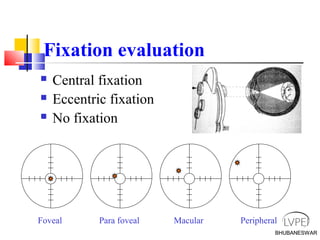
Fixation evaluation
 Central fixation
 Eccentric fixation
 No fixation
Foveal Para foveal Macular Peripheral
BHUBANESWAR
BHUBANESWAR
Neutral Density Filter
 Reduce vision in eyes with central retinal
lesions and glaucoma
 Kodak Wratten Filter No.96
BHUBANESWAR
Amblyopia Therapy
BHUBANESWAR
BHUBANESWAR
Amblyopia Therapy
1. Removal of ocular pathology
2. Full refractive correction
3. Occlusion therapy / Penalization therapy
4. CAM vision stimulator
BHUBANESWAR
BHUBANESWAR
Cont………
5. Auxiliary therapy for eccentric fixation
6. Prescription of appropriate maintenance
programme
7. Periodic visit
BHUBANESWAR
BHUBANESWAR
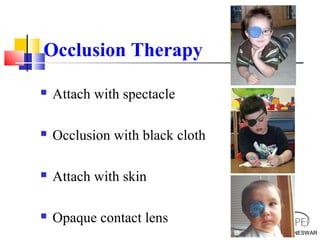
Occlusion Therapy
BHUBANESWAR
 Attach with spectacle
 Occlusion with black cloth
 Attach with skin
 Opaque contact lens
BHUBANESWAR
Types
 According the area of visual field occluded
 According which eye occluded
 According the effect of light transmission
 According the occlusion time
BHUBANESWAR
BHUBANESWAR
 Degree of amblyopia
 Age of the patient
Required time
BHUBANESWAR
Maintenance therapy
 Patching for 1-3 hours per day
 Penalization with atropine 1 or 2 day per
week.
 This may require periodic monitoring until
age 8-10 years
BHUBANESWAR
Risk of Occlusion Therapy
 Full time occlusion requires close
monitoring, especially in the younger child
 The first follow up visit after initial
treatment should occur within 1 week
 Part time occlusion method allows for less
frequent observation
BHUBANESWAR
Reality
 Poor cooperation
 Underlying organic defect
 Started too late
 Grossly unequal eyes (unilateral high myopia -
unilateral aphakia)
 Latent nystagmus
BHUBANESWAR
Children with sensitive skin
 Tincture of benzoin is applied before
occlusion
BHUBANESWAR
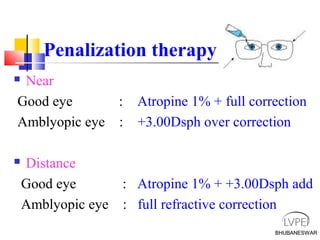
Penalization therapy
 Near
Good eye : Atropine 1% + full correction
Amblyopic eye : +3.00Dsph over correction
 Distance
Good eye : Atropine 1% + +3.00Dsph add
Amblyopic eye : full refractive correction
BHUBANESWAR
BHUBANESWAR
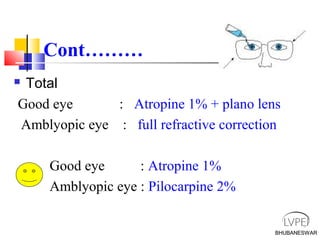
Cont………
 Total
Good eye : Atropine 1% + plano lens
Amblyopic eye : full refractive correction
Good eye : Atropine 1%
Amblyopic eye : Pilocarpine 2%
BHUBANESWAR
BHUBANESWAR
CAM Vision Stimulator
 Campbell and coworkers in 1978
 Stimulation by slowly rotating high
contrast, square wave grating for 7 min.
BHUBANESWARBHUBANESWAR
Auxiliary therapy for eccentric
fixation
 Pleoptics
 Inverse prism therapy
 Red filter therapy
BHUBANESWAR
Pleoptics
 Patch amblyopic eye for 1-2 months
 Bangerter’s method
 Pleoptophore
-Bleaching phase
-Stimulating phase
 Cupper’s method
 Ethyscope
BHUBANESWAR
Inverse prism therapy
 Occlude the normal eye totally
 Place an inverse prism before
amblyopic eye
 Shifts the principal visual direction to the
fovea
BHUBANESWAR
Red filter therapy
 Occlude the normal eye totally
 Kodak Wratten Filter No. 92 (640nm) is
placed before amblyopic eye
BHUBANESWAR
Thank
you…

Amblyopia by surendra