Ancient Irrigation
Systems
& Practices of Sri Lanka
1
Content
Objective
Introduction
History
Evolution
Irrigation water supply system
Water tank
Best example
Recommendation
2
Objectives
• Having a clear about what is the ancient irrigation
systems and the purpose of having that systems.
• Getting a clear idea about the techniques and
methodologies that they have used to build up
irrigation systems.
• Identify the types of irrigation systems.
• Identify present condition of these irrigation
systems.
3
Introduction
• Irrigation can be refer as, the application of controlled
amounts of water to plants at needed intervals.
• In the early settlements of the dry zone in Sri Lanka
irrigation played a vital role to Aryan Sinhalese
civilization.
• Specially without having artificial storage of water
human existence in North Central province would have
been impossible.
History
• Sri Lanka was excellent for agriculture, but enough
water to their cultivation was the main problem.
• According factors the irrigation method were born.
(Reservoirs ,tanks ,canals and lakes )
• As the result in the dry zone raised 2 main complex
irrigation systems. As,
- Tank based systems
- Cannel based system
5
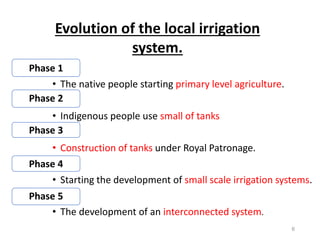
• The native people starting primary level agriculture.
• Indigenous people use small of tanks
• Construction of tanks under Royal Patronage.
• Starting the development of small scale irrigation systems.
• The development of an interconnected system.
Phase 1
Phase 2
Phase 3
Phase 4
Phase 5
Evolution of the local irrigation
system.
6
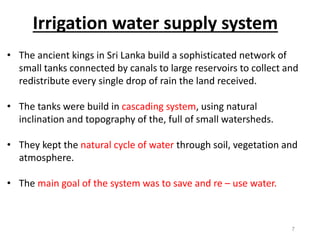
• The ancient kings in Sri Lanka build a sophisticated network of
small tanks connected by canals to large reservoirs to collect and
redistribute every single drop of rain the land received.
• The tanks were build in cascading system, using natural
inclination and topography of the, full of small watersheds.
• They kept the natural cycle of water through soil, vegetation and
atmosphere.
• The main goal of the system was to save and re – use water.
Irrigation water supply system
7
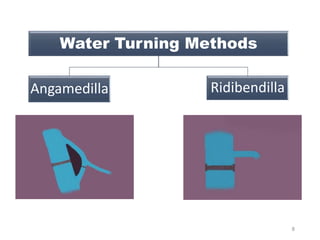
Water Turning Methods
Angamedilla Ridibendilla
8
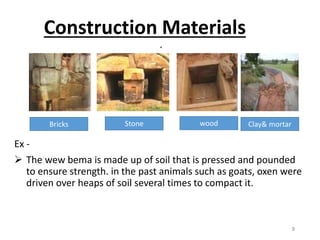
Construction Materials
Ex -
 The wew bema is made up of soil that is pressed and pounded
to ensure strength. in the past animals such as goats, oxen were
driven over heaps of soil several times to compact it.
*
Bricks Stone wood Clay& mortar
9
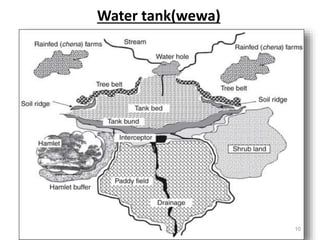
Water tank(wewa)
10
Major Parts of a wewa
• Tank Bund(Veaw Bamma)
Holds water inside the tank.
• Sluice Gates (Sorowwa)
constructed to release water into paddy fields
• Surplus Weir (Pitavana)
protect the tank bund from damage during heavy
rainfall by discharging excess water
• Stone Liner (Ralapanava)
granite stone liner constructed on the inside of the
tank bund to prevent it from being eroded by the water
current
• Diyakata Pahana
measured water level of the Vewa
11
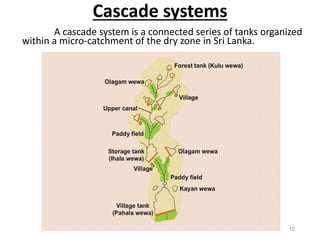
Cascade systems
A cascade system is a connected series of tanks organized
within a micro-catchment of the dry zone in Sri Lanka.
12
Village tank (Maha Wewa/Pahala Wewa)
• Main component of the tank cascade system. Water from all other tanks in the
system drain into the village tank. This tank is used for agriculture, as well as
other community activities.
Kulu Wewa (Forest tank)
• Constructed in the upper catchment of the village in order to provide water for
wild animals, filter debris and silt, and capture the rainwater that will enter
into the village tank through seepage.
Kayan Wewa
• Built where the upper catchment has been cleared or degraded. It is used to
trap sediment and controls salinity.
Olagam Wewa
• Lies close to the village, but is not associated with a permanent settlement or
cultivation. It is used as a source of water for seasonal cultivation.
Different components in a
cascade system
13
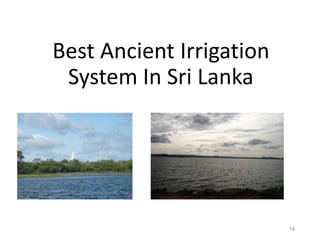
Best Ancient Irrigation
System In Sri Lanka
14
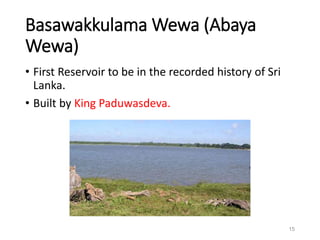
Basawakkulama Wewa (Abaya
Wewa)
• First Reservoir to be in the recorded history of Sri
Lanka.
• Built by King Paduwasdeva.
15
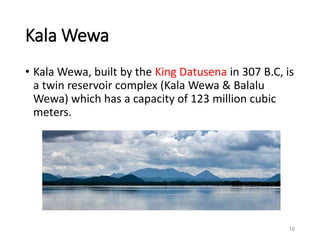
Kala Wewa
• Kala Wewa, built by the King Datusena in 307 B.C, is
a twin reservoir complex (Kala Wewa & Balalu
Wewa) which has a capacity of 123 million cubic
meters.
16
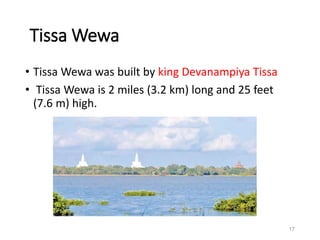
Tissa Wewa
• Tissa Wewa was built by king Devanampiya Tissa
• Tissa Wewa is 2 miles (3.2 km) long and 25 feet
(7.6 m) high.
17
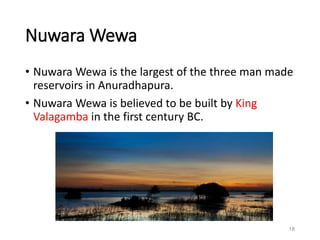
Nuwara Wewa
• Nuwara Wewa is the largest of the three man made
reservoirs in Anuradhapura.
• Nuwara Wewa is believed to be built by King
Valagamba in the first century BC.
18
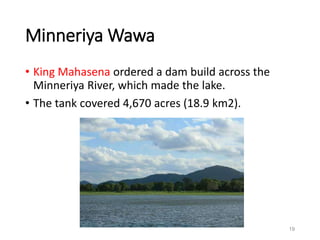
Minneriya Wawa
• King Mahasena ordered a dam build across the
Minneriya River, which made the lake.
• The tank covered 4,670 acres (18.9 km2).
19
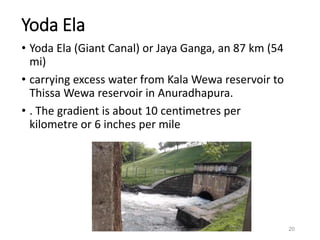
Yoda Ela
• Yoda Ela (Giant Canal) or Jaya Ganga, an 87 km (54
mi)
• carrying excess water from Kala Wewa reservoir to
Thissa Wewa reservoir in Anuradhapura.
• . The gradient is about 10 centimetres per
kilometre or 6 inches per mile
20
• Ancient rulers ruled the country by controlling the supply
of water, which was essentially the life blood of all life
sustaining agricultural activities.
• The local irrigation system, which took thousands of years
to evolve into the advanced state it was at its peak, is now
falling apart.
Recommendation
21
22

Ancient irrigation system

  • 1.
  • 2.
  • 3.
    Objectives • Having aclear about what is the ancient irrigation systems and the purpose of having that systems. • Getting a clear idea about the techniques and methodologies that they have used to build up irrigation systems. • Identify the types of irrigation systems. • Identify present condition of these irrigation systems. 3
  • 4.
    Introduction • Irrigation canbe refer as, the application of controlled amounts of water to plants at needed intervals. • In the early settlements of the dry zone in Sri Lanka irrigation played a vital role to Aryan Sinhalese civilization. • Specially without having artificial storage of water human existence in North Central province would have been impossible.
  • 5.
    History • Sri Lankawas excellent for agriculture, but enough water to their cultivation was the main problem. • According factors the irrigation method were born. (Reservoirs ,tanks ,canals and lakes ) • As the result in the dry zone raised 2 main complex irrigation systems. As, - Tank based systems - Cannel based system 5
  • 6.
    • The nativepeople starting primary level agriculture. • Indigenous people use small of tanks • Construction of tanks under Royal Patronage. • Starting the development of small scale irrigation systems. • The development of an interconnected system. Phase 1 Phase 2 Phase 3 Phase 4 Phase 5 Evolution of the local irrigation system. 6
  • 7.
    • The ancientkings in Sri Lanka build a sophisticated network of small tanks connected by canals to large reservoirs to collect and redistribute every single drop of rain the land received. • The tanks were build in cascading system, using natural inclination and topography of the, full of small watersheds. • They kept the natural cycle of water through soil, vegetation and atmosphere. • The main goal of the system was to save and re – use water. Irrigation water supply system 7
  • 8.
  • 9.
    Construction Materials Ex - The wew bema is made up of soil that is pressed and pounded to ensure strength. in the past animals such as goats, oxen were driven over heaps of soil several times to compact it. * Bricks Stone wood Clay& mortar 9
  • 10.
  • 11.
    Major Parts ofa wewa • Tank Bund(Veaw Bamma) Holds water inside the tank. • Sluice Gates (Sorowwa) constructed to release water into paddy fields • Surplus Weir (Pitavana) protect the tank bund from damage during heavy rainfall by discharging excess water • Stone Liner (Ralapanava) granite stone liner constructed on the inside of the tank bund to prevent it from being eroded by the water current • Diyakata Pahana measured water level of the Vewa 11
  • 12.
    Cascade systems A cascadesystem is a connected series of tanks organized within a micro-catchment of the dry zone in Sri Lanka. 12
  • 13.
    Village tank (MahaWewa/Pahala Wewa) • Main component of the tank cascade system. Water from all other tanks in the system drain into the village tank. This tank is used for agriculture, as well as other community activities. Kulu Wewa (Forest tank) • Constructed in the upper catchment of the village in order to provide water for wild animals, filter debris and silt, and capture the rainwater that will enter into the village tank through seepage. Kayan Wewa • Built where the upper catchment has been cleared or degraded. It is used to trap sediment and controls salinity. Olagam Wewa • Lies close to the village, but is not associated with a permanent settlement or cultivation. It is used as a source of water for seasonal cultivation. Different components in a cascade system 13
  • 14.
  • 15.
    Basawakkulama Wewa (Abaya Wewa) •First Reservoir to be in the recorded history of Sri Lanka. • Built by King Paduwasdeva. 15
  • 16.
    Kala Wewa • KalaWewa, built by the King Datusena in 307 B.C, is a twin reservoir complex (Kala Wewa & Balalu Wewa) which has a capacity of 123 million cubic meters. 16
  • 17.
    Tissa Wewa • TissaWewa was built by king Devanampiya Tissa • Tissa Wewa is 2 miles (3.2 km) long and 25 feet (7.6 m) high. 17
  • 18.
    Nuwara Wewa • NuwaraWewa is the largest of the three man made reservoirs in Anuradhapura. • Nuwara Wewa is believed to be built by King Valagamba in the first century BC. 18
  • 19.
    Minneriya Wawa • KingMahasena ordered a dam build across the Minneriya River, which made the lake. • The tank covered 4,670 acres (18.9 km2). 19
  • 20.
    Yoda Ela • YodaEla (Giant Canal) or Jaya Ganga, an 87 km (54 mi) • carrying excess water from Kala Wewa reservoir to Thissa Wewa reservoir in Anuradhapura. • . The gradient is about 10 centimetres per kilometre or 6 inches per mile 20
  • 21.
    • Ancient rulersruled the country by controlling the supply of water, which was essentially the life blood of all life sustaining agricultural activities. • The local irrigation system, which took thousands of years to evolve into the advanced state it was at its peak, is now falling apart. Recommendation 21
  • 22.