Dr Sujaya Raghavendra
Systolic murmurs
Definition
 Prolonged vibration due to disturbance in blood
flow that manifests as turbulence.
 Site of maximum intensity generally corresponds
to the site of turbulence.
Areas of auscultation
Cardiac cycle
 It is produced due to:
1. Due to increased blood flow from a normal or
abnormal orifice
2. Through a narrowed orifice to a dilated chamber
3. Backflow flow through an incompetent valve
Mechanism of murmur
 Due to turbulent blood flow
 It arises when the Reynolds number reaches > 2000
i.e
1.when blood flow velocity is high
2.orifice (vessel/chamber) diameter is small
3. Kinetic viscosity is low
 Reynold number = flow / [2 (diameter) x kinetic velocity]
Consequence of turbulence
 Vortex shedding: as the blood flow passes the
narrow orifice , vortices produced at the tip of the
orifice are shed laterally to hit the vessel wall
producing vibrations and thereby a high pitched
murmur
 Jet impact: a jet turbulent flow hit wall of heart or
blood vessel
 Cavitations : a high turbulent flow producing
theoretically micro – bubbles that generate a
sound of different frequencies – harsh murmur
 Eddies : a high velocity jet of blood produces
currents in the adjacent slow moving blood .
These eddies cause vibrations transmitted to the
soft tissue and skin surface, resulting in murmur
 Periodic wake phenomena : as blood passes to
either side of a structure a periodic wake
phenomena arises , producing relatively pure
musical tones .
 Flitter: A high speed jet of blood in a blood vessel
may pull the wall of blood vessel inward by
“Bernoulli effect” ,which causes vibrations in the
vessel wall hence generating a murmur .
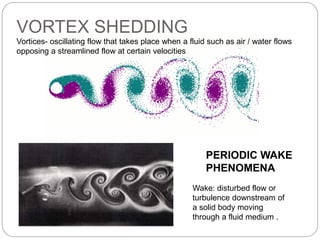
VORTEX SHEDDING
PERIODIC WAKE
PHENOMENA
Vortices- oscillating flow that takes place when a fluid such as air / water flows
opposing a streamlined flow at certain velocities
Wake: disturbed flow or
turbulence downstream of
a solid body moving
through a fluid medium .
Characteristics of murmur
 Timing in relation to heart sounds
 Location
 Duration or length
 Intensity
 Frequency or pitch
 Configuration or shape
 Transmission of murmur
 Dynamic auscultation
Timing
 Systolic murmurs : murmur begins with or after
S1 and ends or before S2
 Diastolic murmurs begin with or after S2 and ends
before the subsequent S1
 Continuous murmur: begins in systole and
continues without interruption through S2 into all
or a part of diastole
 Further can be classified as early ,mid, late and
pan (holo)
LOCATION
 Murmurs at the apex
ONLY AT APEX BEST HEARD
SOMEWHERE
ELSE BUT ALSO
HEARD AT APEX
NOT HEARD AT
APEX
Systolic murmur
of MR
ESM of AS Murmurs of right
sided origin (but
can be heard when
RV forms the apex
ESM of calcified
AS in elderly
patients with
emphysema
(loss of jet effect)
Pansystolic
murmur of TR ,
VSD
ESM of PS
MDM of MS MDM of TS EDM of PR
Functional MDM of
MR
Murmurs at tricuspid area
AT TRICUSPID AREA
ONLY
BEST HEARD
SOMEWHERE ELSE
BUT ALSO HEARD
AT TRICUSPID AREA
NOT HEARD AT
TRICUSPID AREA
Systolic murmur of
TR
PSM of MR and VSD MDM of MS
MDM of TS ESM of AS and PS
Murmurs at left sternal border of 3rd
intercostal space
ONLY AT LSB BEST HEARD
ELSEWHERE BUT
ALSO ALONG LSB
NEVER HEARD
PSM of VSD ESM of valvular
PS,and TR
MDM of MS
ESM of infundibular
PS
EDM of AR
Murmurs at Pulmonary area
BEST HEARD BEST HEARD
ELSEWHERE BUT
ALSO ALONG PA
NEVER HEARD
ESM of PS AS MDM of MS and TS
Flow murmur of
pulmonary origin in
ASD
VSD
Continuous murmur of
PDA
MR,AR
Murmur of sub
pulmonary VSD
Murmurs at Aortic area
BEST HEARD RARELY HEARD: ESM of PS
ESM of AS(valvular, subvalvular ),
aortic sclerosis
Never heard : MDM OF MS
EDM of AR
Duration /length of murmur
 Short , long or holo
 Duration of pressure gradient between the two sites
or chambers
 reflects the severity of the lesion.(true for stenotic
lesions like MS,AS,PS)
 Regurgitant murmurs(PSM) are longer than stenotic
lesions and the length is not related to severity of the
lesion (MR ,VSD, TR) as the very prsence of these
lesions produce the murmur
 In aortic regurgiation length of the murmur better
correlates than MR in severity but is not reliable
Grading(Freeman & Levine
1933)
Grade of murmur Basis
Grade 1 Faint murmur heard on careful
auscultation
Grade 2 Easily audible not loud
Grade 3 Easily audible loud murmur but no
thrill
Grade 4 Murmur with thrill
Grade 5
Grade 6
Murmur audible stethoscope audible
to chest
Murmur audible half an inch from
the chest.
Associated with thrill.
GRADE 3/6 or more intensity of systolic murmur is clinically significant
with few exceptions but diastolic murmur of any degree of intensity is
organic in nature .
Factors affecting intensity of murmur
 Quantity and velocity of blood flow across the
sound producing area i.e degree of turbulence
1.high output states , murmurs are
accentuated while in hypo dynamic states
intensity decreases
2. high velocity of blood flow through a small
VSD produces loud murmur, whereas a large
flow at low velocity through an ASD produces no
murmur
 Accentuated in thin individuals
 Obesity, pericardial or pleural effusion
emphysema will reduce the intensity.
Functional murmurs and thrills
SITE THRILL Organic
LESION
CAUSE
Apex Diastolic MS Severe MR
Carotids Systolic Aortic stenosis Severe AR
Pulmonary area Diastolic PR Severe PAH
Pulmonary area Systolic PS Moderate to
large ASD
Neck veins Continuous Mimicking PDA
/AV fistula
Cervical venous
hum
Character and frequency
 Directly related to velocity of blood flow
 High pressure gradient – high pitched (soft in AR
blowing in MR, musical in papillary muscle
rupture
 Low pressure gradient – low pitched (rough –
MS)
 Mixed frequency – harsh in ASD,VSD, PS,
transmission seen
Configuration or shape of
murmur
 Related to the pattern of blood flow velocity
 Help in identification of the lesion
1. Crescendo (increasing) – ESM of AS
2. Decrescendo (decreasing)-EDM of AR
3. crescendo- decrescendo – (diamond
shaped )- systolic murmur of AS and PS
4. Plateau- (even or unchanged)- PSM of
MR
Transmission of murmurs
 Conduction occurs when there is direct
anatomical continuity is present – systolic murmur
of AS to carotids , PSM of MR to left axilla or
back.
 loud murmurs transmit widely whereas soft
murmurs are confined to their area of origin
 High frequency murmur or sound transmits
proximally to its origin while low frequency goes
distally.
 Low frequency murmur transmits better through
the thorax and can be felt as thrill as compared to
high frequency murmur.
 Table
Systolic murmurs
 Classified into two basic categories :
1. Ejection mid systolic murmur
2. Regurgitant murmur
Systolic ejection murmurs – forward flow across the
LV or RF out flow tract.
Systolic regurgitant murmurs – retrograde flow from
a high pressure cardiac chamber to a low
pressure cardiac chamber
Ejection systolic murmurs
 It begins shortly after the pressure in RV or LV
exceeds the aortic or pulmonic diastolic pressure
sufficiently to open the aortic or pulmonic valve
 There is a delay between the s1, which occurs
after AV pressure cross over and the beginning of
the murmur.
 The murmur is a crescendo- decresendo type
(diamond shaped or spindle shaped in
configuration).
 Intensity of the murmur is proportional to the rate of
ventricular ejection
 The shape depends on the instantaneous flow
velocity during the ejections
 Flow characteristics of normal RV ejections are of
rounded contour
 As early ejection rates are not high and flow curve
peaks are late( ASD , straight back syndrome )
 If LV or RV obstruction is severe systole is prolonged
and the closure sound of the semilunar valve is
delayed.
Innocent murmur
 Systolic ejection in nature
 Without the evidence of physiologic or structural
abnormalities in CVS
 Grade < 3/6
 No radiation to carotids or axilla
 Flow across the normal LVOT/RVOT
 30-50% childeren
Still s murmur
 Young children 3-8 years , disappears by puberty
 flow across normal LVOT
 Related to small ascending aorta diameter with a
concomitant high aortic blood flow velocity
 Short medium frequency murmur
 Croaking or buzzing in character
 Best heard : left sternal border at the 3rd or 4th
ICS.
Innocent Pulmonary murmur
 Common in children , adolescents, and young
adults .
 Flow across RVOT
 low to medium frequency
 mid systolic
 Blowing character
 Best heard: PA with radiation to left sternal border
LVOT obstruction
 Causes
valvular supravalvular subvalvular
rheumatic Hour glass type HOCM
Bicuspid/unicuspid
valve
Diffuse type Discrete
membranous
Acommissural/unic
omissural with
eccentric opening
Aortic dissection Tunnel type
Myxoid dysplasia Healing
aortotomy site
hyperlipidemia Rubella
Fabry s disease
Calcific
degenerative
Features of aortic stenosis
murmur
Site of best audibilty Aortic area (second right ICS )
rt sternal border , apex
conducted to the neck vessels (rt
carotid)
Timing Ejection systolic
Grade Usually 3/6
Length of murmur Short , medium or long
Relation to physiological act Does not increase on inspiration
Decrease on standing and valsalva
character harsh
Accompanying features Slow rising arterial pulse
Sustained left ventricular impulse
S4, ejection click
Symptoms of angina , syncope and
dyspnoea
Site of best audibilty/selective
conduction
significance
Best audible at Right second space
conducted to carotid
Valvular non calcific AS, congenital
bicuspid AS (withsystolic ejection
sound)
Best audible at left sternal border ,
no conduction
Subvalvular AS(fixed or dynamic)
Calcific AS
Mistaken VSD/MR
Carotid murmur with/without right
second space murmur
Supravalvular AS(elfien facies)
Carotid stenosis
Audible only at apex Calcific AS in elderly with
emphysema
Mistaken as MR(not radiated to
axilla )
Length of the murmur
 Longer the murmur and later in systole peaks ,
more the severity of AS
 Duration is the reflection of the pressure
difference across the valve
 Any change in the cardiac output makes the
severity of the lesion unreliable
 Overestimation can be made in high output states
like anemia, thyrotoxicosis , pregnancy
associated AR ,PDA anxiety
Condition Mechanism
CCF Low cardiac output
Polycythemia Increased viscosity of blood
Associated with proximal obstruction MS,TS, low CO
Associated with proximal
regurgitation or shunt
MR,VSD
Associated with SHT/coarctation Obliteration of gradient
CAD/MI/
Hypothyroidism
Elderly female
AF
Low cardiac output
UNDER ESTIMATION OF THE
MURMUR
Gallavardin phenomena
 Elderly patient with aortic sclerosis/AS due to fibro calcific changes have
gallavardin dissociation
Two distinct mid diastolic murmurs are heard –
 A noisy medium pitched murmur at the right second space(due to turbulence
caused by the high velocity jet within aortic root)
 A high frequency musical murmur at the apex (due to periodic wake
phenomena caused by high frequency vibrations of the fibrocalcific aortic
cusps
 Simulates murmur of MR but without radiation to the axilla or back or is
accentuated with slowing of heart rate such as a compensatory pause or pre
mature beat
Relationship with physiological
act
maneuver Fixed obstruction (AS) Dynamic obstruction
(HOCM)
Respiration No change Increase with expiration
Standing decrease increase
valsalva decrease increase
Squatting increases decreases
•HOCM is associated with pulsus bisfirens with double or triple apex
•A2 is of normal intensity and S2 maybe single or reversed split
•Usually doesnot exceed grade 3 intensity
•Murmur decreases with increase in preload or afterload(squatting,
passive leg raising vasopressors) or reduce contractility(B blockers
) and increases with inotropic administration
•Best heard : apex & lower left sternal edge.
FEATURE Aortic valve sclerosis AS
murmur Short medium pitched Long/rough
AR Absent Maybe present
A2 Normal /increased Diminished or absent
S2 Normal split Single / reversed split
LVH absent present
S4 Absent Maybe present
Calcification rare Maybe present
Arterial pulse Normal Slow rising
Other features
 The slow rising and sustained pulse (pulsus
parvus et tardus ) Is accompanied with a long
ejection systolic murmur and a delayed peak
 Normal arterial pulse is consistent with a short
ejection murmur with early peak
 Arterial pulse is normal + long ejection
murmur- likely to be MR(along with S3)/VSD
 long ejection murmur+ S4- fixed obstruction (AS)
 Short murmur or no murmur(decreased
ventricular compliance) + S4- Dynamic
obstruction –HOCM .
 Ejection click(mobile non calcific valve - PS>AS
AR with AS
 Fixed valvular or subvalvular obstruction is likely
 The accompanying systolic murmur is likely due
to AS or VSD and not due to PS
 A “new murmur” of AR in AS may mean infective
endocarditis in a febrile patient with AS.
Summary
Valvular PS
 Congenital or acquired usually with intact
ventricular septum
 Best heard: left 2nd- 3rd ICS , (conducted to the
left supraclavicular and left side of the neck
 Begins with systolic ejection sound (accentuates
with expiration) , severe PS the ejection sound
fuses with S1 and S4.
 Early peaking with a short duration or a late
peaking with prolonged duration- severity of
obstruction
 P2 soft
 S2 split widens – increasing severity of stenosis
 Prominent a waves in JVP, left parasternal heave,
And RV S4 which increases with inspiration
 Associated with PR in dysplastic pulmonary
valve(Noonan s syndrome) or with IE
 Hypertelorism and moon facies
 It increases with inspiration
 Decreases on standing , valsalva
 Grade 4/6
Infundibular PS
 Associated with TOF
 Best heard – 3rd left ICS
 Shorter as severity of obstruction increases
 Ejection click can be there
 Shortens and decreases in intensity with amyl
nitrate inhalation
 P2 absent
Supravalvular PS
 Maybe associated with supravalvular AS
 Best heard: upper left sternal border,
infraclavicular region and laterally
 Murmur is Less harsh high pitched with varying
intensity.
 On branched PA stenosis : murmur is heard more
laterally with transmission to right chest , back
and both axillae. Can become continuous with
increased severity
Functional murmurs
Due to
dilatation of
aortic root
Dilatation of
pulmonary
artery
Due to
increased flow
into aorta
Due to
increased flow
into the PA
Sclerotic aorta in
elderly
Idiopathic PA
dilatation
Pregnancy ASD
Dilated PA
secondary to
PAH
Anemia VSD
Thyrotoxicosis straight back
syndrome and
pectus
excavatum
Fever
Peripheral A-V
Fistula
Regurgitant
murmurs
Early systolic murmur
 High pitch
 Decrescendo
 Begin at S1 and end well before S2 , mid systole
 Regurgitant murmurs flow from high pressure
chamber to low pressure cardiac chamber.
 Acute severe MR(associated with exp. Split S2)
 TR(with normal RV systolic pressure)
 Small VSD or non restrictive VSD with PAH
Regurgitant or holosystolic or
Pansystolic murmur
 High pitched
 Blowing in quality
 Produced by retrograde flow from high chamber to
low chamber .
 Begins with S1 occupies whole of systole and ends
with S2 at its origin
Causes
 Chronic MR
 Chronic TR
 Restrictive VSD
 Aorto- pulmonary connection : AP window and PDA
with PAH(rise in PVR abolishes the diastolic portion of
continuous murmur and PSM is audible)
CHRONIC MR
 LV Pressure exceeds the LA throughout systole
 High pitched ,
 blowing in quality,
 plateau like in configuration
 grade 3/6 in intensity
 No thrill
 No little variation with respiration /cardiac cycle
during arrhythmias
 Best heard: apex , radiating to left axilla , angle of
the scapula and occasionally to the vertebral
column .
 Anterior mitral leaflet involvement : the regurgitant jet
is directed posterolaterally within LA with bone
conduction from cervical to lumbar spine .
 Posterior mitral leaflet: left sternal edge, base and
may even radiate into the neck when the direction of
the intra –atrial jet is forward and medial against the
interatrial septum.
 Presence of LVS3 with muffled S1- significant MR.
Chronic TR
 Holosystolic – RV pressure is elevated or
secondary to PAH/PS
 Soft , high pitched and blowing
 Grade <3/6
 Increases in intensity with inspiration (Carvallo’ s
sign ) but absent when associated with severe RV
failure or organic TR
 In severe RV failure , RV fails to take up
additional venous return with inspiration , CO falls
, decrease in murmur
 Associated organic TS with TR prevents increase
in venous return into RV, hence murmur
decreases
 Best heard at the lower left sternal border
(Tricuspid area) with no selective radiation
 RV forms apex , murmur can be heard t the apex
(simulating MR)
 Associated with prominent ‘v’ wave with rapid ‘y’
decent in JVP
 RVS3,left parasternal heave .
 Organic TR:murmur is non- holosystolic low
frequency , RV systolic pressure normal.
Murmur of VSD(restrictive )
 Left ventricular systolic pressure and systemic
vascular resistance exceed right ventricular
systolic pressure and pulmonary vasculature
resistance from the onset to the end of systole.
 Medium pitched harsh , >4/6 grade and
associated with thrill
 Best heard along the left sternal border in 3rd to
5th ICS spaces during expiration
 Supracristal VSD: PA conducted to infraclavicular
area and left neck (confused with PS
 In Gerbode’s defect (VSD of LV to RA) – murmur
conducted to right sternum
 VSD of L- TGA may be best heard at the apex
 Valsalva maneuver and amyl nitrate inhalation
decrease the murmur intensity
 Non PSM – large non restrictive VSD(>0.8cm sq.
/meter sq.),
 Very small VSDs,
 multiple VSDs
 Eisenmanger syndrome (pulmonary ESM maybe
present )
SUMMARY
Features MR TR VSD
Best heard apex Lower left sternal
area
Left sternal
border in 3rd -4th
ICS
Selective
transmission
Radiation to
axilla and back
No No
Thrill Rare (with
chordal rupture )
- common
Character High pitched ,
blowing
High pitched ,
soft and blowing
Medium pitched ,
rough and harsh
Respiration No change Increases during
inspiration
Increases during
expiration
Accompanying
features
Eccentric left
ventricular
hypertrophy ,
soft S1, LV S3
Right ventricular
hypertrophy ‘v ‘
wave in JVP
.signs of PAH
Biventricular
enlargement and
have signs of PH
Late systolic murmur
 Begin at mid to late systole and proceed upto S2
 MVP – prolapse of posterior mitral leaflet
 High pitched
 Musical quality(whoop or honk)
 Best heard : apex introduced by single or multiple
ejection clicks
 Thank you

Systolic murmur

  • 1.
  • 2.
    Definition  Prolonged vibrationdue to disturbance in blood flow that manifests as turbulence.  Site of maximum intensity generally corresponds to the site of turbulence.
  • 3.
  • 4.
  • 5.
     It isproduced due to: 1. Due to increased blood flow from a normal or abnormal orifice 2. Through a narrowed orifice to a dilated chamber 3. Backflow flow through an incompetent valve
  • 6.
    Mechanism of murmur Due to turbulent blood flow  It arises when the Reynolds number reaches > 2000 i.e 1.when blood flow velocity is high 2.orifice (vessel/chamber) diameter is small 3. Kinetic viscosity is low  Reynold number = flow / [2 (diameter) x kinetic velocity]
  • 7.
    Consequence of turbulence Vortex shedding: as the blood flow passes the narrow orifice , vortices produced at the tip of the orifice are shed laterally to hit the vessel wall producing vibrations and thereby a high pitched murmur  Jet impact: a jet turbulent flow hit wall of heart or blood vessel  Cavitations : a high turbulent flow producing theoretically micro – bubbles that generate a sound of different frequencies – harsh murmur
  • 8.
     Eddies :a high velocity jet of blood produces currents in the adjacent slow moving blood . These eddies cause vibrations transmitted to the soft tissue and skin surface, resulting in murmur  Periodic wake phenomena : as blood passes to either side of a structure a periodic wake phenomena arises , producing relatively pure musical tones .  Flitter: A high speed jet of blood in a blood vessel may pull the wall of blood vessel inward by “Bernoulli effect” ,which causes vibrations in the vessel wall hence generating a murmur .
  • 9.
    VORTEX SHEDDING PERIODIC WAKE PHENOMENA Vortices-oscillating flow that takes place when a fluid such as air / water flows opposing a streamlined flow at certain velocities Wake: disturbed flow or turbulence downstream of a solid body moving through a fluid medium .
  • 11.
    Characteristics of murmur Timing in relation to heart sounds  Location  Duration or length  Intensity  Frequency or pitch  Configuration or shape  Transmission of murmur  Dynamic auscultation
  • 12.
    Timing  Systolic murmurs: murmur begins with or after S1 and ends or before S2  Diastolic murmurs begin with or after S2 and ends before the subsequent S1  Continuous murmur: begins in systole and continues without interruption through S2 into all or a part of diastole  Further can be classified as early ,mid, late and pan (holo)
  • 13.
    LOCATION  Murmurs atthe apex ONLY AT APEX BEST HEARD SOMEWHERE ELSE BUT ALSO HEARD AT APEX NOT HEARD AT APEX Systolic murmur of MR ESM of AS Murmurs of right sided origin (but can be heard when RV forms the apex ESM of calcified AS in elderly patients with emphysema (loss of jet effect) Pansystolic murmur of TR , VSD ESM of PS MDM of MS MDM of TS EDM of PR Functional MDM of MR
  • 14.
    Murmurs at tricuspidarea AT TRICUSPID AREA ONLY BEST HEARD SOMEWHERE ELSE BUT ALSO HEARD AT TRICUSPID AREA NOT HEARD AT TRICUSPID AREA Systolic murmur of TR PSM of MR and VSD MDM of MS MDM of TS ESM of AS and PS
  • 15.
    Murmurs at leftsternal border of 3rd intercostal space ONLY AT LSB BEST HEARD ELSEWHERE BUT ALSO ALONG LSB NEVER HEARD PSM of VSD ESM of valvular PS,and TR MDM of MS ESM of infundibular PS EDM of AR
  • 16.
    Murmurs at Pulmonaryarea BEST HEARD BEST HEARD ELSEWHERE BUT ALSO ALONG PA NEVER HEARD ESM of PS AS MDM of MS and TS Flow murmur of pulmonary origin in ASD VSD Continuous murmur of PDA MR,AR Murmur of sub pulmonary VSD
  • 17.
    Murmurs at Aorticarea BEST HEARD RARELY HEARD: ESM of PS ESM of AS(valvular, subvalvular ), aortic sclerosis Never heard : MDM OF MS EDM of AR
  • 18.
    Duration /length ofmurmur  Short , long or holo  Duration of pressure gradient between the two sites or chambers  reflects the severity of the lesion.(true for stenotic lesions like MS,AS,PS)  Regurgitant murmurs(PSM) are longer than stenotic lesions and the length is not related to severity of the lesion (MR ,VSD, TR) as the very prsence of these lesions produce the murmur  In aortic regurgiation length of the murmur better correlates than MR in severity but is not reliable
  • 19.
    Grading(Freeman & Levine 1933) Gradeof murmur Basis Grade 1 Faint murmur heard on careful auscultation Grade 2 Easily audible not loud Grade 3 Easily audible loud murmur but no thrill Grade 4 Murmur with thrill Grade 5 Grade 6 Murmur audible stethoscope audible to chest Murmur audible half an inch from the chest. Associated with thrill. GRADE 3/6 or more intensity of systolic murmur is clinically significant with few exceptions but diastolic murmur of any degree of intensity is organic in nature .
  • 20.
    Factors affecting intensityof murmur  Quantity and velocity of blood flow across the sound producing area i.e degree of turbulence 1.high output states , murmurs are accentuated while in hypo dynamic states intensity decreases 2. high velocity of blood flow through a small VSD produces loud murmur, whereas a large flow at low velocity through an ASD produces no murmur
  • 21.
     Accentuated inthin individuals  Obesity, pericardial or pleural effusion emphysema will reduce the intensity.
  • 22.
    Functional murmurs andthrills SITE THRILL Organic LESION CAUSE Apex Diastolic MS Severe MR Carotids Systolic Aortic stenosis Severe AR Pulmonary area Diastolic PR Severe PAH Pulmonary area Systolic PS Moderate to large ASD Neck veins Continuous Mimicking PDA /AV fistula Cervical venous hum
  • 23.
    Character and frequency Directly related to velocity of blood flow  High pressure gradient – high pitched (soft in AR blowing in MR, musical in papillary muscle rupture  Low pressure gradient – low pitched (rough – MS)  Mixed frequency – harsh in ASD,VSD, PS, transmission seen
  • 24.
    Configuration or shapeof murmur  Related to the pattern of blood flow velocity  Help in identification of the lesion 1. Crescendo (increasing) – ESM of AS 2. Decrescendo (decreasing)-EDM of AR 3. crescendo- decrescendo – (diamond shaped )- systolic murmur of AS and PS 4. Plateau- (even or unchanged)- PSM of MR
  • 25.
    Transmission of murmurs Conduction occurs when there is direct anatomical continuity is present – systolic murmur of AS to carotids , PSM of MR to left axilla or back.  loud murmurs transmit widely whereas soft murmurs are confined to their area of origin  High frequency murmur or sound transmits proximally to its origin while low frequency goes distally.  Low frequency murmur transmits better through the thorax and can be felt as thrill as compared to high frequency murmur.
  • 26.
  • 27.
    Systolic murmurs  Classifiedinto two basic categories : 1. Ejection mid systolic murmur 2. Regurgitant murmur Systolic ejection murmurs – forward flow across the LV or RF out flow tract. Systolic regurgitant murmurs – retrograde flow from a high pressure cardiac chamber to a low pressure cardiac chamber
  • 30.
    Ejection systolic murmurs It begins shortly after the pressure in RV or LV exceeds the aortic or pulmonic diastolic pressure sufficiently to open the aortic or pulmonic valve  There is a delay between the s1, which occurs after AV pressure cross over and the beginning of the murmur.
  • 31.
     The murmuris a crescendo- decresendo type (diamond shaped or spindle shaped in configuration).  Intensity of the murmur is proportional to the rate of ventricular ejection  The shape depends on the instantaneous flow velocity during the ejections  Flow characteristics of normal RV ejections are of rounded contour  As early ejection rates are not high and flow curve peaks are late( ASD , straight back syndrome )  If LV or RV obstruction is severe systole is prolonged and the closure sound of the semilunar valve is delayed.
  • 34.
    Innocent murmur  Systolicejection in nature  Without the evidence of physiologic or structural abnormalities in CVS  Grade < 3/6  No radiation to carotids or axilla  Flow across the normal LVOT/RVOT  30-50% childeren
  • 35.
    Still s murmur Young children 3-8 years , disappears by puberty  flow across normal LVOT  Related to small ascending aorta diameter with a concomitant high aortic blood flow velocity  Short medium frequency murmur  Croaking or buzzing in character  Best heard : left sternal border at the 3rd or 4th ICS.
  • 36.
    Innocent Pulmonary murmur Common in children , adolescents, and young adults .  Flow across RVOT  low to medium frequency  mid systolic  Blowing character  Best heard: PA with radiation to left sternal border
  • 37.
    LVOT obstruction  Causes valvularsupravalvular subvalvular rheumatic Hour glass type HOCM Bicuspid/unicuspid valve Diffuse type Discrete membranous Acommissural/unic omissural with eccentric opening Aortic dissection Tunnel type Myxoid dysplasia Healing aortotomy site hyperlipidemia Rubella Fabry s disease Calcific degenerative
  • 38.
    Features of aorticstenosis murmur Site of best audibilty Aortic area (second right ICS ) rt sternal border , apex conducted to the neck vessels (rt carotid) Timing Ejection systolic Grade Usually 3/6 Length of murmur Short , medium or long Relation to physiological act Does not increase on inspiration Decrease on standing and valsalva character harsh Accompanying features Slow rising arterial pulse Sustained left ventricular impulse S4, ejection click Symptoms of angina , syncope and dyspnoea
  • 40.
    Site of bestaudibilty/selective conduction significance Best audible at Right second space conducted to carotid Valvular non calcific AS, congenital bicuspid AS (withsystolic ejection sound) Best audible at left sternal border , no conduction Subvalvular AS(fixed or dynamic) Calcific AS Mistaken VSD/MR Carotid murmur with/without right second space murmur Supravalvular AS(elfien facies) Carotid stenosis Audible only at apex Calcific AS in elderly with emphysema Mistaken as MR(not radiated to axilla )
  • 41.
    Length of themurmur  Longer the murmur and later in systole peaks , more the severity of AS  Duration is the reflection of the pressure difference across the valve  Any change in the cardiac output makes the severity of the lesion unreliable  Overestimation can be made in high output states like anemia, thyrotoxicosis , pregnancy associated AR ,PDA anxiety
  • 42.
    Condition Mechanism CCF Lowcardiac output Polycythemia Increased viscosity of blood Associated with proximal obstruction MS,TS, low CO Associated with proximal regurgitation or shunt MR,VSD Associated with SHT/coarctation Obliteration of gradient CAD/MI/ Hypothyroidism Elderly female AF Low cardiac output UNDER ESTIMATION OF THE MURMUR
  • 43.
    Gallavardin phenomena  Elderlypatient with aortic sclerosis/AS due to fibro calcific changes have gallavardin dissociation Two distinct mid diastolic murmurs are heard –  A noisy medium pitched murmur at the right second space(due to turbulence caused by the high velocity jet within aortic root)  A high frequency musical murmur at the apex (due to periodic wake phenomena caused by high frequency vibrations of the fibrocalcific aortic cusps  Simulates murmur of MR but without radiation to the axilla or back or is accentuated with slowing of heart rate such as a compensatory pause or pre mature beat
  • 44.
    Relationship with physiological act maneuverFixed obstruction (AS) Dynamic obstruction (HOCM) Respiration No change Increase with expiration Standing decrease increase valsalva decrease increase Squatting increases decreases •HOCM is associated with pulsus bisfirens with double or triple apex •A2 is of normal intensity and S2 maybe single or reversed split •Usually doesnot exceed grade 3 intensity •Murmur decreases with increase in preload or afterload(squatting, passive leg raising vasopressors) or reduce contractility(B blockers ) and increases with inotropic administration •Best heard : apex & lower left sternal edge.
  • 47.
    FEATURE Aortic valvesclerosis AS murmur Short medium pitched Long/rough AR Absent Maybe present A2 Normal /increased Diminished or absent S2 Normal split Single / reversed split LVH absent present S4 Absent Maybe present Calcification rare Maybe present Arterial pulse Normal Slow rising
  • 48.
    Other features  Theslow rising and sustained pulse (pulsus parvus et tardus ) Is accompanied with a long ejection systolic murmur and a delayed peak  Normal arterial pulse is consistent with a short ejection murmur with early peak
  • 49.
     Arterial pulseis normal + long ejection murmur- likely to be MR(along with S3)/VSD  long ejection murmur+ S4- fixed obstruction (AS)  Short murmur or no murmur(decreased ventricular compliance) + S4- Dynamic obstruction –HOCM .  Ejection click(mobile non calcific valve - PS>AS
  • 50.
    AR with AS Fixed valvular or subvalvular obstruction is likely  The accompanying systolic murmur is likely due to AS or VSD and not due to PS  A “new murmur” of AR in AS may mean infective endocarditis in a febrile patient with AS.
  • 51.
  • 52.
    Valvular PS  Congenitalor acquired usually with intact ventricular septum  Best heard: left 2nd- 3rd ICS , (conducted to the left supraclavicular and left side of the neck  Begins with systolic ejection sound (accentuates with expiration) , severe PS the ejection sound fuses with S1 and S4.  Early peaking with a short duration or a late peaking with prolonged duration- severity of obstruction
  • 53.
     P2 soft S2 split widens – increasing severity of stenosis  Prominent a waves in JVP, left parasternal heave, And RV S4 which increases with inspiration  Associated with PR in dysplastic pulmonary valve(Noonan s syndrome) or with IE  Hypertelorism and moon facies
  • 54.
     It increaseswith inspiration  Decreases on standing , valsalva  Grade 4/6
  • 56.
    Infundibular PS  Associatedwith TOF  Best heard – 3rd left ICS  Shorter as severity of obstruction increases  Ejection click can be there  Shortens and decreases in intensity with amyl nitrate inhalation  P2 absent
  • 58.
    Supravalvular PS  Maybeassociated with supravalvular AS  Best heard: upper left sternal border, infraclavicular region and laterally  Murmur is Less harsh high pitched with varying intensity.  On branched PA stenosis : murmur is heard more laterally with transmission to right chest , back and both axillae. Can become continuous with increased severity
  • 59.
    Functional murmurs Due to dilatationof aortic root Dilatation of pulmonary artery Due to increased flow into aorta Due to increased flow into the PA Sclerotic aorta in elderly Idiopathic PA dilatation Pregnancy ASD Dilated PA secondary to PAH Anemia VSD Thyrotoxicosis straight back syndrome and pectus excavatum Fever Peripheral A-V Fistula
  • 60.
  • 61.
    Early systolic murmur High pitch  Decrescendo  Begin at S1 and end well before S2 , mid systole  Regurgitant murmurs flow from high pressure chamber to low pressure cardiac chamber.  Acute severe MR(associated with exp. Split S2)  TR(with normal RV systolic pressure)  Small VSD or non restrictive VSD with PAH
  • 63.
    Regurgitant or holosystolicor Pansystolic murmur  High pitched  Blowing in quality  Produced by retrograde flow from high chamber to low chamber .  Begins with S1 occupies whole of systole and ends with S2 at its origin Causes  Chronic MR  Chronic TR  Restrictive VSD  Aorto- pulmonary connection : AP window and PDA with PAH(rise in PVR abolishes the diastolic portion of continuous murmur and PSM is audible)
  • 64.
    CHRONIC MR  LVPressure exceeds the LA throughout systole  High pitched ,  blowing in quality,  plateau like in configuration  grade 3/6 in intensity  No thrill  No little variation with respiration /cardiac cycle during arrhythmias  Best heard: apex , radiating to left axilla , angle of the scapula and occasionally to the vertebral column .
  • 66.
     Anterior mitralleaflet involvement : the regurgitant jet is directed posterolaterally within LA with bone conduction from cervical to lumbar spine .  Posterior mitral leaflet: left sternal edge, base and may even radiate into the neck when the direction of the intra –atrial jet is forward and medial against the interatrial septum.  Presence of LVS3 with muffled S1- significant MR.
  • 67.
    Chronic TR  Holosystolic– RV pressure is elevated or secondary to PAH/PS  Soft , high pitched and blowing  Grade <3/6  Increases in intensity with inspiration (Carvallo’ s sign ) but absent when associated with severe RV failure or organic TR
  • 69.
     In severeRV failure , RV fails to take up additional venous return with inspiration , CO falls , decrease in murmur  Associated organic TS with TR prevents increase in venous return into RV, hence murmur decreases
  • 70.
     Best heardat the lower left sternal border (Tricuspid area) with no selective radiation  RV forms apex , murmur can be heard t the apex (simulating MR)  Associated with prominent ‘v’ wave with rapid ‘y’ decent in JVP  RVS3,left parasternal heave .  Organic TR:murmur is non- holosystolic low frequency , RV systolic pressure normal.
  • 71.
    Murmur of VSD(restrictive)  Left ventricular systolic pressure and systemic vascular resistance exceed right ventricular systolic pressure and pulmonary vasculature resistance from the onset to the end of systole.  Medium pitched harsh , >4/6 grade and associated with thrill  Best heard along the left sternal border in 3rd to 5th ICS spaces during expiration
  • 72.
     Supracristal VSD:PA conducted to infraclavicular area and left neck (confused with PS  In Gerbode’s defect (VSD of LV to RA) – murmur conducted to right sternum  VSD of L- TGA may be best heard at the apex  Valsalva maneuver and amyl nitrate inhalation decrease the murmur intensity
  • 74.
     Non PSM– large non restrictive VSD(>0.8cm sq. /meter sq.),  Very small VSDs,  multiple VSDs  Eisenmanger syndrome (pulmonary ESM maybe present )
  • 75.
    SUMMARY Features MR TRVSD Best heard apex Lower left sternal area Left sternal border in 3rd -4th ICS Selective transmission Radiation to axilla and back No No Thrill Rare (with chordal rupture ) - common Character High pitched , blowing High pitched , soft and blowing Medium pitched , rough and harsh Respiration No change Increases during inspiration Increases during expiration Accompanying features Eccentric left ventricular hypertrophy , soft S1, LV S3 Right ventricular hypertrophy ‘v ‘ wave in JVP .signs of PAH Biventricular enlargement and have signs of PH
  • 76.
    Late systolic murmur Begin at mid to late systole and proceed upto S2  MVP – prolapse of posterior mitral leaflet  High pitched  Musical quality(whoop or honk)  Best heard : apex introduced by single or multiple ejection clicks
  • 79.