K.SRINIVAS
Ist yr pg
Department of general medicine
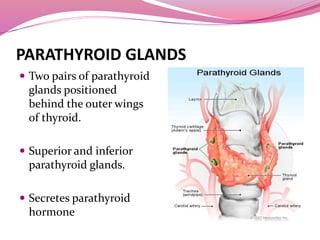
PARATHYROID GLANDS
 Two pairs of parathyroid
glands positioned
behind the outer wings
of thyroid.
 Superior and inferior
parathyroid glands.
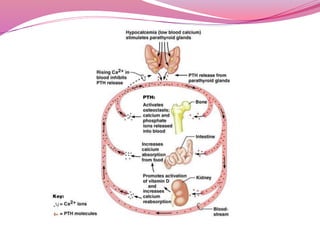
 Secretes parathyroid
hormone
PARATHYROID HORMONE(PTH)
 84 aminoacid single chain peptide.
 Primary function is to maintain the ECF calcium
concentration with in normal range.
 Acts directly on
bone(calcium resorption)
kidney(calcium reabsorption)
 Stimulates 1 alpha hydroxylase activity, increases
production of 1,25(OH)2D,which increases the
efficiency of calcium absorption.
 PTH secretion increases steeply to a maximum value
of about 5 times the basal rate of secretion as calcium
concentration falls to the range of 7.5-8mg/dl.
 ECF calcium controls PTH secretion by interaction
with a calcium sensor, a G protein coupled
receptor(GPCR)
PTHrP(parathyroid hormone related protein)
 Responsible for most instances of hypercalcemia of
malignancy.
 A syndrome that resembles hyperparathyroidism but
without elevated PTH levels.
 Produced by brain,pancreas,heart,lung,mammory
tissue,placenta and endothelial cells.
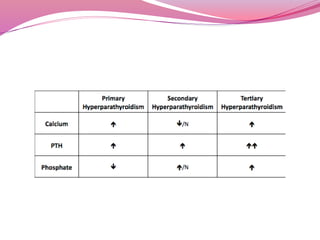
PRIMARY HYPER PARATHYROIDISM.
 A generalized disorder of calcium,phosphate and
bone metabolism due to increased secretion of
PTH leading to hypercalcemia and
hypophosphatemia.
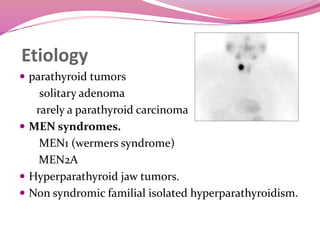
 parathyroid tumors
solitary adenoma
rarely a parathyroid carcinoma
 MEN syndromes.
MEN1 (wermers syndrome)
MEN2A
 Hyperparathyroid jaw tumors.
 Non syndromic familial isolated hyperparathyroidism.
Etiology
Secondary hyperparathyroidism
Is an adaptive process that develops in response to
declining kidney function, impaired phosphate excretion
and failure to bioactivate vitD.
Teritiary hyperparathyroidism
Is a state of severe hyperparathyroidism in patients with
renal failure that requires surgery .
SECONDARY HYPERPARATHYROIDISM
Etiology
 Kidney failure requiring dialysis.
 Stomach or intestine bypass surgery for obesity surgery.
 Celiac disease.
 Crohns disease.
 Severe vit D deficiency.
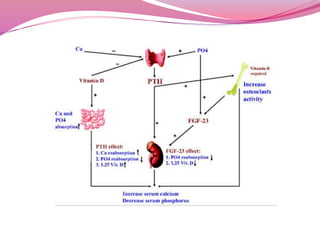
Pathophysiology
 Continuous stimulation of the parathyroid glands by a
combination of
increased phosphate concentration and
decreased calcium concentration and markedly reduced
serum calcitriol
increased PTH secretion and synthesis
parathyroid hyperplasia
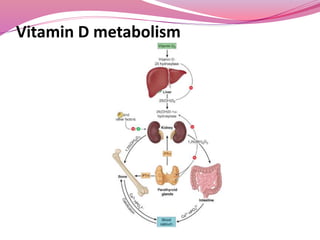
vitaminD
 Is an essential factor for regulation of calcium and
phophorous.
 Active form is 1,25dihydroxy vitaminD .
 Increases the intestinal absorption of calcium and
phosphorous.
 Increase reabsorption of calcium and phosphorous in the
renal tubules.
 Direct effect on the parathyroid glands to supress PTH
secretion
Vitamin D metabolism
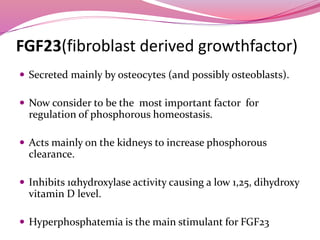
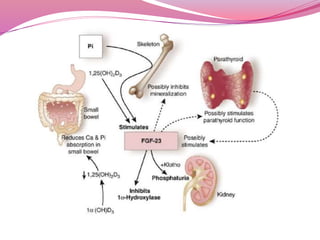
FGF23(fibroblast derived growthfactor)
 Secreted mainly by osteocytes (and possibly osteoblasts).
 Now consider to be the most important factor for
regulation of phosphorous homeostasis.
 Acts mainly on the kidneys to increase phosphorous
clearance.
 Inhibits 1αhydroxylase activity causing a low 1,25, dihydroxy
vitamin D level.
 Hyperphosphatemia is the main stimulant for FGF23
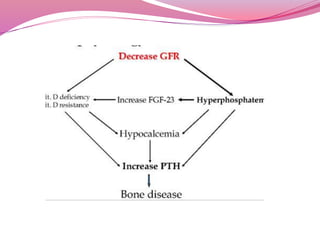
Calcium and phosphorous metabolism in renal
failure
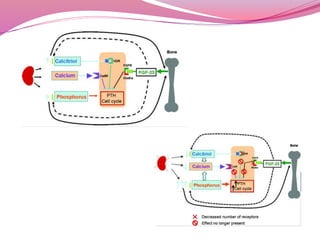
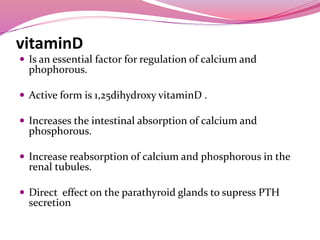
 When GFR falls,the phopsphorous clearance decrease
leading to phopshate retention.
 Hyperphosphatemia induces PTH secretion by 3 ways
1. Direct stimulatory effect on parathyroid.
2. Induction of mild hypocalcemia by precipitating with
calcium to form (caHpo4).
3. Stimulation of FBG23
Decreased 1αhydroxylase
Decreased 1,25 dihydroxyvitaminD
Down regulation of vitD receptors
parathyroidgland
Clinical features
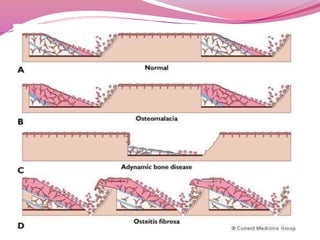
Renal osteodystrophy
 bone and joint pains.
 bone deformation and fractures during late stages .
 Some times called as silent crippler .
 Osteitis fibrosis cystica.
 A dynamic or aplastic bone disease.
Osteitis fibrosis cystica
 Classic and former most common form of osteodysrophy.
 High bone turn over caused by high circulating PTH.
 Histologically ,an increase in gaint multinucleated
osteoclasts on the surface of the bone and replacement of
normal cellular and marrow elements with fibrofatty
tissue.
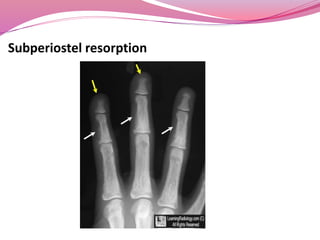
 Xray changes include sub periosteal resorption of the
phalangeal tufts.
Subperiostel resorption
Aplastic or adynamic bone disease
 Low bone turn over by excessive supression of PTH during
late stages of disease.
 The number of PTH receptors is downregulated in the
skeleton leading to skeletal resistance.
 It is a normal mechanism of the bone to defend itself
against high circulating levels of PTH.
Treatment
 Management of secondary hyperparathyroidism in CKD
should start at the beginning of stage 3
 It can be divided in to 3 steps
1. Optimize the levels of serum calcium and phosphate.
2. Control of PTH and vitaminD
3. The dosages of phosphate binders, calcimimmetics and
vitD analogues should be adjusted to achieve K/DOQI
value
 1st step is to optimize the levels of serum phosphate and calcium
through dietary restriction of phosporous and phosphate
binders
 Dietary restriction of phosphorous
 For ptnts with CKD stage 3 and 4 when serum phosphorous is
more than 4.6 and 5.5 mg/dl in CKD 5.
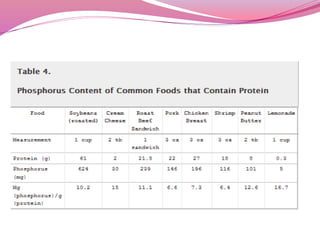
 Dietary restriction of phosphorous to 800-1000mg/day
 Two main sources dietary proteins and phosphorous additives
 Additives are manily present in the processed foods such as
meat,beverages,cheese and dietary products.
Phosphate binders
 main stay of therapy in secondary hyperparathyroidism.
 To limit the dietary absorption of phopsphorous.
Aluminium hydroxide forms aluminium precipitates in the
intestine and lowers phosphatemia levels.
 Used when serum phosphorous is >7mg/dl for lessthan 4 weeks
 Aluminium toxicity leads to severe refractory microcytic
anemia,osteomalacia,dementia
Calcium salts as calcium carbonates and calcium acetates
 Sevelamer hydrochloride is non calcium,non aluminium and
non magnesium compound.
 it forms a cationic polymer that binds to dietary phosphorous
through ion exchange.
 Sevelamer carbonate replacement of chloride ion with a
carbonate.
 decrease s the chances of metaboilic acidosis caused by sevalmer
hydrochloride.
 Lanthum carbonates is a rare earth element and has the
property of phosphorous binding.
Step 2 is to control of PTH and vitD by the use of vit D
analogues and calcimimetics.
vitD and its derivatives is the oldest treatment for secondary
hyperparathyroidism.
 Calcitriol deficiency and resistance are the major contributors to
the pathophysiology of the disease.
 Calcitriol(1,25dihydroxyvitaminD3)is the natural form of vitamin
D produced by the humanbody.
 Intermittent and IV administration is more effective than oral
calcitriol
Ergocalciferol s vitamin D2 or the nutritional vitamin D
 Is only indicated if 25-hydoxy vitamin D levels<30ng/ml;
Selective vitamin D analogues are paricalcitol and
doxercalciferol.
 Selective agents that have more affinity towards kidney rather
than intestinal receptors.
Calcimimetics are the newer agents that allosterically
increase the sensitivity to calcium and calcium sensing receptors
in the parathyroid gland thus supressing PTH.
 Cinacalcet is indicated in dialysis patients when
sercalcium>8.4mg/dl and PTH levels>300pg/ml.
 Side effects include GI symptoms and qt prolongation syndrome.
parathyroidectomy
Indications
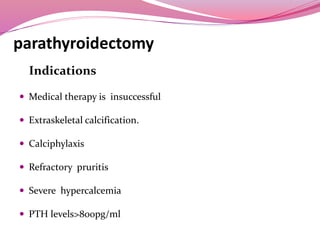
 Medical therapy is insuccessful
 Extraskeletal calcification.
 Calciphylaxis
 Refractory pruritis
 Severe hypercalcemia
 PTH levels>800pg/ml
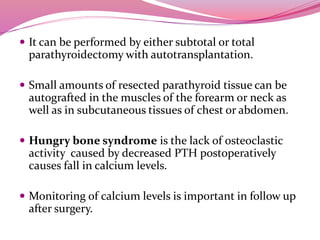
 It can be performed by either subtotal or total
parathyroidectomy with autotransplantation.
 Small amounts of resected parathyroid tissue can be
autografted in the muscles of the forearm or neck as
well as in subcutaneous tissues of chest or abdomen.
 Hungry bone syndrome is the lack of osteoclastic
activity caused by decreased PTH postoperatively
causes fall in calcium levels.
 Monitoring of calcium levels is important in follow up
after surgery.
Secondary hyperparathyroidism

Secondary hyperparathyroidism

  • 1.
  • 2.
    PARATHYROID GLANDS  Twopairs of parathyroid glands positioned behind the outer wings of thyroid.  Superior and inferior parathyroid glands.  Secretes parathyroid hormone
  • 3.
    PARATHYROID HORMONE(PTH)  84aminoacid single chain peptide.  Primary function is to maintain the ECF calcium concentration with in normal range.  Acts directly on bone(calcium resorption) kidney(calcium reabsorption)  Stimulates 1 alpha hydroxylase activity, increases production of 1,25(OH)2D,which increases the efficiency of calcium absorption.
  • 4.
     PTH secretionincreases steeply to a maximum value of about 5 times the basal rate of secretion as calcium concentration falls to the range of 7.5-8mg/dl.  ECF calcium controls PTH secretion by interaction with a calcium sensor, a G protein coupled receptor(GPCR)
  • 6.
    PTHrP(parathyroid hormone relatedprotein)  Responsible for most instances of hypercalcemia of malignancy.  A syndrome that resembles hyperparathyroidism but without elevated PTH levels.  Produced by brain,pancreas,heart,lung,mammory tissue,placenta and endothelial cells.
  • 7.
    PRIMARY HYPER PARATHYROIDISM. A generalized disorder of calcium,phosphate and bone metabolism due to increased secretion of PTH leading to hypercalcemia and hypophosphatemia.
  • 8.
     parathyroid tumors solitaryadenoma rarely a parathyroid carcinoma  MEN syndromes. MEN1 (wermers syndrome) MEN2A  Hyperparathyroid jaw tumors.  Non syndromic familial isolated hyperparathyroidism. Etiology
  • 9.
    Secondary hyperparathyroidism Is anadaptive process that develops in response to declining kidney function, impaired phosphate excretion and failure to bioactivate vitD. Teritiary hyperparathyroidism Is a state of severe hyperparathyroidism in patients with renal failure that requires surgery .
  • 10.
    SECONDARY HYPERPARATHYROIDISM Etiology  Kidneyfailure requiring dialysis.  Stomach or intestine bypass surgery for obesity surgery.  Celiac disease.  Crohns disease.  Severe vit D deficiency.
  • 11.
    Pathophysiology  Continuous stimulationof the parathyroid glands by a combination of increased phosphate concentration and decreased calcium concentration and markedly reduced serum calcitriol increased PTH secretion and synthesis parathyroid hyperplasia
  • 14.
    vitaminD  Is anessential factor for regulation of calcium and phophorous.  Active form is 1,25dihydroxy vitaminD .  Increases the intestinal absorption of calcium and phosphorous.  Increase reabsorption of calcium and phosphorous in the renal tubules.  Direct effect on the parathyroid glands to supress PTH secretion
  • 15.
  • 16.
    FGF23(fibroblast derived growthfactor) Secreted mainly by osteocytes (and possibly osteoblasts).  Now consider to be the most important factor for regulation of phosphorous homeostasis.  Acts mainly on the kidneys to increase phosphorous clearance.  Inhibits 1αhydroxylase activity causing a low 1,25, dihydroxy vitamin D level.  Hyperphosphatemia is the main stimulant for FGF23
  • 18.
    Calcium and phosphorousmetabolism in renal failure  When GFR falls,the phopsphorous clearance decrease leading to phopshate retention.  Hyperphosphatemia induces PTH secretion by 3 ways 1. Direct stimulatory effect on parathyroid. 2. Induction of mild hypocalcemia by precipitating with calcium to form (caHpo4).
  • 19.
    3. Stimulation ofFBG23 Decreased 1αhydroxylase Decreased 1,25 dihydroxyvitaminD Down regulation of vitD receptors parathyroidgland
  • 21.
    Clinical features Renal osteodystrophy bone and joint pains.  bone deformation and fractures during late stages .  Some times called as silent crippler .  Osteitis fibrosis cystica.  A dynamic or aplastic bone disease.

  • 22.
    Osteitis fibrosis cystica Classic and former most common form of osteodysrophy.  High bone turn over caused by high circulating PTH.  Histologically ,an increase in gaint multinucleated osteoclasts on the surface of the bone and replacement of normal cellular and marrow elements with fibrofatty tissue.  Xray changes include sub periosteal resorption of the phalangeal tufts.
  • 23.
  • 24.
    Aplastic or adynamicbone disease  Low bone turn over by excessive supression of PTH during late stages of disease.  The number of PTH receptors is downregulated in the skeleton leading to skeletal resistance.  It is a normal mechanism of the bone to defend itself against high circulating levels of PTH.
  • 26.
    Treatment  Management ofsecondary hyperparathyroidism in CKD should start at the beginning of stage 3  It can be divided in to 3 steps 1. Optimize the levels of serum calcium and phosphate. 2. Control of PTH and vitaminD 3. The dosages of phosphate binders, calcimimmetics and vitD analogues should be adjusted to achieve K/DOQI value
  • 27.
     1st stepis to optimize the levels of serum phosphate and calcium through dietary restriction of phosporous and phosphate binders  Dietary restriction of phosphorous  For ptnts with CKD stage 3 and 4 when serum phosphorous is more than 4.6 and 5.5 mg/dl in CKD 5.  Dietary restriction of phosphorous to 800-1000mg/day  Two main sources dietary proteins and phosphorous additives  Additives are manily present in the processed foods such as meat,beverages,cheese and dietary products.
  • 29.
    Phosphate binders  mainstay of therapy in secondary hyperparathyroidism.  To limit the dietary absorption of phopsphorous. Aluminium hydroxide forms aluminium precipitates in the intestine and lowers phosphatemia levels.  Used when serum phosphorous is >7mg/dl for lessthan 4 weeks  Aluminium toxicity leads to severe refractory microcytic anemia,osteomalacia,dementia Calcium salts as calcium carbonates and calcium acetates
  • 30.
     Sevelamer hydrochlorideis non calcium,non aluminium and non magnesium compound.  it forms a cationic polymer that binds to dietary phosphorous through ion exchange.  Sevelamer carbonate replacement of chloride ion with a carbonate.  decrease s the chances of metaboilic acidosis caused by sevalmer hydrochloride.  Lanthum carbonates is a rare earth element and has the property of phosphorous binding.
  • 31.
    Step 2 isto control of PTH and vitD by the use of vit D analogues and calcimimetics. vitD and its derivatives is the oldest treatment for secondary hyperparathyroidism.  Calcitriol deficiency and resistance are the major contributors to the pathophysiology of the disease.  Calcitriol(1,25dihydroxyvitaminD3)is the natural form of vitamin D produced by the humanbody.  Intermittent and IV administration is more effective than oral calcitriol Ergocalciferol s vitamin D2 or the nutritional vitamin D  Is only indicated if 25-hydoxy vitamin D levels<30ng/ml;
  • 32.
    Selective vitamin Danalogues are paricalcitol and doxercalciferol.  Selective agents that have more affinity towards kidney rather than intestinal receptors. Calcimimetics are the newer agents that allosterically increase the sensitivity to calcium and calcium sensing receptors in the parathyroid gland thus supressing PTH.  Cinacalcet is indicated in dialysis patients when sercalcium>8.4mg/dl and PTH levels>300pg/ml.  Side effects include GI symptoms and qt prolongation syndrome.
  • 33.
    parathyroidectomy Indications  Medical therapyis insuccessful  Extraskeletal calcification.  Calciphylaxis  Refractory pruritis  Severe hypercalcemia  PTH levels>800pg/ml
  • 34.
     It canbe performed by either subtotal or total parathyroidectomy with autotransplantation.  Small amounts of resected parathyroid tissue can be autografted in the muscles of the forearm or neck as well as in subcutaneous tissues of chest or abdomen.  Hungry bone syndrome is the lack of osteoclastic activity caused by decreased PTH postoperatively causes fall in calcium levels.  Monitoring of calcium levels is important in follow up after surgery.