Rome (Ch 6)
Section 5
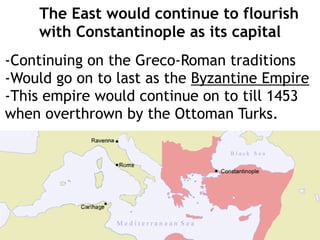
The East would continue to flourish
with Constantinople as its capital
-Continuing on the Greco-Roman traditions
-Would go on to last as the Byzantine Empire
-This empire would continue on to till 1453
when overthrown by the Ottoman Turks.
Rome and the Roots of
Western Civilization
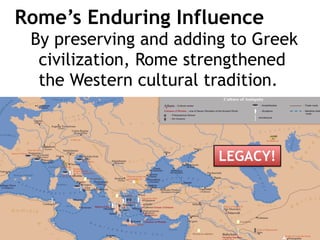
Rome’s Enduring Influence
By preserving and adding to Greek
civilization, Rome strengthened
the Western cultural tradition.
LEGACY!
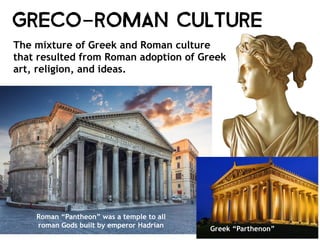
Greco-Roman Culture
The mixture of Greek and Roman culture
that resulted from Roman adoption of Greek
art, religion, and ideas.
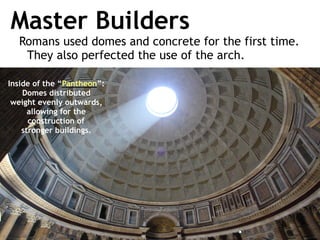
Roman “Pantheon” was a temple to all
roman Gods built by emperor Hadrian
Greek “Parthenon”
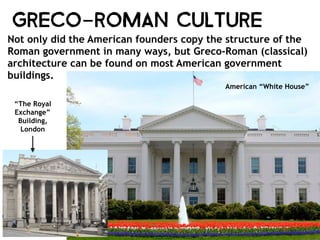
Greco-Roman Culture
Not only did the American founders copy the structure of the
Roman government in many ways, but Greco-Roman (classical)
architecture can be found on most American government
buildings.
American “White House”
“The Royal
Exchange”
Building,
London
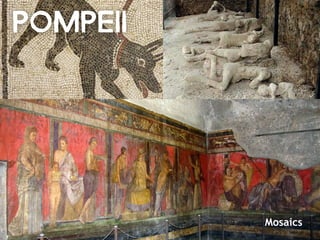
Pompeii
Mosaics
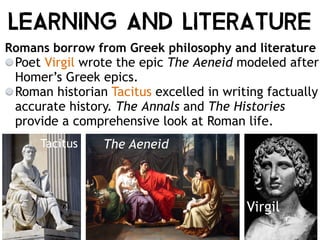
Virgil
Tacitus The Aeneid
Romans borrow from Greek philosophy and literature
Poet Virgil wrote the epic The Aeneid modeled after
Homer’s Greek epics.
Roman historian Tacitus excelled in writing factually
accurate history. The Annals and The Histories
provide a comprehensive look at Roman life.
Learning and Literature
Master Builders
Romans used domes and concrete for the first time.
They also perfected the use of the arch.
Inside of the “Pantheon”:
Domes distributed
weight evenly outwards,
allowing for the
construction of
stronger buildings.
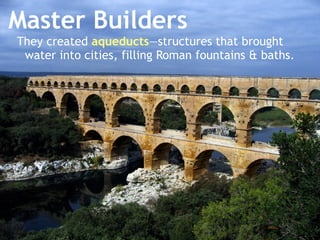
Master Builders
They created aqueducts—structures that brought
water into cities, filling Roman fountains & baths.
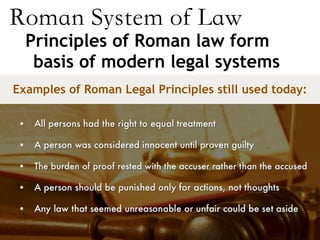
Roman System of Law
Principles of Roman law form
basis of modern legal systems
Examples of Roman Legal Principles still used today:
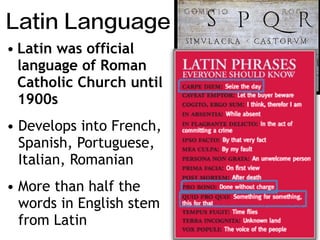
• Latin was official
language of Roman
Catholic Church until
1900s
• Develops into French,
Spanish, Portuguese,
Italian, Romanian
• More than half the
words in English stem
from Latin Continued…
Latin Language
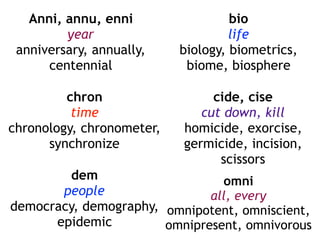
Anni, annu, enni
year
anniversary, annually,
centennial
bio
life
biology, biometrics,
biome, biosphere
chron
time
chronology, chronometer,
synchronize
cide, cise
cut down, kill
homicide, exorcise,
germicide, incision,
scissors
dem
people
democracy, demography,
epidemic
omni
all, every
omnipotent, omniscient,
omnipresent, omnivorous
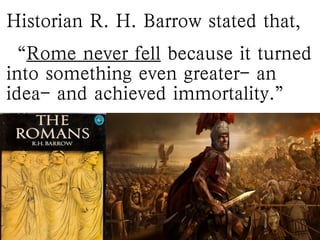
Historian R. H. Barrow stated that,
“Rome never fell because it turned
into something even greater- an
idea- and achieved immortality.”
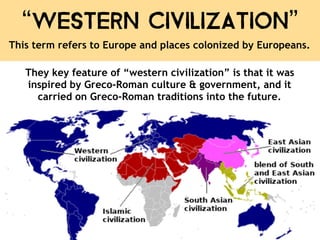
“Western Civilization”
This term refers to Europe and places colonized by Europeans.
They key feature of “western civilization” is that it was
inspired by Greco-Roman culture & government, and it
carried on Greco-Roman traditions into the future.
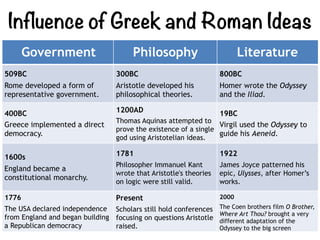
Influence of Greek and Roman Ideas
Government Philosophy Literature
509BC
Rome developed a form of
representative government.
300BC
Aristotle developed his
philosophical theories.
800BC
Homer wrote the Odyssey
and the Iliad.
400BC
Greece implemented a direct
democracy.
1200AD
Thomas Aquinas attempted to
prove the existence of a single
god using Aristotelian ideas.
19BC
Virgil used the Odyssey to
guide his Aeneid.
1600s
England became a
constitutional monarchy.
1781
Philosopher Immanuel Kant
wrote that Aristotle's theories
on logic were still valid.
1922
James Joyce patterned his
epic, Ulysses, after Homer’s
works.
1776
The USA declared independence
from England and began building
a Republican democracy
Present
Scholars still hold conferences
focusing on questions Aristotle
raised.
2000
The Coen brothers film O Brother,
Where Art Thou? brought a very
different adaptation of the
Odyssey to the big screen
Chapter 6 Rome Part 5

Chapter 6 Rome Part 5

  • 1.
  • 2.
    The East wouldcontinue to flourish with Constantinople as its capital -Continuing on the Greco-Roman traditions -Would go on to last as the Byzantine Empire -This empire would continue on to till 1453 when overthrown by the Ottoman Turks.
  • 3.
    Rome and theRoots of Western Civilization
  • 4.
    Rome’s Enduring Influence Bypreserving and adding to Greek civilization, Rome strengthened the Western cultural tradition. LEGACY!
  • 5.
    Greco-Roman Culture The mixtureof Greek and Roman culture that resulted from Roman adoption of Greek art, religion, and ideas. Roman “Pantheon” was a temple to all roman Gods built by emperor Hadrian Greek “Parthenon”
  • 6.
    Greco-Roman Culture Not onlydid the American founders copy the structure of the Roman government in many ways, but Greco-Roman (classical) architecture can be found on most American government buildings. American “White House” “The Royal Exchange” Building, London
  • 7.
  • 8.
    Virgil Tacitus The Aeneid Romansborrow from Greek philosophy and literature Poet Virgil wrote the epic The Aeneid modeled after Homer’s Greek epics. Roman historian Tacitus excelled in writing factually accurate history. The Annals and The Histories provide a comprehensive look at Roman life. Learning and Literature
  • 9.
    Master Builders Romans useddomes and concrete for the first time. They also perfected the use of the arch. Inside of the “Pantheon”: Domes distributed weight evenly outwards, allowing for the construction of stronger buildings.
  • 10.
    Master Builders They createdaqueducts—structures that brought water into cities, filling Roman fountains & baths.
  • 11.
    Roman System ofLaw Principles of Roman law form basis of modern legal systems Examples of Roman Legal Principles still used today:
  • 13.
    • Latin wasofficial language of Roman Catholic Church until 1900s • Develops into French, Spanish, Portuguese, Italian, Romanian • More than half the words in English stem from Latin Continued… Latin Language
  • 14.
    Anni, annu, enni year anniversary,annually, centennial bio life biology, biometrics, biome, biosphere chron time chronology, chronometer, synchronize cide, cise cut down, kill homicide, exorcise, germicide, incision, scissors dem people democracy, demography, epidemic omni all, every omnipotent, omniscient, omnipresent, omnivorous
  • 15.
    Historian R. H.Barrow stated that, “Rome never fell because it turned into something even greater- an idea- and achieved immortality.”
  • 16.
    “Western Civilization” This termrefers to Europe and places colonized by Europeans. They key feature of “western civilization” is that it was inspired by Greco-Roman culture & government, and it carried on Greco-Roman traditions into the future.
  • 17.
    Influence of Greekand Roman Ideas Government Philosophy Literature 509BC Rome developed a form of representative government. 300BC Aristotle developed his philosophical theories. 800BC Homer wrote the Odyssey and the Iliad. 400BC Greece implemented a direct democracy. 1200AD Thomas Aquinas attempted to prove the existence of a single god using Aristotelian ideas. 19BC Virgil used the Odyssey to guide his Aeneid. 1600s England became a constitutional monarchy. 1781 Philosopher Immanuel Kant wrote that Aristotle's theories on logic were still valid. 1922 James Joyce patterned his epic, Ulysses, after Homer’s works. 1776 The USA declared independence from England and began building a Republican democracy Present Scholars still hold conferences focusing on questions Aristotle raised. 2000 The Coen brothers film O Brother, Where Art Thou? brought a very different adaptation of the Odyssey to the big screen