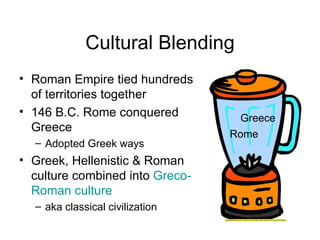
Cultural Blending Roman Empire tied hundreds of territories together 146 B.C. Rome conquered Greece Adopted Greek ways Greek, Hellenistic & Roman culture combined into  Greco-Roman culture aka classical civilization Rome Greece
Adapting Greek Ways Took Greek and Hellenistic models & made them their own Roman art and literature began representing the ideals of: STRENGTH PERMANENCE SOLIDITY
Fine Arts - Sculpture  Realistic Made of stone Practical purpose Intended for educating Developed bas-relief sculpture Images projecting from flat background Subjects: landscapes, crowds, battle scenes Told stories
 
 
Fine Arts - Mosaics Designs or pictures made by setting small pieces of stone, glass or tile onto a surface Common in wealthy Roman homes
Fine Arts - Painting Frescoes Large murals Painted on plaster Colorful Very few surviving paintings Most remaining found in Pompeii Preserved by ash from Mt. Vesuvius eruption
 
Philosophy and Literature Adopted much of Greek philosophy Stoicism popular because of its emphasis: Virtue Duty Moderation Endurance
Literature Followed Greek literary forms and models Ex: epic Used own themes and ideas Ovid  Light, funny poet Amores Written for enjoyment Virgil  Wrote the  Aeneid Modeled off Homer’s epics Praised Roman virtues and government Seriousness of Roman character
 
Historians Livy Wrote multivolume history of Rome from its beginning to 9 B.C. Incorporated legends, created national myth Tacitus  Famous for presenting facts accurately Wrote about the good and bad in the Roman Empire Criticized immoral leaders Ex: Nero
Rome’s Lasting Legacy Language = Latin Official language of Roman Catholic Church til 20th century French, Spanish, Portuguese, Italian, Romanian derived from Latin “ Roman ce languages”
Architecture Architectural marvel Arches Domes Built w/ concrete Used arches to support bridges and aquaducts Aquaducts = carried water


Roman System of Law Most widespread, lasting contribution Romans came to believe laws should be fair & equal to all (rich and poor) Judges began to recognize set standards for justice Influenced by Stoicism Based on common sense
Roman System of Law Most important principals: All have right to equal treatment under law Innocent until proven guilty Accuser must provide proof, not the accused People should only be punishable for actions Not thoughts Unreasonable, extremely unfair laws can be set aside Basis of legal systems in Europe, USA, etc.
Rome’s Lasting Influence Continued, added Greek civilization Strong cultural tradition Left an enduring legacy even after fall of Rome
For Next Class… Benchmark Review Sheet Terms DUE Brainstorm for “When in Rome” project

Rome Legacy

  • 1.
    Cultural Blending RomanEmpire tied hundreds of territories together 146 B.C. Rome conquered Greece Adopted Greek ways Greek, Hellenistic & Roman culture combined into Greco-Roman culture aka classical civilization Rome Greece
  • 2.
    Adapting Greek WaysTook Greek and Hellenistic models & made them their own Roman art and literature began representing the ideals of: STRENGTH PERMANENCE SOLIDITY
  • 3.
    Fine Arts -Sculpture Realistic Made of stone Practical purpose Intended for educating Developed bas-relief sculpture Images projecting from flat background Subjects: landscapes, crowds, battle scenes Told stories
  • 4.
  • 5.
  • 6.
    Fine Arts -Mosaics Designs or pictures made by setting small pieces of stone, glass or tile onto a surface Common in wealthy Roman homes
  • 7.
    Fine Arts -Painting Frescoes Large murals Painted on plaster Colorful Very few surviving paintings Most remaining found in Pompeii Preserved by ash from Mt. Vesuvius eruption
  • 8.
  • 9.
    Philosophy and LiteratureAdopted much of Greek philosophy Stoicism popular because of its emphasis: Virtue Duty Moderation Endurance
  • 10.
    Literature Followed Greekliterary forms and models Ex: epic Used own themes and ideas Ovid Light, funny poet Amores Written for enjoyment Virgil Wrote the Aeneid Modeled off Homer’s epics Praised Roman virtues and government Seriousness of Roman character
  • 11.
  • 12.
    Historians Livy Wrotemultivolume history of Rome from its beginning to 9 B.C. Incorporated legends, created national myth Tacitus Famous for presenting facts accurately Wrote about the good and bad in the Roman Empire Criticized immoral leaders Ex: Nero
  • 13.
    Rome’s Lasting LegacyLanguage = Latin Official language of Roman Catholic Church til 20th century French, Spanish, Portuguese, Italian, Romanian derived from Latin “ Roman ce languages”
  • 14.
    Architecture Architectural marvelArches Domes Built w/ concrete Used arches to support bridges and aquaducts Aquaducts = carried water
  • 15.
  • 16.
  • 17.
  • 18.
  • 19.
  • 20.
  • 21.
    Roman System ofLaw Most widespread, lasting contribution Romans came to believe laws should be fair & equal to all (rich and poor) Judges began to recognize set standards for justice Influenced by Stoicism Based on common sense
  • 22.
    Roman System ofLaw Most important principals: All have right to equal treatment under law Innocent until proven guilty Accuser must provide proof, not the accused People should only be punishable for actions Not thoughts Unreasonable, extremely unfair laws can be set aside Basis of legal systems in Europe, USA, etc.
  • 23.
    Rome’s Lasting InfluenceContinued, added Greek civilization Strong cultural tradition Left an enduring legacy even after fall of Rome
  • 24.
    For Next Class…Benchmark Review Sheet Terms DUE Brainstorm for “When in Rome” project

Editor's Notes

  • #2 Romans freely borrowed and changed various elements of different cultures. Last time we talked about how diverse Rome, today we will find out how they all combined into one. And how they left their imprint on the world. The biggest influence on Rome came from none other than Greece! Rome certainly defined their own way of governing, but they borrowed the Greeks leadership in art, architecture, literature and philosophy. In 146 B.C. Rome conquered Greece. But Horace, who was a Roman poet said that, “Greece, once overcame, overcame her wild conquerer.” Romans admired Greek culture. Wealthy Romans learned Greek language for example. It was highly praised. The blending on Hellenistic, Greek and Roman cutlure became known as Greco-Roman culture or classical civilizations.