Rome: Republic and Empire A Precursor to the Medieval Era
Introduction A classic civilization in its own right, but in different ways. A model of government of  law, of military strategy—and the roads The gods were inherited from the Greeks Art: Realism Architecture: The arch, the vault, and the dome Provided the organizational framework of the church that bore its name: the Roman Catholic Church
Overview of Rome Its rise Its Republican phase The Imperial phase Demise and Transformation
Rome: Its Location Rome: Republican Phase: 750-500 BC Rome: Maximum Extent of Empire, AD 63
Rise of Rome Latins invaded the peninsula in 1000 BCE By 800 BCE, founded Rome at the lower valley of the Tiber River, central locus for control of the rest of Italy Other ethnicities migrated to the region: Etruscans, Phoenicians, Greeks Unlike the other villages, Rome encouraged other ethnic groups to migrate there
Multiethnic Contributions to Rome Phoenicians  contributed maritime and commercial skills and phonetic alphabet Etruscans  brought urban planning, chariot racing, the toga, bronze and gold crafting—and the arch Greeks:  the pantheon of gods and goddesses, linguistic and literary principles, and aesthetic
Roman Republic: Roots Etruscans ruled the Latins but were overthrown in 509 BC Gradually, monarchy gave way to government by the people ( res publica ) Predominately comprised the  patricians  (aristocrats) and the  plebians  (farmers, artisans, and other common folk.  Slaves formed a third category as the empire expanded The rise of the republic was a slow process
Structure of the Roman Republic Patricians through the Senate controlled the lawmaking process However, plebians filled the ranks of the Roman army and exercised veto power over the decisions of the Senate Eventually, through their leaders, the tribunes, acquired the right to hold executive office and lawmaking power
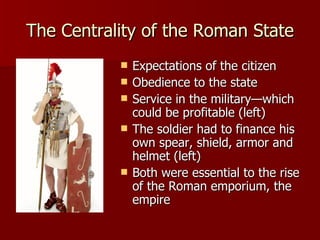
The Centrality of the Roman State Expectations of the citizen Obedience to the state Service in the military—which could be profitable (left) The soldier had to finance his own spear, shield, armor and helmet (left) Both were essential to the rise of the Roman emporium, the empire
From Republic to Empire I Rome then began to build an empire Conquest of the known world was the extension of conquest of the Italian peninsula by the Latins War with the Phoenicians of Carthage (Punic Wars) was the first phase of Roman expansion  Other expeditions led to Roman control of the entire Mediterranean ( Mare Nostrum,  “Our Sea”) and much of Europe: Hispania (now Spain), Gallia (France) Britannia (England) and part of Germania (Germany)
From Republic to Empire Led by military dictators, of which Julius Caesar was the best known He expanded the empire to include western and central Europe He directed the construction of a wooden bridge to enable the troop to invade and conquer Germania (central Europe) Under Caesar Augustus, the empire entered into a pax romana (peace under Rome) This, which brought in a long era of high culture and stability
Military Organization The army was the tool of imperial expansion The Roman army was a highly disciplined force and the backbone of Rome Initially, all free men served two-years Later, professional soldiers filled the ranks As the empire expanded, non-Romans joined to gain Roman citizenship  The phalanx was the basic unit (left) Later it would be divided into smaller units These units could combine to form a legion if necessary. See pp. 133-134, Fiero, for the Jewish scholar Josephus’s description of an army regiment
Roman Law Formed the model of legal systems throughout European countries except England, which relied on common law The term  jus  meant  both the law and justice The system of customary law ( ius ) was written down as codes ( lex ) These were displayed as the Twelve Tables of Law at the Forum.
Twelve Tables of Roman Law The Twelve Tables of Law formed the basis  of all Roman law These tenets were engraved in stone and mounted at the speakers’ forum near the Temple of Saturn (left) The Tables were destroyed by the Celts in AD 700 The Tables summarized such tenets as civil procedure, parents and children, debts, constitutional law, and crime
Other Concepts of Roman Law The Romans also:  Invented and evolved case law, focusing on bringing commonsense solutions to private disputes Invented the concept of  equity , putting the spirit of the law above the letter of the law After the fall of Rome and the rise of Christianity, Justinian codified the law into  jus juris civilis
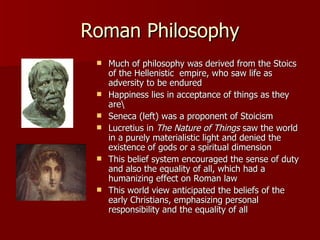
Roman Philosophy Much of philosophy was derived from the Stoics of the Hellenistic  empire, who saw life as adversity to be endured Happiness lies in acceptance of things as they are\ Seneca (left) was a proponent of Stoicism Lucretius in  The Nature of Things  saw the world in a purely materialistic light and denied the existence of gods or a spiritual dimension This belief system encouraged the sense of duty and also the equality of all, which had a humanizing effect on Roman law This world view anticipated the beliefs of the early Christians, emphasizing personal responsibility and the equality of all
Roman Literature Best known for prose, writing as a vehicle for providing information Provided the first geographies and encyclopedias Other media: instruction manuals, histories, and biographies Titus Livius (Livy) provided a detailed history of Rome from the 8 th  century BCE to his own day (1 st  century BCE) (upper left) Also masters of oratory, exemplified by Tullius Cicero (106-41 BCE); read his “On Duty” on pp. 138-139, Fiero text Cornelius Tacitus was both historian and orator; see his “On Oratory” on pp. 139-140 (lower left)
Roman Literature: Epic Poetry Under sponsorship of Octavian, produced a golden age of poetry Virgil (Publius Vergilius Mato) wrote the epic poem  Aeneid , on Aeneas, the mythical Trojan founder of Rome (left) Virgil accompanies Dante in the Purgatorio and Inferno in the  Divine Comedy Catullus, a Sicilian, wrote lyric poetry, some of it inspired by his adulterous affair with Clodia, wife of a Roman consul, and the collapse of the affair Publius Ovidus Naso (Ovid) covers the art of seduction, work which earned him exile Horace was the master of satire that addresses Stoic themes, such as  Carpe Diem  (Seize the Day)
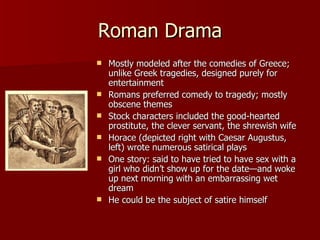
Roman Drama Mostly modeled after the comedies of Greece; unlike Greek tragedies, designed purely for entertainment Romans preferred comedy to tragedy; mostly obscene themes Stock characters included the good-hearted prostitute, the clever servant, the shrewish wife Horace (depicted right with Caesar Augustus, left) wrote numerous satirical plays One story: said to have tried to have sex with a girl who didn’t show up for the date—and woke up next morning with an embarrassing wet dream He could be the subject of satire himself
Roman Architecture Noted for the paved roads, still used today They extended from Tigris and Euphrates to the Atlantic Ocean Tenements (8 or 9 stories) to accommodate thousands of people in Rome were also built Constructed 18 aqueducts to supply Rome with water
Building Materials Brick used by both Etruscans and Romans Marble was used as a facing over brick Concrete: Mixture of mortar, gravel, rubble, and water made a solid mix of material Travertine: Hard, durable limestone that ages into an attractive shade of yellow.
The Arch Rome built on the arch, contributed by the Etruscans The principle appears left; weight is evenly distributed from the keystone to the sides It could provide so much strength that other structures could be built above it This aqueduct in Nimes, France,  is one example (lower left) Notice that the lower row of arches support the upper row and the canal at the top.  More details: see p. 313
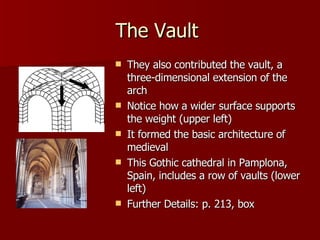
The Vault  They also contributed the vault, a three-dimensional extension of the arch Notice how a wider surface supports the weight (upper left) It formed the basic architecture of medieval This Gothic cathedral in Pamplona, Spain, includes a row of vaults (lower left) Further Details: p. 213, box
The Dome The dome was a third form of rooftop architecture in Rome  (upper left) It is created by rotating a round arch through 180  degrees on its axis They must be buttressed from all sides The weight must be evenly distributed at all sides The dome included a circular skylight (interior of dome, lower left)
Domestic Architecture Entrance to a home was an atrium  (left) This was a large hall entered through a corridor from the street,  An open compluvium (skylight) which let in rainwater and sunlight Rainwater was collected in a sunken basin in the floor (impluvium) and channeled off into a cistern
Architectural and Engineering Professions Roman architecture and engineering were considered to be one discipline The most influential manuals were Vitruvius’s  Ten Books on Architecture Function to the Roman architecture determined design Classic architecture emphasized size to accommodate 1 million people of Rome: Namely,  the Coliseum, the amphitheaters, all designed for entertainment, whether gladiators, drama, or circuses
Public Architecture: The Forum A rectangular open space, usually with a temple at one end Bounded on three sides by colonnades (rows of columns) Fourth side by a basilica Best known: Forum Romanum (upper left)  and Forum Julium The plan of Imperial Fora (lower left)
Basilica A large roofed building, usually at one end of a forum Divided into three aisles, one large central one and one smaller aisle on either side (upper left) The nave (raised section of center aisle) allowed construction of a second story The apse was a recessed part at one end Trajan’s marketplace was one example
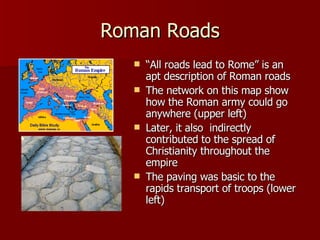
Roman Roads “ All roads lead to Rome” is an apt description of Roman roads The network on this map show how the Roman army could go anywhere (upper left) Later, it also  indirectly contributed to the spread of Christianity throughout the empire The paving was basic to the rapids transport of troops (lower left)
Aqueducts Romans left their marks in the form of Aqueducts built in Rome and through Europe They were built so that water could flow hundreds on miles using gravity Notice how arches were so strong that several could be built atop one another (left)  They were used long after the Fall of Rome
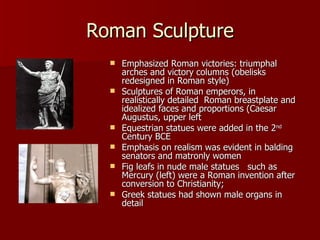
Roman Sculpture Emphasized Roman victories: triumphal arches and victory columns (obelisks redesigned in Roman style) Sculptures of Roman emperors, in realistically detailed  Roman breastplate and idealized faces and proportions (Caesar Augustus, upper left Equestrian statues were added in the 2 nd  Century BCE Emphasis on realism was evident in balding senators and matronly women Fig leafs in nude male statues  such as Mercury (left) were a Roman invention after conversion to Christianity;  Greek statues had shown male organs in detail
Roman Sculpture: Realism Except for selected emperors, the subjects were portrayed with all their flaws Augustus is portrayed here as a idealized figure, though a faithful replication (upper left; detail from the statue, p. 239) The woman’s eyes and wrinkles reveal a realistic style of her aging (lower left)
Equestrian Statues Equestrian statues were a Roman invention reproduced throughout history This statue of Marcus Aurelius is typical  It depicts both horse and rider in Grecian naturalistic design The veins and muscles of the horse are visible as it raises its foreleg, a triumphal pose
Roman Painting Paintings depicted realistic representations of mythical themes, historical events, and landscapes Murals in atria (sing. Atrium), large airy rooms, were commonplace Mosaics were commonly used Frescos gave the impression that viewers were looking out into actual gardens ( trompe l’oeil , or “fool the eye”) Still life styles were also common
Murals Scene from the Villa of the Mysteries (upper left) An initiate is flagellated (by a winged woman out of view) Another women plays cymbals while in a frenzied dance The technique give a three-dimensional image on a two dimensional surfact Portraits were common, as seen in  Young Woman With a Stylus  (lower left)
Conclusion Romans were imperialists first and republicans second Much of the themes emphasize war and conquest The arts mostly had a practical side There was much art in Rome—sculpture, art, even architecture—that were Greek imitations The gods themselves were renamed imitations of the Greeks: Zeus became Jupiter, for example, and Athena, Minerva They were engineers first and artist second—size mattered in the arts and architecture

Classical Rome

  • 1.
    Rome: Republic andEmpire A Precursor to the Medieval Era
  • 2.
    Introduction A classiccivilization in its own right, but in different ways. A model of government of law, of military strategy—and the roads The gods were inherited from the Greeks Art: Realism Architecture: The arch, the vault, and the dome Provided the organizational framework of the church that bore its name: the Roman Catholic Church
  • 3.
    Overview of RomeIts rise Its Republican phase The Imperial phase Demise and Transformation
  • 4.
    Rome: Its LocationRome: Republican Phase: 750-500 BC Rome: Maximum Extent of Empire, AD 63
  • 5.
    Rise of RomeLatins invaded the peninsula in 1000 BCE By 800 BCE, founded Rome at the lower valley of the Tiber River, central locus for control of the rest of Italy Other ethnicities migrated to the region: Etruscans, Phoenicians, Greeks Unlike the other villages, Rome encouraged other ethnic groups to migrate there
  • 6.
    Multiethnic Contributions toRome Phoenicians contributed maritime and commercial skills and phonetic alphabet Etruscans brought urban planning, chariot racing, the toga, bronze and gold crafting—and the arch Greeks: the pantheon of gods and goddesses, linguistic and literary principles, and aesthetic
  • 7.
    Roman Republic: RootsEtruscans ruled the Latins but were overthrown in 509 BC Gradually, monarchy gave way to government by the people ( res publica ) Predominately comprised the patricians (aristocrats) and the plebians (farmers, artisans, and other common folk. Slaves formed a third category as the empire expanded The rise of the republic was a slow process
  • 8.
    Structure of theRoman Republic Patricians through the Senate controlled the lawmaking process However, plebians filled the ranks of the Roman army and exercised veto power over the decisions of the Senate Eventually, through their leaders, the tribunes, acquired the right to hold executive office and lawmaking power
  • 9.
    The Centrality ofthe Roman State Expectations of the citizen Obedience to the state Service in the military—which could be profitable (left) The soldier had to finance his own spear, shield, armor and helmet (left) Both were essential to the rise of the Roman emporium, the empire
  • 10.
    From Republic toEmpire I Rome then began to build an empire Conquest of the known world was the extension of conquest of the Italian peninsula by the Latins War with the Phoenicians of Carthage (Punic Wars) was the first phase of Roman expansion Other expeditions led to Roman control of the entire Mediterranean ( Mare Nostrum, “Our Sea”) and much of Europe: Hispania (now Spain), Gallia (France) Britannia (England) and part of Germania (Germany)
  • 11.
    From Republic toEmpire Led by military dictators, of which Julius Caesar was the best known He expanded the empire to include western and central Europe He directed the construction of a wooden bridge to enable the troop to invade and conquer Germania (central Europe) Under Caesar Augustus, the empire entered into a pax romana (peace under Rome) This, which brought in a long era of high culture and stability
  • 12.
    Military Organization Thearmy was the tool of imperial expansion The Roman army was a highly disciplined force and the backbone of Rome Initially, all free men served two-years Later, professional soldiers filled the ranks As the empire expanded, non-Romans joined to gain Roman citizenship The phalanx was the basic unit (left) Later it would be divided into smaller units These units could combine to form a legion if necessary. See pp. 133-134, Fiero, for the Jewish scholar Josephus’s description of an army regiment
  • 13.
    Roman Law Formedthe model of legal systems throughout European countries except England, which relied on common law The term jus meant both the law and justice The system of customary law ( ius ) was written down as codes ( lex ) These were displayed as the Twelve Tables of Law at the Forum.
  • 14.
    Twelve Tables ofRoman Law The Twelve Tables of Law formed the basis of all Roman law These tenets were engraved in stone and mounted at the speakers’ forum near the Temple of Saturn (left) The Tables were destroyed by the Celts in AD 700 The Tables summarized such tenets as civil procedure, parents and children, debts, constitutional law, and crime
  • 15.
    Other Concepts ofRoman Law The Romans also: Invented and evolved case law, focusing on bringing commonsense solutions to private disputes Invented the concept of equity , putting the spirit of the law above the letter of the law After the fall of Rome and the rise of Christianity, Justinian codified the law into jus juris civilis
  • 16.
    Roman Philosophy Muchof philosophy was derived from the Stoics of the Hellenistic empire, who saw life as adversity to be endured Happiness lies in acceptance of things as they are\ Seneca (left) was a proponent of Stoicism Lucretius in The Nature of Things saw the world in a purely materialistic light and denied the existence of gods or a spiritual dimension This belief system encouraged the sense of duty and also the equality of all, which had a humanizing effect on Roman law This world view anticipated the beliefs of the early Christians, emphasizing personal responsibility and the equality of all
  • 17.
    Roman Literature Bestknown for prose, writing as a vehicle for providing information Provided the first geographies and encyclopedias Other media: instruction manuals, histories, and biographies Titus Livius (Livy) provided a detailed history of Rome from the 8 th century BCE to his own day (1 st century BCE) (upper left) Also masters of oratory, exemplified by Tullius Cicero (106-41 BCE); read his “On Duty” on pp. 138-139, Fiero text Cornelius Tacitus was both historian and orator; see his “On Oratory” on pp. 139-140 (lower left)
  • 18.
    Roman Literature: EpicPoetry Under sponsorship of Octavian, produced a golden age of poetry Virgil (Publius Vergilius Mato) wrote the epic poem Aeneid , on Aeneas, the mythical Trojan founder of Rome (left) Virgil accompanies Dante in the Purgatorio and Inferno in the Divine Comedy Catullus, a Sicilian, wrote lyric poetry, some of it inspired by his adulterous affair with Clodia, wife of a Roman consul, and the collapse of the affair Publius Ovidus Naso (Ovid) covers the art of seduction, work which earned him exile Horace was the master of satire that addresses Stoic themes, such as Carpe Diem (Seize the Day)
  • 19.
    Roman Drama Mostlymodeled after the comedies of Greece; unlike Greek tragedies, designed purely for entertainment Romans preferred comedy to tragedy; mostly obscene themes Stock characters included the good-hearted prostitute, the clever servant, the shrewish wife Horace (depicted right with Caesar Augustus, left) wrote numerous satirical plays One story: said to have tried to have sex with a girl who didn’t show up for the date—and woke up next morning with an embarrassing wet dream He could be the subject of satire himself
  • 20.
    Roman Architecture Notedfor the paved roads, still used today They extended from Tigris and Euphrates to the Atlantic Ocean Tenements (8 or 9 stories) to accommodate thousands of people in Rome were also built Constructed 18 aqueducts to supply Rome with water
  • 21.
    Building Materials Brickused by both Etruscans and Romans Marble was used as a facing over brick Concrete: Mixture of mortar, gravel, rubble, and water made a solid mix of material Travertine: Hard, durable limestone that ages into an attractive shade of yellow.
  • 22.
    The Arch Romebuilt on the arch, contributed by the Etruscans The principle appears left; weight is evenly distributed from the keystone to the sides It could provide so much strength that other structures could be built above it This aqueduct in Nimes, France, is one example (lower left) Notice that the lower row of arches support the upper row and the canal at the top. More details: see p. 313
  • 23.
    The Vault They also contributed the vault, a three-dimensional extension of the arch Notice how a wider surface supports the weight (upper left) It formed the basic architecture of medieval This Gothic cathedral in Pamplona, Spain, includes a row of vaults (lower left) Further Details: p. 213, box
  • 24.
    The Dome Thedome was a third form of rooftop architecture in Rome (upper left) It is created by rotating a round arch through 180 degrees on its axis They must be buttressed from all sides The weight must be evenly distributed at all sides The dome included a circular skylight (interior of dome, lower left)
  • 25.
    Domestic Architecture Entranceto a home was an atrium (left) This was a large hall entered through a corridor from the street, An open compluvium (skylight) which let in rainwater and sunlight Rainwater was collected in a sunken basin in the floor (impluvium) and channeled off into a cistern
  • 26.
    Architectural and EngineeringProfessions Roman architecture and engineering were considered to be one discipline The most influential manuals were Vitruvius’s Ten Books on Architecture Function to the Roman architecture determined design Classic architecture emphasized size to accommodate 1 million people of Rome: Namely, the Coliseum, the amphitheaters, all designed for entertainment, whether gladiators, drama, or circuses
  • 27.
    Public Architecture: TheForum A rectangular open space, usually with a temple at one end Bounded on three sides by colonnades (rows of columns) Fourth side by a basilica Best known: Forum Romanum (upper left) and Forum Julium The plan of Imperial Fora (lower left)
  • 28.
    Basilica A largeroofed building, usually at one end of a forum Divided into three aisles, one large central one and one smaller aisle on either side (upper left) The nave (raised section of center aisle) allowed construction of a second story The apse was a recessed part at one end Trajan’s marketplace was one example
  • 29.
    Roman Roads “All roads lead to Rome” is an apt description of Roman roads The network on this map show how the Roman army could go anywhere (upper left) Later, it also indirectly contributed to the spread of Christianity throughout the empire The paving was basic to the rapids transport of troops (lower left)
  • 30.
    Aqueducts Romans lefttheir marks in the form of Aqueducts built in Rome and through Europe They were built so that water could flow hundreds on miles using gravity Notice how arches were so strong that several could be built atop one another (left) They were used long after the Fall of Rome
  • 31.
    Roman Sculpture EmphasizedRoman victories: triumphal arches and victory columns (obelisks redesigned in Roman style) Sculptures of Roman emperors, in realistically detailed Roman breastplate and idealized faces and proportions (Caesar Augustus, upper left Equestrian statues were added in the 2 nd Century BCE Emphasis on realism was evident in balding senators and matronly women Fig leafs in nude male statues such as Mercury (left) were a Roman invention after conversion to Christianity; Greek statues had shown male organs in detail
  • 32.
    Roman Sculpture: RealismExcept for selected emperors, the subjects were portrayed with all their flaws Augustus is portrayed here as a idealized figure, though a faithful replication (upper left; detail from the statue, p. 239) The woman’s eyes and wrinkles reveal a realistic style of her aging (lower left)
  • 33.
    Equestrian Statues Equestrianstatues were a Roman invention reproduced throughout history This statue of Marcus Aurelius is typical It depicts both horse and rider in Grecian naturalistic design The veins and muscles of the horse are visible as it raises its foreleg, a triumphal pose
  • 34.
    Roman Painting Paintingsdepicted realistic representations of mythical themes, historical events, and landscapes Murals in atria (sing. Atrium), large airy rooms, were commonplace Mosaics were commonly used Frescos gave the impression that viewers were looking out into actual gardens ( trompe l’oeil , or “fool the eye”) Still life styles were also common
  • 35.
    Murals Scene fromthe Villa of the Mysteries (upper left) An initiate is flagellated (by a winged woman out of view) Another women plays cymbals while in a frenzied dance The technique give a three-dimensional image on a two dimensional surfact Portraits were common, as seen in Young Woman With a Stylus (lower left)
  • 36.
    Conclusion Romans wereimperialists first and republicans second Much of the themes emphasize war and conquest The arts mostly had a practical side There was much art in Rome—sculpture, art, even architecture—that were Greek imitations The gods themselves were renamed imitations of the Greeks: Zeus became Jupiter, for example, and Athena, Minerva They were engineers first and artist second—size mattered in the arts and architecture