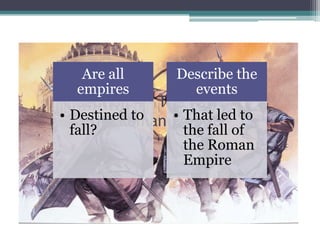
Are all      Describe the
  empires         events
   Section 4 – The Fall of
• Destined to
     the Roman Empire to
                 • That led
 fall?           the fall of
                 the Roman
                 Empire
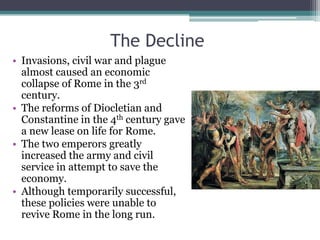
The Decline
• Invasions, civil war and plague
  almost caused an economic
  collapse of Rome in the 3rd
  century.
• The reforms of Diocletian and
  Constantine in the 4th century gave
  a new lease on life for Rome.
• The two emperors greatly
  increased the army and civil
  service in attempt to save the
  economy.
• Although temporarily successful,
  these policies were unable to
  revive Rome in the long run.
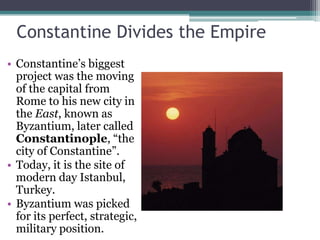
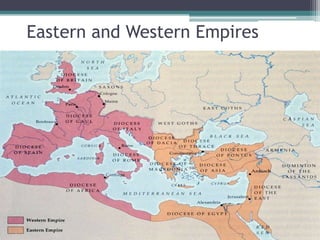
Constantine Divides the Empire
• Constantine’s biggest
  project was the moving
  of the capital from
  Rome to his new city in
  the East, known as
  Byzantium, later called
  Constantinople, “the
  city of Constantine”.
• Today, it is the site of
  modern day Istanbul,
  Turkey.
• Byzantium was picked
  for its perfect, strategic,
  military position.
Eastern and Western Empires
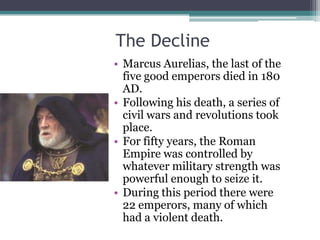
The Decline
• Marcus Aurelias, the last of the
  five good emperors died in 180
  AD.
• Following his death, a series of
  civil wars and revolutions took
  place.
• For fifty years, the Roman
  Empire was controlled by
  whatever military strength was
  powerful enough to seize it.
• During this period there were
  22 emperors, many of which
  had a violent death.
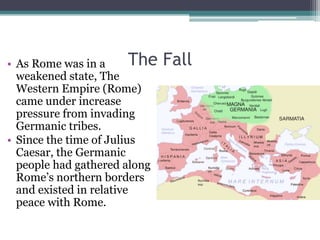
• As Rome was in a       The   Fall
  weakened state, The
  Western Empire (Rome)
  came under increase
  pressure from invading
  Germanic tribes.
• Since the time of Julius
  Caesar, the Germanic
  people had gathered along
  Rome’s northern borders
  and existed in relative
  peace with Rome.
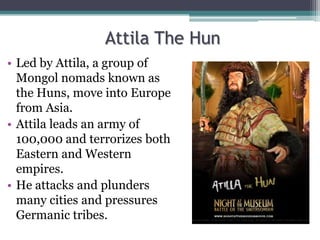
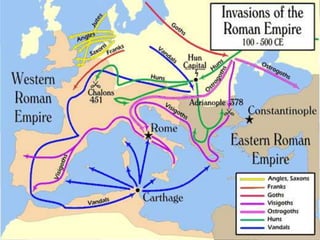
Attila The Hun
• Led by Attila, a group of
  Mongol nomads known as
  the Huns, move into Europe
  from Asia.
• Attila leads an army of
  100,000 and terrorizes both
  Eastern and Western
  empires.
• He attacks and plunders
  many cities and pressures
  Germanic tribes.
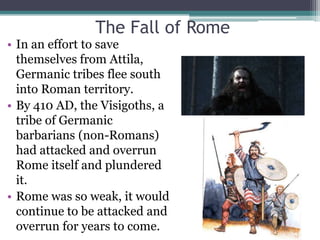
The Fall of Rome
• In an effort to save
  themselves from Attila,
  Germanic tribes flee south
  into Roman territory.
• By 410 AD, the Visigoths, a
  tribe of Germanic
  barbarians (non-Romans)
  had attacked and overrun
  Rome itself and plundered
  it.
• Rome was so weak, it would
  continue to be attacked and
  overrun for years to come.
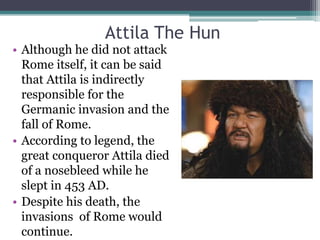
Attila The Hun
• Although he did not attack
  Rome itself, it can be said
  that Attila is indirectly
  responsible for the
  Germanic invasion and the
  fall of Rome.
• According to legend, the
  great conqueror Attila died
  of a nosebleed while he
  slept in 453 AD.
• Despite his death, the
  invasions of Rome would
  continue.
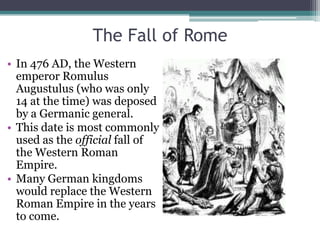
The Fall of Rome
• In 476 AD, the Western
  emperor Romulus
  Augustulus (who was only
  14 at the time) was deposed
  by a Germanic general.
• This date is most commonly
  used as the official fall of
  the Western Roman
  Empire.
• Many German kingdoms
  would replace the Western
  Roman Empire in the years
  to come.
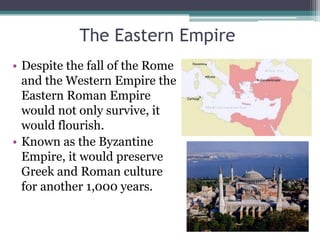
The Eastern Empire
• Despite the fall of the Rome
  and the Western Empire the
  Eastern Roman Empire
  would not only survive, it
  would flourish.
• Known as the Byzantine
  Empire, it would preserve
  Greek and Roman culture
  for another 1,000 years.
Why Did Rome Fall?
• Many theories have been proposed about the fall of
  Rome.
  - Christianity influence on a spiritual kingdom
   weakened the army
  - Traditional Roman values declined as more non-
   Romans gained prominence.
  - Lead poisoning from water pipes and cups caused a
   decline in population
  - Plague wiping out 1/10 of the population
  - Failure to advance in technology because of slavery
  - Unable to put together a workable political system
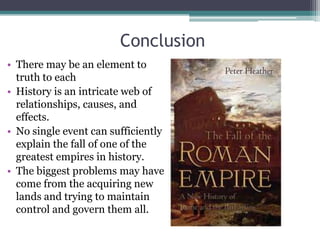
Conclusion
• There may be an element to
  truth to each
• History is an intricate web of
  relationships, causes, and
  effects.
• No single event can sufficiently
  explain the fall of one of the
  greatest empires in history.
• The biggest problems may have
  come from the acquiring new
  lands and trying to maintain
  control and govern them all.
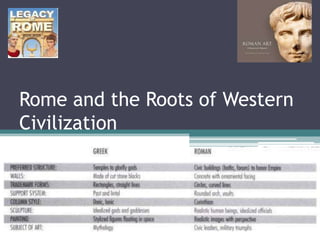
Rome and the Roots of Western
Civilization
1. Identify Roman achievements in
   the arts, sciences and law.
2. Describe the legacy of the Greco-
   Roman civilization
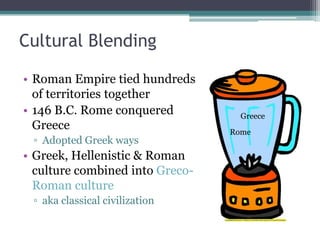
Cultural Blending

• Roman Empire tied hundreds
  of territories together
• 146 B.C. Rome conquered          Greece
  Greece                         Rome
 ▫ Adopted Greek ways
• Greek, Hellenistic & Roman
  culture combined into Greco-
  Roman culture
 ▫ aka classical civilization
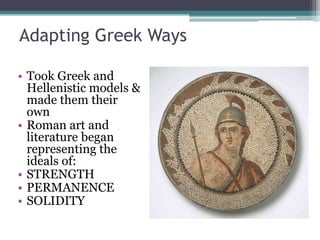
Adapting Greek Ways

• Took Greek and
  Hellenistic models &
  made them their
  own
• Roman art and
  literature began
  representing the
  ideals of:
• STRENGTH
• PERMANENCE
• SOLIDITY
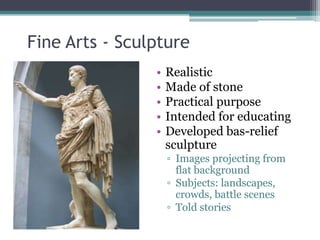
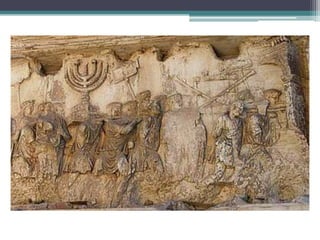
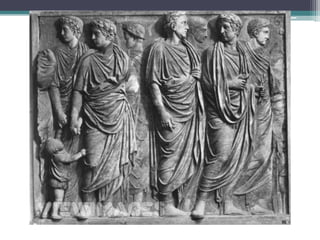
Fine Arts - Sculpture
                •   Realistic
                •   Made of stone
                •   Practical purpose
                •   Intended for educating
                •   Developed bas-relief
                    sculpture
                    ▫ Images projecting from
                      flat background
                    ▫ Subjects: landscapes,
                      crowds, battle scenes
                    ▫ Told stories
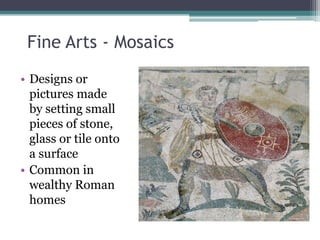
Fine Arts - Mosaics
• Designs or
  pictures made
  by setting small
  pieces of stone,
  glass or tile onto
  a surface
• Common in
  wealthy Roman
  homes
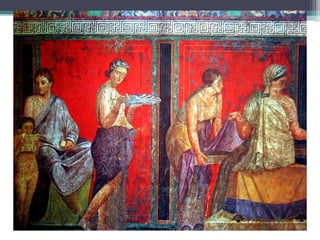
Fine Arts - Painting
• Frescoes
  ▫ Large murals
  ▫ Painted on plaster
  ▫ Colorful
• Very few surviving paintings
• Most remaining found in Pompeii
  ▫ Preserved by ash from Mt. Vesuvius eruption
Philosophy and Literature

• Adopted much of Greek philosophy
• Stoicism popular because of its
  emphasis:
  ▫ Virtue
  ▫ Duty
  ▫ Moderation
  ▫ Endurance
Literature

• Followed Greek literary   • Virgil
  forms and models            ▫ Wrote the Aeneid
  ▫ Ex: epic                  ▫ Modeled off
• Used own themes and           Homer’s epics
  ideas                       ▫ Praised Roman
• Ovid                          virtues and
  ▫ Light, funny poet           government
  ▫ Amores                    ▫ Seriousness of
  ▫ Written for enjoyment       Roman character
Historians
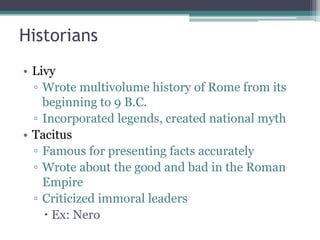
• Livy
  ▫ Wrote multivolume history of Rome from its
    beginning to 9 B.C.
  ▫ Incorporated legends, created national myth
• Tacitus
  ▫ Famous for presenting facts accurately
  ▫ Wrote about the good and bad in the Roman
    Empire
  ▫ Criticized immoral leaders
     Ex: Nero
Rome’s Lasting Legacy

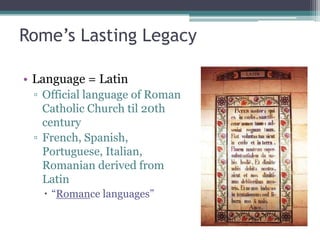
• Language = Latin
 ▫ Official language of Roman
   Catholic Church til 20th
   century
 ▫ French, Spanish,
   Portuguese, Italian,
   Romanian derived from
   Latin
    “Romance languages”
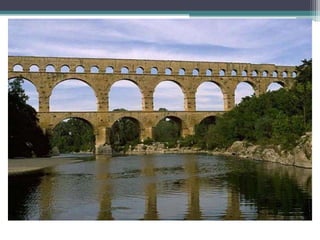
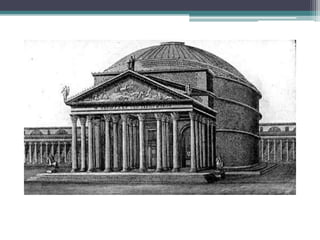
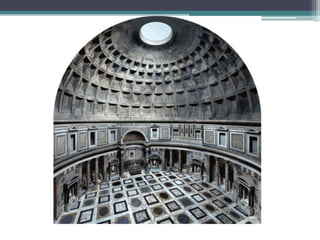
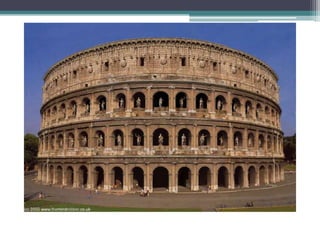
Architecture
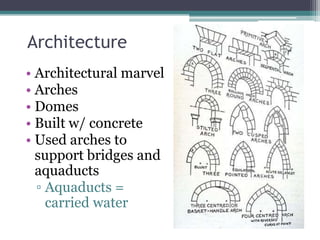
• Architectural marvel
• Arches
• Domes
• Built w/ concrete
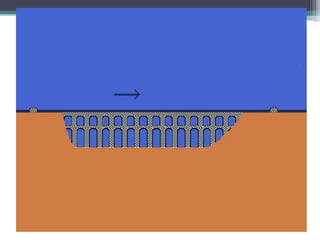
• Used arches to
  support bridges and
  aquaducts
  ▫ Aquaducts =
    carried water
Roman System of Law
• Most widespread, lasting contribution
• Romans came to believe laws should
  be fair & equal to all (rich and poor)
• Judges began to recognize set
  standards for justice
  ▫ Influenced by Stoicism
  ▫ Based on common sense
Roman System of Law
• Most important principals:
 ▫ All have right to equal treatment under law
 ▫ Innocent until proven guilty
 ▫ Accuser must provide proof, not the accused
 ▫ People should only be punishable for actions
    Not thoughts
 ▫ Unreasonable, extremely unfair laws can be set
   aside
• Basis of legal systems in Europe, USA, etc.
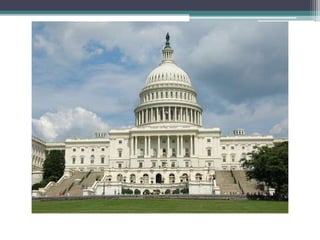
Rome’s Lasting Influence
• Continued, added
  Greek civilization
• Strong cultural
  tradition
• Left an enduring
  legacy even after
  fall of Rome

6.4.5 conclusion

  • 1.
    Are all Describe the empires events Section 4 – The Fall of • Destined to the Roman Empire to • That led fall? the fall of the Roman Empire
  • 2.
    The Decline • Invasions,civil war and plague almost caused an economic collapse of Rome in the 3rd century. • The reforms of Diocletian and Constantine in the 4th century gave a new lease on life for Rome. • The two emperors greatly increased the army and civil service in attempt to save the economy. • Although temporarily successful, these policies were unable to revive Rome in the long run.
  • 3.
    Constantine Divides theEmpire • Constantine’s biggest project was the moving of the capital from Rome to his new city in the East, known as Byzantium, later called Constantinople, “the city of Constantine”. • Today, it is the site of modern day Istanbul, Turkey. • Byzantium was picked for its perfect, strategic, military position.
  • 4.
  • 5.
    The Decline • MarcusAurelias, the last of the five good emperors died in 180 AD. • Following his death, a series of civil wars and revolutions took place. • For fifty years, the Roman Empire was controlled by whatever military strength was powerful enough to seize it. • During this period there were 22 emperors, many of which had a violent death.
  • 6.
    • As Romewas in a The Fall weakened state, The Western Empire (Rome) came under increase pressure from invading Germanic tribes. • Since the time of Julius Caesar, the Germanic people had gathered along Rome’s northern borders and existed in relative peace with Rome.
  • 7.
    Attila The Hun •Led by Attila, a group of Mongol nomads known as the Huns, move into Europe from Asia. • Attila leads an army of 100,000 and terrorizes both Eastern and Western empires. • He attacks and plunders many cities and pressures Germanic tribes.
  • 8.
    The Fall ofRome • In an effort to save themselves from Attila, Germanic tribes flee south into Roman territory. • By 410 AD, the Visigoths, a tribe of Germanic barbarians (non-Romans) had attacked and overrun Rome itself and plundered it. • Rome was so weak, it would continue to be attacked and overrun for years to come.
  • 9.
    Attila The Hun •Although he did not attack Rome itself, it can be said that Attila is indirectly responsible for the Germanic invasion and the fall of Rome. • According to legend, the great conqueror Attila died of a nosebleed while he slept in 453 AD. • Despite his death, the invasions of Rome would continue.
  • 11.
    The Fall ofRome • In 476 AD, the Western emperor Romulus Augustulus (who was only 14 at the time) was deposed by a Germanic general. • This date is most commonly used as the official fall of the Western Roman Empire. • Many German kingdoms would replace the Western Roman Empire in the years to come.
  • 12.
    The Eastern Empire •Despite the fall of the Rome and the Western Empire the Eastern Roman Empire would not only survive, it would flourish. • Known as the Byzantine Empire, it would preserve Greek and Roman culture for another 1,000 years.
  • 13.
    Why Did RomeFall? • Many theories have been proposed about the fall of Rome.  - Christianity influence on a spiritual kingdom weakened the army  - Traditional Roman values declined as more non- Romans gained prominence.  - Lead poisoning from water pipes and cups caused a decline in population  - Plague wiping out 1/10 of the population  - Failure to advance in technology because of slavery  - Unable to put together a workable political system
  • 14.
    Conclusion • There maybe an element to truth to each • History is an intricate web of relationships, causes, and effects. • No single event can sufficiently explain the fall of one of the greatest empires in history. • The biggest problems may have come from the acquiring new lands and trying to maintain control and govern them all.
  • 15.
    Rome and theRoots of Western Civilization
  • 16.
    1. Identify Romanachievements in the arts, sciences and law. 2. Describe the legacy of the Greco- Roman civilization
  • 17.
    Cultural Blending • RomanEmpire tied hundreds of territories together • 146 B.C. Rome conquered Greece Greece Rome ▫ Adopted Greek ways • Greek, Hellenistic & Roman culture combined into Greco- Roman culture ▫ aka classical civilization
  • 18.
    Adapting Greek Ways •Took Greek and Hellenistic models & made them their own • Roman art and literature began representing the ideals of: • STRENGTH • PERMANENCE • SOLIDITY
  • 19.
    Fine Arts -Sculpture • Realistic • Made of stone • Practical purpose • Intended for educating • Developed bas-relief sculpture ▫ Images projecting from flat background ▫ Subjects: landscapes, crowds, battle scenes ▫ Told stories
  • 22.
    Fine Arts -Mosaics • Designs or pictures made by setting small pieces of stone, glass or tile onto a surface • Common in wealthy Roman homes
  • 23.
    Fine Arts -Painting • Frescoes ▫ Large murals ▫ Painted on plaster ▫ Colorful • Very few surviving paintings • Most remaining found in Pompeii ▫ Preserved by ash from Mt. Vesuvius eruption
  • 25.
    Philosophy and Literature •Adopted much of Greek philosophy • Stoicism popular because of its emphasis: ▫ Virtue ▫ Duty ▫ Moderation ▫ Endurance
  • 26.
    Literature • Followed Greekliterary • Virgil forms and models ▫ Wrote the Aeneid ▫ Ex: epic ▫ Modeled off • Used own themes and Homer’s epics ideas ▫ Praised Roman • Ovid virtues and ▫ Light, funny poet government ▫ Amores ▫ Seriousness of ▫ Written for enjoyment Roman character
  • 28.
    Historians • Livy ▫ Wrote multivolume history of Rome from its beginning to 9 B.C. ▫ Incorporated legends, created national myth • Tacitus ▫ Famous for presenting facts accurately ▫ Wrote about the good and bad in the Roman Empire ▫ Criticized immoral leaders  Ex: Nero
  • 29.
    Rome’s Lasting Legacy •Language = Latin ▫ Official language of Roman Catholic Church til 20th century ▫ French, Spanish, Portuguese, Italian, Romanian derived from Latin  “Romance languages”
  • 30.
    Architecture • Architectural marvel •Arches • Domes • Built w/ concrete • Used arches to support bridges and aquaducts ▫ Aquaducts = carried water
  • 37.
    Roman System ofLaw • Most widespread, lasting contribution • Romans came to believe laws should be fair & equal to all (rich and poor) • Judges began to recognize set standards for justice ▫ Influenced by Stoicism ▫ Based on common sense
  • 38.
    Roman System ofLaw • Most important principals: ▫ All have right to equal treatment under law ▫ Innocent until proven guilty ▫ Accuser must provide proof, not the accused ▫ People should only be punishable for actions  Not thoughts ▫ Unreasonable, extremely unfair laws can be set aside • Basis of legal systems in Europe, USA, etc.
  • 39.
    Rome’s Lasting Influence •Continued, added Greek civilization • Strong cultural tradition • Left an enduring legacy even after fall of Rome