Power
Transformer
Protection
Ang Sovann 1
National Polytechnic Institute of Cambodia
2
Introduction
 Transformer is a static device used to transform the
electrical energy from one alternating current circuit to
another without any change in frequency.
 Power Transformer is a vital link in a power transmission
system and distribution.
3
Introduction
 A Power Transformer is an expensive part of a power
network.
 The impact of a transformer outage due to fault is more
serious than a transmission line outage.
4
Transformer Protection
 The type of protection for the transformers varies depending
on the application and the importance of the transformer.
 Transformers are protected primarily against faults and
overloads.
 The type of protection used should minimize the time of
disconnection for faults within the transformer and to reduce
the risk of catastrophic failure.
5
Why use transformer ???
 To reduce of transmission losses.
 For increasing the low voltage level to high voltage level.
 The voltage level of a power is increased, the current of the
power is reduced which causes reduction in ohm or I2R
losses in the system.
 Low level power must be stepped up for efficient electrical
power transmission.
6
Why transformer protection ???
 To Protect the Transformer from severe damages.
 Time required to rectify the Transformer in case of
damages is more and it is very difficult.
 Operation of a power network when the power
transformer is out of service is always difficult.
7
Why transformer protection ???
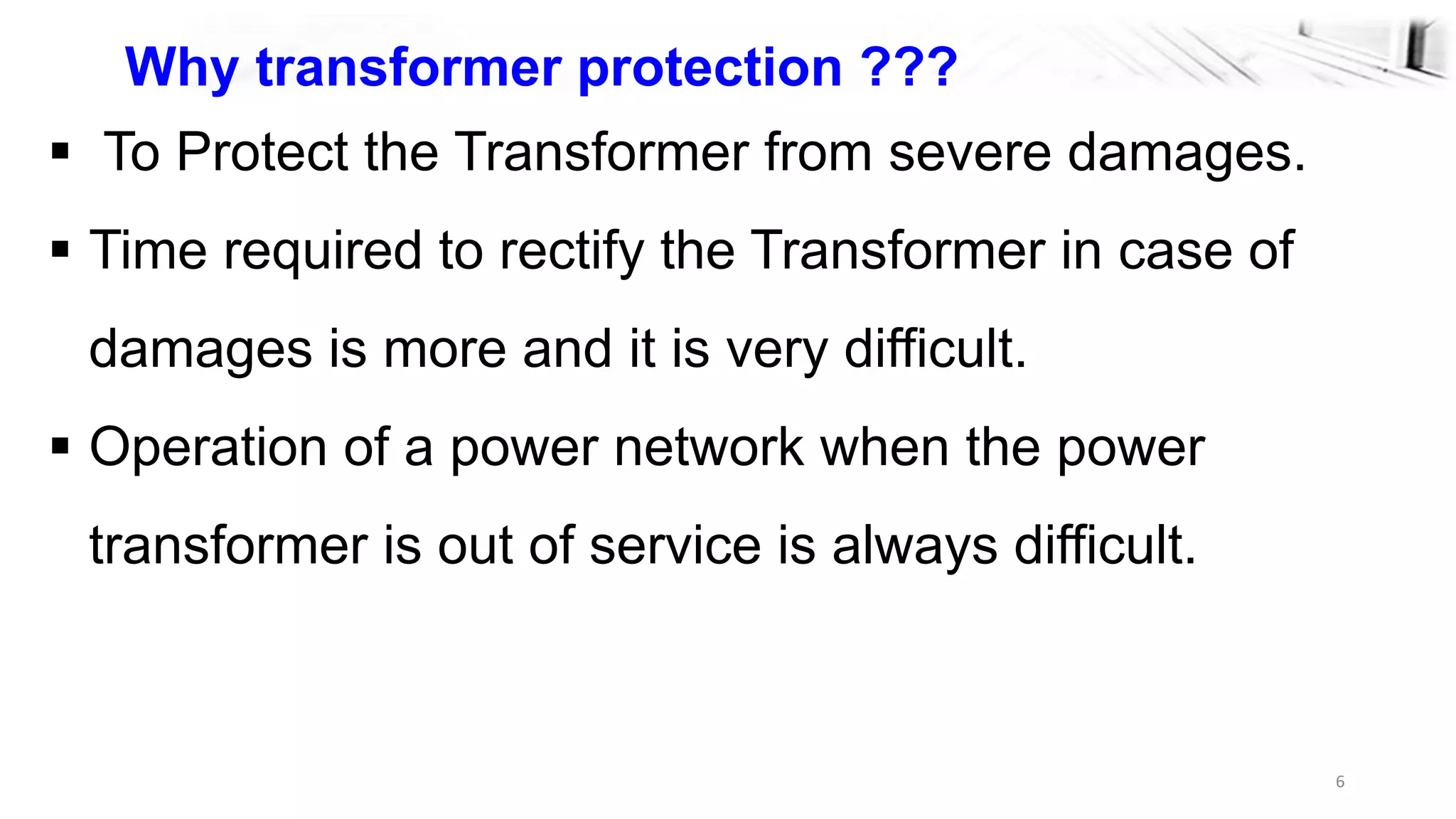
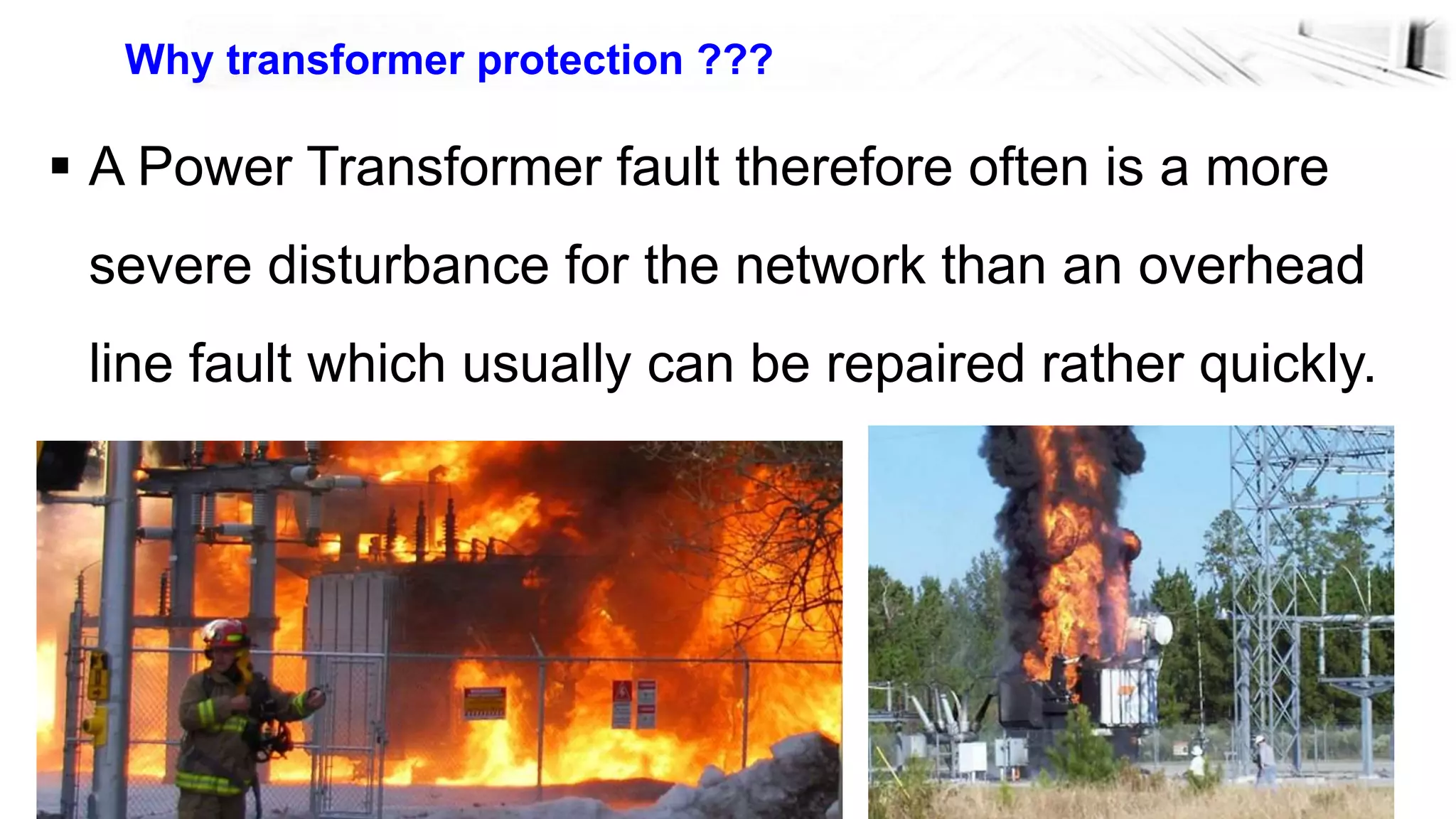
 A Power Transformer fault therefore often is a more
severe disturbance for the network than an overhead
line fault which usually can be repaired rather quickly.
8
Induction Law
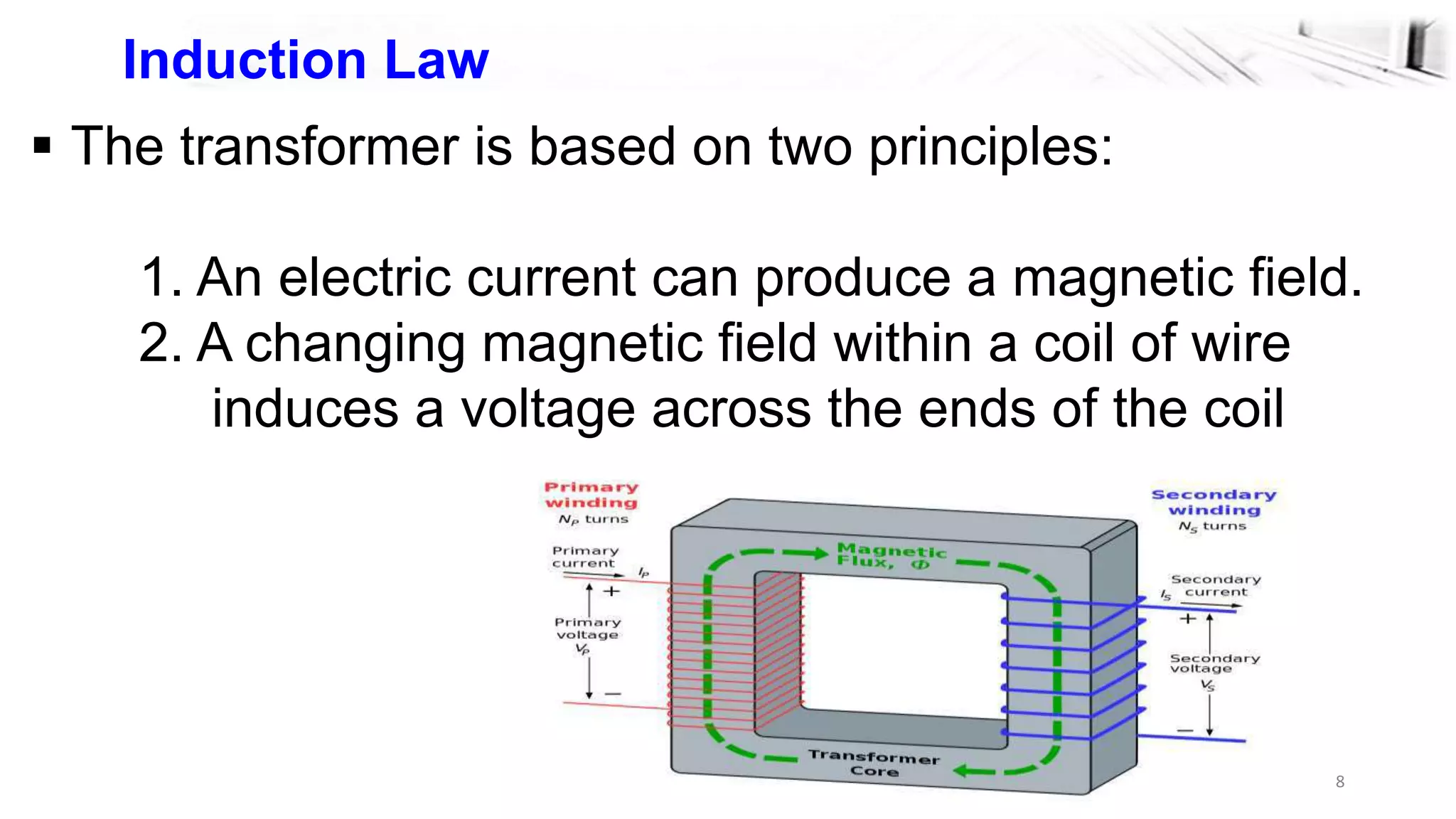
 The transformer is based on two principles:
1. An electric current can produce a magnetic field.
2. A changing magnetic field within a coil of wire
induces a voltage across the ends of the coil
9
Power Transformer
 Term power transformer is used to refer to those transformers used in the
generator and the distribution circuits, and these are usually rated at 500 KVA
and above.
 Power systems typically consist of a large number of generation locations,
distribution points, and interconnections within the system or with nearby
systems, such as a neighboring utility.
 The complexity of the system leads to a variety of transmission and distribution
voltages.
 Power transformers must be used at each of these points where there is a
transition between voltage levels.
10
Power Transformer
 Term power transformer is used to refer to those
transformers used in the generator and the distribution
circuits, and these are usually rated at 500 KVA and
above.
 Power systems typically consist of a large number of
generation locations, distribution points, and
interconnections within the system or with nearby
systems, such as a neighboring utility.
11
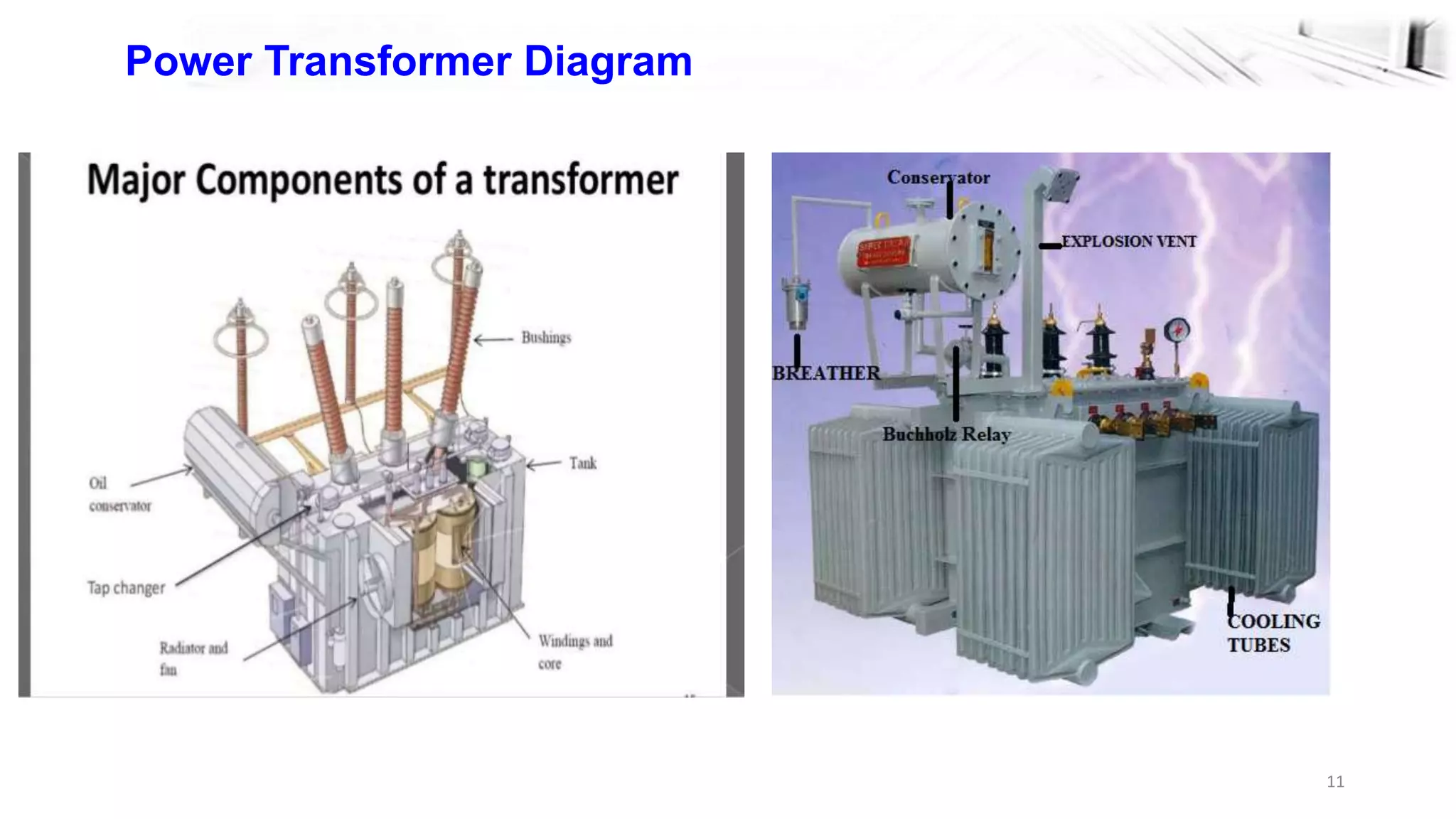
Power Transformer Diagram
12
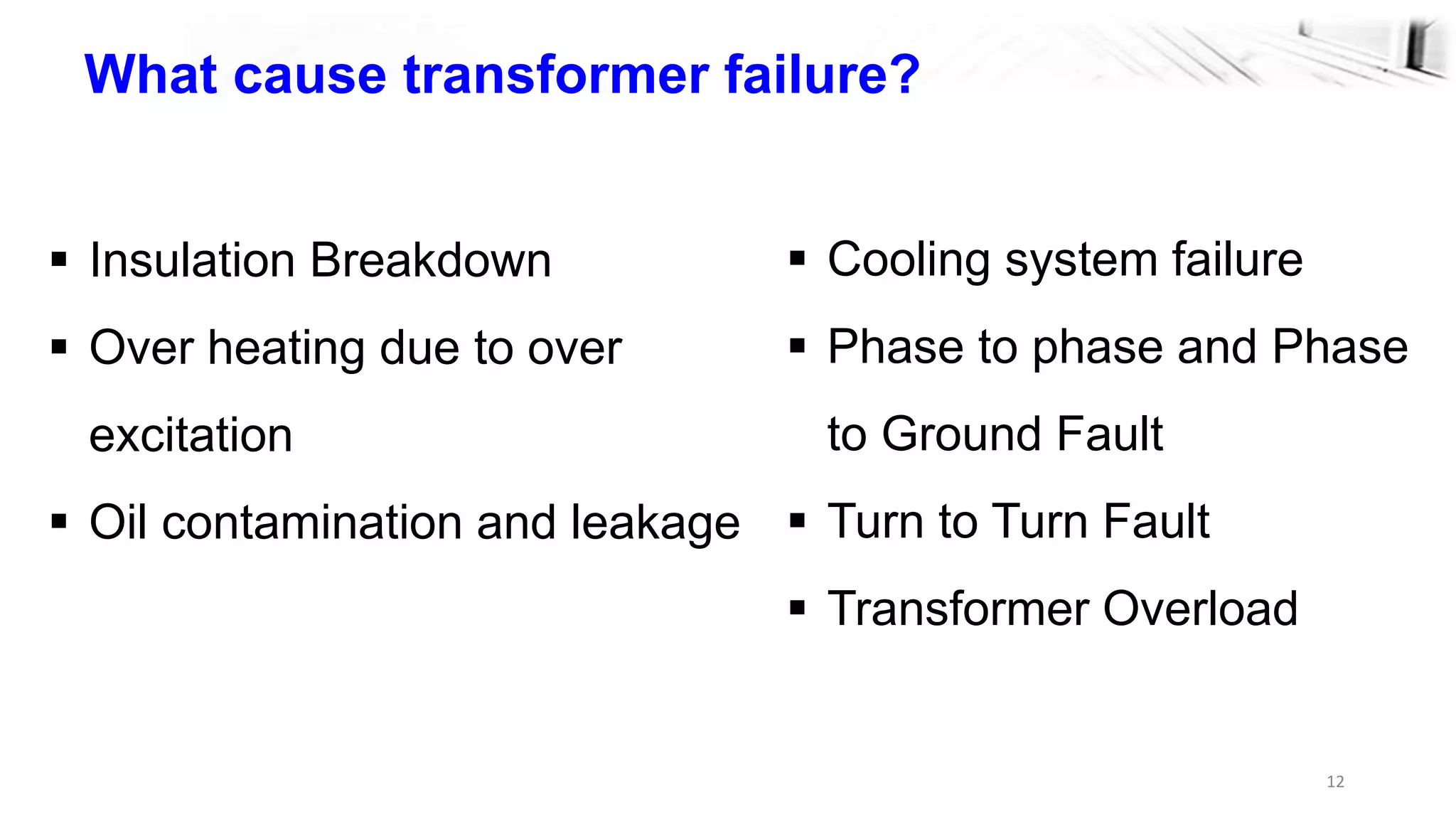
What cause transformer failure?
 Insulation Breakdown
 Over heating due to over
excitation
 Oil contamination and leakage
 Cooling system failure
 Phase to phase and Phase
to Ground Fault
 Turn to Turn Fault
 Transformer Overload
13
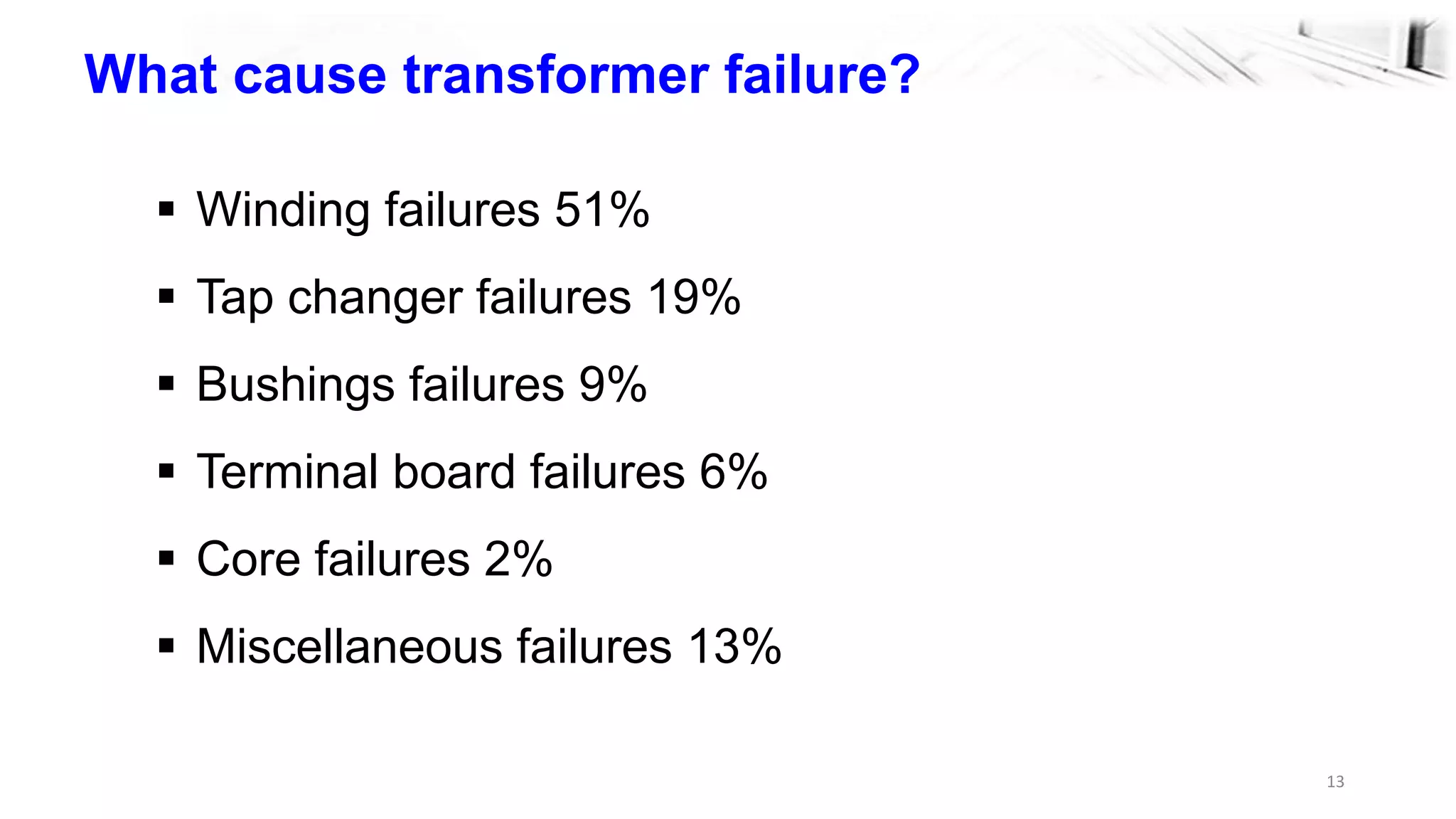
What cause transformer failure?
 Winding failures 51%
 Tap changer failures 19%
 Bushings failures 9%
 Terminal board failures 6%
 Core failures 2%
 Miscellaneous failures 13%
14
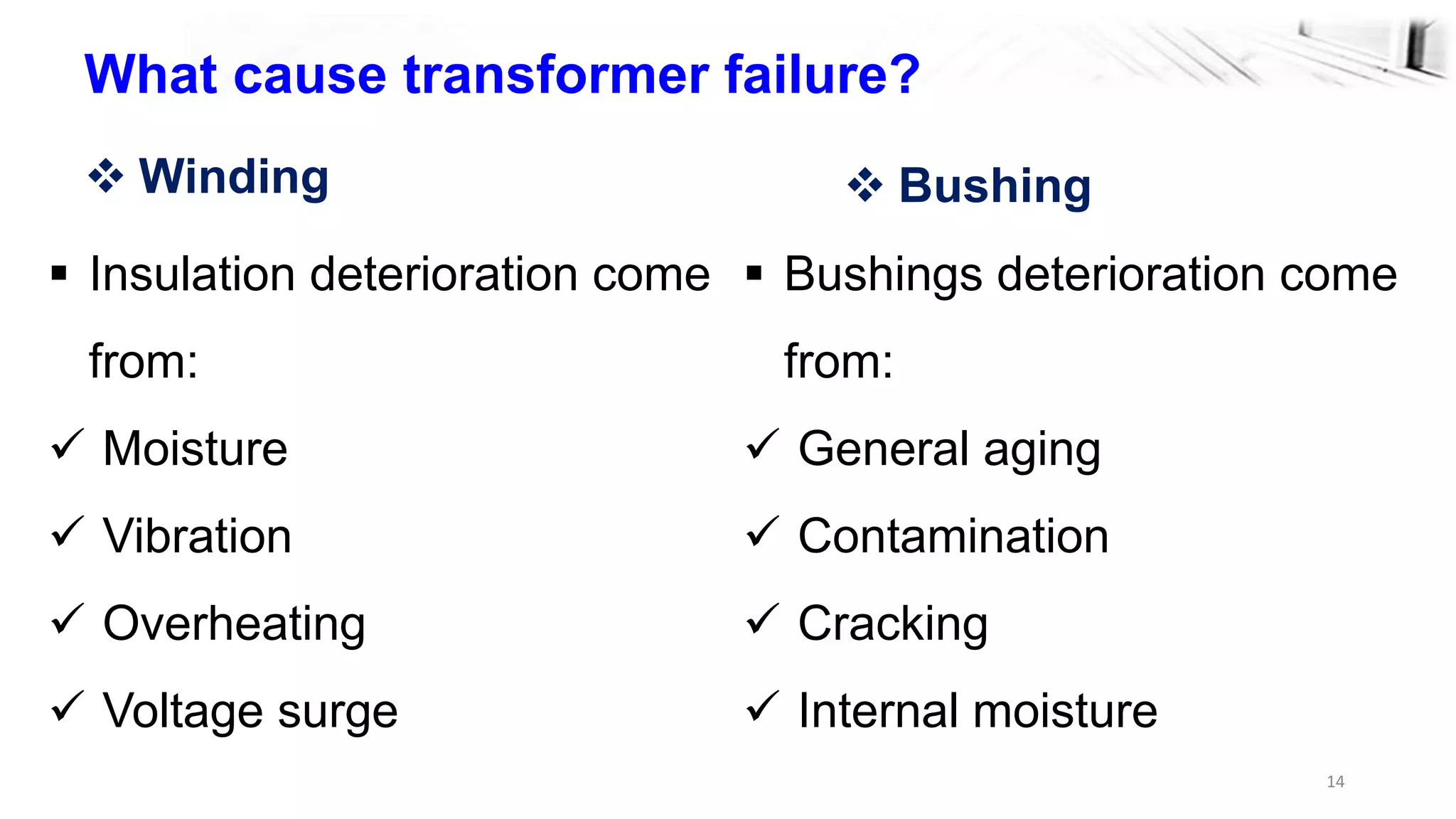
What cause transformer failure?
 Insulation deterioration come
from:
 Moisture
 Vibration
 Overheating
 Voltage surge
 Winding  Bushing
 Bushings deterioration come
from:
 General aging
 Contamination
 Cracking
 Internal moisture
15
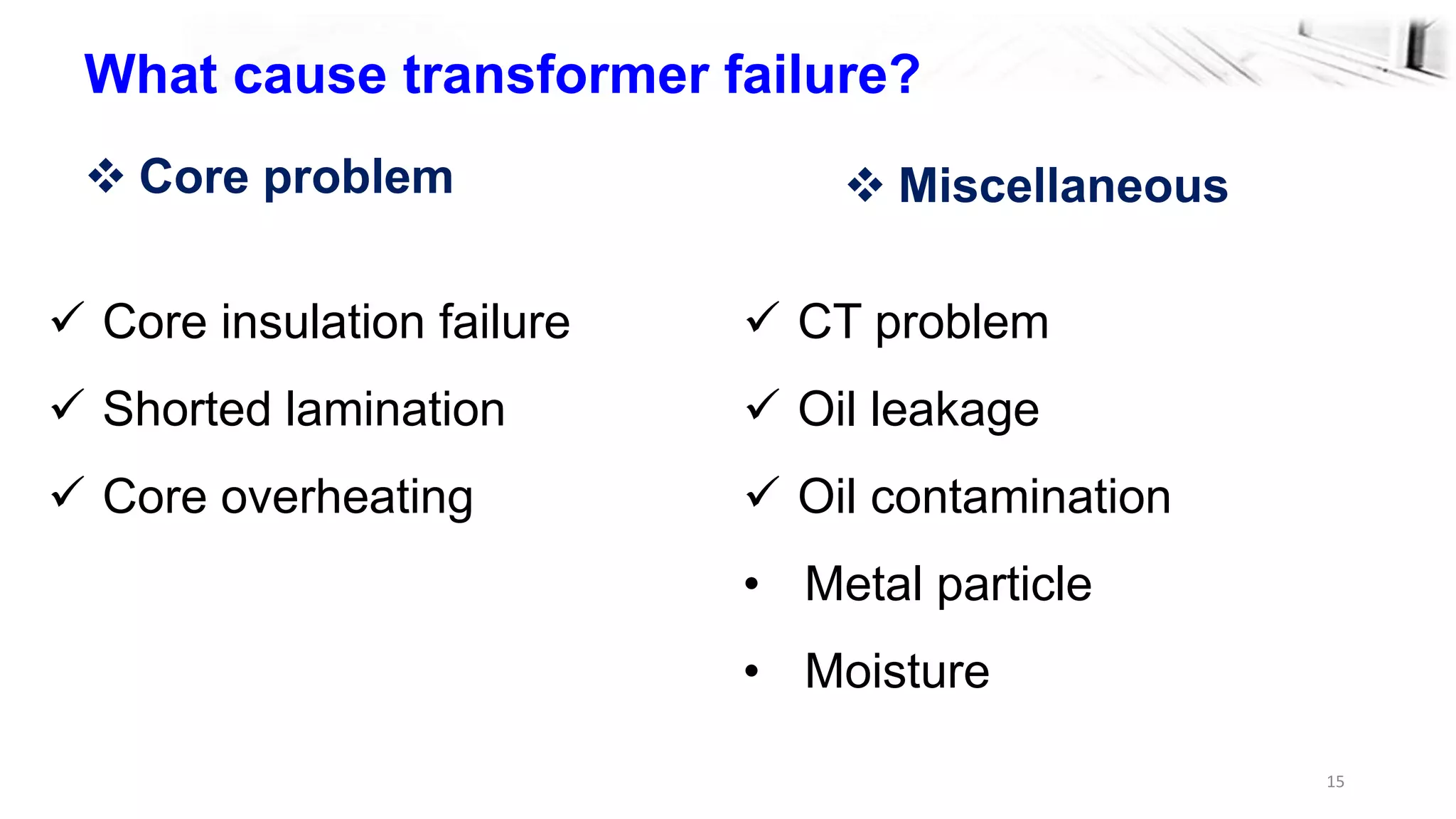
What cause transformer failure?
 Core insulation failure
 Shorted lamination
 Core overheating
 Core problem  Miscellaneous
 CT problem
 Oil leakage
 Oil contamination
• Metal particle
• Moisture
16
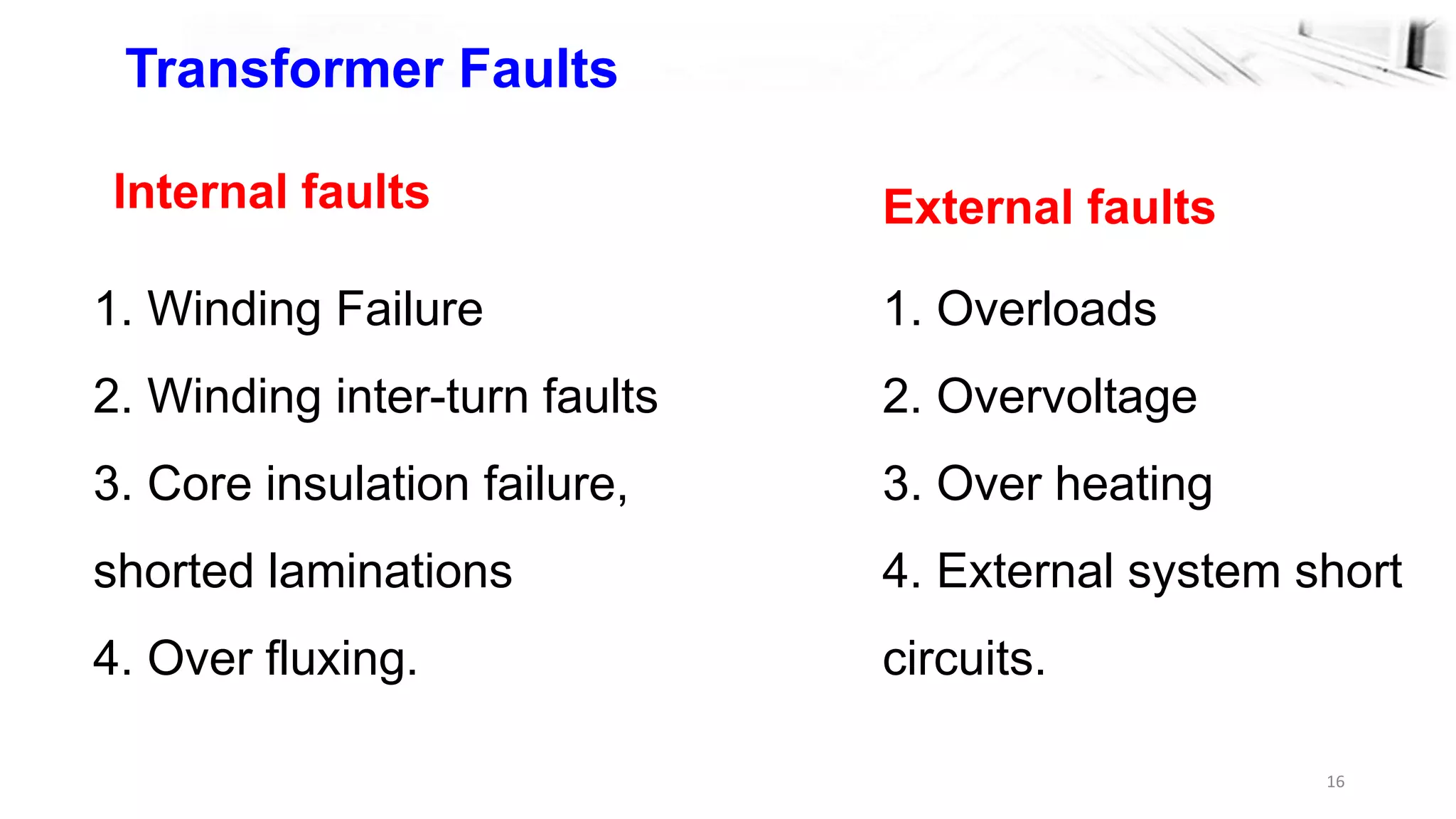
Transformer Faults
Internal faults
1. Winding Failure
2. Winding inter-turn faults
3. Core insulation failure,
shorted laminations
4. Over fluxing.
External faults
1. Overloads
2. Overvoltage
3. Over heating
4. External system short
circuits.
17
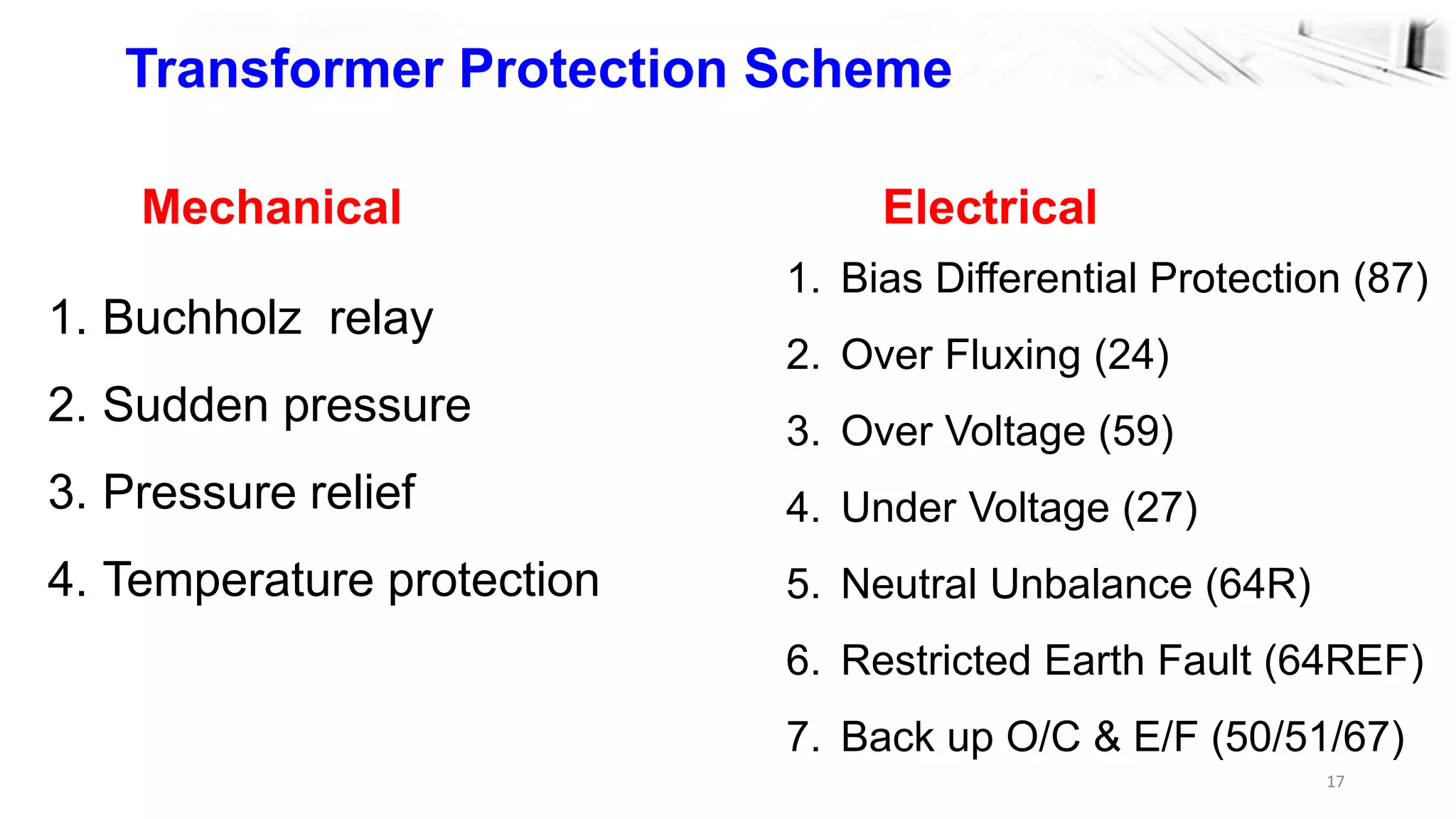
Transformer Protection Scheme
Mechanical
1. Buchholz relay
2. Sudden pressure
3. Pressure relief
4. Temperature protection
Electrical
1. Bias Differential Protection (87)
2. Over Fluxing (24)
3. Over Voltage (59)
4. Under Voltage (27)
5. Neutral Unbalance (64R)
6. Restricted Earth Fault (64REF)
7. Back up O/C & E/F (50/51/67)
18
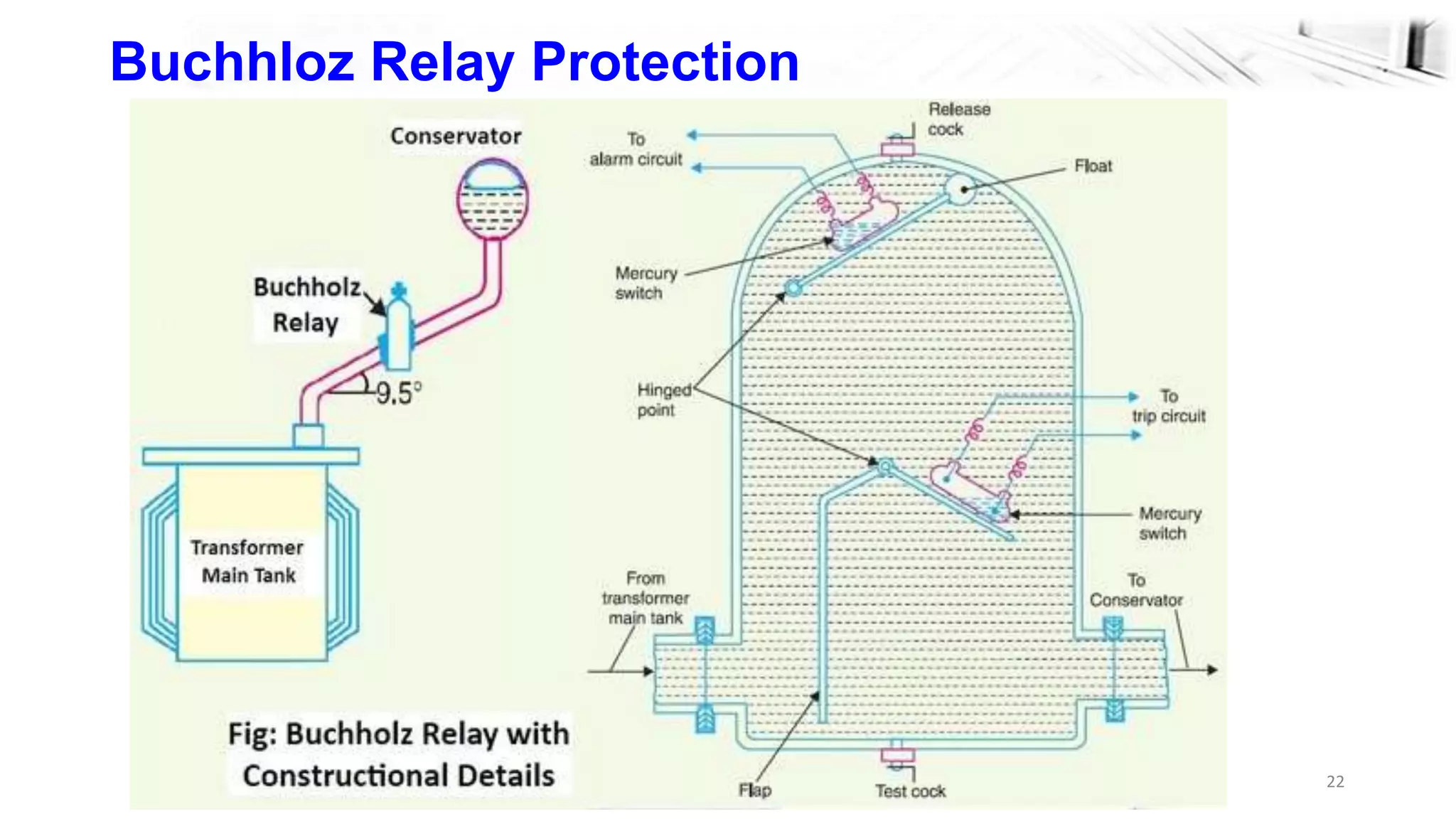
Buchhloz Relay Protection
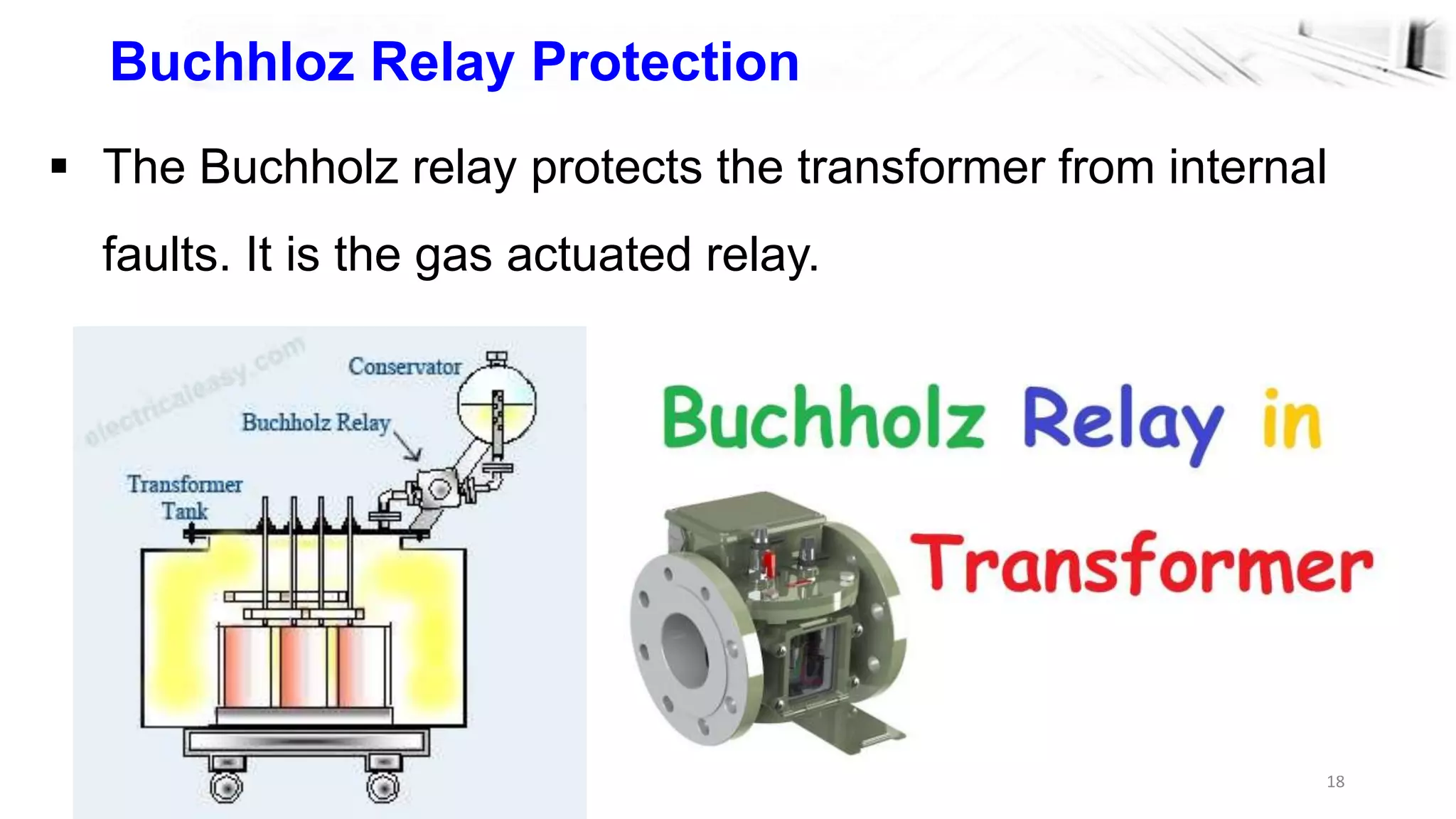
 The Buchholz relay protects the transformer from internal
faults. It is the gas actuated relay.
19
Buchhloz Relay Protection
20
Buchhloz Relay Protection
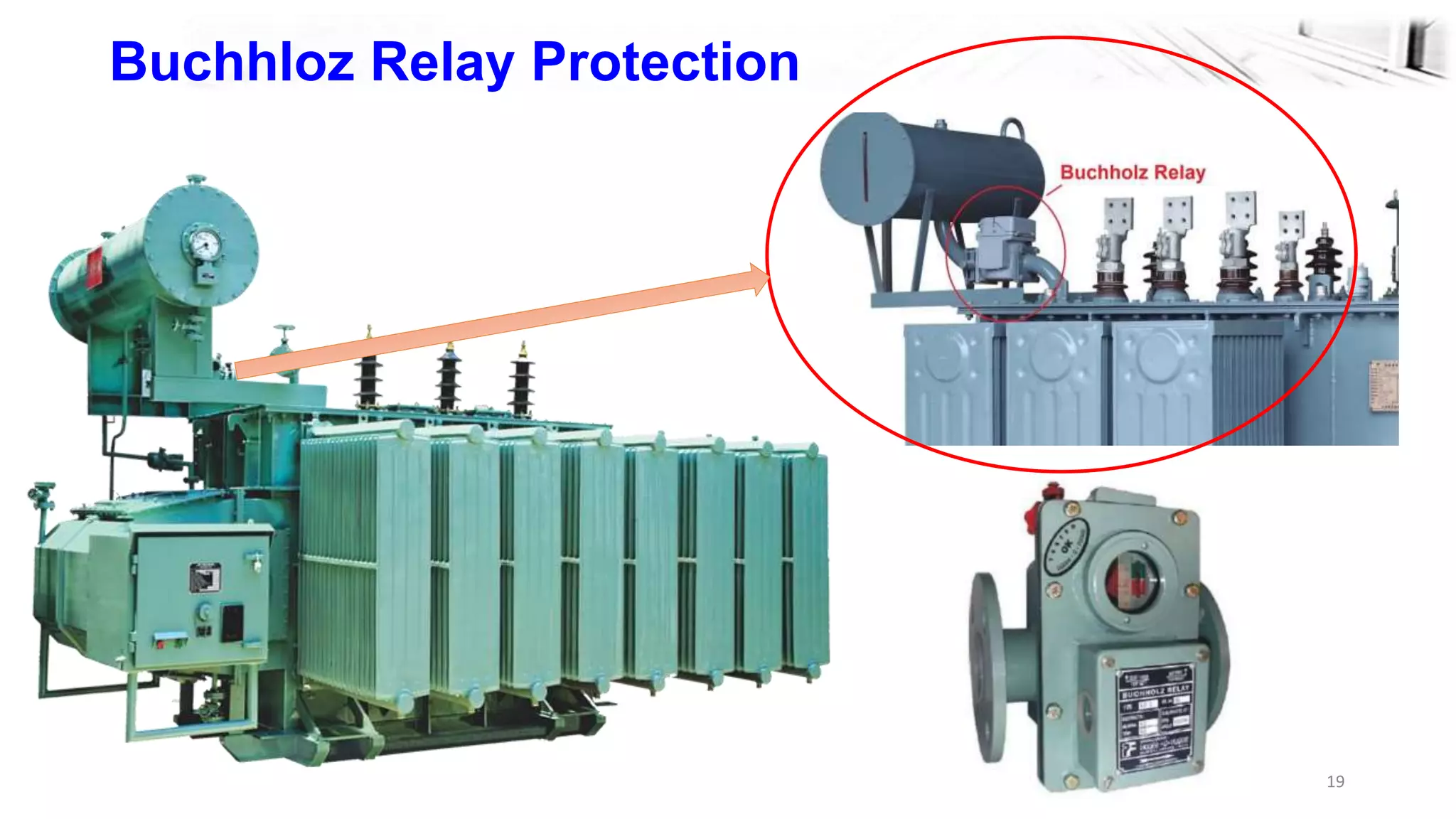
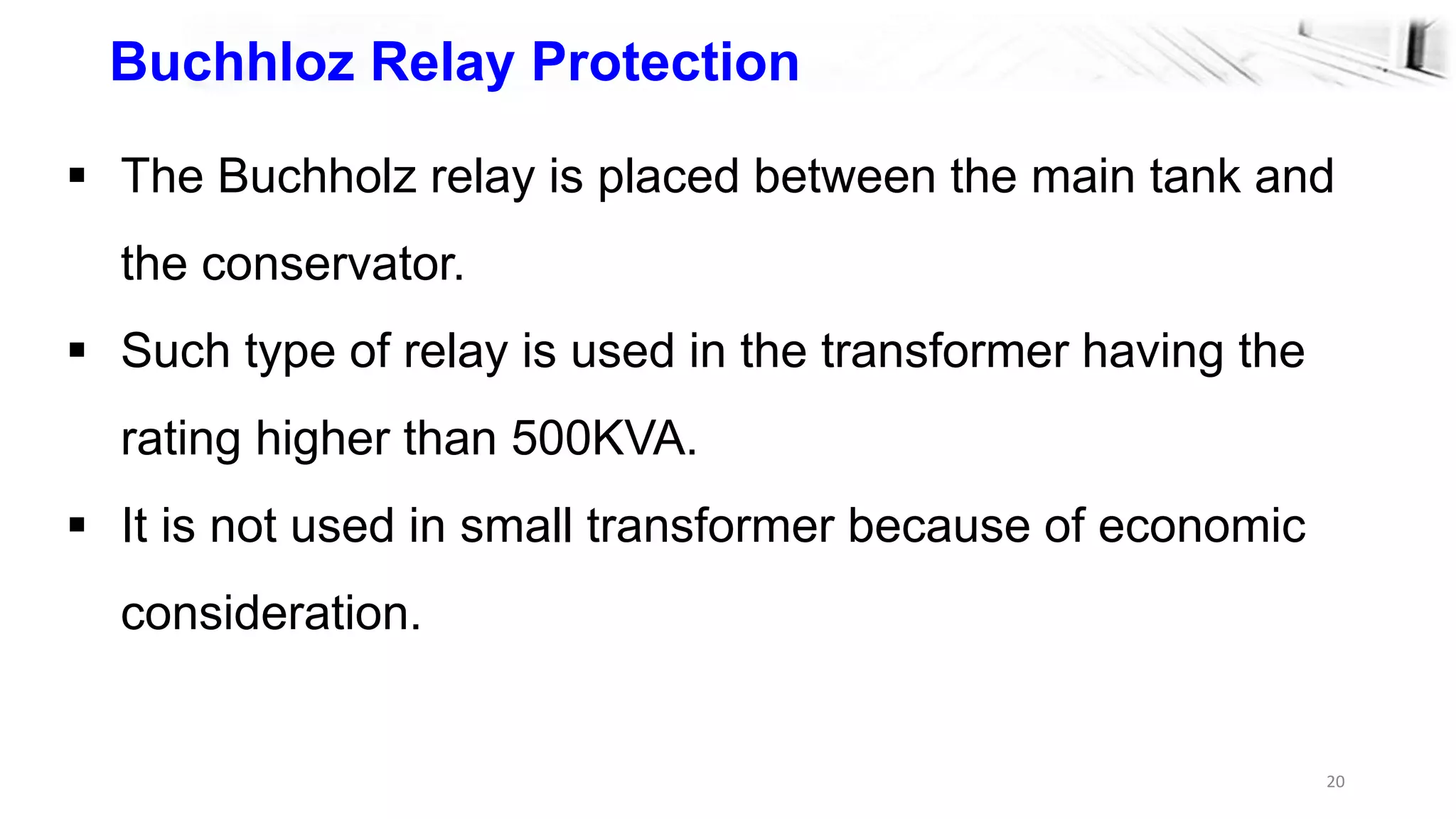
 The Buchholz relay is placed between the main tank and
the conservator.
 Such type of relay is used in the transformer having the
rating higher than 500KVA.
 It is not used in small transformer because of economic
consideration.
21
Buchhloz Relay Protection
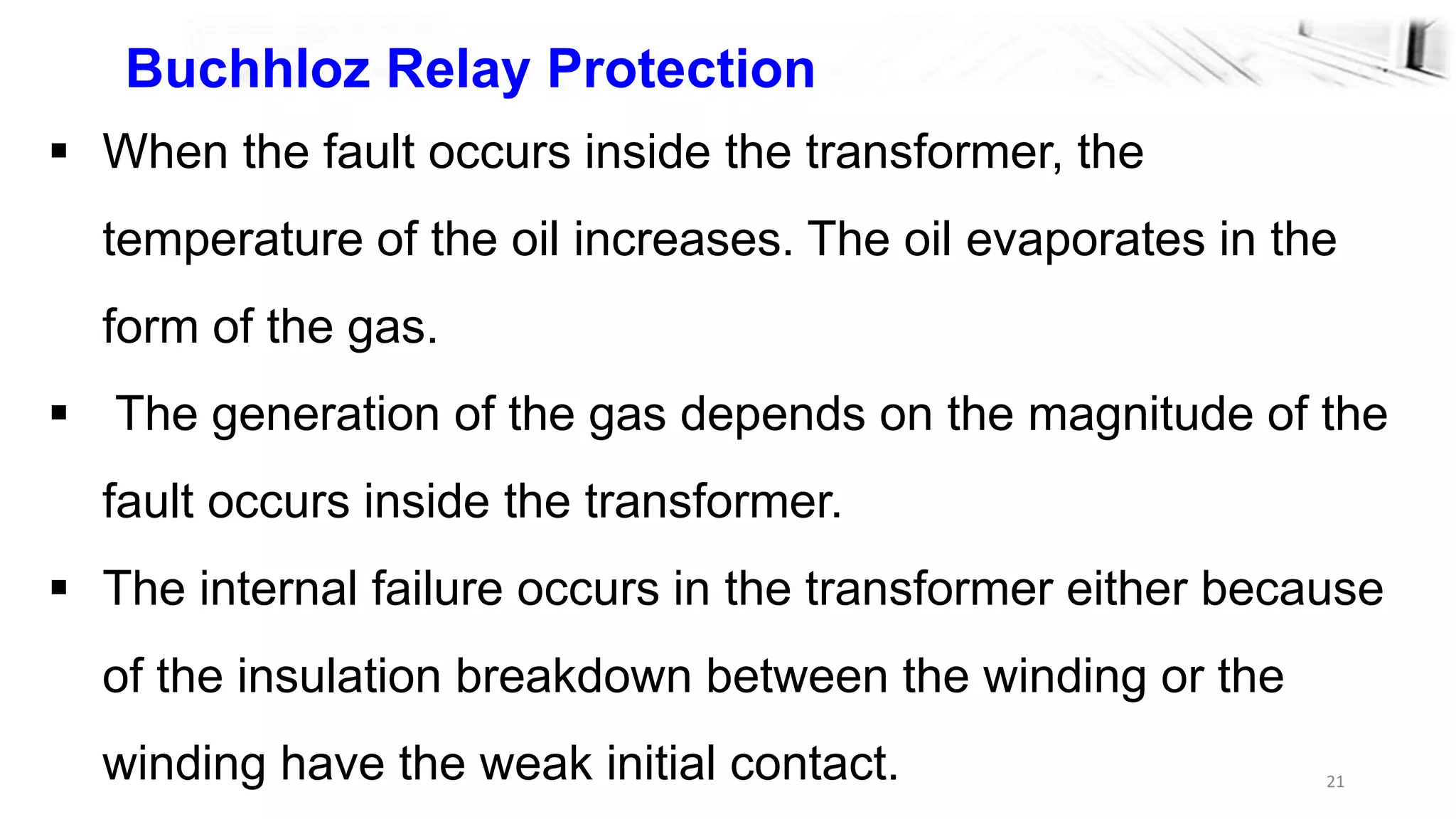
 When the fault occurs inside the transformer, the
temperature of the oil increases. The oil evaporates in the
form of the gas.
 The generation of the gas depends on the magnitude of the
fault occurs inside the transformer.
 The internal failure occurs in the transformer either because
of the insulation breakdown between the winding or the
winding have the weak initial contact.
22
Buchhloz Relay Protection
23
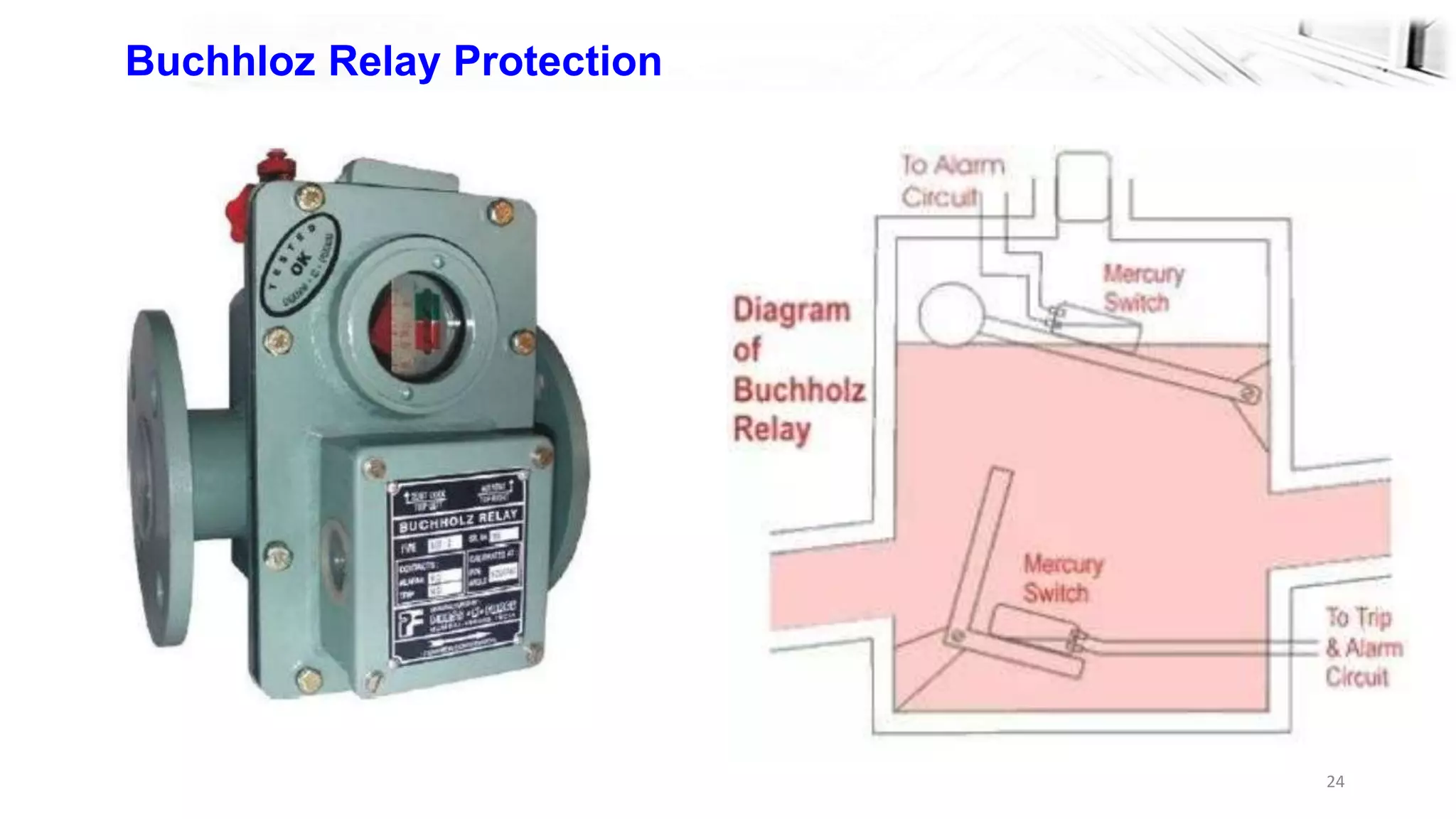
Buchhloz Relay Protection
 The relay has two elements 1st stage and 2nd stage. The 1st stage
for alarm and the 2nd stage for trip.
 The 1st stage work on the accumulation of sufficient gas in the relay
chamber and the 2nd stage work on the high velocity of oil caused
due to evolution of gases as a result of high energy faults.
 The setting of 1st stage is done at collected gas volume of 300 to
500ml.
 The setting of 2nd stage is done at oil flow velocity of 100cm/s .
24
Buchhloz Relay Protection
25
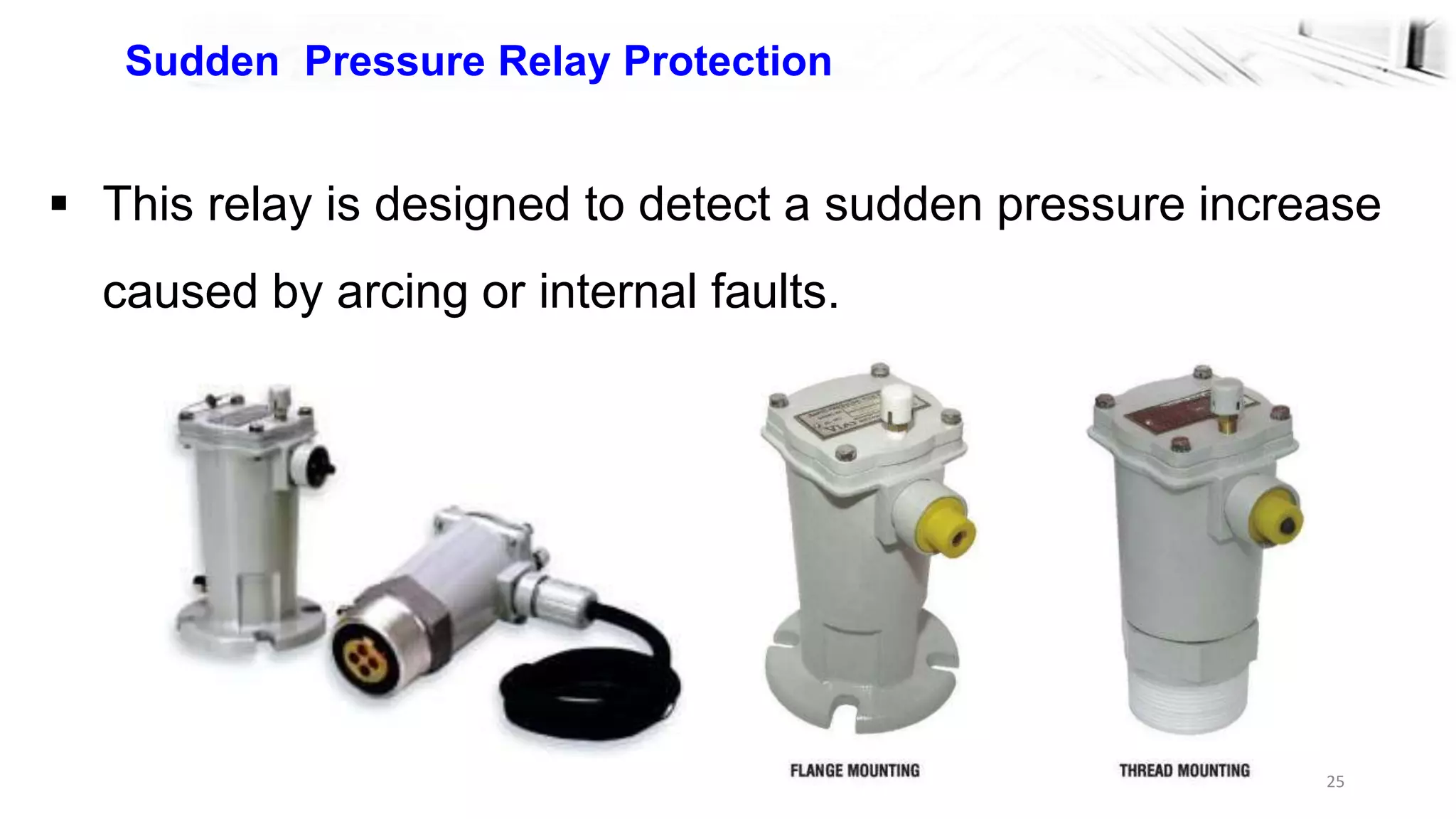
Sudden Pressure Relay Protection
 This relay is designed to detect a sudden pressure increase
caused by arcing or internal faults.
26
Sudden Pressure Relay Protection
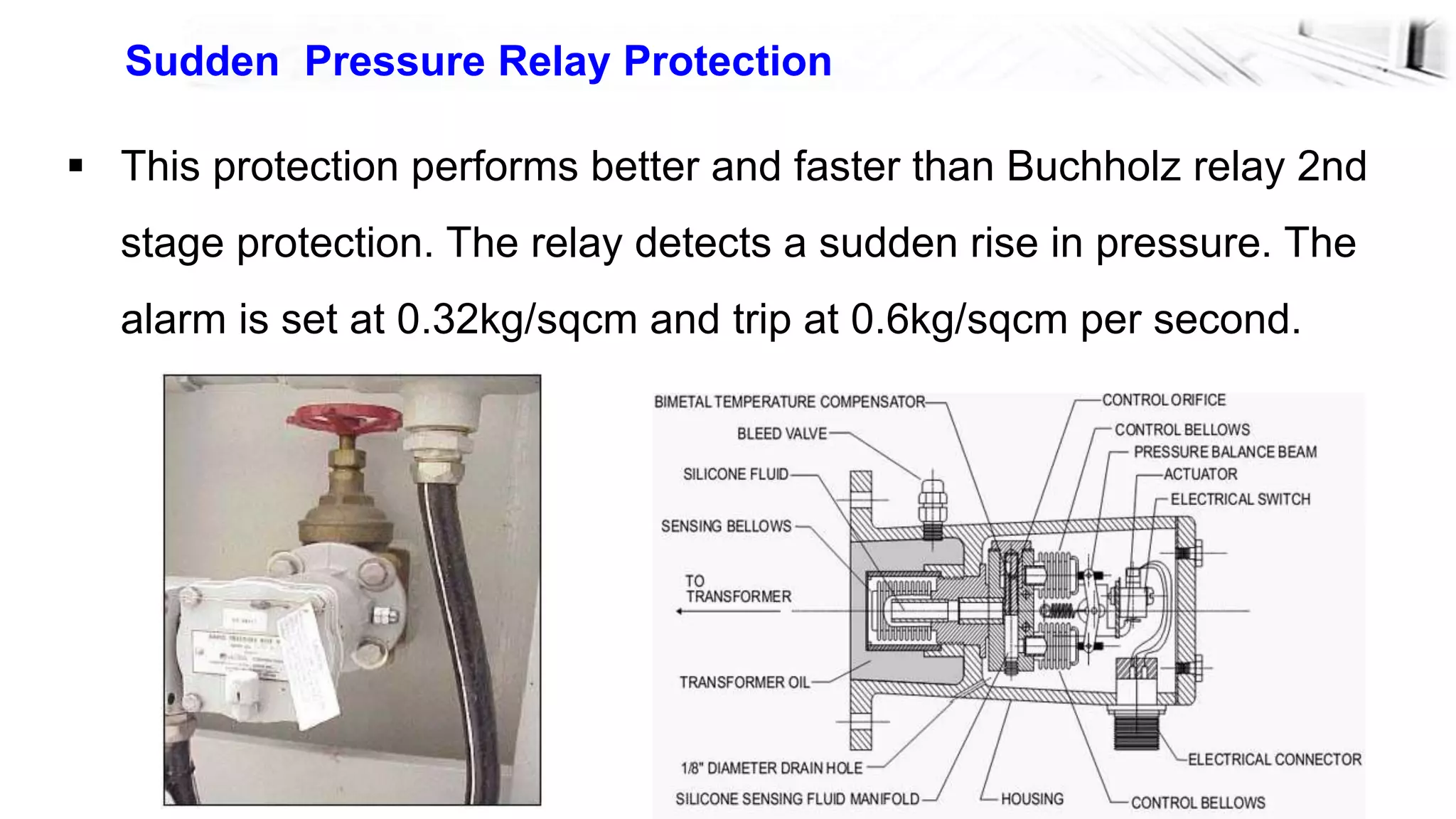
 This protection performs better and faster than Buchholz relay 2nd
stage protection. The relay detects a sudden rise in pressure. The
alarm is set at 0.32kg/sqcm and trip at 0.6kg/sqcm per second.
27
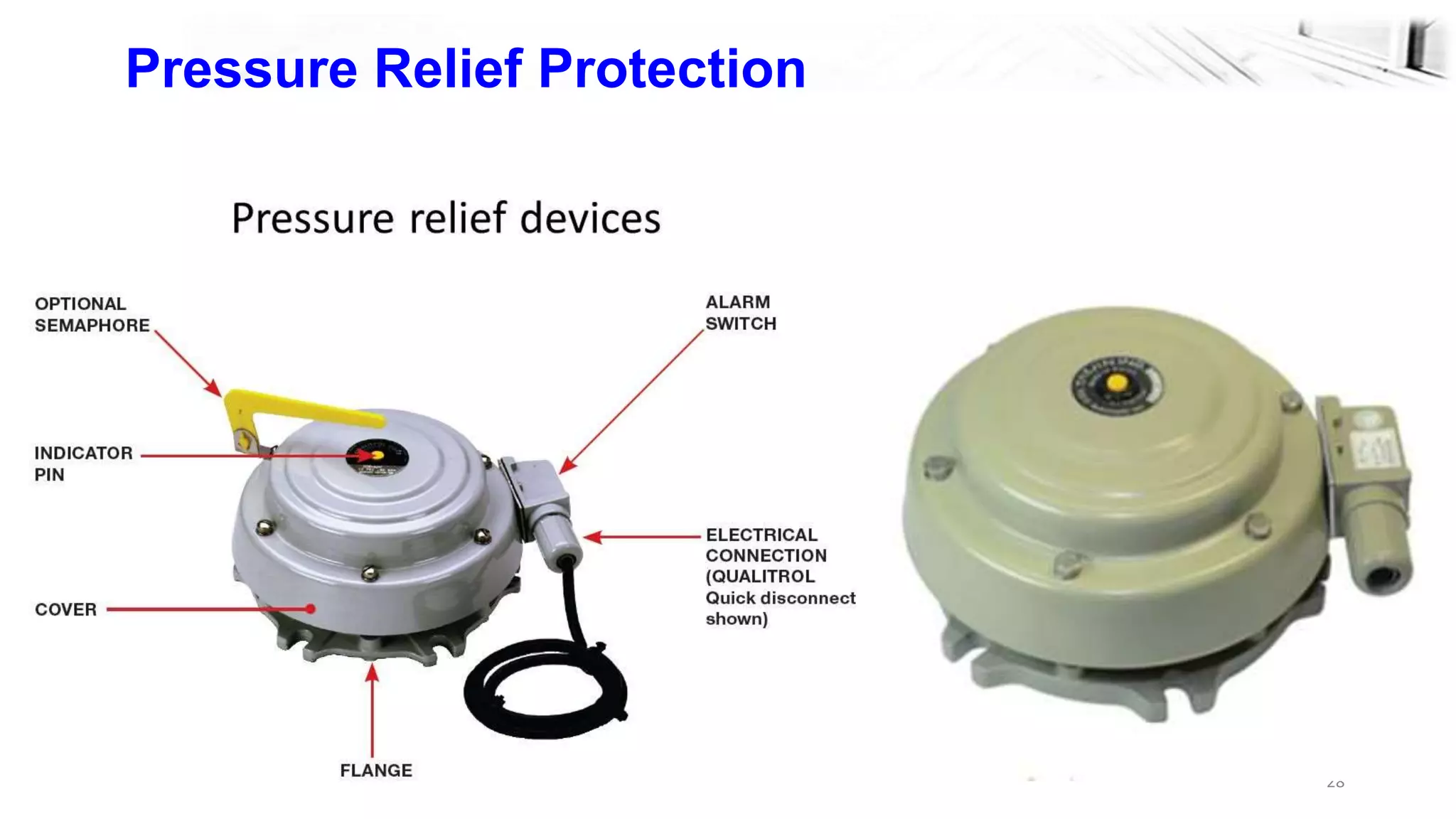
Pressure Relief Protection
 This is used to evacuate any over pressure inside the
transformer to avoid explosion of the transformer tank.
 The pressure relief device limits the tank overpressure and
reduces the risk of tank rupture and uncontrolled oil spill,
which might also cause a fire.
28
Pressure Relief Protection
29
Fire Protection
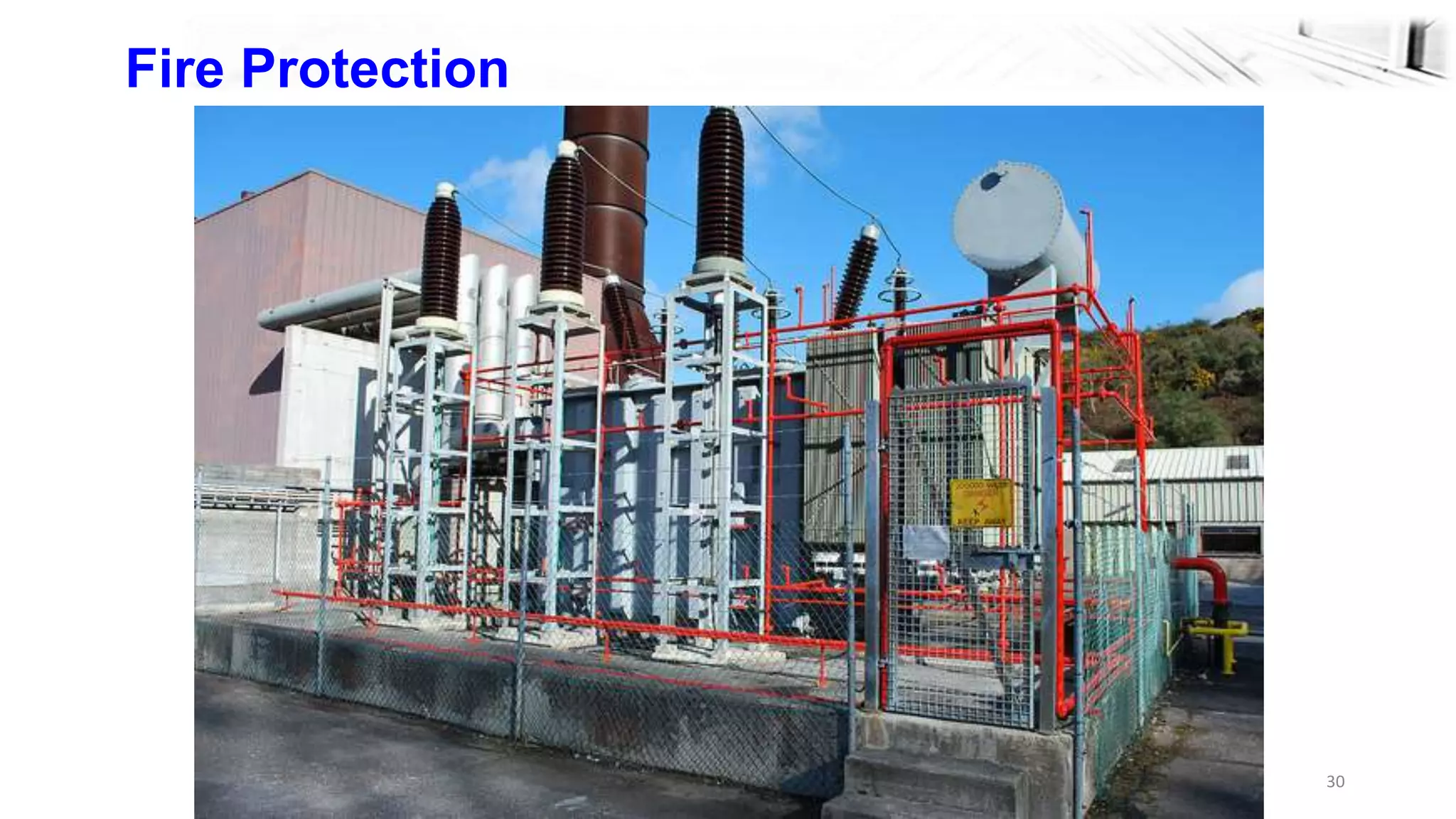
 It can occur because of deterioration of insulation in the
transformer.
 This produces arcing which in turn overheats the insulating
oil and causes the tanks to rupture; further arcing then will
start a fire.
 Fires are also initiated by lightning and occasionally by dirty
insulators on the outside of the tanks.
30
Fire Protection
31
Lightning Protection
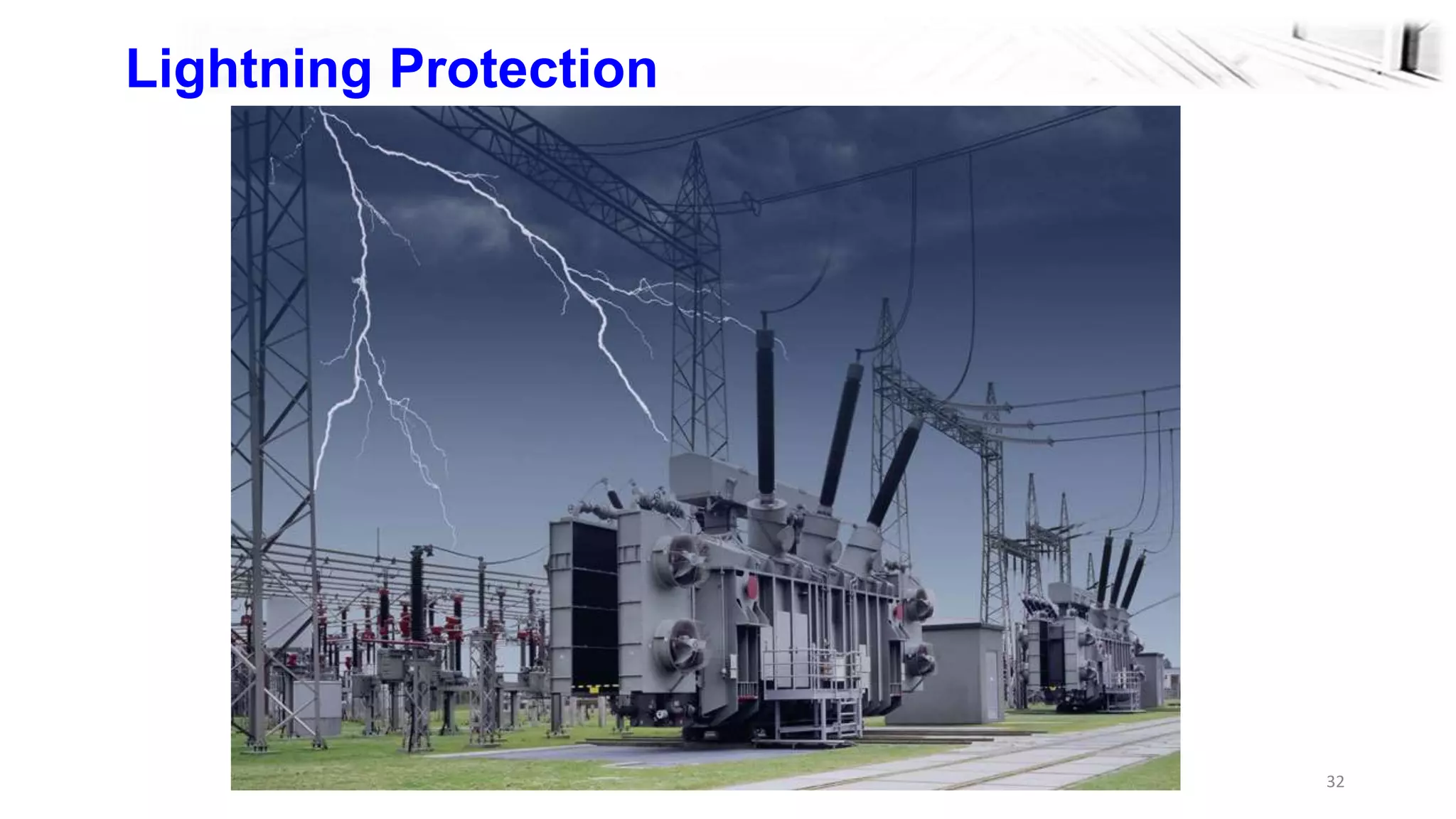
 Lightning overvoltage surges originate from atmospheric
discharges and they can reach their peak within a few
microseconds and subsequently decay very rapidly.
 The charge from the surge produces both short duration
high current impulse and long duration continuing current
impulse which affects the transformer insulation system.
32
Lightning Protection
33
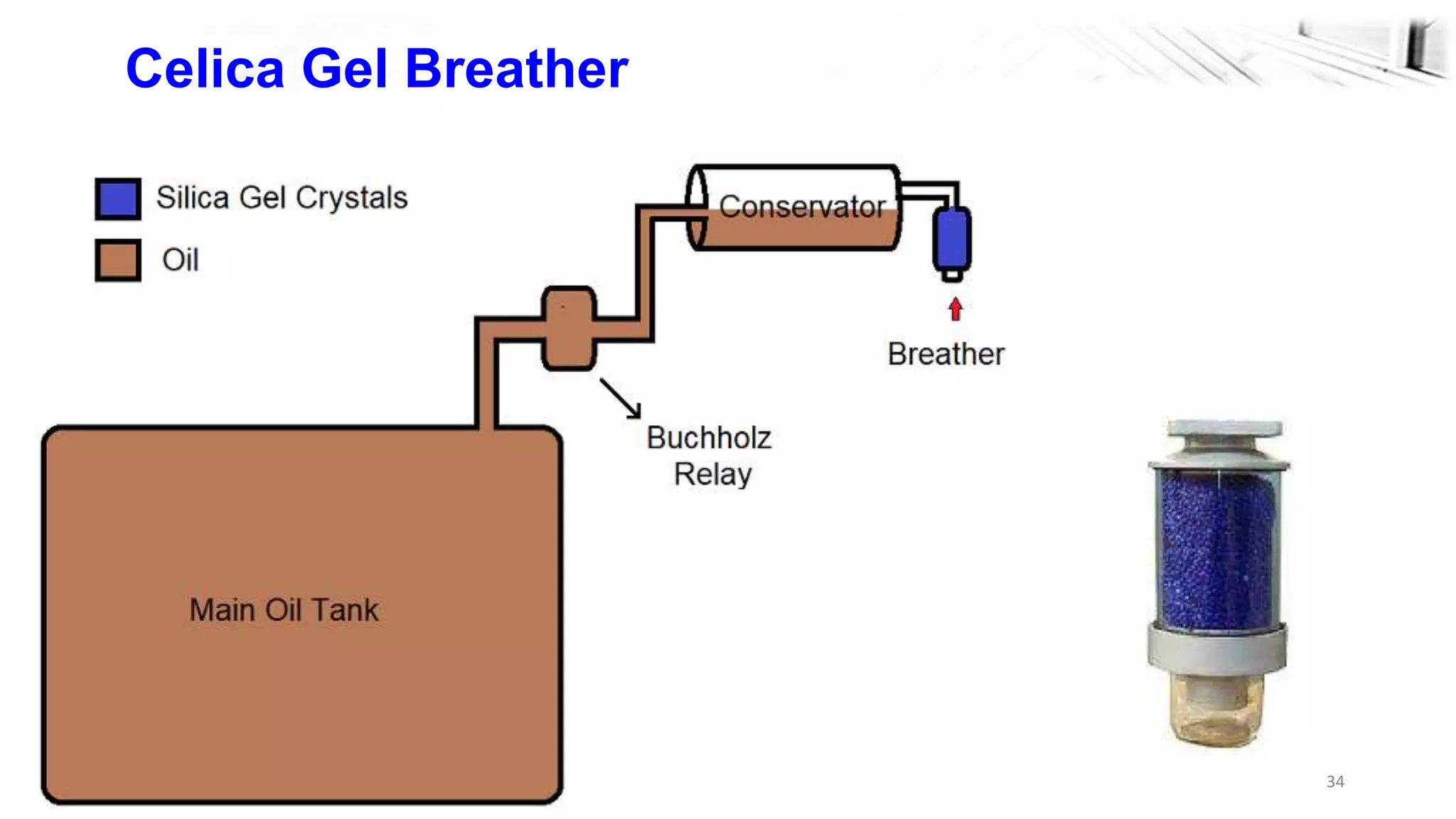
Celica Gel Breather
 Silica gel breathers is used on the conservator of oil filled
transformers.
 The purpose of these silica gel breathers is to absorb the
moisture in the air sucked in by the transformer during the
breathing process.
34
Celica Gel Breather
35
Celica Gel Breather
 During the breathing process, the incoming air may consist
of moisture and dirt which should be removed in order to
prevent any damage.
 Hence the air is made to pass through the silica gel
breather, which will absorb the moisture in the air and
ensures that only dry air enters in to the transformer.
36
Celica Gel Breather
 Silica gel in the breather will be blue when installed and they
turn to pink colour when they absorb moisture which indicates
the crystals should be replaced.
 These breathers also have an oil cup fitted with, so that the
dust particles get settled in the cup.
37
Celica Gel Breather
38
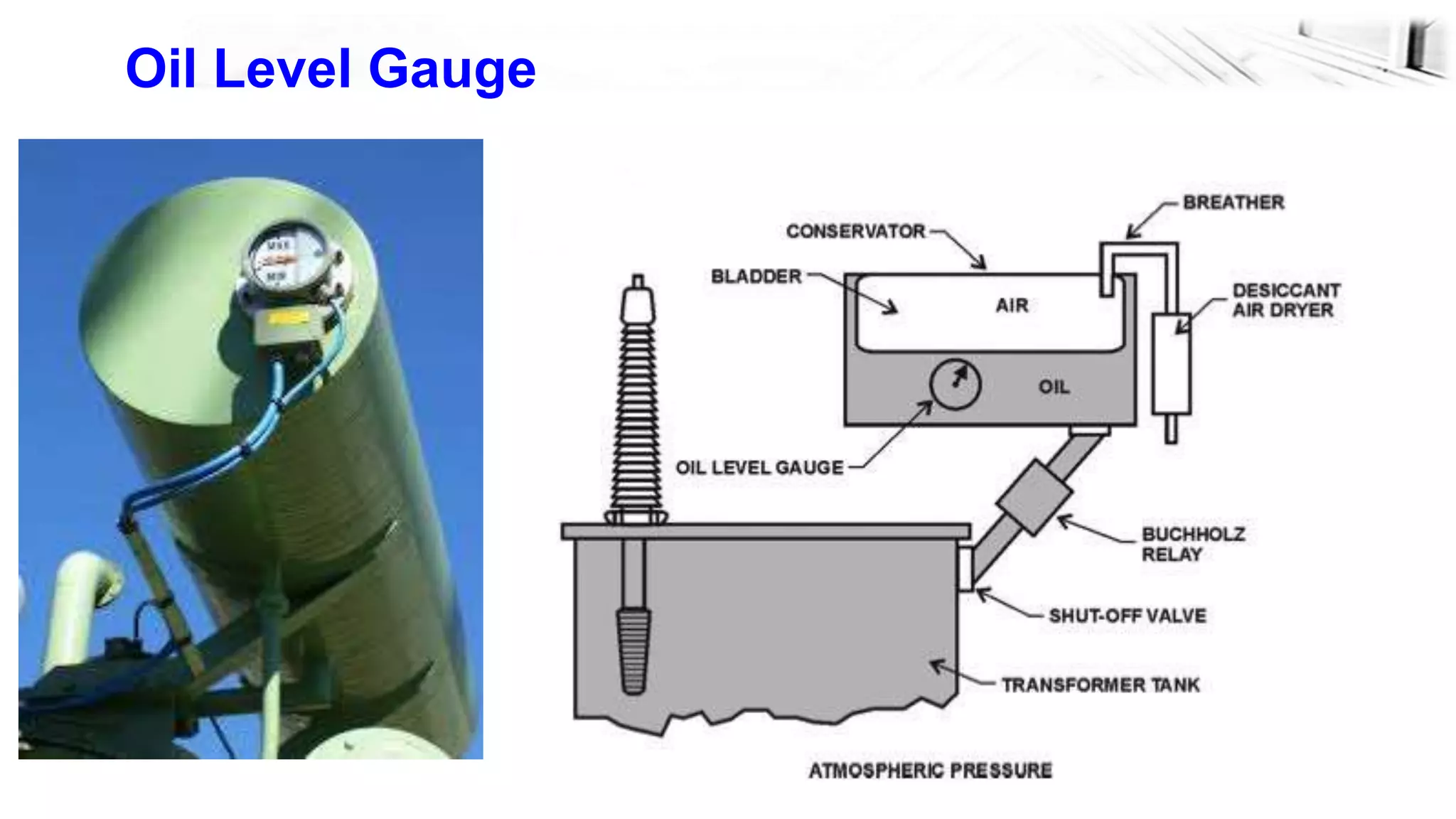
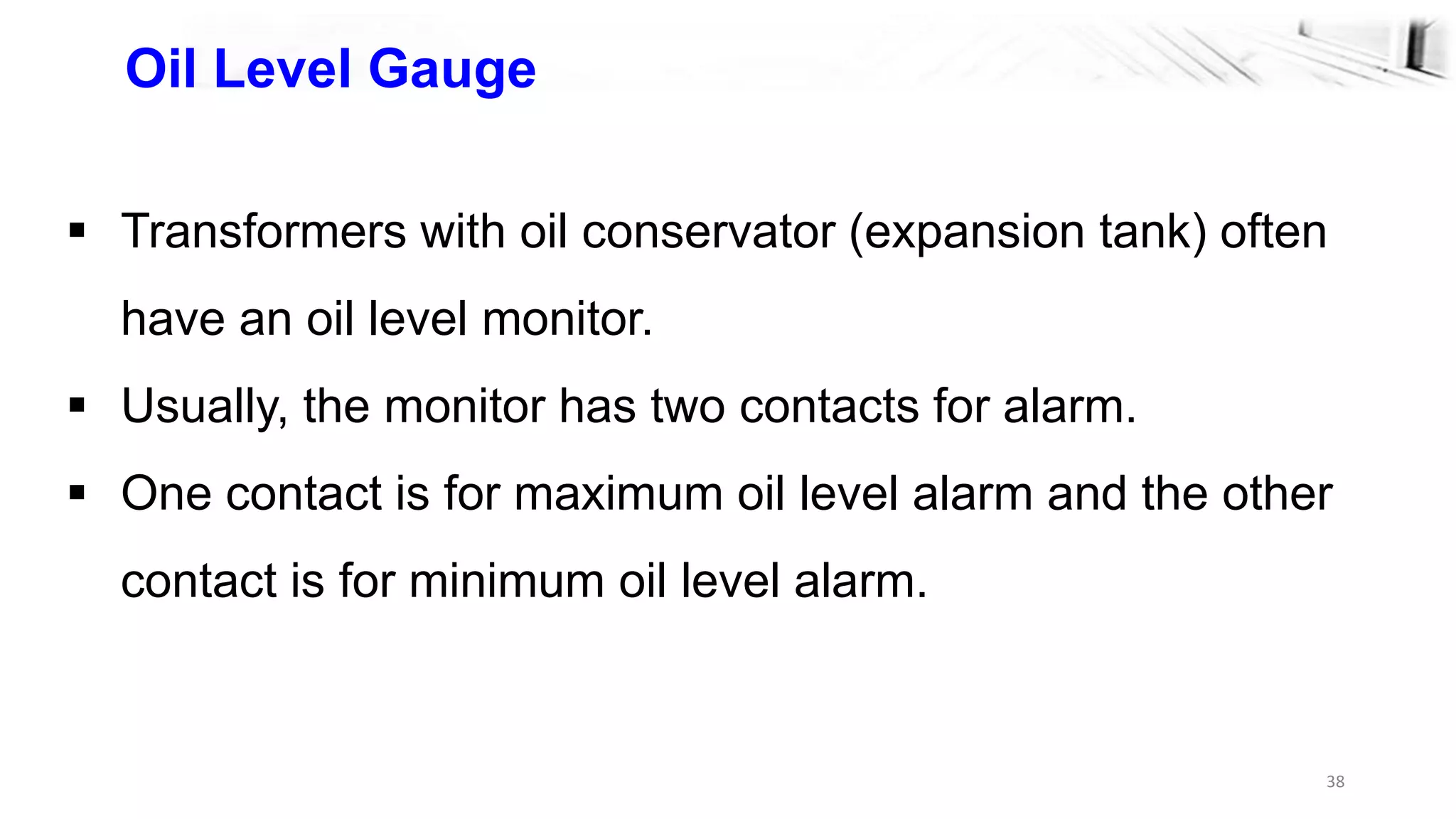
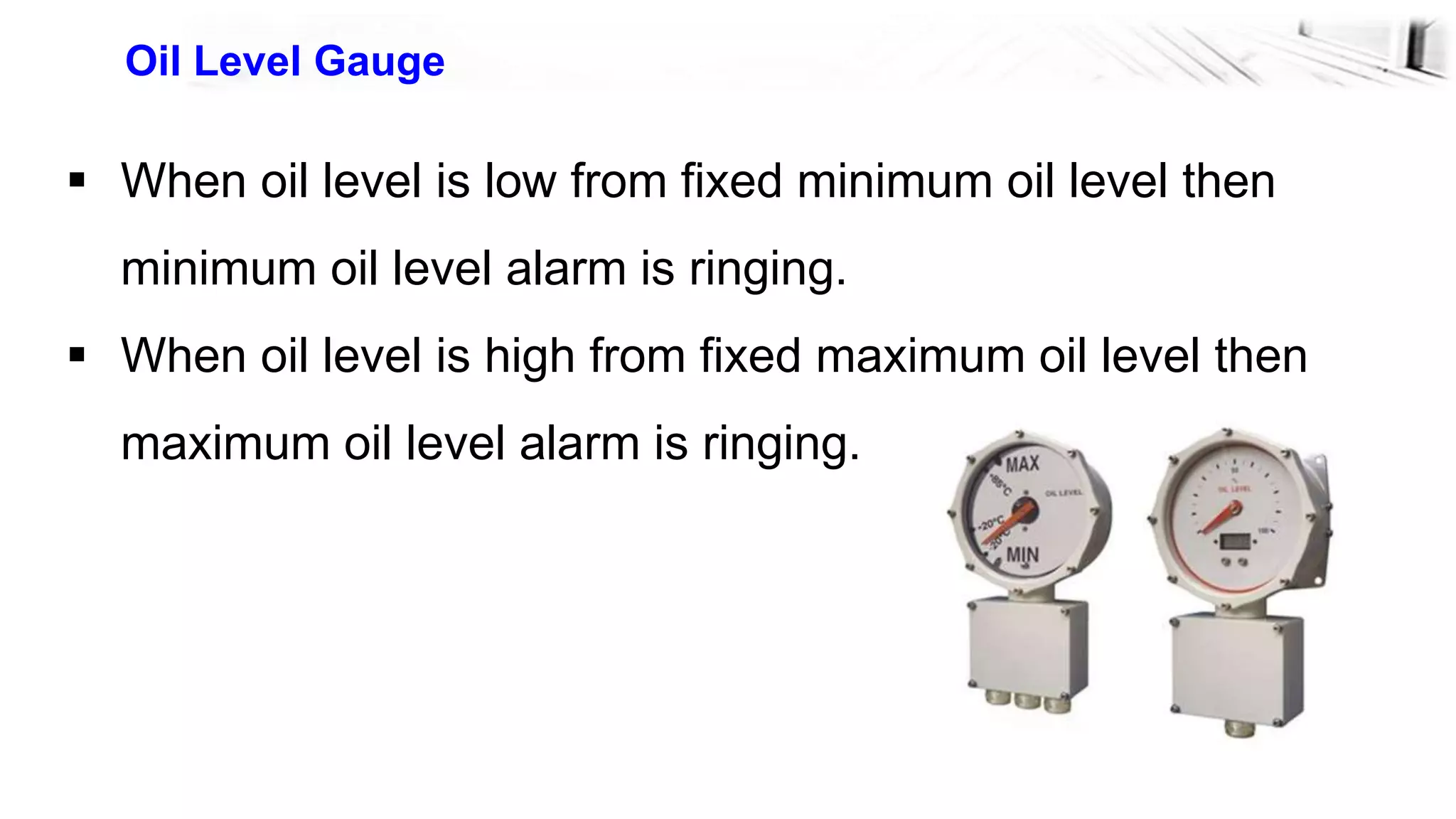
Oil Level Gauge
 Transformers with oil conservator (expansion tank) often
have an oil level monitor.
 Usually, the monitor has two contacts for alarm.
 One contact is for maximum oil level alarm and the other
contact is for minimum oil level alarm.
39
Oil Level Gauge
 When oil level is low from fixed minimum oil level then
minimum oil level alarm is ringing.
 When oil level is high from fixed maximum oil level then
maximum oil level alarm is ringing.
40
Oil Level Gauge
41
Oil Level Gauge
42
Differential Relay Protection
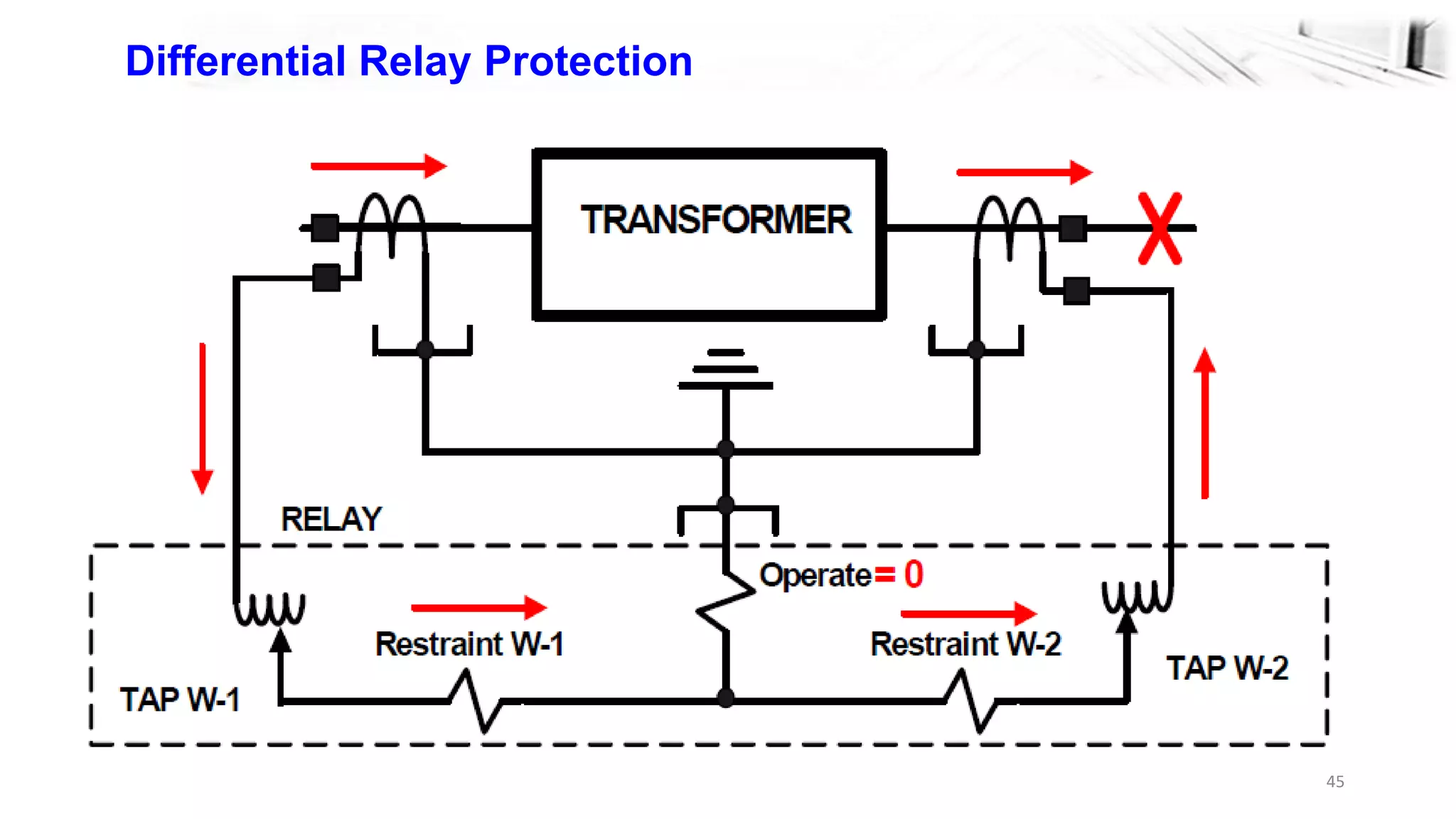
 This scheme is employed for the protection of transformers
against internal short circuits. It provides the best overall
protection for internal faults.
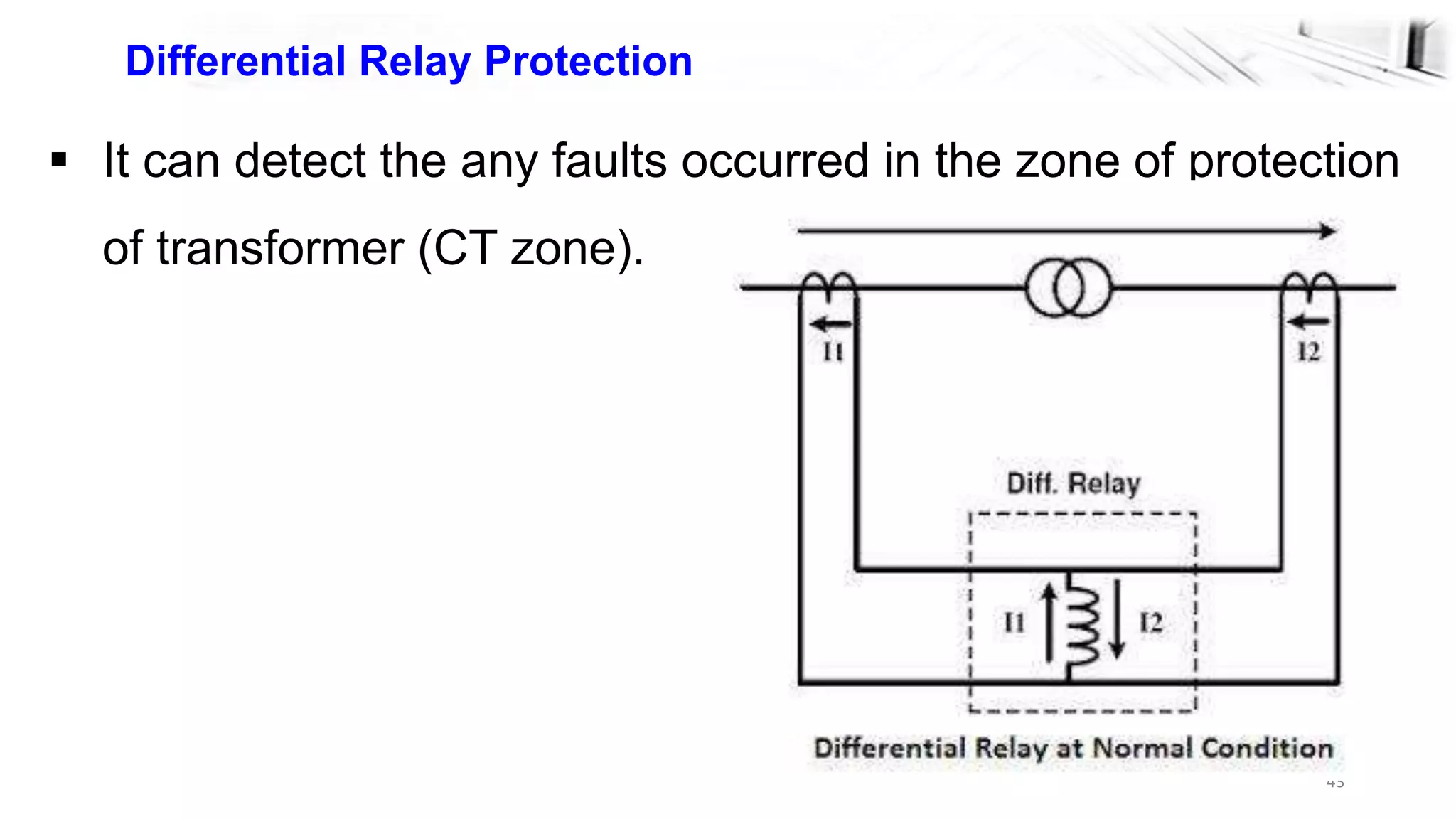
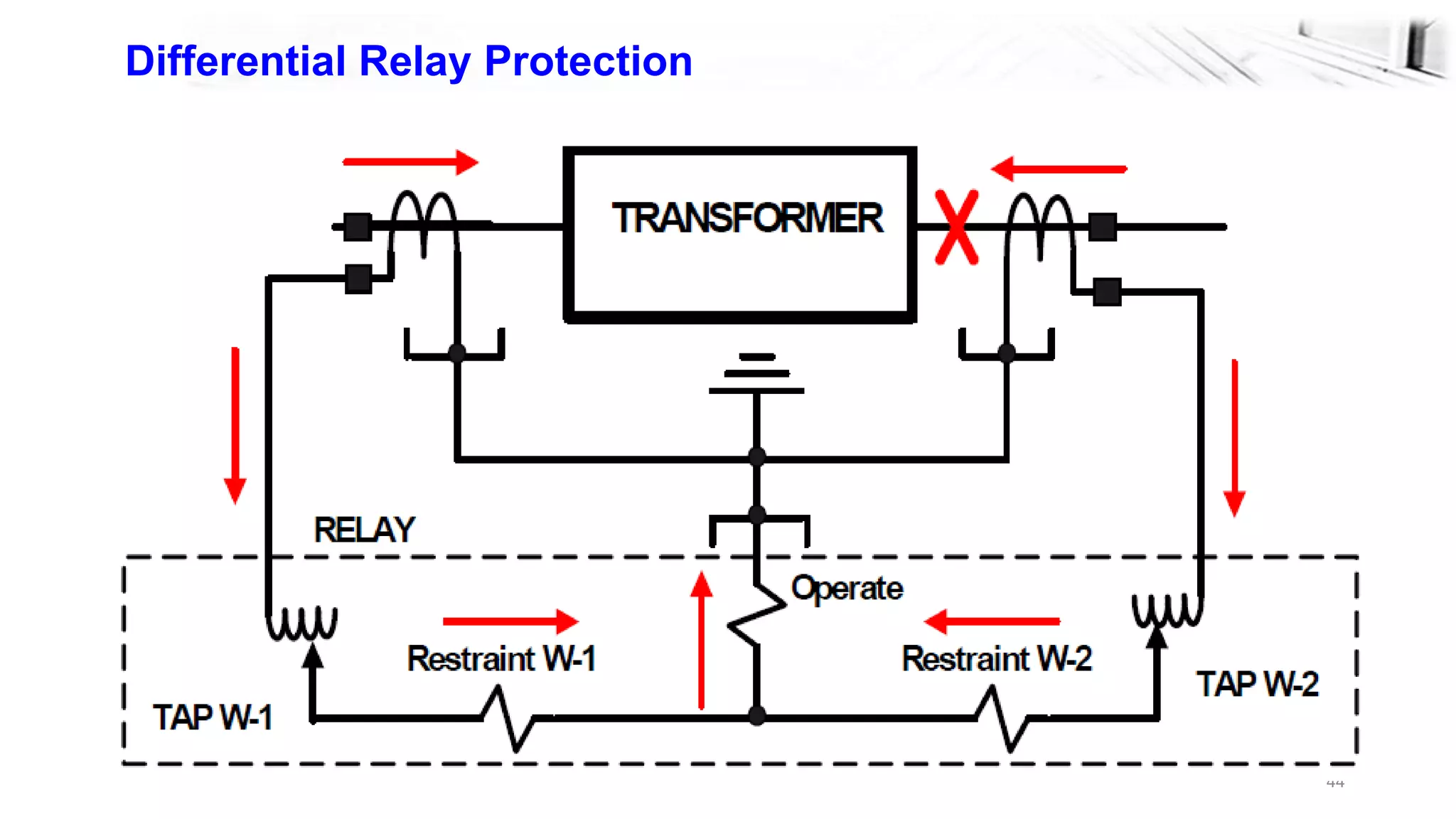
 It compares the current entering the transformer with the
current leaving the element.
 If they are equal there is no fault inside the zone of protection
 If they are not equal it means that a fault occurs between the
two ends.
43
Differential Relay Protection
 It can detect the any faults occurred in the zone of protection
of transformer (CT zone).
44
Differential Relay Protection
45
Differential Relay Protection
46
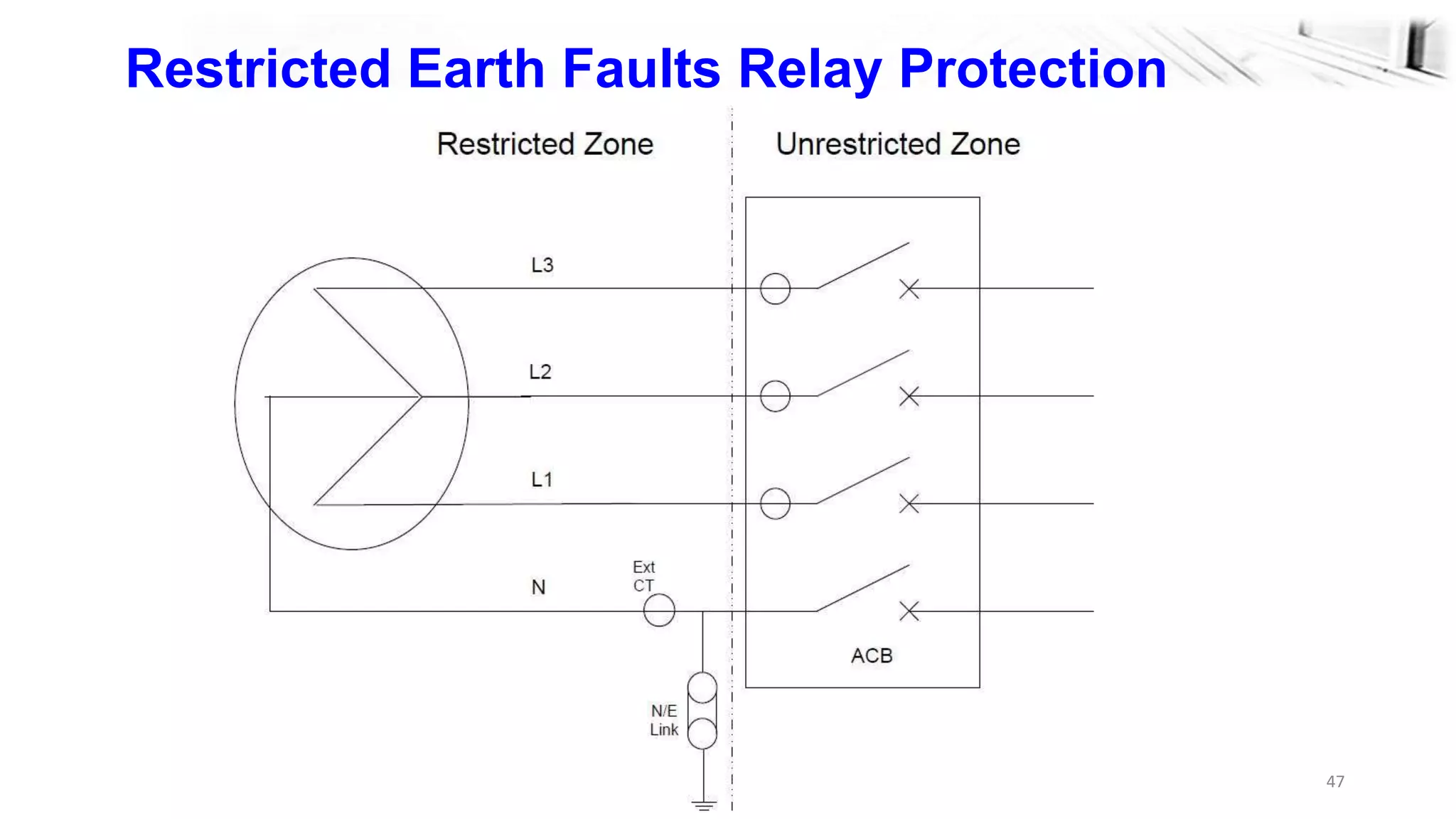
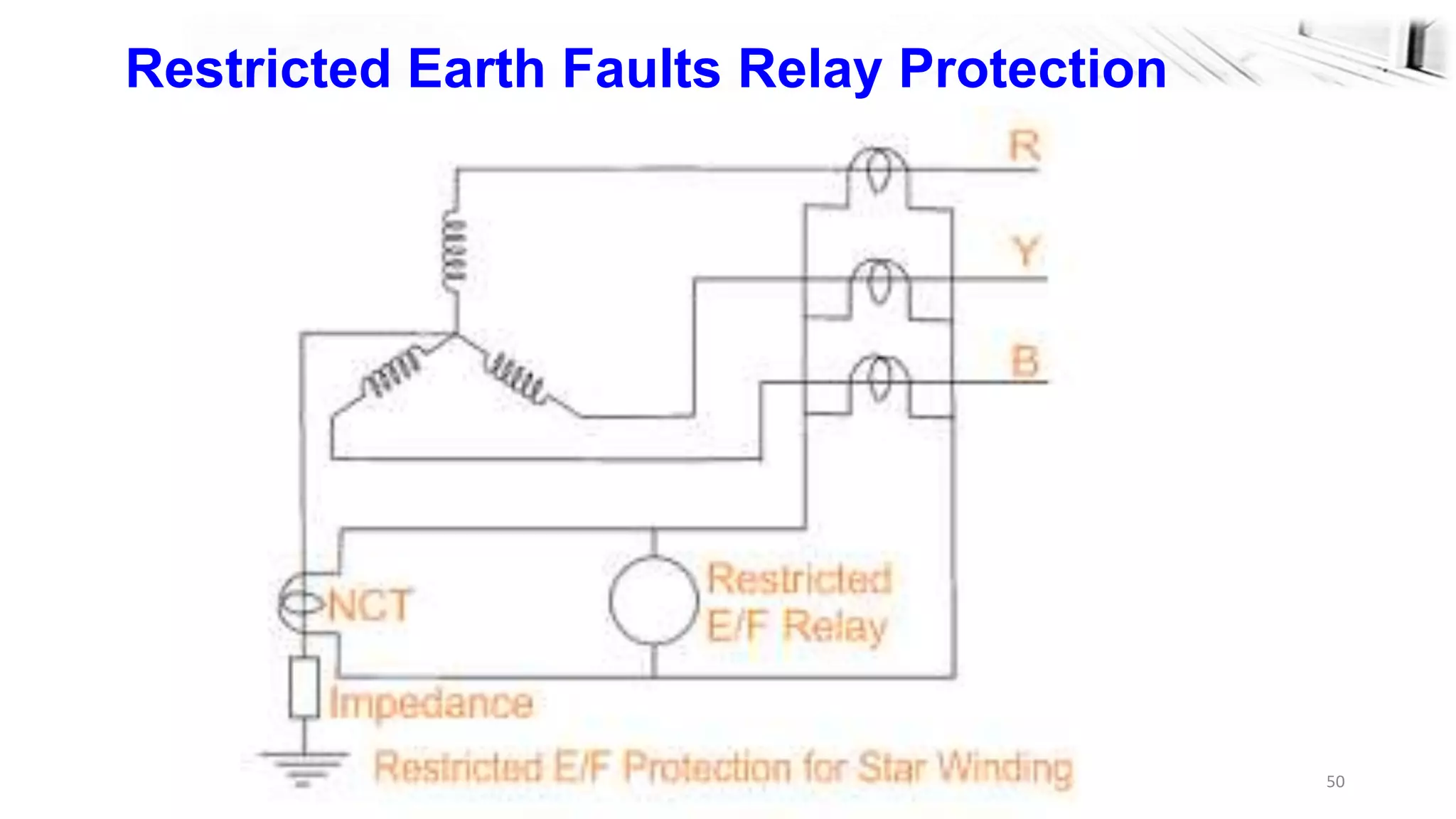
 Restricted Earth Fault (REF) means an earth fault from a
restricted/localized zone of a circuit.
 The term "REF protection method " means not to sense any
earth faults outside this restricted zone. This type of
protection is prevalent in Dyn group of transformers (Delta
Primary and Star Secondary).
Restricted Earth Faults Relay Protection
47
Restricted Earth Faults Relay Protection
48
Restricted Earth Faults Relay Protection
 Differential protection has excellent operation in most fault
cases, but in the situations that a single phase to ground fault
that current increases slightly and causes differential
protection not to detect the fault.
 Restricted earth fault (REF) relay can be used as a
complementary of differential protection.
49
Restricted Earth Faults Relay Protection
 Differential relay will operate for earth faults inside the zone
only if the earth fault current is more than the bias setting in
the relay. The normal bias setting in a differential relay is
20%.
 So, complete earth fault protection is not possible with
differential relay. That is why you need a restricted earth fault
relay with sensitive settings like 5%.
50
Restricted Earth Faults Relay Protection
51
Over fluxing Protection
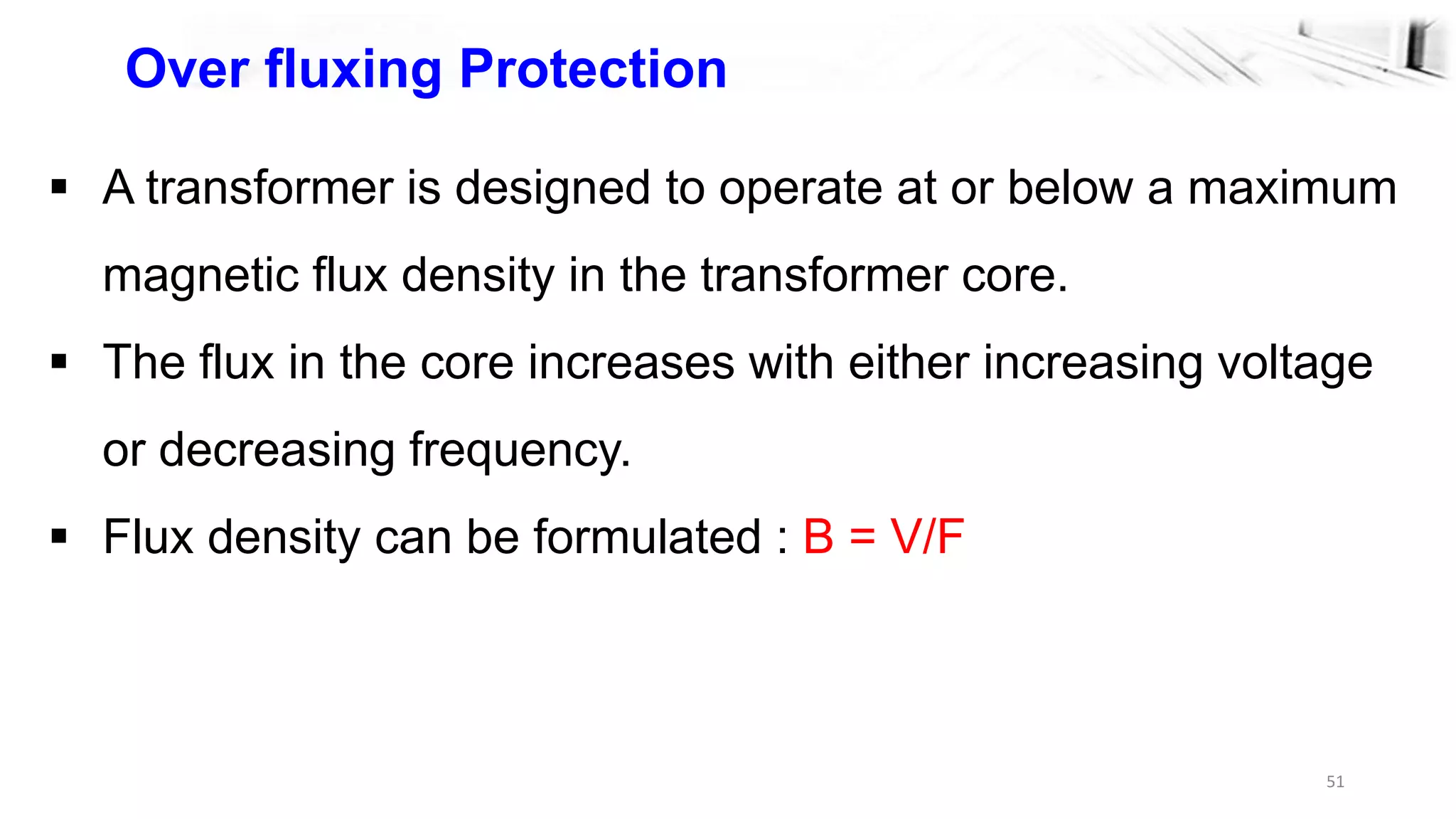
 A transformer is designed to operate at or below a maximum
magnetic flux density in the transformer core.
 The flux in the core increases with either increasing voltage
or decreasing frequency.
 Flux density can be formulated : B = V/F
52
Over fluxing Protection
 During startup or shutdown of generator-connected
transformers, or following a load rejection, the transformer
may experience an excessive ratio of volts to hertz.
 Over fluxing relays are so adjusted, that for every transient
over flux condition the transformer does not trip for
maintaining the power system stability.
 But it should trip as soon as the duration and severity of the
condition crosses the specified safe limit
53
Earth Fault Back up Protection
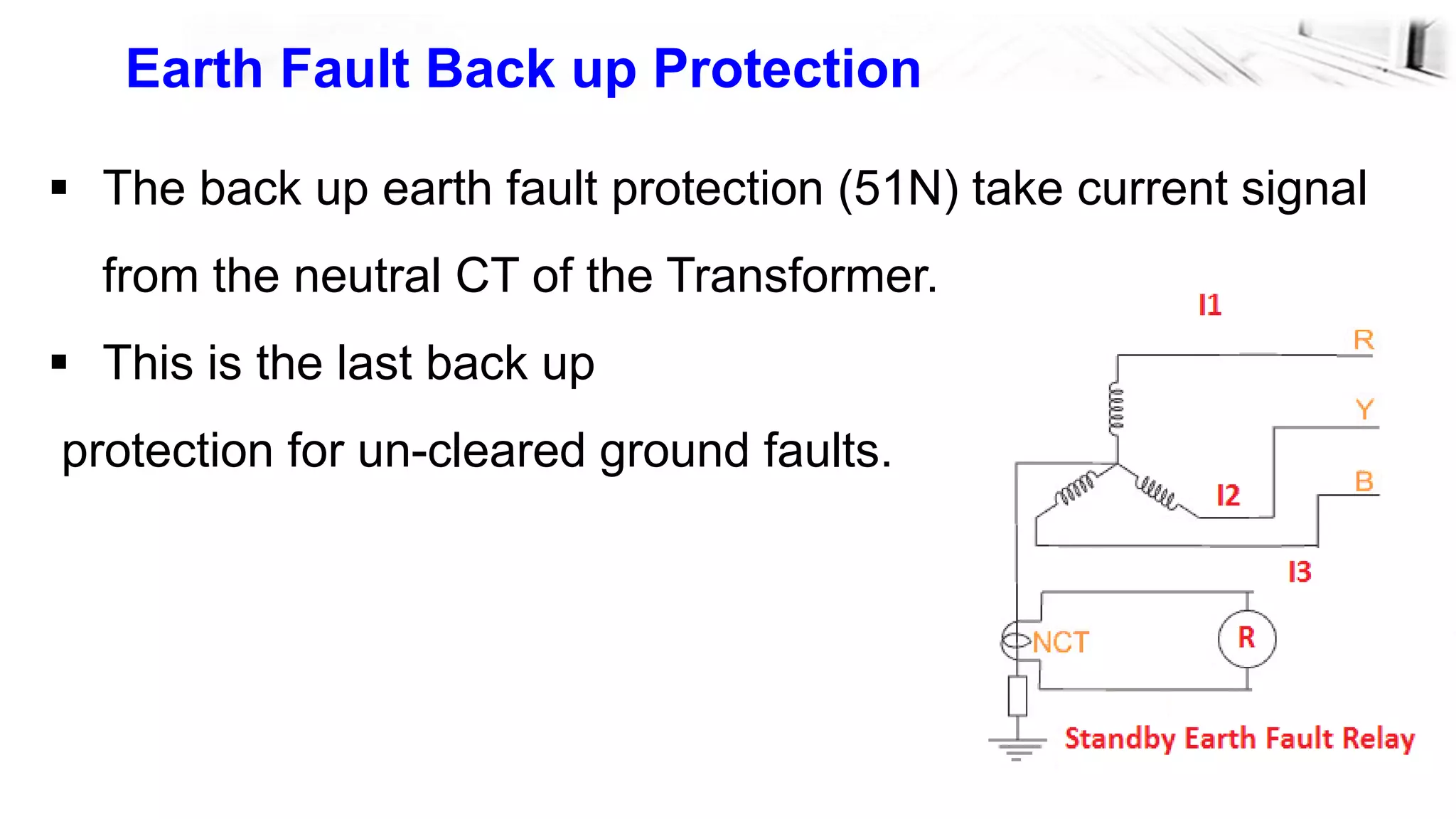
 The back up earth fault protection (51N) take current signal
from the neutral CT of the Transformer.
 This is the last back up
protection for un-cleared ground faults.
54
Overcurrent Back up Protection
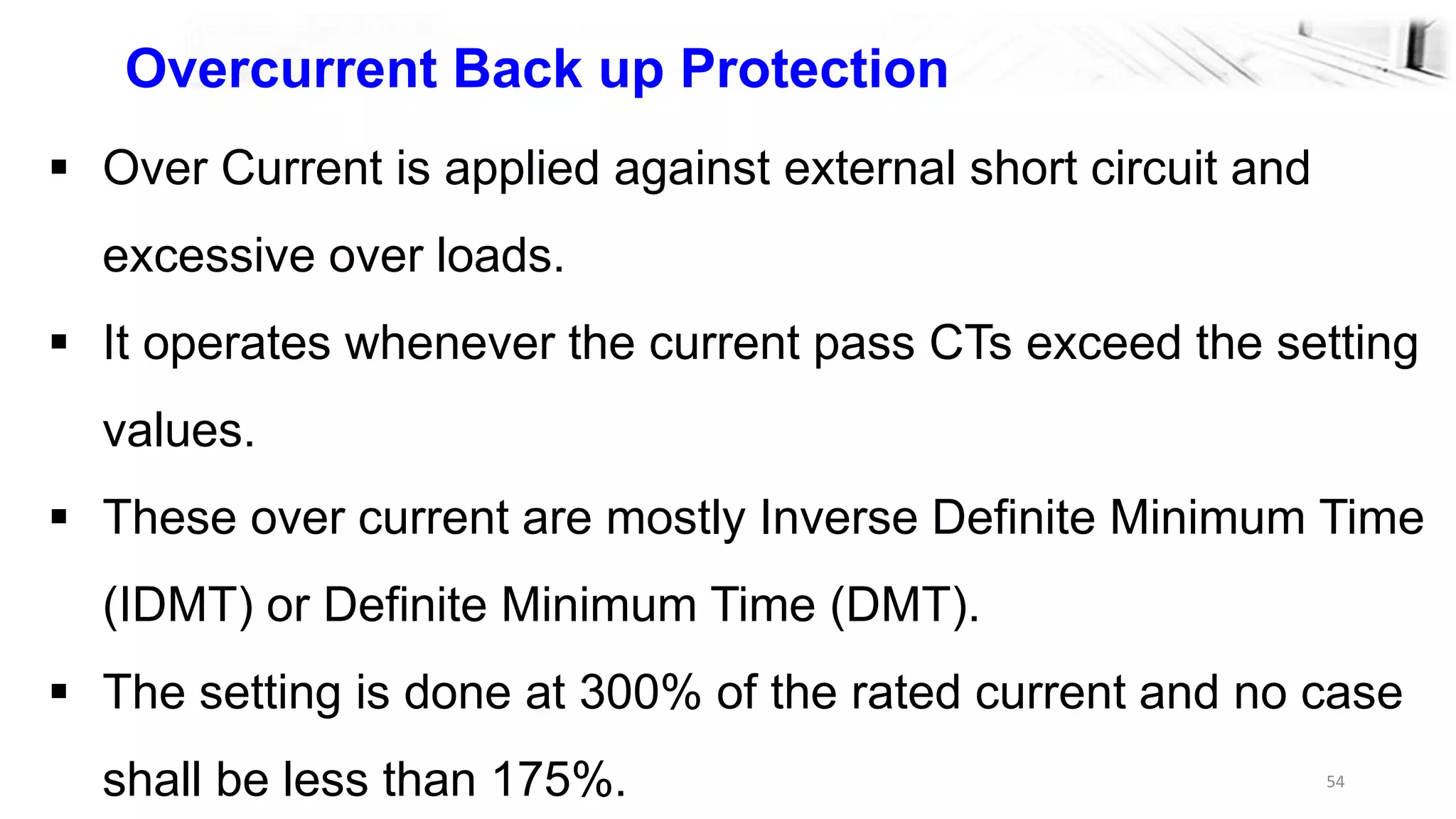
 Over Current is applied against external short circuit and
excessive over loads.
 It operates whenever the current pass CTs exceed the setting
values.
 These over current are mostly Inverse Definite Minimum Time
(IDMT) or Definite Minimum Time (DMT).
 The setting is done at 300% of the rated current and no case
shall be less than 175%.
55
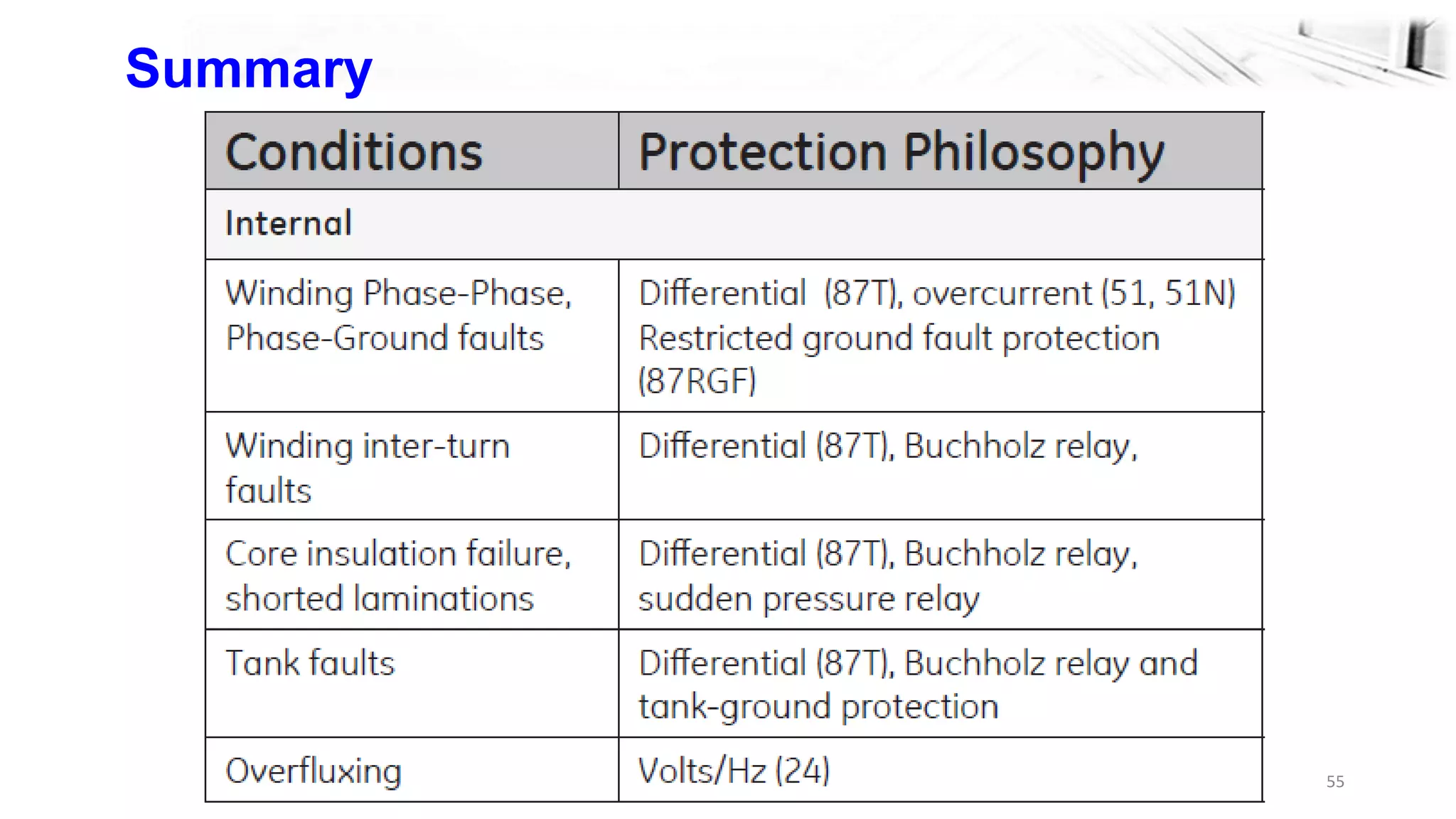
Summary
56
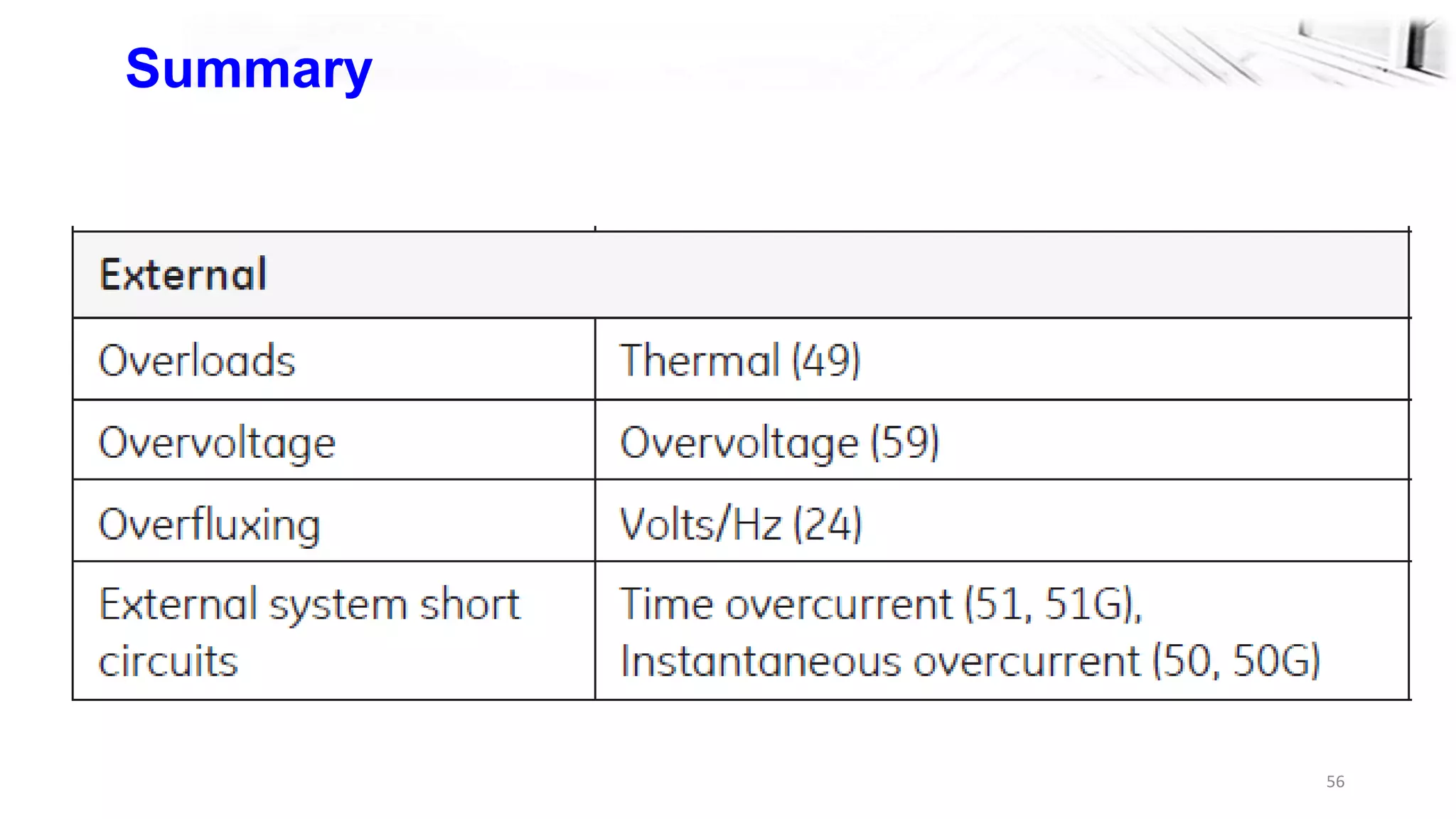
Summary

Power Transformer Protection

  • 1.
    Power Transformer Protection Ang Sovann 1 NationalPolytechnic Institute of Cambodia
  • 2.
    2 Introduction  Transformer isa static device used to transform the electrical energy from one alternating current circuit to another without any change in frequency.  Power Transformer is a vital link in a power transmission system and distribution.
  • 3.
    3 Introduction  A PowerTransformer is an expensive part of a power network.  The impact of a transformer outage due to fault is more serious than a transmission line outage.
  • 4.
    4 Transformer Protection  Thetype of protection for the transformers varies depending on the application and the importance of the transformer.  Transformers are protected primarily against faults and overloads.  The type of protection used should minimize the time of disconnection for faults within the transformer and to reduce the risk of catastrophic failure.
  • 5.
    5 Why use transformer???  To reduce of transmission losses.  For increasing the low voltage level to high voltage level.  The voltage level of a power is increased, the current of the power is reduced which causes reduction in ohm or I2R losses in the system.  Low level power must be stepped up for efficient electrical power transmission.
  • 6.
    6 Why transformer protection???  To Protect the Transformer from severe damages.  Time required to rectify the Transformer in case of damages is more and it is very difficult.  Operation of a power network when the power transformer is out of service is always difficult.
  • 7.
    7 Why transformer protection???  A Power Transformer fault therefore often is a more severe disturbance for the network than an overhead line fault which usually can be repaired rather quickly.
  • 8.
    8 Induction Law  Thetransformer is based on two principles: 1. An electric current can produce a magnetic field. 2. A changing magnetic field within a coil of wire induces a voltage across the ends of the coil
  • 9.
    9 Power Transformer  Termpower transformer is used to refer to those transformers used in the generator and the distribution circuits, and these are usually rated at 500 KVA and above.  Power systems typically consist of a large number of generation locations, distribution points, and interconnections within the system or with nearby systems, such as a neighboring utility.  The complexity of the system leads to a variety of transmission and distribution voltages.  Power transformers must be used at each of these points where there is a transition between voltage levels.
  • 10.
    10 Power Transformer  Termpower transformer is used to refer to those transformers used in the generator and the distribution circuits, and these are usually rated at 500 KVA and above.  Power systems typically consist of a large number of generation locations, distribution points, and interconnections within the system or with nearby systems, such as a neighboring utility.
  • 11.
  • 12.
    12 What cause transformerfailure?  Insulation Breakdown  Over heating due to over excitation  Oil contamination and leakage  Cooling system failure  Phase to phase and Phase to Ground Fault  Turn to Turn Fault  Transformer Overload
  • 13.
    13 What cause transformerfailure?  Winding failures 51%  Tap changer failures 19%  Bushings failures 9%  Terminal board failures 6%  Core failures 2%  Miscellaneous failures 13%
  • 14.
    14 What cause transformerfailure?  Insulation deterioration come from:  Moisture  Vibration  Overheating  Voltage surge  Winding  Bushing  Bushings deterioration come from:  General aging  Contamination  Cracking  Internal moisture
  • 15.
    15 What cause transformerfailure?  Core insulation failure  Shorted lamination  Core overheating  Core problem  Miscellaneous  CT problem  Oil leakage  Oil contamination • Metal particle • Moisture
  • 16.
    16 Transformer Faults Internal faults 1.Winding Failure 2. Winding inter-turn faults 3. Core insulation failure, shorted laminations 4. Over fluxing. External faults 1. Overloads 2. Overvoltage 3. Over heating 4. External system short circuits.
  • 17.
    17 Transformer Protection Scheme Mechanical 1.Buchholz relay 2. Sudden pressure 3. Pressure relief 4. Temperature protection Electrical 1. Bias Differential Protection (87) 2. Over Fluxing (24) 3. Over Voltage (59) 4. Under Voltage (27) 5. Neutral Unbalance (64R) 6. Restricted Earth Fault (64REF) 7. Back up O/C & E/F (50/51/67)
  • 18.
    18 Buchhloz Relay Protection The Buchholz relay protects the transformer from internal faults. It is the gas actuated relay.
  • 19.
  • 20.
    20 Buchhloz Relay Protection The Buchholz relay is placed between the main tank and the conservator.  Such type of relay is used in the transformer having the rating higher than 500KVA.  It is not used in small transformer because of economic consideration.
  • 21.
    21 Buchhloz Relay Protection When the fault occurs inside the transformer, the temperature of the oil increases. The oil evaporates in the form of the gas.  The generation of the gas depends on the magnitude of the fault occurs inside the transformer.  The internal failure occurs in the transformer either because of the insulation breakdown between the winding or the winding have the weak initial contact.
  • 22.
  • 23.
    23 Buchhloz Relay Protection The relay has two elements 1st stage and 2nd stage. The 1st stage for alarm and the 2nd stage for trip.  The 1st stage work on the accumulation of sufficient gas in the relay chamber and the 2nd stage work on the high velocity of oil caused due to evolution of gases as a result of high energy faults.  The setting of 1st stage is done at collected gas volume of 300 to 500ml.  The setting of 2nd stage is done at oil flow velocity of 100cm/s .
  • 24.
  • 25.
    25 Sudden Pressure RelayProtection  This relay is designed to detect a sudden pressure increase caused by arcing or internal faults.
  • 26.
    26 Sudden Pressure RelayProtection  This protection performs better and faster than Buchholz relay 2nd stage protection. The relay detects a sudden rise in pressure. The alarm is set at 0.32kg/sqcm and trip at 0.6kg/sqcm per second.
  • 27.
    27 Pressure Relief Protection This is used to evacuate any over pressure inside the transformer to avoid explosion of the transformer tank.  The pressure relief device limits the tank overpressure and reduces the risk of tank rupture and uncontrolled oil spill, which might also cause a fire.
  • 28.
  • 29.
    29 Fire Protection  Itcan occur because of deterioration of insulation in the transformer.  This produces arcing which in turn overheats the insulating oil and causes the tanks to rupture; further arcing then will start a fire.  Fires are also initiated by lightning and occasionally by dirty insulators on the outside of the tanks.
  • 30.
  • 31.
    31 Lightning Protection  Lightningovervoltage surges originate from atmospheric discharges and they can reach their peak within a few microseconds and subsequently decay very rapidly.  The charge from the surge produces both short duration high current impulse and long duration continuing current impulse which affects the transformer insulation system.
  • 32.
  • 33.
    33 Celica Gel Breather Silica gel breathers is used on the conservator of oil filled transformers.  The purpose of these silica gel breathers is to absorb the moisture in the air sucked in by the transformer during the breathing process.
  • 34.
  • 35.
    35 Celica Gel Breather During the breathing process, the incoming air may consist of moisture and dirt which should be removed in order to prevent any damage.  Hence the air is made to pass through the silica gel breather, which will absorb the moisture in the air and ensures that only dry air enters in to the transformer.
  • 36.
    36 Celica Gel Breather Silica gel in the breather will be blue when installed and they turn to pink colour when they absorb moisture which indicates the crystals should be replaced.  These breathers also have an oil cup fitted with, so that the dust particles get settled in the cup.
  • 37.
  • 38.
    38 Oil Level Gauge Transformers with oil conservator (expansion tank) often have an oil level monitor.  Usually, the monitor has two contacts for alarm.  One contact is for maximum oil level alarm and the other contact is for minimum oil level alarm.
  • 39.
    39 Oil Level Gauge When oil level is low from fixed minimum oil level then minimum oil level alarm is ringing.  When oil level is high from fixed maximum oil level then maximum oil level alarm is ringing.
  • 40.
  • 41.
  • 42.
    42 Differential Relay Protection This scheme is employed for the protection of transformers against internal short circuits. It provides the best overall protection for internal faults.  It compares the current entering the transformer with the current leaving the element.  If they are equal there is no fault inside the zone of protection  If they are not equal it means that a fault occurs between the two ends.
  • 43.
    43 Differential Relay Protection It can detect the any faults occurred in the zone of protection of transformer (CT zone).
  • 44.
  • 45.
  • 46.
    46  Restricted EarthFault (REF) means an earth fault from a restricted/localized zone of a circuit.  The term "REF protection method " means not to sense any earth faults outside this restricted zone. This type of protection is prevalent in Dyn group of transformers (Delta Primary and Star Secondary). Restricted Earth Faults Relay Protection
  • 47.
  • 48.
    48 Restricted Earth FaultsRelay Protection  Differential protection has excellent operation in most fault cases, but in the situations that a single phase to ground fault that current increases slightly and causes differential protection not to detect the fault.  Restricted earth fault (REF) relay can be used as a complementary of differential protection.
  • 49.
    49 Restricted Earth FaultsRelay Protection  Differential relay will operate for earth faults inside the zone only if the earth fault current is more than the bias setting in the relay. The normal bias setting in a differential relay is 20%.  So, complete earth fault protection is not possible with differential relay. That is why you need a restricted earth fault relay with sensitive settings like 5%.
  • 50.
  • 51.
    51 Over fluxing Protection A transformer is designed to operate at or below a maximum magnetic flux density in the transformer core.  The flux in the core increases with either increasing voltage or decreasing frequency.  Flux density can be formulated : B = V/F
  • 52.
    52 Over fluxing Protection During startup or shutdown of generator-connected transformers, or following a load rejection, the transformer may experience an excessive ratio of volts to hertz.  Over fluxing relays are so adjusted, that for every transient over flux condition the transformer does not trip for maintaining the power system stability.  But it should trip as soon as the duration and severity of the condition crosses the specified safe limit
  • 53.
    53 Earth Fault Backup Protection  The back up earth fault protection (51N) take current signal from the neutral CT of the Transformer.  This is the last back up protection for un-cleared ground faults.
  • 54.
    54 Overcurrent Back upProtection  Over Current is applied against external short circuit and excessive over loads.  It operates whenever the current pass CTs exceed the setting values.  These over current are mostly Inverse Definite Minimum Time (IDMT) or Definite Minimum Time (DMT).  The setting is done at 300% of the rated current and no case shall be less than 175%.
  • 55.
  • 56.