TopicTopic:-:- OINTMENTSOINTMENTS
Presented To:- Presented By:-
Dr. Sonali Singh Priyanka
Singh
Assiatant Professor Chaudhary
M. Pharm I year
Department of Pharmaceutical Science
BBAU (Central University)
Lucknow U.P.
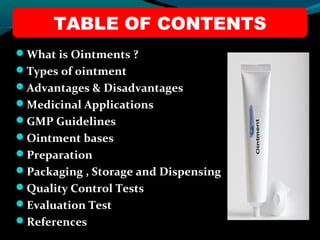
TABLE OF CONTENTS
What is Ointments ?
Types of ointment
Advantages & Disadvantages
Medicinal Applications
GMP Guidelines
Ointment bases
Preparation
Packaging , Storage and Dispensing
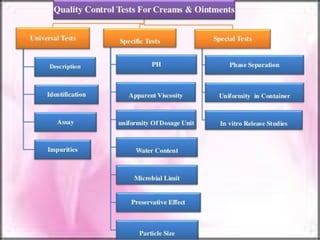
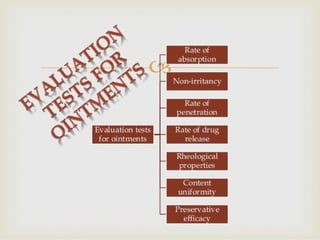
Quality Control Tests
Evaluation Test
References
Any greasy or oily semi-solid
preparation, usually medicated, that
can be applied externally to the skin in
order to heal, soothe or protect it.
It is a viscous semisolid preparation
used topically on a variety of body
surfaces.
What is Ointments?
 Drug ingredients can be dissolved,
emulsified or suspended in the
ointment base.
 The word ointment comes from the
Latin ungere meaning anoint with oil.
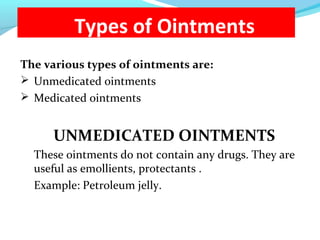
Types of Ointments
The various types of ointments are:
 Unmedicated ointments
 Medicated ointments
UNMEDICATED OINTMENTS
These ointments do not contain any drugs. They are
useful as emollients, protectants .
Example: Petroleum jelly.
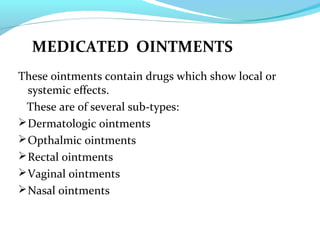
MEDICATED OINTMENTS
These ointments contain drugs which show local or
systemic effects.
These are of several sub-types:
Dermatologic ointments
Opthalmic ointments
Rectal ointments
Vaginal ointments
Nasal ointments
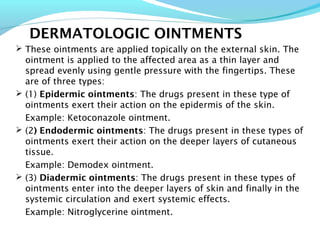
DERMATOLOGIC OINTMENTS
 These ointments are applied topically on the external skin. The
ointment is applied to the affected area as a thin layer and
spread evenly using gentle pressure with the fingertips. These
are of three types:
 (1) Epidermic ointments: The drugs present in these type of
ointments exert their action on the epidermis of the skin.
Example: Ketoconazole ointment.
 (2) Endodermic ointments: The drugs present in these types of
ointments exert their action on the deeper layers of cutaneous
tissue.
Example: Demodex ointment.
 (3) Diadermic ointments: The drugs present in these types of
ointments enter into the deeper layers of skin and finally in the
systemic circulation and exert systemic effects.
Example: Nitroglycerine ointment.
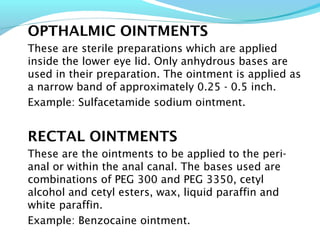
OPTHALMIC OINTMENTS
These are sterile preparations which are applied
inside the lower eye lid. Only anhydrous bases are
used in their preparation. The ointment is applied as
a narrow band of approximately 0.25 - 0.5 inch.
Example: Sulfacetamide sodium ointment.
RECTAL OINTMENTS
These are the ointments to be applied to the peri-
anal or within the anal canal. The bases used are
combinations of PEG 300 and PEG 3350, cetyl
alcohol and cetyl esters, wax, liquid paraffin and
white paraffin.
Example: Benzocaine ointment.
VAGINAL OINTMENTS
These ointments are applied to the vulvo-vaginal
area or inside the vagina. As vagina is more
susceptible to infections, the ointment should be
free from micro-organisms, moulds and yeasts.
Example: Candicidin ointment.
NASAL OINTMENTS
These are used in the topical treatment of nasal
mucosa. Drugs get absorbed into the general
circulation through the rich blood supply of
the nasal lining.
Example: Ipratropium bromide ointment.
ADVANTAGES
 Handling of ointments is easier than bulky liquid dosage
forms.
 They are chemically more stable than liquid dosage
forms.
 They facilitate application of the directly to the effected
body part and avoid exposure of other parts to the drug.
 They are suitable for patients who find it difficult to take
the drugs by parenteral and oral routes.
 They prolong the contact time between the drug and
effected area.
 The bioavailability of drugs administered as ointments is
more since it prevents passage through liver.
DISADVANTAGES
They are bulkier than solid dosage forms.
When applications of an exact quantity of ointment to
the affected area is required, it is difficult to ascertain
the same.
They are less stable than solid dosage forms.
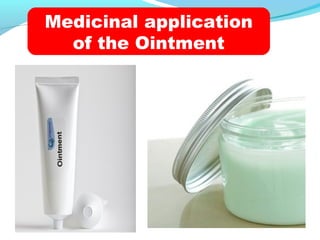
Medicinal application
of the Ointment
Ointments are used topically for several
purposes, e.g., as protectants, antiseptics,
emollients, antipruritics, kerotolytics, and
astringents.
 In the case of a protective ointment, it serves
to protect the skin against moisture, air, sun
rays and other external factors.
It is necessary that the ointment neither
penetrates the human skin barriers nor
facilitates the absorption of substances through
this barrier.
An antiseptic ointment is used to destroy or
inhibit the growth of bacteria. Frequently
bacterial infections are deeply seated; a
base which has the capacity to either
penetrate or dissolve and release the
medication effectively is therefore desired.
 Ointments used for their emollient effect
should be easy to apply, be non-greasy and
effectively penetrate the skin.
Good Manufacturing Practices and
Requirements of Premises, plant and
Equipment for Pharmaceutical Products
[SCHEDULE M]
(Rules 71, 74, 76, and 78)
PART ID
SPECIFIC REQUIREMENTS FOR MANUFACTURING OF
TOPICAL PRODUCTS i.e. EXTERNAL PREPARATIONS
(CREAMS, OINTMENTS, PASTES, EMULSIONS,
LOTIONS, SOLUTIONS, DUSTING POWDERS AND
IDENTICAL PRODUCTS)
1. The entrance to the area where topical products are
manufactured shall be through a suitable airlock.
Outside the airlock, insectoctors shall be installed.
2. The air to this manufacturing area shall be filtered
through at least 20 air filters and shall be air-
conditioned. The area shall be ventilated.
3. The area shall be fitted with an exhaust system of
suitable capacity to effectively remove vapours, fumes,
smoke, floating dust particles.
4. The equipment used shall be designed and maintained
to prevent the product from being accidently
contaminated with any foreign matter or lubricant.
5. No rags or dusters shall be used in the process of
cleaning or drying the process equipment or
accessories used.
6. Water used in compounding shall be Purified Water
IP.
7. Powders, whenever used, shall be suitably sieved
before use.
8. Heating vehicles and a base like petroleum jelly
shall be done in separate mixing area in suitable
stainless steel vessels, using steam, gas, electricity,
solar energy etc.
9. A Separate packing section may be provided for
primary packaging of the products.
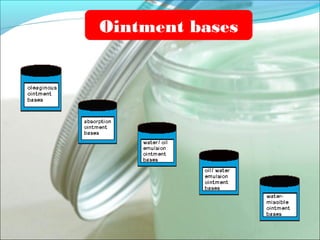
Ointment bases
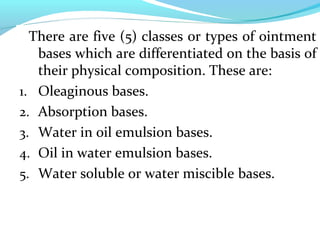
There are five (5) classes or types of ointment
bases which are differentiated on the basis of
their physical composition. These are:
1. Oleaginous bases.
2. Absorption bases.
3. Water in oil emulsion bases.
4. Oil in water emulsion bases.
5. Water soluble or water miscible bases.
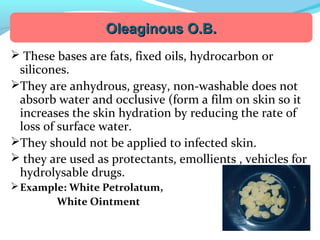
 These bases are fats, fixed oils, hydrocarbon or
silicones.
They are anhydrous, greasy, non-washable does not
absorb water and occlusive (form a film on skin so it
increases the skin hydration by reducing the rate of
loss of surface water.
They should not be applied to infected skin.
 they are used as protectants, emollients , vehicles for
hydrolysable drugs.
Example: White Petrolatum,
White Ointment
Oleaginous O.B.Oleaginous O.B.
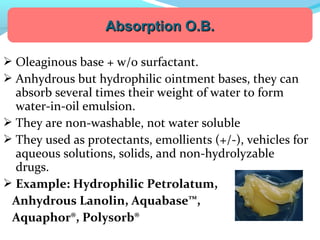
 Oleaginous base + w/o surfactant.
 Anhydrous but hydrophilic ointment bases, they can
absorb several times their weight of water to form
water-in-oil emulsion.
 They are non-washable, not water soluble
 They used as protectants, emollients (+/-), vehicles for
aqueous solutions, solids, and non-hydrolyzable
drugs.
 Example: Hydrophilic Petrolatum,
Anhydrous Lanolin, Aquabase™,
Aquaphor®, Polysorb®
Absorption O.B.Absorption O.B.
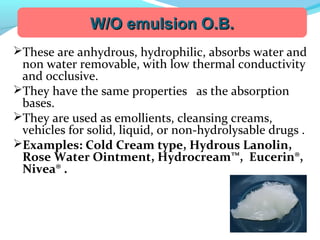
These are anhydrous, hydrophilic, absorbs water and
non water removable, with low thermal conductivity
and occlusive.
They have the same properties as the absorption
bases.
They are used as emollients, cleansing creams,
vehicles for solid, liquid, or non-hydrolysable drugs .
Examples: Cold Cream type, Hydrous Lanolin,
Rose Water Ointment, Hydrocream™, Eucerin®,
Nivea® .
W/O emulsion O.B.W/O emulsion O.B.
 These bases are anhydrous, water soluble, absorb
water and water washable.
 They are either carbowaxes Polyethylene Glycols
(PEGs) or hydrated gums (bentonite, gelatin,
cellulose derivatives).
 They are used as drug vehicles.
 Examples: PEG Ointment, Polybase™
O/W emulsion O.B.O/W emulsion O.B.
 These bases are anhydrous, water soluble, absorb
water and water washable.
 They are either carbowaxes Polyethylene Glycols
(PEGs) or hydrated gums (bentonite, gelatin,
cellulose derivatives).
 They are used as drug vehicles.
 Examples: PEG Ointment, Polybase™
Water miscible O.B.Water miscible O.B.
Selection of the Appropriate Base Based on:
1. Desired release rate.
2. Desirability for enhancement of per-cutaneous
absorption.
3. Advisability of occlusion.
4. Short-term or long-term stability.
5. Influence of drug on consistency or other features
of ointment base.
6. Patient factor - dry or weeping (oozing) skin.
Choice of the O.B.Choice of the O.B.
Among the properties which an
Ideal ointment base should possess are:
1. Does not retard wound healing.
2. Low sensitization index.
3. Pharmaceutical elegance.
4. A low index of irritation.
5. Non dehydrating.
6. Non greasy.
7. Neutral in reaction.
8. Good keeping qualities.
Ideal O.B.Ideal O.B.
9. Compatible with common medicaments.
10. Efficient release of medicament at site of
application.
11. Washable (easily removed with water).
12. Minimum number of ingredients.
13. Ease of compounding.
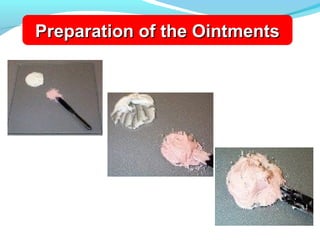
Preparation of the OintmentsPreparation of the Ointments
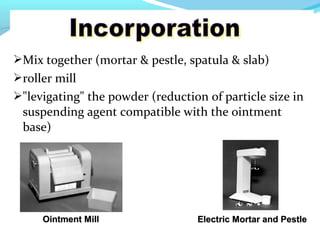
Mix together (mortar & pestle, spatula & slab)
roller mill
"levigating" the powder (reduction of particle size in
suspending agent compatible with the ointment
base)
Electric Mortar and PestleElectric Mortar and PestleOintment MillOintment Mill
 In porcelain dish all or some components of an
ointment melted together and cooled with constant
stirring until congealed, add non-melting substances as
the ointment is being cooled and stirred.
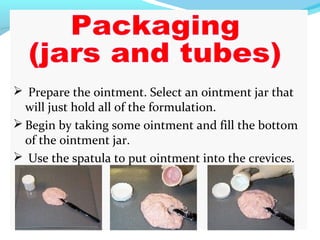
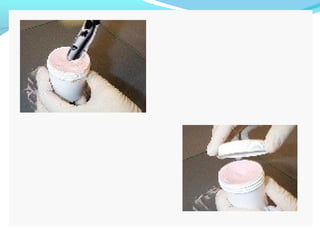
 Prepare the ointment. Select an ointment jar that
will just hold all of the formulation.
 Begin by taking some ointment and fill the bottom
of the ointment jar.
 Use the spatula to put ointment into the crevices.
Ointments should be stored in tightly closed and
completely filled containers
Changes in temperature can lead to the crystallization of
the drug and to changes in the ointment base.
They are usually dispensed in jars of glass or plastic
material or in collapsible tubes.
Sterile ointments must be dispensed in tubes or single dose
units in order to protect the product against contamination
during use.
With tin tubes, there is a risk of corrosion with hydrophilic
ointments.
Storage and dispensingStorage and dispensing
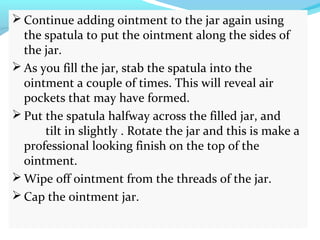
 Continue adding ointment to the jar again using
the spatula to put the ointment along the sides of
the jar.
 As you fill the jar, stab the spatula into the
ointment a couple of times. This will reveal air
pockets that may have formed.
 Put the spatula halfway across the filled jar, and
tilt in slightly . Rotate the jar and this is make a
professional looking finish on the top of the
ointment.
 Wipe off ointment from the threads of the jar.
 Cap the ointment jar.
Test for rate of absorption
The diadermatic ointment should be evaluated for
the rate of absorption of drug into the blood
stream.
This test can be done in-vivo only.
The ointment should be applied over a definite
area of the skin by rubbing.
At regular intervals of time, serum and urine
samples should be analyzed for the quantity of
drug absorbed. The rate of absorption i.e., the
amount of drug absorbed per unit time should be
more.
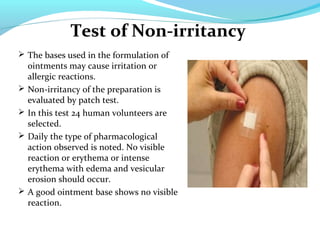
Test of Non-irritancy
 The bases used in the formulation of
ointments may cause irritation or
allergic reactions.
 Non-irritancy of the preparation is
evaluated by patch test.
 In this test 24 human volunteers are
selected.
 Daily the type of pharmacological
action observed is noted. No visible
reaction or erythema or intense
erythema with edema and vesicular
erosion should occur.
 A good ointment base shows no visible
reaction.
Test of rate of penetration
 The difference between the initial and the final weights of
the preparation gives the amount of preparation penetrated
through the skin and this when divided by the area and
time period of application gives the rate of penetration of
the preparation. The test should be repeated twice or
thrice. The rate of penetration of a semisolid dosage form is
crucial in the onset and duration of action of the drug.
Weighed quantity of the preparation should be applied
over selected area of the skin for a definite period of time.
Then the preparation left over is collected and weighed.
REFERENCES
"Dispensing pharmacy", R.M. Mehta, pg 217-230.
 L. Lachman, H.A, Lieberman and J.L. Kanig, Theory &
Practice of
industrial pharmacy, Lea & Febieger, Philadelphia
Latest Edn
Ointments

Ointments

  • 1.
    TopicTopic:-:- OINTMENTSOINTMENTS Presented To:-Presented By:- Dr. Sonali Singh Priyanka Singh Assiatant Professor Chaudhary M. Pharm I year Department of Pharmaceutical Science BBAU (Central University) Lucknow U.P.
  • 2.
    TABLE OF CONTENTS Whatis Ointments ? Types of ointment Advantages & Disadvantages Medicinal Applications GMP Guidelines Ointment bases Preparation Packaging , Storage and Dispensing Quality Control Tests Evaluation Test References
  • 3.
    Any greasy oroily semi-solid preparation, usually medicated, that can be applied externally to the skin in order to heal, soothe or protect it. It is a viscous semisolid preparation used topically on a variety of body surfaces. What is Ointments?
  • 4.
     Drug ingredientscan be dissolved, emulsified or suspended in the ointment base.  The word ointment comes from the Latin ungere meaning anoint with oil.
  • 5.
    Types of Ointments Thevarious types of ointments are:  Unmedicated ointments  Medicated ointments UNMEDICATED OINTMENTS These ointments do not contain any drugs. They are useful as emollients, protectants . Example: Petroleum jelly.
  • 6.
    MEDICATED OINTMENTS These ointmentscontain drugs which show local or systemic effects. These are of several sub-types: Dermatologic ointments Opthalmic ointments Rectal ointments Vaginal ointments Nasal ointments
  • 7.
    DERMATOLOGIC OINTMENTS  Theseointments are applied topically on the external skin. The ointment is applied to the affected area as a thin layer and spread evenly using gentle pressure with the fingertips. These are of three types:  (1) Epidermic ointments: The drugs present in these type of ointments exert their action on the epidermis of the skin. Example: Ketoconazole ointment.  (2) Endodermic ointments: The drugs present in these types of ointments exert their action on the deeper layers of cutaneous tissue. Example: Demodex ointment.  (3) Diadermic ointments: The drugs present in these types of ointments enter into the deeper layers of skin and finally in the systemic circulation and exert systemic effects. Example: Nitroglycerine ointment.
  • 8.
    OPTHALMIC OINTMENTS These aresterile preparations which are applied inside the lower eye lid. Only anhydrous bases are used in their preparation. The ointment is applied as a narrow band of approximately 0.25 - 0.5 inch. Example: Sulfacetamide sodium ointment. RECTAL OINTMENTS These are the ointments to be applied to the peri- anal or within the anal canal. The bases used are combinations of PEG 300 and PEG 3350, cetyl alcohol and cetyl esters, wax, liquid paraffin and white paraffin. Example: Benzocaine ointment.
  • 9.
    VAGINAL OINTMENTS These ointmentsare applied to the vulvo-vaginal area or inside the vagina. As vagina is more susceptible to infections, the ointment should be free from micro-organisms, moulds and yeasts. Example: Candicidin ointment. NASAL OINTMENTS These are used in the topical treatment of nasal mucosa. Drugs get absorbed into the general circulation through the rich blood supply of the nasal lining. Example: Ipratropium bromide ointment.
  • 10.
    ADVANTAGES  Handling ofointments is easier than bulky liquid dosage forms.  They are chemically more stable than liquid dosage forms.  They facilitate application of the directly to the effected body part and avoid exposure of other parts to the drug.  They are suitable for patients who find it difficult to take the drugs by parenteral and oral routes.  They prolong the contact time between the drug and effected area.  The bioavailability of drugs administered as ointments is more since it prevents passage through liver.
  • 11.
    DISADVANTAGES They are bulkierthan solid dosage forms. When applications of an exact quantity of ointment to the affected area is required, it is difficult to ascertain the same. They are less stable than solid dosage forms.
  • 12.
  • 13.
    Ointments are usedtopically for several purposes, e.g., as protectants, antiseptics, emollients, antipruritics, kerotolytics, and astringents.  In the case of a protective ointment, it serves to protect the skin against moisture, air, sun rays and other external factors. It is necessary that the ointment neither penetrates the human skin barriers nor facilitates the absorption of substances through this barrier.
  • 14.
    An antiseptic ointmentis used to destroy or inhibit the growth of bacteria. Frequently bacterial infections are deeply seated; a base which has the capacity to either penetrate or dissolve and release the medication effectively is therefore desired.  Ointments used for their emollient effect should be easy to apply, be non-greasy and effectively penetrate the skin.
  • 15.
    Good Manufacturing Practicesand Requirements of Premises, plant and Equipment for Pharmaceutical Products [SCHEDULE M] (Rules 71, 74, 76, and 78) PART ID SPECIFIC REQUIREMENTS FOR MANUFACTURING OF TOPICAL PRODUCTS i.e. EXTERNAL PREPARATIONS (CREAMS, OINTMENTS, PASTES, EMULSIONS, LOTIONS, SOLUTIONS, DUSTING POWDERS AND IDENTICAL PRODUCTS) 1. The entrance to the area where topical products are manufactured shall be through a suitable airlock. Outside the airlock, insectoctors shall be installed.
  • 16.
    2. The airto this manufacturing area shall be filtered through at least 20 air filters and shall be air- conditioned. The area shall be ventilated. 3. The area shall be fitted with an exhaust system of suitable capacity to effectively remove vapours, fumes, smoke, floating dust particles. 4. The equipment used shall be designed and maintained to prevent the product from being accidently contaminated with any foreign matter or lubricant. 5. No rags or dusters shall be used in the process of cleaning or drying the process equipment or accessories used.
  • 17.
    6. Water usedin compounding shall be Purified Water IP. 7. Powders, whenever used, shall be suitably sieved before use. 8. Heating vehicles and a base like petroleum jelly shall be done in separate mixing area in suitable stainless steel vessels, using steam, gas, electricity, solar energy etc. 9. A Separate packing section may be provided for primary packaging of the products.
  • 18.
  • 19.
    There are five(5) classes or types of ointment bases which are differentiated on the basis of their physical composition. These are: 1. Oleaginous bases. 2. Absorption bases. 3. Water in oil emulsion bases. 4. Oil in water emulsion bases. 5. Water soluble or water miscible bases.
  • 20.
     These basesare fats, fixed oils, hydrocarbon or silicones. They are anhydrous, greasy, non-washable does not absorb water and occlusive (form a film on skin so it increases the skin hydration by reducing the rate of loss of surface water. They should not be applied to infected skin.  they are used as protectants, emollients , vehicles for hydrolysable drugs. Example: White Petrolatum, White Ointment Oleaginous O.B.Oleaginous O.B.
  • 21.
     Oleaginous base+ w/o surfactant.  Anhydrous but hydrophilic ointment bases, they can absorb several times their weight of water to form water-in-oil emulsion.  They are non-washable, not water soluble  They used as protectants, emollients (+/-), vehicles for aqueous solutions, solids, and non-hydrolyzable drugs.  Example: Hydrophilic Petrolatum, Anhydrous Lanolin, Aquabase™, Aquaphor®, Polysorb® Absorption O.B.Absorption O.B.
  • 22.
    These are anhydrous,hydrophilic, absorbs water and non water removable, with low thermal conductivity and occlusive. They have the same properties as the absorption bases. They are used as emollients, cleansing creams, vehicles for solid, liquid, or non-hydrolysable drugs . Examples: Cold Cream type, Hydrous Lanolin, Rose Water Ointment, Hydrocream™, Eucerin®, Nivea® . W/O emulsion O.B.W/O emulsion O.B.
  • 23.
     These basesare anhydrous, water soluble, absorb water and water washable.  They are either carbowaxes Polyethylene Glycols (PEGs) or hydrated gums (bentonite, gelatin, cellulose derivatives).  They are used as drug vehicles.  Examples: PEG Ointment, Polybase™ O/W emulsion O.B.O/W emulsion O.B.
  • 24.
     These basesare anhydrous, water soluble, absorb water and water washable.  They are either carbowaxes Polyethylene Glycols (PEGs) or hydrated gums (bentonite, gelatin, cellulose derivatives).  They are used as drug vehicles.  Examples: PEG Ointment, Polybase™ Water miscible O.B.Water miscible O.B.
  • 25.
    Selection of theAppropriate Base Based on: 1. Desired release rate. 2. Desirability for enhancement of per-cutaneous absorption. 3. Advisability of occlusion. 4. Short-term or long-term stability. 5. Influence of drug on consistency or other features of ointment base. 6. Patient factor - dry or weeping (oozing) skin. Choice of the O.B.Choice of the O.B.
  • 26.
    Among the propertieswhich an Ideal ointment base should possess are: 1. Does not retard wound healing. 2. Low sensitization index. 3. Pharmaceutical elegance. 4. A low index of irritation. 5. Non dehydrating. 6. Non greasy. 7. Neutral in reaction. 8. Good keeping qualities. Ideal O.B.Ideal O.B.
  • 27.
    9. Compatible withcommon medicaments. 10. Efficient release of medicament at site of application. 11. Washable (easily removed with water). 12. Minimum number of ingredients. 13. Ease of compounding.
  • 28.
    Preparation of theOintmentsPreparation of the Ointments
  • 29.
    Mix together (mortar& pestle, spatula & slab) roller mill "levigating" the powder (reduction of particle size in suspending agent compatible with the ointment base) Electric Mortar and PestleElectric Mortar and PestleOintment MillOintment Mill
  • 30.
     In porcelaindish all or some components of an ointment melted together and cooled with constant stirring until congealed, add non-melting substances as the ointment is being cooled and stirred.
  • 31.
     Prepare theointment. Select an ointment jar that will just hold all of the formulation.  Begin by taking some ointment and fill the bottom of the ointment jar.  Use the spatula to put ointment into the crevices.
  • 33.
    Ointments should bestored in tightly closed and completely filled containers Changes in temperature can lead to the crystallization of the drug and to changes in the ointment base. They are usually dispensed in jars of glass or plastic material or in collapsible tubes. Sterile ointments must be dispensed in tubes or single dose units in order to protect the product against contamination during use. With tin tubes, there is a risk of corrosion with hydrophilic ointments. Storage and dispensingStorage and dispensing
  • 34.
     Continue addingointment to the jar again using the spatula to put the ointment along the sides of the jar.  As you fill the jar, stab the spatula into the ointment a couple of times. This will reveal air pockets that may have formed.  Put the spatula halfway across the filled jar, and tilt in slightly . Rotate the jar and this is make a professional looking finish on the top of the ointment.  Wipe off ointment from the threads of the jar.  Cap the ointment jar.
  • 45.
    Test for rateof absorption The diadermatic ointment should be evaluated for the rate of absorption of drug into the blood stream. This test can be done in-vivo only. The ointment should be applied over a definite area of the skin by rubbing. At regular intervals of time, serum and urine samples should be analyzed for the quantity of drug absorbed. The rate of absorption i.e., the amount of drug absorbed per unit time should be more.
  • 46.
    Test of Non-irritancy The bases used in the formulation of ointments may cause irritation or allergic reactions.  Non-irritancy of the preparation is evaluated by patch test.  In this test 24 human volunteers are selected.  Daily the type of pharmacological action observed is noted. No visible reaction or erythema or intense erythema with edema and vesicular erosion should occur.  A good ointment base shows no visible reaction.
  • 47.
    Test of rateof penetration  The difference between the initial and the final weights of the preparation gives the amount of preparation penetrated through the skin and this when divided by the area and time period of application gives the rate of penetration of the preparation. The test should be repeated twice or thrice. The rate of penetration of a semisolid dosage form is crucial in the onset and duration of action of the drug. Weighed quantity of the preparation should be applied over selected area of the skin for a definite period of time. Then the preparation left over is collected and weighed.
  • 48.
    REFERENCES "Dispensing pharmacy", R.M.Mehta, pg 217-230.  L. Lachman, H.A, Lieberman and J.L. Kanig, Theory & Practice of industrial pharmacy, Lea & Febieger, Philadelphia Latest Edn