ZERO TURNING RADIUS STRETCHER
A Project Submitted in Partial Fulfillment of the Requirement for the Award of the Degree
BACHELOR OF TECHNOLOGY
MECHANICAL ENGINEERING
RIZWAN SEIKH
AKASH KUMAR SINGH (ID No. 175126
VINOD KUMAR YADAV (ID No. 175105
NIDHI YADAV (ID No. 175139
Mr. HIMANSHU TIWARI
Department of Mechanical
Uma Nath Singh Institute of Engineering & Technology
VEER BAHADUR SINGH PURVANCHAL
JAUNPUR, UTTAR PRADESH
ZERO TURNING RADIUS STRETCHER
Project Submitted in Partial Fulfillment of the Requirement for the Award of the Degree
BACHELOR OF TECHNOLOGY
in
MECHANICAL ENGINEERING
Submitted By
RIZWAN SEIKH (ID No. 175150)
AKASH KUMAR SINGH (ID No. 175126)
VINOD KUMAR YADAV (ID No. 175105)
NIDHI YADAV (ID No. 175139)
Under the Supervision of
Mr. HIMANSHU TIWARI
(Assistant Professor)
Department of Mechanical Engineering
ath Singh Institute of Engineering & Technology
VEER BAHADUR SINGH PURVANCHAL UNIVERSITY
JAUNPUR, UTTAR PRADESH
[2017-2021]
Project Submitted in Partial Fulfillment of the Requirement for the Award of the Degree of
ath Singh Institute of Engineering & Technology
UNIVERSITY
CERTIFICATE
This is to certify that the project entitled “Zero Turning Radius Stretcher
(ZTRS)” submitted by Rizwan Sheikh (ID No.175150), Akash Kumar Singh (ID No.
175126), Vinod Kumar Yadav (ID No. 175105) and Nidhi Yadav (ID No. 175139) to
Department of Mechanical Engineering, Uma Nath Singh Institute of Engineering and
Technology, Veer Bahadur Singh Purvanchal University, Jaunpur, is a record of bon fide
research work carried out by them under my supervision and is worthy of consideration for the
award of the degree of Bachelor of Technology in Mechanical Engineering. The
embodiment of this project has not been submitted in any other University and/or Institute for
the award of the any degree.
Dr. Sandeep Kumar Singh Mr. Himanshu
Tiwari
(HEAD) (Supervisor)
(Assistant Professor) (Assistant Professor)
UNSIET,VBSPU, Jaunpur
Date: 23/07/2021
Place: Department of Mechanical Engineering
UNSIET, VBSPU, Jaunpur
DECLARATION
We Rizwan Sheikh (ID No.175150), Akash Kumar Singh (ID No. 175126),
Vinod Kumar Yadav (ID No. 175105) and Nidhi Yadav (ID No. 175139) declare that the
work presented in this project entitled “Zero Turning Radius Stretcher (ZTRS)” submitted
to the Department of Mechanical Engineering, in Uma Nath Singh Institute of Engineering and
Technology, Veer Bahadur Singh Purvanchal University, Jaunpur for the award of the
Bachelor of Technology degree in Mechanical Engineering an original work. We have
done this research work on our own under the guidance of Mr. Himanshu Tiwari, The data
mentioned in this report have been generated during the work and experiments are genuine. It
is the result of extensive work carried out by us. We have neither plagiarized nor submitted the
same work for the award of any other degree. In case this undertaking is found incorrect, our
degree may be withdrawn unconditionally by the University.
Date: 23/07/2021 …………………………….
Place: Department of Mechaical Engineering RIZWAN SHEIKH
UNSIET, VBSPU, Jaunpur (ID NO. 175150)
………………………….
AKASH KUMAR SINGH
(ID NO. 175126)
………………………….
VINOD KUMAR YADAV
(ID NO. 175105)
………………………….
NIDHI YADAV
(ID NO. 175139)
ACKNOWLEDGEMENT
It gives me great pleasure to express my gratitude and heart full thanks
to all those who are helping me in complete this project.
I want to thank to “Mr. HIMANSHU TIWARI”, who has always
encouraged and help me in making this project. In addition to this, I am grateful
to other faculties too who made me in right direction and gave me their precious
time and expert guidance whenever necessary through which I could achieve this
extent.
At last but not the least I am feeling glad to say about my family whose
wishes are always with me, without which it was not possible for me to reach this
extent.
I hope my work is praised and my efforts render fruitful result.
Date: 23/07/2021 …………………………….
Place: Department of Mechanical Engineering RIZWAN SHEIKH
UNSIET, VBSPU, Jaunpur (ID NO. 175150)
………………………….
AKASH KUMAR SINGH
(ID NO. 175126)
………………………….
VINOD KUMAR YADAV
(ID NO. 175105)
………………………….
NIDHI YADAV
(ID NO. 175139)
ABSTRACT
This project is a Prototype model of “Zero Turn Drive Stretcher”. This project is a
Prototype model of “Zero Turn Derive Stretcher”. This Model build a mechanism which
depict zero turning radius of the stretcher, so that a Stretcher may take turn automatically
having centre at the midpoint of the Stretcher .It is very innovative idea for the quick turning
i.e. turning about centre of stretcher.
Zero turning radius of a Stretcher implies the Stretcher rotating about an axis passing through
the centre of gravity of Stretcher rather than describing a circular path as in conventional
turning, i.e. the Stretcher turning at the same place, where it is standing. No extra space is
required to turn the Stretcher. So, vehicle can be turned in the space equal to the length of
Stretcher itself.
This project use ultrasonic sensor for finding the path automatically and also have two mode
called Automatic and manual. Here use three ultrasonic sensors for sensing the path.
Key Words: Arduino, Stretcher, Obstacle, Microcontroller, Ultrasonic sensor, Encoder
Mechatronic, Autonomous Robot, Ultrasonic Sensors, Servo Motors,
TABLE OF CONTENTS
CONTENT PAGE
NO.
Acknowledgement i
Abstract ii
Table of Contents iii-iv
List of Figures v
List of Abbreviations vi
CHAPTER 1: INTRODUCTION 1-5
1.1 Introduction 1
1.2 Zero Turning Radius Stretcher 1
1.3 Purpose 2
1.4 Working Principle 2
1.4 Ultrasonic Sensor 3
CHAPTER-1
INTRODUCTION
1.1 INTRODUCTION:
Automobiles have become a basic necessity in present world of industrialization and fast
growing population. An automobile is a self-propelled vehicle, which is used for road
transportation of passengers and goods. The self-propelled vehicle is that contains its own
source of power for the propulsion, e.g., car, jeep, bus, truck etc. World’s first automobile was
produced in 1892. General Motors India Ltd.
Started their factory in Mumbai in 1928 for assembling cars and truck, Due to increasing
demand and supply of cars, roads are overflowed by vehicles. There is severe problem of
parking at home, parking at public places and multiplexes, traffic jam etc. the problem at
parking and traffic jam.In this work, main emphasis was given on developing a system for
minimum turning space or turning radius of the vehicle.
1.2 ZERO TURNING RADIUS STRETCHER:
Driving and steering mechanism for a vehicle having a pair of driving wheels includes
a steering wheel rotatable mounted to the vehicle and an accelerator foot pedal pivotally
mounted to the vehicle. Zero turning radius of a vehicle implies the vehicle rotating about an
axis passing through the centre of gravity of vehicle rather than describing a circular path as in
conventional turning, i.e. the vehicle turning at the same place, where it is standing. No extra
space is required to turn the vehicle. So, vehicle can be turned in the space equal to the length
of vehicle itself.
Zero turning radiuses exists in heavy earth mover, like excavator, which consists of two
parts, i.e. the upper part, cabin and boom/jaw and lower part, crawler chain. Transmissions
associated with the driving wheels include a pivot able control arm for controlling the
operation of the transmission, which independently controls the speed and direction of rotation
of the associated wheel. The vehicle is turned by causing one wheel to rotate faster than the
other wheel. A zero turning radius turn can be effected by causing the driving wheels to rotate
in opposite directions.
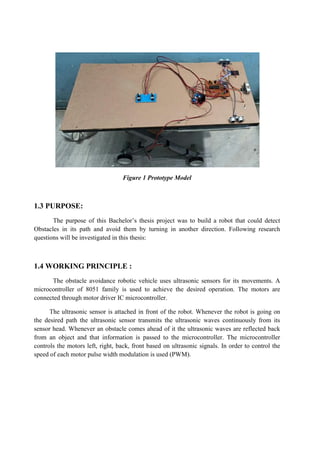
Figure 1 Prototype Model
1.3 PURPOSE:
The purpose of this Bachelor’s thesis project was to build a robot that could detect
Obstacles in its path and avoid them by turning in another direction. Following research
questions will be investigated in this thesis:
1.4 WORKING PRINCIPLE :
The obstacle avoidance robotic vehicle uses ultrasonic sensors for its movements. A
microcontroller of 8051 family is used to achieve the desired operation. The motors are
connected through motor driver IC microcontroller.
The ultrasonic sensor is attached in front of the robot. Whenever the robot is going on
the desired path the ultrasonic sensor transmits the ultrasonic waves continuously from its
sensor head. Whenever an obstacle comes ahead of it the ultrasonic waves are reflected back
from an object and that information is passed to the microcontroller. The microcontroller
controls the motors left, right, back, front based on ultrasonic signals. In order to control the
speed of each motor pulse width modulation is used (PWM).
1.5 ULTRASONIC SENSOR HC
The ultrasonic sensor is used for obstacle detection. Ultrasonic sensor transmits the
ultrasonic waves from its sensor head and again receives the ultrasonic waves reflected from
an object.
There are many application use ultrasonic sensors like instruction alarm system,
automatic door openers etc. The ultrasonic
performance. It has both the transmitter and receiver. It consists of four pins Vcc pin to offer a
5V supply to the sensor, trigger pin give a TTL pulses (15us), echo pin to get the output from
the sensor and ground pin.
Ultrasonic sensor HC-SR04 is shown in Fig. 3. An object was also placed to the right to
ensure it turned left that time. When the code had been adjusted so that these things worked an
obstacle was placed to the left as well to see if the robot the
placed all around the robot to make sure it would stop completely. After all of the testing an
obstacle course was built. Minor adjustments in the code were made until the robot drove
through the obstacle course without d
1.6 FEATURES:
 Easy to left/right turn on the turning area
 Less parking area required
 Easy to operate.
1.7 MECHANISMS:
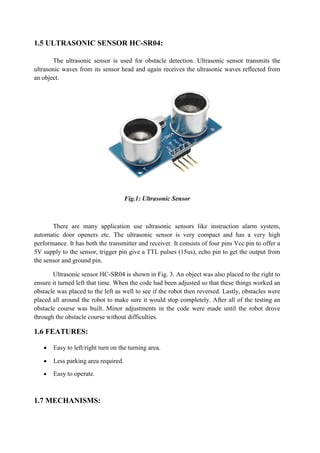
1.5 ULTRASONIC SENSOR HC-SR04:
The ultrasonic sensor is used for obstacle detection. Ultrasonic sensor transmits the
ltrasonic waves from its sensor head and again receives the ultrasonic waves reflected from
Fig.1: Ultrasonic Sensor
There are many application use ultrasonic sensors like instruction alarm system,
automatic door openers etc. The ultrasonic sensor is very compact and has a very high
performance. It has both the transmitter and receiver. It consists of four pins Vcc pin to offer a
5V supply to the sensor, trigger pin give a TTL pulses (15us), echo pin to get the output from
SR04 is shown in Fig. 3. An object was also placed to the right to
ensure it turned left that time. When the code had been adjusted so that these things worked an
obstacle was placed to the left as well to see if the robot then reversed. Lastly, obstacles were
placed all around the robot to make sure it would stop completely. After all of the testing an
obstacle course was built. Minor adjustments in the code were made until the robot drove
through the obstacle course without difficulties.
Easy to left/right turn on the turning area.
Less parking area required.
The ultrasonic sensor is used for obstacle detection. Ultrasonic sensor transmits the
ltrasonic waves from its sensor head and again receives the ultrasonic waves reflected from
There are many application use ultrasonic sensors like instruction alarm system,
sensor is very compact and has a very high
performance. It has both the transmitter and receiver. It consists of four pins Vcc pin to offer a
5V supply to the sensor, trigger pin give a TTL pulses (15us), echo pin to get the output from
SR04 is shown in Fig. 3. An object was also placed to the right to
ensure it turned left that time. When the code had been adjusted so that these things worked an
n reversed. Lastly, obstacles were
placed all around the robot to make sure it would stop completely. After all of the testing an
obstacle course was built. Minor adjustments in the code were made until the robot drove
 Sliding mechanism
 Scissor Mechanism
1.8 TECHNOLOGY USED:
 Ultrasonic Sensor rang finder
 Manual operation using switches
 Autonomous Robot
 Ultrasonic
1.9 ADVANTAGES:
 It is less costly load carry vehicle.
 Eco friendly.
 Less noise operation.
 This type of load carry vehicle is easily parked in any direction.
 Battery operated thus no fuel required.
 It is more efficient compare to other type of load carry vehicle.
 More efficient.
 Turning left/right at narrow roads
 Use in service and maintenance etc.
 This can give fast response and less space is required
 Battery is using in this 360 degree wheel rotation vehicle to move forward and
backward, so it is a kind pollution free vehicle
 Better parking at home in narrow space and at Multiplexes
 Easy removal of vehicle from the traffic jams
1.10DISADVANTAGES:
 A primary disadvantage is cost these machines are more expensive than other
comparably sized lawnmowers.
 Another disadvantage is that zero-turn mowers are usually dedicated machines.
1.11 APPLICATION:
 Hospitals
 Zero Turning driving
 In Industries for automation of raw material like automated guided vehicle.
 In automobile sector there are so many types of vehicle are using to carry goods
from one position to another position, there is space problem in the industry so this
vehicle is used in automobile applications because this vehicle consumes very less
space compare to other type of vehicle.
 This vehicle is used in small Industries for transportation of raw material from one
position to another position.
 Modern development and economical progression of Indian society resulted in
increase of vehicle in park so there are also problem. In park other vehicle are
taking more space to move from one direction to other direction and 360 degree
wheel rotation vehicle have capability to move parallel direction so this vehicle is
easily move from one direction to other direction in park.
 Take easily U-turn because front wheel of this vehicle are rotating freely by
steering, chain drive and sprocket arrangement.
CHAPTER- 2
REQUIRED TOOLS & MATERIALS
2.1 LIST OF TOOLS AND MACHINES
 Screw Drivers
 Knife
 Pliers
 Hammer
 Wrench
 Hex sew
 Vise
 Drill
 Drill machine
 Grinder
 File
 Hole Sew
 Lath Machine
2.2DESCRIPTION OF TOOLS:
2.2.1 Screw Drivers:
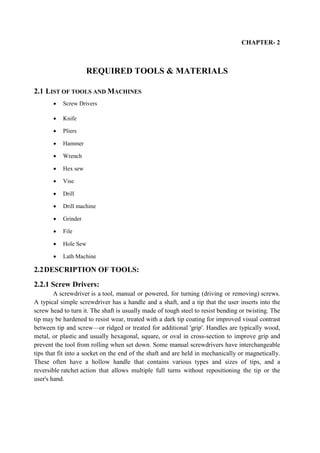
A screwdriver is a tool, manual or powered, for turning (driving or removing) screws.
A typical simple screwdriver has a handle and a shaft, and a tip that the user inserts into the
screw head to turn it. The shaft is usually made of tough steel to resist bending or twisting. The
tip may be hardened to resist wear, treated with a dark tip coating for improved visual contrast
between tip and screw—or ridged or treated for additional 'grip'. Handles are typically wood,
metal, or plastic and usually hexagonal, square, or oval in cross-section to improve grip and
prevent the tool from rolling when set down. Some manual screwdrivers have interchangeable
tips that fit into a socket on the end of the shaft and are held in mechanically or magnetically.
These often have a hollow handle that contains various types and sizes of tips, and a
reversible ratchet action that allows multiple full turns without repositioning the tip or the
user's hand.
Fig. 2: Screw Driver
A screwdriver is classified by its tip, which is shaped to fit the driving surfaces—slots,
grooves, recesses, etc.—on the corresponding screw head. Proper use requires that the
screwdriver's tip engage the head of a screw of the same size and type designation as the
screwdriver tip. Screwdriver tips are available in a wide variety of types and sizes (List of
screw drives). The two most common are the simple 'blade'-type for slotted screws, and
Phillips®, generically referred to as "cross-recess".
2.2.2 Knife:
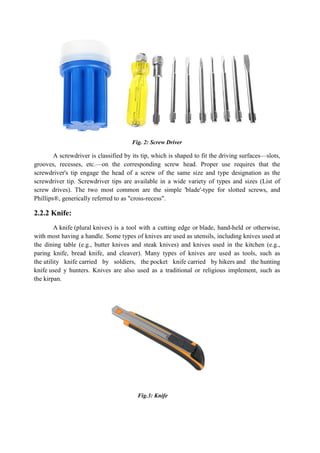
A knife (plural knives) is a tool with a cutting edge or blade, hand-held or otherwise,
with most having a handle. Some types of knives are used as utensils, including knives used at
the dining table (e.g., butter knives and steak knives) and knives used in the kitchen (e.g.,
paring knife, bread knife, and cleaver). Many types of knives are used as tools, such as
the utility knife carried by soldiers, the pocket knife carried by hikers and the hunting
knife used y hunters. Knives are also used as a traditional or religious implement, such as
the kirpan.
Fig.3: Knife
2.2.3 Pliers:
Pliers are a hand tool used to hold objects firmly, possibly developed from tongs used
to handle hot metal in Bronze Age Europe.[1]
They are also useful
for bending and compressing a wide range of materials. Generally, pliers consist of a pair
of metal first-class levers joined at a fulcrum positioned closer to one end of the levers,
creating short jaws on one side of the fulcrum, and longer handles on the other side.[1]
This
arrangement creates a mechanical advantage, allowing the force of the hand's grip to be
amplified and focused on an object with precision. The jaws can also be used to manipulate
objects too small or unwieldy to be manipulated with the fingers.
Fig.4: Pliers
Pincers are a similar tool with a different type of head used for cutting and pulling,
rather than squeezing. Tools designed for safely handling hot objects are usually called tongs.
Special tools for making crimp connections in electrical and electronic applications are often
called "crimping pliers"; each type of connection uses its own dedicated tool.
2.2.4 Hammer:
A hammer is a tool or device that delivers a blow (a sudden impact) to an object. Most
hammers are hand tools used to drive nails, fit parts, forge metal, and break apart objects.
Hammers vary in shape, size, and structure, depending on their purposes.
Hammers are basic tools in many trades. The usual features are a head (most often
made of steel) and a handle (also called a helve or haft). Although most hammers are hand
tools, powered versions exist; they are known as powered hammers. Types of power hammer
include steam hammers and trip hammers, often for heavier uses, such as forging.
Fig.5: Hammer
Some hammers have other names, such as sledgehammer, mallet and gavel. The term
"hammer" also applies to devices that deliver blows, such as the hammer of a firearm or the
hammer of a piano or the hammer ice scraper.
2.2.5 Wrench:
A wrench (or spanner outside of North America) is a tool used to provide grip
and mechanical advantage in applying torque to turn objects—usually rotary fasteners, such
as nuts and bolts or keep them from turning.
In Commonwealth English (excluding Canada), spanner is the standard term. The most
common shapes are called open-ended spanner and ring spanner. The term wrench is
generally used for tools that turn non-fastening devices (e.g. tap wrench and pipe wrench), or
may be used for a monkey wrench - an adjustable spanner.[1]
In North American English, wrench is the standard term. The most common shapes are
called open-end wrench and box-end wrench. In American English, spanner refers to a
specialised wrench with a series of pins or tabs around the circumference. (These pins or tabs
fit into the holes or notches cut into the object to be turned.) In American commerce, such a
wrench may be called a spanner wrench to distinguish it from the British sense of spanner.
Fig.6: Wrench
2.2.6 Hex Saw:
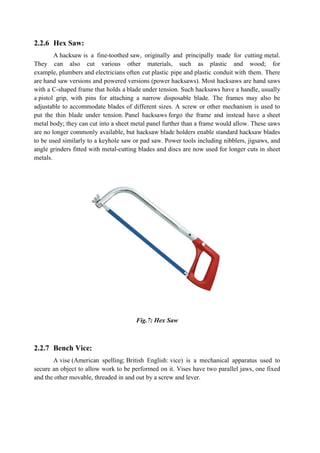
A hacksaw is a fine-toothed saw, originally and principally made for cutting metal.
They can also cut various other materials, such as plastic and wood; for
example, plumbers and electricians often cut plastic pipe and plastic conduit with them. There
are hand saw versions and powered versions (power hacksaws). Most hacksaws are hand saws
with a C-shaped frame that holds a blade under tension. Such hacksaws have a handle, usually
a pistol grip, with pins for attaching a narrow disposable blade. The frames may also be
adjustable to accommodate blades of different sizes. A screw or other mechanism is used to
put the thin blade under tension. Panel hacksaws forgo the frame and instead have a sheet
metal body; they can cut into a sheet metal panel further than a frame would allow. These saws
are no longer commonly available, but hacksaw blade holders enable standard hacksaw blades
to be used similarly to a keyhole saw or pad saw. Power tools including nibblers, jigsaws, and
angle grinders fitted with metal-cutting blades and discs are now used for longer cuts in sheet
metals.
Fig.7: Hex Saw
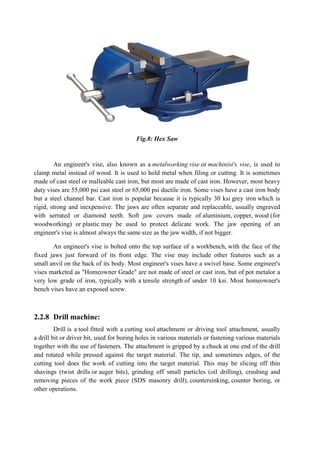
2.2.7 Bench Vice:
A vise (American spelling; British English: vice) is a mechanical apparatus used to
secure an object to allow work to be performed on it. Vises have two parallel jaws, one fixed
and the other movable, threaded in and out by a screw and lever.
Fig.8: Hex Saw
An engineer's vise, also known as a metalworking vise or machinist's vise, is used to
clamp metal instead of wood. It is used to hold metal when filing or cutting. It is sometimes
made of cast steel or malleable cast iron, but most are made of cast iron. However, most heavy
duty vises are 55,000 psi cast steel or 65,000 psi ductile iron. Some vises have a cast iron body
but a steel channel bar. Cast iron is popular because it is typically 30 ksi grey iron which is
rigid, strong and inexpensive. The jaws are often separate and replaceable, usually engraved
with serrated or diamond teeth. Soft jaw covers made of aluminium, copper, wood (for
woodworking) or plastic may be used to protect delicate work. The jaw opening of an
engineer's vise is almost always the same size as the jaw width, if not bigger.
An engineer's vise is bolted onto the top surface of a workbench, with the face of the
fixed jaws just forward of its front edge. The vise may include other features such as a
small anvil on the back of its body. Most engineer's vises have a swivel base. Some engineer's
vises marketed as "Homeowner Grade" are not made of steel or cast iron, but of pot metalor a
very low grade of iron, typically with a tensile strength of under 10 ksi. Most homeowner's
bench vises have an exposed screw.
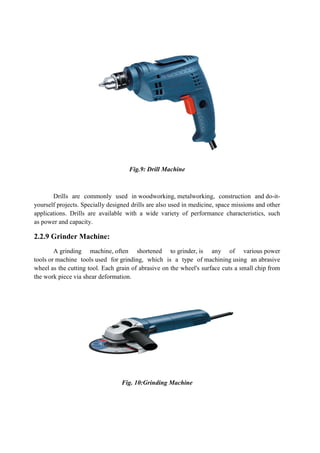
2.2.8 Drill machine:
Drill is a tool fitted with a cutting tool attachment or driving tool attachment, usually
a drill bit or driver bit, used for boring holes in various materials or fastening various materials
together with the use of fasteners. The attachment is gripped by a chuck at one end of the drill
and rotated while pressed against the target material. The tip, and sometimes edges, of the
cutting tool does the work of cutting into the target material. This may be slicing off thin
shavings (twist drills or auger bits), grinding off small particles (oil drilling), crushing and
removing pieces of the work piece (SDS masonry drill), countersinking, counter boring, or
other operations.
Fig.9: Drill Machine
Drills are commonly used in woodworking, metalworking, construction and do-it-
yourself projects. Specially designed drills are also used in medicine, space missions and other
applications. Drills are available with a wide variety of performance characteristics, such
as power and capacity.
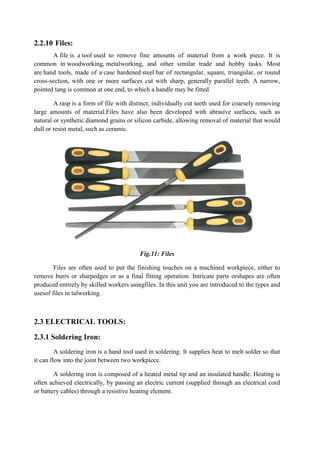
2.2.9 Grinder Machine:
A grinding machine, often shortened to grinder, is any of various power
tools or machine tools used for grinding, which is a type of machining using an abrasive
wheel as the cutting tool. Each grain of abrasive on the wheel's surface cuts a small chip from
the work piece via shear deformation.
Fig. 10:Grinding Machine
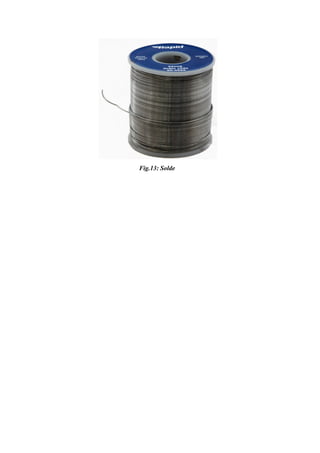
2.2.10 Files:
A file is a tool used to remove fine amounts of material from a work piece. It is
common in woodworking, metalworking, and other similar trade and hobby tasks. Most
are hand tools, made of a case hardened steel bar of rectangular, square, triangular, or round
cross-section, with one or more surfaces cut with sharp, generally parallel teeth. A narrow,
pointed tang is common at one end, to which a handle may be fitted.
A rasp is a form of file with distinct, individually cut teeth used for coarsely removing
large amounts of material.Files have also been developed with abrasive surfaces, such as
natural or synthetic diamond grains or silicon carbide, allowing removal of material that would
dull or resist metal, such as ceramic.
Fig.11: Files
Files are often used to put the finishing touches on a machined workpiece, either to
remove burrs or sharpedges or as a final fitting operation. Intricate parts orshapes are often
produced entirely by skilled workers usingfiles. In this unit you are introduced to the types and
usesof files in talworking.
2.3 ELECTRICAL TOOLS:
2.3.1 Soldering Iron:
A soldering iron is a hand tool used in soldering. It supplies heat to melt solder so that
it can flow into the joint between two workpiece.
A soldering iron is composed of a heated metal tip and an insulated handle. Heating is
often achieved electrically, by passing an electric current (supplied through an electrical cord
or battery cables) through a resistive heating element.
Solder melts at approximately 185°C (365°F). Soldering irons are designed to reach a
temperature range of 200° to 480°C (392° to 896° F).Soldering
installation, repairs, and limited production work in electronics assembly. High
production lines use other soldering methods.
sheet metal objects. Less common uses inc
and plastic welding(Ultrasonic welding
2.3.2 Solder:
Solder or in North America
between metal work pieces. Solder is melted in order to adhere to and connect the pieces after
cooling, which requires that an alloy suitable for use as solder have a lower melting
the pieces being joined. The solder should also be resistant to oxidative and corrosive effects
that would degrade the joint over time. Solder used in making electrical connections also needs
to have favourable electrical characteristics.
Solder melts at approximately 185°C (365°F). Soldering irons are designed to reach a
temperature range of 200° to 480°C (392° to 896° F).Soldering irons are most often used for
installation, repairs, and limited production work in electronics assembly. High
production lines use other soldering methods.[1]
Large irons may be used for soldering joints in
sheet metal objects. Less common uses include pyrography (burning designs into wood)
plastic welding(Ultrasonic welding could possibly be used if set correctly).
Fig.12: Soldering Iron
in North America is a fusible metal alloy used to create a permanent bond
between metal work pieces. Solder is melted in order to adhere to and connect the pieces after
cooling, which requires that an alloy suitable for use as solder have a lower melting
the pieces being joined. The solder should also be resistant to oxidative and corrosive effects
that would degrade the joint over time. Solder used in making electrical connections also needs
to have favourable electrical characteristics.
Solder melts at approximately 185°C (365°F). Soldering irons are designed to reach a
irons are most often used for
installation, repairs, and limited production work in electronics assembly. High-volume
Large irons may be used for soldering joints in
(burning designs into wood)
could possibly be used if set correctly).
used to create a permanent bond
between metal work pieces. Solder is melted in order to adhere to and connect the pieces after
cooling, which requires that an alloy suitable for use as solder have a lower melting point than
the pieces being joined. The solder should also be resistant to oxidative and corrosive effects
that would degrade the joint over time. Solder used in making electrical connections also needs
Fig.13: Solde
CHAPTER-3
SELECTION OF MECHANICAL MATERIALS
The quality, performance, life etc. of an engineering product, all are effected by the
engineering material being used for manufacturing that product. Hence it becomes necessary to
select suitable Engineering materials for a successful engineering product. For selection of
suitable materials for any engineering application / product, following factors should be
considered –
 Mechanical strength
 Stability
 Ductility
 Availability
 Fabric ability
 Design
 Corrosion Resistance
 Cost
2.3 MECHANICAL STRENGTH:
Mechanical strength is primary criteria for selection of suitable materials for any
Engineering application / product. Mechanical strength is the ability of materials to withstand
with load or forces. Materials selected for any engineering application, should have
appropriate mechanical strength to be capable to withstand with loads or forces developed in
structure of engineering product during operation.
2.4 STABILITY:
Stability of engineering material is defined by the ability of engineering product
manufactured by using that material to with stand with following operating conditions-
1. Temperature
2. Fluctuations in temperature
3. During of operation
4. Radiation
5. Atmospheric conditions
2.5 DUCTILITY:
Ductility of engineering material is the property of material makes the material suitable for
fabrication by rolling, drawing, extrusion and other mechanical processes. Basically it is the
ability of material that how much the materials can be stretched plastically without breakdown
or failure. Ductility of materials is related to the strength of material. Considerable ductility
can be obtained at a sacrifice of strength or vice versa. For example, by increase of temperature
ductility of material increased and strength decreased. By cold rolling the mechanical strength
is increased whereas the ductility is decreased. It is not necessary the material being used for
all products should have high ductility. But it should have suitable ductility.
2.6 AVAILABILITY:
Material selected for engineering product should be easily available in desired form and at
appropriate cost. So that the product can be produced economically to make its price
competitive in market, Material may be available in any form such as casting, forging, rolled
sheets etc. But the availability of material in suitable form is necessary to facilitate the
manufacturing the product with desired quality.
2.7 FABRIC ABILITY:
Fabric ability of an Engineering material is the ability of material, which indicates that how
easily it can be fabricated in desired form and shape in order to manufacture an engineering
product. Fabric ability of material makes it suitable for mechanical processing to convert it in
desired form and shape.
2.8 DESIGN:
The selection of material for any engineering product is also governed by the design of
product. The design of engineering product decides the strength and ductility required for in
materials being selected for that product. Hence, the engineering product should be designed
with consideration of properties of engineering material.
2.9CORROSION RESISTANCE:
When the Engineering product is used in an industrial atmospheric environment, there are
chances that the base materials of product get corroded. Corrosion of refined material is a
natural process which converts the refined material in more stable oxides. This corrosion
makes the material gradually weak with time. Hence, for the satisfactory operation,
performance and life of engineering product, it becomes necessary that material being selected
for that product should have sufficient corrosion resistance.
2.10 COST:
To make the engineering product commercially successful and profitable, its price should
be reasonable and competitive in market. The price value of any engineering product is
governed by many factors such as material cost, labour cost, processing cost etc. Hence, the
keep the price of product low, it becomes necessary that the material cost, labour cost.
CHAPTER-4
MECHANICAL RAW MATERIALS
LIST OF MECHANICAL RAW MATERIALS:
1. Square Tube
2. Nut Bolts
3. Linear Sliders
4. Wheel
5. Ply Wood
4.1 SQUARE TUBE:
Carbon steel, also called plain-carbon steel, is a metal alloy, a combination of two
elements, iron and carbon, where other elements are present in quantities too small to affect the
properties. The only other alloying elements allowed in plain-carbon steel
are: manganese (1.65% max), silicon (0.60% max), and copper (0.60% max). Steel with low
carbon content has the same properties as iron, soft but easily formed. As carbon content rises
the metal becomes harder and stronger but less ductile and more difficult to weld. Higher
carbon content lowers steel's melting point and its temperature resistance in general.
4.1.1 TYPES OF CARBON STEEL:
Typical compositions of carbon are:
 Mild (low carbon) steel: approximately 0.05% to 0.25% carbon content with up to
0.4% manganese content (e.g. AISI 1018 steel). Less strong but cheap and easy to
shape; surface hardness can be increased through carburizing.
 Medium carbon steel: approximately 0.29% to 0.54% carbon content with 0.60 to
1.65% manganese content (e.g. AISI 1040 steel). Balances ductility and strength and
has good wear resistance; used for large parts, forging and car parts.
 High carbon steel: approximately 0.55% to 0.95% carbon content with 0.30 to 0.90%
manganese content. Very strong, used for springs and high-strength wires.
 Very high carbon steel: approximately 0.96% to 2.1% carbon content specially
processed to produce specific atomic and molecular microstructures.
Steel can be heat-treated which allows parts to be fabricated in an easily-formable soft
state. If enough carbon is present, the alloy can be hardened to increase strength, wear, and
impact resistance. Steels are often wrought by cold-working methods, which is the shaping of
metal through deformation at a low equilibrium or Meta stable temperature.
4.1.2 Mild Steels:
Carbon steel is sometimes referred to as ‘mild steel’ or ‘plain carbon steel’. The
American Iron and Steel Institute defines a carbon steel as having no more than 2 % carbon
and no other appreciable alloying element. Carbon steel makes up the largest part of steel
production and is used in a vast range of applications.
Typically carbon steels are stiff and strong. They also exhibit ferromagnetism (i.e. they
are magnetic). This means they are extensively used in motors and electrical appliances.
Welding carbon steels with a carbon content greater than 0.3 % requires that special
precautions be taken. However, welding carbon steel presents far fewer problems than welding
stainless steels. The corrosion resistance of carbon steels is poor (i.e. they rust) and so they
should not be used in a corrosive environment unless some form of protective coating is used.
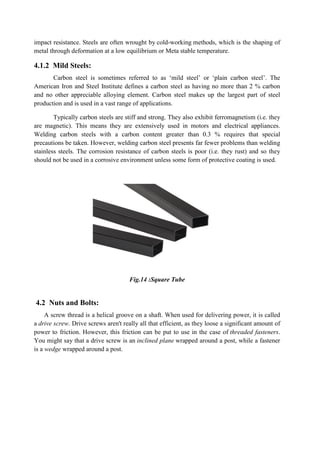
Fig.14 :Square Tube
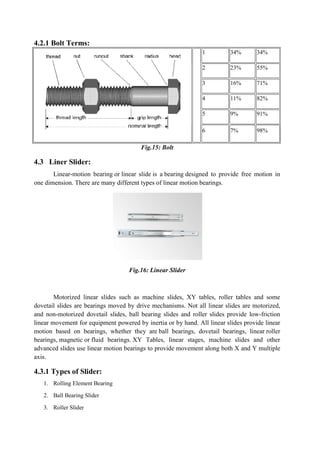
4.2 Nuts and Bolts:
A screw thread is a helical groove on a shaft. When used for delivering power, it is called
a drive screw. Drive screws aren't really all that efficient, as they loose a significant amount of
power to friction. However, this friction can be put to use in the case of threaded fasteners.
You might say that a drive screw is an inclined plane wrapped around a post, while a fastener
is a wedge wrapped around a post.
4.2.1 Bolt Terms:
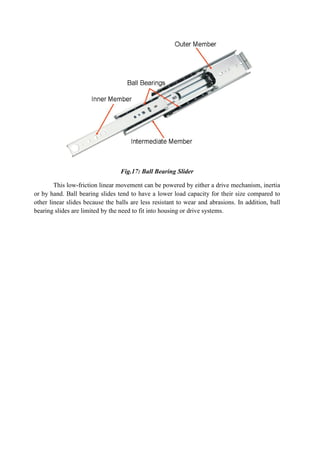
4.3 Liner Slider:
Linear-motion bearing or
one dimension. There are many different types of
Motorized linear slides such as machine slides, XY tables, roller tables and some
dovetail slides are bearings moved by drive mechanisms. Not all linear slides are motorized,
and non-motorized dovetail slides, ball bearing slides and roller slides provide
linear movement for equipment powered by inertia or by hand. All linear slides provide linear
motion based on bearings, whether they are
bearings, magnetic or fluid bearings
advanced slides use linear motion bearings to provide movement along both X and Y multiple
axis.
4.3.1 Types of Slider:
1. Rolling Element Bearing
2. Ball Bearing Slider
3. Roller Slider
1 34%
2 23%
3 16%
4 11%
5 9%
6 7%
Fig.15: Bolt
or linear slide is a bearing designed to provide free motion in
dimension. There are many different types of linear motion bearings.
Fig.16: Linear Slider
Motorized linear slides such as machine slides, XY tables, roller tables and some
dovetail slides are bearings moved by drive mechanisms. Not all linear slides are motorized,
motorized dovetail slides, ball bearing slides and roller slides provide
linear movement for equipment powered by inertia or by hand. All linear slides provide linear
motion based on bearings, whether they are ball bearings, dovetail bearings
fluid bearings. XY Tables, linear stages, machine slides and other
advanced slides use linear motion bearings to provide movement along both X and Y multiple
34% 34%
23% 55%
16% 71%
11% 82%
9% 91%
7% 98%
designed to provide free motion in
Motorized linear slides such as machine slides, XY tables, roller tables and some
dovetail slides are bearings moved by drive mechanisms. Not all linear slides are motorized,
motorized dovetail slides, ball bearing slides and roller slides provide low-friction
linear movement for equipment powered by inertia or by hand. All linear slides provide linear
, dovetail bearings, linear roller
, linear stages, machine slides and other
advanced slides use linear motion bearings to provide movement along both X and Y multiple
1. Rolling-element Bearing
Rolling-element A rolling-element bearing is generally composed of a sleeve-like outer
ring and several rows of balls retained by cages. The cages were originally machined from
solid metal and were quickly replaced by stampings. It features smooth motion, low friction,
high rigidity and long life. They are economical, and easy to maintain and replace. Thomson
(currently owned by Danaher) is generally given credit for first producing [what is now known
as] a linear ball bearing.
 Rolling-element bearings can only run on hardened steel or stainless steel shafting
(raceways).
 bearings are more rigid than plane bearings.
 Rolling-element bearings do not handle contamination well and require seals.
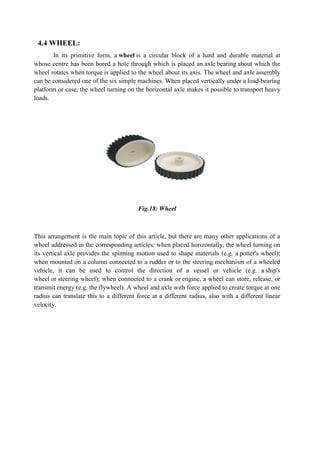
2.Ball Bearing Slides
Also called "ball slides", ball bearing slides are the most common type of linear slide.
Ball bearing slides offer smooth precision motion along a single-axis linear design, aided by
ball bearings housed in the linear base, with self-lubrication properties that increase reliability.
Constructed from materials such as Aluminum, hardened cold rolled steel and
galvanized steel, ball bearing slides consist of two linear rows of ball bearings contained by
four rods and located on differing sides of the base, which support the carriage for smooth
linear movement along the ball bearings.Ball bearing slide applications include delicate
instrumentation, robotic assembly, cabinetry, high-end appliances and clean room
environments, which primarily serve the manufacturing industry but also the furniture,
electronics and construction industries. For example, a widely used ball bearing slide in the
furniture industry is a ball bearing drawer slide.
Fig.17: Ball Bearing Slider
This low-friction linear movement can be powered by either a drive mechanism, inertia
or by hand. Ball bearing slides tend to have a lower load capacity for their size compared to
other linear slides because the balls are less resistant to wear and abrasions. In addition, ball
bearing slides are limited by the need to fit into housing or drive systems.
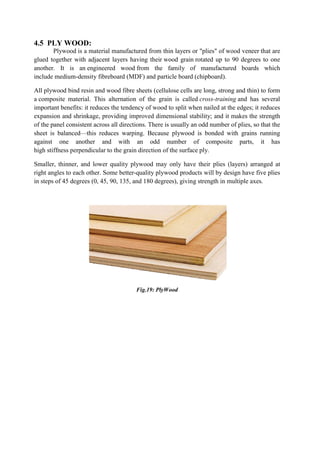
4.4 WHEEL:
In its primitive form, a
whose centre has been bored a hole through which is placed an
wheel rotates when torque is applied to the wheel about its axis. The
can be considered one of the six simple machines. When placed vertically under a load
platform or case, the wheel turning on the horizontal axle makes it possible to
loads.
This arrangement is the main topi
wheel addressed in the corresponding articles: when placed horizontally, the wheel turning on
its vertical axle provides the spinning motion used to shape materials (e.g. a
when mounted on a column connected to a rudder or to the steering mechanism of a wheeled
vehicle, it can be used to control the direction of a vessel or vehicle (e.g. a
wheel or steering wheel); when connected to a crank or
transmit energy (e.g. the flywheel). A
radius can translate this to a different force at a different radius, also with a different linear
velocity.
primitive form, a wheel is a circular block of a hard and durable material at
whose centre has been bored a hole through which is placed an axle bearing
is applied to the wheel about its axis. The wheel and axle
six simple machines. When placed vertically under a load
platform or case, the wheel turning on the horizontal axle makes it possible to
Fig.18: Wheel
This arrangement is the main topic of this article, but there are many other applications of a
wheel addressed in the corresponding articles: when placed horizontally, the wheel turning on
its vertical axle provides the spinning motion used to shape materials (e.g. a
mounted on a column connected to a rudder or to the steering mechanism of a wheeled
vehicle, it can be used to control the direction of a vessel or vehicle (e.g. a
steering wheel); when connected to a crank or engine, a wheel can store, re
flywheel). A wheel and axle with force applied to create torque at one
radius can translate this to a different force at a different radius, also with a different linear
is a circular block of a hard and durable material at
bearing about which the
wheel and axle assembly
six simple machines. When placed vertically under a load-bearing
platform or case, the wheel turning on the horizontal axle makes it possible to transport heavy
c of this article, but there are many other applications of a
wheel addressed in the corresponding articles: when placed horizontally, the wheel turning on
its vertical axle provides the spinning motion used to shape materials (e.g. a potter's wheel);
mounted on a column connected to a rudder or to the steering mechanism of a wheeled
vehicle, it can be used to control the direction of a vessel or vehicle (e.g. a ship's
engine, a wheel can store, release, or
with force applied to create torque at one
radius can translate this to a different force at a different radius, also with a different linear
4.5 PLY WOOD:
Plywood is a material manufactured from thin layers or "plies" of wood veneer that are
glued together with adjacent layers having their wood grain rotated up to 90 degrees to one
another. It is an engineered wood from the family of manufactured boards which
include medium-density fibreboard (MDF) and particle board (chipboard).
All plywood bind resin and wood fibre sheets (cellulose cells are long, strong and thin) to form
a composite material. This alternation of the grain is called cross-training and has several
important benefits: it reduces the tendency of wood to split when nailed at the edges; it reduces
expansion and shrinkage, providing improved dimensional stability; and it makes the strength
of the panel consistent across all directions. There is usually an odd number of plies, so that the
sheet is balanced—this reduces warping. Because plywood is bonded with grains running
against one another and with an odd number of composite parts, it has
high stiffness perpendicular to the grain direction of the surface ply.
Smaller, thinner, and lower quality plywood may only have their plies (layers) arranged at
right angles to each other. Some better-quality plywood products will by design have five plies
in steps of 45 degrees (0, 45, 90, 135, and 180 degrees), giving strength in multiple axes.
Fig.19: PlyWood
ELECTRICAL AND ELECTRONICS COMPONENTS
LIST OF ELECTRICAL COMPONENTS
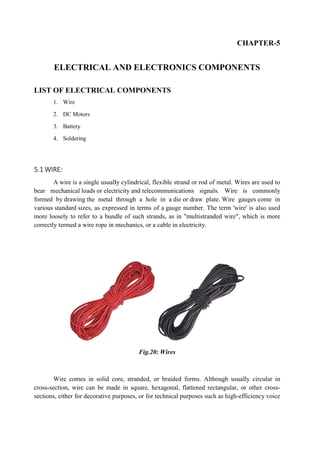
1. Wire
2. DC Motors
3. Battery
4. Soldering
5.1 WIRE:
A wire is a single usually
bear mechanical loads or electricity
formed by drawing the metal through a hole in a
various standard sizes, as expressed in terms of a
more loosely to refer to a bundle of such strands, as in "multistranded wire", which is more
correctly termed a wire rope in mechanics, or a
Wire comes in solid core, stranded, or braided forms. Although usually circular in
cross-section, wire can be made in square, hexagonal, flattened rectangular, or other cross
sections, either for decorative purposes, or for technical purposes such as high
ELECTRICAL AND ELECTRONICS COMPONENTS
LIST OF ELECTRICAL COMPONENTS
is a single usually cylindrical, flexible strand or rod of metal. Wires
electricity and telecommunications signals. Wire is commonly
the metal through a hole in a die or draw plate. Wire gauges
sizes, as expressed in terms of a gauge number. The term 'wire' is also used
more loosely to refer to a bundle of such strands, as in "multistranded wire", which is more
in mechanics, or a cable in electricity.
Fig.20: Wires
Wire comes in solid core, stranded, or braided forms. Although usually circular in
section, wire can be made in square, hexagonal, flattened rectangular, or other cross
sections, either for decorative purposes, or for technical purposes such as high
CHAPTER-5
ELECTRICAL AND ELECTRONICS COMPONENTS
cylindrical, flexible strand or rod of metal. Wires are used to
telecommunications signals. Wire is commonly
Wire gauges come in
erm 'wire' is also used
more loosely to refer to a bundle of such strands, as in "multistranded wire", which is more
Wire comes in solid core, stranded, or braided forms. Although usually circular in
section, wire can be made in square, hexagonal, flattened rectangular, or other cross-
sections, either for decorative purposes, or for technical purposes such as high-efficiency voice
coils in loudspeakers. Edge-wound
flattened wire.
Electrical wiring is an electrical
distribution boards, sockets, and light fittings in a structure.Wiring is subject to safety
standards for design and installation. Allowable
according to the circuit operating
restrictions on the environmental conditions, such as ambient temperature range, moisture
levels, and exposure to sunlight and chemicals.
Associated circuit protection, control and distribution devices within a building's wiring
system are subject to voltage, curre
5.2 BRUSHED DC ELECTRIC
A brushed DC motor is an internally
from a direct current power source. Brushed motors were the first commercially important
application of electric power to driving mechanical loads, and DC distribution systems were
used for more than 100 years to operate motors in commercial and industrial buildings.
Brushed DC motors can be varied in speed by changing the operating voltage or the s
the magnetic field. Depending on the connections of the field to the power supply, the speed
and torque characteristics of a brushed motor can be altered to provide steady speed or speed
inversely proportional to the mechanical load. Brushed mot
electrical propulsion, cranes, paper machines and steel rolling mills. Since the brushes wear
down and require replacement, brushless motors using
displaced brushed motors from many applications.
wound[1]
coil springs, such as the Slinky toy, are made of special
electrical installation of cabling and associated devices such as switches,
, and light fittings in a structure.Wiring is subject to safety
standards for design and installation. Allowable wire and cable types and sizes are specified
according to the circuit operating voltage and electric current capability, with further
ons on the environmental conditions, such as ambient temperature range, moisture
levels, and exposure to sunlight and chemicals.
Associated circuit protection, control and distribution devices within a building's wiring
system are subject to voltage, current and functional specification. Wiring safety codes vary
ELECTRIC MOTOR:
is an internally commutated electric motor designed to be run
power source. Brushed motors were the first commercially important
ation of electric power to driving mechanical loads, and DC distribution systems were
used for more than 100 years to operate motors in commercial and industrial buildings.
Brushed DC motors can be varied in speed by changing the operating voltage or the s
the magnetic field. Depending on the connections of the field to the power supply, the speed
and torque characteristics of a brushed motor can be altered to provide steady speed or speed
inversely proportional to the mechanical load. Brushed motors continue to be used for
electrical propulsion, cranes, paper machines and steel rolling mills. Since the brushes wear
down and require replacement, brushless motors using power electronic devices
displaced brushed motors from many applications.
Fig.21: DC Geared Motor
toy, are made of special
installation of cabling and associated devices such as switches,
, and light fittings in a structure.Wiring is subject to safety
types and sizes are specified
capability, with further
ons on the environmental conditions, such as ambient temperature range, moisture
Associated circuit protection, control and distribution devices within a building's wiring
nt and functional specification. Wiring safety codes vary
designed to be run
power source. Brushed motors were the first commercially important
ation of electric power to driving mechanical loads, and DC distribution systems were
used for more than 100 years to operate motors in commercial and industrial buildings.
Brushed DC motors can be varied in speed by changing the operating voltage or the strength of
the magnetic field. Depending on the connections of the field to the power supply, the speed
and torque characteristics of a brushed motor can be altered to provide steady speed or speed
ors continue to be used for
electrical propulsion, cranes, paper machines and steel rolling mills. Since the brushes wear
power electronic devices have
When the armature becomes horizontally aligned, the torque becomes zero. At this point, the
commutator reverses the direction of current through the coil, reversing the magnetic field.
A simple DC electric motor. When the coil is powered, a
armature. The left side of the armature is pushed away from the left
Fig.22
When a current passes through the coil wound
positive pole is acted upon by an upwards force, while the other side is acted upon by a
downward force. According to Fleming's left hand rule
coil, making it rotate. To make the motor rotate in a constant direction, "direct current"
commutator make the current reverse in direction every half a cycle (in a two
causing the motor to continue to rotate in the same direction.
5.3BATTERY:
As they are inexpensive compared to newer technologies, lead
used even when surge current is not important and other designs could provide higher
densities. In 1999 lead–acid battery sales accounted for 40
sold worldwide (excluding China and Russia), equivalent to a manufacturing market value of
about $15 billion.[8]
Large-format lead
power supplies in cell phone towers, high
power systems. For these roles, modified versions of the standard cell may be used to improve
storage times and reduce maintenance requirements.
mat batteries are common in these roles, collectively known as
acid) batteries.
When the armature becomes horizontally aligned, the torque becomes zero. At this point, the
reverses the direction of current through the coil, reversing the magnetic field.
A simple DC electric motor. When the coil is powered, a magnetic field is generated around the
armature. The left side of the armature is pushed away from the left magnet and drawn toward the right,
Fig.22: Brushless DC Electric Motor
When a current passes through the coil wound around a soft iron core, the side of the
positive pole is acted upon by an upwards force, while the other side is acted upon by a
Fleming's left hand rule, the forces cause a turning effect on the
coil, making it rotate. To make the motor rotate in a constant direction, "direct current"
commutator make the current reverse in direction every half a cycle (in a two
causing the motor to continue to rotate in the same direction.
As they are inexpensive compared to newer technologies, lead–acid batteries are widely
used even when surge current is not important and other designs could provide higher
acid battery sales accounted for 40–45% of the value from batteries
sold worldwide (excluding China and Russia), equivalent to a manufacturing market value of
format lead–acid designs are widely used for stora
cell phone towers, high-availability settings like hospitals, and
power systems. For these roles, modified versions of the standard cell may be used to improve
storage times and reduce maintenance requirements. Gel-cells and
batteries are common in these roles, collectively known as VRLA (valve
When the armature becomes horizontally aligned, the torque becomes zero. At this point, the
reverses the direction of current through the coil, reversing the magnetic field.
is generated around the
and drawn toward the right,
around a soft iron core, the side of the
positive pole is acted upon by an upwards force, while the other side is acted upon by a
, the forces cause a turning effect on the
coil, making it rotate. To make the motor rotate in a constant direction, "direct current"
commutator make the current reverse in direction every half a cycle (in a two-pole motor) thus
acid batteries are widely
used even when surge current is not important and other designs could provide higher energy
45% of the value from batteries
sold worldwide (excluding China and Russia), equivalent to a manufacturing market value of
acid designs are widely used for storage in backup
availability settings like hospitals, and stand-alone
power systems. For these roles, modified versions of the standard cell may be used to improve
and absorbed glass-
VRLA (valve-regulated lead–
The lead–acid battery was invented in 1859 by French physicist
earliest type of rechargeable battery. Despite having a very low energy
low energy-to-volume ratio, its ability to supply high
relatively large power-to-weight ratio. These features, along with their low cost, make them
attractive for use in motor vehicles to provide the high current required by
In the charged state, the chemical energy of the battery is stored in the potential
difference between the pure lead at the negative side and
the aqueous sulphuric acid. The electrical energy produced by a discharging lead
can be attributed to the energy released when the strong chemical bonds of water (H
molecules are formed from H
charging, the battery acts as a
batteries such as the Ca–Sb and Sn
LIST OF ELECTRONICS COMPONENTS
1. Microcontroller
2. Ultrasonic Sensors
3. Diode
4. Voltage Regulators
was invented in 1859 by French physicist Gaston Planté
battery. Despite having a very low energy-to-
volume ratio, its ability to supply high surge currents means that the cells have a
weight ratio. These features, along with their low cost, make them
ttractive for use in motor vehicles to provide the high current required by starter motors.
Fig.23: Battery
In the charged state, the chemical energy of the battery is stored in the potential
difference between the pure lead at the negative side and the PbO2 on the positive side, plus
the aqueous sulphuric acid. The electrical energy produced by a discharging lead
can be attributed to the energy released when the strong chemical bonds of water (H
molecules are formed from H+
ions of the acid and O2−
ions of PbO2.[9]
Conversely, during
charging, the battery acts as a water-splitting device. Liquid metal and
Sb and Sn–Bi also use this effect.
LIST OF ELECTRONICS COMPONENTS
Gaston Planté and is the
-weight ratio and a
means that the cells have a
weight ratio. These features, along with their low cost, make them
starter motors.
In the charged state, the chemical energy of the battery is stored in the potential
on the positive side, plus
the aqueous sulphuric acid. The electrical energy produced by a discharging lead–acid battery
can be attributed to the energy released when the strong chemical bonds of water (H2O)
Conversely, during
device. Liquid metal and molten-salt
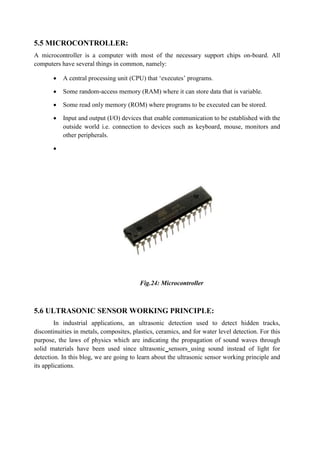
5.5 MICROCONTROLLER:
A microcontroller is a computer with most of the necessary support chips on-board. All
computers have several things in common, namely:
 A central processing unit (CPU) that ‘executes’ programs.
 Some random-access memory (RAM) where it can store data that is variable.
 Some read only memory (ROM) where programs to be executed can be stored.
 Input and output (I/O) devices that enable communication to be established with the
outside world i.e. connection to devices such as keyboard, mouse, monitors and
other peripherals.

Fig.24: Microcontroller
5.6 ULTRASONIC SENSOR WORKING PRINCIPLE:
In industrial applications, an ultrasonic detection used to detect hidden tracks,
discontinuities in metals, composites, plastics, ceramics, and for water level detection. For this
purpose, the laws of physics which are indicating the propagation of sound waves through
solid materials have been used since ultrasonic sensors using sound instead of light for
detection. In this blog, we are going to learn about the ultrasonic sensor working principle and
its applications.
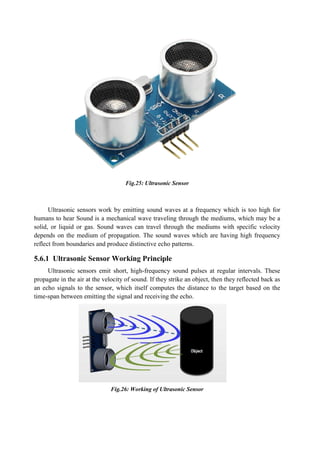
Ultrasonic sensors work by emitting sound waves at a frequency which is too high for
humans to hear Sound is a mechanical wave traveling through the mediums, which may be a
solid, or liquid or gas. Sound waves can travel through the mediums with specific velocity
depends on the medium of propagation. The sound waves which are having high frequency
reflect from boundaries and produce distinctive echo patterns.
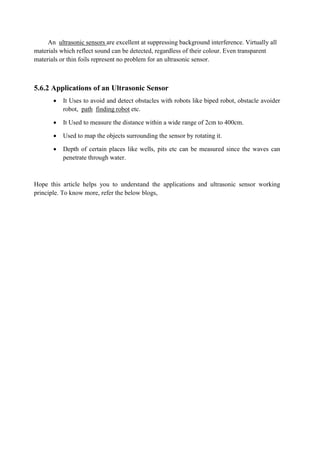
5.6.1 Ultrasonic Sensor Working Principle
Ultrasonic sensors emit short, high
propagate in the air at the velocity of sound. If they strike an object, th
an echo signals to the sensor, which itself computes the distance to the target based on the
time-span between emitting the signal and receiving the echo.
Fig.26
Fig.25: Ultrasonic Sensor
Ultrasonic sensors work by emitting sound waves at a frequency which is too high for
is a mechanical wave traveling through the mediums, which may be a
solid, or liquid or gas. Sound waves can travel through the mediums with specific velocity
depends on the medium of propagation. The sound waves which are having high frequency
boundaries and produce distinctive echo patterns.
Ultrasonic Sensor Working Principle
Ultrasonic sensors emit short, high-frequency sound pulses at regular intervals. These
propagate in the air at the velocity of sound. If they strike an object, then they reflected back as
an echo signals to the sensor, which itself computes the distance to the target based on the
span between emitting the signal and receiving the echo.
Fig.26: Working of Ultrasonic Sensor
Ultrasonic sensors work by emitting sound waves at a frequency which is too high for
is a mechanical wave traveling through the mediums, which may be a
solid, or liquid or gas. Sound waves can travel through the mediums with specific velocity
depends on the medium of propagation. The sound waves which are having high frequency
frequency sound pulses at regular intervals. These
en they reflected back as
an echo signals to the sensor, which itself computes the distance to the target based on the
An ultrasonic sensors are excellent at suppressing background interference. Virtually all
materials which reflect sound can be detected, regardless of their colour. Even transparent
materials or thin foils represent no problem for an ultrasonic sensor.
5.6.2 Applications of an Ultrasonic Sensor
 It Uses to avoid and detect obstacles with robots like biped robot, obstacle avoider
robot, path finding robot etc.
 It Used to measure the distance within a wide range of 2cm to 400cm.
 Used to map the objects surrounding the sensor by rotating it.
 Depth of certain places like wells, pits etc can be measured since the waves can
penetrate through water.
Hope this article helps you to understand the applications and ultrasonic sensor working
principle. To know more, refer the below blogs,
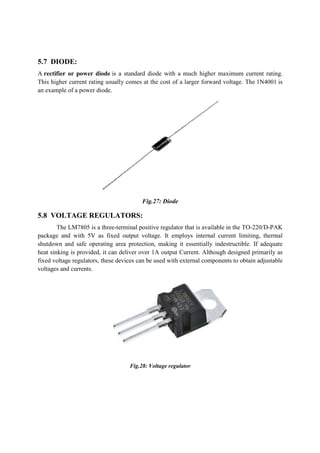
5.7 DIODE:
A rectifier or power diode is a standard diode with a much higher maximum current rating.
This higher current rating usually comes at the cost
an example of a power diode.
5.8 VOLTAGE REGULATORS
The LM7805 is a three
package and with 5V as fixed output voltage. It employ
shutdown and safe operating area protection, making it essentially indestructible. If adequate
heat sinking is provided, it can deliver over 1A output Current. Although designed primarily as
fixed voltage regulators, these devices can be used with external components to obtain adjustable
voltages and currents.
is a standard diode with a much higher maximum current rating.
This higher current rating usually comes at the cost of a larger forward voltage. The
Fig.27: Diode
VOLTAGE REGULATORS:
The LM7805 is a three-terminal positive regulator that is available in the TO
package and with 5V as fixed output voltage. It employs internal current limiting, thermal
shutdown and safe operating area protection, making it essentially indestructible. If adequate
heat sinking is provided, it can deliver over 1A output Current. Although designed primarily as
ese devices can be used with external components to obtain adjustable
Fig.28: Voltage regulator
is a standard diode with a much higher maximum current rating.
of a larger forward voltage. The 1N4001 is
terminal positive regulator that is available in the TO-220/D-PAK
s internal current limiting, thermal
shutdown and safe operating area protection, making it essentially indestructible. If adequate
heat sinking is provided, it can deliver over 1A output Current. Although designed primarily as
ese devices can be used with external components to obtain adjustable
REFERENCES
[1] V. Prasannabalaji, R. Rakesh, S. Sairam . “Staircase powergeneration using piezoelectric
transducers”, Advance inElectronic and Electric Engineering, 2013; 3: 747–754p.
[2] G.Dhanalakshmi ,T.Manjulai ,“Footstep Power GenerationSystem” ,International Journal
Of Engineering And ComputerScience, ISSN:2319-7242, Volume 6 Issue 4 April 2017,
PageNo. 21011-21014,
[3] Yogesh Motey, Pooja Dekate, “Footstep Power GenerationSystem”, International Journal
of Innovations in Engineeringand Science, Vol. 2, No.6, 2017.
[4] K.Ramakrishna, Guruswamy Revana, “Generation ofElectrical Power through
Footsteps”, International Journal ofMultidisciplinary and Current Research, ISSN: 2321-
3124.
[5] “Interfacing Piezo Film to Electronics”, Measurement Specialties. March 2006, Retrieved
December 2, 2007.
[6] Alfredo Vazquez Carazo (January 2000), “Novel Piezoelectric Transducers for High
Voltage Measurements”, Universitat Politecnica de Catalunya: 242.
[7] Orcutt, Mike, “Managing Light To Increases Solar Efficiency”, MIT Technology Review,
Retrieved 2018-03-14.
[8] Binoy Boban, Tom Jose v, Sijvo MT , “Electricity generation from footstep ;a Generative
energy Resource’’ International journal of sciventic and research publication 1-3, March
2013
[9] U.K Singh and R.H. Middleton has developed a system “piezoelectric power scavenging of
mechanical vibration energy” research publication In 4 Oct 2007
[10] Mechatronics (ICOM) ,2011 4th International conference by Fakhazan
,M.N.,Muthalif,A.G.A.

ZERO TURNING RADIUS STRETCHER (ZTRS)

  • 1.
    ZERO TURNING RADIUSSTRETCHER A Project Submitted in Partial Fulfillment of the Requirement for the Award of the Degree BACHELOR OF TECHNOLOGY MECHANICAL ENGINEERING RIZWAN SEIKH AKASH KUMAR SINGH (ID No. 175126 VINOD KUMAR YADAV (ID No. 175105 NIDHI YADAV (ID No. 175139 Mr. HIMANSHU TIWARI Department of Mechanical Uma Nath Singh Institute of Engineering & Technology VEER BAHADUR SINGH PURVANCHAL JAUNPUR, UTTAR PRADESH ZERO TURNING RADIUS STRETCHER Project Submitted in Partial Fulfillment of the Requirement for the Award of the Degree BACHELOR OF TECHNOLOGY in MECHANICAL ENGINEERING Submitted By RIZWAN SEIKH (ID No. 175150) AKASH KUMAR SINGH (ID No. 175126) VINOD KUMAR YADAV (ID No. 175105) NIDHI YADAV (ID No. 175139) Under the Supervision of Mr. HIMANSHU TIWARI (Assistant Professor) Department of Mechanical Engineering ath Singh Institute of Engineering & Technology VEER BAHADUR SINGH PURVANCHAL UNIVERSITY JAUNPUR, UTTAR PRADESH [2017-2021] Project Submitted in Partial Fulfillment of the Requirement for the Award of the Degree of ath Singh Institute of Engineering & Technology UNIVERSITY
  • 2.
    CERTIFICATE This is tocertify that the project entitled “Zero Turning Radius Stretcher (ZTRS)” submitted by Rizwan Sheikh (ID No.175150), Akash Kumar Singh (ID No. 175126), Vinod Kumar Yadav (ID No. 175105) and Nidhi Yadav (ID No. 175139) to Department of Mechanical Engineering, Uma Nath Singh Institute of Engineering and Technology, Veer Bahadur Singh Purvanchal University, Jaunpur, is a record of bon fide research work carried out by them under my supervision and is worthy of consideration for the award of the degree of Bachelor of Technology in Mechanical Engineering. The embodiment of this project has not been submitted in any other University and/or Institute for the award of the any degree. Dr. Sandeep Kumar Singh Mr. Himanshu Tiwari (HEAD) (Supervisor) (Assistant Professor) (Assistant Professor) UNSIET,VBSPU, Jaunpur Date: 23/07/2021 Place: Department of Mechanical Engineering UNSIET, VBSPU, Jaunpur
  • 3.
    DECLARATION We Rizwan Sheikh(ID No.175150), Akash Kumar Singh (ID No. 175126), Vinod Kumar Yadav (ID No. 175105) and Nidhi Yadav (ID No. 175139) declare that the work presented in this project entitled “Zero Turning Radius Stretcher (ZTRS)” submitted to the Department of Mechanical Engineering, in Uma Nath Singh Institute of Engineering and Technology, Veer Bahadur Singh Purvanchal University, Jaunpur for the award of the Bachelor of Technology degree in Mechanical Engineering an original work. We have done this research work on our own under the guidance of Mr. Himanshu Tiwari, The data mentioned in this report have been generated during the work and experiments are genuine. It is the result of extensive work carried out by us. We have neither plagiarized nor submitted the same work for the award of any other degree. In case this undertaking is found incorrect, our degree may be withdrawn unconditionally by the University. Date: 23/07/2021 ……………………………. Place: Department of Mechaical Engineering RIZWAN SHEIKH UNSIET, VBSPU, Jaunpur (ID NO. 175150) …………………………. AKASH KUMAR SINGH (ID NO. 175126) …………………………. VINOD KUMAR YADAV (ID NO. 175105) …………………………. NIDHI YADAV (ID NO. 175139)
  • 4.
    ACKNOWLEDGEMENT It gives megreat pleasure to express my gratitude and heart full thanks to all those who are helping me in complete this project. I want to thank to “Mr. HIMANSHU TIWARI”, who has always encouraged and help me in making this project. In addition to this, I am grateful to other faculties too who made me in right direction and gave me their precious time and expert guidance whenever necessary through which I could achieve this extent. At last but not the least I am feeling glad to say about my family whose wishes are always with me, without which it was not possible for me to reach this extent. I hope my work is praised and my efforts render fruitful result. Date: 23/07/2021 ……………………………. Place: Department of Mechanical Engineering RIZWAN SHEIKH UNSIET, VBSPU, Jaunpur (ID NO. 175150) …………………………. AKASH KUMAR SINGH (ID NO. 175126) …………………………. VINOD KUMAR YADAV (ID NO. 175105) …………………………. NIDHI YADAV (ID NO. 175139)
  • 5.
    ABSTRACT This project isa Prototype model of “Zero Turn Drive Stretcher”. This project is a Prototype model of “Zero Turn Derive Stretcher”. This Model build a mechanism which depict zero turning radius of the stretcher, so that a Stretcher may take turn automatically having centre at the midpoint of the Stretcher .It is very innovative idea for the quick turning i.e. turning about centre of stretcher. Zero turning radius of a Stretcher implies the Stretcher rotating about an axis passing through the centre of gravity of Stretcher rather than describing a circular path as in conventional turning, i.e. the Stretcher turning at the same place, where it is standing. No extra space is required to turn the Stretcher. So, vehicle can be turned in the space equal to the length of Stretcher itself. This project use ultrasonic sensor for finding the path automatically and also have two mode called Automatic and manual. Here use three ultrasonic sensors for sensing the path. Key Words: Arduino, Stretcher, Obstacle, Microcontroller, Ultrasonic sensor, Encoder Mechatronic, Autonomous Robot, Ultrasonic Sensors, Servo Motors,
  • 6.
    TABLE OF CONTENTS CONTENTPAGE NO. Acknowledgement i Abstract ii Table of Contents iii-iv List of Figures v List of Abbreviations vi CHAPTER 1: INTRODUCTION 1-5 1.1 Introduction 1 1.2 Zero Turning Radius Stretcher 1 1.3 Purpose 2 1.4 Working Principle 2 1.4 Ultrasonic Sensor 3
  • 7.
    CHAPTER-1 INTRODUCTION 1.1 INTRODUCTION: Automobiles havebecome a basic necessity in present world of industrialization and fast growing population. An automobile is a self-propelled vehicle, which is used for road transportation of passengers and goods. The self-propelled vehicle is that contains its own source of power for the propulsion, e.g., car, jeep, bus, truck etc. World’s first automobile was produced in 1892. General Motors India Ltd. Started their factory in Mumbai in 1928 for assembling cars and truck, Due to increasing demand and supply of cars, roads are overflowed by vehicles. There is severe problem of parking at home, parking at public places and multiplexes, traffic jam etc. the problem at parking and traffic jam.In this work, main emphasis was given on developing a system for minimum turning space or turning radius of the vehicle. 1.2 ZERO TURNING RADIUS STRETCHER: Driving and steering mechanism for a vehicle having a pair of driving wheels includes a steering wheel rotatable mounted to the vehicle and an accelerator foot pedal pivotally mounted to the vehicle. Zero turning radius of a vehicle implies the vehicle rotating about an axis passing through the centre of gravity of vehicle rather than describing a circular path as in conventional turning, i.e. the vehicle turning at the same place, where it is standing. No extra space is required to turn the vehicle. So, vehicle can be turned in the space equal to the length of vehicle itself. Zero turning radiuses exists in heavy earth mover, like excavator, which consists of two parts, i.e. the upper part, cabin and boom/jaw and lower part, crawler chain. Transmissions associated with the driving wheels include a pivot able control arm for controlling the operation of the transmission, which independently controls the speed and direction of rotation of the associated wheel. The vehicle is turned by causing one wheel to rotate faster than the other wheel. A zero turning radius turn can be effected by causing the driving wheels to rotate in opposite directions.
  • 8.
    Figure 1 PrototypeModel 1.3 PURPOSE: The purpose of this Bachelor’s thesis project was to build a robot that could detect Obstacles in its path and avoid them by turning in another direction. Following research questions will be investigated in this thesis: 1.4 WORKING PRINCIPLE : The obstacle avoidance robotic vehicle uses ultrasonic sensors for its movements. A microcontroller of 8051 family is used to achieve the desired operation. The motors are connected through motor driver IC microcontroller. The ultrasonic sensor is attached in front of the robot. Whenever the robot is going on the desired path the ultrasonic sensor transmits the ultrasonic waves continuously from its sensor head. Whenever an obstacle comes ahead of it the ultrasonic waves are reflected back from an object and that information is passed to the microcontroller. The microcontroller controls the motors left, right, back, front based on ultrasonic signals. In order to control the speed of each motor pulse width modulation is used (PWM).
  • 9.
    1.5 ULTRASONIC SENSORHC The ultrasonic sensor is used for obstacle detection. Ultrasonic sensor transmits the ultrasonic waves from its sensor head and again receives the ultrasonic waves reflected from an object. There are many application use ultrasonic sensors like instruction alarm system, automatic door openers etc. The ultrasonic performance. It has both the transmitter and receiver. It consists of four pins Vcc pin to offer a 5V supply to the sensor, trigger pin give a TTL pulses (15us), echo pin to get the output from the sensor and ground pin. Ultrasonic sensor HC-SR04 is shown in Fig. 3. An object was also placed to the right to ensure it turned left that time. When the code had been adjusted so that these things worked an obstacle was placed to the left as well to see if the robot the placed all around the robot to make sure it would stop completely. After all of the testing an obstacle course was built. Minor adjustments in the code were made until the robot drove through the obstacle course without d 1.6 FEATURES:  Easy to left/right turn on the turning area  Less parking area required  Easy to operate. 1.7 MECHANISMS: 1.5 ULTRASONIC SENSOR HC-SR04: The ultrasonic sensor is used for obstacle detection. Ultrasonic sensor transmits the ltrasonic waves from its sensor head and again receives the ultrasonic waves reflected from Fig.1: Ultrasonic Sensor There are many application use ultrasonic sensors like instruction alarm system, automatic door openers etc. The ultrasonic sensor is very compact and has a very high performance. It has both the transmitter and receiver. It consists of four pins Vcc pin to offer a 5V supply to the sensor, trigger pin give a TTL pulses (15us), echo pin to get the output from SR04 is shown in Fig. 3. An object was also placed to the right to ensure it turned left that time. When the code had been adjusted so that these things worked an obstacle was placed to the left as well to see if the robot then reversed. Lastly, obstacles were placed all around the robot to make sure it would stop completely. After all of the testing an obstacle course was built. Minor adjustments in the code were made until the robot drove through the obstacle course without difficulties. Easy to left/right turn on the turning area. Less parking area required. The ultrasonic sensor is used for obstacle detection. Ultrasonic sensor transmits the ltrasonic waves from its sensor head and again receives the ultrasonic waves reflected from There are many application use ultrasonic sensors like instruction alarm system, sensor is very compact and has a very high performance. It has both the transmitter and receiver. It consists of four pins Vcc pin to offer a 5V supply to the sensor, trigger pin give a TTL pulses (15us), echo pin to get the output from SR04 is shown in Fig. 3. An object was also placed to the right to ensure it turned left that time. When the code had been adjusted so that these things worked an n reversed. Lastly, obstacles were placed all around the robot to make sure it would stop completely. After all of the testing an obstacle course was built. Minor adjustments in the code were made until the robot drove
  • 10.
     Sliding mechanism Scissor Mechanism 1.8 TECHNOLOGY USED:  Ultrasonic Sensor rang finder  Manual operation using switches  Autonomous Robot  Ultrasonic 1.9 ADVANTAGES:  It is less costly load carry vehicle.  Eco friendly.  Less noise operation.  This type of load carry vehicle is easily parked in any direction.  Battery operated thus no fuel required.  It is more efficient compare to other type of load carry vehicle.  More efficient.  Turning left/right at narrow roads  Use in service and maintenance etc.  This can give fast response and less space is required  Battery is using in this 360 degree wheel rotation vehicle to move forward and backward, so it is a kind pollution free vehicle  Better parking at home in narrow space and at Multiplexes  Easy removal of vehicle from the traffic jams 1.10DISADVANTAGES:  A primary disadvantage is cost these machines are more expensive than other comparably sized lawnmowers.  Another disadvantage is that zero-turn mowers are usually dedicated machines.
  • 11.
    1.11 APPLICATION:  Hospitals Zero Turning driving  In Industries for automation of raw material like automated guided vehicle.  In automobile sector there are so many types of vehicle are using to carry goods from one position to another position, there is space problem in the industry so this vehicle is used in automobile applications because this vehicle consumes very less space compare to other type of vehicle.  This vehicle is used in small Industries for transportation of raw material from one position to another position.  Modern development and economical progression of Indian society resulted in increase of vehicle in park so there are also problem. In park other vehicle are taking more space to move from one direction to other direction and 360 degree wheel rotation vehicle have capability to move parallel direction so this vehicle is easily move from one direction to other direction in park.  Take easily U-turn because front wheel of this vehicle are rotating freely by steering, chain drive and sprocket arrangement.
  • 12.
    CHAPTER- 2 REQUIRED TOOLS& MATERIALS 2.1 LIST OF TOOLS AND MACHINES  Screw Drivers  Knife  Pliers  Hammer  Wrench  Hex sew  Vise  Drill  Drill machine  Grinder  File  Hole Sew  Lath Machine 2.2DESCRIPTION OF TOOLS: 2.2.1 Screw Drivers: A screwdriver is a tool, manual or powered, for turning (driving or removing) screws. A typical simple screwdriver has a handle and a shaft, and a tip that the user inserts into the screw head to turn it. The shaft is usually made of tough steel to resist bending or twisting. The tip may be hardened to resist wear, treated with a dark tip coating for improved visual contrast between tip and screw—or ridged or treated for additional 'grip'. Handles are typically wood, metal, or plastic and usually hexagonal, square, or oval in cross-section to improve grip and prevent the tool from rolling when set down. Some manual screwdrivers have interchangeable tips that fit into a socket on the end of the shaft and are held in mechanically or magnetically. These often have a hollow handle that contains various types and sizes of tips, and a reversible ratchet action that allows multiple full turns without repositioning the tip or the user's hand.
  • 13.
    Fig. 2: ScrewDriver A screwdriver is classified by its tip, which is shaped to fit the driving surfaces—slots, grooves, recesses, etc.—on the corresponding screw head. Proper use requires that the screwdriver's tip engage the head of a screw of the same size and type designation as the screwdriver tip. Screwdriver tips are available in a wide variety of types and sizes (List of screw drives). The two most common are the simple 'blade'-type for slotted screws, and Phillips®, generically referred to as "cross-recess". 2.2.2 Knife: A knife (plural knives) is a tool with a cutting edge or blade, hand-held or otherwise, with most having a handle. Some types of knives are used as utensils, including knives used at the dining table (e.g., butter knives and steak knives) and knives used in the kitchen (e.g., paring knife, bread knife, and cleaver). Many types of knives are used as tools, such as the utility knife carried by soldiers, the pocket knife carried by hikers and the hunting knife used y hunters. Knives are also used as a traditional or religious implement, such as the kirpan. Fig.3: Knife
  • 14.
    2.2.3 Pliers: Pliers area hand tool used to hold objects firmly, possibly developed from tongs used to handle hot metal in Bronze Age Europe.[1] They are also useful for bending and compressing a wide range of materials. Generally, pliers consist of a pair of metal first-class levers joined at a fulcrum positioned closer to one end of the levers, creating short jaws on one side of the fulcrum, and longer handles on the other side.[1] This arrangement creates a mechanical advantage, allowing the force of the hand's grip to be amplified and focused on an object with precision. The jaws can also be used to manipulate objects too small or unwieldy to be manipulated with the fingers. Fig.4: Pliers Pincers are a similar tool with a different type of head used for cutting and pulling, rather than squeezing. Tools designed for safely handling hot objects are usually called tongs. Special tools for making crimp connections in electrical and electronic applications are often called "crimping pliers"; each type of connection uses its own dedicated tool. 2.2.4 Hammer: A hammer is a tool or device that delivers a blow (a sudden impact) to an object. Most hammers are hand tools used to drive nails, fit parts, forge metal, and break apart objects. Hammers vary in shape, size, and structure, depending on their purposes. Hammers are basic tools in many trades. The usual features are a head (most often made of steel) and a handle (also called a helve or haft). Although most hammers are hand tools, powered versions exist; they are known as powered hammers. Types of power hammer include steam hammers and trip hammers, often for heavier uses, such as forging.
  • 15.
    Fig.5: Hammer Some hammershave other names, such as sledgehammer, mallet and gavel. The term "hammer" also applies to devices that deliver blows, such as the hammer of a firearm or the hammer of a piano or the hammer ice scraper. 2.2.5 Wrench: A wrench (or spanner outside of North America) is a tool used to provide grip and mechanical advantage in applying torque to turn objects—usually rotary fasteners, such as nuts and bolts or keep them from turning. In Commonwealth English (excluding Canada), spanner is the standard term. The most common shapes are called open-ended spanner and ring spanner. The term wrench is generally used for tools that turn non-fastening devices (e.g. tap wrench and pipe wrench), or may be used for a monkey wrench - an adjustable spanner.[1] In North American English, wrench is the standard term. The most common shapes are called open-end wrench and box-end wrench. In American English, spanner refers to a specialised wrench with a series of pins or tabs around the circumference. (These pins or tabs fit into the holes or notches cut into the object to be turned.) In American commerce, such a wrench may be called a spanner wrench to distinguish it from the British sense of spanner. Fig.6: Wrench
  • 16.
    2.2.6 Hex Saw: Ahacksaw is a fine-toothed saw, originally and principally made for cutting metal. They can also cut various other materials, such as plastic and wood; for example, plumbers and electricians often cut plastic pipe and plastic conduit with them. There are hand saw versions and powered versions (power hacksaws). Most hacksaws are hand saws with a C-shaped frame that holds a blade under tension. Such hacksaws have a handle, usually a pistol grip, with pins for attaching a narrow disposable blade. The frames may also be adjustable to accommodate blades of different sizes. A screw or other mechanism is used to put the thin blade under tension. Panel hacksaws forgo the frame and instead have a sheet metal body; they can cut into a sheet metal panel further than a frame would allow. These saws are no longer commonly available, but hacksaw blade holders enable standard hacksaw blades to be used similarly to a keyhole saw or pad saw. Power tools including nibblers, jigsaws, and angle grinders fitted with metal-cutting blades and discs are now used for longer cuts in sheet metals. Fig.7: Hex Saw 2.2.7 Bench Vice: A vise (American spelling; British English: vice) is a mechanical apparatus used to secure an object to allow work to be performed on it. Vises have two parallel jaws, one fixed and the other movable, threaded in and out by a screw and lever.
  • 17.
    Fig.8: Hex Saw Anengineer's vise, also known as a metalworking vise or machinist's vise, is used to clamp metal instead of wood. It is used to hold metal when filing or cutting. It is sometimes made of cast steel or malleable cast iron, but most are made of cast iron. However, most heavy duty vises are 55,000 psi cast steel or 65,000 psi ductile iron. Some vises have a cast iron body but a steel channel bar. Cast iron is popular because it is typically 30 ksi grey iron which is rigid, strong and inexpensive. The jaws are often separate and replaceable, usually engraved with serrated or diamond teeth. Soft jaw covers made of aluminium, copper, wood (for woodworking) or plastic may be used to protect delicate work. The jaw opening of an engineer's vise is almost always the same size as the jaw width, if not bigger. An engineer's vise is bolted onto the top surface of a workbench, with the face of the fixed jaws just forward of its front edge. The vise may include other features such as a small anvil on the back of its body. Most engineer's vises have a swivel base. Some engineer's vises marketed as "Homeowner Grade" are not made of steel or cast iron, but of pot metalor a very low grade of iron, typically with a tensile strength of under 10 ksi. Most homeowner's bench vises have an exposed screw. 2.2.8 Drill machine: Drill is a tool fitted with a cutting tool attachment or driving tool attachment, usually a drill bit or driver bit, used for boring holes in various materials or fastening various materials together with the use of fasteners. The attachment is gripped by a chuck at one end of the drill and rotated while pressed against the target material. The tip, and sometimes edges, of the cutting tool does the work of cutting into the target material. This may be slicing off thin shavings (twist drills or auger bits), grinding off small particles (oil drilling), crushing and removing pieces of the work piece (SDS masonry drill), countersinking, counter boring, or other operations.
  • 18.
    Fig.9: Drill Machine Drillsare commonly used in woodworking, metalworking, construction and do-it- yourself projects. Specially designed drills are also used in medicine, space missions and other applications. Drills are available with a wide variety of performance characteristics, such as power and capacity. 2.2.9 Grinder Machine: A grinding machine, often shortened to grinder, is any of various power tools or machine tools used for grinding, which is a type of machining using an abrasive wheel as the cutting tool. Each grain of abrasive on the wheel's surface cuts a small chip from the work piece via shear deformation. Fig. 10:Grinding Machine
  • 19.
    2.2.10 Files: A fileis a tool used to remove fine amounts of material from a work piece. It is common in woodworking, metalworking, and other similar trade and hobby tasks. Most are hand tools, made of a case hardened steel bar of rectangular, square, triangular, or round cross-section, with one or more surfaces cut with sharp, generally parallel teeth. A narrow, pointed tang is common at one end, to which a handle may be fitted. A rasp is a form of file with distinct, individually cut teeth used for coarsely removing large amounts of material.Files have also been developed with abrasive surfaces, such as natural or synthetic diamond grains or silicon carbide, allowing removal of material that would dull or resist metal, such as ceramic. Fig.11: Files Files are often used to put the finishing touches on a machined workpiece, either to remove burrs or sharpedges or as a final fitting operation. Intricate parts orshapes are often produced entirely by skilled workers usingfiles. In this unit you are introduced to the types and usesof files in talworking. 2.3 ELECTRICAL TOOLS: 2.3.1 Soldering Iron: A soldering iron is a hand tool used in soldering. It supplies heat to melt solder so that it can flow into the joint between two workpiece. A soldering iron is composed of a heated metal tip and an insulated handle. Heating is often achieved electrically, by passing an electric current (supplied through an electrical cord or battery cables) through a resistive heating element.
  • 20.
    Solder melts atapproximately 185°C (365°F). Soldering irons are designed to reach a temperature range of 200° to 480°C (392° to 896° F).Soldering installation, repairs, and limited production work in electronics assembly. High production lines use other soldering methods. sheet metal objects. Less common uses inc and plastic welding(Ultrasonic welding 2.3.2 Solder: Solder or in North America between metal work pieces. Solder is melted in order to adhere to and connect the pieces after cooling, which requires that an alloy suitable for use as solder have a lower melting the pieces being joined. The solder should also be resistant to oxidative and corrosive effects that would degrade the joint over time. Solder used in making electrical connections also needs to have favourable electrical characteristics. Solder melts at approximately 185°C (365°F). Soldering irons are designed to reach a temperature range of 200° to 480°C (392° to 896° F).Soldering irons are most often used for installation, repairs, and limited production work in electronics assembly. High production lines use other soldering methods.[1] Large irons may be used for soldering joints in sheet metal objects. Less common uses include pyrography (burning designs into wood) plastic welding(Ultrasonic welding could possibly be used if set correctly). Fig.12: Soldering Iron in North America is a fusible metal alloy used to create a permanent bond between metal work pieces. Solder is melted in order to adhere to and connect the pieces after cooling, which requires that an alloy suitable for use as solder have a lower melting the pieces being joined. The solder should also be resistant to oxidative and corrosive effects that would degrade the joint over time. Solder used in making electrical connections also needs to have favourable electrical characteristics. Solder melts at approximately 185°C (365°F). Soldering irons are designed to reach a irons are most often used for installation, repairs, and limited production work in electronics assembly. High-volume Large irons may be used for soldering joints in (burning designs into wood) could possibly be used if set correctly). used to create a permanent bond between metal work pieces. Solder is melted in order to adhere to and connect the pieces after cooling, which requires that an alloy suitable for use as solder have a lower melting point than the pieces being joined. The solder should also be resistant to oxidative and corrosive effects that would degrade the joint over time. Solder used in making electrical connections also needs
  • 21.
  • 22.
    CHAPTER-3 SELECTION OF MECHANICALMATERIALS The quality, performance, life etc. of an engineering product, all are effected by the engineering material being used for manufacturing that product. Hence it becomes necessary to select suitable Engineering materials for a successful engineering product. For selection of suitable materials for any engineering application / product, following factors should be considered –  Mechanical strength  Stability  Ductility  Availability  Fabric ability  Design  Corrosion Resistance  Cost 2.3 MECHANICAL STRENGTH: Mechanical strength is primary criteria for selection of suitable materials for any Engineering application / product. Mechanical strength is the ability of materials to withstand with load or forces. Materials selected for any engineering application, should have appropriate mechanical strength to be capable to withstand with loads or forces developed in structure of engineering product during operation. 2.4 STABILITY: Stability of engineering material is defined by the ability of engineering product manufactured by using that material to with stand with following operating conditions- 1. Temperature 2. Fluctuations in temperature 3. During of operation 4. Radiation 5. Atmospheric conditions 2.5 DUCTILITY: Ductility of engineering material is the property of material makes the material suitable for fabrication by rolling, drawing, extrusion and other mechanical processes. Basically it is the
  • 23.
    ability of materialthat how much the materials can be stretched plastically without breakdown or failure. Ductility of materials is related to the strength of material. Considerable ductility can be obtained at a sacrifice of strength or vice versa. For example, by increase of temperature ductility of material increased and strength decreased. By cold rolling the mechanical strength is increased whereas the ductility is decreased. It is not necessary the material being used for all products should have high ductility. But it should have suitable ductility. 2.6 AVAILABILITY: Material selected for engineering product should be easily available in desired form and at appropriate cost. So that the product can be produced economically to make its price competitive in market, Material may be available in any form such as casting, forging, rolled sheets etc. But the availability of material in suitable form is necessary to facilitate the manufacturing the product with desired quality. 2.7 FABRIC ABILITY: Fabric ability of an Engineering material is the ability of material, which indicates that how easily it can be fabricated in desired form and shape in order to manufacture an engineering product. Fabric ability of material makes it suitable for mechanical processing to convert it in desired form and shape. 2.8 DESIGN: The selection of material for any engineering product is also governed by the design of product. The design of engineering product decides the strength and ductility required for in materials being selected for that product. Hence, the engineering product should be designed with consideration of properties of engineering material. 2.9CORROSION RESISTANCE: When the Engineering product is used in an industrial atmospheric environment, there are chances that the base materials of product get corroded. Corrosion of refined material is a natural process which converts the refined material in more stable oxides. This corrosion makes the material gradually weak with time. Hence, for the satisfactory operation, performance and life of engineering product, it becomes necessary that material being selected for that product should have sufficient corrosion resistance. 2.10 COST: To make the engineering product commercially successful and profitable, its price should be reasonable and competitive in market. The price value of any engineering product is governed by many factors such as material cost, labour cost, processing cost etc. Hence, the keep the price of product low, it becomes necessary that the material cost, labour cost.
  • 24.
    CHAPTER-4 MECHANICAL RAW MATERIALS LISTOF MECHANICAL RAW MATERIALS: 1. Square Tube 2. Nut Bolts 3. Linear Sliders 4. Wheel 5. Ply Wood 4.1 SQUARE TUBE: Carbon steel, also called plain-carbon steel, is a metal alloy, a combination of two elements, iron and carbon, where other elements are present in quantities too small to affect the properties. The only other alloying elements allowed in plain-carbon steel are: manganese (1.65% max), silicon (0.60% max), and copper (0.60% max). Steel with low carbon content has the same properties as iron, soft but easily formed. As carbon content rises the metal becomes harder and stronger but less ductile and more difficult to weld. Higher carbon content lowers steel's melting point and its temperature resistance in general. 4.1.1 TYPES OF CARBON STEEL: Typical compositions of carbon are:  Mild (low carbon) steel: approximately 0.05% to 0.25% carbon content with up to 0.4% manganese content (e.g. AISI 1018 steel). Less strong but cheap and easy to shape; surface hardness can be increased through carburizing.  Medium carbon steel: approximately 0.29% to 0.54% carbon content with 0.60 to 1.65% manganese content (e.g. AISI 1040 steel). Balances ductility and strength and has good wear resistance; used for large parts, forging and car parts.  High carbon steel: approximately 0.55% to 0.95% carbon content with 0.30 to 0.90% manganese content. Very strong, used for springs and high-strength wires.  Very high carbon steel: approximately 0.96% to 2.1% carbon content specially processed to produce specific atomic and molecular microstructures. Steel can be heat-treated which allows parts to be fabricated in an easily-formable soft state. If enough carbon is present, the alloy can be hardened to increase strength, wear, and
  • 25.
    impact resistance. Steelsare often wrought by cold-working methods, which is the shaping of metal through deformation at a low equilibrium or Meta stable temperature. 4.1.2 Mild Steels: Carbon steel is sometimes referred to as ‘mild steel’ or ‘plain carbon steel’. The American Iron and Steel Institute defines a carbon steel as having no more than 2 % carbon and no other appreciable alloying element. Carbon steel makes up the largest part of steel production and is used in a vast range of applications. Typically carbon steels are stiff and strong. They also exhibit ferromagnetism (i.e. they are magnetic). This means they are extensively used in motors and electrical appliances. Welding carbon steels with a carbon content greater than 0.3 % requires that special precautions be taken. However, welding carbon steel presents far fewer problems than welding stainless steels. The corrosion resistance of carbon steels is poor (i.e. they rust) and so they should not be used in a corrosive environment unless some form of protective coating is used. Fig.14 :Square Tube 4.2 Nuts and Bolts: A screw thread is a helical groove on a shaft. When used for delivering power, it is called a drive screw. Drive screws aren't really all that efficient, as they loose a significant amount of power to friction. However, this friction can be put to use in the case of threaded fasteners. You might say that a drive screw is an inclined plane wrapped around a post, while a fastener is a wedge wrapped around a post.
  • 26.
    4.2.1 Bolt Terms: 4.3Liner Slider: Linear-motion bearing or one dimension. There are many different types of Motorized linear slides such as machine slides, XY tables, roller tables and some dovetail slides are bearings moved by drive mechanisms. Not all linear slides are motorized, and non-motorized dovetail slides, ball bearing slides and roller slides provide linear movement for equipment powered by inertia or by hand. All linear slides provide linear motion based on bearings, whether they are bearings, magnetic or fluid bearings advanced slides use linear motion bearings to provide movement along both X and Y multiple axis. 4.3.1 Types of Slider: 1. Rolling Element Bearing 2. Ball Bearing Slider 3. Roller Slider 1 34% 2 23% 3 16% 4 11% 5 9% 6 7% Fig.15: Bolt or linear slide is a bearing designed to provide free motion in dimension. There are many different types of linear motion bearings. Fig.16: Linear Slider Motorized linear slides such as machine slides, XY tables, roller tables and some dovetail slides are bearings moved by drive mechanisms. Not all linear slides are motorized, motorized dovetail slides, ball bearing slides and roller slides provide linear movement for equipment powered by inertia or by hand. All linear slides provide linear motion based on bearings, whether they are ball bearings, dovetail bearings fluid bearings. XY Tables, linear stages, machine slides and other advanced slides use linear motion bearings to provide movement along both X and Y multiple 34% 34% 23% 55% 16% 71% 11% 82% 9% 91% 7% 98% designed to provide free motion in Motorized linear slides such as machine slides, XY tables, roller tables and some dovetail slides are bearings moved by drive mechanisms. Not all linear slides are motorized, motorized dovetail slides, ball bearing slides and roller slides provide low-friction linear movement for equipment powered by inertia or by hand. All linear slides provide linear , dovetail bearings, linear roller , linear stages, machine slides and other advanced slides use linear motion bearings to provide movement along both X and Y multiple
  • 27.
    1. Rolling-element Bearing Rolling-elementA rolling-element bearing is generally composed of a sleeve-like outer ring and several rows of balls retained by cages. The cages were originally machined from solid metal and were quickly replaced by stampings. It features smooth motion, low friction, high rigidity and long life. They are economical, and easy to maintain and replace. Thomson (currently owned by Danaher) is generally given credit for first producing [what is now known as] a linear ball bearing.  Rolling-element bearings can only run on hardened steel or stainless steel shafting (raceways).  bearings are more rigid than plane bearings.  Rolling-element bearings do not handle contamination well and require seals. 2.Ball Bearing Slides Also called "ball slides", ball bearing slides are the most common type of linear slide. Ball bearing slides offer smooth precision motion along a single-axis linear design, aided by ball bearings housed in the linear base, with self-lubrication properties that increase reliability. Constructed from materials such as Aluminum, hardened cold rolled steel and galvanized steel, ball bearing slides consist of two linear rows of ball bearings contained by four rods and located on differing sides of the base, which support the carriage for smooth linear movement along the ball bearings.Ball bearing slide applications include delicate instrumentation, robotic assembly, cabinetry, high-end appliances and clean room environments, which primarily serve the manufacturing industry but also the furniture, electronics and construction industries. For example, a widely used ball bearing slide in the furniture industry is a ball bearing drawer slide.
  • 28.
    Fig.17: Ball BearingSlider This low-friction linear movement can be powered by either a drive mechanism, inertia or by hand. Ball bearing slides tend to have a lower load capacity for their size compared to other linear slides because the balls are less resistant to wear and abrasions. In addition, ball bearing slides are limited by the need to fit into housing or drive systems.
  • 29.
    4.4 WHEEL: In itsprimitive form, a whose centre has been bored a hole through which is placed an wheel rotates when torque is applied to the wheel about its axis. The can be considered one of the six simple machines. When placed vertically under a load platform or case, the wheel turning on the horizontal axle makes it possible to loads. This arrangement is the main topi wheel addressed in the corresponding articles: when placed horizontally, the wheel turning on its vertical axle provides the spinning motion used to shape materials (e.g. a when mounted on a column connected to a rudder or to the steering mechanism of a wheeled vehicle, it can be used to control the direction of a vessel or vehicle (e.g. a wheel or steering wheel); when connected to a crank or transmit energy (e.g. the flywheel). A radius can translate this to a different force at a different radius, also with a different linear velocity. primitive form, a wheel is a circular block of a hard and durable material at whose centre has been bored a hole through which is placed an axle bearing is applied to the wheel about its axis. The wheel and axle six simple machines. When placed vertically under a load platform or case, the wheel turning on the horizontal axle makes it possible to Fig.18: Wheel This arrangement is the main topic of this article, but there are many other applications of a wheel addressed in the corresponding articles: when placed horizontally, the wheel turning on its vertical axle provides the spinning motion used to shape materials (e.g. a mounted on a column connected to a rudder or to the steering mechanism of a wheeled vehicle, it can be used to control the direction of a vessel or vehicle (e.g. a steering wheel); when connected to a crank or engine, a wheel can store, re flywheel). A wheel and axle with force applied to create torque at one radius can translate this to a different force at a different radius, also with a different linear is a circular block of a hard and durable material at bearing about which the wheel and axle assembly six simple machines. When placed vertically under a load-bearing platform or case, the wheel turning on the horizontal axle makes it possible to transport heavy c of this article, but there are many other applications of a wheel addressed in the corresponding articles: when placed horizontally, the wheel turning on its vertical axle provides the spinning motion used to shape materials (e.g. a potter's wheel); mounted on a column connected to a rudder or to the steering mechanism of a wheeled vehicle, it can be used to control the direction of a vessel or vehicle (e.g. a ship's engine, a wheel can store, release, or with force applied to create torque at one radius can translate this to a different force at a different radius, also with a different linear
  • 30.
    4.5 PLY WOOD: Plywoodis a material manufactured from thin layers or "plies" of wood veneer that are glued together with adjacent layers having their wood grain rotated up to 90 degrees to one another. It is an engineered wood from the family of manufactured boards which include medium-density fibreboard (MDF) and particle board (chipboard). All plywood bind resin and wood fibre sheets (cellulose cells are long, strong and thin) to form a composite material. This alternation of the grain is called cross-training and has several important benefits: it reduces the tendency of wood to split when nailed at the edges; it reduces expansion and shrinkage, providing improved dimensional stability; and it makes the strength of the panel consistent across all directions. There is usually an odd number of plies, so that the sheet is balanced—this reduces warping. Because plywood is bonded with grains running against one another and with an odd number of composite parts, it has high stiffness perpendicular to the grain direction of the surface ply. Smaller, thinner, and lower quality plywood may only have their plies (layers) arranged at right angles to each other. Some better-quality plywood products will by design have five plies in steps of 45 degrees (0, 45, 90, 135, and 180 degrees), giving strength in multiple axes. Fig.19: PlyWood
  • 31.
    ELECTRICAL AND ELECTRONICSCOMPONENTS LIST OF ELECTRICAL COMPONENTS 1. Wire 2. DC Motors 3. Battery 4. Soldering 5.1 WIRE: A wire is a single usually bear mechanical loads or electricity formed by drawing the metal through a hole in a various standard sizes, as expressed in terms of a more loosely to refer to a bundle of such strands, as in "multistranded wire", which is more correctly termed a wire rope in mechanics, or a Wire comes in solid core, stranded, or braided forms. Although usually circular in cross-section, wire can be made in square, hexagonal, flattened rectangular, or other cross sections, either for decorative purposes, or for technical purposes such as high ELECTRICAL AND ELECTRONICS COMPONENTS LIST OF ELECTRICAL COMPONENTS is a single usually cylindrical, flexible strand or rod of metal. Wires electricity and telecommunications signals. Wire is commonly the metal through a hole in a die or draw plate. Wire gauges sizes, as expressed in terms of a gauge number. The term 'wire' is also used more loosely to refer to a bundle of such strands, as in "multistranded wire", which is more in mechanics, or a cable in electricity. Fig.20: Wires Wire comes in solid core, stranded, or braided forms. Although usually circular in section, wire can be made in square, hexagonal, flattened rectangular, or other cross sections, either for decorative purposes, or for technical purposes such as high CHAPTER-5 ELECTRICAL AND ELECTRONICS COMPONENTS cylindrical, flexible strand or rod of metal. Wires are used to telecommunications signals. Wire is commonly Wire gauges come in erm 'wire' is also used more loosely to refer to a bundle of such strands, as in "multistranded wire", which is more Wire comes in solid core, stranded, or braided forms. Although usually circular in section, wire can be made in square, hexagonal, flattened rectangular, or other cross- sections, either for decorative purposes, or for technical purposes such as high-efficiency voice
  • 32.
    coils in loudspeakers.Edge-wound flattened wire. Electrical wiring is an electrical distribution boards, sockets, and light fittings in a structure.Wiring is subject to safety standards for design and installation. Allowable according to the circuit operating restrictions on the environmental conditions, such as ambient temperature range, moisture levels, and exposure to sunlight and chemicals. Associated circuit protection, control and distribution devices within a building's wiring system are subject to voltage, curre 5.2 BRUSHED DC ELECTRIC A brushed DC motor is an internally from a direct current power source. Brushed motors were the first commercially important application of electric power to driving mechanical loads, and DC distribution systems were used for more than 100 years to operate motors in commercial and industrial buildings. Brushed DC motors can be varied in speed by changing the operating voltage or the s the magnetic field. Depending on the connections of the field to the power supply, the speed and torque characteristics of a brushed motor can be altered to provide steady speed or speed inversely proportional to the mechanical load. Brushed mot electrical propulsion, cranes, paper machines and steel rolling mills. Since the brushes wear down and require replacement, brushless motors using displaced brushed motors from many applications. wound[1] coil springs, such as the Slinky toy, are made of special electrical installation of cabling and associated devices such as switches, , and light fittings in a structure.Wiring is subject to safety standards for design and installation. Allowable wire and cable types and sizes are specified according to the circuit operating voltage and electric current capability, with further ons on the environmental conditions, such as ambient temperature range, moisture levels, and exposure to sunlight and chemicals. Associated circuit protection, control and distribution devices within a building's wiring system are subject to voltage, current and functional specification. Wiring safety codes vary ELECTRIC MOTOR: is an internally commutated electric motor designed to be run power source. Brushed motors were the first commercially important ation of electric power to driving mechanical loads, and DC distribution systems were used for more than 100 years to operate motors in commercial and industrial buildings. Brushed DC motors can be varied in speed by changing the operating voltage or the s the magnetic field. Depending on the connections of the field to the power supply, the speed and torque characteristics of a brushed motor can be altered to provide steady speed or speed inversely proportional to the mechanical load. Brushed motors continue to be used for electrical propulsion, cranes, paper machines and steel rolling mills. Since the brushes wear down and require replacement, brushless motors using power electronic devices displaced brushed motors from many applications. Fig.21: DC Geared Motor toy, are made of special installation of cabling and associated devices such as switches, , and light fittings in a structure.Wiring is subject to safety types and sizes are specified capability, with further ons on the environmental conditions, such as ambient temperature range, moisture Associated circuit protection, control and distribution devices within a building's wiring nt and functional specification. Wiring safety codes vary designed to be run power source. Brushed motors were the first commercially important ation of electric power to driving mechanical loads, and DC distribution systems were used for more than 100 years to operate motors in commercial and industrial buildings. Brushed DC motors can be varied in speed by changing the operating voltage or the strength of the magnetic field. Depending on the connections of the field to the power supply, the speed and torque characteristics of a brushed motor can be altered to provide steady speed or speed ors continue to be used for electrical propulsion, cranes, paper machines and steel rolling mills. Since the brushes wear power electronic devices have
  • 33.
    When the armaturebecomes horizontally aligned, the torque becomes zero. At this point, the commutator reverses the direction of current through the coil, reversing the magnetic field. A simple DC electric motor. When the coil is powered, a armature. The left side of the armature is pushed away from the left Fig.22 When a current passes through the coil wound positive pole is acted upon by an upwards force, while the other side is acted upon by a downward force. According to Fleming's left hand rule coil, making it rotate. To make the motor rotate in a constant direction, "direct current" commutator make the current reverse in direction every half a cycle (in a two causing the motor to continue to rotate in the same direction. 5.3BATTERY: As they are inexpensive compared to newer technologies, lead used even when surge current is not important and other designs could provide higher densities. In 1999 lead–acid battery sales accounted for 40 sold worldwide (excluding China and Russia), equivalent to a manufacturing market value of about $15 billion.[8] Large-format lead power supplies in cell phone towers, high power systems. For these roles, modified versions of the standard cell may be used to improve storage times and reduce maintenance requirements. mat batteries are common in these roles, collectively known as acid) batteries. When the armature becomes horizontally aligned, the torque becomes zero. At this point, the reverses the direction of current through the coil, reversing the magnetic field. A simple DC electric motor. When the coil is powered, a magnetic field is generated around the armature. The left side of the armature is pushed away from the left magnet and drawn toward the right, Fig.22: Brushless DC Electric Motor When a current passes through the coil wound around a soft iron core, the side of the positive pole is acted upon by an upwards force, while the other side is acted upon by a Fleming's left hand rule, the forces cause a turning effect on the coil, making it rotate. To make the motor rotate in a constant direction, "direct current" commutator make the current reverse in direction every half a cycle (in a two causing the motor to continue to rotate in the same direction. As they are inexpensive compared to newer technologies, lead–acid batteries are widely used even when surge current is not important and other designs could provide higher acid battery sales accounted for 40–45% of the value from batteries sold worldwide (excluding China and Russia), equivalent to a manufacturing market value of format lead–acid designs are widely used for stora cell phone towers, high-availability settings like hospitals, and power systems. For these roles, modified versions of the standard cell may be used to improve storage times and reduce maintenance requirements. Gel-cells and batteries are common in these roles, collectively known as VRLA (valve When the armature becomes horizontally aligned, the torque becomes zero. At this point, the reverses the direction of current through the coil, reversing the magnetic field. is generated around the and drawn toward the right, around a soft iron core, the side of the positive pole is acted upon by an upwards force, while the other side is acted upon by a , the forces cause a turning effect on the coil, making it rotate. To make the motor rotate in a constant direction, "direct current" commutator make the current reverse in direction every half a cycle (in a two-pole motor) thus acid batteries are widely used even when surge current is not important and other designs could provide higher energy 45% of the value from batteries sold worldwide (excluding China and Russia), equivalent to a manufacturing market value of acid designs are widely used for storage in backup availability settings like hospitals, and stand-alone power systems. For these roles, modified versions of the standard cell may be used to improve and absorbed glass- VRLA (valve-regulated lead–
  • 34.
    The lead–acid batterywas invented in 1859 by French physicist earliest type of rechargeable battery. Despite having a very low energy low energy-to-volume ratio, its ability to supply high relatively large power-to-weight ratio. These features, along with their low cost, make them attractive for use in motor vehicles to provide the high current required by In the charged state, the chemical energy of the battery is stored in the potential difference between the pure lead at the negative side and the aqueous sulphuric acid. The electrical energy produced by a discharging lead can be attributed to the energy released when the strong chemical bonds of water (H molecules are formed from H charging, the battery acts as a batteries such as the Ca–Sb and Sn LIST OF ELECTRONICS COMPONENTS 1. Microcontroller 2. Ultrasonic Sensors 3. Diode 4. Voltage Regulators was invented in 1859 by French physicist Gaston Planté battery. Despite having a very low energy-to- volume ratio, its ability to supply high surge currents means that the cells have a weight ratio. These features, along with their low cost, make them ttractive for use in motor vehicles to provide the high current required by starter motors. Fig.23: Battery In the charged state, the chemical energy of the battery is stored in the potential difference between the pure lead at the negative side and the PbO2 on the positive side, plus the aqueous sulphuric acid. The electrical energy produced by a discharging lead can be attributed to the energy released when the strong chemical bonds of water (H molecules are formed from H+ ions of the acid and O2− ions of PbO2.[9] Conversely, during charging, the battery acts as a water-splitting device. Liquid metal and Sb and Sn–Bi also use this effect. LIST OF ELECTRONICS COMPONENTS Gaston Planté and is the -weight ratio and a means that the cells have a weight ratio. These features, along with their low cost, make them starter motors. In the charged state, the chemical energy of the battery is stored in the potential on the positive side, plus the aqueous sulphuric acid. The electrical energy produced by a discharging lead–acid battery can be attributed to the energy released when the strong chemical bonds of water (H2O) Conversely, during device. Liquid metal and molten-salt
  • 35.
    5.5 MICROCONTROLLER: A microcontrolleris a computer with most of the necessary support chips on-board. All computers have several things in common, namely:  A central processing unit (CPU) that ‘executes’ programs.  Some random-access memory (RAM) where it can store data that is variable.  Some read only memory (ROM) where programs to be executed can be stored.  Input and output (I/O) devices that enable communication to be established with the outside world i.e. connection to devices such as keyboard, mouse, monitors and other peripherals.  Fig.24: Microcontroller 5.6 ULTRASONIC SENSOR WORKING PRINCIPLE: In industrial applications, an ultrasonic detection used to detect hidden tracks, discontinuities in metals, composites, plastics, ceramics, and for water level detection. For this purpose, the laws of physics which are indicating the propagation of sound waves through solid materials have been used since ultrasonic sensors using sound instead of light for detection. In this blog, we are going to learn about the ultrasonic sensor working principle and its applications.
  • 36.
    Ultrasonic sensors workby emitting sound waves at a frequency which is too high for humans to hear Sound is a mechanical wave traveling through the mediums, which may be a solid, or liquid or gas. Sound waves can travel through the mediums with specific velocity depends on the medium of propagation. The sound waves which are having high frequency reflect from boundaries and produce distinctive echo patterns. 5.6.1 Ultrasonic Sensor Working Principle Ultrasonic sensors emit short, high propagate in the air at the velocity of sound. If they strike an object, th an echo signals to the sensor, which itself computes the distance to the target based on the time-span between emitting the signal and receiving the echo. Fig.26 Fig.25: Ultrasonic Sensor Ultrasonic sensors work by emitting sound waves at a frequency which is too high for is a mechanical wave traveling through the mediums, which may be a solid, or liquid or gas. Sound waves can travel through the mediums with specific velocity depends on the medium of propagation. The sound waves which are having high frequency boundaries and produce distinctive echo patterns. Ultrasonic Sensor Working Principle Ultrasonic sensors emit short, high-frequency sound pulses at regular intervals. These propagate in the air at the velocity of sound. If they strike an object, then they reflected back as an echo signals to the sensor, which itself computes the distance to the target based on the span between emitting the signal and receiving the echo. Fig.26: Working of Ultrasonic Sensor Ultrasonic sensors work by emitting sound waves at a frequency which is too high for is a mechanical wave traveling through the mediums, which may be a solid, or liquid or gas. Sound waves can travel through the mediums with specific velocity depends on the medium of propagation. The sound waves which are having high frequency frequency sound pulses at regular intervals. These en they reflected back as an echo signals to the sensor, which itself computes the distance to the target based on the
  • 37.
    An ultrasonic sensorsare excellent at suppressing background interference. Virtually all materials which reflect sound can be detected, regardless of their colour. Even transparent materials or thin foils represent no problem for an ultrasonic sensor. 5.6.2 Applications of an Ultrasonic Sensor  It Uses to avoid and detect obstacles with robots like biped robot, obstacle avoider robot, path finding robot etc.  It Used to measure the distance within a wide range of 2cm to 400cm.  Used to map the objects surrounding the sensor by rotating it.  Depth of certain places like wells, pits etc can be measured since the waves can penetrate through water. Hope this article helps you to understand the applications and ultrasonic sensor working principle. To know more, refer the below blogs,
  • 38.
    5.7 DIODE: A rectifieror power diode is a standard diode with a much higher maximum current rating. This higher current rating usually comes at the cost an example of a power diode. 5.8 VOLTAGE REGULATORS The LM7805 is a three package and with 5V as fixed output voltage. It employ shutdown and safe operating area protection, making it essentially indestructible. If adequate heat sinking is provided, it can deliver over 1A output Current. Although designed primarily as fixed voltage regulators, these devices can be used with external components to obtain adjustable voltages and currents. is a standard diode with a much higher maximum current rating. This higher current rating usually comes at the cost of a larger forward voltage. The Fig.27: Diode VOLTAGE REGULATORS: The LM7805 is a three-terminal positive regulator that is available in the TO package and with 5V as fixed output voltage. It employs internal current limiting, thermal shutdown and safe operating area protection, making it essentially indestructible. If adequate heat sinking is provided, it can deliver over 1A output Current. Although designed primarily as ese devices can be used with external components to obtain adjustable Fig.28: Voltage regulator is a standard diode with a much higher maximum current rating. of a larger forward voltage. The 1N4001 is terminal positive regulator that is available in the TO-220/D-PAK s internal current limiting, thermal shutdown and safe operating area protection, making it essentially indestructible. If adequate heat sinking is provided, it can deliver over 1A output Current. Although designed primarily as ese devices can be used with external components to obtain adjustable
  • 39.
    REFERENCES [1] V. Prasannabalaji,R. Rakesh, S. Sairam . “Staircase powergeneration using piezoelectric transducers”, Advance inElectronic and Electric Engineering, 2013; 3: 747–754p. [2] G.Dhanalakshmi ,T.Manjulai ,“Footstep Power GenerationSystem” ,International Journal Of Engineering And ComputerScience, ISSN:2319-7242, Volume 6 Issue 4 April 2017, PageNo. 21011-21014, [3] Yogesh Motey, Pooja Dekate, “Footstep Power GenerationSystem”, International Journal of Innovations in Engineeringand Science, Vol. 2, No.6, 2017. [4] K.Ramakrishna, Guruswamy Revana, “Generation ofElectrical Power through Footsteps”, International Journal ofMultidisciplinary and Current Research, ISSN: 2321- 3124. [5] “Interfacing Piezo Film to Electronics”, Measurement Specialties. March 2006, Retrieved December 2, 2007. [6] Alfredo Vazquez Carazo (January 2000), “Novel Piezoelectric Transducers for High Voltage Measurements”, Universitat Politecnica de Catalunya: 242. [7] Orcutt, Mike, “Managing Light To Increases Solar Efficiency”, MIT Technology Review, Retrieved 2018-03-14. [8] Binoy Boban, Tom Jose v, Sijvo MT , “Electricity generation from footstep ;a Generative energy Resource’’ International journal of sciventic and research publication 1-3, March 2013
  • 40.
    [9] U.K Singhand R.H. Middleton has developed a system “piezoelectric power scavenging of mechanical vibration energy” research publication In 4 Oct 2007 [10] Mechatronics (ICOM) ,2011 4th International conference by Fakhazan ,M.N.,Muthalif,A.G.A.