Air Powered Car
FUTURE TECHNOLOGY
By
R.Kishore & D.John Peter Raja
Sensex
 In modern technology
transportation is done with
fossil fuels .
( gasoline, petroleum……..)
 But the main flaw is we are
running out of fossil fuels due
to increase in population , the
effect is by 2035 we will run
out of all fossil fuels
 To overcome this we go for renewable energy
resources like sunlight , water , bio-gas etc.
 But solar panels are costlier now a days . That they
do not provide output to that of the conventional
energy .
 In fact water energy has the same flaws .
 Since the vehicle density increases day by day
, to avoid pollution and not to affect
transportation go for Air Powered cars .
 Which uses air as the source . Even though
air is an renewable energy resource we can
attain the specifications to that of the other
renewable energy cars .
 The first air car will almost certainly use the Compressed Air
Engine (CAE) developed by the French company, Motor
Development International (MDI).
 Most likely, it will be the e.Volution car that is being built by
Zero Pollution Motors
 Principle :
The law of physics dictate that
uncontained gases will fill any given space. The
easiest way to see this in action is to inflate a
balloon. The elastic skin of the balloon holds the
air tightly inside, but the moment you use a pin to
create a hole in the balloon's surface, the air
expands outward with so much energy that the
balloon explodes.
 Compressed air tanks
 Brake power recovery
 The body
 The Air Filter
 The chassis
 Electrical system
Engine:
Compressed air cars are powered by motors driven
by compressed air, which is stored in a tank at high pressure such as 30 MPa (4500 psi or 310
bars). Rather than driving engine pistons with an ignited fuel-air mixture, compressed air
cars use the expansion of compressed air, in a similar manner to the expansion of steam in a
steam engine.
Storage tank:
Carbon-fiber tanks safely hold air at a pressure
somewhere around 4500 psi, making them comparable to steel tanks. The cars are
designed to be filled up at a high-pressure pump.
 The first piston takes in ambient air and compresses it to
approximately 300 psi and 200*f in the compression
chamber during the first cycle of the engine
 When the piston pause, a small amount of compressed
air from the tanks is released into the expansion chamber
to create a low pressured, low temperature volume of
about 140psi
 Shortly before the valve to the exhaust cylinder is
opened, a high-speed shutter connects the compression
and expansion chambers. The sudden pressure and
temperature difference between the low chambers
creates pressure waves in the expansion chamber,
thereby producing work in the exhaust chamber that
drives the piston to power the engine
 The car engine runs on compressed air and incorporates the
three laws of thermodynamics
 The first law states that energy can neither be created nor
be destroyed
 The second law describes the disorder within substances
 The third law defines that only in crystals at 0o
k, there is
absolute disorder
 Runs on compressed air instead of gasoline.
 No pollution car.
 A two cylinder, compressed air engine, powers the car.
 The engine can run either on compressed air alone or act as an
internal combustion engine.
 Compressed air is stored in fiber or glass fiber tanks at a
pressure of 4351 pounds per square inch.
 The air is fed through an air injector to the engine and flows
into a small chamber, which expands the air.
 The air pushing down on the piston moves the crankshaft,
which gives the vehicle power.
 When the car is moving at speeds below 60kph,it
runs on air.
 At higher speeds, it runs on a fuel such as gasoline
diesel or natural gas
 Air tanks fixed to the underside of the vehicle can
hold about 79 gallons (300 litres) of air.
 This compressed air can fuel the car upto 200km at
a top speed of 96.5kph.When the tank nears empty
it can be refilled at the nearest air pump.
 The car motors require a small amount of oil about
0.8 litres worth that have to change just every
50,000km
 The engine has four stage pistons that are 8
compression and or expansion chambers.
They have two functions
 To compress ambient air
 To make successive expansions thereby approaching
isothermic expansion
Crank shaft
90o
180o
BC
TC
0o
270o
θ
Injects pressurised air
from the compressor
Top
Center
(TC)
Bottom
Center
(BC)
Valves
Clearance
volume
Cylinder
wall
Piston
Stroke
 Engine pulls piston
out of cylinder
 Low pressure inside
cylinder (< 1 atm.)
 Atmospheric
pressure pushes air
into cylinder
 Engine does work
on the pressurised
air during this
stroke
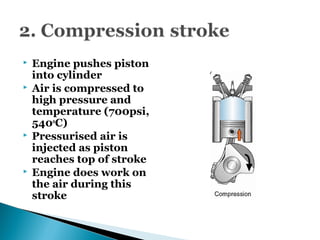
 Engine pushes piston
into cylinder
 Air is compressed to
high pressure and
temperature (700psi,
540o
C)
 Pressurised air is
injected as piston
reaches top of stroke
 Engine does work on
the air during this
stroke
 Pressurised air
expands (2000o
C,
1000psi)
 Air push piston out
 Air expand to lower
pressure and
temperature
 Air do work on
engine during this
stroke
 Engine pushes
piston into
cylinder
 High pressure
inside cylinder
 Pressure pushes
the piston out of
cylinder
 Engine does work
on the pressurised
air during this
stroke
Air Cars in the Marketplace :
 India 's Tata Motors will likely produce the first air car in the
marketplace in the next few years .
 Tata announced in August 2008 that they aren't quite ready to roll
out their air cars for mass production, Zero Pollution Motors still
plans to produce a similar vehicle in the United States. Known
collectively as the Flow AIR .
 The company, based in New Paltz, N.Y., says that it will start taking
reservations in mid-2009 for vehicle deliveries in 2010. The
company plans to roll out 10,000 air cars in the first year of
production
 MDI also recently unveiled the joystick-driven Air Pod, the newest addition
to its air car arsenal. Although the Air Pod generates a top speed of only 43
mph, it's also extremely light and generates zero emissions.
Companies working on air car
Production :
K'Airmobiles -- French company K'Air Energy has built
prototypes of an air-fueled bicycle and light road vehicle
based on the K'air air compression engine
Air Car Factories SA -- This Spanish company has an air car
engine currently in development. The company's owner is
currently involved in a dispute with former employer MDI
over the rights to the technology
1 . Economical
2 . Pollution free
3 . Better Fuel efficiency
4 . Better comfort
5 . Less Maintenance
6 . Low Cost
 Less power is produced
 Air pumping stations are less in number
 Inorder to ignite compressor we need Electricity
 Compressor needs Gasoline to compress air
 Low speed of about 50-90 km/hr
 On accidents compressed air is dangerous
 Air powered cars is a realization of latest
technology in automobile field.
 It eliminates the use of non-renewable fuels
like gasoline, diesel petrol etc, and Thereby
preventing pollution caused by millions of
automobiles all over the world.
 This could be the future of automobiles and
step to a healthier environment
air powered car presentation

air powered car presentation

  • 1.
    Air Powered Car FUTURETECHNOLOGY By R.Kishore & D.John Peter Raja
  • 2.
    Sensex  In moderntechnology transportation is done with fossil fuels . ( gasoline, petroleum……..)  But the main flaw is we are running out of fossil fuels due to increase in population , the effect is by 2035 we will run out of all fossil fuels
  • 3.
     To overcomethis we go for renewable energy resources like sunlight , water , bio-gas etc.  But solar panels are costlier now a days . That they do not provide output to that of the conventional energy .  In fact water energy has the same flaws .
  • 4.
     Since thevehicle density increases day by day , to avoid pollution and not to affect transportation go for Air Powered cars .  Which uses air as the source . Even though air is an renewable energy resource we can attain the specifications to that of the other renewable energy cars .
  • 5.
     The firstair car will almost certainly use the Compressed Air Engine (CAE) developed by the French company, Motor Development International (MDI).  Most likely, it will be the e.Volution car that is being built by Zero Pollution Motors
  • 6.
     Principle : Thelaw of physics dictate that uncontained gases will fill any given space. The easiest way to see this in action is to inflate a balloon. The elastic skin of the balloon holds the air tightly inside, but the moment you use a pin to create a hole in the balloon's surface, the air expands outward with so much energy that the balloon explodes.
  • 7.
     Compressed airtanks  Brake power recovery  The body  The Air Filter  The chassis  Electrical system
  • 8.
    Engine: Compressed air carsare powered by motors driven by compressed air, which is stored in a tank at high pressure such as 30 MPa (4500 psi or 310 bars). Rather than driving engine pistons with an ignited fuel-air mixture, compressed air cars use the expansion of compressed air, in a similar manner to the expansion of steam in a steam engine. Storage tank: Carbon-fiber tanks safely hold air at a pressure somewhere around 4500 psi, making them comparable to steel tanks. The cars are designed to be filled up at a high-pressure pump.
  • 10.
     The firstpiston takes in ambient air and compresses it to approximately 300 psi and 200*f in the compression chamber during the first cycle of the engine  When the piston pause, a small amount of compressed air from the tanks is released into the expansion chamber to create a low pressured, low temperature volume of about 140psi  Shortly before the valve to the exhaust cylinder is opened, a high-speed shutter connects the compression and expansion chambers. The sudden pressure and temperature difference between the low chambers creates pressure waves in the expansion chamber, thereby producing work in the exhaust chamber that drives the piston to power the engine
  • 11.
     The carengine runs on compressed air and incorporates the three laws of thermodynamics  The first law states that energy can neither be created nor be destroyed  The second law describes the disorder within substances  The third law defines that only in crystals at 0o k, there is absolute disorder
  • 12.
     Runs oncompressed air instead of gasoline.  No pollution car.  A two cylinder, compressed air engine, powers the car.  The engine can run either on compressed air alone or act as an internal combustion engine.  Compressed air is stored in fiber or glass fiber tanks at a pressure of 4351 pounds per square inch.  The air is fed through an air injector to the engine and flows into a small chamber, which expands the air.  The air pushing down on the piston moves the crankshaft, which gives the vehicle power.
  • 13.
     When thecar is moving at speeds below 60kph,it runs on air.  At higher speeds, it runs on a fuel such as gasoline diesel or natural gas  Air tanks fixed to the underside of the vehicle can hold about 79 gallons (300 litres) of air.  This compressed air can fuel the car upto 200km at a top speed of 96.5kph.When the tank nears empty it can be refilled at the nearest air pump.  The car motors require a small amount of oil about 0.8 litres worth that have to change just every 50,000km
  • 14.
     The enginehas four stage pistons that are 8 compression and or expansion chambers. They have two functions  To compress ambient air  To make successive expansions thereby approaching isothermic expansion
  • 15.
    Crank shaft 90o 180o BC TC 0o 270o θ Injects pressurisedair from the compressor Top Center (TC) Bottom Center (BC) Valves Clearance volume Cylinder wall Piston Stroke
  • 16.
     Engine pullspiston out of cylinder  Low pressure inside cylinder (< 1 atm.)  Atmospheric pressure pushes air into cylinder  Engine does work on the pressurised air during this stroke
  • 17.
     Engine pushespiston into cylinder  Air is compressed to high pressure and temperature (700psi, 540o C)  Pressurised air is injected as piston reaches top of stroke  Engine does work on the air during this stroke
  • 18.
     Pressurised air expands(2000o C, 1000psi)  Air push piston out  Air expand to lower pressure and temperature  Air do work on engine during this stroke
  • 19.
     Engine pushes pistoninto cylinder  High pressure inside cylinder  Pressure pushes the piston out of cylinder  Engine does work on the pressurised air during this stroke
  • 21.
    Air Cars inthe Marketplace :  India 's Tata Motors will likely produce the first air car in the marketplace in the next few years .  Tata announced in August 2008 that they aren't quite ready to roll out their air cars for mass production, Zero Pollution Motors still plans to produce a similar vehicle in the United States. Known collectively as the Flow AIR .  The company, based in New Paltz, N.Y., says that it will start taking reservations in mid-2009 for vehicle deliveries in 2010. The company plans to roll out 10,000 air cars in the first year of production  MDI also recently unveiled the joystick-driven Air Pod, the newest addition to its air car arsenal. Although the Air Pod generates a top speed of only 43 mph, it's also extremely light and generates zero emissions.
  • 22.
    Companies working onair car Production : K'Airmobiles -- French company K'Air Energy has built prototypes of an air-fueled bicycle and light road vehicle based on the K'air air compression engine Air Car Factories SA -- This Spanish company has an air car engine currently in development. The company's owner is currently involved in a dispute with former employer MDI over the rights to the technology
  • 24.
    1 . Economical 2. Pollution free 3 . Better Fuel efficiency 4 . Better comfort 5 . Less Maintenance 6 . Low Cost
  • 25.
     Less poweris produced  Air pumping stations are less in number  Inorder to ignite compressor we need Electricity  Compressor needs Gasoline to compress air  Low speed of about 50-90 km/hr  On accidents compressed air is dangerous
  • 28.
     Air poweredcars is a realization of latest technology in automobile field.  It eliminates the use of non-renewable fuels like gasoline, diesel petrol etc, and Thereby preventing pollution caused by millions of automobiles all over the world.  This could be the future of automobiles and step to a healthier environment